
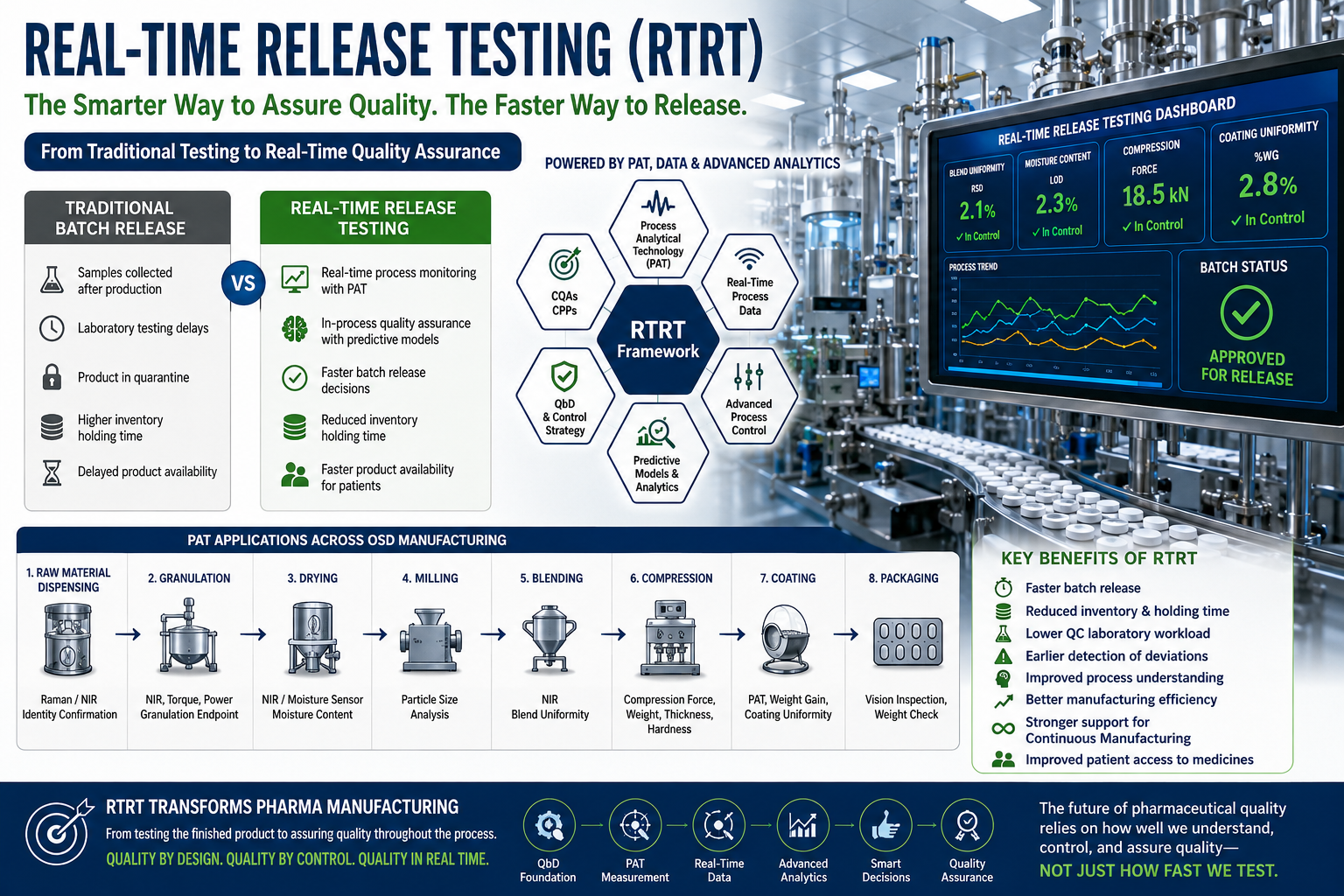
Traditional pharmaceutical batch release can be time-consuming. After manufacturing is completed, samples are collected and transferred to the Quality Control laboratory, analytical testing is performed, results are reviewed, manufacturing documentation is checked, deviations and Out-of-Specification (OOS) results are investigated when required, and Quality Assurance (QA) finally decides whether the batch can be released.
During this period, finished products remain under quarantine, increasing inventory holding time and delaying product availability.
Real-Time Release Testing (RTRT) offers a science- and risk-based alternative.
Instead of depending exclusively on end-product testing, RTRT uses Process Analytical Technology (PAT), Critical Quality Attributes (CQAs), Critical Process Parameters (CPPs), real-time process data, validated predictive models, and robust manufacturing control strategies to provide assurance that the product meets predefined quality requirements.
RTRT does not eliminate Quality Assurance oversight or automatically remove all laboratory testing. It transforms pharmaceutical batch release by building greater process understanding and quality assurance directly into manufacturing operations.
What Is Real-Time Release Testing (RTRT)?
Real-Time Release Testing is the ability to evaluate and ensure the quality of in-process materials and/or finished products using process data generated during manufacturing.
Traditional quality control primarily asks:
“Does the finished product meet specifications?”
RTRT asks a broader question:
“Was the manufacturing process continuously monitored, understood, and controlled well enough to assure that the product meets its predefined quality requirements?”
The foundation of RTRT begins during pharmaceutical development.
Through Quality by Design (QbD) and Quality Risk Management, manufacturers identify:
- Critical Quality Attributes (CQAs).
- Critical Process Parameters (CPPs).
- Critical Material Attributes (CMAs).
- Sources of process variability.
- Relationships between process parameters and product quality.
- Appropriate design space and proven acceptable operating ranges.
- Monitoring requirements and control strategies.
PAT instruments, process sensors, automation systems, and validated analytical or predictive models can then monitor or predict selected quality attributes during manufacturing.
The result is a transition from testing quality after production toward measuring, controlling, and assuring quality throughout the manufacturing process.
Technologies Enabling RTRT in Pharmaceutical Manufacturing
Successful implementation of RTRT requires the integration of process science, analytical technology, automation, data management, and pharmaceutical quality systems.
Important technologies include Near-Infrared Spectroscopy (NIR), Raman spectroscopy, particle size analyzers, moisture sensors, process chromatography, Multivariate Data Analysis (MVDA), chemometric models, Advanced Process Control (APC), Manufacturing Execution Systems (MES), process historians, electronic batch records, and data analytics platforms.
Depending on the product and process, these technologies can measure or predict quality attributes such as:
- Blend uniformity and API distribution.
- Granulation endpoint.
- Moisture content during drying.
- Particle size distribution.
- Tablet weight and compression force.
- Tablet hardness and thickness.
- Content uniformity.
- Coating uniformity.
- Dissolution performance.
Artificial Intelligence and Machine Learning may further support predictive quality analytics, process optimization, anomaly detection, and early identification of manufacturing variability.
However, models used for GMP decisions must remain scientifically justified, validated for their intended use, appropriately governed, and continuously monitored throughout their lifecycle.
Traditional Batch Release vs Real-Time Release Testing (RTRT)
| Parameter | Traditional Batch Release | Real-Time Release Testing |
|---|---|---|
| Testing Approach | Primarily laboratory and finished-product testing | Process measurements, PAT data, process controls, and validated models |
| Data Availability | Often reviewed after processing | Data generated and evaluated during manufacturing |
| Release Timeline | Dependent on laboratory testing and review activities | Potentially shorter when predefined release criteria are satisfied |
| Dependence on End-Product Testing | High | Reduced for attributes covered by an approved RTRT strategy |
| Process Understanding | May rely heavily on historical process validation | Requires extensive product and process understanding |
| Risk of Manufacturing Deviations | Problems may be identified later | Earlier detection and control of process variability |
| Inventory Holding Time | Potentially longer | Can be significantly reduced |
| QC Laboratory Workload | Extensive routine release testing | Potential reduction in routine testing activities |
| Manufacturing Efficiency | Quality decisions may occur after production | Quality information can support timely process decisions |
| Regulatory Expectations | Established compendial and release testing approaches | Requires scientifically justified, validated, lifecycle-managed control strategies |
Practical Example: RTRT in Oral Solid Dosage Manufacturing
Consider an Oral Solid Dosage manufacturing process:
Raw Material Dispensing → Granulation → Drying → Milling → Blending → Compression → Coating → Packaging
At the dispensing stage, material identification technologies such as Raman or NIR spectroscopy can help confirm raw material identity.
During granulation, measurements such as impeller torque, power consumption, temperature, binder addition rate, and NIR spectroscopy can support determination of the granulation endpoint.
During fluid-bed drying, online moisture sensors or NIR analyzers can continuously monitor moisture content rather than relying only on periodically collected samples.
Following milling, particle size analyzers can provide information about particle size distribution and process consistency.
During blending, NIR spectroscopy and validated chemometric models can evaluate blend uniformity and help identify the appropriate blending endpoint.
Modern tablet compression machines generate large quantities of process data, including compression force, tablet weight, thickness, speed, feeder performance, and rejection trends. Statistical process control and advanced analytics can identify abnormal conditions before significant quantities of nonconforming tablets are produced.
During coating, spray rate, inlet air temperature, product temperature, airflow, atomization pressure, and weight gain can be monitored. PAT systems and predictive models may support the evaluation of coating uniformity and process endpoints.
Data from each manufacturing stage can be integrated through SCADA, DCS, process historians, MES, electronic batch records, and analytics platforms.
A validated control strategy can then evaluate whether predefined process conditions, model acceptance criteria, alarms, deviations, and quality requirements have been satisfied.
This creates the scientific foundation required to support an RTRT strategy.
How RTRT Can Reduce Pharmaceutical Batch Release Time
Conventional pharmaceutical batch release may require several sequential activities:
Manufacturing completion, sample collection, sample transportation, laboratory testing, data review, documentation reconciliation, deviation assessment, OOS investigation when applicable, and final QA disposition.
RTRT can transform many of these sequential activities into parallel and increasingly automated quality assurance processes.
PAT measurements provide quality information during production.
Electronic Batch Records (EBR) and MES platforms enable automated verification of predefined manufacturing conditions.
Process historians consolidate manufacturing data.
Analytics platforms identify trends, deviations, and abnormal process behavior.
Validated release models can determine whether specific quality attributes meet predefined acceptance criteria.
QA professionals can therefore focus on exception review, deviation assessment, process performance, data integrity, and confirmation that the approved release strategy has been satisfied.
RTRT does not remove QA responsibility.
Instead, it enables QA decisions to be supported by comprehensive, real-time manufacturing knowledge rather than waiting primarily for finished-product test results.
Key Benefits of Real-Time Release Testing
The potential benefits of RTRT include:
- Faster pharmaceutical batch release.
- Reduced product quarantine and inventory holding time.
- Lower routine QC laboratory workload.
- Earlier detection of process deviations.
- Improved understanding of manufacturing variability.
- Better process control and manufacturing consistency.
- Improved equipment and manufacturing capacity utilization.
- Greater supply chain responsiveness.
- Potential reduction in Cost of Poor Quality (COPQ).
- Stronger support for Continuous Manufacturing.
- Faster availability of medicines for patients.
One of the most important advantages is that manufacturers gain greater visibility into how product quality develops throughout the manufacturing process.
Major Challenges in Implementing RTRT
Implementing RTRT is a significant scientific, technological, regulatory, and organizational transformation.
Major challenges include high initial investment, selecting and qualifying appropriate PAT technologies, developing representative calibration datasets, validating chemometric and predictive models, and maintaining model performance throughout the product lifecycle.
Integration between PAT instruments, PLCs, SCADA, DCS, MES, LIMS, process historians, and QMS platforms can also be complex.
Data integrity and Computerized System Validation (CSV) requirements must be addressed, particularly when automated systems and predictive models contribute directly to GMP decisions.
Other challenges include cybersecurity, management of large manufacturing datasets, continued process verification, model lifecycle management, regulatory strategy, technology transfer, change management, and training multidisciplinary teams.
Successful RTRT implementation therefore requires collaboration among Production, QA, QC, Process Development, Engineering, Automation, IT, Data Science, Validation, and Regulatory Affairs.
Regulatory Expectations for RTRT
The regulatory foundation supporting RTRT has developed through science- and risk-based pharmaceutical quality initiatives.
The FDA Process Analytical Technology Guidance encourages enhanced process understanding and timely measurements of critical quality and performance attributes.
ICH Q8 Pharmaceutical Development establishes the concepts of QbD, CQAs, design space, and control strategy.
ICH Q9 Quality Risk Management provides principles for making risk-based quality decisions.
ICH Q10 Pharmaceutical Quality System establishes lifecycle-oriented pharmaceutical quality management.
ICH Q13 Continuous Manufacturing provides additional principles relevant to continuous processes, process monitoring, control strategies, and real-time quality assurance.
European regulatory expectations also recognize Real-Time Release Testing approaches when they are supported by adequate process understanding, appropriate analytical technologies, validated models, robust control strategies, data integrity, and effective lifecycle management.
Regulatory acceptance of RTRT ultimately depends on the scientific strength of the proposed release strategy.
Manufacturers must demonstrate that the RTRT approach provides an appropriate level of assurance that each batch or continuously manufactured quantity meets predefined quality requirements.
RTRT and the Future of Smart Pharmaceutical Manufacturing
The next generation of Smart Pharmaceutical Manufacturing will increasingly integrate RTRT with Artificial Intelligence, Machine Learning, Digital Twins, Advanced Process Control, Continuous Manufacturing, Industrial Internet of Things (IIoT), cloud and edge computing, and predictive quality analytics.
Digital Twins may enable manufacturers to simulate process behavior and evaluate potential manufacturing adjustments.
Machine Learning algorithms may identify complex patterns associated with process variability.
Advanced Process Control systems can automatically adjust process parameters to maintain operations within validated conditions.
Predictive quality systems may identify emerging process failures before product quality is affected.
Together, these technologies support the evolution from traditional laboratory-based quality testing toward Quality by Design, Quality by Control, predictive quality assurance, and increasingly autonomous pharmaceutical manufacturing operations.
Conclusion: From Testing Quality to Building Quality into the Process
Real-Time Release Testing represents a fundamental transformation in pharmaceutical manufacturing and quality assurance.
The traditional pharmaceutical quality model relies heavily on testing samples after manufacturing operations have been completed.
RTRT creates the opportunity to continuously monitor manufacturing processes, understand variability, control Critical Process Parameters, evaluate Critical Quality Attributes, and generate scientific evidence of product quality throughout production.
The future pharmaceutical manufacturing facility will increasingly combine PAT technologies, advanced analytics, integrated manufacturing systems, Artificial Intelligence, Continuous Manufacturing, and scientifically validated control strategies.
Pharmaceutical companies that successfully implement RTRT can potentially achieve faster product release, reduced inventory holding time, stronger process understanding, improved manufacturing efficiency, lower operational costs, and more responsive pharmaceutical supply chains.
The transition will require significant investment, regulatory engagement, digital infrastructure, multidisciplinary expertise, and robust lifecycle management.
However, the direction of pharmaceutical manufacturing is increasingly clear:
The future of pharmaceutical quality will not depend on how quickly manufacturers can test finished products—but on how effectively they can understand, control, and assure quality throughout the manufacturing process.
Frequently Asked Questions About RTRT
1. What is Real-Time Release Testing in pharmaceutical manufacturing?
Real-Time Release Testing is a science- and risk-based approach that uses process measurements, PAT data, validated analytical methods, process controls, and manufacturing knowledge to evaluate product quality during manufacturing and support release decisions.
2. Does RTRT eliminate finished-product testing?
Not necessarily. RTRT can replace or reduce specific finished-product tests when the alternative control strategy is scientifically justified, validated, approved, and maintained throughout the product lifecycle.
3. What is the role of PAT in RTRT?
Process Analytical Technology provides timely measurements of materials, process parameters, and quality attributes. PAT generates critical information required for process understanding, process control, predictive models, and real-time quality assurance.
4. Can RTRT be implemented in tablet manufacturing?
Yes. PAT technologies and process data can support monitoring of granulation endpoints, drying, particle size, blend uniformity, tablet compression, coating processes, and selected product quality attributes.
5. Is Artificial Intelligence required for RTRT?
No. RTRT can be implemented using established PAT technologies, statistical methods, chemometric models, and robust control strategies. AI and Machine Learning are emerging technologies that may enhance predictive quality analytics and process control.
Call to Action
Pharmaceutical manufacturing is rapidly evolving toward connected, data-driven, and science-based operations.
Follow and regularly visit Pharma Manufacturing Hub for practical knowledge on pharmaceutical manufacturing technologies, GMP compliance, equipment qualification, validation, pharmaceutical quality systems, Process Analytical Technology, Continuous Manufacturing, Pharma 4.0, Artificial Intelligence, and emerging industry trends.
Stay informed. Strengthen your technical knowledge. Prepare for the future of pharmaceutical manufacturing.
About the Author
Ramesh Palav is a seasoned professional in GxP Quality, Computer System Validation (CSV), Data Integrity, and Pharmaceutical IT Compliance. He has extensive experience in implementing and managing GxP computerized systems, risk-based validation, audit trails, data integrity, and regulatory compliance. Through his articles and professional insights, he aims to share practical knowledge and help pharmaceutical and life-sciences professionals strengthen quality, compliance, and data integrity.