
Introduction: The Changing Pharmaceutical Manufacturing Landscape
Pharmaceutical manufacturing is undergoing a fundamental transformation. Traditional facilities were typically designed around large, permanently installed equipment trains capable of producing a limited portfolio of products at high volumes. Such facilities were economically effective for blockbuster drugs but offered limited flexibility when product demand, batch sizes, technologies, or manufacturing processes changed.
Today, the industry is moving toward personalized medicines, precision therapies, orphan drugs, biologics, vaccines, clinical products, and cell and gene therapies. These products often serve smaller patient populations, require smaller batch sizes, and experience rapidly changing production demand.
At the same time, pharmaceutical companies face pressure to accelerate product commercialization, reduce capital expenditure, improve manufacturing resilience, and respond quickly to supply chain disruptions.
Flexible Manufacturing Systems in Pharma are emerging as a strategic solution.
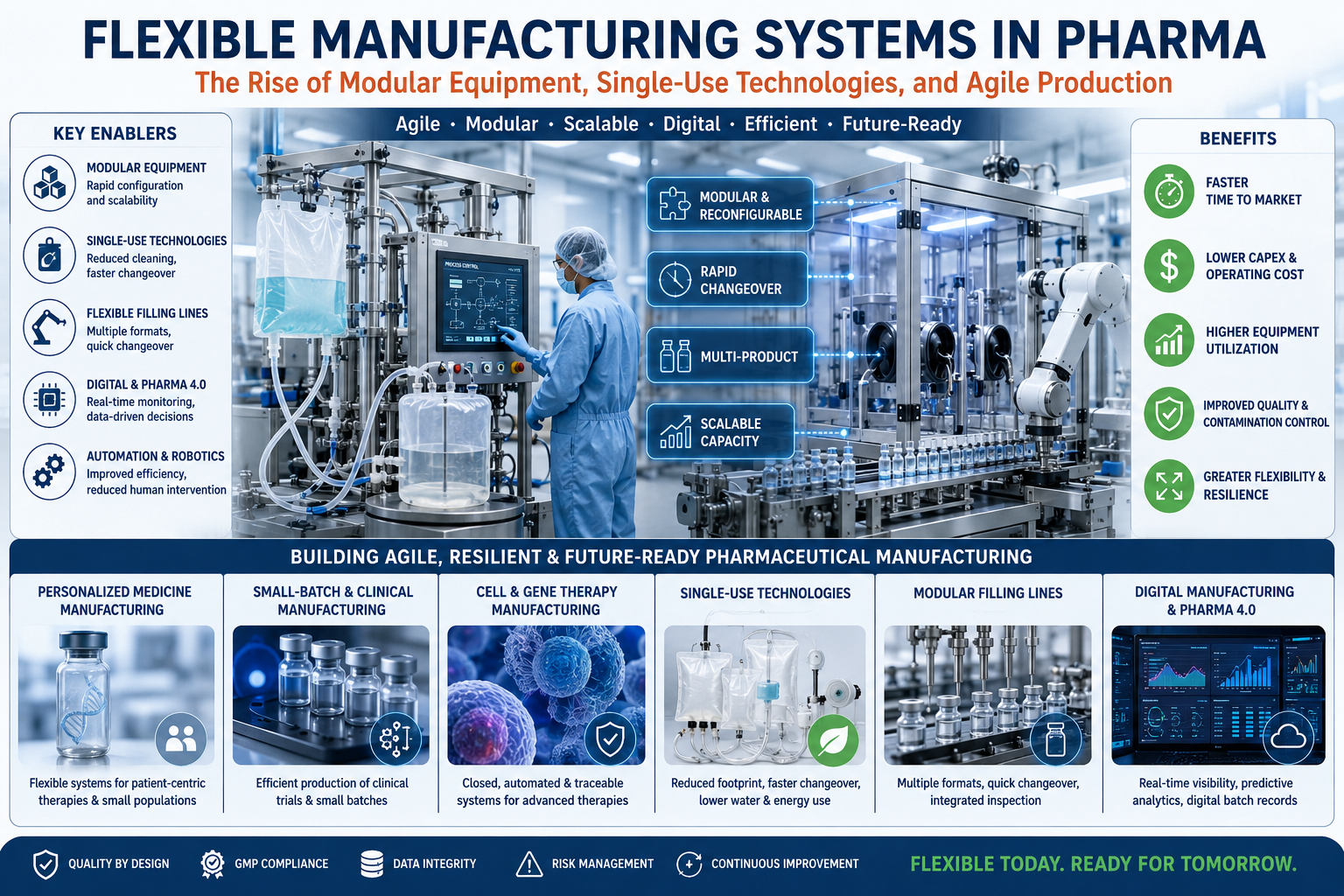
By combining modular equipment, Single-Use Technologies, automation, digital manufacturing platforms, flexible facility layouts, and rapidly reconfigurable production systems, manufacturers can create agile pharmaceutical manufacturing facilities capable of adapting to changing products, processes, and production volumes.
What Are Flexible Manufacturing Systems in Pharma?
Flexible Pharmaceutical Manufacturing refers to the design and operation of manufacturing systems that can rapidly adapt to changes in products, processes, technologies, batch sizes, and production demand.
Unlike traditional product-dedicated facilities, flexible manufacturing environments are designed around modularity, scalability, automation, and reconfigurability.
Key characteristics include:
- Modular processing equipment.
- Mobile and reconfigurable manufacturing systems.
- Rapid product and format changeover.
- Scalable production capacity.
- Multi-product manufacturing capabilities.
- Integrated automation and digital control systems.
- Single-Use Technologies in Pharma.
- Flexible facility and cleanroom layouts.
For example, a biopharmaceutical facility using mobile chromatography skids, single-use bioreactors, disposable mixing systems, and flexible transfer assemblies can modify manufacturing configurations significantly faster than a traditional stainless-steel facility.
This flexibility enables manufacturers to align production capacity with changing market demand while reducing equipment downtime and improving asset utilization.
Why Pharmaceutical Manufacturers Are Moving Toward Flexible Manufacturing
Several industry trends are accelerating the adoption of Flexible Manufacturing Systems.
The first is the rapid growth of personalized and precision medicines. Instead of producing billions of identical doses, manufacturers increasingly need capabilities for producing smaller quantities of highly specialized therapies.
Clinical Manufacturing is another major driver. Development pipelines contain numerous products requiring frequent process changes, technology transfers, scale adjustments, and unpredictable production schedules.
Biologics, vaccines, orphan drugs, and advanced therapies also require manufacturing platforms capable of supporting multiple products and rapidly evolving processes.
Flexible manufacturing can help pharmaceutical companies:
- Reduce facility construction and commissioning timelines.
- Improve equipment utilization.
- Reduce dependence on product-dedicated manufacturing lines.
- Accelerate technology transfer.
- Respond faster to market demand.
- Improve manufacturing and supply chain resilience.
The result is a shift from capacity-driven manufacturing strategies toward capability-driven manufacturing networks.
Flexible Manufacturing for Personalized Medicines
Personalized Medicine Manufacturing requires a fundamentally different manufacturing strategy from conventional mass production.
Patient populations may be small, production campaigns shorter, formulations more diverse, and manufacturing schedules highly dynamic.
Flexible manufacturing platforms allow facilities to accommodate multiple products, strengths, formulations, and processes without requiring extensive facility modifications.
Modular processing equipment can be added, removed, or reconfigured according to production requirements. Automated recipe management and advanced process control systems can support rapid transitions between products while maintaining validated operating parameters.
Digital manufacturing technologies also improve production scheduling, material tracking, electronic documentation, and process monitoring.
Together, these technologies create the manufacturing agility required to support increasingly complex product portfolios.
Small-Batch Production and Clinical Manufacturing
Traditional pharmaceutical facilities are often economically inefficient for Small-Batch Pharmaceutical Manufacturing.
Large equipment may operate significantly below capacity, cleaning activities can consume substantial manufacturing time, and frequent product changeovers increase operational complexity.
Flexible manufacturing platforms address these challenges through modular equipment and scalable production technologies.
Manufacturers can select equipment capacity according to batch requirements instead of forcing small products into oversized manufacturing systems.
Mobile processing units and standardized equipment interfaces can accelerate technology transfer between development, clinical, and commercial manufacturing facilities.
Flexible platforms can also enable several products to be manufactured within the same facility.
This capability improves equipment utilization, reduces capital investment, supports rapid process development, and allows manufacturers to respond quickly to changing clinical trial requirements.
Role of Flexible Manufacturing in Cell and Gene Therapy Production
Cell and Gene Therapy Manufacturing presents some of the pharmaceutical industry’s most complex operational challenges.
Many advanced therapies involve small patient populations or patient-specific manufacturing processes. Autologous therapies may require every patient batch to be individually scheduled, manufactured, tested, tracked, and released.
Manufacturers must maintain strict chain of identity and chain of custody while controlling contamination risks and managing short manufacturing timelines.
Modular cleanrooms, closed processing systems, automated manufacturing platforms, and single-use technologies can provide the flexibility required for these operations.
Closed systems can reduce dependence on high-grade cleanroom environments while improving contamination control.
Digital manufacturing platforms can manage patient scheduling, material traceability, electronic batch records, equipment status, and manufacturing workflows.
As advanced therapy products move from clinical development toward commercialization, scalable and flexible manufacturing infrastructure will become increasingly important.
Single-Use Technologies as a Key Enabler of Flexible Manufacturing
Single-Use Technologies in Pharma are among the most important enablers of flexible biopharmaceutical manufacturing.
Common applications include:
- Single-use bioreactors.
- Disposable mixing systems.
- Single-use filtration assemblies.
- Disposable tubing and connectors.
- Storage and transfer bags.
- Pre-sterilized processing assemblies.
Single-use systems can significantly reduce cleaning requirements and eliminate many cleaning validation activities associated with product-contact stainless-steel equipment.
They can also reduce cross-contamination risks, shorten product changeovers, decrease facility footprint, and reduce water and energy consumption.
Facilities using disposable processing technologies may also require smaller Clean-in-Place and Steam-in-Place infrastructure.
However, implementation requires robust Quality Risk Management.
Manufacturers must address extractables and leachables, material compatibility, container and system integrity, supplier qualification, component availability, plastic waste management, and supply chain security.
Single-use systems must therefore be managed through comprehensive lifecycle strategies covering design, qualification, supplier management, change control, routine operation, and continued performance monitoring.
Modular Filling Lines and Flexible Aseptic Manufacturing
Modular Filling Lines are transforming sterile pharmaceutical manufacturing.
Traditional filling lines were often designed around a specific container format and product portfolio. Modern flexible filling platforms can process vials, prefilled syringes, cartridges, and other drug delivery systems.
Robotics, isolators, Restricted Access Barrier Systems, Ready-to-Use containers, automated format changeover, and recipe-driven control systems reduce manual intervention and improve manufacturing flexibility.
Integrated visual inspection, electronic batch records, Process Analytical Technology, and real-time process monitoring further strengthen process control.
A modular filling platform may allow manufacturers to introduce new container formats through standardized modules rather than installing an entirely new production line.
For multi-product aseptic facilities, this capability can reduce product changeover time while improving equipment utilization and manufacturing agility.
Role of Digital Technologies and Pharma 4.0
Flexible manufacturing depends heavily on digital integration.
Pharma 4.0 technologies provide the information infrastructure required to operate complex, multi-product manufacturing environments.
Manufacturing Execution Systems coordinate production workflows and provide real-time manufacturing visibility.
Electronic Batch Records improve documentation accuracy and data integrity while supporting faster batch review.
Industrial Internet of Things sensors provide continuous information about equipment condition and process performance.
Artificial Intelligence can support production scheduling, predictive maintenance, deviation detection, and process optimization.
Digital twins can simulate equipment configurations, manufacturing processes, facility layouts, and production scenarios before physical implementation.
Advanced process control and real-time monitoring can improve process consistency while enabling faster operational decisions.
The long-term objective is the development of connected manufacturing ecosystems where equipment, materials, processes, quality systems, and personnel interact through integrated digital platforms.
Benefits of Flexible Manufacturing Systems
Flexible Manufacturing Systems in Pharma can provide significant operational and strategic benefits.
These include faster product changeover, reduced manufacturing downtime, improved equipment utilization, lower capital expenditure, smaller facility footprints, and faster facility construction and deployment.
Flexible manufacturing also enables scalable capacity expansion. Instead of constructing large facilities based on uncertain future demand, companies can install additional manufacturing modules as product requirements increase.
Multi-product capabilities improve asset utilization and support portfolio diversification.
Standardized modular platforms can accelerate technology transfer between development and commercial manufacturing sites.
Most importantly, flexible manufacturing improves operational resilience by allowing pharmaceutical companies to adjust production networks more rapidly in response to market changes and supply chain disruptions.
Challenges and GMP Considerations
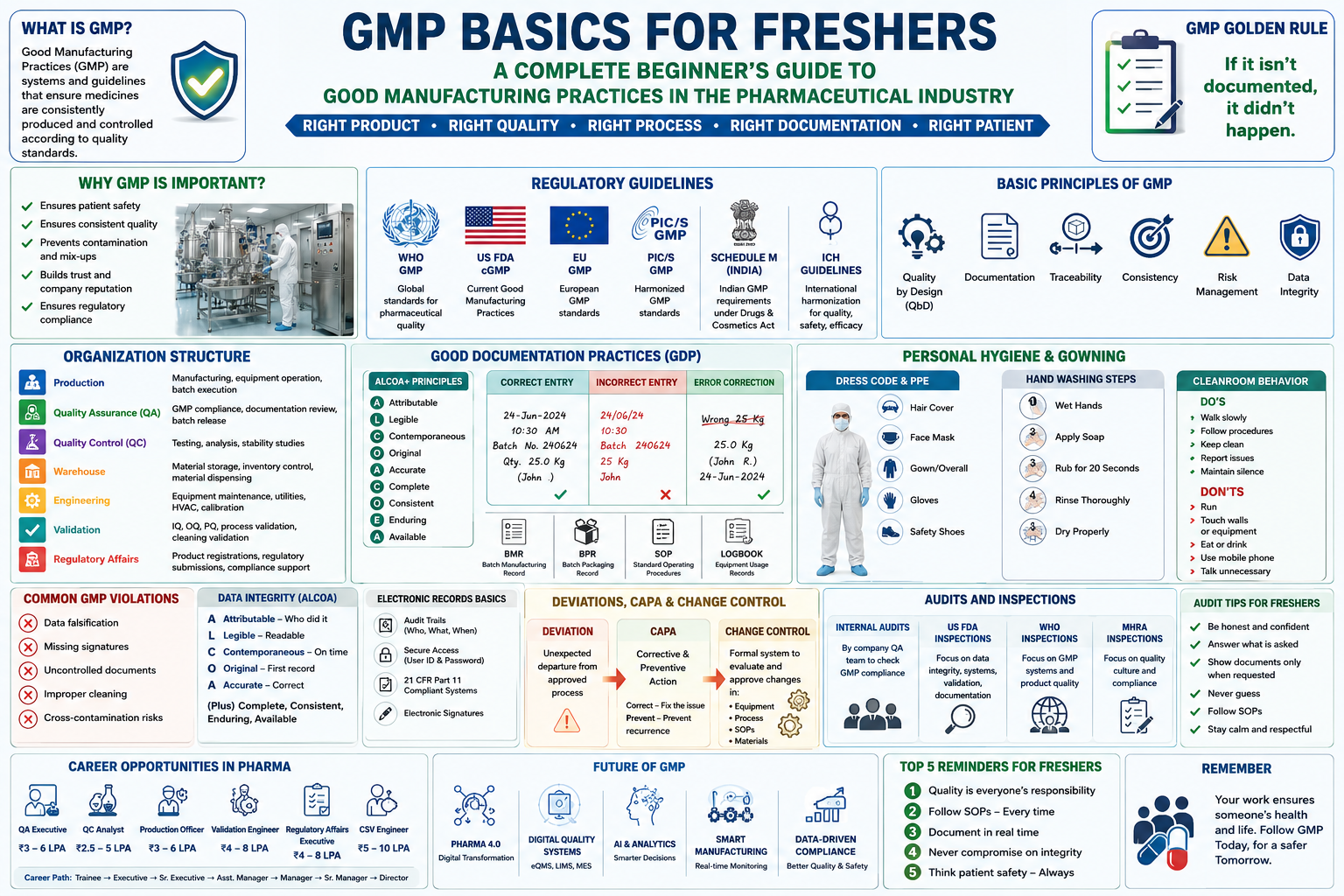
Flexible Pharmaceutical Manufacturing introduces new technical and regulatory challenges.
Multi-product facilities require robust contamination control strategies supported by Quality Risk Management.
Cleaning validation approaches must consider equipment design, product characteristics, campaign manufacturing strategies, and shared manufacturing environments.
Single-use systems require supplier qualification, extractables and leachables assessments, material compatibility studies, integrity assurance, and effective change notification agreements.
Automated and digitally connected manufacturing systems must comply with applicable requirements for Computer System Validation, Computer Software Assurance, data integrity, audit trails, access controls, electronic records, and cybersecurity.
Equipment qualification and process validation strategies must account for modular configurations and potential changes in equipment arrangements.
Material flows, personnel flows, pressure cascades, environmental controls, and segregation strategies must remain compliant even when facility configurations change.
Effective change control is particularly important.
Re configuring manufacturing modules, introducing new single-use components, modifying automation recipes, or integrating digital platforms may create new risks requiring formal assessment.
Lifecycle-based validation and Quality Risk Management provide the foundation for maintaining GMP compliance while allowing manufacturing systems to remain flexible.
Future of Flexible Pharmaceutical Manufacturing
The Future of Pharmaceutical Manufacturing will likely involve increasingly modular, connected, automated, and distributed manufacturing networks.
Portable manufacturing units and factory-in-a-box platforms could allow production capacity to be deployed rapidly near markets experiencing urgent demand.
Distributed manufacturing networks may reduce dependence on large centralized manufacturing sites.
Point-of-care manufacturing could become increasingly important for certain personalized medicines and advanced therapies.
AI-driven production scheduling may dynamically allocate manufacturing campaigns based on equipment availability, patient demand, supply chain conditions, and quality performance.
Autonomous manufacturing operations could combine robotics, advanced process control, real-time release strategies, predictive analytics, and automated material handling.
Continuous manufacturing platforms may also become increasingly modular and flexible, allowing pharmaceutical companies to rapidly scale capacity through standardized manufacturing units.
The long-term transformation will be from static manufacturing facilities toward intelligent manufacturing ecosystems capable of continuously adapting to changing products, technologies, and market conditions.
Conclusion
Flexible Manufacturing Systems are becoming strategically important as pharmaceutical companies transition from high-volume, product-dedicated manufacturing toward more complex and diversified product portfolios.
Modular Pharmaceutical Manufacturing, Single-Use Technologies, Modular Filling Lines, automation, advanced aseptic processing technologies, and Pharma 4.0 platforms are enabling manufacturers to build more agile, scalable, and resilient manufacturing operations.
However, manufacturing flexibility must be implemented within a strong GMP framework supported by contamination control, Quality Risk Management, equipment qualification, process validation, supplier management, data integrity, cybersecurity, and lifecycle-based validation strategies.
Pharmaceutical companies investing in Agile Pharmaceutical Manufacturing capabilities will be better positioned to manufacture personalized medicines, clinical products, small batches, biologics, vaccines, and advanced therapies.
Over the next decade, the most competitive pharmaceutical manufacturing organizations will not simply be those with the largest facilities. They will be those capable of rapidly reconfiguring manufacturing capacity, integrating emerging technologies, scaling production efficiently, and responding to changing patient and market needs.
Flexible manufacturing is therefore more than an equipment strategy. It is becoming a fundamental operating model for building the intelligent, resilient, and patient-focused pharmaceutical factories of the future.
About the Author
Ramesh Palav is a seasoned professional in GxP Quality, Computer System Validation (CSV), Data Integrity, and Pharmaceutical IT Compliance. He has extensive experience in implementing and managing GxP computerized systems, risk-based validation, audit trails, data integrity, and regulatory compliance. Through his articles and professional insights, he aims to share practical knowledge and help pharmaceutical and life-sciences professionals strengthen quality, compliance, and data integrity.