
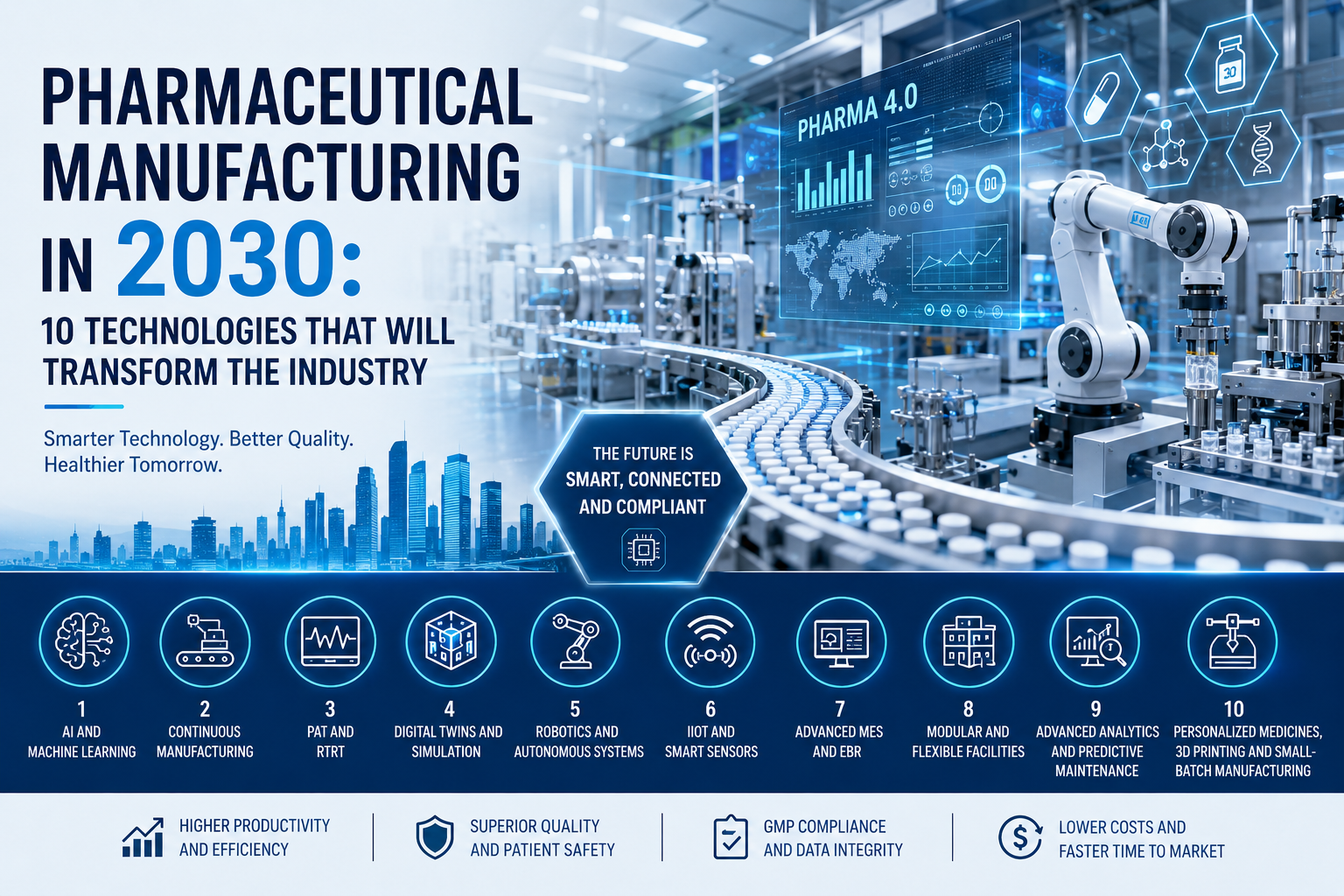
Pharmaceutical manufacturing is entering one of the most significant technological transformations in its history. Growing demand for personalized medicines, complex therapies, faster product launches, stronger regulatory expectations, supply chain resilience, and affordable medicines is forcing manufacturers to rethink traditional production models.
By 2030, pharmaceutical factories will increasingly become connected, automated, flexible, and data driven. Pharma 4.0 technologies will integrate manufacturing equipment, quality systems, laboratories, engineering operations, and supply chains through intelligent digital platforms. Decisions that currently depend heavily on manual review and historical data will increasingly use real time information, predictive analytics, and automated control strategies.
The future of pharmaceutical manufacturing will not simply involve installing advanced equipment. Successful transformation will require strong data governance, cybersecurity, workforce development, validation strategies, and GMP compliant implementation.
Here are ten future pharmaceutical technologies expected to transform pharmaceutical manufacturing by 2030.
1. Artificial Intelligence and Machine Learning
Artificial Intelligence and Machine Learning will become important technologies for improving manufacturing efficiency, product quality, and decision making. AI systems analyze large volumes of process, equipment, laboratory, and quality data to identify patterns that traditional analysis may overlook.
Applications of AI in pharmaceutical manufacturing include process optimization, deviation investigation, visual inspection, predictive quality, demand forecasting, and equipment monitoring. For example, machine learning algorithms can analyze compression parameters and historical batch data to predict tablet weight variation or potential quality failures.
AI can reduce investigations, prevent deviations, improve process consistency, and support faster decisions. However, data quality, algorithm transparency, cybersecurity, model lifecycle management, and regulatory acceptance remain important implementation challenges.
By 2030, AI will increasingly support operators, engineers, quality professionals, and manufacturing leaders through intelligent decision support systems.
2. Continuous Pharmaceutical Manufacturing
Continuous manufacturing replaces traditional batch processing with integrated production systems where materials continuously enter the process and finished products are continuously produced.
Continuous granulators, feeders, blenders, tablet presses, and coaters can operate as connected manufacturing lines. Integrated process controls and PAT technologies enable manufacturers to monitor critical quality attributes and adjust process parameters during production.
The technology can reduce manufacturing cycle times, facility footprints, work in process inventory, and variability while improving process control and manufacturing flexibility.
Challenges include equipment integration, process development, regulatory strategies, workforce capabilities, and significant initial investments.
By 2030, continuous manufacturing will become increasingly important for selected commercial products and flexible production platforms.
3. PAT and Real-Time Release Testing
Process Analytical Technology and Real-Time Release Testing will transform pharmaceutical quality control by moving testing closer to manufacturing processes.
PAT tools such as near infrared spectroscopy, Raman spectroscopy, particle size analyzers, and advanced sensors continuously monitor critical process parameters and quality attributes.
For example, manufacturers can monitor blend uniformity, moisture content, coating thickness, and material properties during production instead of relying exclusively on laboratory testing.
RTRT uses process knowledge, validated analytical technologies, and controlled manufacturing parameters to support product release decisions.
Benefits include faster product release, improved process understanding, reduced inventory, and earlier detection of process variability.
Implementation requires robust control strategies, validated analytical models, regulatory engagement, and effective data governance.
4. Digital Twins and Advanced Process Simulation
Digital twins in pharma are virtual representations of equipment, manufacturing processes, utilities, or complete production facilities that continuously use operational data.
Engineers can use digital twins to simulate process changes, optimize equipment performance, investigate failures, and evaluate manufacturing scenarios before implementing physical modifications.
For example, a digital twin of a tablet compression process could evaluate relationships between material properties, machine parameters, and tablet quality.
Digital twins can reduce development timelines, improve process understanding, support predictive maintenance, and minimize manufacturing risks.
Challenges include data integration, model validation, system interoperability, cybersecurity, and maintaining models throughout their lifecycle.
By 2030, digital twins will become valuable tools supporting development, technology transfer, manufacturing, and engineering decisions.
5. Robotics and Autonomous Manufacturing Systems
Pharmaceutical robotics will increasingly perform repetitive, hazardous, high precision, and contamination sensitive manufacturing activities.
Robotic systems can support material handling, equipment loading, sampling, packaging, laboratory testing, warehouse operations, and aseptic manufacturing.
Autonomous mobile robots may transport materials between warehouses and production areas while integrated systems automatically verify material identity and manufacturing status.
Robotics can improve operator safety, reduce contamination risks, increase productivity, and provide consistent execution of manufacturing activities.
Major challenges include capital investment, equipment integration, validation, maintenance capabilities, cybersecurity, and managing human machine collaboration.
By 2030, pharmaceutical factories will increasingly combine skilled employees with collaborative robots and autonomous manufacturing systems.
6. IIoT and Smart Sensors
The Industrial Internet of Things connects equipment, instruments, utilities, environmental monitoring systems, and manufacturing platforms through secure digital networks.
Smart sensors continuously collect information about temperature, pressure, vibration, humidity, energy consumption, equipment performance, and manufacturing conditions.
IIoT in pharma enables real time process visibility, remote equipment monitoring, condition based maintenance, and faster detection of abnormal operating conditions.
For example, vibration sensors installed on manufacturing equipment can identify developing mechanical problems before unexpected breakdowns occur.
Benefits include improved equipment reliability, reduced downtime, better resource utilization, and stronger process understanding.
Challenges include cybersecurity, legacy equipment integration, data management, network reliability, and system validation.
7. Advanced MES and Electronic Batch Records
Advanced Manufacturing Execution Systems and Electronic Batch Records will become the digital backbone of smart pharmaceutical manufacturing.
MES platforms coordinate production schedules, material movements, equipment status, operator activities, electronic instructions, and manufacturing data.
Electronic Batch Records replace paper documentation with controlled digital workflows, automated calculations, electronic signatures, and exception based review.
These systems can reduce documentation errors, improve data integrity, accelerate batch review, and provide real time manufacturing visibility.
Implementation challenges include integration with ERP, LIMS, equipment systems, validation requirements, master data governance, and organizational change management.
By 2030, connected MES platforms will increasingly support paperless manufacturing operations.
8. Modular and Flexible Manufacturing Facilities
Modular manufacturing facilities use standardized, configurable production units that can be rapidly installed, expanded, or reconfigured.
Flexible manufacturing platforms enable companies to produce multiple products, smaller batches, and specialized therapies using adaptable equipment and production spaces.
Single use technologies, modular cleanrooms, portable equipment, and flexible filling systems will support faster capacity expansion and product changeovers.
These approaches can reduce facility construction timelines, improve capital efficiency, and respond quickly to changing market demand.
Challenges include equipment compatibility, contamination control strategies, supply chain dependencies, regulatory expectations, and operational complexity.
By 2030, modular facilities will become important for regional manufacturing and specialized medicines.
9. Advanced Analytics and Predictive Maintenance
Advanced analytics platforms transform manufacturing data into actionable insights for operations, quality, and engineering teams.
Predictive maintenance systems analyze equipment condition, alarms, process parameters, and maintenance history to predict failures before production interruptions occur.
For example, analytics can identify unusual vibration, temperature, or motor current patterns indicating equipment deterioration.
Manufacturers can schedule maintenance based on equipment condition instead of relying only on fixed maintenance intervals.
Benefits include reduced downtime, longer equipment life, optimized maintenance resources, and improved production reliability.
Challenges include data quality, sensor reliability, analytics expertise, system integration, and validated decision making.
10. Personalized Medicines, 3D Printing, and Small-Batch Manufacturing
Personalized medicines will require manufacturing systems capable of producing smaller batches and patient specific therapies efficiently.
Three dimensional printing, automated dispensing, flexible equipment, and digital manufacturing platforms can support decentralized and on demand production models.
These technologies may enable customized dosage forms, rapid clinical manufacturing, and production closer to patients.
However, regulatory frameworks, process validation, product traceability, quality control, and scalable business models remain significant challenges.
By 2030, flexible small batch technologies will become increasingly important for precision medicines.
What Will the Pharmaceutical Factory of 2030 Look Like?
The pharmaceutical factory of 2030 will combine connected equipment, intelligent automation, real time quality monitoring, digital workflows, advanced analytics, and skilled employees.
Operators will increasingly supervise automated processes using digital dashboards, augmented decision support, and predictive alerts. Quality teams will focus more on process intelligence, risk management, data governance, and continuous improvement.
Manufacturing systems will automatically collect trusted data, detect abnormal conditions, recommend corrective actions, and support faster product release.
Human expertise will remain essential. Pharmaceutical professionals will require stronger capabilities in data analytics, automation, cybersecurity, digital validation, process science, and systems thinking.
Conclusion
Pharmaceutical manufacturing 2030 will be defined by intelligent, connected, flexible, and increasingly autonomous production systems.
AI, continuous manufacturing, PAT, RTRT, digital twins, pharmaceutical robotics, IIoT, MES, modular facilities, predictive analytics, and personalized manufacturing technologies will reshape how medicines are developed, produced, tested, and released.
However, technology alone cannot guarantee successful transformation. Pharmaceutical manufacturers must build strong digital strategies, develop workforce capabilities, maintain data integrity, manage cybersecurity risks, and implement innovation within robust pharmaceutical quality systems.
Companies that successfully integrate technology, people, processes, and quality culture will be better prepared to manufacture medicines efficiently, maintain regulatory compliance, respond to changing patient needs, and compete in the evolving pharmaceutical industry.
The factory of 2030 will therefore represent more than digitalization. It will be a connected manufacturing ecosystem where science, engineering, quality, data, and human expertise work together to deliver safer medicines faster and more reliably.
About the Author
Ramesh Palav is a seasoned professional in GxP Quality, Computer System Validation (CSV), Data Integrity, and Pharmaceutical IT Compliance. He has extensive experience in implementing and managing GxP computerized systems, risk-based validation, audit trails, data integrity, and regulatory compliance. Through his articles and professional insights, he aims to share practical knowledge and help pharmaceutical and life-sciences professionals strengthen quality, compliance, and data integrity.