
Applying ICH Q9(R1), FMEA, Risk Matrices, and Science-Based Decision Making
Series: Part 10 of 20
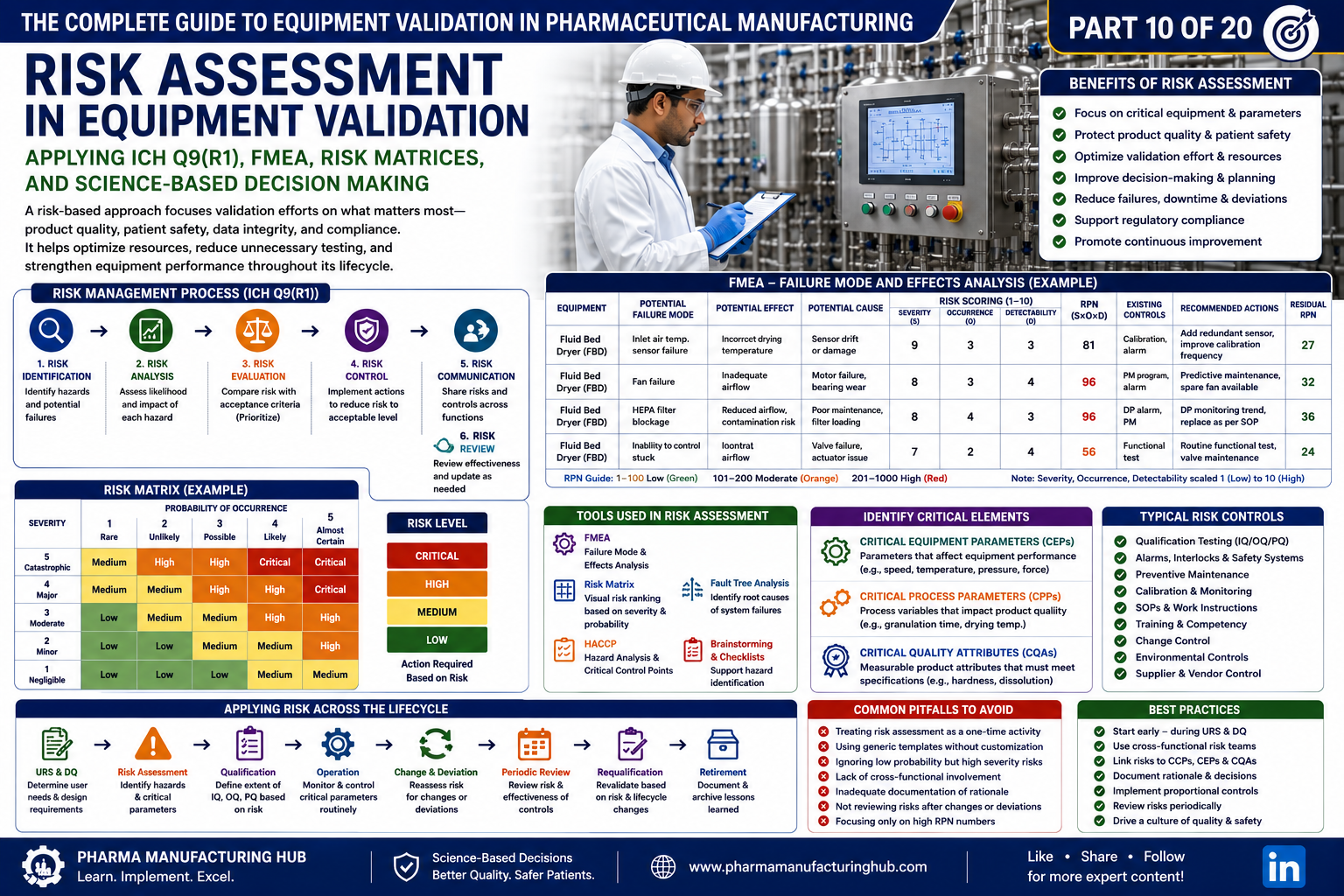
Introduction
Modern pharmaceutical manufacturing has moved away from the traditional approach of validating every piece of equipment with the same level of effort. Today, global regulatory agencies expect manufacturers to apply a science-based, risk-based approach that focuses qualification activities on aspects that have the greatest impact on product quality, patient safety, data integrity, and regulatory compliance.
This philosophy is embedded in ICH Q9(R1) – Quality Risk Management, one of the most influential international guidelines governing pharmaceutical quality systems. Risk assessment is now an integral part of equipment qualification, supporting decisions throughout the lifecycle—from User Requirement Specification (URS) and Design Qualification (DQ) to Installation Qualification (IQ), Operational Qualification (OQ), Performance Qualification (PQ), change control, requalification, and equipment retirement.
A robust risk assessment program enables organizations to allocate resources effectively, reduce validation effort where justified, strengthen control over critical equipment, and demonstrate compliance during regulatory inspections.
What is Risk Assessment?
Risk assessment is the systematic process of identifying, analyzing, evaluating, and controlling potential hazards that may affect product quality, patient safety, equipment performance, or regulatory compliance.
In equipment validation, risk assessment helps determine:
- Which equipment is critical.
- Which parameters require qualification.
- The extent of testing required.
- Appropriate acceptance criteria.
- Ongoing monitoring requirements.
- Requalification strategy.
Objectives of Risk Assessment
The objectives are to:
- Protect patient safety.
- Ensure product quality.
- Focus validation on critical risks.
- Improve qualification efficiency.
- Support scientific decision-making.
- Reduce unnecessary testing.
- Strengthen regulatory compliance.
- Support continuous improvement.
Risk Management Lifecycle
Risk Identification
        │
        ▼
Risk Analysis
        │
        ▼
Risk Evaluation
        │
        ▼
Risk Control
        │
        ▼
Risk Communication
        │
        ▼
Risk Review
This lifecycle is consistent with the principles outlined in ICH Q9(R1).
ICH Q9(R1): Quality Risk Management
ICH Q9(R1) provides a globally accepted framework for managing quality risks throughout the pharmaceutical product lifecycle.
The guideline emphasizes that:
- Risk evaluation should be science-based.
- Effort should be proportional to the level of risk.
- Decisions should be documented.
- Risk management is a continuous process.
The revised guideline also highlights the importance of:
- Knowledge management
- Subjectivity reduction
- Risk communication
- Quality culture
- Continual review
Key Principles of Quality Risk Management
Effective risk management should be:
- Systematic
- Scientific
- Documented
- Transparent
- Proportionate
- Cross-functional
- Lifecycle-oriented
Risk Assessment Process
Step 1 – Risk Identification
Identify potential hazards associated with the equipment.
Examples include:
- Equipment malfunction
- Incorrect installation
- Calibration failure
- Sensor drift
- Utility interruption
- Software malfunction
- Cross-contamination
- Operator error
- Inadequate cleaning
- Data integrity failure
Step 2 – Risk Analysis
Assess the likelihood and impact of each identified hazard.
Typical considerations:
- Severity
- Probability of occurrence
- Detectability
Step 3 – Risk Evaluation
Compare calculated risk with predefined acceptance criteria to determine whether additional controls are required.
Step 4 – Risk Control
Implement actions to reduce risk.
Examples:
- Additional qualification testing
- Preventive maintenance
- Alarm systems
- Interlocks
- SOP revisions
- Operator training
- Design modifications
Step 5 – Risk Review
Review risks periodically to ensure controls remain effective.
Triggers include:
- Equipment modifications
- Deviations
- CAPA
- New products
- Regulatory changes
- Periodic review
Failure Mode and Effects Analysis (FMEA)
FMEA is the most widely used risk assessment tool for equipment qualification.
It systematically evaluates:
- Potential failure modes.
- Causes of failure.
- Effects of failure.
- Existing controls.
- Recommended actions.
FMEA Components
Severity (S)
Impact of failure on:
- Product quality
- Patient safety
- Regulatory compliance
- Equipment performance
Typical scale:
1 = Negligible
10 = Catastrophic
Occurrence (O)
Probability of failure occurring.
1 = Remote
10 = Frequent
Detectability (D)
Likelihood that the failure will be detected before affecting product quality.
1 = Easily detected
10 = Very difficult to detect
Risk Priority Number (RPN)
The Risk Priority Number (RPN) is calculated as:
RPN = Severity × Occurrence × Detectability
Higher RPN values indicate higher-priority risks requiring mitigation.
Example FMEA Table
| Failure Mode | Effect | S | O | D | RPN | Action |
|---|---|---|---|---|---|---|
| Temperature sensor failure | Incorrect process temperature | 9 | 3 | 3 | 81 | Add redundant sensor and calibration checks |
| PLC communication failure | Equipment stoppage | 7 | 2 | 4 | 56 | Validate network and implement alarms |
| Door interlock failure | Operator safety risk | 10 | 2 | 2 | 40 | Functional interlock testing and PM |
| Vacuum pump failure | Incomplete drying | 8 | 4 | 3 | 96 | Add preventive maintenance and monitoring |
The objective is not simply to calculate an RPN but to identify meaningful actions that reduce risk.
Risk Matrix
A risk matrix is another commonly used tool.
Example
| Severity ↓ / Probability → | Low | Medium | High |
|---|---|---|---|
| Low | Low | Low | Medium |
| Medium | Low | Medium | High |
| High | Medium | High | Critical |
The matrix helps prioritize qualification effort.
HACCP
Hazard Analysis and Critical Control Points (HACCP) may also be applied, particularly for:
- Water systems
- Sterile manufacturing
- Cleaning processes
- Utility systems
Key steps include:
- Hazard Identification
- Critical Control Point (CCP) Identification
- Critical Limits
- Monitoring
- Corrective Actions
- Verification
- Documentation
Equipment Criticality Assessment
Risk assessment should classify equipment based on its impact.
| Equipment | Criticality | Qualification Strategy |
|---|---|---|
| Tablet Press | High | Full IQ/OQ/PQ |
| Autoclave | Critical | Extensive Qualification |
| HVAC | Critical | Comprehensive Qualification |
| Purified Water System | Critical | Lifecycle Qualification |
| Conveyor | Medium | Risk-Based Qualification |
| Pallet Truck | Low | Engineering Verification |
Identifying Critical Equipment Parameters (CEPs)
Critical Equipment Parameters directly influence equipment performance.
Examples include:
- Mixing speed
- Compression force
- Temperature
- Pressure
- Airflow
- RPM
- Spray rate
- Vacuum level
CEPs identified during risk assessment become key focus areas during OQ and PQ.
Relationship Between CQAs, CPPs, and CEPs
| Element | Description |
|---|---|
| CQA | Critical Quality Attribute (e.g., tablet hardness, sterility) |
| CPP | Critical Process Parameter (e.g., granulation time, drying temperature) |
| CEP | Critical Equipment Parameter (e.g., impeller RPM, pan speed) |
A strong risk assessment links these elements to ensure equipment qualification supports product quality.
Applying Risk Assessment Throughout the Lifecycle
Risk assessment should be revisited at every stage:
- URS
- DQ
- FAT
- SAT
- IQ
- OQ
- PQ
- Change Control
- Periodic Review
- Requalification
- Retirement
This lifecycle approach ensures that risk controls remain effective as equipment and processes evolve.
Documentation Requirements
A complete risk assessment package should include:
- Scope
- Team members
- Methodology
- Equipment description
- Hazard list
- FMEA worksheet or risk matrix
- Risk ranking
- Mitigation actions
- Residual risk evaluation
- Approval signatures
Documentation should be version-controlled and linked to the validation package.
Common Risk Mitigation Measures
Examples include:
- Redundant sensors
- Preventive maintenance
- Routine calibration
- Alarm verification
- Interlocks
- Operator training
- SOP revisions
- Software validation
- Enhanced environmental monitoring
- Additional qualification testing
Mitigation measures should be proportionate to the level of risk.
Inspector’s Perspective
Regulatory inspectors increasingly evaluate the quality of risk assessments rather than the quantity of qualification testing.
Inspectors often ask:
- Why was this equipment classified as critical?
- How were Critical Equipment Parameters identified?
- What methodology was used?
- How were risks reduced?
- Are residual risks acceptable?
- Is the assessment reviewed after changes or deviations?
- Does the qualification strategy reflect the risk assessment?
A well-documented, science-based assessment demonstrates mature quality risk management.
Expert Tips
Expert Tip 1: Perform the initial risk assessment during the URS and Design Qualification stages. Early identification of critical risks helps optimize qualification protocols and avoid unnecessary testing.
Expert Tip 2: Include cross-functional experts from Engineering, Production, Quality Assurance, Validation, Automation, and Maintenance. Diverse expertise improves hazard identification and reduces subjectivity.
Expert Tip 3: Review risk assessments whenever significant changes occur—such as software upgrades, equipment modifications, recurring deviations, or new product introductions—to ensure controls remain appropriate.
Common Pitfalls
Avoid these common mistakes:
- Treating risk assessment as a one-time exercise.
- Using generic FMEA templates without equipment-specific analysis.
- Focusing only on high RPN values while ignoring severe low-frequency hazards.
- Failing to reassess risks after changes.
- Inadequate documentation of mitigation actions.
- Poor linkage between risk assessment and qualification protocols.
- Lack of management review and approval.
Frequently Asked Questions (FAQs)
1. Why is risk assessment important in equipment validation?
It ensures qualification activities focus on equipment functions that have the greatest impact on product quality, patient safety, and regulatory compliance.
2. What is ICH Q9(R1)?
ICH Q9(R1) is the international guideline describing Quality Risk Management principles for pharmaceutical products and manufacturing systems.
3. What is FMEA?
Failure Mode and Effects Analysis (FMEA) is a structured method for identifying potential equipment failures, assessing their impact, and prioritizing corrective actions.
4. What is a Risk Priority Number (RPN)?
The RPN is calculated by multiplying Severity, Occurrence, and Detectability scores. It helps prioritize risks but should always be interpreted with scientific judgment rather than used as the sole decision-making criterion.
5. When should risk assessments be updated?
Risk assessments should be reviewed after significant changes, major deviations, recurring failures, software upgrades, process modifications, and during periodic reviews.
6. What is the difference between CEPs, CPPs, and CQAs?
CEPs are equipment operating parameters, CPPs are process parameters, and CQAs are product quality characteristics. All three should be linked during qualification and process validation.
7. Can low-risk equipment have a simplified qualification approach?
Yes. A documented risk assessment may justify a reduced qualification strategy for equipment with minimal impact on product quality or patient safety.
8. Which departments should participate in risk assessment?
Engineering, Validation, Quality Assurance, Production, Maintenance, Automation/IT, and Regulatory Affairs should participate to ensure a balanced and comprehensive evaluation.
Key Takeaways
- Risk assessment is the foundation of modern, science-based equipment qualification and lifecycle validation.
- ICH Q9(R1) provides the internationally accepted framework for Quality Risk Management throughout the equipment lifecycle.
- Tools such as FMEA, risk matrices, and HACCP help identify hazards, prioritize qualification activities, and implement effective controls.
- Linking Critical Equipment Parameters (CEPs), Critical Process Parameters (CPPs), and Critical Quality Attributes (CQAs) strengthens qualification programs and supports robust process performance.
- Effective risk management is continuous and should be integrated into change control, periodic review, preventive maintenance, and continual improvement.
Coming Up in Part 11
Acceptance Criteria, Calibration, and Preventive Maintenance: Maintaining Equipment in a Validated State
In Part 11, we will explore how scientifically justified acceptance criteria are established, the role of calibration in ensuring measurement accuracy, management of out-of-tolerance instruments, preventive maintenance planning, critical spare parts, reliability engineering, equipment health monitoring, and best practices for maintaining pharmaceutical manufacturing equipment in a validated state throughout its operational lifecycle.
About the Author
Ramesh Palav is a pharmaceutical manufacturing professional with 21+ years of industry experience across pharmaceutical manufacturing, GMP compliance, qualification and validation, CSV, quality systems, production operations, and digital transformation.
With hands-on experience in OSD/tablet manufacturing, Granulation, Compression and Coating, he has worked extensively with GMP, regulatory audits, QMS, CAPA, FMEA, deviation management, root-cause analysis, validation, data integrity, and pharmaceutical technology systems.
Through Pharma Manufacturing Hub, he shares practical, experience-driven knowledge on pharmaceutical manufacturing, GMP, ERP, Pharma 4.0, AI, digital transformation, quality systems, validation, and pharma careers, helping professionals and students understand complex pharmaceutical concepts in a simple and practical way.