
Building a Robust Documentation System for Equipment Qualification
Series: Part 9 of 20
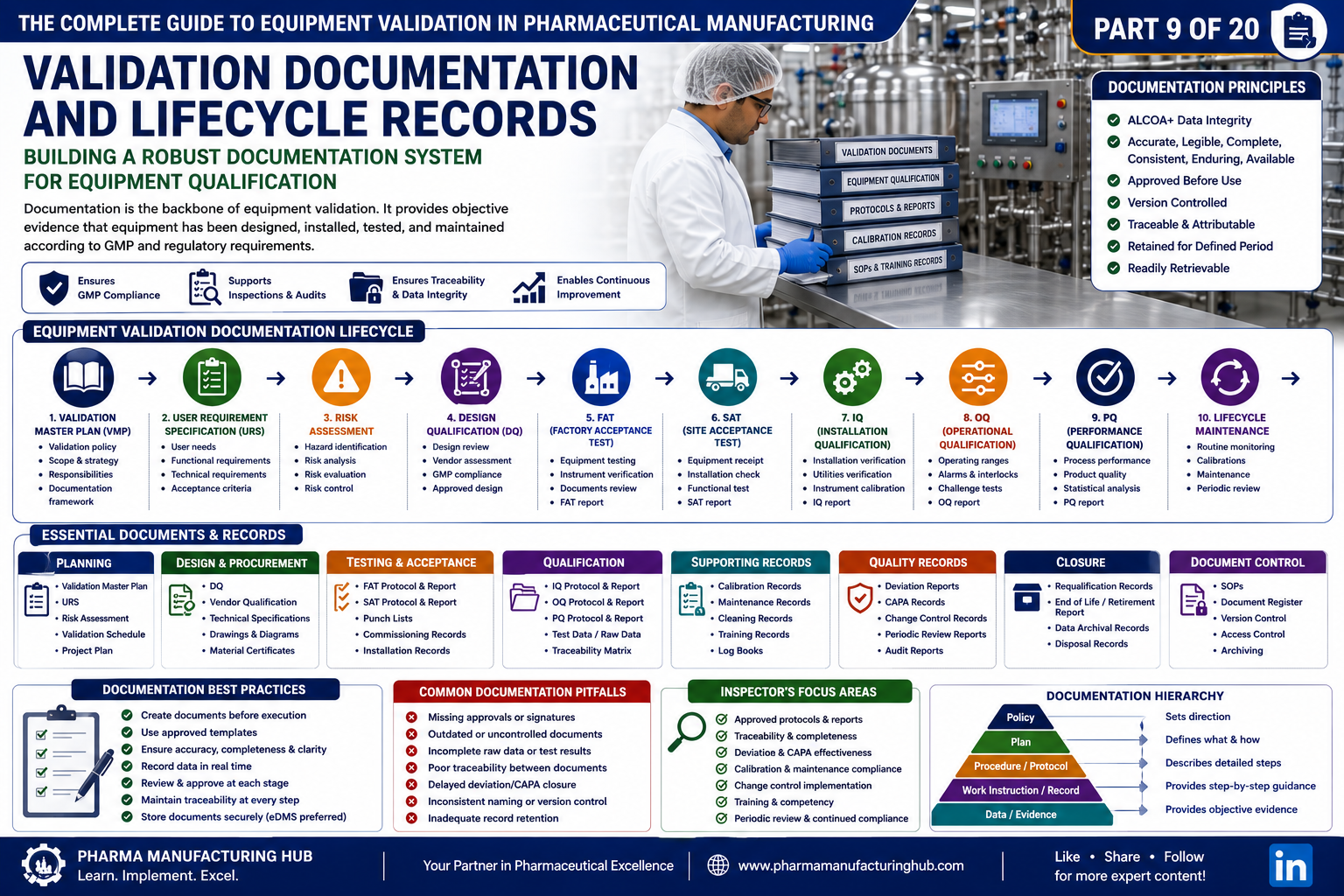
Introduction
In pharmaceutical manufacturing, documentation is the cornerstone of equipment validation. Regulators worldwide—including the US FDA, EMA, MHRA, WHO, PIC/S, and industry guidance from ISPE, ASTM, and ICH—consistently reinforce the principle:
“If it isn’t documented, it didn’t happen.”
Even if equipment has been properly designed, installed, operated, and maintained, the absence of complete, accurate, and controlled documentation can result in regulatory observations, delayed product release, or even rejection of the qualification effort.
Validation documentation provides objective evidence that equipment has been qualified according to approved procedures and remains in a validated state throughout its lifecycle. It also supports traceability, change management, inspections, audits, and continual improvement.
This article explains the complete documentation package required for pharmaceutical equipment qualification, from project initiation through equipment retirement.
Why Validation Documentation is Important
Validation documentation provides:
- Evidence of GMP compliance.
- Traceability of qualification activities.
- Support for regulatory inspections.
- Historical records for lifecycle management.
- Basis for change control and requalification.
- Confidence in equipment performance.
- Protection of patient safety.
Documentation Lifecycle
Validation Master Plan (VMP)
            │
            ▼
User Requirement Specification (URS)
            │
            ▼
Risk Assessment
            │
            ▼
Design Qualification (DQ)
            │
            ▼
Factory Acceptance Test (FAT)
            │
            ▼
Site Acceptance Test (SAT)
            │
            ▼
Installation Qualification (IQ)
            │
            ▼
Operational Qualification (OQ)
            │
            ▼
Performance Qualification (PQ)
            │
            ▼
Routine Monitoring
            │
            ▼
Maintenance / Calibration
            │
            ▼
Periodic Review
            │
            ▼
Change Control
            │
            ▼
Requalification
            │
            ▼
Retirement Report
Each document builds on the previous one, creating a complete and traceable validation history.
Validation Master Plan (VMP)
The Validation Master Plan is the highest-level document describing the organization’s validation strategy.
Purpose
The VMP defines:
- Validation policy
- Scope
- Responsibilities
- Applicable regulations
- Qualification approach
- Documentation hierarchy
- Risk management strategy
- Change control process
- Periodic review approach
Typical Sections
- Purpose
- Scope
- Validation Policy
- Organization
- Responsibilities
- Equipment List
- Validation Schedule
- Documentation Matrix
- Approval Requirements
User Requirement Specification (URS)
The URS documents what the equipment must achieve.
Typical contents:
- Intended use
- Capacity
- Materials of construction
- Utilities
- Automation
- Cleaning requirements
- Safety
- Regulatory expectations
- Acceptance criteria
URS serves as the foundation for all subsequent qualification documents.
Risk Assessment
Risk assessments identify potential failures before qualification begins.
Common methods include:
- FMEA
- Risk Matrix
- HACCP
- Fault Tree Analysis
Documentation should include:
- Hazard identification
- Severity
- Probability
- Detectability
- Risk Priority Number (RPN)
- Mitigation actions
- Residual risk
Design Qualification (DQ)
DQ documentation demonstrates that the proposed design satisfies the URS.
Typical contents:
- Design review
- Vendor assessment
- Material verification
- Utility review
- Automation review
- Safety review
- GMP assessment
- Approval records
Factory Acceptance Test (FAT)
The FAT package should include:
- FAT Protocol
- Test Results
- Punch List
- Calibration Certificates
- Material Certificates
- Software Verification
- Drawings
- Final FAT Report
Site Acceptance Test (SAT)
SAT documentation includes:
- Site Installation Verification
- Utility Checks
- Equipment Receipt Inspection
- Commissioning Records
- Functional Testing
- Punch List Closure
- SAT Report
Installation Qualification (IQ)
The IQ documentation package typically contains:
- IQ Protocol
- Equipment Identification
- Nameplate Verification
- Utility Verification
- Material Certificates
- Instrument Calibration
- Drawing Verification
- Software Verification
- Safety Verification
- IQ Report
Operational Qualification (OQ)
OQ documentation includes:
- Approved Protocol
- Operating Range Tests
- Alarm Testing
- Interlock Verification
- PLC Testing
- SCADA Testing
- HMI Verification
- Challenge Tests
- Acceptance Criteria
- OQ Report
Performance Qualification (PQ)
Typical PQ documentation includes:
- PQ Protocol
- Batch Records
- Sampling Plan
- Laboratory Results
- Statistical Analysis
- Deviations
- CAPA
- Final Report
Validation Protocols
Every qualification stage should have an approved protocol.
A protocol typically includes:
- Purpose
- Scope
- Responsibilities
- Test Procedures
- Acceptance Criteria
- Data Recording Forms
- Deviation Procedure
- Approval Signatures
Protocols should be approved before execution.
Validation Reports
Each qualification stage concludes with a report summarizing:
- Activities performed
- Results obtained
- Deviations encountered
- CAPA implemented
- Acceptance criteria evaluation
- Overall conclusion
- Recommendation for approval
Reports should include references to raw data and supporting records.
Calibration Records
Calibration records demonstrate that critical measuring instruments are accurate and traceable.
Typical information includes:
- Instrument ID
- Calibration date
- Due date
- Standard used
- Results
- Tolerance
- Technician
- Approval
Preventive Maintenance Records
Maintenance documentation should include:
- Equipment ID
- Maintenance schedule
- Work performed
- Spare parts used
- Lubricants
- Technician
- Completion date
- Verification
Maintaining complete maintenance records helps demonstrate the equipment remains in a validated state.
Training Records
Personnel qualification is a key element of GMP.
Training records should document:
- Employee name
- Training topic
- SOP version
- Trainer
- Assessment results
- Completion date
Only trained personnel should execute qualification activities.
Deviation Reports
Every deviation identified during qualification should be documented.
Typical sections include:
- Description
- Date
- Root cause
- Impact assessment
- Immediate correction
- CAPA
- Approval
No deviation should be closed without documented evaluation.
CAPA Documentation
Corrective and Preventive Action (CAPA) records should include:
- Problem statement
- Root cause
- Corrective action
- Preventive action
- Effectiveness verification
- Closure approval
Effective CAPA prevents recurrence of qualification issues.
Change Control Documentation
Any modification to qualified equipment should be managed through change control.
Examples include:
- Software updates
- PLC changes
- Motor replacement
- Sensor replacement
- Utility modifications
- Equipment relocation
Each change should include:
- Description
- Justification
- Risk assessment
- Validation impact
- Approval
- Implementation
- Verification
Traceability Matrix
The traceability matrix links requirements to qualification evidence.
Example:
| URS Requirement | DQ | FAT | SAT | IQ | OQ | PQ |
|---|---|---|---|---|---|---|
| Capacity | ✔ | ✔ | ✔ | ✔ | ||
| Material | ✔ | ✔ | ✔ | |||
| Utilities | ✔ | ✔ | ||||
| Alarm System | ✔ | ✔ | ✔ | |||
| Product Quality | ✔ |
Traceability is frequently reviewed during regulatory inspections.
Periodic Review
To maintain the validated state, equipment should undergo periodic review.
Review topics include:
- Calibration compliance
- Maintenance history
- Deviations
- CAPA trends
- Change controls
- Breakdown history
- Qualification status
- Regulatory updates
Periodic reviews support continual improvement.
Equipment Retirement Report
At the end of the equipment lifecycle, retirement should be documented.
Typical contents:
- Equipment identification
- Reason for retirement
- Product impact assessment
- Data archival
- Disposal method
- Environmental considerations
- Approval
Retirement documentation ensures complete lifecycle traceability.
Document Control
All validation documents should comply with document control procedures.
Requirements include:
- Unique document numbers
- Version control
- Approval signatures
- Revision history
- Controlled distribution
- Retention period
- Archiving
Uncontrolled documents should never be used for GMP activities.
Electronic Documentation
Many organizations now use electronic document management systems (eDMS).
Benefits include:
- Version control
- Electronic signatures
- Audit trails
- Secure storage
- Rapid retrieval
- Workflow approvals
- Backup and disaster recovery
Electronic systems should comply with 21 CFR Part 11 and EU Annex 11 where applicable.
Inspector’s Perspective
During inspections, regulators often focus heavily on documentation quality.
Inspectors commonly verify:
- Approved protocols and reports.
- Version-controlled documents.
- Complete traceability.
- Proper deviation handling.
- Timely CAPA closure.
- Current calibration and maintenance records.
- Training evidence.
- Controlled document revisions.
Well-organized documentation demonstrates a mature quality system and facilitates efficient inspections.
Expert Tips
Expert Tip 1: Establish standardized templates for protocols, reports, and checklists while allowing equipment-specific customization. This improves consistency without sacrificing technical accuracy.
Expert Tip 2: Maintain a central validation index or document register. It simplifies retrieval during audits and helps ensure no required records are overlooked.
Expert Tip 3: Perform periodic internal reviews of validation documentation to verify completeness, accuracy, and ongoing compliance with current regulatory expectations.
Common Pitfalls
Avoid these common documentation issues:
- Missing approval signatures.
- Use of uncontrolled document copies.
- Incomplete raw data.
- Poor traceability between qualification stages.
- Delayed deviation documentation.
- Missing calibration records.
- Outdated SOP references.
- Failure to update revision history.
- Inconsistent document numbering.
- Inadequate archival practices.
Frequently Asked Questions (FAQs)
1. Why is documentation so important in equipment validation?
Documentation provides objective evidence that qualification activities were performed according to approved procedures and supports regulatory compliance.
2. What is the role of the Validation Master Plan (VMP)?
The VMP defines the organization’s overall validation strategy, scope, responsibilities, and documentation framework.
3. Why is a traceability matrix required?
It links user requirements to qualification evidence, demonstrating that every requirement has been verified.
4. Are electronic validation records acceptable?
Yes, provided they comply with applicable regulations such as 21 CFR Part 11 and EU Annex 11, including controls for electronic signatures, audit trails, and data integrity.
5. What documents are reviewed during inspections?
Inspectors commonly review protocols, reports, calibration records, maintenance logs, training records, deviations, CAPA, change controls, and periodic review reports.
6. How long should validation documents be retained?
Retention periods should comply with applicable regulations, company procedures, and product lifecycle requirements.
7. Can qualification proceed with incomplete documentation?
No. Missing or incomplete documentation may compromise the qualification effort and should be resolved before approval.
8. What is the benefit of electronic document management?
Electronic systems improve document control, version management, traceability, retrieval efficiency, and regulatory compliance.
Key Takeaways
- Validation documentation provides the objective evidence required to demonstrate equipment qualification and ongoing GMP compliance.
- A complete documentation system spans the entire equipment lifecycle—from the Validation Master Plan and URS through qualification protocols, reports, maintenance, periodic review, and retirement.
- Strong document control, traceability, deviation management, CAPA, and electronic record compliance are essential for inspection readiness.
- Effective documentation is not only a regulatory requirement but also a critical tool for knowledge management, lifecycle control, and continuous improvement.
Coming Up in Part 10
Risk Assessment in Equipment Validation: Applying ICH Q9(R1), FMEA, Risk Matrices, and Science-Based Decision Making
In Part 10, we will explore pharmaceutical risk assessment methodologies in detail, including ICH Q9(R1), Failure Mode and Effects Analysis (FMEA), risk matrices, hazard identification, risk ranking, risk control, residual risk evaluation, practical examples, and equipment-specific case studies to help build robust, risk-based qualification programs aligned with global GMP expectations.
About the Author
Ramesh Palav is a pharmaceutical manufacturing professional with 21+ years of industry experience across pharmaceutical manufacturing, GMP compliance, qualification and validation, CSV, quality systems, production operations, and digital transformation.
With hands-on experience in OSD/tablet manufacturing, Granulation, Compression and Coating, he has worked extensively with GMP, regulatory audits, QMS, CAPA, FMEA, deviation management, root-cause analysis, validation, data integrity, and pharmaceutical technology systems.
Through Pharma Manufacturing Hub, he shares practical, experience-driven knowledge on pharmaceutical manufacturing, GMP, ERP, Pharma 4.0, AI, digital transformation, quality systems, validation, and pharma careers, helping professionals and students understand complex pharmaceutical concepts in a simple and practical way.