Part 2A – Scientific Risk Assessment Framework
Series Navigation
← Previous Article: Cleaning Validation in Pharmaceutical Manufacturing: Complete Beginner’s Guide (Part 1)
In Part 1, we explored the fundamentals of pharmaceutical cleaning validation, including its lifecycle, GMP expectations, regulatory requirements, contamination control, and why it is essential for patient safety.
In this article, we move to one of the most important aspects of a successful cleaning validation program—scientific risk assessment and establishing justified acceptance criteria.
Rather than validating every product and every piece of equipment independently, modern regulatory agencies expect manufacturers to apply Quality Risk Management (QRM) principles to identify the highest-risk scenarios and develop scientifically justified cleaning limits.
Table of Contents
- Introduction
- Why Risk Assessment is Essential
- Regulatory Expectations
- Quality Risk Management (ICH Q9(R1))
- Risk Assessment Process
- Worst-Case Product Selection
- Equipment Grouping Strategy
- Matrix Approach
- Practical Industrial Example
- Summary Table
- Continue to Part 2B
Introduction
Cleaning Validation has evolved significantly over the past decade. Earlier approaches relied on generalized residue limits such as the “10 ppm criterion” or “1/1000th therapeutic dose.” While these methods provided a starting point, they often lacked a strong scientific basis.
Today, global regulatory authorities—including the US FDA, EMA, MHRA, WHO-GMP, and PIC/S—expect manufacturers to use a science- and risk-based approach for establishing cleaning validation acceptance criteria.
At the heart of this approach lies Quality Risk Management (QRM), as described in ICH Q9(R1). Risk assessment helps manufacturers determine:
- Which products represent the greatest contamination risk.
- Which equipment requires dedicated validation.
- Which residues are most hazardous.
- Which cleaning procedures require the highest level of control.
- Which analytical methods are appropriate.
- How acceptance criteria should be scientifically justified.
By applying QRM principles, organizations can focus resources where they matter most—protecting patient safety while maintaining compliance and operational efficiency.
Why Risk Assessment is Essential
Cleaning validation is much more than proving that equipment is visibly clean. It is about ensuring that any residual material remaining after cleaning does not pose an unacceptable risk to the next patient.
Without a structured risk assessment, manufacturers may:
- Select inappropriate worst-case products.
- Underestimate contamination risks.
- Use overly lenient acceptance limits.
- Miss difficult-to-clean equipment locations.
- Increase the likelihood of cross-contamination.
- Face regulatory observations during inspections.
A robust risk assessment provides the scientific foundation for every major decision in a cleaning validation program.
Key Objectives of Risk Assessment
A well-designed risk assessment should:
- Protect patient safety.
- Identify critical contamination risks.
- Support scientifically justified residue limits.
- Optimize validation studies.
- Reduce unnecessary validation efforts.
- Improve regulatory compliance.
- Enhance equipment utilization.
- Support lifecycle management.
Regulatory Expectations
Regulatory agencies consistently emphasize the importance of risk-based cleaning validation.
US FDA
The FDA expects manufacturers to:
- Use scientific rationale for cleaning validation.
- Identify worst-case conditions.
- Validate analytical methods.
- Investigate failures.
- Maintain documented risk assessments.
Inspectors frequently review risk assessment documentation during GMP inspections.
EMA
EMA introduced one of the most significant changes to cleaning validation by requiring manufacturers to establish Health-Based Exposure Limits (HBELs).
EMA expects:
- Toxicological evaluations.
- Scientific acceptance criteria.
- Patient-based risk assessments.
- Product-specific residue limits.
- Lifecycle management.
WHO GMP
WHO recommends that cleaning validation be based on:
- Scientific evidence.
- Risk assessment.
- Product characteristics.
- Equipment design.
- Cleaning process capability.
PIC/S
PIC/S guidance aligns closely with EMA expectations and encourages:
- Worst-case product selection.
- Equipment grouping.
- Matrix validation.
- Risk-based acceptance criteria.
- Continuous review of cleaning effectiveness.
Quality Risk Management (ICH Q9(R1))
Quality Risk Management (QRM) is the systematic process used to assess, control, communicate, and review risks that may affect pharmaceutical quality.
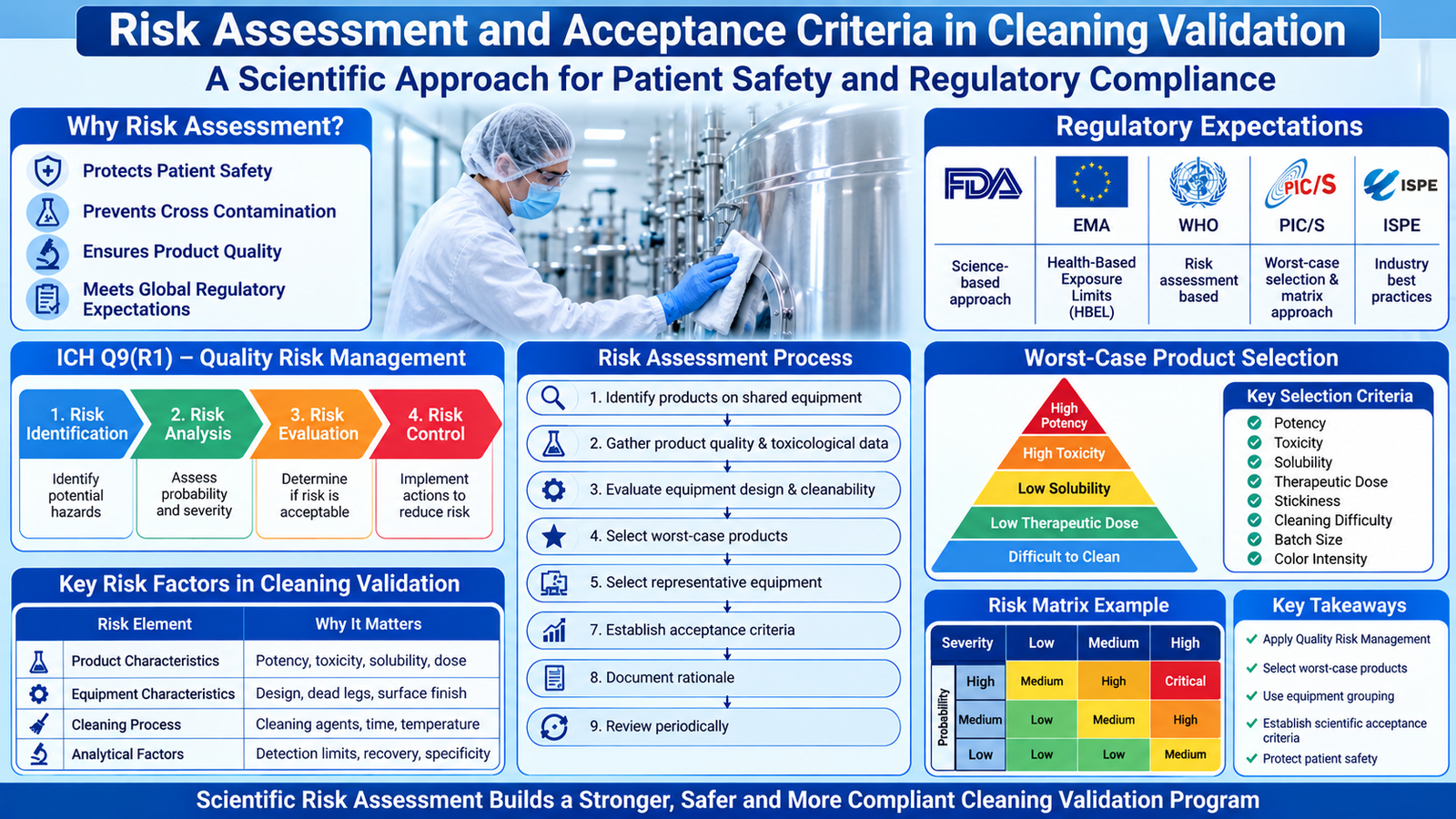
ICH Q9(R1) identifies four key stages:
| Step | Purpose |
|---|---|
| Risk Identification | Identify potential contamination hazards. |
| Risk Analysis | Assess the probability and severity of contamination. |
| Risk Evaluation | Determine whether the risk is acceptable. |
| Risk Control | Implement actions to reduce or eliminate unacceptable risks. |
Risk management should be a continuous activity throughout the lifecycle of the cleaning validation program.
Factors Considered During Risk Assessment
When evaluating cleaning validation risks, manufacturers should consider:
Product Characteristics
- Potency
- Toxicity
- Solubility
- Cleanability
- Therapeutic dose
- Batch size
- Color intensity
- Stickiness
- Stability
- Sensitizing potential
Equipment Characteristics
- Surface finish
- Dead legs
- Crevices
- Gaskets
- Spray coverage
- Drainability
- Product contact surfaces
- Accessibility
- Material of construction
Cleaning Process Factors
- Cleaning agent effectiveness
- Cleaning temperature
- Contact time
- Mechanical action
- Water quality
- Rinse efficiency
- Drying process
- Operator variability
Analytical Factors
- Detection limits
- Recovery efficiency
- Swab compatibility
- Instrument sensitivity
- Specificity
- Method validation
Risk Assessment Process
A structured cleaning validation risk assessment generally follows these steps:
| Step | Activity |
|---|---|
| 1 | Identify products manufactured on shared equipment |
| 2 | Gather product quality and toxicological data |
| 3 | Evaluate equipment design and cleanability |
| 4 | Identify worst-case products |
| 5 | Select representative equipment |
| 6 | Define analytical methods |
| 7 | Establish acceptance criteria |
| 8 | Document rationale |
| 9 | Review periodically |
Each decision should be supported by documented scientific evidence.
Worst-Case Product Selection
One of the most important outcomes of risk assessment is identifying the worst-case product.
Rather than validating every product individually, manufacturers often validate the product that presents the greatest cleaning challenge.
Typical selection criteria include:
| Evaluation Parameter | Higher Risk |
|---|---|
| Potency | Very High |
| Toxicity | High |
| Solubility | Low |
| Therapeutic Dose | Low |
| Stickiness | High |
| Cleaning Difficulty | High |
| Batch Size | Large |
| Color Residues | Dark |
| Microbial Growth Potential | High |
Products with multiple high-risk characteristics are strong candidates for worst-case selection.
Practical Example
Consider a shared tablet manufacturing line producing three products:
| Product | Potency | Solubility | Cleaning Difficulty |
|---|---|---|---|
| Vitamin Tablet | Low | High | Easy |
| Antibiotic Tablet | Medium | Moderate | Moderate |
| Oncology Tablet | Very High | Low | Difficult |
Based on risk, the Oncology Tablet would typically be selected as the worst-case product because it combines high potency, low solubility, and difficult-to-clean residues.
Equipment Grouping Strategy
Cleaning validation does not always require every piece of equipment to be validated independently.
Equipment with similar design, materials, and cleaning procedures can often be grouped into families.
Examples include:
- Mixing vessels of similar construction
- Fluid bed dryers of comparable design
- Bin blenders with identical cleaning procedures
- Tablet presses sharing the same product-contact surfaces
Grouping reduces validation effort while maintaining scientific justification.
Matrix Approach
A matrix approach combines:
- Product grouping
- Equipment grouping
- Worst-case selection
Instead of validating every possible product–equipment combination, representative worst-case combinations are selected.
This approach is widely accepted when supported by a documented risk assessment and scientific rationale.
Practical Industrial Example
A pharmaceutical facility manufactures 30 oral solid dosage products on five compression machines.
Without a risk-based strategy:
- 30 products × 5 machines = 150 validation studies
By applying:
- Product grouping
- Equipment grouping
- Worst-case selection
- Matrix validation
the company may reduce the required studies to 10–15 representative validations, saving significant time and resources while maintaining compliance.
Summary Table
| Risk Element | Why It Matters |
|---|---|
| Product Potency | Determines potential patient impact |
| Toxicity | Drives health-based exposure limits |
| Solubility | Influences cleanability |
| Equipment Design | Affects residue retention |
| Cleaning Method | Determines cleaning effectiveness |
| Analytical Capability | Ensures accurate residue detection |
| Risk Assessment | Supports scientific decision-making |
Looking Ahead
In Part 2B, we’ll build on this risk assessment framework by exploring:
- Health-Based Exposure Limits (HBEL)
- Permitted Daily Exposure (PDE)
- Acceptable Daily Exposure (ADE)
- Maximum Allowable Carryover (MACO) calculations
- Visual cleanliness
- Swab and rinse acceptance limits
- Toxicological evaluations
- Worked numerical examples
- Decision trees and risk matrices
These concepts form the scientific basis for establishing defensible cleaning validation acceptance criteria and are critical for meeting modern global regulatory expectations.
Continue to Part 2B → HBEL, PDE, MACO Calculations, and Acceptance Criteria.
About Author
Ramesh Palav is a pharmaceutical manufacturing and quality professional with 20+ years of industry experience across pharmaceutical manufacturing, GMP, validation, qualification, quality systems, regulatory compliance, digital transformation and Pharma 4.0. Through Pharma Manufacturing Hub, he focuses on practical pharmaceutical knowledge, industry readiness, technology, compliance and professional development for students and pharma professionals.
Pingback: Cleaning Validation Protocol, Sampling and Analytical Methods.