
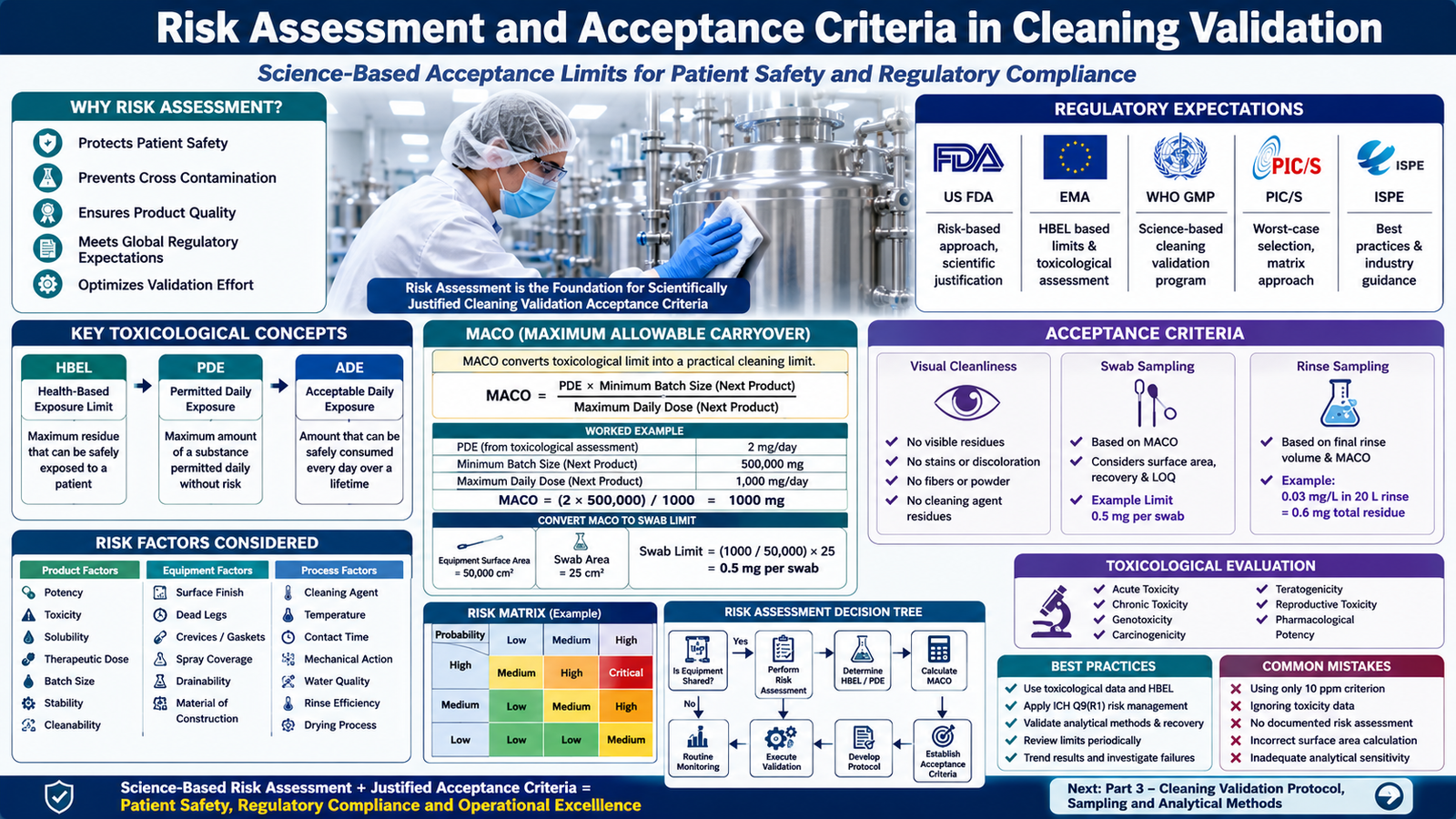
Establishing Scientifically Justified Acceptance Criteria
Article Series
Part 1: Cleaning Validation in Pharmaceutical Manufacturing – Complete Beginner’s Guide
Part 2A: Scientific Risk Assessment Framework
Current Section: Part 2B – HBEL, PDE, MACO Calculation and Acceptance Criteria
Next: Part 3 – Cleaning Validation Protocol, Sampling and Analytical Methods
Table of Contents
- Introduction
- Health-Based Exposure Limits (HBEL)
- Permitted Daily Exposure (PDE)
- Acceptable Daily Exposure (ADE)
- Maximum Allowable Carryover (MACO)
- Worked MACO Calculation
- Visual Cleanliness
- Swab Sampling Acceptance Limits
- Rinse Sampling Acceptance Limits
- Toxicological Evaluation
- Risk Matrix
- Decision Tree
- Best Practices
- Common Mistakes
- Key Takeaways
- FAQs
- Conclusion
- Continue Reading
Introduction
In Part 2A, we explored how Quality Risk Management (ICH Q9(R1)) provides the foundation for selecting worst-case products, grouping equipment, and prioritizing cleaning validation activities.
The next critical step is to establish scientifically justified cleaning validation acceptance criteria.
Historically, many companies relied on simple rules such as:
- 10 ppm carryover
- 1/1000th therapeutic dose
Although these approaches are still occasionally referenced, they are no longer considered sufficient for modern pharmaceutical manufacturing, particularly for highly potent APIs, hormones, cytotoxic compounds, antibiotics, and biological products.
Today’s regulatory expectation is that acceptance criteria should be based on toxicological data and patient safety, using concepts such as HBEL, PDE, ADE, and MACO.
Health-Based Exposure Limits (HBEL)
What is HBEL?
A Health-Based Exposure Limit (HBEL) is the maximum amount of residue from a previous product that a patient can safely be exposed to without experiencing adverse health effects.
HBEL values are developed by qualified toxicologists using:
- Toxicity studies
- Clinical safety data
- Animal studies
- Human exposure information
- Pharmacological data
HBEL forms the scientific basis for modern cleaning validation acceptance criteria.
Why HBEL is Important
HBEL helps manufacturers:
- Protect patient safety
- Justify cleaning limits scientifically
- Reduce regulatory risk
- Support shared manufacturing facilities
- Demonstrate compliance with EMA and PIC/S expectations
Regulatory Perspective
EMA specifically recommends HBEL-based cleaning validation.
Many multinational pharmaceutical companies now use HBEL as the primary basis for establishing cleaning limits.
Permitted Daily Exposure (PDE)
Definition
Permitted Daily Exposure (PDE) is the maximum amount of a substance that a patient may be exposed to every day without appreciable health risk.
PDE considers:
- Toxicity
- Route of administration
- Exposure duration
- Patient safety
- Uncertainty factors
PDE values are generally expressed as:
mg/day
PDE Calculation Concept
Although toxicologists perform detailed calculations, the simplified concept is:
| Parameter | Description |
|---|---|
| NOAEL | No Observed Adverse Effect Level |
| Body Weight | Standard patient weight |
| Safety Factors | Species, variability, study duration |
| PDE | Final acceptable daily exposure |
Manufacturers normally obtain PDE values from toxicological assessments rather than calculating them independently.
Acceptable Daily Exposure (ADE)
ADE is conceptually similar to PDE.
Many companies use ADE and PDE interchangeably depending on regulatory guidance.
ADE also represents:
The amount of residue that can be safely consumed every day throughout a patient’s lifetime.
PDE vs ADE
| PDE | ADE |
|---|---|
| More commonly used by EMA | Common in toxicology literature |
| Health-based | Health-based |
| Scientifically derived | Scientifically derived |
| Patient safety focused | Patient safety focused |
For cleaning validation purposes, both serve the same objective—protecting patients through science-based exposure limits.
Maximum Allowable Carryover (MACO)
What is MACO?
Maximum Allowable Carryover (MACO) is the maximum amount of residue from the previous product that may remain on equipment without posing an unacceptable risk.
MACO links toxicological exposure limits to manufacturing operations.
It converts PDE into a practical cleaning limit.
Typical MACO Equation
A simplified MACO equation is:\textbf{MACO = \frac{PDE \times Minimum Batch Size_{Next}}{Maximum Daily Dose_{Next}}}
Where:
| Variable | Meaning |
|---|---|
| PDE | Permitted Daily Exposure |
| Minimum Batch Size | Smallest subsequent batch |
| Maximum Daily Dose | Highest daily dose of next product |
Different organizations may use variations of this equation depending on their validation strategy.
Worked MACO Example
Consider:
| Parameter | Value |
|---|---|
| PDE | 2 mg/day |
| Next Product Batch Size | 500,000 mg |
| Maximum Daily Dose | 1,000 mg/day |
Calculation:MACO=10002×500000MACO=1000 mg
Therefore,
Maximum residue permitted on shared equipment = 1000 mg
This value is then distributed across equipment surface area to establish swab limits.
Converting MACO into Swab Limits
Assume:
Equipment surface area
= 50,000 cm²
MACO
= 1000 mg
Swab area
= 25 cm²
Swab limit:500001000=0.02 mg/cm²
Swab acceptance:
0.02 × 25
= 0.5 mg per swab
This becomes the analytical acceptance criterion.
Visual Cleanliness
Visual inspection remains an important component of cleaning validation.
However:
Visually clean does NOT necessarily mean chemically clean.
Regulators expect:
- No visible residues
- No stains
- No discoloration
- No fibers
- No powder
- No droplets
- No cleaning agent residues
Visual inspection complements—not replaces—analytical testing.
Swab Sampling Acceptance Criteria
Swab sampling is preferred for:
- Direct surface assessment
- Difficult-to-clean locations
- Equipment corners
- Gaskets
- Dead legs
- Product contact surfaces
Acceptance limits are typically based on:
- MACO
- HBEL
- Surface area
- Recovery factor
- Analytical sensitivity
Example
| Parameter | Value |
|---|---|
| Swab Area | 25 cm² |
| Recovery | 85% |
| Analytical LOQ | 0.05 ppm |
| Acceptance Limit | 0.5 mg/swab |
Rinse Sampling Acceptance Criteria
Rinse sampling evaluates residues removed during the final rinse.
Suitable for:
- Large tanks
- Pipelines
- CIP systems
- Difficult-to-access equipment
Acceptance depends on:
- Final rinse volume
- Detection capability
- Recovery studies
- MACO allocation
Example:
Final rinse volume
= 20 L
Residue detected
= 0.03 mg/L
Total residue
= 0.6 mg
Compare against calculated MACO.
Toxicological Evaluation
A qualified toxicologist evaluates:
- Acute toxicity
- Chronic toxicity
- Genotoxicity
- Carcinogenicity
- Teratogenicity
- Reproductive toxicity
- Pharmacological potency
This assessment determines the HBEL/PDE used for cleaning validation.
Cleaning Validation Risk Matrix
| Severity | Low Probability | Medium Probability | High Probability |
|---|---|---|---|
| High Impact | Medium | High | Critical |
| Medium Impact | Low | Medium | High |
| Low Impact | Low | Low | Medium |
High-risk products require:
- More sampling
- Lower acceptance limits
- Additional validation studies
Decision Tree
Start

↓

Is equipment shared?

↓

No

↓

Dedicated equipment

↓

Cleaning Verification

↓

Yes

↓

Perform Risk Assessment

↓

Determine HBEL/PDE

↓

Calculate MACO

↓

Establish Acceptance Criteria

↓

Develop Cleaning Validation Protocol

↓

Execute Validation

↓

Routine Monitoring
Best Practices
✔ Use toxicological data
✔ Apply ICH Q9(R1)
✔ Justify worst-case products
✔ Review limits periodically
✔ Validate analytical methods
✔ Include recovery studies
✔ Trend validation results
✔ Train personnel regularly
Common Industry Mistakes
❌ Using only the 10 ppm criterion
❌ Ignoring toxicity
❌ No documented risk assessment
❌ Incorrect equipment surface area
❌ Poor recovery studies
❌ Inadequate analytical sensitivity
❌ Failure to review limits after product changes
❌ No toxicologist involvement
Key Takeaways
- Modern cleaning validation is based on patient safety.
- HBEL and PDE provide the scientific foundation for acceptance criteria.
- MACO converts toxicological limits into practical cleaning limits.
- Swab and rinse limits must be scientifically justified.
- Visual inspection alone is insufficient.
- Risk assessment should guide every cleaning validation program.
Frequently Asked Questions (FAQs)
1. Why is HBEL preferred over the 10 ppm criterion?
HBEL is based on toxicological science and patient safety rather than generic assumptions.
2. Is MACO mandatory?
Most regulatory agencies expect scientifically justified carryover limits, and MACO is the accepted industry approach.
3. Can visual inspection replace analytical testing?
No. Visual inspection complements analytical methods but cannot detect trace residues.
4. Who should calculate PDE?
A qualified toxicologist or an appropriately trained expert.
5. Can one MACO value apply to all products?
No. MACO is product-specific and depends on toxicological and manufacturing parameters.
6. Why are recovery studies important?
They demonstrate that the sampling method can reliably recover residues from equipment surfaces.
7. When should acceptance criteria be reviewed?
Following product changes, process changes, new toxicological data, or periodic quality reviews.
8. Which guidance documents emphasize risk-based cleaning validation?
EMA, PIC/S, WHO-GMP, FDA guidance, and ICH Q9(R1).
Conclusion
Risk assessment and scientifically justified acceptance criteria are the cornerstone of a robust cleaning validation program. By integrating Quality Risk Management (ICH Q9(R1)), HBEL, PDE, ADE, and MACO, manufacturers can establish cleaning limits that are defensible, patient-centric, and aligned with current global regulatory expectations.
In the next article, we’ll move from theory to execution by examining how to develop a Cleaning Validation Protocol, perform swab and rinse sampling, validate analytical methods, conduct recovery studies, and investigate cleaning validation failures.
Continue Reading
➡ Part 1: Cleaning Validation in Pharmaceutical Manufacturing: Complete Beginner’s Guide
➡ Part 2: Risk Assessment and Acceptance Criteria in Cleaning Validation (Current Article)
➡ Part 3: Cleaning Validation Protocol, Sampling and Analytical Methods (Next Article)
➡ Part 4: Executing Cleaning Validation and Maintaining Continued Verification
➡ Part 5: Advanced Cleaning Validation: Pharma 4.0, AI and Future Technologies
About Author
Ramesh Palav is a pharmaceutical manufacturing and quality professional with 20+ years of industry experience across pharmaceutical manufacturing, GMP, validation, qualification, quality systems, regulatory compliance, digital transformation and Pharma 4.0. Through Pharma Manufacturing Hub, he focuses on practical pharmaceutical knowledge, industry readiness, technology, compliance and professional development for students and pharma professionals.