Introduction
Pharmaceutical manufacturing is one of the world’s most highly regulated industries because every medicine directly impacts patient health. Whether manufacturing tablets, capsules, injectables, creams, ointments, or biologics, manufacturers must ensure that every product meets the highest standards of quality, safety, purity, and efficacy.
Among the many quality systems implemented within pharmaceutical facilities, Cleaning Validation plays a critical role in preventing contamination and ensuring that manufacturing equipment consistently produces safe medicines.
Imagine manufacturing a highly potent oncology drug today and a common painkiller tomorrow using the same equipment. Even microscopic traces of the previous product could contaminate the next batch if cleaning is ineffective. Such contamination can lead to product recalls, regulatory actions, patient harm, and significant financial losses.
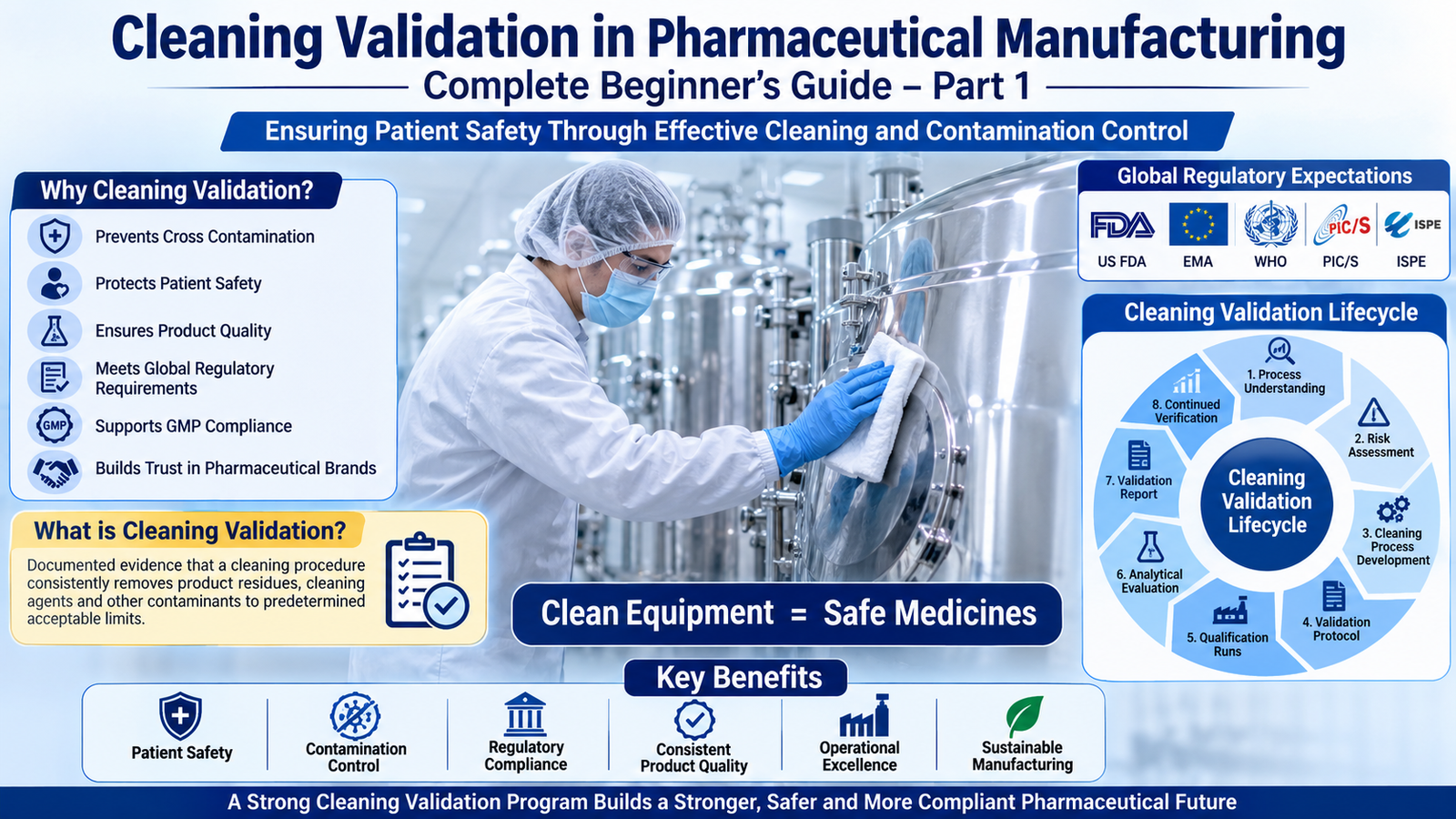
Cleaning Validation provides documented scientific evidence that an established cleaning procedure consistently removes product residues, cleaning agents, microorganisms, and other contaminants to predefined acceptable limits.
It is not simply a regulatory requirement—it’s a fundamental component of Pharmaceutical Quality Systems (PQS), Good Manufacturing Practices (GMP), and contamination control strategies.
In this five-part series, you’ll gain a comprehensive understanding of pharmaceutical cleaning validation, from basic concepts to advanced Pharma 4.0 technologies. Whether you’re a validation engineer, production manager, QA professional, student, or regulatory specialist, this guide will help you build a strong foundation.
What is Cleaning Validation?
Definition
Cleaning Validation is the documented process of demonstrating with a high degree of assurance that a cleaning procedure consistently removes residues from manufacturing equipment to predetermined acceptable levels.
The objective is to prove that the equipment is clean enough for the manufacture of the next product without risking contamination.
Cleaning Validation focuses on the removal of:
- Product residues
- Active pharmaceutical ingredients (APIs)
- Excipients
- Cleaning agent residues
- Lubricants
- Microbial contamination
- Endotoxins (where applicable)
- Environmental contaminants
- Particulate matter
The validation process is based on scientific principles, risk assessment, analytical testing, and regulatory expectations rather than assumptions.
Cleaning Validation vs Cleaning Verification
Many professionals confuse these two terms.
| Cleaning Validation | Cleaning Verification |
|---|---|
| Performed initially to establish the effectiveness of a cleaning process | Performed routinely after validation |
| Demonstrates consistency through multiple successful runs | Confirms each cleaning activity meets predefined limits |
| Extensive documentation | Routine monitoring |
| Usually includes protocol, execution, report, and approval | Usually limited to analytical testing |
| Required before commercial manufacturing | Required during routine manufacturing |
Validation establishes the process, while verification confirms its continued effectiveness.
Objectives of Cleaning Validation
An effective cleaning validation program aims to:
- Prevent cross contamination
- Protect patient safety
- Demonstrate regulatory compliance
- Ensure consistent product quality
- Verify effectiveness of cleaning procedures
- Establish scientifically justified residue limits
- Minimize manufacturing risks
- Improve equipment utilization
- Support inspection readiness
- Maintain product integrity throughout the equipment lifecycle
Why Cleaning Validation is Important
Cleaning validation is one of the most critical contamination control activities in pharmaceutical manufacturing.
Its importance extends beyond regulatory compliance—it directly protects patients.
1. Preventing Cross Contamination
Cross contamination occurs when residues from one product unintentionally contaminate another.
Potential contaminants include:
- Active ingredients
- Potent compounds
- Allergens
- Hormones
- Antibiotics
- Cytotoxic drugs
- Cleaning chemicals
- Lubricants
Even trace amounts can affect the safety and efficacy of the subsequent product.
Industrial Example
Consider a facility manufacturing:
- Product A: High-potency corticosteroid tablet
- Product B: Vitamin supplement
If equipment cleaning is inadequate, residual corticosteroid could contaminate the vitamin product, exposing consumers to unintended medication and creating serious health risks.
2. Protecting Patient Safety
The ultimate goal of pharmaceutical manufacturing is patient safety.
Residues left on equipment may cause:
- Toxicity
- Allergic reactions
- Therapeutic failure
- Incorrect dosing
- Drug interactions
- Microbial contamination
- Product instability
Cleaning validation ensures these risks remain within scientifically acceptable limits.
3. Maintaining Product Quality
Product quality depends on consistent manufacturing processes.
Poor cleaning may result in:
- Out-of-specification batches
- Product discoloration
- Unexpected impurities
- Failed dissolution
- Failed assay
- Stability failures
Validated cleaning procedures help ensure every batch meets quality specifications.
4. Meeting Regulatory Expectations
Global health authorities require pharmaceutical manufacturers to demonstrate effective cleaning procedures.
Regulators expect manufacturers to have:
- Scientifically justified acceptance criteria
- Risk-based cleaning validation strategies
- Documented protocols
- Validated analytical methods
- Periodic review programs
- Change control systems
- Investigation procedures
- Continued verification programs
Failure to comply can result in:
- FDA Form 483 observations
- Warning letters
- Import alerts
- Product recalls
- Manufacturing suspension
- Loss of market authorization
Regulatory Expectations
Cleaning validation is governed by multiple international regulatory agencies and industry guidance documents.
Although the wording differs slightly, the fundamental expectations remain consistent worldwide.
US FDA
The U.S. Food and Drug Administration expects manufacturers to:
- Validate cleaning procedures
- Scientifically justify residue limits
- Use validated analytical methods
- Investigate failures
- Maintain comprehensive documentation
- Apply risk management principles
- Demonstrate lifecycle management
FDA inspections frequently review cleaning validation programs during GMP audits.
European Medicines Agency (EMA)
EMA places strong emphasis on:
- Health-Based Exposure Limits (HBEL)
- Risk assessment
- Scientific justification
- Toxicological evaluations
- Shared facility contamination control
- Lifecycle validation
EMA’s guidance has significantly influenced modern cleaning validation practices worldwide.
WHO GMP
WHO expects manufacturers to:
- Establish written cleaning procedures
- Validate critical cleaning processes
- Periodically review cleaning effectiveness
- Train personnel
- Maintain documented evidence
WHO guidance is widely adopted across emerging pharmaceutical markets.
PIC/S Guidance
PIC/S promotes harmonized GMP standards across participating countries.
Cleaning validation expectations include:
- Risk-based validation
- Worst-case product selection
- Equipment grouping
- Scientific rationale
- Lifecycle approach
- Documentation integrity
ISPE and PDA Guidance
While not regulatory agencies, ISPE and PDA provide industry-recognized best practices that support robust cleaning validation programs.
Their guidance documents cover:
- Risk assessment methodologies
- Cleaning process development
- Acceptance criteria
- Analytical strategies
- Lifecycle management
GMP Requirements for Cleaning Validation
Cleaning validation is an integral part of Good Manufacturing Practices (GMP).
An effective GMP-compliant cleaning validation program should include:
| GMP Requirement | Purpose |
|---|---|
| Approved cleaning procedures | Standardize cleaning activities |
| Qualified equipment | Ensure equipment suitability |
| Trained operators | Reduce human error |
| Validated analytical methods | Accurate residue detection |
| Risk assessments | Identify critical cleaning risks |
| Acceptance criteria | Define cleanliness limits |
| Cleaning records | Demonstrate compliance |
| Change control | Manage process modifications |
| Deviation management | Address unexpected events |
| Periodic review | Ensure continued effectiveness |
Cleaning validation should never be treated as a one-time activity. Instead, it must be managed throughout the equipment lifecycle using a science- and risk-based approach.
Cleaning Validation Lifecycle
Modern regulatory guidance promotes a lifecycle approach to cleaning validation rather than a single validation exercise.
The lifecycle typically consists of the following phases:
| Phase | Key Activities |
|---|---|
| Process Understanding | Product review, equipment assessment, residue identification |
| Risk Assessment | Worst-case product selection, equipment grouping, cleaning challenges |
| Cleaning Process Development | Optimize cleaning agents, parameters, and procedures |
| Validation Protocol | Define scope, sampling, testing, and acceptance criteria |
| Qualification Runs | Execute cleaning validation studies |
| Analytical Evaluation | Swab, rinse, TOC, HPLC, conductivity, and microbial testing |
| Validation Report | Summarize results and approve the validated process |
| Continued Verification | Routine monitoring, trending, periodic review, and revalidation |
This lifecycle approach ensures that cleaning validation remains effective as products, equipment, and manufacturing processes evolve over time.
Looking Ahead
Now that you understand the fundamentals of Cleaning Validation, the next section of this guide will explore practical aspects such as product changeover, cross-contamination control, validation terminology, types of cleaning, manual vs. automated cleaning, benefits, common industry challenges, and future trends.
These topics will help bridge the gap between regulatory expectations and real-world implementation in pharmaceutical manufacturing.
Continue to Part 1B → where we dive deeper into practical cleaning validation concepts used every day in GMP facilities.
About the Author
Ramesh Palav is a pharmaceutical professional with 21+ years of experience in manufacturing, qualification, validation, CSV, GMP, and quality compliance. He shares practical industry insights on pharmaceutical manufacturing, GxP compliance, digital transformation, and Pharma 4.0 through Pharma Manufacturing Hub
Pingback: Executing Cleaning Validation and Maintaining Continued Verification
Pingback: Cleaning Validation Protocol, Sampling and Analytical Methods.
Pingback: Why Smart Pharma Companies Are Rethinking CAPA in the Quality 4.0 Era