
Introduction
Bringing a new pharmaceutical product from the research laboratory to commercial manufacturing is a complex process that requires scientific expertise, cross-functional collaboration, and strict regulatory compliance. Two critical processes that enable this transition are Pharmaceutical Technology Transfer (TT) and New Product Introduction (NPI).
Pharmaceutical Technology Transfer ensures that product knowledge, manufacturing processes, analytical methods, and quality requirements are successfully transferred from Research & Development (R&D) to commercial manufacturing or between manufacturing sites. Meanwhile, New Product Introduction (NPI) provides the structured project management framework needed to transform an approved product concept into a commercially available medicine.
Whether manufacturing oral solid dosage (OSD) tablets, sterile injectables, or biologics, a well-executed Tech Transfer Process minimizes risks, reduces time-to-market, and ensures consistent product quality while meeting global regulatory requirements.
What is Pharmaceutical Technology Transfer?
Pharmaceutical Technology Transfer is the systematic process of transferring product and process knowledge, analytical methods, manufacturing instructions, and quality requirements from a sending unit (such as R&D or another manufacturing site) to a receiving manufacturing site capable of producing the product consistently and compliantly.
Primary Objectives
- Ensure consistent product quality and performance.
- Maintain compliance with GMP and regulatory requirements.
- Achieve successful commercial manufacturing with minimal risk.
- Reduce technology transfer timelines and manufacturing costs.
- Facilitate knowledge sharing across departments.
Business Benefits
A successful Technology Transfer in Pharma delivers significant business value by:
- Accelerating product commercialization.
- Improving manufacturing efficiency.
- Reducing batch failures and deviations.
- Enhancing supply chain reliability.
- Increasing regulatory inspection readiness.
- Supporting global product launches.
For example, during the transfer of an immediate-release tablet from R&D to production, optimized granulation parameters, compression settings, and coating processes must be accurately transferred to ensure commercial batches perform identically to development batches.
Technology Transfer Lifecycle
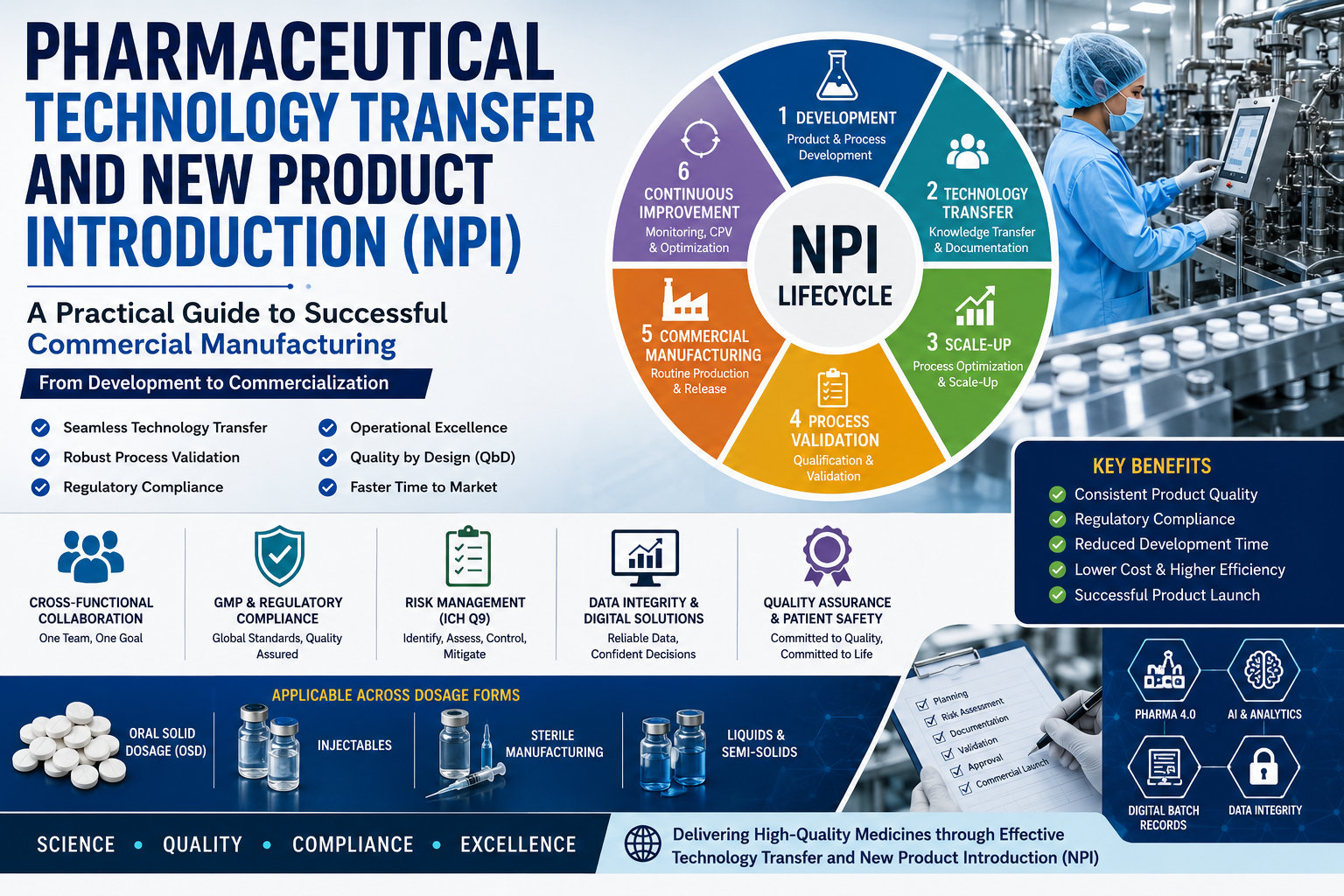
A structured Tech Transfer Process follows several interconnected stages.
1. Product Development
R&D develops the formulation, establishes manufacturing processes, identifies Critical Quality Attributes (CQAs), and defines Critical Process Parameters (CPPs).
2. Knowledge Transfer
Comprehensive documentation—including product development reports, manufacturing instructions, analytical methods, specifications, and risk assessments—is transferred to the receiving site. Technical workshops and cross-functional discussions help ensure complete process understanding.
3. Scale-Up
Manufacturing moves from laboratory or pilot scale to commercial production. During this stage, equipment capability, mixing dynamics, compression force, coating parameters, and process robustness are evaluated.
4. Process Validation
Commercial-scale Process Validation demonstrates that the manufacturing process consistently produces products meeting predetermined quality attributes. This stage typically includes Process Performance Qualification (PPQ) batches and supporting validation activities.
5. Commercial Manufacturing
Following successful validation and regulatory approval, routine production begins under approved Batch Manufacturing Records (BMRs), Standard Operating Procedures (SOPs), and quality systems.
6. Continuous Improvement
Post-launch monitoring includes Continued Process Verification (CPV), trend analysis, deviation investigations, CAPA implementation, and ongoing process optimization to support Pharma Manufacturing Excellence.
New Product Introduction (NPI)
New Product Introduction (NPI) is the structured project management approach used to introduce new pharmaceutical products into commercial manufacturing.
Typical NPI stages include:
- Product concept approval
- Formulation development
- Process development
- Pilot batch manufacturing
- Scale-up
- Registration or exhibit batches
- Process Validation
- Commercial launch
Effective Pharmaceutical Project Management plays a vital role during NPI by coordinating activities across multiple departments, managing project timelines, mitigating risks, and ensuring milestone completion.
Cross-Functional Team Roles
Successful Technology Transfer depends on collaboration between several departments.
Production prepares equipment, executes engineering and validation batches, and supports commercial manufacturing.
Quality Assurance (QA) reviews documentation, approves protocols, oversees deviations, and ensures GMP compliance.
Quality Control (QC) transfers analytical methods, performs testing, validates laboratory methods, and releases materials and finished products.
Research & Development (R&D) provides product knowledge, manufacturing parameters, formulation expertise, and troubleshooting support.
Engineering ensures equipment qualification, utility readiness, calibration, and preventive maintenance.
Validation performs equipment qualification, cleaning validation, Process Validation, and computerized system validation where applicable.
Regulatory Affairs manages product registration, dossier submissions, regulatory commitments, and health authority interactions.
Supply Chain and Planning coordinate raw material availability, production scheduling, packaging materials, and inventory management to ensure uninterrupted product launch.
Common Challenges
Despite careful planning, several challenges can impact Pharmaceutical Technology Transfer.
Equipment Differences
Variations in equipment design, mixing efficiency, or compression capability may require process optimization during scale-up.
Raw Material Variability
Differences in supplier characteristics or excipient properties can influence granulation, dissolution, or tablet hardness.
Documentation Gaps
Incomplete development reports or missing manufacturing knowledge often result in delays, deviations, and repeat studies.
Process Scale-Up Issues
Parameters that perform well in laboratory-scale batches may not directly translate to commercial-scale equipment.
Validation Delays
Equipment readiness, protocol approvals, or unexpected process variability can delay commercial launch timelines.
Best Practices for Successful Technology Transfer
Organizations can significantly improve Technology Transfer success by adopting industry best practices.
- Perform structured risk assessments early using tools aligned with ICH Q9(R1).
- Establish effective knowledge transfer sessions between R&D and manufacturing teams.
- Maintain complete and accurate GMP documentation throughout the project.
- Promote regular cross-functional communication and project governance meetings.
- Develop robust validation strategies supported by scientific rationale.
- Implement effective Change Control procedures to manage process modifications.
- Conduct engineering batches before Process Validation to identify potential issues.
- Monitor post-launch process performance through Continued Process Verification (CPV).
These practices improve project execution while reducing regulatory and operational risks.
Regulatory Perspective
Global regulatory agencies expect Pharmaceutical Technology Transfer activities to follow science- and risk-based principles.
Key regulatory expectations include compliance with:
- USFDA cGMP requirements for consistent manufacturing and quality systems.
- WHO-GMP guidance for pharmaceutical manufacturing and quality assurance.
- EU GMP, including Annex 15 expectations for qualification and validation.
- ICH Q8 for Pharmaceutical Development and Quality by Design.
- ICH Q9(R1) for Quality Risk Management throughout the product lifecycle.
- ICH Q10 for Pharmaceutical Quality Systems and continual improvement.
Maintaining complete documentation, validated processes, and effective change management supports successful regulatory inspections.
Future Trends in Technology Transfer
Technology Transfer is evolving through digital transformation and advanced manufacturing technologies.
Key trends include:
- Pharma 4.0 integrating automation, digital connectivity, and smart manufacturing.
- Digital Manufacturing using Manufacturing Execution Systems (MES) and real-time production monitoring.
- Artificial Intelligence (AI) for predictive analytics, process optimization, deviation prediction, and project scheduling.
- Digital Batch Records (eBMR) replacing paper documentation while improving efficiency and data integrity.
- Enhanced Data Integrity practices ensuring secure, traceable, and compliant electronic records throughout the product lifecycle.
These innovations are improving decision-making, reducing transfer timelines, and supporting more efficient commercial manufacturing.
Conclusion
Pharmaceutical Technology Transfer and New Product Introduction (NPI) are essential components of successful pharmaceutical commercialization. From transferring scientific knowledge to validating manufacturing processes and achieving regulatory compliance, every stage requires detailed planning, strong cross-functional collaboration, effective risk management, and robust quality systems.
Organizations that implement structured Technology Transfer programs, supported by GMP principles, Process Validation, and continuous improvement initiatives, are better positioned to deliver high-quality medicines efficiently while maintaining global regulatory compliance.
Five Key Takeaways
- Technology Transfer bridges the gap between product development and commercial manufacturing.
- Successful NPI relies on strong project management and cross-functional collaboration.
- Early risk assessment and scientific scale-up minimize delays and validation failures.
- Compliance with USFDA, WHO-GMP, EU GMP, and ICH guidelines is essential for inspection readiness.
- Digital technologies, AI, and Pharma 4.0 are transforming the future of Pharmaceutical Technology Transfer.
Explore More at Pharma Manufacturing Hub
Looking to deepen your expertise in Pharmaceutical Technology Transfer, New Product Introduction (NPI), Process Validation, GMP Technology Transfer, and Pharma Manufacturing Excellence? Explore more practical guides, industry insights, and expert resources at Pharma Manufacturing Hub to stay ahead in today’s evolving pharmaceutical manufacturing lands
About the Author
Ramesh Palav is a pharmaceutical professional with 21+ years of experience in manufacturing, qualification, validation, CSV, GMP, and quality compliance. He shares practical industry insights on pharmaceutical manufacturing, GxP compliance, digital transformation, and Pharma 4.0 through Pharma Manufacturing Hub.