
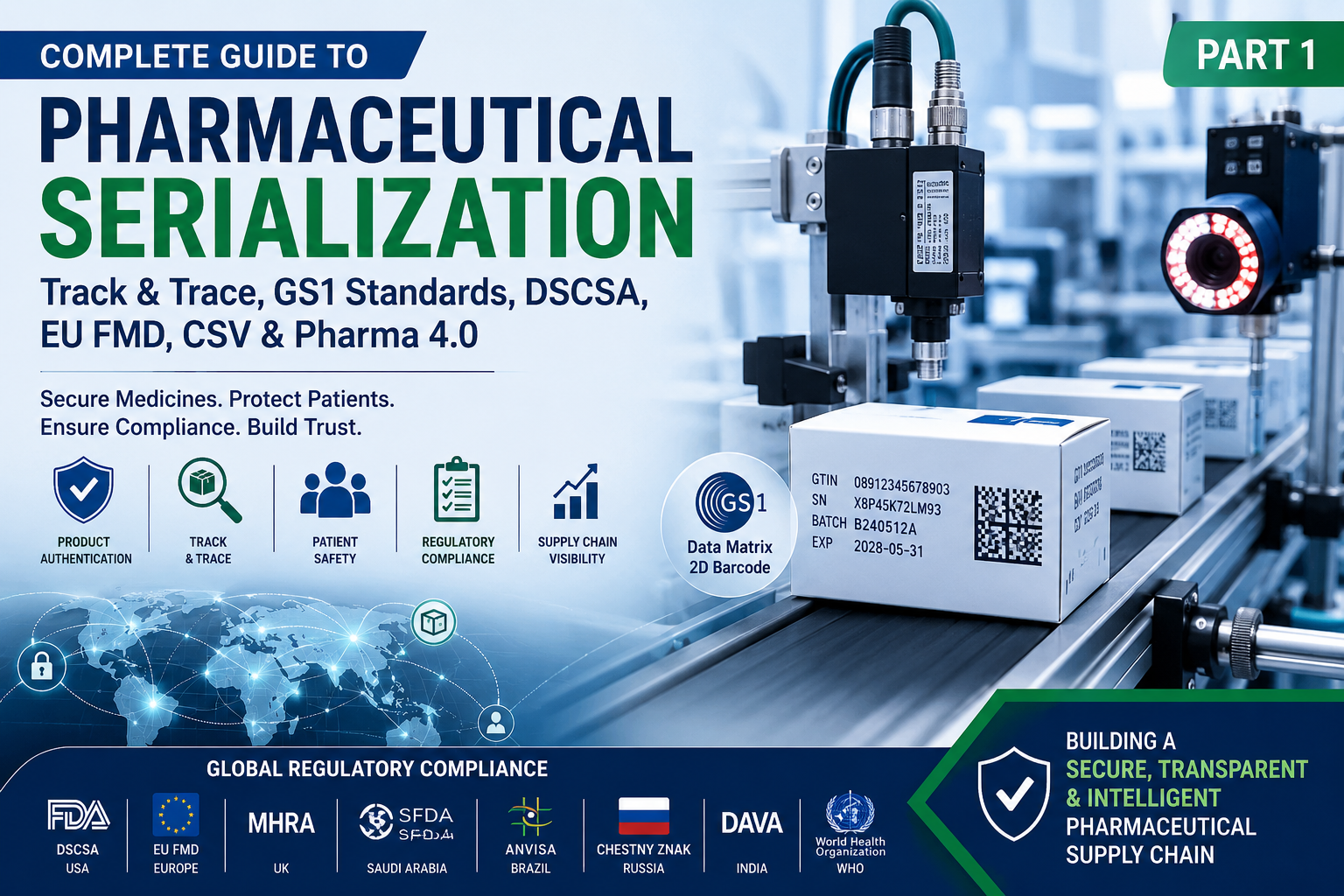
Introduction
Counterfeit medicines remain one of the greatest threats to global healthcare. According to international health organizations, falsified medicines can compromise patient safety, damage brand reputation, and lead to significant financial losses. To combat this challenge, regulatory authorities worldwide have introduced pharmaceutical serialization and track-and-trace requirements.
Serialization assigns a unique identity to every saleable pharmaceutical pack, enabling it to be identified, authenticated, traced, and verified throughout the supply chain. Combined with aggregation, serialization improves visibility from manufacturing through distribution to the patient.
Today, serialization is not only a regulatory obligation but also a strategic investment that strengthens supply chain integrity, enhances patient safety, supports recall management, and drives digital transformation under Pharma 4.0.
What is Pharmaceutical Serialization?
Pharmaceutical serialization is the process of assigning a unique serial number to each saleable unit of a pharmaceutical product. This unique identifier is encoded into a 2D GS1 Data Matrix barcode and linked to product information stored in a secure database.
A serialized pack typically includes:
- Global Trade Item Number (GTIN)
- Unique Serial Number
- Batch/Lot Number
- Expiry Date
- GS1 Data Matrix Barcode
- Human-readable information
Every serial number is unique and cannot be reused, allowing each pack to be authenticated throughout its lifecycle.
Objectives of Serialization
- Prevent counterfeit medicines
- Improve patient safety
- Ensure product authenticity
- Enable product traceability
- Support rapid recalls
- Meet global regulatory requirements
- Improve supply chain transparency
- Enhance inventory accuracy
Business Benefits
Beyond compliance, serialization provides significant operational advantages:
- Stronger brand protection
- Better inventory visibility
- Faster recall execution
- Reduced diversion and theft
- Improved customer confidence
- Enhanced supply chain analytics
- Better regulatory inspection readiness
- Foundation for digital supply chains
Why is Serialization Mandatory?
Governments across the world have made serialization mandatory to secure pharmaceutical supply chains against counterfeit products and unauthorized distribution.
Key regulatory drivers include:
- Patient safety
- Product authentication
- Supply chain transparency
- Recall effectiveness
- Global harmonization
- Regulatory compliance
Global Pharmaceutical Serialization Regulations
Different countries have implemented serialization programs based on their regulatory frameworks. While implementation varies, most regulations rely on GS1 standards, unique serial numbers, and electronic reporting.
| Region/Country | Regulation | Primary Requirement |
|---|---|---|
| United States | DSCSA | Package serialization and interoperable electronic traceability |
| European Union | EU FMD | Safety features and end-point verification |
| United Kingdom | MHRA Guidance | Compliance with applicable serialization requirements and supply chain security measures |
| Saudi Arabia | Saudi FDA | Drug Track & Trace System (RSD) |
| Brazil | ANVISA | Medicine traceability system |
| Russia | Chestny ZNAK | Mandatory serialization and national reporting |
| India | DAVA Portal | Export serialization and reporting |
| Global | WHO Guidelines | Anti-counterfeit and supply chain integrity recommendations |
USFDA DSCSA
The Drug Supply Chain Security Act (DSCSA) establishes requirements for an interoperable electronic system to identify and trace prescription medicines throughout the U.S. supply chain. Manufacturers, wholesalers, dispensers, and repackagers all have defined responsibilities for product identification, tracing, verification, and authorized trading partner requirements.
European Union FMD
The EU Falsified Medicines Directive (EU FMD) requires most prescription medicines to include:
- Unique Identifier
- 2D Data Matrix barcode
- Tamper-evident packaging
Products are verified before dispensing to patients through connected national repositories.
GS1 Standards
GS1 is the globally accepted standard for pharmaceutical identification and data exchange.
GS1 enables:
- Global interoperability
- Standardized product identification
- Efficient electronic communication
- International supply chain compatibility
Essential Serialization Components
Every serialized pharmaceutical package contains several critical data elements.
1. GTIN (Global Trade Item Number)
The GTIN uniquely identifies the product and packaging level. It remains the same for identical products marketed in the same configuration.
Example:
GTIN: 089123456789032. Unique Serial Number
Each saleable pack receives a randomly generated or algorithmically controlled serial number.
Example:
SN: X8P45K72LM93No two packs should ever have the same serial number.
3. Batch Number
The batch or lot number links the product to its manufacturing records, facilitating investigations, recalls, and quality reviews.
Example:
Batch: B240512A4. Expiry Date
The expiry date ensures products are not dispensed beyond their approved shelf life.
Example:
EXP: 2028-055. GS1 Data Matrix Barcode
The GS1 Data Matrix is a compact two-dimensional barcode capable of storing:
- GTIN
- Serial Number
- Batch Number
- Expiry Date
Benefits include:
- High data capacity
- Small print area
- Excellent readability
- High error correction capability
- Global acceptance
6. Tamper-Evident Features
Serialization is often combined with tamper-evident packaging to provide visible evidence if a product has been opened or altered.
Common examples include:
- Security seals
- Tamper labels
- Tear strips
- Perforated cartons
- Void labels
Packaging Line Serialization Architecture
A modern pharmaceutical packaging line integrates mechanical equipment, automation, vision systems, and software to ensure every pack is serialized correctly.
Printer
Prints the GS1 Data Matrix barcode and human-readable information onto cartons or labels using technologies such as Thermal Inkjet (tijuana) or Laser Printing.
Vision Camera
Captures high-resolution images to verify barcode quality, readability, and printed information.
Vision Inspection System
Automatically checks:
- Barcode readability
- Print quality
- OCR accuracy
- Presence of tamper-evident features
Reject System
Automatically removes non-compliant packs, such as those with unreadable codes or incorrect printing, from the production line.
PLC (Programmable Logic Controller)
Coordinates machine control, synchronization, and communication between packaging equipment.
HMI (Human-Machine Interface)
Provides operators with real-time status, alarms, production data, and machine controls.
Line Controller
Manages serialization activities at the packaging line level, including serial number commissioning, communication with printers and cameras, and reconciliation of serialized packs.
Site Server
Acts as the Level 3 serialization system, storing line data, coordinating multiple packaging lines, and exchanging information with enterprise systems.
Enterprise Server
Acts as the central repository for serialization data across manufacturing sites and interfaces with ERP systems and external regulatory or partner repositories.
Conclusion
Pharmaceutical serialization has become a cornerstone of modern pharmaceutical manufacturing. It protects patients from counterfeit medicines, strengthens supply chain security, supports regulatory compliance, and enhances operational efficiency.
By combining GS1 standards, track-and-trace technologies, Computer System Validation (CSV), and Pharma 4.Pharma 4.0: The Future of Pharmaceutical Manufacturing and Quality Systems0 principles, manufacturers can build secure, transparent, and digitally connected supply chains. As global regulations continue to evolve, organizations that invest in robust serialization systems, validated processes, and well-trained personnel will be better positioned to achieve compliance, improve product integrity, and maintain patient trust.
About the Author
Ramesh Palav is a pharmaceutical professional with 21+ years of experience in manufacturing, qualification, validation, CSV, GMP, and quality compliance. He shares practical industry insights on pharmaceutical manufacturing, GxP compliance, digital transformation, and Pharma 4.0 through Pharma Manufacturing Hub