
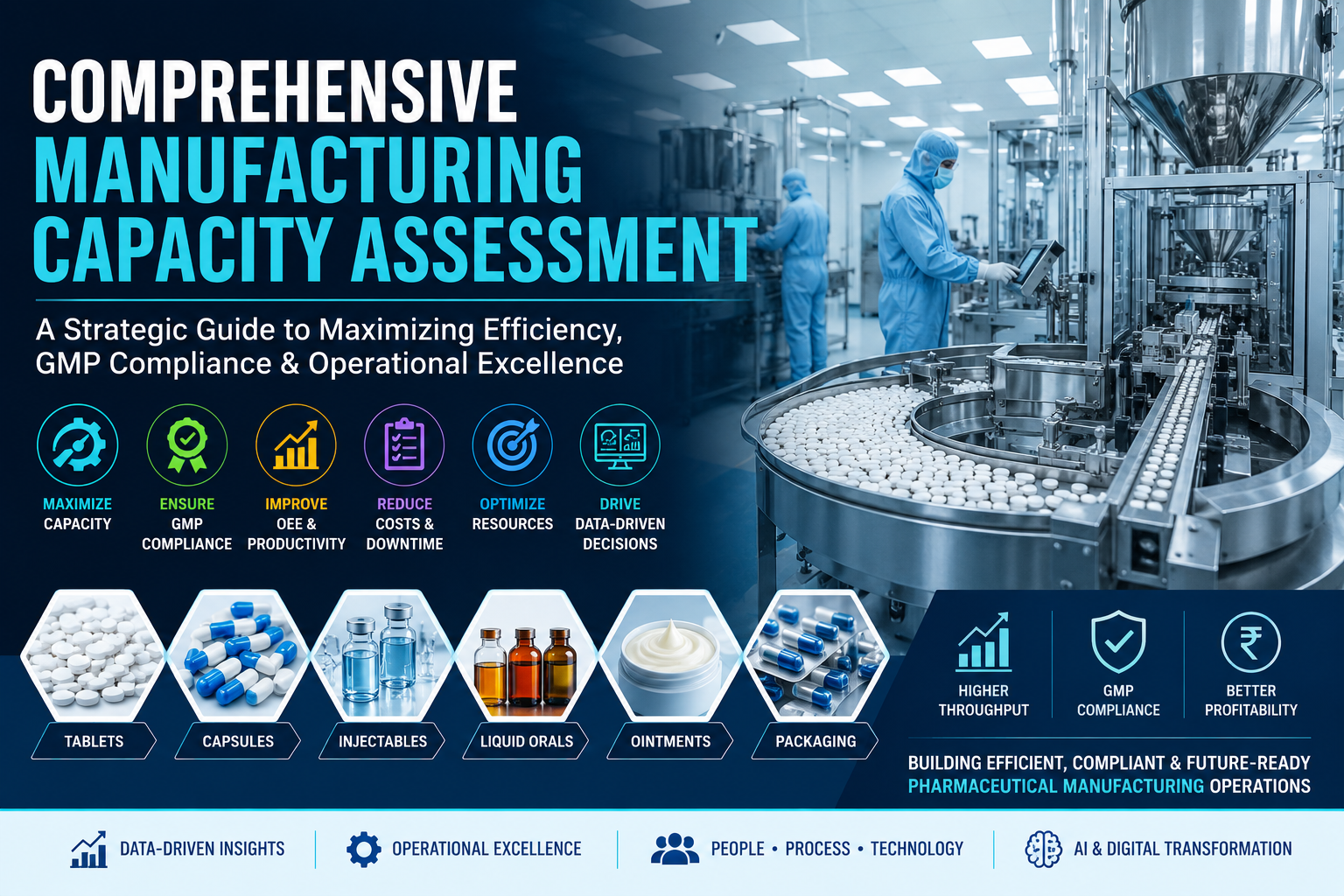
Manufacturing capacity is one of the most critical determinants of success in the pharmaceutical industry. In an environment governed by stringent regulatory requirements, fluctuating market demand, and increasing pressure to reduce costs while maintaining quality, pharmaceutical companies must continuously evaluate and optimize their manufacturing capacity.
A comprehensive manufacturing capacity assessment enables organizations to understand their true production capability, identify hidden constraints, improve operational efficiency, and make informed investment decisions. Whether producing oral solid dosage (OSD) products, injectables, APIs, liquid orals, ointments, or packaging operations, an effective capacity assessment forms the foundation for sustainable growth and operational excellence.
Understanding Manufacturing Capacity
Manufacturing capacity represents the maximum quantity of pharmaceutical products that a facility can produce within a specified period while consistently meeting quality, regulatory, and customer requirements.
Capacity is not limited to equipment speed alone. It depends on multiple interconnected factors, including production lines, utilities, manpower, quality systems, maintenance practices, warehouse operations, and production planning.
Organizations typically evaluate several types of capacity:
- Installed Capacity: Maximum production based on equipment design.
- Theoretical Capacity: Production assuming continuous operation without interruptions.
- Practical Capacity: Capacity after accounting for planned downtime such as maintenance and changeovers.
- Effective Capacity: Actual production capability considering operational constraints.
- Available Capacity: Capacity available after deducting planned production commitments.
- Actual Capacity: Real output achieved under normal operating conditions.
Understanding these capacity levels allows management to identify gaps between potential and actual performance.
Why Manufacturing Capacity Assessment Matters
Many pharmaceutical facilities operate below their installed capacity due to inefficient scheduling, frequent changeovers, equipment downtime, documentation delays, quality bottlenecks, or poor resource utilization.
A structured capacity assessment helps organizations:
- Improve Overall Equipment Effectiveness (OEE)
- Increase throughput without significant capital investment
- Reduce manufacturing costs
- Optimize manpower utilization
- Improve delivery performance
- Support new product introductions
- Strengthen regulatory compliance
- Improve customer satisfaction
Most importantly, it enables data-driven decision-making instead of relying on assumptions.
Key Areas of Capacity Assessment
A comprehensive assessment covers every stage of pharmaceutical manufacturing.
Production Capacity Assessment
Each manufacturing operation—including dispensing, granulation, blending, compression, coating, capsule filling, inspection, blister packing, bottle packing, cartoning, serialization, and warehousing—should be evaluated to determine actual production capability.
Capacity calculations typically include annual, monthly, weekly, daily, and hourly production capabilities while considering shift patterns, batch sizes, and product mix.
Machine Capacity Evaluation
Equipment performance has a direct impact on manufacturing output.
Each critical machine should be evaluated for:
- Rated speed
- Actual operating speed
- Availability
- Performance efficiency
- Product quality
- Downtime
- Setup time
- Cleaning duration
- Changeover time
- Maintenance activities
- Validation schedules
- Capacity losses
Comparing rated capacity with actual production often reveals significant hidden capacity that can be unlocked through operational improvements.
Bottleneck Identification
Every manufacturing facility has at least one constraint limiting overall throughput.
Common pharmaceutical bottlenecks include:
- Granulation delays
- Compression line imbalance
- Coating cycle limitations
- Packaging capacity shortages
- Serialization delays
- Warehouse congestion
- Quality approval waiting times
- Documentation backlogs
- Utility limitations
- Equipment failures
Applying the Theory of Constraints (TOC) helps organizations identify and systematically eliminate these production constraints.
Overall Equipment Effectiveness (OEE)
OEE is one of the most important indicators of manufacturing performance.
It combines three critical parameters:
- Availability: Percentage of scheduled production time during which equipment is operational.
- Performance: Comparison of actual production speed to the designed speed.
- Quality: Percentage of products meeting quality standards without rework.
World-class pharmaceutical manufacturers typically target an OEE of 85% or higher, although many facilities operate between 60% and 75%, indicating substantial opportunities for improvement.
Production Planning and Scheduling
Capacity assessment extends beyond manufacturing equipment.
Production Planning and Scheduling (PPS) significantly influences plant performance through:
- Demand forecasting
- Capacity loading
- Batch sequencing
- Campaign planning
- Material availability
- Inventory optimization
- Customer prioritization
Well-planned production schedules minimize changeovers, reduce waiting times, and maximize equipment utilization.
Utility and Warehouse Capacity
Utilities often become hidden production constraints.
Critical systems requiring evaluation include:
- HVAC
- Purified Water (PW)
- Water for Injection (WFI)
- Clean Steam
- Compressed Air
- Nitrogen
- Electrical Power
- Chillers
- Boilers
- Dust Extraction Systems
Similarly, warehouse operations should assess raw material storage, packaging materials, finished goods, sampling areas, dispatch capacity, and inventory turnover to ensure seamless material flow.
Human Resource Capacity
Even highly automated facilities depend on skilled personnel.
Capacity assessment should evaluate:
- Operator availability
- Supervisor workload
- Engineering support
- QA and QC staffing
- Maintenance resources
- Warehouse personnel
- Training effectiveness
- Skill matrix
- Cross-functional competencies
- Labor productivity
Cross-training employees and maintaining competency-based training programs improve operational flexibility and reduce production interruptions.
Lean Manufacturing Opportunities
Lean Manufacturing focuses on eliminating non-value-added activities.
Pharmaceutical facilities commonly encounter the following wastes:
- Waiting
- Transportation
- Excess inventory
- Unnecessary motion
- Overproduction
- Overprocessing
- Defects
- Underutilized talent
Implementing Lean tools such as 5S, Value Stream Mapping (VSM), Kaizen, SMED (Single-Minute Exchange of Dies), and Total Productive Maintenance (TPM) can significantly improve throughput without major capital investment.
Digital Manufacturing and Pharma 4.0
Modern pharmaceutical manufacturing increasingly relies on digital technologies to optimize capacity.
Key digital enablers include:
- Manufacturing Execution Systems (MES)
- Enterprise Resource Planning (ERP)
- SCADA
- Industrial Internet of Things (IIoT)
- Electronic Batch Records (EBR)
- Digital Dashboards
- Advanced Manufacturing Analytics
- Artificial Intelligence (AI)
- Predictive Maintenance
- Digital Twins
Real-time production visibility enables faster decision-making and proactive issue resolution, improving both efficiency and compliance.
Financial Impact of Capacity Optimization
Capacity losses directly affect profitability.
A comprehensive financial assessment should estimate:
- Downtime costs
- Capacity loss costs
- Inventory carrying costs
- Maintenance expenses
- Utility consumption
- Labor costs
- Cost per batch
- Cost per tablet
- Cost per machine hour
- Return on Investment (ROI) for improvement initiatives
Organizations often discover that relatively small operational improvements deliver significant financial returns.
Future Capacity Planning
Long-term planning ensures manufacturing facilities remain competitive.
A strategic roadmap should include:
- Three-year and five-year demand forecasts
- Capacity expansion requirements
- Additional production lines
- Warehouse expansion
- Utility upgrades
- Automation initiatives
- Digital transformation projects
- AI-driven production optimization
Scenario planning helps organizations prepare for new product introductions, market expansion, and evolving regulatory expectations.
Conclusion
A comprehensive pharmaceutical manufacturing capacity assessment is far more than a calculation of equipment output—it is a strategic evaluation of the entire manufacturing ecosystem. By analyzing production capacity, machine performance, bottlenecks, utilities, warehousing, workforce, quality systems, maintenance, and digital maturity, organizations can unlock hidden capacity, improve productivity, and strengthen GMP compliance.
In an era defined by operational excellence, Pharma 4.0, and data-driven decision-making, capacity optimization has become a competitive necessity. Facilities that embrace structured assessments, Lean principles, advanced analytics, and AI-enabled manufacturing are better positioned to meet growing market demand, reduce costs, accelerate product delivery, and achieve sustainable growth.
For pharmaceutical manufacturers, investing in capacity assessment is not merely an operational exercise—it is a strategic initiative that enhances efficiency, profitability, regulatory readiness, and long-term business resilience.
About the Author
Ramesh Palav is a pharmaceutical professional with 21+ years of experience in manufacturing, qualification, validation, CSV, GMP, and quality compliance. He shares practical industry insights on pharmaceutical manufacturing, GxP compliance, digital transformation, and Pharma 4.0 through Pharma Manufacturing Hub