
Publised on :14/08/2026.
Introduction
Pharmaceutical manufacturing is undergoing a fundamental transformation. The industry is moving beyond traditional batch-oriented production toward highly integrated, data-driven, risk-based, and increasingly continuous manufacturing environments.
At the same time, the fundamental objective has not changed: every batch must consistently deliver a product that is safe, effective, and of the required quality.
Modern pharmaceutical manufacturing therefore requires much more than equipment, automation, and production capacity. It requires integration of:
- cGMP compliance
- Pharmaceutical Quality Systems (PQS)
- Quality Risk Management (QRM)
- Quality by Design (QbD)
- Process Validation and Continued Process Verification (CPV)
- Engineering and utility qualification
- Contamination Control Strategy (CCS)
- Data integrity
- Computerized System Validation (CSV)
- Operational excellence
- Supply-chain resilience
- Digital manufacturing
- Continuous improvement
The most successful manufacturing organizations are those that treat quality, compliance, productivity, engineering, technology, and business performance as interconnected elements of one operating system.
ICH’s quality framework explicitly connects pharmaceutical development, quality risk management, pharmaceutical quality systems, lifecycle management, and continuous manufacturing through Q8, Q9, Q10, Q12 and Q13.
Executive Insight: Compliance should not be treated as an activity performed before an inspection. A mature organization designs compliance into the facility, process, equipment, computerized systems, documentation, people, and management systems from the beginning.
I. The Evolving Landscape of Pharmaceutical Manufacturing
From Traditional Batch Manufacturing to Pharma 4.0
Historically, pharmaceutical manufacturing relied heavily on:
- Manual operations
- Paper batch records
- Periodic laboratory testing
- Fixed manufacturing recipes
- Standalone equipment
- Reactive maintenance
- End-product testing
- Human interpretation of process data
Modern manufacturing is progressively moving toward:
- Electronic Batch Records
- MES and eBR/eBER platforms
- SCADA and industrial historians
- Automated material handling
- Process Analytical Technology (PAT)
- Real-time monitoring
- Predictive maintenance
- Digital twins and advanced process models
- Artificial intelligence and machine learning
- Continuous manufacturing
- Automated deviation detection
- Integrated quality systems
However, digitization does not automatically create a compliant manufacturing environment.
A poorly designed digital system can simply automate a poorly controlled process.
The correct sequence is:
Process understanding → Risk assessment → Control strategy → Qualification/validation → Automation → Data governance → Continuous improvement
II. Technical Foundations and Core Operations
Facility Design and Contamination Control
Facility design is one of the most important foundations of pharmaceutical manufacturing.
A compliant facility should be designed around the risks associated with:
- Product contamination
- Cross-contamination
- Mix-ups
- Microbial contamination
- Personnel movement
- Material movement
- Waste movement
- Equipment cleaning
- Airflow
- Environmental conditions
- Utility distribution
Cleanroom Classification
Cleanroom classification should be appropriate to the manufacturing operation and applicable regulatory requirements.
For sterile manufacturing, environmental classification and contamination control are particularly critical. The EU GMP Annex 1 revision emphasizes a holistic contamination-control approach and became operational on 25 August 2023, with a specific provision deferred to 25 August 2024.
Important considerations include:
- Airborne particulate control
- Microbial control
- HEPA filtration
- Air changes
- Airflow patterns
- Pressure differentials
- Temperature and relative humidity
- Personnel practices
- Material transfer
- Cleaning and disinfection
- Environmental monitoring
- Barrier technologies
- Cleaning validation
HVAC and Airflow Dynamics
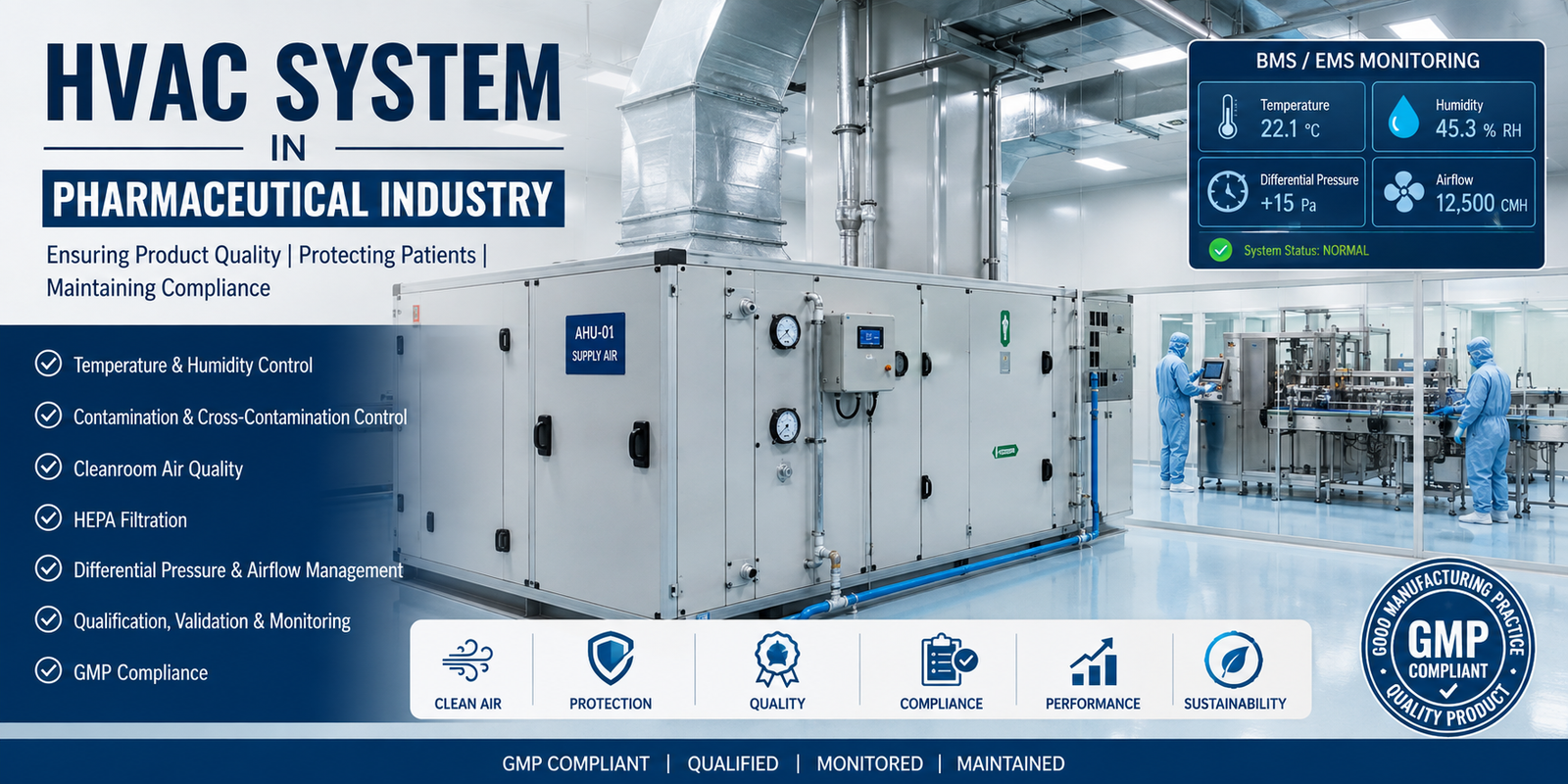
The HVAC system is not simply a comfort-conditioning system. In pharmaceutical manufacturing, it is a critical product-protection system.
Key parameters may include:
- Supply airflow
- Return airflow
- Air changes per hour
- Room pressure differential
- Temperature
- Relative humidity
- HEPA filter integrity
- Airflow direction
- Air velocity
- Recovery time
- Smoke visualization
- Alarm functionality
For aseptic processing, airflow visualization studies should demonstrate that airflow patterns are appropriate for protecting exposed sterile product and critical surfaces.
For non-sterile operations, HVAC design should address dust containment, personnel protection, product protection, and cross-contamination control.
Pressure Cascade
A properly designed pressure cascade can help control movement of airborne contaminants.
Depending on the process, the facility may use:
Cleaner area → Higher pressure → Controlled airflow → Less clean area
or, where containment is the primary objective:
Contained process area → Lower pressure → Inward airflow → Prevention of contaminant escape
The correct pressure philosophy should be established through a documented risk assessment rather than copied from another facility.
Key Principle: Pressure differential is only one element of contamination control. A pressure cascade that looks acceptable on paper can still fail if door-opening behavior, material movement, leakage, airflow patterns, or operational practices are poorly controlled.
Process Mastery
Pharmaceutical manufacturing processes differ significantly by dosage form and technology, but every process should ultimately be understood through:
- Critical Quality Attributes (CQAs)
- Critical Material Attributes (CMAs)
- Critical Process Parameters (CPPs)
- Process parameters
- In-process controls
- Sampling plans
- Control strategy
- Process capability
- Variability sources
Solid Oral Dosage Manufacturing
For tablets, a typical process may include:
Dispensing → Sifting → Granulation → Drying → Milling → Blending → Lubrication → Compression → Coating → Inspection → Packaging
Critical considerations include:
- API particle-size distribution
- Excipient variability
- Granulation endpoint
- Moisture content
- Granule particle-size distribution
- Blend uniformity
- Lubrication time
- Compression force
- Tablet weight
- Hardness
- Thickness
- Friability
- Disintegration
- Dissolution
- Coating parameters
The objective should not be merely to produce tablets that pass finished-product testing.
The objective is to understand and control the process so that acceptable quality is consistently generated.
Aseptic Processing
Aseptic processing requires a substantially higher level of contamination control because the finished product may not undergo a terminal sterilization process capable of eliminating all viable microorganisms after filling.
Critical elements include:
- Cleanroom classification
- Personnel qualification
- Gowning qualification
- Environmental monitoring
- HEPA filtration
- Airflow visualization
- Sterilization/depyrogenation
- Cleaning and disinfection
- Media fills
- Container-closure integrity
- Intervention management
- Material transfer
- Barrier technology
- Microbiological controls
The modern regulatory approach increasingly emphasizes contamination prevention rather than relying exclusively on finished-product testing.
Biopharmaceutical Manufacturing
Biotechnology operations introduce additional complexity through:
- Cell culture
- Fermentation
- Harvest
- Clarification
- Chromatography
- Viral clearance
- Ultrafiltration/diafiltration
- Buffer preparation
- Aseptic formulation
- Sterile filtration
- Filling
Process understanding must account for biological variability, raw-material variability, microbial contamination, viral safety, product stability, and process sensitivity.
III. Equipment and Utility Qualification
Pharmaceutical manufacturing cannot remain in a validated state if its critical infrastructure is unreliable.
Critical systems may include:
- HVAC
- Purified Water
- WFI
- Clean/Pure Steam
- Compressed Air
- Nitrogen
- Vacuum
- Chilled Water
- Process gases
- Electrical systems
- Environmental monitoring systems
- Manufacturing automation systems
Qualification Lifecycle
A robust qualification lifecycle generally follows:
URS → Risk Assessment → Functional/Design Specifications → DQ → FAT → SAT → Installation → IQ → OQ → PQ → Continued Verification
Qualification should demonstrate that:
- The design is appropriate.
- The equipment/system has been installed correctly.
- It operates within defined ranges.
- It performs effectively under intended operating conditions.
- It remains in a controlled state during its lifecycle.
FDA’s current process-validation framework follows a lifecycle concept consisting of process design, process qualification, and continued process verification.
Water Systems
Pharmaceutical water systems require particular attention because water can directly or indirectly affect product quality.
A typical Purified Water system may include:
Raw Water → Pretreatment → Filtration → RO → EDI → UV → Storage → Distribution Loop → Points of Use
Critical controls can include:
- Conductivity
- TOC
- Temperature
- Microbial monitoring
- Flow velocity
- Sanitization
- Dead-leg control
- Tank vent filtration
- Recirculation
- Sampling locations
WFI systems require even more rigorous control of microbial and endotoxin risks.
Compressed Air and Process Gases
Where compressed gases contact product or product-contact surfaces, qualification should consider:
- Particle contamination
- Oil contamination
- Moisture
- Microbial contamination
- Pressure
- Flow
- Filtration
- Dew point
- Point-of-use quality
Clean/Pure Steam
Steam used for sterilization or direct product-contact applications should be evaluated for:
- Non-condensable gases
- Dryness fraction
- Superheat
- Condensate quality
- Microbial/endotoxin considerations where applicable
- Distribution-system design
- Trap performance
Qualification Principle: IQ/OQ/PQ should not become documentation exercises. Each qualification protocol should demonstrate a meaningful connection between system capability and the intended GMP process.
IV. Quality Management and Regulatory Compliance
cGMP Compliance
An effective Pharmaceutical Quality System integrates:
- Management responsibility
- Quality oversight
- Documentation
- Change management
- Deviation management
- CAPA
- Complaints
- Product quality review
- Supplier qualification
- Training
- Audits
- Validation
- Risk management
- Data integrity
FDA describes its quality-systems approach as a framework for implementing modern quality systems and risk-management principles while meeting applicable cGMP requirements under 21 CFR Parts 210 and 211.
Regulatory Expectations
Manufacturers operating internationally may need to align their systems with expectations from organizations and jurisdictions including:
- US FDA
- European Union/EU GMP
- EMA
- WHO
- PIC/S
- ICH
- Applicable national regulatory authorities
The exact regulatory obligations depend on the product, manufacturing site, market, and regulatory authorization.
Compliance Insight: “We have an SOP” is not evidence that the process is under control. Inspectors increasingly evaluate whether procedures are actually implemented, whether records are reliable, whether investigations are scientifically justified, and whether management systems identify and prevent recurring failures
V. Quality by Design and Process Analytical Technology
Quality by Design
QbD shifts the manufacturing philosophy from:
“Test the finished product and determine whether it passes.”
toward:
“Understand the product and process sufficiently to design a robust process that consistently produces acceptable quality.”
ICH Q8 establishes a framework in which product and process understanding, quality risk management, critical attributes, process parameters, and design space support scientifically justified manufacturing controls.
Typical QbD Framework
QTPP → CQAs → CMAs/CPPs → Risk Assessment → DoE → Design Space → Control Strategy → Process Validation → CPV
For example, in tablet manufacturing:
CQA: Dissolution
Potential contributing factors:
- API particle size
- Granule porosity
- Granulation endpoint
- Lubrication time
- Compression force
- Tablet hardness
- Coating weight gain
The objective is to understand relationships between these variables rather than treating each parameter independently.
Process Analytical Technology
PAT enables greater process understanding through:
- In-line measurements
- On-line measurements
- At-line testing
- Spectroscopy
- NIR
- Raman
- Multivariate analysis
- Process models
- Real-time process monitoring
PAT can support:
- Real-time process control
- Reduced sampling
- Improved process understanding
- Faster detection of variability
- Potential real-time release strategies
FDA’s CGMP resources recognize PAT as an approach for modernizing manufacturing through enhanced process control.
VI. Process Validation and Continued Process Verification
Process validation should be considered a lifecycle rather than a one-time event.
Stage 1 — Process Design
Activities include:
- Product/process understanding
- Scale-up
- Risk assessment
- Identification of CQAs
- Identification of CPPs
- Development studies
- Control strategy
Stage 2 — Process Qualification
Activities include:
- Facility qualification
- Equipment qualification
- Utility qualification
- Process Performance Qualification
- Sampling and testing
- Protocol execution
- Deviation management
Stage 3 — Continued Process Verification
Commercial manufacturing data are continuously monitored to confirm that the process remains in a state of control.
Potential CPV metrics include:
- Yield
- OOS/OOT trends
- Process capability
- Tablet weight variability
- Compression force
- Dissolution
- Assay
- Moisture
- Granulation parameters
- Equipment downtime
- Environmental monitoring
- Utility performance
FDA explicitly describes Stage 3 as continued assurance that the process remains in its validated state during commercial manufacturing.
Importantly, FDA does not prescribe a universal requirement for exactly three process-validation batches. The number of batches should be scientifically justified based on process knowledge, risk, complexity, and evidence of reproducibility.
VII. Data Integrity and Computerized System Validation
Digital transformation creates enormous opportunities, but also introduces significant compliance risks.
Data Integrity
Data should be:
- Attributable
- Legible
- Contemporaneously recorded
- Original or a true copy
- Accurate
The broader ALCOA+ concept additionally emphasizes characteristics such as completeness, consistency, persistence, and availability.
FDA defines data integrity in terms of the completeness, consistency, and accuracy of data and emphasizes that data integrity controls should operate throughout the data lifecycle.
Critical Data-Integrity Controls
A robust computerized environment should address:
- Unique user IDs
- Role-based access
- Password management
- Electronic signatures
- Audit trails
- Time synchronization
- Backup and restoration
- Data retention
- System security
- Change control
- Periodic review
- User access review
- Disaster recovery
- Business continuity
- Vendor management
CSV and GxP Systems
Computerized systems should be assessed according to intended use and GxP impact.
A risk-based lifecycle may include:
User Requirements → Risk Assessment → Functional/Design Specifications → Configuration/Development → Testing → Validation → Release → Operation → Periodic Review → Retirement
Examples include:
- SCADA
- PLC systems
- MES
- eBR/eBER
- LIMS
- eQMS
- EDMS
- ERP systems
- Environmental monitoring systems
- Laboratory instruments
A printed report should not automatically be treated as a complete substitute for the underlying electronic record. FDA specifically notes that electronic records and associated metadata/audit-trail information may need to be maintained where required by the applicable predicate rules.
Data Integrity Principle: A validated system does not guarantee data integrity. System configuration, access management, procedures, user behavior, audit-trail review, backup controls, and governance must work together.
VIII. Operational Excellence and Risk Mitigation
Root Cause Analysis
A mature organization does not stop at identifying the immediate cause of a deviation.
For example:
Problem: Tablet weight variation
A superficial investigation may conclude:
“Compression machine malfunction.”
A stronger investigation asks:
- Why did the machine malfunction?
- Why was the malfunction not detected earlier?
- Was preventive maintenance adequate?
- Was the feeder design appropriate?
- Was material flow understood?
- Was the operating range justified?
- Was operator training adequate?
- Did similar events occur previously?
- Were historical trends reviewed?
- Did the change-control system identify the risk?
RCA Tools
Useful tools include:
- 5 Why
- Fishbone/Ishikawa
- Fault Tree Analysis
- Pareto analysis
- Process mapping
- FMEA
- Trend analysis
- Statistical analysis
- Barrier analysis
The objective should be to identify the systemic root cause, not simply the most visible event.
IX. Deviation, OOS and CAPA Management
A robust investigation should evaluate:
Immediate Impact
- Product impact
- Batch impact
- Patient risk
- Data impact
- Equipment impact
- Regulatory impact
Investigation
- What happened?
- When did it happen?
- Where did it happen?
- Who performed the operation?
- What records support the event?
- Were there similar historical events?
- Were procedures followed?
- Was the procedure itself adequate?
Root Cause
Identify:
- Direct cause
- Contributing causes
- Systemic cause
CAPA
CAPA should address:
- Correction
- Corrective action
- Preventive action
- Effectiveness verification
- Trend monitoring
A CAPA that merely says “retrain the operator” should be challenged when the underlying problem involves equipment design, procedure weakness, inadequate supervision, poor human factors, or systemic process control.
X. Supply Chain Resilience and Technology Transfer
Pharmaceutical manufacturing performance increasingly depends on supply-chain reliability.
Major risks include:
- Single-source suppliers
- API shortages
- Excipient variability
- Packaging-material shortages
- Long lead times
- Equipment spare-part shortages
- Geopolitical disruptions
- Transportation interruptions
- Supplier quality failures
Technology Transfer
Successful technology transfer requires more than transferring the master formula.
Critical knowledge should include:
- Product knowledge
- Process parameters
- CQAs
- CPPs
- Equipment differences
- Scale effects
- Sampling requirements
- Cleaning requirements
- Analytical methods
- Hold times
- Material attributes
- Process capability
- Historical deviations
- Stability data
- Control strategy
ICH Q8/Q9/Q10 principles emphasize the importance of maintaining relevant development knowledge and the rationale behind CQAs, CPPs, and process controls at the manufacturing site.
XI. Traditional Batch Manufacturing vs. Continuous Manufacturing
| Parameter | Traditional Batch Manufacturing | Continuous Manufacturing |
|---|---|---|
| Production mode | Discrete batches | Continuous material flow |
| Process duration | Longer | Potentially shorter |
| Material inventory | Higher | Lower |
| Process monitoring | Often periodic | More continuous |
| Automation | Variable | Typically high |
| Process understanding | Batch-focused | Dynamic/process-focused |
| PAT integration | Optional/variable | Often highly valuable |
| Scale-up philosophy | Equipment/batch scale | Throughput/residence-time/process dynamics |
| Traceability | Batch-based | Requires robust material/process tracking |
| Flexibility | Established and familiar | Can be highly flexible but technology-dependent |
| Control strategy | Unit-operation focused | Integrated process control |
| Validation | Lifecycle-based | Lifecycle-based with additional dynamic considerations |
| Main challenge | Batch variability and downtime | Control of continuous process dynamics |
| Main opportunity | Mature, established infrastructure | Efficiency, consistency, reduced inventory and enhanced monitoring |
ICH Q13 specifically provides a framework for continuous manufacturing of drug substances and drug products.
Continuous manufacturing should therefore not be viewed simply as “running equipment continuously.” It requires a fundamentally different approach to:
- Process control
- Material tracking
- Residence-time distribution
- Disturbance management
- Process monitoring
- Diversion strategies
- Control-system architecture
- Real-time decision-making
XII. Future Trends in Pharmaceutical Manufacturing
Artificial Intelligence and Machine Learning
AI can increasingly support:
- Predictive maintenance
- Deviation classification
- Investigation assistance
- Process anomaly detection
- Predictive quality
- Demand forecasting
- Energy optimization
- Visual inspection
- Batch-record review
- CPV trend analysis
- Knowledge management
However, AI used in GxP environments requires appropriate governance.
Questions should include:
- What data trained the model?
- Can the output be explained?
- How is the model validated?
- How is model drift controlled?
- Who approves model changes?
- How are outputs reviewed?
- What happens if the model produces an incorrect recommendation?
AI should support qualified human decision-making rather than bypassing established quality controls.
IoT and Smart Manufacturing
Industrial IoT can connect:
Equipment → Sensors → PLC/SCADA → Historian → MES → eQMS → Analytics → Management Dashboard
This enables organizations to move from reactive management toward predictive operations.
Potential applications include:
- Equipment-health monitoring
- Energy monitoring
- HVAC optimization
- Utility performance monitoring
- Predictive maintenance
- Real-time production dashboards
- Automated alarm management
- CPV analytics
XIII. Real-Time Release Testing
Real-Time Release Testing (RTRT) represents an advanced quality-control strategy in which appropriately justified process measurements and models can provide evidence that the product meets predefined quality requirements.
RTRT requires:
- Strong process understanding
- Robust analytical methods
- Validated models
- Reliable process sensors
- Defined acceptance criteria
- Strong data integrity
- Appropriate control strategy
- Regulatory justification
RTRT is therefore not simply “testing faster.”
It represents a fundamental transition from:
Finished-product testing → Process understanding and real-time control
XIV. Sustainability and Green Pharmaceutical Manufacturing
Sustainability is becoming increasingly relevant to manufacturing strategy.
Potential improvement areas include:
Energy
- HVAC optimization
- Variable-speed drives
- Heat recovery
- Efficient chillers
- Smart energy monitoring
Water
- Reduced water consumption
- Optimized cleaning cycles
- Improved CIP efficiency
- Water-system optimization
- Recovery/reuse where scientifically and regulatorily appropriate
Waste
- Reduced material rejection
- Solvent recovery
- Packaging optimization
- Reduced cleaning waste
- Improved yield
Manufacturing Excellence
The strongest sustainability programs often overlap with operational excellence.
Reducing:
- Batch failures
- Rework
- Rejects
- Downtime
- Excessive cleaning
- Energy consumption
- Water consumption
can simultaneously improve environmental performance and manufacturing economics.
XV. Building an Inspection-Ready Manufacturing Plant
Inspection readiness should be a permanent state of operational control, not a project initiated several weeks before an audit.
A mature plant should continuously demonstrate:
Facility
- Qualified infrastructure
- Effective contamination controls
- Controlled environmental conditions
- Appropriate maintenance
Equipment
- Qualified equipment
- Calibration
- Preventive maintenance
- Cleaning controls
- Change management
Utilities
- Qualified systems
- Reliable monitoring
- Defined alert/action limits
- Appropriate sampling
- Trending
Manufacturing
- Validated processes
- Controlled CPPs
- Defined IPCs
- Robust batch documentation
- Effective line clearance
Quality
- Effective investigations
- Scientifically justified RCA
- CAPA effectiveness
- Change-control discipline
- Product quality review
Data
- ALCOA+ principles
- Secure electronic records
- Audit trails
- Access control
- Backup and recovery
- Periodic review
People
- Qualification
- Training
- Role clarity
- Quality culture
- Technical competence
XVI. Management Dashboard for Pharmaceutical Manufacturing Excellence
Senior leadership should avoid measuring success using only production volume.
A balanced manufacturing dashboard should include:
| Dimension | Example KPIs |
|---|---|
| Quality | Right First Time, OOS, deviations, complaints |
| Compliance | CAPA overdue, audit observations, repeat observations |
| Productivity | OEE, throughput, schedule adherence |
| Reliability | MTBF, MTTR, downtime |
| Process | Yield, process capability, CPP trends |
| Validation | Qualification status, CPV performance |
| Utilities | Water quality, HVAC alarms, energy consumption |
| Data Integrity | Audit-trail findings, access-review compliance |
| People | Training effectiveness, qualification status |
| Cost | Cost per batch, material loss, rework |
| Sustainability | Water, energy, waste |
| Supply Chain | Supplier performance, shortages, lead time |
The goal is to identify relationships rather than isolated numbers.
For example:
Higher OEE + increasing deviations = potentially unhealthy productivity
Higher yield + increasing complaints = potentially dangerous optimization
Lower downtime + increasing maintenance backlog = future reliability risk
Higher production + declining training compliance = organizational risk
Leadership Principle: The best manufacturing KPI system does not merely report what happened. It identifies where the system is moving before quality or compliance deteriorates.
XVII. Practical Roadmap to Manufacturing Excellence
A pharmaceutical site seeking sustainable improvement can implement the following roadmap:
Phase 1 — Establish the Baseline
Assess:
- GMP compliance
- Facility condition
- Equipment qualification
- Utility performance
- Process capability
- Data integrity
- QMS maturity
- Training effectiveness
- Maintenance performance
Phase 2 — Identify Critical Risks
Use QRM to prioritize:
- Patient-impacting risks
- Product-quality risks
- Cross-contamination risks
- Data-integrity risks
- Utility failures
- Process variability
- Supply-chain risks
Phase 3 — Strengthen the Control Strategy
Define:
- CQAs
- CPPs
- CMAs
- IPCs
- Monitoring strategy
- Alarm limits
- Action limits
- Sampling strategy
Phase 4 — Digitize Intelligently
Prioritize systems that provide measurable value:
- MES
- eBR/eBER
- LIMS
- eQMS
- SCADA
- Historian
- Predictive analytics
Do not digitize uncontrolled processes without first understanding and improving them.
Phase 5 — Establish CPV
Create a structured program for:
- Process data collection
- Trend analysis
- Statistical monitoring
- Process capability
- Variability analysis
- Early-warning indicators
Phase 6 — Drive Continuous Improvement
Use:
- Lean
- Six Sigma
- Kaizen
- FMEA
- DoE
- Statistical Process Control
- Reliability engineering
- Digital analytics
Phase 7 — Sustain the System
Ensure:
- Management review
- Periodic evaluation
- Internal audits
- Training
- CAPA effectiveness
- Change control
- Technology lifecycle management
- Continuous process verification
XVIII. Key Takeaways for Pharmaceutical Leaders
The future pharmaceutical manufacturing organization will not be defined simply by how automated its factory is.
It will be defined by how effectively it integrates science, quality, engineering, people, technology, and risk management.
The most important principles are:
- Design quality into the process rather than relying exclusively on finished-product testing.
- Treat facility and utility engineering as critical components of product quality.
- Use risk-based qualification and validation rather than documentation-heavy approaches without scientific value.
- Develop strong process understanding through QbD, PAT, DoE, and CPV.
- Build contamination control into facility design and operational practices.
- Treat data integrity as a fundamental quality attribute of the manufacturing system.
- Investigate deviations and OOS events for systemic causes, not convenient explanations.
- Use technology transfer as a knowledge-transfer process, not simply a document-transfer exercise.
- Use digitalization to improve process control, not merely to replace paper.
- Measure quality, compliance, productivity, reliability, people, and sustainability together.
- Use AI and advanced analytics with appropriate GxP governance and human oversight.
- Make inspection readiness a daily operating condition.
Conclusion
Pharmaceutical manufacturing excellence is ultimately the ability to produce consistent quality, reliably, efficiently, and compliantly—while continuously improving the process throughout its lifecycle.
The strongest organizations do not view Quality, Production, Engineering, Validation, Automation, QC, Supply Chain, and Regulatory Affairs as separate functions.
They operate as an integrated system.
The future operating model can be summarized as:
Science-Based Development → Risk-Based Design → Qualified Infrastructure → Robust Process → Validated Control Strategy → Reliable Data → Continuous Verification → Digital Intelligence → Continuous Improvement
FDA’s lifecycle approach to process validation reinforces this philosophy by connecting process design, qualification, and continued verification rather than treating validation as a one-time event.
Ultimately, the objective is not merely to build an inspection-ready plant.
It is to build a process-ready, data-ready, risk-ready, technology-enabled, and continuously improving pharmaceutical manufacturing organization capable of protecting patients while delivering sustainable operational performance.
Final Executive Message:
Manufacturing excellence is achieved when compliance becomes embedded in the process, quality becomes measurable in real time, risk becomes proactively managed, data becomes trustworthy, and continuous improvement becomes part of the organization’s operating culture.
Selected Regulatory and Technical References
- FDA, Process Validation: General Principles and Practices.
- FDA, Data Integrity and Compliance With Drug CGMP: Questions and Answers.
- FDA, Quality Systems Approach to Pharmaceutical CGMP Regulations.
- ICH Quality Guidelines: Q8, Q9, Q10, Q12, Q13 and related quality guidance.
- European Commission, EU GMP Annex 1 – Manufacture of Sterile Medicinal Products.
About the Author
Ramesh Palav is a pharmaceutical manufacturing professional with 21+ years of experience in Oral Solid Dosage manufacturing, production operations, GMP compliance, qualification, validation, QMS and operational excellence. Through Pharma Manufacturing Hub, he shares practical industry knowledge with pharmaceutical professionals, students and manufacturing leaders.
Pingback: Top Pharma Production Manager Interview Questions & Answers
Pingback: Operational Excellence in Pharmaceutical Manufacturing.