
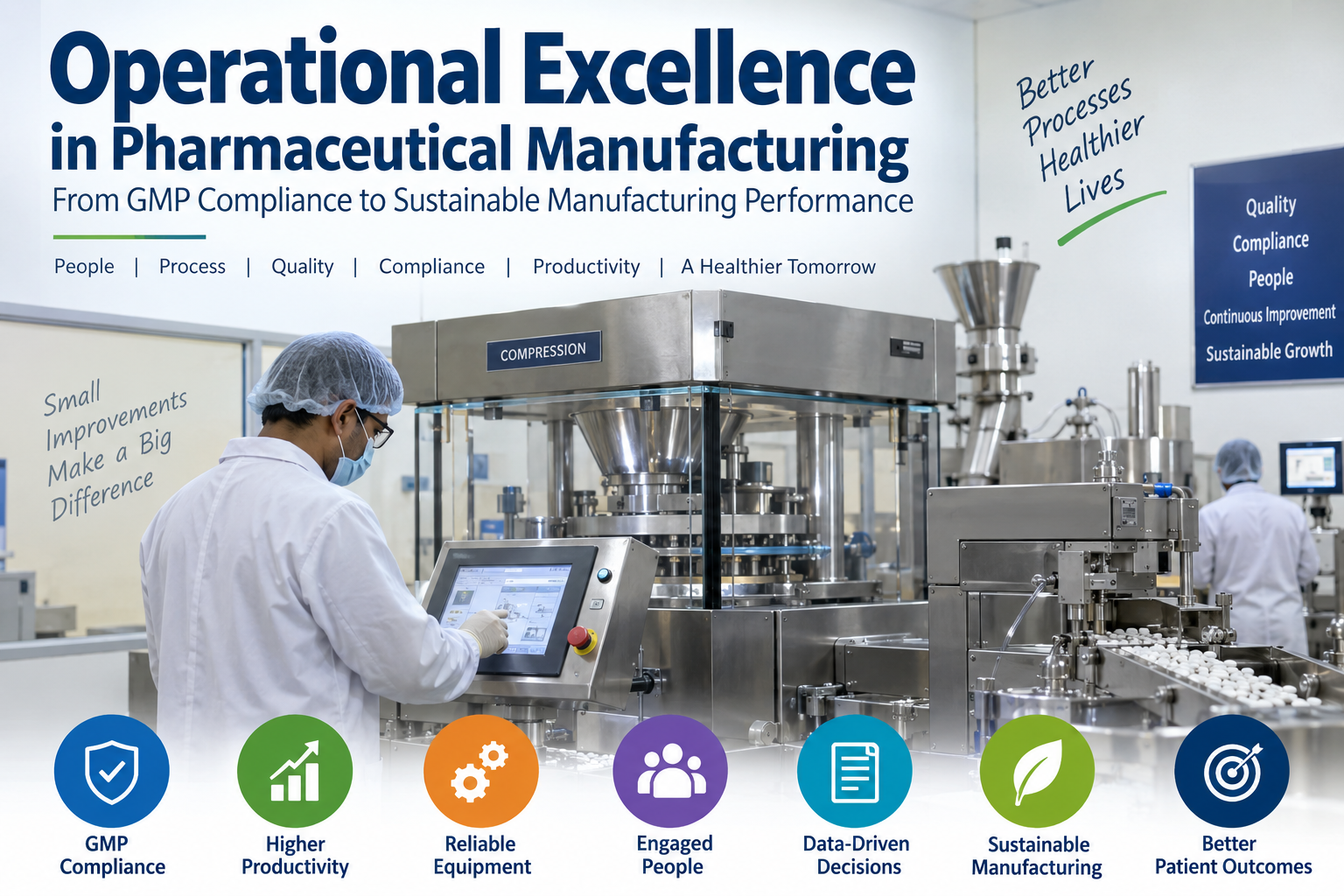
Operational Excellence in Pharmaceutical Manufacturing is not simply about producing more tablets, faster. It is about producing the right product, consistently, safely and compliantly, while making the manufacturing process more reliable, efficient and sustainable.
A production meeting can look perfectly normal on paper. The plan is available, materials are issued, operators are trained, equipment is qualified and the batch starts on time.
Then the problems begin.
The granulator takes longer than expected. Compression starts late because of a tooling issue. During compression, the machine stops several times for minor adjustments. A coating parameter drifts and the operator has to make an intervention. At the end of the batch, yield is below target. The batch record has documentation errors. QA raises questions during review. Engineering is called again for the same recurring breakdown.
None of these problems, taken individually, may look dramatic.
But when they happen repeatedly across hundreds of batches, they become a major manufacturing problem.
This is where Operational Excellence in Pharmaceutical Manufacturing becomes important.
Operational Excellence is about understanding the entire manufacturing system rather than trying to improve one isolated KPI. It connects GMP compliance, process capability, equipment reliability, people, productivity, quality, cost, data and continuous improvement.
For an Oral Solid Dosage (OSD) plant, this means looking beyond the question, “Did we manufacture the batch according to the BMR?”
The better questions are:
- Why did the batch take longer than planned?
- Why did we lose yield?
- Why did the same deviation happen again?
- Why did the compression machine stop repeatedly?
- Why does changeover take six hours when only two hours of actual cleaning is required?
- Why are operators spending so much time completing paperwork?
- Why are deviations remaining open for months?
- Why are utilities consuming more energy than expected?
- And most importantly, can we improve these areas without weakening GMP controls?
That last point is critical.
GMP is not an obstacle to Operational Excellence. Properly understood, it is one of its foundations. WHO describes GMP as a system intended to ensure that pharmaceutical products are consistently produced and controlled according to appropriate quality standards, with controls extending across materials, premises, equipment, personnel, production and documentation.
Operational Excellence builds on that foundation.
What Is Operational Excellence in Pharmaceutical Manufacturing?
There is no single regulatory definition of Operational Excellence.
In industry practice, it can be understood as a management approach in which an organization continuously improves the performance of its processes while maintaining product quality, patient safety, regulatory compliance and business sustainability.
A useful way of looking at it is:
Operational Excellence = Quality + Compliance + Reliability + Productivity + People + Data + Cost + Continuous Improvement
The important word is “together.”
Increasing production volume, a plant that also creates more deviations has not achieved Operational Excellence in Pharmaceutical Manufacturing.
Plants that cut maintenance costs while increasing equipment failures have not achieved Operational Excellence.
Such a plant that improves OEE by allowing operators to bypass controls has certainly not achieved Operational Excellence.
The objective is to improve the complete manufacturing system.
GMP is the foundation
Pharmaceutical manufacturing is different from many other industries because the final product is directly connected to patient safety.
A manufacturing process therefore cannot be optimized simply by removing every activity that appears to consume time.
For example, a line clearance may appear to be a delay when compared with a conventional manufacturing environment. But if the activity prevents mix-ups and confirms that the area is ready for the next product, it has a quality purpose.
The question is not:
“How can we eliminate line clearance?”
It is:
“How can we perform effective line clearance more efficiently, consistently and with less unnecessary waiting?”
That is an Operational Excellence mindset.
Operational Excellence vs Productivity Improvement
Productivity improvement is generally concerned with achieving more output from available resources.
Operational Excellence goes further.
Consider a compression machine.
Suppose a machine produces 1 million tablets during a shift instead of 850,000.
At first glance, this appears to be a productivity improvement.
But imagine that the increase happened because:
- inspection frequency was reduced without scientific justification,
- operators ignored minor quality signals,
- rejected tablets were mixed into good output,
- documentation was completed later from memory,
- machine parameters were adjusted without proper controls.
The production number may look impressive, but the manufacturing system has become less controlled.
That is not Operational Excellence.
A better improvement could involve:
- reducing avoidable minor stoppages,
- improving feeder performance,
- optimizing tooling condition,
- improving preventive maintenance,
- standardizing machine setup,
- reducing unnecessary waiting between activities,
- improving operator troubleshooting capability,
- using trend data to identify recurring causes.
The output may increase, but the process remains controlled.
This distinction is particularly important in GMP manufacturing.
The Core Pillars of Pharmaceutical Operational Excellence
Operational Excellence normally rests on several interconnected pillars.
| Pillar | Practical objective |
|---|---|
| Quality | Consistent product meeting specifications |
| GMP Compliance | Reliable adherence to approved requirements |
| Process Capability | Stable and predictable processes |
| Equipment Reliability | Fewer failures and unplanned stoppages |
| People | Skilled, engaged and accountable teams |
| Productivity | Better utilization of time and resources |
| Cost | Reduction of avoidable manufacturing losses |
| Data | Reliable information for decision-making |
| Digitalization | Better visibility and control |
| Continuous Improvement | Sustained improvement rather than one-time projects |
These pillars should not be managed independently.
For example, poor equipment reliability can cause production delays. Production delays can create schedule pressure. Schedule pressure can increase the likelihood of human error. Errors can generate deviations. Deviations can delay batch release. Delayed release affects inventory and customer supply.
One problem can therefore travel through the entire manufacturing system.
That is why Operational Excellence requires a cross-functional approach.
Operational Excellence on the Pharmaceutical Shop Floor
The real test of Operational Excellence is not the presentation made to senior management.
It is what happens at 10:30 a.m. on the manufacturing floor when a batch is running and something goes wrong.
Consider an OSD manufacturing process:
Dispensing → Granulation → Drying → Milling → Blending → Compression → Coating → Packing
There are opportunities for loss at every stage.
In granulation, losses may arise from:
- incorrect charging sequence,
- excessive granulation time,
- poor endpoint control,
- equipment loading issues,
- transfer losses,
- cleaning delays.
In compression:
- feeder problems,
- tooling wear,
- machine stoppages,
- weight variation,
- hardness issues,
- sticking or picking,
- high rejection,
- slow machine setup.
During coating:
- spray-gun blockage,
- improper atomization,
- coating pan speed variation,
- inlet air problems,
- excessive drying time,
- appearance defects,
- repeated interventions.
The Operational Excellence approach is to identify where the actual loss is occurring rather than simply asking operators to “work faster.”
Improving OEE in Pharmaceutical Manufacturing
Overall Equipment Effectiveness (OEE) is widely used to understand equipment performance.
The conventional calculation is:
OEE = Availability × Performance × Quality
Availability
Availability reflects the amount of planned production time during which equipment is actually available for production.
Typical losses include:
- breakdowns,
- changeover,
- setup,
- waiting for maintenance,
- waiting for materials,
- extended cleaning.
Performance
Performance considers whether the equipment is running at its expected operating rate.
Typical losses include:
- minor stoppages,
- reduced speed,
- machine adjustments,
- slow feeding,
- repeated operator interventions.
Quality
Quality reflects the proportion of acceptable output compared with total production output.
Quality losses include:
- rejection,
- scrap,
- defective tablets,
- rework,
- startup losses.
A practical OEE example
Imagine a tablet compression machine with:
- 480 minutes scheduled production time
- 60 minutes of downtime
- 420 minutes actual running time
- performance at 90% of theoretical rate
- quality rate of 98%
Availability:
420 / 480 = 87.5%
OEE:
87.5% × 90% × 98% = approximately 77.2%
Now imagine the plant team investigates the losses and discovers that 25 minutes of the downtime comes from repeated minor stoppages that had never been properly categorized.
After addressing the causes, suppose availability rises to 92.7%, while performance and quality remain unchanged.
The OEE becomes approximately:
92.7% × 90% × 98% = approximately 81.8%
The important point is not the exact percentage.
The important point is where the improvement came from.
The plant did not simply push operators to run the machine faster. It removed a source of avoidable loss.
A warning about OEE
OEE is useful, but it can also become misleading when treated as the primary objective.
If operators are pressured to maximize OEE at any cost, the wrong behaviors can appear:
- quality checks may be treated as delays,
- planned maintenance may be postponed,
- changeovers may be rushed,
- minor quality issues may be ignored,
- downtime categories may be manipulated.
OEE should therefore be treated as a diagnostic KPI, not the sole definition of manufacturing success.
Reducing Batch Losses, Rejections and Rework
A good manufacturing process does not depend on final inspection to discover problems.
The goal is to build quality into the process.
WHO GMP principles emphasize that quality should be consistently built into pharmaceutical manufacturing rather than relying only on testing of finished products.
This is where process understanding becomes important.
Suppose a tablet batch has repeated picking during compression.
A weak investigation might conclude:
“Operator cleaned punches and compression was restarted.”
The immediate problem may disappear, but the root cause remains.
A stronger investigation asks:
- Is granule moisture contributing?
- Is lubricant distribution consistent?
- Is compression force appropriate?
- Is tooling condition acceptable?
- Is the punch surface condition contributing?
- Is machine speed affecting the problem?
- Is environmental humidity relevant?
- Does the problem occur only with specific batches or formulations?
This is where RCA, FMEA, process monitoring and CAPA become useful.
ICH Q9(R1) provides a framework for quality risk management across the pharmaceutical lifecycle and specifically identifies tools such as FMEA as useful approaches. It also emphasizes that risk management should support, rather than replace, regulatory compliance.
Improving Yield and First-Time-Right Performance
Yield is one of the most visible manufacturing KPIs, but it should not be treated as a number that Production owns alone.
Yield losses can originate from:
- dispensing,
- transfer,
- granulation,
- drying,
- milling,
- blending,
- compression,
- coating,
- sampling,
- cleaning,
- handling.
For example, if compression rejection increases, the problem may actually originate much earlier in the process.
A change in granule characteristics may affect:
- flow,
- die filling,
- tablet weight,
- compression behavior,
- friability,
- hardness,
- ejection.
Therefore, yield improvement should begin with process understanding.
Right First Time
Right First Time (RFT) asks a simple but powerful question:
Did we get the process right without avoidable correction, rejection, rework or repeated intervention?
High RFT generally indicates a more stable process.
A plant can improve RFT by:
- identifying recurring failure modes;
- establishing meaningful process controls;
- improving operator training;
- reducing equipment variability;
- improving material control;
- strengthening standard work;
- investigating repeated deviations rather than treating each occurrence independently.
Changeover and Cleaning Optimization
Changeover is one of the most common sources of lost manufacturing capacity.
In an OSD facility, changeover may involve:
- batch completion;
- equipment shutdown;
- dismantling;
- cleaning;
- inspection;
- line clearance;
- documentation;
- equipment assembly;
- setup;
- tooling change;
- machine parameter verification;
- QA checks;
- startup verification.
Not all of these activities can simply be shortened.
Some are GMP controls.
The improvement opportunity is to understand which activities genuinely require time and which delays are created by poor planning.
SMED in pharmaceutical manufacturing
Single-Minute Exchange of Die (SMED) originated in manufacturing and focuses on reducing changeover time by separating internal and external activities.
In a pharmaceutical environment, the concept can be adapted carefully.
For example:
Before changeover
- prepare required tools,
- verify cleaning materials,
- stage approved documentation,
- prepare product-contact parts,
- check tooling availability,
- confirm equipment status.
During changeover
- perform approved cleaning,
- conduct required inspection,
- complete line clearance,
- perform setup activities.
After changeover
- verify equipment readiness,
- complete required checks,
- start the process according to approved procedures.
The key is that GMP controls are not removed simply to reduce time.
The process is redesigned so that necessary controls happen more efficiently.
Lean Manufacturing and Six Sigma in Pharma
Lean and Six Sigma are not pharmaceutical regulations.
They are improvement methodologies.
They can be used within a pharmaceutical quality system provided that improvements remain consistent with applicable GMP requirements, validated states, approved procedures and regulatory commitments.
Lean
Lean focuses on reducing activities that do not add value.
Common pharmaceutical examples include:
- unnecessary movement,
- waiting for materials,
- duplicate documentation,
- excess inventory,
- unnecessary approvals,
- repeated handling,
- long equipment setup,
- avoidable transportation.
Six Sigma
Six Sigma focuses more heavily on reducing process variation and defects using structured data analysis.
A typical DMAIC approach is:
Define → Measure → Analyze → Improve → Control
The two approaches can complement each other.
Lean may identify that operators wait 30 minutes for materials.
Six Sigma may then help determine whether the waiting is associated with warehouse response time, material staging, scheduling variability or another measurable factor.
The important thing is not the terminology.
The important thing is solving the actual problem.
TPM and Equipment Reliability
Equipment reliability is often underestimated until a major breakdown occurs.
A tablet press may be highly capable, but if it repeatedly stops for the same issue, its theoretical capacity means little.
Total Productive Maintenance (TPM) provides a structured approach to equipment ownership, preventive maintenance and reliability.
A strong reliability program typically includes:
- preventive maintenance,
- condition monitoring,
- lubrication management,
- critical spare management,
- breakdown analysis,
- calibration,
- equipment qualification,
- operator basic care,
- maintenance history,
- predictive maintenance where justified.
Predictive maintenance
Predictive maintenance can use equipment data to identify abnormal conditions before failure.
Potential signals include:
- vibration,
- temperature,
- motor current,
- pressure,
- cycle count,
- lubrication condition,
- operating hours.
However, predictive maintenance should not become a technology project without a clear business or reliability problem.
Sometimes a basic preventive-maintenance improvement solves the issue more effectively.
Quality and Operational Excellence Must Work Together
This is probably the most important principle in pharmaceutical Operational Excellence.
Quality cannot be separated from manufacturing performance.
ICH Q10 describes a pharmaceutical quality system covering the product lifecycle and includes concepts such as process performance and product quality monitoring, corrective and preventive action, change management and continual improvement.
Operational Excellence therefore needs close integration with:
- Deviations
- CAPA
- Change Control
- RCA
- Risk Management
- Validation
- Continued Process Verification
- Product Quality Review/APQR
- Training
- Data Integrity
Deviations
A deviation is not simply a documentation burden.
A well-managed deviation system provides valuable information about where the process is failing.
If ten deviations occur over twelve months and all are investigated separately, the plant may miss the common pattern.
A stronger approach is to trend deviations by:
- equipment,
- product,
- process step,
- failure mode,
- shift,
- department,
- root cause,
- material,
- operator intervention.
That trend can reveal a systemic problem.
CAPA effectiveness
Closing a CAPA is not the same as solving a problem.
For example:
Problem: repeated compression machine stoppages.
Weak CAPA: retrain operators.
Better CAPA: investigate machine history, identify mechanical failure mode, correct equipment condition, review preventive maintenance, update troubleshooting guidance where appropriate and verify recurrence over subsequent batches.
Training may be part of the solution, but it should not automatically become the root-cause answer.
Validation
Operational Excellence cannot justify uncontrolled changes to validated processes.
FDA’s process validation guidance describes process validation as a lifecycle activity and includes continued process verification as part of maintaining process control.
Therefore, process improvements should be evaluated through the site’s established change-control, risk-assessment and validation systems.
People: The Most Important Element
It is easy to say that people are the most important asset in manufacturing.
The harder question is whether the plant actually behaves that way.
Operators often know where the process loses time.
They know:
- which machine takes longest to clean,
- which component fails repeatedly,
- which material causes problems,
- which alarm appears before a breakdown,
- which step in the BMR causes confusion,
- where waiting occurs,
- where unnecessary movement happens.
Yet many improvement programs are designed without asking them.
That is a missed opportunity.
Practical operator involvement
A useful Kaizen discussion can begin with:
“What is the most frustrating recurring problem in this process?”
The answers can be surprisingly practical.
One operator may point out that a particular tool is always stored in another room.
Another may explain that a cleaning component is difficult to dismantle.
A technician may know that a recurring breakdown occurs because a particular bearing is being replaced too late.
A QA officer may identify a documentation step that repeatedly generates review comments.
These observations can lead to meaningful improvements.
Training is equally important.
Employees need to understand not only what to do but why the control exists.
Digital Transformation and Pharma 4.0
Digitalization can significantly support Operational Excellence, but technology should follow process understanding.
A plant with a poorly designed process does not automatically become efficient because it installs software.
A practical digital ecosystem may include:
| Technology | Potential Operational Excellence contribution |
|---|---|
| MES | Production execution and real-time visibility |
| eBMR | Electronic batch documentation |
| SCADA/HMI | Equipment monitoring and control |
| LIMS | Laboratory workflow and data management |
| eQMS | Deviations, CAPA, change control and quality workflows |
| eDMS | Controlled documentation |
| SAP | Materials, planning, inventory and enterprise data |
| Analytics | Trend identification and performance analysis |
| AI | Pattern detection, forecasting and decision support |
| Predictive maintenance | Early identification of equipment deterioration |
MES and eBMR
Electronic manufacturing systems can reduce manual transcription and provide better visibility of production status.
But implementation should begin with process mapping.
If the existing paper process contains unnecessary approvals, duplicate entries or poorly defined responsibilities, simply converting the paper form into an electronic screen may digitize the inefficiency.
SCADA and HMI
SCADA/HMI systems can provide useful information about:
- equipment status,
- alarms,
- operating parameters,
- downtime,
- process trends.
The value increases when the data can be connected to meaningful performance analysis.
Data Integrity and ALCOA+
Operational Excellence depends on reliable data.
When downtime data is inaccurate, the improvement team may target the wrong problem.
When batch documentation is incomplete, management may misunderstand process performance.
When laboratory data cannot be trusted, quality decisions become questionable.
FDA’s data-integrity guidance states that CGMP data should be reliable and accurate and describes risk-based approaches to preventing and detecting data-integrity problems.
The ALCOA+ principles are therefore relevant not only to QA.
They support operational decision-making.
Data should be:
- Attributable
- Legible
- Contemporaneous
- Original
- Accurate
with additional expectations commonly described as:
- Complete
- Consistent
- Enduring
- Available
A plant cannot become genuinely data-driven if the underlying data is poor.
Data-Driven Manufacturing
Many pharmaceutical plants already possess enormous quantities of data.
The challenge is converting data into useful information.
For example, a production team could analyze the previous 12 months of compression data and discover:
- 35% of downtime occurs on one machine;
- most minor stoppages occur during a particular product family;
- rejection increases after a certain operating duration;
- one shift has significantly more interventions;
- breakdowns are concentrated around a particular component.
The next question should be:
Why?
Data should lead to investigation, not merely another dashboard.
Useful manufacturing analytics
Plant teams can trend:
- recurring downtime,
- batch delays,
- repeated deviations,
- material-related issues,
- equipment failures,
- yield losses,
- rejection,
- changeover time,
- cleaning time,
- energy consumption,
- maintenance cost,
- batch-release delays.
Common Mistakes in Operational Excellence Programs
Several mistakes repeatedly appear when improvement programs are implemented.
1. Focusing only on OEE
OEE is useful, but it does not represent the entire manufacturing system.
Quality, compliance, cost, people and schedule performance also matter.
2. Too many KPIs
When everything is a KPI, nothing receives enough attention.
Plants should identify a small number of meaningful measures linked to business and quality objectives.
3. Poor data quality
Bad downtime classification creates bad analysis.
4. Treating Lean as cost cutting
Lean is about removing waste and improving flow, not simply reducing headcount or maintenance spending.
5. Ignoring operators
People closest to the process often have the best practical understanding of recurring problems.
6. Weak RCA
“Operator error” is frequently used as a convenient endpoint.
But why did the operator make the error?
Was the procedure unclear? Was the interface poorly designed? Was training inadequate? Was the alarm confusing? Was there excessive workload?
7. Closing CAPAs without addressing systemic causes
A CAPA should reduce recurrence, not merely close a record.
8. Poor cross-functional ownership
Production cannot solve every manufacturing problem alone.
9. Technology before process improvement
Automation does not automatically correct poor process design.
10. Chasing short-term numbers
A plant may temporarily improve output by postponing maintenance or reducing planned activities. The consequences may appear later.
Sustainable Operational Excellence requires a longer view.
Practical Operational Excellence KPI Dashboard
A balanced dashboard should combine productivity, quality, reliability, compliance and cost.
| KPI | What It Measures | Why It Matters | Typical Improvement Approach |
|---|---|---|---|
| OEE | Overall equipment effectiveness | Shows equipment losses | Loss-tree analysis, TPM, setup improvement |
| Yield | Material/output efficiency | Identifies process losses | Process optimization, loss analysis |
| RFT | Batches/processes completed correctly first time | Shows process stability | RCA, standardization, training |
| Batch cycle time | Time from start to completion | Impacts capacity and release | Process mapping, bottleneck removal |
| Downtime | Lost production time | Indicates reliability problems | Breakdown analysis, TPM |
| Changeover time | Time required between products/batches | Affects available capacity | SMED, staging, standard work |
| Rejection | Material/product rejected | Impacts quality and cost | Process capability, RCA |
| Rework | Work requiring correction | Indicates process inefficiency | Preventive controls, CAPA |
| Deviation rate | Number/frequency of deviations | Indicates process control | Trending, risk assessment |
| CAPA effectiveness | Whether CAPAs prevent recurrence | Tests corrective action quality | Effectiveness checks, systemic RCA |
| Schedule adherence | Actual vs planned production | Shows planning/execution performance | Scheduling and material coordination |
| Energy consumption | Energy used per batch/unit | Supports cost and sustainability | Utility monitoring, optimization |
| Cost per batch | Manufacturing cost | Links operations to business performance | Loss reduction, productivity improvement |
The dashboard should not become a wall of numbers.
Each KPI should have an owner, target or expectation where appropriate, trend, action threshold and defined response.
Practical Roadmap for Implementing Operational Excellence
Operational Excellence should not begin with a large transformation program.
Start with the problems that matter.
Stage 1 – Assess
Understand current performance.
Review:
- production performance,
- quality trends,
- downtime,
- deviations,
- CAPA,
- maintenance,
- yield,
- changeovers,
- energy,
- batch release.
Stage 2 – Identify Losses
Create a loss tree.
For example:
Compression loss
→ Breakdown
→ Minor stoppage
→ Speed loss
→ Setup
→ Changeover
→ Rejection
→ Waiting
This is more useful than simply reporting low OEE.
Stage 3 – Prioritize
Do not attempt to solve everything simultaneously.
Prioritize based on:
- patient/product quality risk,
- frequency,
- business impact,
- capacity impact,
- cost,
- recurrence,
- ease of improvement.
Stage 4 – Root Cause Analysis
Use appropriate tools:
- 5 Why,
- Fishbone,
- FMEA,
- Pareto,
- process mapping,
- trend analysis,
- statistical analysis.
The tool should match the problem.
Stage 5 – Implement Improvements
Possible actions include:
- equipment modification,
- standard work,
- training,
- preventive maintenance changes,
- material staging,
- process optimization,
- digitalization,
- layout improvement,
- changeover redesign.
Where required, use formal change control and validation processes.
Stage 6 – Verify Results
Do not declare victory immediately after implementation.
Monitor subsequent batches.
Ask:
- Did the problem recur?
- Did quality remain stable?
- Did the improvement create a new problem?
- Did the KPI actually improve?
Stage 7 – Standardize
Once proven:
- update SOPs where appropriate,
- update training,
- revise standard work,
- update maintenance practices,
- document lessons learned.
Stage 8 – Sustain
Sustainability requires:
- regular review,
- visual management,
- trend analysis,
- management review,
- employee involvement,
- periodic audits,
- continuous improvement.
Realistic OSD Manufacturing Case Study
Note: The following case study is fictional and illustrative. It is not based on confidential company information. The numerical improvements are hypothetical examples intended to demonstrate the improvement methodology.
The Problem
An OSD facility is experiencing problems in a tablet compression area.
The plant reports:
- frequent minor stoppages,
- lower-than-desired OEE,
- elevated tablet rejection,
- long changeover time,
- repeated equipment-related deviations.
Management initially asks Production to improve machine utilization.
Instead of immediately increasing machine speed, a cross-functional team is formed involving:
- Production,
- QA,
- Engineering,
- Maintenance,
- Validation,
- Warehouse,
- Process/Technical team.
Step 1: Data Collection
The team reviews three months of production data.
The analysis shows that downtime is not dominated by one major breakdown.
Instead, many small events are responsible:
- feeder adjustment,
- tooling replacement,
- sensor alarms,
- material waiting,
- cleaning delays,
- setup adjustments.
This is important.
The machine does not have one big problem.
It has many small problems.
Step 2: RCA
The team performs Pareto analysis.
The largest recurring loss is linked to feeder-related stoppages.
Further investigation identifies:
- inconsistent preventive-maintenance checks,
- variation in setup practices,
- delayed replacement of worn components,
- differences in operator adjustment methods.
Step 3: Corrective Actions
The team introduces:
- standardized setup instructions;
- improved pre-start inspection;
- defined component-condition checks;
- operator training;
- maintenance frequency review;
- spare-component availability;
- standardized downtime coding;
- daily review of recurring stoppages.
No GMP control is removed.
Where changes affect validated or approved processes, the site’s established change-control and qualification/validation procedures are followed.
Step 4: Changeover Improvement
The team maps the changeover process.
They discover that several activities were being performed sequentially even though some could be prepared in advance.
Examples include:
- tooling availability check,
- cleaning-material preparation,
- documentation preparation,
- spare-part staging.
After review, activities that can legitimately be performed before the machine becomes available are moved outside the internal changeover window.
Illustrative Results
After several production cycles, the hypothetical site observes:
| Measure | Before | Illustrative After |
|---|---|---|
| OEE | 72% | 81% |
| Changeover | 240 min | 175 min |
| Minor stoppages/batch | 14 | 7 |
| Rejection | 2.8% | 1.6% |
| Equipment-related deviations | 6/quarter | 2/quarter |
| Schedule adherence | 86% | 94% |
These figures are illustrative, not industry benchmarks.
The more important result is that the improvement came from multiple connected actions rather than one isolated intervention.
Step 5: Sustainment
The site then introduces:
- daily loss review,
- weekly reliability review,
- monthly KPI trend review,
- periodic RCA of recurring issues,
- operator feedback,
- maintenance trend monitoring.
This converts a one-time project into a management system.
Sustainable Manufacturing and Cost Optimization
Operational Excellence increasingly needs to include sustainability.
There is a direct connection between waste reduction and environmental performance.
Every unnecessary:
- machine running hour,
- rejected batch component,
- repeated cleaning cycle,
- water usage,
- HVAC load,
- compressed-air leak,
- steam loss,
- material movement,
has both a cost and potentially an environmental impact.
Utilities
OSD manufacturing can consume significant utilities through:
- HVAC,
- compressed air,
- chilled water,
- purified water,
- steam,
- dust extraction,
- process equipment,
- facility operation.
Utility optimization must remain within engineering, GMP and environmental requirements.
The objective is not simply to reduce consumption.
It is to remove unnecessary consumption while maintaining required process conditions.
For example, compressed-air leakage is a classic engineering loss. Correcting leaks can reduce energy use without affecting product quality.
Similarly, optimizing equipment idle time may reduce energy consumption if the operating strategy remains consistent with approved procedures and facility requirements.
Operational Excellence and Management Culture
Operational Excellence eventually becomes a leadership issue.
If management asks only:
“Did we meet the production target?”
teams will naturally focus on production output.
If management asks:
“Did we meet the production target, what quality losses occurred, what recurring problems did we eliminate, and what risks remain?”
the organization begins to think differently.
A mature plant review may therefore include:
Safety → Quality → Compliance → Supply → Productivity → Reliability → Cost → People → Improvement
The exact order may differ by organization, but the principle remains: manufacturing performance should not be viewed through one number.
The Future of Operational Excellence in Pharma Manufacturing
Pharmaceutical manufacturing is moving toward more connected and data-rich operations.
Several technologies are likely to become increasingly important.
Artificial Intelligence
AI can potentially help identify patterns across:
- equipment data,
- batch history,
- deviations,
- maintenance records,
- laboratory data,
- process parameters.
For example, an AI system could identify that certain equipment conditions frequently precede a breakdown.
But AI does not automatically understand GMP requirements or manufacturing context.
Human review, appropriate validation, data governance and defined decision boundaries remain important.
Predictive Analytics
Predictive analytics can help forecast:
- equipment failures,
- maintenance needs,
- process drift,
- material requirements,
- production delays.
Digital Twins
Digital twins may eventually provide more detailed simulation of manufacturing processes and equipment performance.
Their value will depend on the quality of underlying models and data.
Smart Manufacturing
Connected equipment, sensors, MES, analytics and enterprise systems can provide a more complete picture of manufacturing performance.
But the basic principle remains unchanged:
Good digital manufacturing starts with a good manufacturing process.
Technology should solve a defined problem.
It should not be installed simply because it is available.
Operational Excellence is a Management System, Not a Project
One of the biggest mistakes is treating Operational Excellence as a project with a start date and end date.
A Kaizen event may finish.
A Six Sigma project may finish.
A digital implementation may finish.
But manufacturing does not finish.
There will always be:
- new products,
- new equipment,
- new employees,
- new regulations,
- new suppliers,
- new process risks,
- new customer requirements,
- new business pressures.
The plant therefore needs a management system that continuously asks:
What is happening?
Why is it happening?
What is the risk?
What can we improve?
Did the improvement actually work?
How do we sustain it?
That is the heart of Operational Excellence.
Conclusion
Operational Excellence in Pharmaceutical Manufacturing is not about producing more at any cost.
It is about creating a manufacturing operation where quality, GMP compliance, process capability, equipment reliability, productivity, people, data and cost are managed together.
The strongest improvements are often not dramatic.
They may be as simple as eliminating a recurring machine stoppage, improving material staging, reducing unnecessary waiting, standardizing a setup activity, correcting a recurring root cause, improving maintenance, reducing documentation errors or involving operators in solving a problem they have been dealing with for years.
These small improvements accumulate.
A stable process produces fewer deviations.
A reliable machine creates more predictable capacity.
Better process control improves yield.
Better documentation supports faster review.
Better data improves decision-making.
Better employee involvement creates stronger ownership.
And when these improvements are connected, the plant becomes more predictable.
That is what Operational Excellence should ultimately deliver:
A pharmaceutical manufacturing operation that consistently makes quality product, protects the patient, meets GMP expectations, uses its resources responsibly, and continuously gets better.
Operational Excellence is therefore not a one-time productivity initiative.
It is a way of managing pharmaceutical manufacturing.
Frequently Asked Questions
1. What is Operational Excellence in pharmaceutical manufacturing?
Operational Excellence is a structured approach to improving pharmaceutical manufacturing performance while maintaining product quality, GMP compliance, safety and regulatory requirements. It combines process improvement, equipment reliability, people, data, productivity and cost management.
2. How is Operational Excellence different from Lean Manufacturing?
Lean Manufacturing is an improvement methodology focused largely on identifying and reducing waste. Operational Excellence is broader. It incorporates Lean along with quality, GMP compliance, reliability, people, data, productivity, cost and continuous improvement.
3. How can OEE be improved in pharmaceutical manufacturing?
OEE can be improved by identifying losses in availability, performance and quality. Common actions include reducing unplanned downtime, addressing minor stoppages, improving changeovers, improving equipment reliability and reducing rejection.
OEE should not be improved by weakening GMP controls.
4. How can Operational Excellence improve GMP compliance?
Operational Excellence can strengthen GMP by improving process consistency, equipment reliability, documentation, deviation management, CAPA effectiveness, training, data integrity and risk management.
The objective is to make compliant processes more reliable and efficient, not to remove required controls.
5. What KPIs should pharma plants monitor?
A balanced dashboard can include OEE, yield, RFT, batch cycle time, downtime, changeover time, rejection, rework, deviation trends, CAPA effectiveness, schedule adherence, energy consumption and cost per batch.
The exact KPI set should reflect the site’s products, processes and business objectives.
6. How does AI support Operational Excellence?
AI can help analyze large amounts of manufacturing data, identify patterns, support predictive maintenance, detect unusual trends and assist decision-making. AI should not be treated as a replacement for GMP systems, process knowledge or human accountability.
7. What role does employee engagement play?
Operators, technicians and supervisors often understand practical process problems that may not be obvious from reports. Involving them in problem-solving can improve the quality and practicality of improvement initiatives.
8. Why do Operational Excellence programs fail?
Common reasons include poor leadership support, unreliable data, excessive KPIs, weak root-cause analysis, lack of operator involvement, poor cross-functional ownership, treating Lean as cost cutting and implementing technology before understanding the underlying process.
9. How can Operational Excellence reduce manufacturing costs?
Cost can be reduced by eliminating avoidable downtime, reducing rejection and rework, improving yield, shortening changeovers, reducing unnecessary material movement, improving equipment reliability, optimizing utilities and reducing recurring deviations.
Cost reduction should not compromise quality or GMP compliance.
10. How can a pharmaceutical company start its Operational Excellence journey?
Start with a focused assessment of current performance. Identify the largest recurring losses, collect reliable data, prioritize problems based on risk and business impact, perform appropriate RCA, implement controlled improvements, verify results and standardize successful practices.
Starting with one production area or one significant recurring loss is often more practical than launching a large site-wide program immediately.
References
U.S. FDA – Process Validation: General Principles and Practices
FDA’s guidance provides the framework for process validation and lifecycle process understanding, including continued process verification.
FDA Process Validation GuidanceU.S. FDA – Data Integrity and Compliance With Drug CGMP
Useful reference for understanding reliable and accurate CGMP data and risk-based approaches to data integrity.
FDA Data Integrity GuidanceWHO – Good Manufacturing Practices
WHO explains the role of GMP in ensuring pharmaceutical products are consistently produced and controlled to appropriate quality standards.
WHO Good Manufacturing PracticesICH Q9(R1) – Quality Risk Management
Provides the international framework for applying quality risk management, including FMEA and risk-based decision-making across the pharmaceutical lifecycle. The current version became effective on July 26, 2023.
EMA/ICH Q9 Quality Risk ManagementICH Q10 – Pharmaceutical Quality System
Provides the pharmaceutical quality-system framework covering the product lifecycle, knowledge management, change management and continual improvement.
EMA/ICH Q10 Pharmaceutical Quality System
About the Author
Ramesh Palav
Ramesh Palav is a pharmaceutical manufacturing professional with extensive experience in Oral Solid Dosage (OSD) manufacturing, tablet production, GMP compliance, qualification and validation, quality systems, process improvement and manufacturing operations.
His professional interests include pharmaceutical manufacturing excellence, GMP, operational excellence, process optimization, equipment reliability, digital transformation, Pharma 4.0, data integrity and the practical application of continuous improvement principles within regulated pharmaceutical environments.
Through Pharma Manufacturing Hub, he shares practical knowledge and industry-focused resources covering pharmaceutical manufacturing, GMP, quality systems, technology, operational excellence and professional development.
Pharma Manufacturing Hub is intended to provide useful, practical information for pharmaceutical manufacturing professionals, young engineers and pharmacists, QA/QC teams, Production professionals, Engineering and Validation teams, and others working across the pharmaceutical industry.