
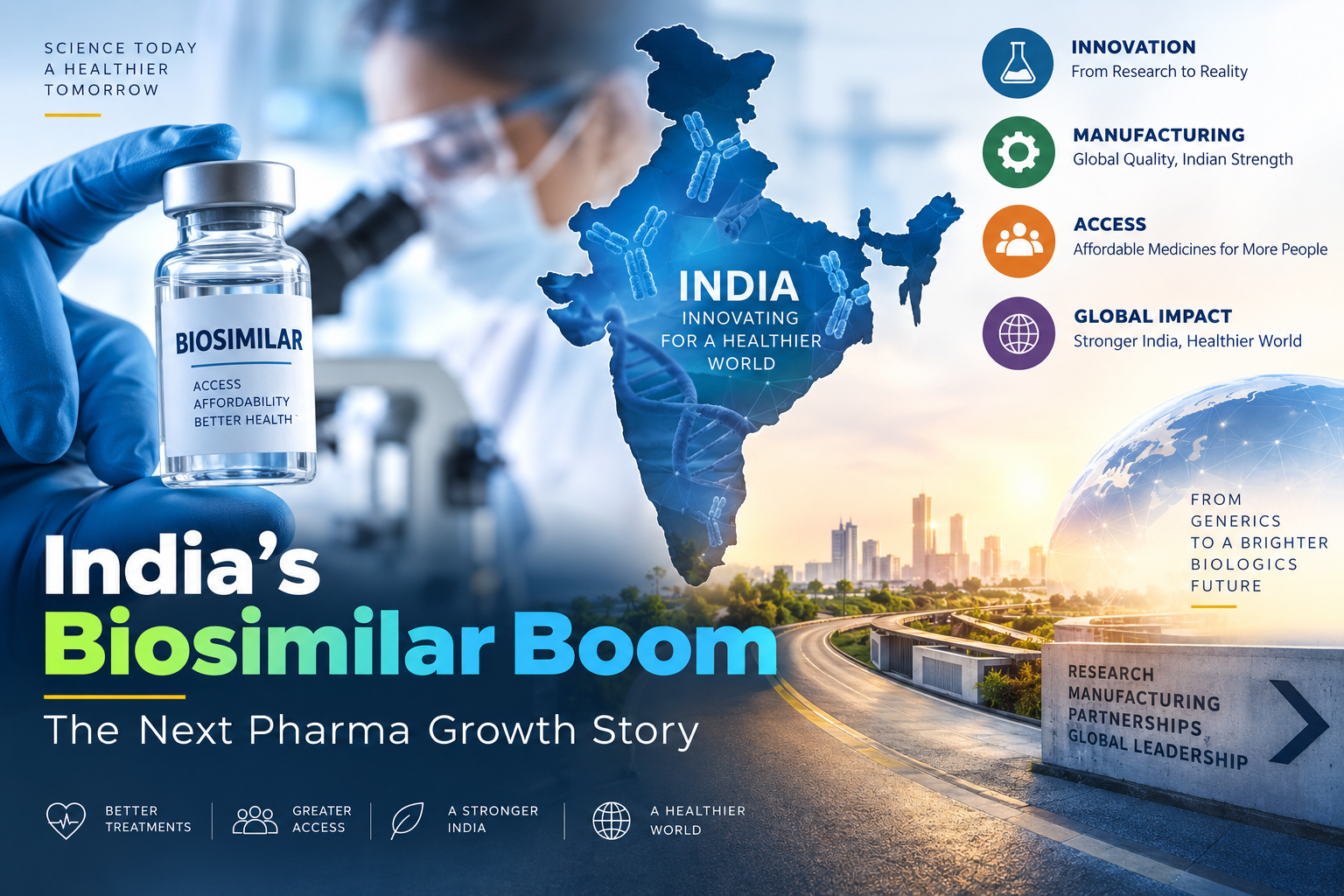
India’s pharmaceutical story has largely been built on generics. For decades, Indian companies have earned global recognition by making quality medicines more affordable and accessible.
But the next chapter could look very different.
The industry is moving steadily from traditional generics toward complex generics, biologics, biosimilars, specialty medicines and advanced therapies. And among these, biosimilars could become one of the most important growth opportunities for Indian pharmaceutical companies.
The timing is particularly interesting.
Drugs generating around US$142 billion in annual sales in 2025 are expected to lose exclusivity between 2026 and 2030, according to CareEdge Ratings. After accounting for price erosion, the resulting global opportunity could exceed US$30–40 billion, with Indian companies potentially capturing around US$3–5 billion. More than 60% of the products approaching loss of exclusivity are large-molecule biologics.
This is not simply another generic-drug opportunity.
As a result, it signals a shift in the capabilities expected of Indian pharma.
From Generics to Biologics
Traditional generic medicines are predominantly based on chemically synthesized small molecules.
Biologics are different.
Their manufacturing involves living cells or biological systems and requires highly controlled processes, sophisticated analytical characterization, specialized facilities and stringent quality systems.
A biosimilar is not simply a cheaper copy of a biologic.
The manufacturer must demonstrate a high degree of similarity to the reference biological product without clinically meaningful differences in safety, purity and efficacy.
That makes biosimilar development considerably more complex than conventional generic development.
And this complexity is precisely where the opportunity lies.
Indian companies that can successfully combine science, manufacturing capability, regulatory expertise and cost competitiveness could establish a much stronger position in global biopharma.
India Already Has a Strong Foundation
Nevertheless, India is not starting from zero.
Moreover, the country has built significant capabilities in:
- Vaccines
- Recombinant proteins
- Monoclonal antibodies
- Insulin and insulin analogues
- Biosimilars
- Fermentation
- Bioprocessing
- Clinical development
- Pharmaceutical manufacturing
- Global regulatory submissions
India’s biopharmaceutical ecosystem is also expanding.
According to the India Bioeconomy Report 2026, India’s biotherapeutics segment increased from US$21.4 billion in 2024 to US$24.36 billion in 2025, while biosimilars increased from US$12.84 billion to US$14.77 billion.
This indicates that biologics are becoming an increasingly important part of India’s broader life-sciences economy.
The Government Is Signalling a Bigger Ambition
The policy direction is also changing.
Under the Biopharma SHAKTI initiative announced in Budget 2026–27, the government proposed an outlay of ₹10,000 crore to strengthen domestic production of biologics and biosimilars, alongside measures aimed at expanding clinical research and biopharmaceutical capabilities.
The initiative envisages strengthening India’s capabilities in:
Research → Clinical Development → Manufacturing → Regulation → Global Commercialisation
The government has also stated an ambition linked to the development and launch of 100 biologics by 2047.
That signals something bigger than a short-term market opportunity.
It suggests an attempt to build a complete Indian biopharma ecosystem.
The Patent Cliff Could Accelerate the Opportunity
One of the biggest catalysts for biosimilars is the upcoming patent-expiry cycle.
When major biologic medicines lose exclusivity, pharmaceutical companies around the world begin preparing biosimilar versions.
This creates opportunities—but also intense competition.
Indian companies will have to compete with manufacturers from Europe, South Korea, China, the United States and other emerging biopharma markets.
The advantage cannot simply be lower cost.
The winners will increasingly need to demonstrate:
Cost + Quality + Regulatory Reliability + Speed + Scale
That is a much higher bar.
Why Biosimilars Are Different From Traditional Generics
A conventional generic can generally be demonstrated to be chemically equivalent to its reference medicine.
With biologics, the molecule is much more complex.
Small changes in:
- Cell line
- Culture conditions
- Purification
- Manufacturing process
- Storage
- Formulation
can potentially influence the final product.
This makes process consistency extremely important.
In biosimilars, manufacturing is not just a production activity.
The process itself becomes a critical part of the product.
That means Indian companies will need strong process-development capabilities, analytical laboratories, quality-by-design approaches, process validation and robust technology-transfer systems.
Manufacturing Will Become a Major Differentiator
The next phase of India’s biosimilar growth will require significant investment in manufacturing infrastructure.
This includes:
- Upstream bioprocessing
- Downstream purification
- Single-use technologies
- Bioreactors
- Chromatography systems
- High-end analytical laboratories
- Sterile fill-finish
- Cold-chain infrastructure
- Automated manufacturing systems
- Digital batch records
- Advanced quality-control systems
The shift toward biologics therefore creates opportunities far beyond pharmaceutical companies themselves.
It can benefit the broader ecosystem of:
Equipment suppliers + CDMOs + CROs + analytical laboratories + engineering companies + packaging companies + cold-chain providers + technology companies
This is where the multiplier effect becomes interesting.
CDMOs Could Be Big Winners
Global pharmaceutical companies increasingly want flexible manufacturing partners.
Recent industry commentary points to improving CDMO order inflows, supported by outsourcing, recovery in biotech funding and greater demand for integrated development and manufacturing capabilities.
For India, this creates a significant opportunity.
Instead of competing only by launching their own biosimilars, Indian companies can also become development and manufacturing partners for global innovators and biotech companies.
The future CDMO model is likely to move beyond simply manufacturing a customer’s product.
Customers increasingly want partners who can support:
Development → Scale-up → Clinical Supply → Regulatory Support → Commercial Manufacturing
This creates a much deeper and more valuable relationship.
India’s Real Advantage: Cost Plus Capability
For many years, India’s pharmaceutical advantage was primarily associated with manufacturing cost.
That advantage remains important.
But biologics are changing the equation.
Global customers increasingly want cost-efficient manufacturing without compromising quality or regulatory confidence.
India’s opportunity therefore lies in combining its traditional strengths with new capabilities.
The winning formula could be:
Indian Cost Competitiveness + Global Quality + Biologics Expertise + Regulatory Confidence
That combination could be extremely powerful.
But There Are Significant Challenges
The biosimilar opportunity should not be viewed through rose-coloured glasses.
Biologics require significant capital investment.
Development timelines can be long.
Clinical and analytical requirements are demanding.
Manufacturing facilities require sophisticated infrastructure.
Technology transfer can be complex.
And regulatory expectations continue to evolve.
There is also intense international competition.
Companies that enter the market without sufficient scale or scientific capability could struggle to generate attractive returns.
Therefore, the next phase of Indian pharma growth will require selective investment rather than simply building capacity.
Quality Will Decide Who Wins
This may be the most important point.
India’s future as a global biosimilar manufacturing hub will depend heavily on its ability to maintain consistent quality.
A single serious quality failure can damage not only a company but also confidence in an entire manufacturing ecosystem.
For this reason, Indian companies will need to strengthen:
- Data integrity
- Quality culture
- Process validation
- Supplier qualification
- Contamination control
- Analytical capability
- Technology transfer
- Deviation management
- CAPA effectiveness
- Regulatory readiness
The industry has already learned that quality cannot be inspected into a product—it has to be built into the process.
That principle becomes even more important with biologics.
Digital Manufacturing Will Become Critical
Biosimilar manufacturing is also likely to accelerate the adoption of Industry 4.0.
Advanced manufacturing environments will increasingly use:
- Process analytical technology
- Real-time monitoring
- Electronic batch records
- Manufacturing execution systems
- Predictive maintenance
- Automated process controls
- AI-assisted data analysis
- Digital quality management
The objective is not technology for technology’s sake.
The objective is process consistency and reproducibility.
In biologics manufacturing, even small process variations can matter.
Therefore, better data and better process control can directly translate into better manufacturing reliability.
India Could Move Up the Value Chain
The larger story is not simply about biosimilar sales.
It is about India’s position in global pharmaceutical value chains.
India has already demonstrated that it can manufacture large volumes of affordable medicines.
The next challenge is to demonstrate that it can also manufacture highly complex biological medicines at global standards.
That would represent a major step up the value chain.
Imagine an ecosystem where India can provide:
Discovery support → Cell-line development → Process development → Clinical manufacturing → Biosimilar development → Regulatory support → Commercial manufacturing → Global supply
That is a much bigger opportunity than traditional generic manufacturing.
What Will Separate the Winners From the Rest?
Over the next decade, I believe the strongest biosimilar companies will be those that can successfully combine five capabilities:
1. Scientific capability
Strong R&D and biologics expertise.
2. Manufacturing excellence
Highly reliable and scalable production systems.
3. Regulatory capability
Ability to navigate multiple global regulatory environments.
4. Commercial strength
Access to major markets and strong partnerships.
5. Quality culture
Quality embedded into every stage of the organisation.
Having only one or two of these capabilities will not be enough.
The Bigger Opportunity for India
India’s pharmaceutical industry is entering an interesting transition.
The old model was largely:
Generics → Scale → Cost Advantage
The emerging model is becoming:
Complex Products → Technology → Quality → Innovation → Global Partnerships
Biosimilars fit directly into this transformation.
India already has the manufacturing base, pharmaceutical talent and global market experience required to compete.
Now the opportunity is to build deeper capabilities in biological sciences, advanced manufacturing, clinical development and global regulatory execution.
If India succeeds, biosimilars could become one of the country’s most important pharmaceutical growth engines over the next decade.
The Next Pharma Story May Be Biological
The Indian pharmaceutical industry has spent decades proving that it can make medicines affordable.
The next challenge is to prove that it can also lead in complex biological medicines.
The coming patent-expiry wave, rising demand for affordable biologics, government support and increasing global outsourcing could create a powerful combination.
But the winners will not be those who simply build another manufacturing plant.
They will be the companies that build capability, quality, technology and trust.
India’s pharma journey is therefore moving into a new phase.
From generics to complex generics.
From APIs to advanced molecules.
From manufacturing to development and manufacturing partnerships.
And increasingly—
from traditional pharmaceuticals to biopharmaceuticals.
The biosimilar opportunity could be one of the most important chapters in India’s next pharmaceutical growth story.
The question is no longer whether India can participate in the global biologics revolution.
The real question is: How big a role can India play?
References
- Government of India — Biopharma SHAKTI
- Government of India — Biopharmaceuticals & Biosimilars
- India Bioeconomy Report 2026 — BIRAC
- Business Standard — Patent Expiry Opportunity for Indian Pharma
- Indian Pharmaceutical Alliance — India Pharma’s 2026 Outlook
About the Author
Ramesh Palav is a pharmaceutical industry professional and writer with a keen interest in pharma manufacturing, biopharmaceuticals, APIs, supply chains, Industry 4.0 and emerging trends shaping the global pharmaceutical industry. Through his articles, he shares practical industry insights and perspectives on the future of Indian pharma.