1. Introduction
Commissioning, Qualification and Validation (CQV) is a critical component of pharmaceutical facility and manufacturing-system lifecycle management. A well-designed CQV program provides documented evidence that facilities, utilities, equipment, processes and computerized systems are appropriately designed, installed, operated and capable of performing as intended.
Modern CQV should not be viewed simply as a collection of protocols and qualification reports. It is a lifecycle-based, science- and risk-based verification strategy that connects engineering, project execution, GMP, quality risk management, automation, validation and operational readiness.
This is particularly important in greenfield pharmaceutical projects, where hundreds of systems may need to move from design through construction, commissioning and qualification before commercial manufacturing begins. It is equally important in brownfield projects, where modifications must be introduced without compromising the qualified state of existing systems.
ASTM E2500 provides a lifecycle-oriented, science- and risk-based framework for specification, design and verification of pharmaceutical and biopharmaceutical manufacturing systems and equipment. The current ASTM listing identifies E2500-25 as the active edition and states that the approach applies across the system lifecycle from concept to retirement.
FDA’s process-validation guidance similarly emphasizes a lifecycle approach to process validation, while EU GMP Annex 15 requires manufacturers to determine the validation work needed to demonstrate control of critical aspects and states that risk assessment should be used to determine the scope and extent of validation.
The ultimate objective is straightforward:
Ensure that pharmaceutical systems are fit for intended use and remain in a controlled, qualified state throughout their lifecycle.
2. What Is CQV?
CQV consists of three closely connected disciplines:
Commissioning + Qualification + Validation
Although the activities overlap, each has a different purpose.
Commissioning
Commissioning is primarily an engineering and operational-readiness activity used to demonstrate that systems have been installed correctly, started successfully and function according to their design.
Typical commissioning activities include:
- Equipment startup
- Functional checks
- Instrument verification
- Calibration
- Loop checks
- Motor rotation checks
- Utility verification
- Control-system checks
- Alarm testing
- Interlock testing
- Functional performance testing
- System balancing
- Troubleshooting
- Punch-list closure
- Operational readiness verification
Qualification
Qualification provides documented evidence that a facility, utility, equipment or system is suitable for its intended use.
Typical qualification stages include:
DQ → IQ → OQ → PQ
Not every system necessarily requires identical qualification activities. The extent should be justified through the approved strategy, system impact, risk and applicable GMP requirements.
Validation
Validation provides documented evidence that a process, method, system or activity can consistently achieve predetermined requirements.
Examples include:
- Process validation
- Cleaning validation
- Computerized system validation
- Analytical method validation
- Packaging validation
- Hold-time validation
- Transport validation
- Continued process verification
3. CQV, Qualification and Validation – How They Fit Together
A useful way to understand CQV is:
Engineering proves that the system works.
Qualification proves that the system is suitable for its intended GMP use.
Validation proves that the process or operation consistently achieves its intended outcome.
These activities should not be treated as independent silos.
For example, consider a tablet coating machine.
Engineering may verify:
- Motor operation
- Spray-system operation
- Exhaust airflow
- Temperature control
- PLC functions
- Alarms
- Interlocks
Qualification may verify:
- Installation
- Materials of construction
- Critical operating ranges
- Control functions
- Alarm limits
- Product-contact surfaces
- Documentation
Process validation may then demonstrate that the manufacturing process consistently produces tablets meeting predefined quality requirements.
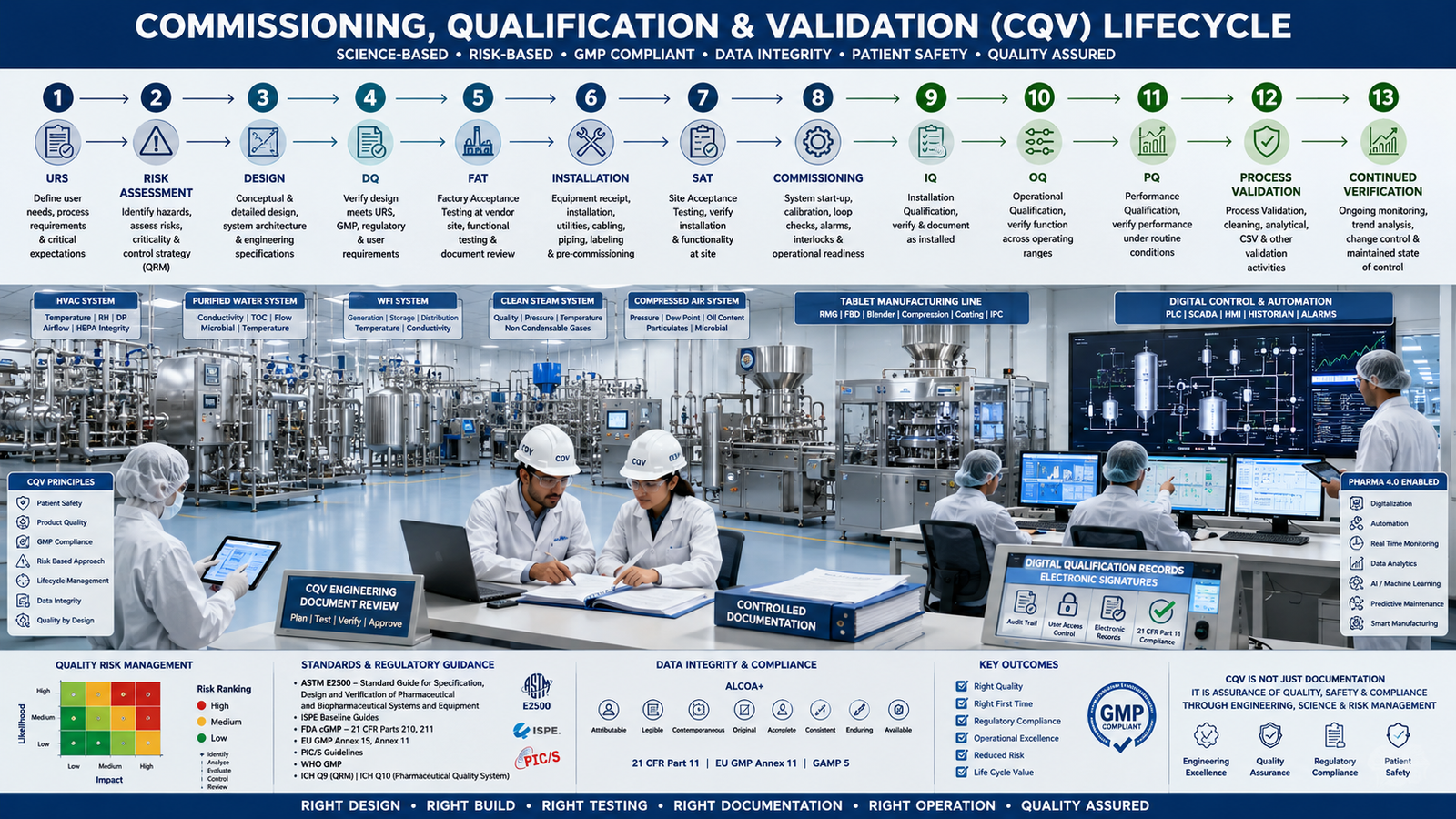
4. CQV Lifecycle
A typical CQV lifecycle can be represented as:
User Requirements
↓
Concept / Design
↓
Risk Assessment
↓
Design Qualification
↓
Procurement
↓
FAT
↓
Construction / Installation
↓
SAT
↓
Commissioning
↓
IQ
↓
OQ
↓
PQ
↓
Process Validation
↓
Continued Verification
↓
Maintained Qualified State
The exact sequence is not universal. Modern CQV programs should avoid forcing every system through an identical protocol sequence when engineering evidence, risk assessment and system criticality support a more appropriate approach.
ASTM E2500 explicitly covers new and existing manufacturing systems and allows the approach to be used for changes and continuous improvement throughout the system lifecycle.
CQV Lifecycle Table
| Stage | Objective | Key Activities | Typical Deliverables |
|---|---|---|---|
| URS | Define user needs | Process and GMP requirements | URS |
| Design | Develop suitable solution | Engineering/design review | Drawings/specifications |
| Risk Assessment | Identify critical risks | FMEA/impact assessment | Risk assessment |
| DQ | Confirm design suitability | Design review against requirements | DQ |
| FAT | Verify supplier-built system | Functional testing | FAT report |
| Installation | Confirm correct installation | Field inspection | Turnover package |
| SAT | Verify site installation/function | Site testing | SAT report |
| Commissioning | Establish operational readiness | Functional testing/startup | Commissioning records |
| IQ | Verify GMP-relevant installation | Installation/document review | IQ protocol/report |
| OQ | Verify operation | Functional/challenge testing | OQ protocol/report |
| PQ | Verify performance | Routine/worst-case operation | PQ report |
| Validation | Verify process capability | Process studies | Validation report |
| Continued Verification | Maintain control | Monitoring/review | CPV/periodic review |
5. CQV vs Traditional Validation
Traditional approaches often separated engineering commissioning from GMP qualification. This could result in duplicate testing.
For example, an alarm might be tested during:
- FAT
- SAT
- Commissioning
- OQ
If the same requirement has already been adequately tested and documented under a controlled, approved strategy, repeating the exact same test may add little value.
A modern CQV strategy instead asks:
What is the requirement?
What is the risk?
Where is the most appropriate place to verify it?
What objective evidence already exists?
What additional GMP verification is necessary?
ASTM E2500 is specifically intended to support this type of science- and risk-based verification strategy. Its scope includes facilities, process equipment, GMP utilities, monitoring/control systems and automation systems that may affect product quality or patient safety.
Traditional vs Modern CQV
| Traditional Approach | Modern CQV Approach |
|---|---|
| Qualification-heavy | Lifecycle-based |
| Protocol-centric | Risk-based |
| Separate engineering/validation | Integrated engineering and quality |
| Repeated testing | Appropriate use of existing evidence |
| Late validation involvement | Early CQV involvement |
| Large documentation burden | Right-sized documentation |
| QA-driven qualification | Cross-functional ownership |
| Limited vendor reliance | Controlled supplier evidence |
| Testing focused | Critical-thinking focused |
Modern CQV does not mean reducing testing simply to save time. It means placing verification where it provides the strongest evidence and ensuring GMP-critical requirements are adequately demonstrated.
6. CQV Governance
Strong governance is essential, especially on large pharmaceutical projects.
A CQV governance framework may include:
- CQV strategy
- Validation Master Plan
- CQV Master Plan
- Project Quality Plan
- System classification
- System boundaries
- Criticality assessment
- Quality risk management
- Documentation strategy
- Change control
- Deviation management
- CAPA
- Traceability
- Approval matrix
- Turnover strategy
- Handover requirements
CQV should be integrated with:
Engineering + QA + Production + QC + Automation + IT + EHS + Regulatory + Vendors + Project Management
The CQV Lead is often the central point connecting these functions.
7. System Classification and Criticality
A common impact-based approach classifies systems as:
Direct Impact
A system that can directly affect product quality, critical process parameters, critical quality attributes, or GMP requirements.
Examples:
- Product-contact equipment
- HVAC serving critical processing areas
- Purified Water`
- WFI
- Clean Steam
- Critical process controls
Indirect Impact
A system that supports a direct-impact system but does not directly contact product or directly control a critical quality attribute.
Examples may include:
- Certain monitoring systems
- Supporting utilities
- Secondary control systems
No Impact
A system with no reasonable potential to affect product quality or GMP operations.
Examples may include some:
- Office systems
- General facility systems
- Non-GMP support equipment
The exact classification methodology must be defined by the company’s approved procedure and applicable regulatory expectations.
8. Criticality Assessment
Criticality assessment asks:
What could happen if this system, component or function fails?
Consider:
- Product quality
- Patient safety
- Data integrity
- Process control
- Contamination control
- Regulatory compliance
- Business continuity
For example, a temperature sensor controlling a critical granulation drying endpoint may be significantly more critical than a general facility temperature indicator.
Criticality can influence:
- Qualification scope
- Testing depth
- Instrument selection
- Calibration requirements
- Alarm testing
- Redundancy
- Monitoring
- Preventive maintenance
- Requalification
9. Risk-Based CQV
Risk-based CQV uses Quality Risk Management principles to determine the appropriate level of verification.
Common tools include:
- FMEA
- FMECA
- HACCP
- Risk ranking
- Criticality assessment
- Impact assessment
- Hazard analysis
A simplified risk model can consider:
Severity × Occurrence × Detectability = Risk Priority
However, the actual scoring methodology should follow the organization’s approved QRM procedure.
Example: HVAC Risk Assessment
| Function | Failure | Potential Impact | Risk | Verification |
|---|---|---|---|---|
| HEPA filtration | Integrity failure | Contamination risk | High | HEPA integrity test |
| Pressure differential | Loss of pressure | Cross-contamination risk | High | DP challenge |
| Temperature | Out of range | Product/process impact | Medium/High | Functional testing |
| RH | Out of range | Process/material impact | Medium | OQ/PQ monitoring |
| Airflow | Insufficient flow | Environmental impact | High | Airflow measurement |
Risk should drive verification rather than simply increasing the number of pages in a qualification protocol.
10. CQV Documentation
A robust CQV documentation package may include:
Planning
- Validation Master Plan
- CQV Master Plan
- CQV strategy
- Project Quality Plan
Requirements
- URS
- Functional requirements
- Design specifications
- Process requirements
Risk
- Risk assessment
- Criticality assessment
- Impact assessment
Design
- DQ
- P&IDs
- Layouts
- Electrical drawings
- Instrumentation drawings
- Equipment specifications
Testing
- FAT
- SAT
- Commissioning records
- IQ
- OQ
- PQ
Supporting Documents
- Calibration certificates
- Material certificates
- Welding documentation
- Pressure-test records
- Manuals
- Software documentation
- As-built drawings
- SOPs
- Training records
Quality Documentation
- Deviations
- CAPA
- Change controls
- Punch lists
- Traceability matrices
Final Documentation
- Qualification reports
- Validation reports
- System release
- Handover package
The objective is not to create maximum documentation. It is to create appropriate, controlled and traceable evidence.
11. Factory Acceptance Testing – FAT
FAT occurs primarily at the supplier’s facility before shipment.
FAT Objectives
- Verify system functionality
- Identify defects early
- Verify critical functions
- Test controls
- Confirm alarms/interlocks
- Review documentation
- Reduce site rework
- Confirm readiness for shipment
Typical FAT Activities
- Equipment inspection
- Nameplate verification
- Functional testing
- PLC testing
- HMI testing
- Alarm testing
- Interlock testing
- Recipe testing
- Emergency-stop testing
- Instrument verification
- Communication testing
- Documentation review
FAT Closeout
All findings should be categorized and controlled.
Typical categories:
- Critical
- Major
- Minor
- Punch-list
- Documentation
Open items should have clear ownership, due dates and impact assessment.
12. Site Acceptance Testing – SAT
SAT confirms that the system received at the site is correctly installed and capable of operating under site conditions.
Typical activities include:
- Equipment identification
- Installation verification
- Utility connections
- Electrical connections
- Instrument connections
- Control-system communication
- Safety-system verification
- Functional testing
- Punch-list review
The relationship can be represented as:
FAT → Shipment → Installation → SAT → Commissioning → Qualification
FAT does not replace appropriate site verification.
13. Design Qualification – DQ
DQ provides documented evidence that the proposed design is appropriate for its intended purpose.
The design should be evaluated against:
- URS
- GMP
- Regulatory expectations
- Process requirements
- Safety
- Maintainability
- Cleanability
- Data integrity
- Automation
- Environmental requirements
Example: Tablet Coating Machine DQ
The DQ could evaluate:
- Product-contact material
- Equipment capacity
- Spray system
- Air handling
- Exhaust
- Temperature control
- PLC/HMI
- Recipe management
- Alarms
- Interlocks
- Cleaning requirements
- Data recording
- Access control
14. Installation Qualification – IQ
IQ verifies that the equipment/system has been installed according to approved requirements.
Typical IQ checks include:
- Equipment identification
- Model/serial number
- Manufacturer
- Location
- Material of construction
- Product-contact surfaces
- P&ID verification
- Utility connections
- Electrical connections
- Instrument identification
- Calibration status
- Software/firmware version
- Safety devices
- Documentation
- As-built drawings
IQ Principle
IQ should answer:
Was the system installed correctly and is there objective evidence supporting its installed configuration?
15. Operational Qualification – OQ
OQ verifies that the system operates as intended over specified operating ranges.
Typical OQ tests include:
- Start/stop functions
- Operating ranges
- Alarms
- Interlocks
- Emergency stop
- Control functions
- Set-point verification
- High/low limit challenges
- Sequence testing
- Recipe functions
- Failure-response testing
Example: Compression Machine
OQ may challenge:
- Machine speed range
- Hopper-level alarm
- Feeder interlock
- Emergency stop
- Main drive trip
- Pressure alarm
- Metal detector interface
- Reject mechanism
- Batch parameter controls
16. Performance Qualification – PQ
PQ demonstrates that the system performs effectively under intended operating conditions.
PQ should be scientifically justified rather than simply repeating OQ.
Consider:
- Routine operating conditions
- Representative product/process
- Worst-case conditions
- Sampling strategy
- Acceptance criteria
- Repeatability
- Reproducibility
- Process capability
Examples
HVAC PQ
- Temperature
- RH
- Pressure differential
- Airflow
- Recovery
- Environmental performance
Purified Water PQ
- Conductivity
- TOC
- Microbiology
- Temperature
- Flow
- System performance
Tablet Compression PQ
- Tablet weight
- Hardness
- Thickness
- Friability
- Disintegration
- Compression force
- Yield
- Rejection rate
17. CQV of Pharmaceutical Utilities
HVAC
Important CQV considerations include:
- Airflow
- Air changes
- Temperature
- RH
- Pressure differential
- HEPA integrity
- Airflow visualization
- Recovery
- Cleanroom classification
- Alarm functionality
The qualification strategy should be linked to room classification, contamination-control requirements, process needs and applicable standards.
Purified Water
Typical verification may include:
- Generation system
- Storage tank
- Distribution loop
- Flow
- Temperature
- Conductivity
- TOC
- Microbiology
- Sanitization
- Sampling points
- Return conditions
WFI
Consider:
- Generation
- Storage
- Distribution
- Temperature
- Sanitization
- Microbial control
- Endotoxin-related controls
- Sampling
- Circulation
Clean Steam
Potential attributes include:
- Non-condensable gases
- Dryness
- Superheat
- Condensate quality
- Pressure
- Temperature
Compressed Air
Potential quality attributes include:
- Pressure
- Dew point
- Oil
- Particulates
- Microbiological quality
- Distribution integrity
Nitrogen
Depending on application:
- Purity
- Pressure
- Flow
- Oxygen concentration
- Microbiological controls
- Distribution integrity
Acceptance criteria must always be established from intended use, applicable standards, pharmacopoeial requirements and approved specifications rather than copied generically from another project.
18. CQV of Pharmaceutical Manufacturing Equipment
A typical equipment lifecycle is:
URS → Risk Assessment → Design → DQ → FAT → Installation → SAT → Commissioning → IQ → OQ → PQ
Rapid Mixer Granulator
Focus on:
- Impeller operation
- Chopper operation
- Speed
- Mixing sequence
- Interlocks
- Safety
- Product-contact materials
- Discharge mechanism
Fluid Bed Dryer
Focus on:
- Airflow
- Temperature
- Differential pressure
- Filter operation
- Product temperature
- Air handling
- Alarms
- Interlocks
Tablet Compression Machine
Focus on:
- Turret speed
- Compression force
- Pre-compression
- Main compression
- Fill depth
- Feeder
- Rejection system
- Metal detection interface
- Alarms/interlocks
- Data recording
Coating Machine
Focus on:
- Pan speed
- Inlet temperature
- Exhaust temperature
- Airflow
- Spray pressure
- Spray rate
- Atomization
- Exhaust system
- Recipe controls
- Interlocks
19. Computerized Systems and CQV
Modern pharmaceutical equipment is increasingly computerized.
Examples include:
- PLC
- HMI
- SCADA
- BMS
- EMS
- MES
- LIMS
- eQMS
- eDMS
- ERP
- Historian
CQV must therefore interface closely with CSV/CSA activities.
For computerized systems, consider:
- User requirements
- System architecture
- Functional requirements
- Risk assessment
- User access
- Roles and privileges
- Audit trail
- Electronic records
- Electronic signatures
- Data retention
- Backup/restore
- Time synchronization
- Change management
- Periodic review
ISPE’s GAMP 5 Second Edition emphasizes risk-based approaches, critical thinking, service-provider involvement and modern software-development and automation practices.
GAMP is guidance rather than a prescriptive regulation or standard; its purpose is to provide practical approaches for compliant GxP computerized systems.
20. CQV and Data Integrity
Data integrity must be considered throughout the CQV lifecycle.
Use the ALCOA+ principles:
- Attributable
- Legible
- Contemporaneous
- Original
- Accurate
- Complete
- Consistent
- Enduring
- Available
Potential CQV data-integrity risks include:
- Shared user accounts
- Excessive administrator access
- Disabled audit trails
- Uncontrolled configuration changes
- Inappropriate time settings
- Missing electronic records
- Poor backup controls
- Uncontrolled USB access
- Inadequate audit-trail review
- Uncontrolled recipe modification
A CQV program should verify that computerized functions important to GMP operations are appropriately controlled.
21. Deviations and Change Control
Qualification does not always proceed perfectly.
A failed test should not simply be repeated until it passes.
A controlled process is:
Failure → Deviation → Investigation → Impact Assessment → Root Cause → CAPA/Correction → Retest → QA Review → Closure
Questions to ask:
- What failed?
- Why did it fail?
- Was product or system quality affected?
- Was the failure related to design?
- Installation?
- Calibration?
- Software?
- Operator error?
- Test method?
- Acceptance criterion?
- Vendor configuration?
Change Control
Changes may include:
- Equipment modification
- Software change
- Utility modification
- HVAC modification
- New product
- New process
- Instrument replacement
- Control-system upgrade
The change-control assessment should determine whether:
- Requalification is required
- Revalidation is required
- Risk assessment needs updating
- SOPs require revision
- Training is required
- Drawings need updating
22. CQV Traceability
Traceability connects requirements to evidence.
A simplified structure is:
URS → Risk → Design → Critical Aspect → Test → Result → Qualification Report
Example Traceability Matrix
| Requirement | Risk | Design Element | Verification | Result | Status |
|---|---|---|---|---|---|
| Maintain 20–25°C | High | HVAC control | OQ/PQ | Pass | Closed |
| Maintain pressure cascade | High | HVAC/BMS | OQ | Pass | Closed |
| Product-contact SS316L | High | Equipment design | DQ/IQ | Pass | Closed |
| Audit trail | High | PLC/HMI | CSV/OQ | Pass | Closed |
Traceability is especially important during audits because it allows the organization to demonstrate how critical requirements were translated into design and ultimately verified.
23. CQV Team Structure
CQV Lead
Responsible for:
- CQV strategy
- Planning
- Resource management
- System prioritization
- Risk management
- Vendor coordination
- Protocol strategy
- FAT/SAT oversight
- Commissioning coordination
- Qualification execution
- Deviation management
- Schedule management
- QA coordination
- Audit readiness
- Final documentation
CQV Engineer
Typical responsibilities:
- Protocol preparation
- Field execution
- Test documentation
- Equipment verification
- Commissioning support
- Deviation initiation
- Data collection
- Qualification report preparation
QA
Provides:
- GMP oversight
- Approval
- Quality risk oversight
- Deviation/CAPA oversight
- Change-control review
Engineering
Owns:
- Design
- Installation
- Technical specifications
- Commissioning
- Maintenance readiness
Automation/CSV
Owns or supports:
- PLC
- SCADA
- HMI
- BMS
- EMS
- Software configuration
- Data integrity
- CSV activities
24. What Does a CQV Lead Do Every Day?
The CQV Lead is not simply a person who signs protocols.
During Project Planning
- Review project scope
- Establish system boundaries
- Build CQV strategy
- Develop resource plan
- Establish schedule
- Identify critical systems
During Design
- Review URS
- Participate in design reviews
- Review P&IDs
- Participate in risk assessments
- Identify critical aspects
During FAT
- Review FAT protocols
- Coordinate SMEs
- Witness critical tests
- Manage punch lists
- Ensure documentation capture
During Construction
- Monitor system turnover
- Review installation status
- Coordinate engineering
- Resolve field issues
During Commissioning
- Coordinate commissioning
- Review test results
- Ensure calibration
- Manage deviations
- Confirm readiness for qualification
During Qualification
- Approve execution strategy
- Monitor IQ/OQ/PQ progress
- Resolve technical issues
- Coordinate QA
- Track deviations
During Handover
- Confirm qualification completion
- Verify documentation
- Ensure SOP/training readiness
- Review outstanding actions
- Establish continued qualified-state requirements
25. CQV KPIs
Useful CQV KPIs include:
| KPI | Purpose |
|---|---|
| Protocol completion % | Progress |
| First-time-right % | Execution quality |
| Schedule adherence | Project control |
| Open deviations | Quality risk |
| Deviation closure time | Efficiency |
| Punch-list closure % | Readiness |
| FAT completion % | Supplier readiness |
| SAT completion % | Site readiness |
| IQ/OQ/PQ completion | Qualification progress |
| Documentation approval time | Workflow efficiency |
| Rework % | Execution effectiveness |
| Training completion | Operational readiness |
KPIs should support decision-making rather than becoming a reporting exercise.
26. Common CQV Failures
1. Poor URS
Problem: Requirements are vague.
Solution: Define measurable, testable and risk-based requirements.
2. Late CQV Involvement
Problem: CQV begins after construction.
Solution: Involve CQV during project/design planning.
3. Weak Risk Assessment
Problem: Everything is classified as critical.
Solution: Apply meaningful criticality and risk assessment.
4. Poor Vendor Documentation
Problem: Missing drawings, certificates or software information.
Solution: Define turnover requirements in procurement documents.
5. Incomplete FAT
Problem: Problems are discovered at site.
Solution: Identify critical functions early and conduct effective FAT.
6. Repeated Testing
Problem: Engineering and validation perform identical tests.
Solution: Establish a controlled evidence strategy.
7. Poor Traceability
Problem: Requirements cannot be linked to tests.
Solution: Maintain an effective requirements-to-verification matrix.
8. Open Deviations
Problem: Qualification is declared complete with unresolved significant issues.
Solution: Establish clear closure criteria and QA oversight.
9. Poor As-Built Documentation
Problem: Installed configuration differs from drawings.
Solution: Make as-built verification part of turnover.
10. Weak Data Integrity
Problem: Automated systems are qualified without adequate data-integrity assessment.
Solution: Integrate CSV/automation expertise into CQV.
27. CQV Audit Readiness
An auditor may ask:
“How did you determine the qualification scope?”
Model response:
“The scope was established using the approved CQV strategy, system classification, intended use, criticality assessment, quality risk management and applicable GMP requirements. Critical aspects were identified and appropriate verification activities were assigned.”
“Why wasn’t this test repeated during OQ?”
Model response:
“The requirement had already been adequately verified during controlled commissioning/FAT activities using approved acceptance criteria. The evidence was assessed for applicability and integrity, and the CQV strategy defined the appropriate verification point. Additional GMP testing was performed where necessary.”
“How do you demonstrate traceability?”
Model response:
“Critical requirements are linked through the approved traceability matrix to risk assessments, design elements and objective verification evidence.”
“How are deviations handled?”
Model response:
“Qualification deviations are documented, investigated and assessed for impact. Retesting, corrective action and closure are performed through the approved quality-system process with appropriate QA oversight.”
“How do you maintain the qualified state?”
Model response:
“Through change control, deviation management, calibration, preventive maintenance, periodic review/requalification where applicable, continued process/system monitoring and controlled lifecycle management.”
28. CQV for Greenfield Projects
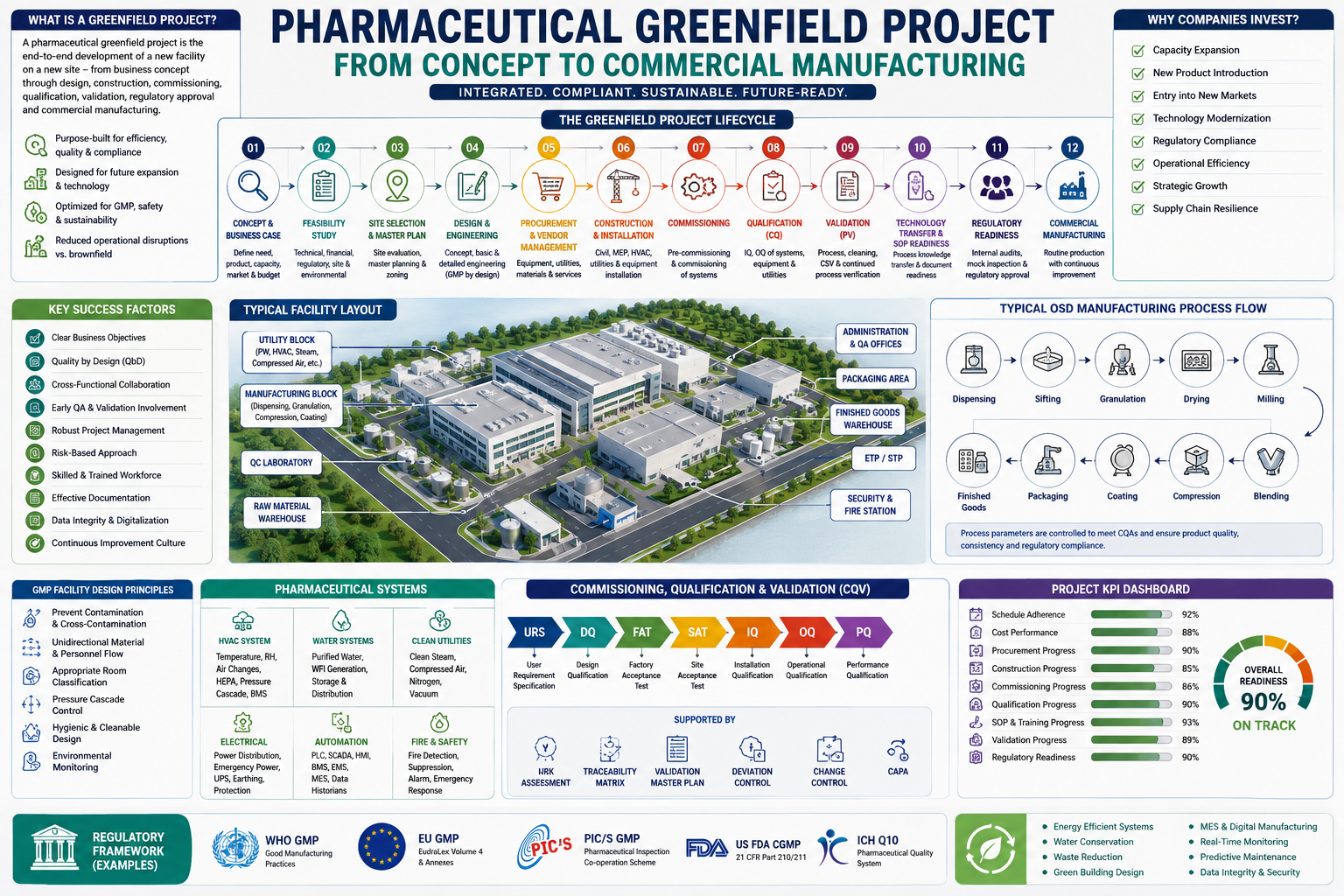
A greenfield CQV program should begin early.
Phase 1 – Concept
- Define CQV philosophy
- Identify systems
- Establish GMP strategy
- Identify critical utilities
Phase 2 – Design
- URS
- Design review
- Risk assessment
- DQ
- System boundaries
Phase 3 – Procurement
- Vendor assessment
- Specifications
- FAT requirements
- Documentation requirements
Phase 4 – Construction
- Installation
- Inspection
- Turnover
- Calibration
- Punch-list
Phase 5 – Commissioning
- Startup
- Functional testing
- Utilities
- Controls
- System optimization
Phase 6 – Qualification
- IQ
- OQ
- PQ
- Supporting validation
Phase 7 – Handover
- Final reports
- SOPs
- Training
- Maintenance
- Calibration
- Drawings
- Spare parts
- Qualified-state management
29. CQV for Brownfield Projects
Brownfield projects introduce additional challenges.
Examples:
- Existing production
- Existing qualified equipment
- Limited shutdown windows
- Legacy automation
- Existing utilities
- Existing data
- Existing validated processes
A brownfield CQV strategy should carefully assess:
- Existing qualified state
- Proposed modification
- Change impact
- Product/process impact
- Utility impact
- Automation impact
- Data-integrity impact
- Requalification requirement
A key question is:
What has changed, and what previously demonstrated state could be affected by that change?
30. ASTM E2500 and Modern CQV
ASTM E2500 is particularly relevant to modern CQV because it provides a science- and risk-based approach to specification, design and verification.
The active ASTM E2500-25 description states that it covers GMP utilities, process equipment, supporting utilities, monitoring/control and automation systems that can affect product quality, availability and/or patient safety. It is applicable to both new and existing systems and across the lifecycle.
The standard is intended to support systems being fit for intended use and aligns with lifecycle and risk-management concepts reflected in ICH quality guidance.
Important Principle
ASTM E2500 should not be interpreted as:
“Do fewer tests.”
It should be interpreted as:
“Perform the right verification, at the right stage, based on science, risk and intended use.”
31. CQV vs Validation Engineer
| CQV | Traditional Validation Focus |
|---|---|
| Lifecycle-oriented | Qualification-oriented |
| Engineering integrated | Validation department centered |
| Commissioning integrated | Commissioning often separate |
| Risk-based verification | Protocol-driven |
| Vendor evidence considered | More site testing |
| Early project involvement | Often later involvement |
| System-level view | Equipment/protocol view |
| Strong project-management interface | Strong QA interface |
| Focus on readiness | Focus on qualification documentation |
Both skill sets remain valuable. Modern projects increasingly benefit from professionals who understand engineering + commissioning + qualification + validation + GMP.
32. CQV Engineer Career Roadmap
A CQV professional should develop knowledge in:
Technical
- Mechanical systems
- Electrical systems
- Instrumentation
- Automation
- HVAC
- Utilities
- Process equipment
GMP
- GMP principles
- Qualification
- Validation
- Quality systems
- Data integrity
Documentation
- URS
- DQ
- IQ
- OQ
- PQ
- Risk assessment
- Traceability
Project Management
- Planning
- Scheduling
- Resource management
- Vendor management
- Issue resolution
Communication
- Technical writing
- Meetings
- Stakeholder management
- Audit communication
Career Progression
CQV Engineer
↓
Senior CQV Engineer
↓
CQV Lead
↓
CQV Manager
↓
Head of CQV / Validation
↓
Engineering / Project / Technical Leadership
33. CQV Interview Questions and Answers
1. What is CQV?
CQV stands for Commissioning, Qualification and Validation. It is a lifecycle approach used to establish and maintain evidence that pharmaceutical facilities, systems, equipment and processes are suitable for their intended use.
2. What is commissioning?
Commissioning is engineering-focused verification and startup of systems to demonstrate that they function according to design.
3. What is qualification?
Qualification provides documented evidence that facilities, utilities, equipment or systems are suitable for intended use.
4. What is validation?
Validation provides documented evidence that a process, method or system can consistently achieve predetermined requirements.
5. What is DQ?
Design Qualification verifies that the proposed design meets user, process, GMP and applicable requirements.
6. What is IQ?
Installation Qualification verifies that equipment/system installation complies with approved requirements.
7. What is OQ?
Operational Qualification verifies that the system operates as intended across defined operating ranges.
8. What is PQ?
Performance Qualification demonstrates that the system performs effectively under intended operating conditions.
9. What is FAT?
Factory Acceptance Testing verifies specified equipment/system functions at the supplier site before shipment.
10. What is SAT?
Site Acceptance Testing verifies equipment/system functionality under site-installed conditions.
11. What is ASTM E2500?
It is a standard guide for specification, design and verification of pharmaceutical and biopharmaceutical manufacturing systems and equipment using a science- and risk-based lifecycle approach. The active edition is E2500-25.
12. How does risk affect qualification?
Risk determines which system attributes are critical and therefore the appropriate level and type of verification.
13. What is a critical aspect?
A critical aspect is a feature, function or attribute that has a potential impact on product quality, patient safety or other defined critical requirements.
14. What is a qualification deviation?
A documented departure from an approved qualification requirement, procedure or acceptance criterion that requires investigation and impact assessment.
15. Should a failed OQ test simply be repeated?
No. The failure should be documented and investigated before determining the appropriate corrective action and retest strategy.
16. What is traceability?
Traceability links requirements to risk assessments, design elements, verification activities and objective evidence.
17. How is CQV different from validation?
CQV integrates engineering commissioning, qualification and validation across the system lifecycle, whereas traditional validation approaches may have treated qualification as a more isolated activity.
18. What is the role of QA in CQV?
QA provides GMP oversight, approval, quality-risk oversight and governance of deviations, changes and qualification documentation.
19. What is the role of the CQV Lead?
The CQV Lead establishes strategy, coordinates resources and stakeholders, manages execution, resolves issues and ensures the qualification package meets project and GMP requirements.
20. What is ALCOA+?
ALCOA+ represents principles for maintaining trustworthy, complete and reliable data throughout its lifecycle.
21. What is GAMP 5?
GAMP 5 is ISPE guidance supporting risk-based approaches for compliant GxP computerized systems. The Second Edition was published in 2022.
22. What is a direct-impact system?
A system that can directly affect product quality, critical process requirements or GMP operations according to the site’s approved classification methodology.
23. How do you determine whether requalification is required?
Evaluate the change through the approved change-control and risk-assessment process and determine whether previously qualified critical aspects could be affected.
24. What is the most important CQV document?
There is no single universally “most important” document. The CQV strategy, URS, risk assessment, traceability and objective verification evidence collectively establish the basis for demonstrating suitability.
25. How do you handle an audit question when you do not know the answer?
Do not guess. Explain what is known, refer to controlled documentation or the responsible SME, and provide evidence through the approved quality system.
26. What is system boundary?
A defined physical and functional boundary identifying what equipment, components, instruments, controls and interfaces belong to the system being commissioned or qualified.
27. Why is FAT important?
FAT allows critical defects to be identified and corrected before equipment reaches the manufacturing site.
28. Can FAT replace IQ/OQ?
Not automatically. FAT evidence may be leveraged where justified, but site installation and applicable GMP requirements still need appropriate verification.
29. What is continued qualified state?
The condition in which a facility, system or equipment remains capable of performing its intended function after initial qualification through controlled operation, maintenance, calibration, change management and other lifecycle controls.
30. What makes a good CQV Lead?
A strong CQV Lead combines technical knowledge, GMP understanding, risk-based thinking, engineering knowledge, project management, communication and leadership.
34. Practical Case Study – New Tablet Manufacturing Facility
Consider a greenfield OSD facility containing:
- Granulation
- Fluid Bed Drying
- Blending
- Compression
- Coating
- Packaging
Supporting systems include:
- HVAC
- Purified Water
- Compressed Air
- Nitrogen
- Electrical systems
- BMS
- EMS
- SCADA
- CIP where applicable
Step 1 – URS
Define:
- Capacity
- Process requirements
- GMP requirements
- Product-contact materials
- Automation
- Data requirements
- Safety
- Cleaning requirements
Step 2 – Risk Assessment
Identify critical:
- Equipment functions
- Process parameters
- Instruments
- Utilities
- Automation functions
Step 3 – Design
Conduct:
- Design reviews
- P&ID review
- Equipment design review
- Automation review
- Data-integrity assessment
Step 4 – FAT
Test:
- Functional operation
- PLC/HMI
- Alarms
- Interlocks
- Critical sequences
Step 5 – Installation
Verify:
- Equipment
- Utilities
- Instruments
- Piping
- Electrical
- Controls
Step 6 – Commissioning
Perform:
- Startup
- Functional testing
- Calibration
- Loop checks
- System optimization
Step 7 – Qualification
Execute appropriate:
- IQ
- OQ
- PQ
Step 8 – Process Validation
Demonstrate that the manufacturing process consistently produces product meeting established requirements.
FDA’s process-validation guidance describes process validation as a lifecycle approach and provides principles applicable to drug manufacturing processes.
Step 9 – Handover
Complete:
- Qualification reports
- SOPs
- Training
- Calibration
- Maintenance
- Drawings
- Spare parts
- Change controls
- Final documentation
35. CQV Checklists
Pre-Commissioning
- Approved drawings available
- System boundary defined
- Equipment installed
- Utilities available
- Instruments installed
- Calibration status verified
- Electrical checks complete
- Safety checks complete
- Vendor documentation available
- Punch list established
Commissioning
- Startup completed
- Functional tests completed
- Controls verified
- Alarms tested
- Interlocks tested
- Emergency functions tested
- Performance optimized
- Commissioning records completed
FAT
- Approved FAT protocol
- URS available
- Critical functions identified
- Alarms tested
- Interlocks tested
- Documentation reviewed
- Punch list documented
- Deviations controlled
SAT
- Installation verified
- Utilities connected
- Controls connected
- Functional testing complete
- Site-specific requirements verified
- Punch list reviewed
IQ
- Equipment identification verified
- Installation verified
- Materials verified
- Utilities verified
- Instruments verified
- Calibration verified
- Drawings verified
- Manuals available
- Software versions recorded
OQ
- Operating ranges tested
- Alarms challenged
- Interlocks challenged
- Emergency functions tested
- Critical functions verified
- Acceptance criteria met
PQ
- Representative operating conditions established
- Sampling plan approved
- Performance criteria established
- Repeatability assessed
- Results reviewed
- Deviations evaluated
- Final report approved
Final Handover
- IQ complete
- OQ complete
- PQ complete
- Deviations closed or appropriately controlled
- Change controls complete
- SOPs approved
- Training completed
- Drawings updated
- Maintenance requirements established
- Calibration program established
- Final qualification report approved
36. CQV Digitalization
The future of CQV is increasingly digital.
Emerging technologies include:
- Electronic protocols
- Electronic signatures
- Digital turnover packages
- Automated test execution
- Digital twins
- AI-assisted document review
- AI-assisted risk analysis
- Automated traceability
- Data analytics
- Remote FAT/SAT
- Smart instruments
- IoT
- Pharma 4.0
AI Opportunities
AI could assist with:
- Requirement classification
- Protocol review
- Document consistency checks
- Risk identification
- Traceability analysis
- Deviation trend analysis
- Missing-document identification
- Audit-readiness reviews
However, AI-generated outputs should not automatically be treated as GMP evidence. Human SME review, controlled procedures, data integrity and appropriate validation/assurance remain essential.
37. Regulatory and Industry Framework
CQV programs may need to consider a combination of:
- FDA GMP requirements
- FDA process-validation guidance
- EU GMP
- EU GMP Annex 15
- EU GMP Annex 11
- WHO GMP
- PIC/S
- ASTM E2500
- ISPE Baseline Guides
- GAMP 5
- ICH Q9
- ICH Q10
- 21 CFR Part 11
- Applicable pharmacopoeial requirements
The hierarchy is important.
Regulations and legally applicable requirements are not interchangeable with industry guidance or company procedures.
For example:
- FDA guidance provides FDA’s current thinking and recommendations.
- EU GMP Annexes form part of the EU GMP framework.
- ASTM E2500 is an industry standard/guide.
- ISPE GAMP 5 is industry guidance.
- Company SOPs define the organization’s approved implementation.
The applicable jurisdiction and product must always be considered.
38. CQV Best Practices
- Start CQV during project planning.
- Establish system boundaries early.
- Build a clear CQV strategy.
- Develop a strong URS.
- Use meaningful risk assessment.
- Involve QA early.
- Involve operations and SMEs early.
- Define critical aspects.
- Engage vendors early.
- Define documentation requirements in procurement.
- Use FAT effectively.
- Integrate commissioning and qualification intelligently.
- Avoid unnecessary duplicate testing.
- Maintain traceability.
- Control deviations.
- Manage changes through formal change control.
- Maintain data integrity.
- Keep as-built documentation current.
- Train operations before handover.
- Establish continued qualified-state controls.
- Use electronic documentation appropriately.
- Monitor CQV KPIs.
- Conduct periodic quality reviews.
- Capture lessons learned.
- Maintain lifecycle ownership after project completion.
39. Final CQV Lifecycle Model
A practical conceptual model is:
URS
↓
Quality & Process Risk Assessment
↓
System Classification / Criticality
↓
Design
↓
DQ
↓
FAT
↓
Installation
↓
SAT
↓
Commissioning
↓
IQ
↓
OQ
↓
PQ
↓
Process Validation
↓
Continued Verification / Monitoring
↓
Maintained Qualified State
↓
Change / Improvement / Requalification as Applicable
↓
Retirement
The actual sequence and documentation should always be established by the approved project CQV strategy, system criticality, risk assessment, intended use, applicable regulations and company quality system.
40. FAQ
What is CQV in pharmaceutical manufacturing?
CQV is an integrated lifecycle approach combining commissioning, qualification and validation to establish documented evidence that pharmaceutical facilities, systems, equipment and processes are suitable for their intended use.
What does a CQV Engineer do?
A CQV Engineer plans, prepares, executes and documents commissioning and qualification activities and supports risk assessments, deviations, traceability and validation.
What is the difference between CQV and validation?
CQV incorporates engineering commissioning and qualification into a broader lifecycle strategy, whereas validation generally focuses on demonstrating that processes or systems consistently achieve predefined requirements.
What are DQ, IQ, OQ and PQ?
They are common qualification stages covering design, installation, operation and performance, respectively.
What is FAT?
Factory Acceptance Testing verifies critical equipment/system functionality at the supplier site before shipment.
What is SAT?
Site Acceptance Testing verifies functionality after installation at the manufacturing site.
What is ASTM E2500?
ASTM E2500 is a standard guide for specification, design and verification of pharmaceutical and biopharmaceutical manufacturing systems and equipment using a science- and risk-based approach. The active edition listed by ASTM is E2500-25.
What is risk-based CQV?
It is an approach where verification scope and depth are determined using intended use, scientific understanding, system criticality and quality risk management.
What is the role of a CQV Lead?
The CQV Lead develops strategy, coordinates teams, manages execution, oversees qualification, manages risks and supports project and regulatory readiness.
What documents are required for CQV?
Documents may include URS, risk assessments, DQ, FAT, SAT, commissioning records, IQ, OQ, PQ, traceability matrices, deviations, change controls and final reports.
How is HVAC qualified?
HVAC qualification may include airflow, temperature, RH, pressure differential, HEPA integrity, recovery, airflow visualization and cleanroom classification, depending on intended use and applicable requirements.
How is a purified water system qualified?
The strategy may include generation, storage and distribution verification, flow, temperature, conductivity, TOC, microbiological monitoring, sanitization and sampling-point verification.
What is the difference between commissioning and qualification?
Commissioning primarily demonstrates engineering functionality and readiness, while qualification establishes documented suitability for intended GMP use.
What skills are required for a CQV Engineer?
Technical engineering knowledge, GMP, qualification, risk management, documentation, automation awareness, communication and project-management skills are highly valuable.
What are common CQV audit observations?
Examples include inadequate traceability, poorly justified acceptance criteria, incomplete deviations, uncontrolled changes, missing calibration evidence, incomplete as-built documentation and inadequate data-integrity controls.
Conclusion
CQV is much more than a sequence of DQ → IQ → OQ → PQ protocols.
A mature CQV program integrates:
Engineering + Science + Risk Management + GMP + Quality + Automation + Documentation + Project Management
The strongest CQV organizations begin with requirements and risk, integrate engineering and quality throughout the project lifecycle, use commissioning intelligently, leverage appropriate objective evidence, and maintain control after qualification is complete.
The objective is not to generate more documents.
The objective is to generate credible evidence that critical pharmaceutical systems are fit for intended use, that risks are controlled, and that the qualified state can be maintained throughout the lifecycle.
For greenfield projects, CQV can become the bridge between design intent and GMP-ready operation.
For brownfield projects, it provides the disciplined framework for introducing change without losing control of the existing qualified state.
For the CQV professional, the role is therefore much broader than protocol execution. A strong CQV Lead must understand engineering, GMP, risk management, automation, project execution, documentation, quality systems and leadership.
That combination is what makes CQV a strategic function in modern pharmaceutical manufacturing.Secondary Keywords
- CQV pharmaceutical industry
- CQV process
- CQV lifecycle
- CQV Engineer
- CQV Lead
- pharmaceutical qualification
- pharmaceutical validation
- equipment qualification
- utility qualification
- IQ OQ PQ
- FAT SAT
- ASTM E2500
- risk-based CQV
- HVAC qualification
- purified water qualification
- WFI qualification
- pharmaceutical facility qualification
- CSV
- GAMP 5
- data integrity