
Part 6
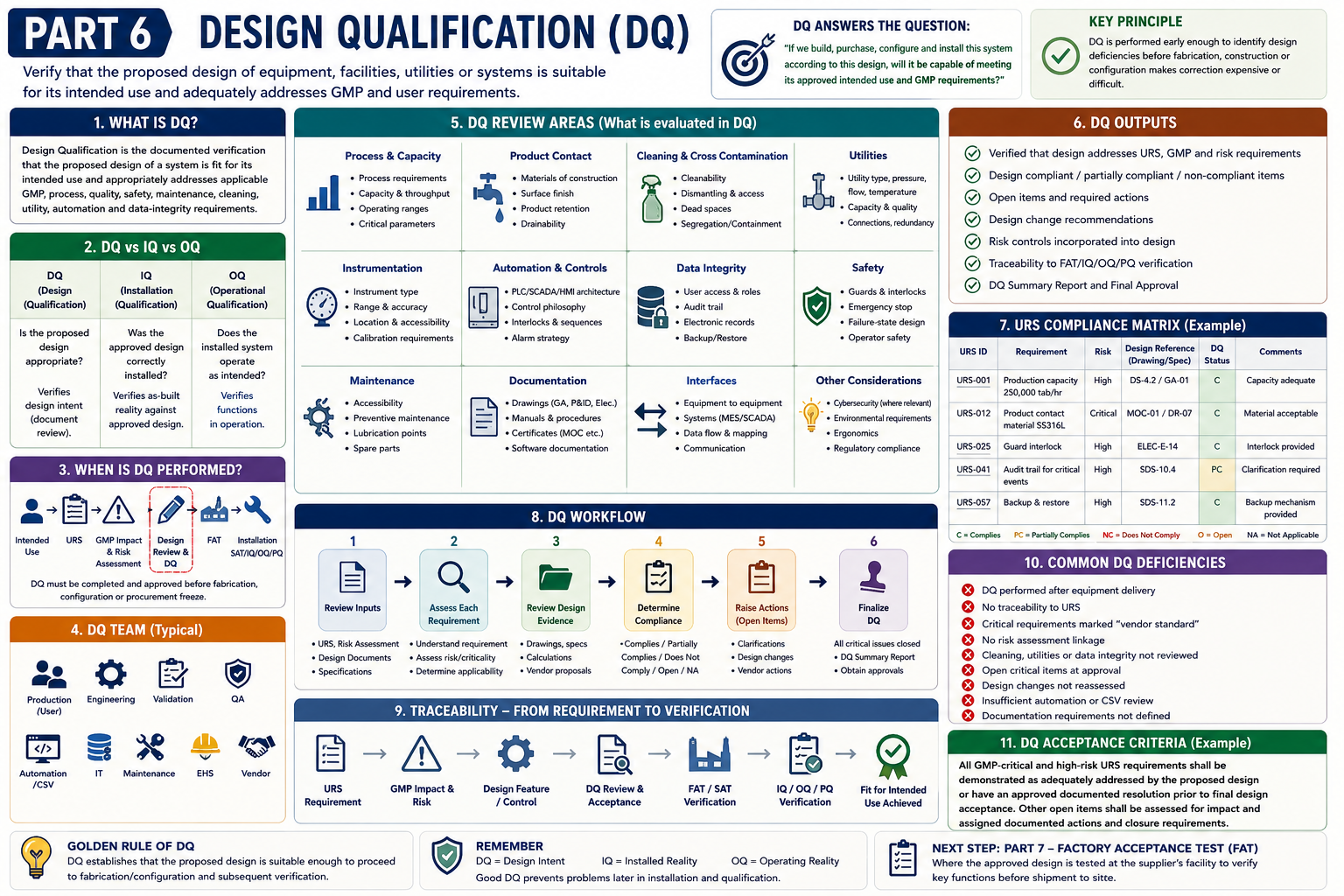
6.1 What Is Design Qualification?
Design Qualification (DQ) is the documented verification that the proposed design of a facility, utility, equipment item, or system is suitable for its intended purpose and appropriately addresses applicable GMP and user requirements.
In practical terms, DQ asks:
If we build, purchase, configure, and install the system according to this design, will it be capable of meeting its approved intended use and GMP requirements?
DQ should therefore occur sufficiently early to identify deficiencies before fabrication, construction, installation, or final configuration makes correction expensive or difficult.
6.2 Position of DQ in the Qualification Lifecycle
A typical lifecycle is:
Business/Process Need
↓
Intended Use
↓
URS
↓
System/GMP Impact Assessment
↓
Quality Risk Assessment
↓
Conceptual/Detailed Design
↓
Design Review + Design Qualification
↓
Approved Design Baseline
↓
Fabrication / Configuration
↓
FAT
↓
Installation
↓
SAT / Commissioning
↓
IQ
↓
OQ
↓
PQ
↓
Qualification Summary / Release
DQ is therefore a major bridge between:
What the user requires
and
What engineering/vendor proposes to build.
6.3 Why DQ Is Important
Many qualification failures originate from design deficiencies.
Examples include:
- unsuitable product-contact material;
- inaccessible cleaning areas;
- insufficient equipment capacity;
- incorrect instrument range;
- inadequate alarm strategy;
- poor drainage;
- insufficient utility capacity;
- uncontrolled recipe modification;
- inadequate user-access architecture;
- missing audit-trail functionality;
- inadequate backup arrangements;
- poor maintenance access.
Discovering these during OQ is late.
A strong DQ attempts to prevent them during design.
6.4 DQ Is Not Simply a Document Review
Weak DQ:
“URS reviewed against vendor quotation — acceptable.”
Strong DQ:
URS Requirement → GMP/Risk Significance → Proposed Design → Design Evidence → Compliance Status → Open Action
The second approach creates traceable evidence that the proposed design addresses requirements.
6.5 DQ vs Design Review
These concepts overlap but should be understood.
Design Review
A multidisciplinary technical review of the design.
It may evaluate:
- process;
- mechanical;
- electrical;
- automation;
- safety;
- maintenance;
- constructability;
- operability.
Design Qualification
The GMP qualification activity that establishes documented evidence that the design is suitable for intended use.
A company may combine the two activities if its procedures allow and the resulting documentation provides adequate evidence.
6.6 DQ vs IQ
The distinction is fundamental.
DQ
Is the proposed design appropriate?
IQ
Was the approved design correctly installed?
Example:
DQ
Verify that SS316L is specified for a defined product-contact component where justified by the approved requirement.
IQ
Verify that the installed component corresponds to the approved material specification using appropriate documentation/evidence.
Thus:
DQ = Design Intent
IQ = Installed Reality
6.7 DQ Inputs
A meaningful DQ requires adequate design information.
Typical inputs include:
- approved URS;
- intended-use statement;
- system boundary;
- GMP impact assessment;
- quality risk assessment;
- vendor proposal;
- design specification;
- functional specification;
- equipment drawings;
- GA drawings;
- P&IDs;
- process-flow diagrams;
- electrical drawings;
- instrumentation list;
- component list;
- automation architecture;
- software/functional descriptions;
- utility requirements;
- material specifications;
- room/layout drawings;
- cleaning philosophy;
- maintenance requirements.
Not every system requires every document.
The required inputs should reflect system complexity and risk.
6.8 DQ Prerequisites
Before formal DQ approval, confirm as applicable:
- □ Intended use defined
- □ URS approved
- □ System boundary defined
- □ GMP impact assessed
- □ Risk assessment available
- □ Vendor selected or proposed
- □ Relevant design documents available
- □ Process requirements established
- □ Critical aspects identified
- □ Relevant sames identified
DQ performed with incomplete design information may require staged review or documented open actions.
6.9 DQ Team
DQ should generally involve appropriate cross-functional sames.
| Function | Typical DQ Contribution |
|---|---|
| Production/User | Intended use and operability |
| Engineering | Mechanical/electrical/design review |
| Validation/CQV | Qualification and traceability |
| QA | GMP/quality oversight |
| Automation | PLC/HMI/SCADA design |
| IT | Infrastructure/security/interface requirements |
| Maintenance | Maintainability and spare strategy |
| EHS | Safety/environmental requirements |
| Vendor | Design explanation/evidence |
| Project Team | Schedule/design coordination |
Actual responsibilities should follow the company’s PQS.
6.10 DQ Review Philosophy
For each important URS requirement, determine:
- What does the requirement mean?
- Is it GMP/risk significant?
- Where is it addressed in the design?
- What document demonstrates this?
- Is the design adequate?
- Is clarification required?
- Is a design change required?
- Does the requirement require later verification?
This creates the chain:
URS
↓
Risk
↓
Design Feature
↓
Design Evidence
↓
DQ Decision
↓
FAT/IQ/OQ/PQ Verification
6.11 URS Compliance Review
A DQ should systematically evaluate relevant URS requirements.
A practical table is:
| URS ID | Requirement | Criticality/Risk | Design Reference | DQ Assessment | Status |
|---|---|---|---|---|---|
| URS-001 | Required production capacity | Significant | DS-4.2 | Design capacity adequate | Complies |
| URS-012 | Product-contact material | Critical | MOC-01 | Specified material acceptable | Complies |
| URS-025 | Guard interlock | Significant | Electrical Drawing E-14 | Interlock included | Complies |
| URS-040 | Role-based access | Critical | FRS-8.3 | Roles defined | Complies |
| URS-041 | Audit trail | Critical | SDS-10.4 | Clarification required | Open |
This provides much stronger evidence than simply signing the vendor drawing.
6.12 DQ Compliance Status
A standardized status system is useful.
For example:
C — Complies
Requirement adequately addressed.
PC — Partially Complies
Some aspects require action.
NC — Does Not Comply
Design does not satisfy requirement.
NA — Not Applicable
Requirement does not apply, with rationale.
O — Open
Additional information is required before final disposition.
Definitions should be established in the DQ protocol.
6.13 Process Requirements Review
DQ should verify that the proposed equipment/system can support the intended process.
For a compression machine, this might include:
- product type;
- batch requirements;
- tablet dimensions;
- tooling requirements;
- production capacity;
- turret-speed capability;
- feeder capability;
- compression-force capability;
- pre-compression capability;
- tablet discharge arrangement.
The design should not merely be capable of operating—it should be capable of supporting the intended pharmaceutical process.
6.14 Capacity Review
Capacity should be assessed against actual user requirements.
Example:
URS
Required production capability: 250,000 tablets/hour under defined product conditions.
Vendor design
Maximum nominal capability: 400,000 tablets/hour.
DQ should not simply conclude:
400,000 > 250,000, therefore acceptable.
The team should consider whether the claimed capability applies to:
- intended tooling;
- tablet size;
- product characteristics;
- feeder limitations;
- quality requirements.
Capacity claims should be evaluated in context.
6.15 GMP Design Review
The DQ should evaluate GMP-relevant design characteristics.
Potential areas include:
- cleanability;
- contamination prevention;
- cross-contamination control;
- product-contact materials;
- product retention;
- accessibility;
- dead spaces;
- drainage where applicable;
- segregation;
- controlled access;
- GMP record generation;
- data integrity.
6.16 Product-Contact Materials
DQ should verify that materials specified for product-contact surfaces are suitable for intended use.
Review may include:
- material grade;
- chemical compatibility;
- corrosion resistance;
- product compatibility;
- cleaning-agent compatibility;
- documentation/certification requirements.
Example evidence:
- material specification;
- drawing;
- vendor material list;
- certificate requirements.
The installed material is later verified through IQ/turnover evidence as appropriate.
6.17 Surface-Finish Requirements
Where surface finish is important, DQ should confirm that the design specification contains appropriate requirements.
Consider:
- product retention;
- cleanability;
- corrosion;
- hygienic design;
- process needs.
Values should not be copied automatically from previous equipment without justification.
6.18 Cleaning Design Review
Cleaning should be considered during design, not after equipment installation.
DQ may assess:
- access to product-contact areas;
- dismantling;
- removable components;
- crevices;
- product traps;
- drainability;
- cleaning-agent compatibility;
- CIP functionality where applicable;
- inspection access.
Key question
Can the equipment be practically and reproducibly cleaned using the intended cleaning strategy?
6.19 Cross-Contamination Controls
DQ should evaluate design features intended to control cross-contamination.
Examples:
- enclosed product path;
- dust extraction;
- containment;
- seals;
- dedicated connections;
- cleanability;
- pressure control interfaces.
The scope should reflect product/process risk.
6.20 Containment
Where containment is required, DQ may evaluate:
- enclosed transfer;
- extraction;
- isolating features;
- glove interfaces;
- seals;
- pressure-control strategy;
- cleaning/decontamination arrangements.
Performance requirements should be linked to the applicable risk assessment and intended process.
6.21 Utility Requirements
DQ should confirm that required utilities are correctly defined.
Potential utilities include:
- electricity;
- compressed air;
- vacuum;
- Purified Water;
- WFI;
- clean steam;
- chilled water;
- nitrogen;
- process gases.
Review:
- pressure;
- flow;
- quality;
- temperature;
- connection;
- capacity;
- redundancy where required.
6.22 Utility Capacity
The review should assess both:
Equipment requirement
What does the machine need?
and
Site capability
Can the facility reliably provide it?
Example:
Machine compressed-air requirement:
6 bar at defined maximum consumption
Site utility:
Available pressure and capacity must be demonstrated adequate at expected operating demand.
This prevents commissioning problems later.
6.23 Instrumentation Design Review
DQ should evaluate critical instrumentation.
Consider:
- measurement parameter;
- instrument type;
- range;
- accuracy;
- resolution;
- location;
- accessibility;
- calibration;
- output;
- alarm/control function.
6.24 Instrument Range
A common design error is selecting an instrument whose range is poorly matched to the operating range.
Example:
Process normally operates:
1–3 bar
Instrument selected:
0–100 bar
Even if calibrated, this may be inappropriate depending on required measurement performance.
Therefore:
Calibration alone does not establish suitability.
DQ should consider the relationship between:
Process Range → Required Accuracy → Instrument Range → Control Requirement
6.25 Automation Design Review
For PLC/HMI/SCADA-controlled equipment, DQ should assess the automation concept.
Potential topics:
- PLC architecture;
- HMI;
- control sequences;
- alarm philosophy;
- interlocks;
- recipes;
- user roles;
- data storage;
- audit trails;
- interfaces;
- reports;
- backup/restore.
Testing occurs later, but DQ establishes whether the design contains appropriate controls.
6.26 PLC Design
Review may include:
- controller architecture;
- I/O capacity;
- communication;
- redundancy where justified;
- program backup;
- software/version control;
- access restrictions.
The depth depends on system risk and complexity.
6.27 HMI Design
Assess whether the HMI supports intended operation.
Consider:
- process status;
- critical parameters;
- alarms;
- operator prompts;
- recipe selection;
- user access;
- trends;
- reports where applicable.
Cosmetic preferences should not be confused with GMP-critical design requirements.
6.28 SCADA Design
For SCADA-controlled systems, DQ may additionally consider:
- server architecture;
- historian;
- interfaces;
- redundancy;
- data storage;
- network;
- time synchronization;
- backup;
- restore;
- security.
6.29 Recipe Management
Recipe design should be evaluated where recipes influence GMP processing.
Questions include:
- Who can create recipes?
- Who can modify them?
- How are recipes identified?
- Are parameter ranges controlled?
- Is approval required?
- Are changes traceable?
- Can obsolete recipes be controlled?
These requirements should derive from intended use and risk.
6.30 User Access Design
Role-based access should be assessed where relevant.
A conceptual matrix might be:
| Function | Operator | Supervisor | Engineering | Administrator |
|---|---|---|---|---|
| Run equipment | Yes | Yes | Conditional | Conditional |
| Select approved recipe | Yes | Yes | Conditional | Conditional |
| Modify recipe | No | Authorized | Conditional | Yes |
| Change configuration | No | No | Authorized | Yes |
| User administration | No | No | No/Conditional | Yes |
The actual matrix should follow approved business and GMP requirements.
6.31 Audit-Trail Design
Where audit trails are applicable, DQ should consider whether the proposed system can capture appropriate GMP-relevant events.
Potential events include:
- parameter changes;
- recipe changes;
- configuration changes;
- user-management changes;
- data modification;
- significant actions.
DQ should also consider whether records are:
- reviewable;
- retained;
- protected;
- time stamped appropriately.
6.32 Electronic Records
DQ should identify:
- what records are electronic;
- where they originate;
- where they are stored;
- how they are protected;
- how they are retrieved;
- how long they are retained;
- whether interfaces exist.
This should be based on intended use rather than assuming every machine display constitutes a regulated electronic record.
6.33 Electronic Signatures
Where electronic signatures are intended, DQ should assess the proposed design against applicable requirements.
Questions include:
- What action is being signed?
- Who is authorized?
- How is identity established?
- How is the signature linked to the record?
- What meaning is associated with the signature?
If electronic signatures are not part of intended use, the requirement should not be artificially imposed.
6.34 Backup and Restore Design
DQ should evaluate:
- what must be backed up;
- backup location;
- frequency;
- configuration backup;
- recipe backup;
- GMP data backup;
- restoration capability;
- responsibilities.
A backup that cannot be restored is not an adequate recovery control.
6.35 Data-Flow Review
For complex computerized systems, DQ should understand data movement.
Example:
Machine Sensor
      ↓
     PLC
      ↓
     HMI
      ↓
   SCADA
      ↓
 Historian / Database
      ↓
      MES
      ↓
 Batch Record / Report
Each interface may introduce risks such as:
- missing data;
- duplicate data;
- incorrect mapping;
- timestamp mismatch;
- communication failure.
6.36 Cybersecurity Considerations
Cybersecurity should be considered where relevant to the reliable GMP operation of the system.
Design considerations may include:
- authentication;
- password management;
- network segmentation;
- controlled remote access;
- firewall architecture;
- malware protection where applicable;
- patching strategy;
- removable media controls;
- administrator access.
The scope should reflect system architecture and GMP risk.
6.37 Alarm Design
DQ should assess whether alarms exist for significant abnormal conditions identified by risk assessment.
For each important alarm, consider:
- trigger condition;
- setpoint;
- priority;
- operator response;
- acknowledgement;
- record/history;
- reset behavior.
Alarm proliferation should be avoided.
Not every event requires a critical alarm.
6.38 Interlock Design
Interlocks may protect:
- product;
- equipment;
- process;
- operator.
Examples:
- guard interlock;
- low lubrication pressure;
- high compression force;
- dust-extraction permissive;
- utility failure.
Risk assessment should determine which interlocks are important to qualification.
6.39 Failure-State Design
DQ should consider credible failure scenarios.
Examples:
- power failure;
- compressed-air failure;
- network failure;
- PLC restart;
- sensor failure;
- communication loss;
- emergency stop.
The design should define safe and controlled system behavior.
6.40 Power Failure and Recovery
Questions include:
- What happens when power fails?
- Does the machine stop safely?
- Are critical parameters retained?
- Are recipes retained?
- Are records preserved?
- What happens after power restoration?
- Does the system automatically restart?
- Is operator intervention required?
These decisions should be established during design rather than discovered during OQ.
6.41 Safety Requirements
DQ should verify applicable safety requirements are incorporated.
Examples:
- guards;
- emergency stops;
- safety interlocks;
- overload protection;
- electrical safety;
- pressure relief;
- safe access.
Safety assessment may be governed primarily by engineering/EHS requirements, but safety functions may overlap with GMP qualification where failure can also affect product/process control.
6.42 Maintenance Design
Maintainability should be considered early.
Review:
- component access;
- calibration access;
- lubrication points;
- filter replacement;
- critical spare parts;
- diagnostic capability;
- software backup;
- safe maintenance access.
Poor maintainability can undermine the qualified state.
6.43 Preventive Maintenance
DQ should identify the manufacturer’s proposed PM requirements and determine whether the design supports:
- inspection;
- lubrication;
- replacement;
- adjustment;
- calibration.
These requirements later feed into the site’s maintenance program.
6.44 Spare Parts
Review should identify critical spares.
Examples:
- sensors;
- PLC modules;
- HMI;
- drives;
- seals;
- filters;
- motors;
- product-contact components.
For computerized systems, obsolescence and replacement compatibility may also be relevant.
6.45 Documentation Requirements
DQ should verify that the supplier will provide the required turnover documentation.
Typical documents include:
- GA drawings;
- P&IDs;
- electrical drawings;
- pneumatic drawings;
- instrument lists;
- component lists;
- material certificates;
- calibration certificates;
- manuals;
- software documentation;
- I/O lists;
- alarm lists;
- spare-parts lists.
6.46 Documentation Deliverable Matrix
A practical table:
| Document | Required | Supplier | Review Stage | Final Status |
|---|---|---|---|---|
| GA Drawing | Yes | Vendor | DQ/FAT | |
| P&ID | Yes | Vendor | DQ | |
| Electrical Drawing | Yes | Vendor | DQ/FAT | |
| Instrument List | Yes | Vendor | DQ/FAT | |
| Material Certificates | Yes | Vendor | FAT/IQ | |
| Software Version List | Conditional | Integrator | FAT/IQ | |
| Operation Manual | Yes | Vendor | FAT/SAT | |
| Maintenance Manual | Yes | Vendor | FAT/SAT |
This prevents missing documentation at project closeout.
6.47 Design Risk Assessment
DQ and design risk assessment should interact closely.
A design FMEA may examine:
| Function | Failure | GMP Effect | Design Control | DQ Verification |
|---|---|---|---|---|
| Product contact | Wrong material | Contamination | Specified material | Review material specification |
| Reject | Failure | Defective product retained | Reject confirmation | Review design |
| Recipe | Unauthorized change | Wrong parameters | Access control | Review roles |
| Alarm | Failure | Condition unnoticed | Alarm logic | Review alarm specification |
| Data | Loss | Missing GMP record | Backup | Review architecture |
DQ verifies that appropriate controls have actually been incorporated into the proposed design.
6.48 Design Qualification and FAT
DQ establishes what the design should provide.
FAT then provides an early opportunity to demonstrate that the fabricated/configured system actually provides important functions.
Example:
DQ
Confirms design includes automatic tablet rejection.
FAT
Physically/functionally challenges the reject system.
Thus:
DQ = Review Design
FAT = Test Fabricated/Configured System
6.49 Design Qualification and IQ
DQ establishes the approved design baseline.
IQ verifies the installed system against that baseline.
Example:
DQ
Critical instrument range specified as appropriate.
IQ
Installed instrument:
- correct tag;
- correct manufacturer/model;
- correct range;
- calibrated;
- correctly installed.
This relationship is essential for traceability.
6.50 Design Qualification and OQ
DQ should identify important functions that later require operational challenge.
For example:
DQ identifies:
- critical alarm;
- guard interlock;
- recipe control;
- reject mechanism;
- access-control architecture.
OQ demonstrates:
- alarm triggers correctly;
- interlock prevents operation;
- recipe controls operate correctly;
- reject mechanism works;
- unauthorized access is prevented.
6.51 DQ and PQ
DQ should confirm that the system has the design capability needed to support eventual PQ.
Example:
For a blender:
- minimum load;
- maximum load;
- operating speed;
- timer;
- control functions.
PQ then evaluates performance under actual or appropriately simulated routine conditions.
6.52 Design Changes During DQ
Design changes are normal during pharmaceutical projects.
They should be controlled.
Typical sequence:
Design Review
↓
Deficiency / Improvement Identified
↓
Design Change Proposed
↓
Impact Assessment
↓
Risk Assessment if necessary
↓
URS Impact
↓
Design Document Updated
↓
DQ Re-review
↓
Approval
Design changes should not result in uncontrolled discrepancies between:
- URS;
- drawings;
- specifications;
- software;
- qualification protocols.
6.53 Example — Design Change
Original requirement:
Compression machine shall support defined product-dedusting interface.
During DQ, the proposed outlet elevation is found incompatible with the selected deduster.
Action:
- Record DQ open item.
- Engineering revises discharge design.
- Vendor updates GA drawing.
- Interface dimensions reviewed.
- Risk assessment updated if needed.
- Revised design accepted.
- DQ item closed.
This is preferable to discovering the incompatibility during SAT.
6.54 Open Items
Not every DQ issue must necessarily stop the entire project.
Open items should be categorized according to significance.
Example:
Critical
Design deficiency affecting GMP suitability.
Disposition: Resolve before design approval/fabrication as appropriate.
Major
Significant issue requiring closure before FAT or installation.
Minor
Documentation/detail that can be closed later without compromising design suitability.
The company’s procedure should define categories and release rules.
6.55 DQ Punch List
A DQ action register may contain:
| Item | Description | Criticality | Owner | Due Date | Evidence | Status |
|---|---|---|---|---|---|---|
| 01 | Clarify audit-trail capability | High | Automation | Revised SDS | Open | |
| 02 | Update P&ID tag | Low | Vendor | Revised P&ID | Open | |
| 03 | Confirm instrument range | High | Engineering | Datasheet | Closed |
Open items must be traceable to final closure.
6.56 DQ Deviations
A distinction should be made between:
- design review comment;
- open item;
- specification discrepancy;
- formal GMP deviation.
Not every design comment is automatically a GMP deviation.
However, significant departures from approved requirements or controlled qualification activities should be managed according to the applicable PQS.
6.57 Requirement Deviations
Suppose the vendor cannot meet a URS requirement.
Do not simply write:
“Vendor standard accepted.”
Instead evaluate:
- Why can the requirement not be met?
- Is the requirement truly necessary?
- What GMP/process risk exists?
- Is an alternative design available?
- Does the URS require formal revision?
- Is risk acceptance justified?
- Who approves the disposition?
The approved requirement should not be silently ignored.
6.58 URS Change During DQ
Sometimes DQ reveals that the URS itself is incorrect or unnecessarily restrictive.
A controlled process should be used:
Issue Identified
↓
URS Change Proposed
↓
Technical/GMP Justification
↓
Risk Assessment
↓
Change Approval
↓
URS Revision
↓
Design Updated
↓
Traceability Updated
Do not retrospectively rewrite the URS merely to make the vendor design appear compliant.
6.59 Supplier Design Review
Supplier participation is valuable because the vendor understands:
- equipment design;
- component selection;
- software architecture;
- standard limitations;
- engineering constraints.
However:
Supplier acceptance of its own design is not a substitute for user/quality review.
The pharmaceutical company remains responsible for determining suitability for its intended GMP use.
6.60 Design Qualification Meeting
For complex equipment, a formal DQ review meeting can be effective.
Suggested agenda:
- Intended use
- URS
- GMP impact
- Risk assessment
- Process requirements
- Mechanical design
- Product-contact materials
- Cleaning
- Utilities
- Instrumentation
- Automation
- Data integrity
- Safety
- Maintenance
- Documentation
- FAT strategy
- Open items
- Approval/readiness decision
Minutes and actions should be controlled according to project/PQS requirements.
6.61 Recommended DQ Protocol Structure
A comprehensive DQ protocol can contain:
1. Document Control
- document title;
- document number;
- revision;
- equipment/system ID;
- project number.
2. Approval
- prepared by;
- reviewed by;
- approved by.
3. Objective
State what DQ intends to establish.
4. Scope
Define:
- equipment/system;
- included subsystems;
- exclusions;
- interfaces.
5. References
Examples:
- URS;
- VMP;
- qualification plan;
- risk assessment;
- applicable specifications;
- drawings;
- company procedures.
6. Definitions and Abbreviations
7. Responsibilities
Define roles.
8. System Description
Describe:
- intended use;
- process;
- major components;
- automation;
- utilities.
9. DQ Prerequisites
List documents required before execution.
10. Design Documents Reviewed
Create a document register.
11. URS Compliance Review
Requirement-by-requirement assessment.
12. GMP Design Review
13. Process Design Review
14. Mechanical Design Review
15. Product-Contact Material Review
16. Cleaning Design Review
17. Utility Review
18. Instrumentation Review
19. Automation Review
20. Data-Integrity Review
21. Safety Review
22. Maintenance Review
23. Documentation Review
24. Risk-Control Verification
25. Open Items
26. Deviations
27. Traceability
28. Conclusion
29. Approval
6.62 Example DQ Test/Review Sheet
DQ Test No.: DQ-04
Title: Product-Contact Material Review
Objective:
Verify that the proposed materials of construction for product-contact components satisfy approved requirements.
Reference:
URS-MOC-001 to URS-MOC-008
Documents Reviewed:
Material specification, GA drawing, vendor component list.
Method:
Review the specified material for each identified product-contact component against the approved URS/design requirement.
| Component | Requirement | Proposed Material | Evidence | Status |
|---|---|---|---|---|
| Hopper | Approved material requirement | _____ | Drawing/Certificate Spec. | |
| Feeder | Approved material requirement | _____ | Drawing/Certificate Spec. | |
| Discharge chute | Approved material requirement | _____ | Drawing/Certificate Spec. |
Acceptance Criteria:
All applicable product-contact components shall be specified using materials that comply with approved requirements, or any exception shall have an approved documented disposition.
Actual Result:
Conclusion:
Pass / Fail / Open
Reviewed By:
6.63 Example — Automation DQ
Requirement
URS-AUT-014
System shall provide defined role-based access.
Risk
Unauthorized users could modify process-critical configuration or recipe parameters.
Design Review
Review:
- role definitions;
- permissions;
- administrator controls;
- recipe privileges;
- configuration privileges.
DQ conclusion
Design architecture provides required access levels.
Later verification
FAT/OQ: Challenge actual access permissions.
Thus:
DQ verifies the design; OQ verifies the implemented function.
6.64 Example — Audit Trail DQ
URS
GMP-relevant changes shall be appropriately traceable where audit-trail functionality is applicable.
DQ Review
Assess:
- which events are recorded;
- user identity;
- date/time;
- old/new value where applicable;
- reason for change where designed/required;
- review capability;
- retention.
DQ Result
If vendor system cannot record relevant critical changes, this should be identified before procurement/final configuration, not discovered during OQ.
6.65 Example — Tablet Compression Machine DQ
Consider a new compression machine.
Intended Use
Manufacture tablets within approved process ranges.
Critical Design Areas
Mechanical
- turret;
- punches/dies;
- feeder;
- compression rollers;
- discharge;
- reject system.
Process Controls
- turret speed;
- feeder speed;
- fill depth;
- pre-compression;
- main compression;
- weight control where provided.
Safety
- guards;
- emergency stop;
- interlocks.
Automation
- PLC;
- HMI;
- alarms;
- recipes;
- user access.
Data
- audit trail where applicable;
- reports;
- electronic records;
- backup where applicable.
6.66 Compression Machine DQ Matrix
| URS | Requirement | Risk | Design Feature | DQ Status | Future Verification |
|---|---|---|---|---|---|
| CM-001 | Required capacity | Medium | Turret/design capacity | Complies | FAT/PQ |
| CM-012 | Product-contact material | High | Defined material | Complies | IQ |
| CM-021 | Compression control | High | Force-control system | Complies | FAT/OQ |
| CM-025 | Reject mechanism | High | Automated reject | Complies | FAT/OQ |
| CM-032 | Emergency stop | High | Safety circuit | Complies | FAT/OQ |
| CM-041 | Recipe control | High | PLC/HMI recipe system | Complies | FAT/OQ |
| CM-045 | User roles | High | Role-based access | Complies | FAT/OQ |
| CM-047 | Audit trail | High where applicable | Audit module | Open | FAT/OQ |
| CM-055 | Backup | Medium/High | Backup functionality | Complies | OQ/CSV |
This matrix becomes an important traceability bridge.
6.67 DQ Acceptance Criteria
DQ acceptance criteria should be predefined.
A practical overall criterion may be:
All GMP-critical and high-risk URS requirements shall be demonstrated as adequately addressed by the proposed design or have an approved documented resolution prior to final design acceptance. Other open items shall be assessed for impact and assigned documented actions and closure requirements.
Do not use a blanket criterion such as:
“90% of requirements must comply.”
Ten percent could contain the most critical requirements.
6.68 DQ Final Disposition
The DQ may conclude:
Approved
Design is acceptable.
Approved with Controlled Open Items
Design is acceptable to proceed to the specified next stage, subject to documented closure requirements.
Not Approved
Significant design deficiencies prevent progression.
The disposition should clearly define what activities may proceed.
6.69 DQ Summary
A DQ summary should document:
- documents reviewed;
- URS compliance;
- risk-control status;
- open items;
- deviations;
- design changes;
- unresolved issues;
- final conclusion.
The summary should answer:
Does the proposed design provide sufficient assurance that the system can meet its intended GMP use?
6.70 Final Approval
DQ approval typically involves the relevant:
- User;
- Engineering;
- Validation;
- QA;
- Automation/IT where applicable.
The approval means more than:
“Document reviewed.”
It indicates acceptance of the design within each function’s responsibility.
6.71 Common DQ Deficiencies
| Deficiency | Concern | Better Practice |
|---|---|---|
| DQ after equipment delivery | Retrospective review | DQ before fabrication/procurement freeze |
| Vendor quotation treated as DQ | Insufficient GMP assessment | Formal requirement review |
| No URS traceability | Requirements may be missed | DQ compliance matrix |
| No risk linkage | Critical design aspects missed | Link RA to DQ |
| Cleaning ignored | Difficult validation later | Hygienic-design review |
| Automation ignored | CSV/data risks missed | Automation DQ |
| Data integrity ignored | Electronic controls inadequate | Data-flow/access review |
| All deviations accepted | Requirements diluted | Formal disposition |
| No open-item control | Issues disappear | Action register |
| DQ not updated after major change | Baseline invalid | Change-controlled reassessment |
6.72 Inspector Perspective
An inspector may ask:
Show me how you determined this equipment design was suitable before purchase.
Expected evidence may include:
- URS;
- risk assessment;
- design review;
- DQ;
- vendor documents.
Another question:
Your URS requires audit trails. Where was that requirement evaluated during design?
The team should trace:
URS → Risk → Design Specification → DQ
The inspector may then ask:
Where did you verify that the implemented function actually works?
Continue:
DQ → FAT/OQ
This demonstrates lifecycle traceability.
6.73 Potential Inspector Red Flags
Examples include:
- DQ approved after FAT;
- DQ copied from another machine;
- no design documents referenced;
- no URS traceability;
- GMP-critical requirement marked “vendor standard”;
- open critical items at approval;
- missing automation review;
- no data-integrity consideration;
- changes after DQ not assessed;
- installed configuration materially differs from approved design.
6.74 DQ Inspection-Readiness Checklist
Before DQ
- □ Intended use approved
- □ URS approved
- □ Impact assessment complete
- □ Risk assessment available
- □ Design documents available
- □ sames identified
- □ DQ protocol approved
Process/Mechanical
- □ Capacity reviewed
- □ Operating ranges reviewed
- □ Product-contact materials reviewed
- □ Surface finish reviewed where relevant
- □ Cleaning requirements reviewed
- □ Drainability reviewed where applicable
- □ Cross-contamination controls reviewed
- □ Containment reviewed where applicable
Utilities/Instrumentation
- □ Utility requirements reviewed
- □ Site utility capacity considered
- □ Critical instruments identified
- □ Instrument ranges reviewed
- □ Accuracy requirements reviewed
- □ Calibration capability reviewed
Automation/Data
- □ PLC architecture reviewed
- □ HMI reviewed
- □ SCADA reviewed where applicable
- □ Recipes reviewed
- □ Alarms reviewed
- □ Interlocks reviewed
- □ User roles reviewed
- □ Audit-trail requirements reviewed
- □ Electronic records reviewed
- □ Electronic signatures reviewed where applicable
- □ Data flow reviewed
- □ Backup/restore reviewed
- □ Security considered
Maintenance/Safety
- □ Maintenance access reviewed
- □ PM requirements considered
- □ Critical spares considered
- □ Safety systems reviewed
- □ Failure/recovery strategy reviewed
Documentation
- □ Vendor deliverables defined
- □ Drawings reviewed
- □ P&IDs reviewed where applicable
- □ Software documents identified
- □ Certificate requirements defined
- □ FAT requirements established
Closure
- □ All critical requirements assessed
- □ Noncompliances documented
- □ Open items classified
- □ Actions assigned
- □ Design changes controlled
- □ Risk assessment updated where necessary
- □ Traceability updated
- □ Final DQ conclusion documented
- □ Approval completed
6.75 Design Qualification Evidence Chain
A mature DQ should establish:
Intended Use
↓
URS
↓
GMP Impact
↓
Quality Risk
↓
Critical Design Requirement
↓
Design Solution
↓
Design Evidence
↓
DQ Acceptance
↓
FAT/SAT/IQ/OQ/PQ Verification
This prevents qualification from becoming disconnected from engineering design.
6.76 Golden Rule of DQ
The most important DQ question is not:
“Does the vendor design match the quotation?”
It is:
“Does the proposed design adequately address the approved intended use, GMP requirements, identified risks, and critical user requirements—and can those design controls subsequently be verified through objective evidence?”
A design should be qualified before the organization becomes commercially or technically locked into a deficient solution whenever practicable.
Part 6 — Key Takeaway
Design Qualification is the stage where pharmaceutical requirements and risk controls are converted into an approved engineering and functional design baseline.
A robust DQ demonstrates:
URS → GMP Impact → Risk → Critical Aspect → Design Solution → Design Review → DQ Acceptance → Verification Strategy
It should establish that the proposed design adequately addresses:
Process + GMP + Product Contact + Cleaning + Cross-Contamination + Utilities + Instrumentation + Safety + Maintenance + Automation + Data Integrity + Lifecycle Requirements
and should identify where each important design feature will later be physically or functionally verified.
Therefore, successful DQ does not prove that the equipment has been correctly manufactured or that it operates successfully. It establishes that the proposed design is suitable enough to proceed to fabrication/configuration and subsequent verification.
The next lifecycle stage is Part 7 — Factory Acceptance Test (FAT), where the approved design moves from paper to physical/configured evidence through mechanical, electrical, instrumentation, PLC/HMI, alarm, interlock, sequence, recipe and data-integrity testing at the supplier’s facility before shipment.
About the Author
Ramesh Palav is a pharmaceutical professional with 20+ years of industry experience in manufacturing, GMP, quality systems, validation, compliance, and operational excellence. Through Pharma Manufacturing Hub, he shares practical insights on pharmaceutical careers, manufacturing, quality, validation, Pharma 4.0, AI, and professional development.
His goal is to help students, freshers, experienced professionals, and career-break professionals build the knowledge and skills needed to succeed in the pharmaceutical industry.