
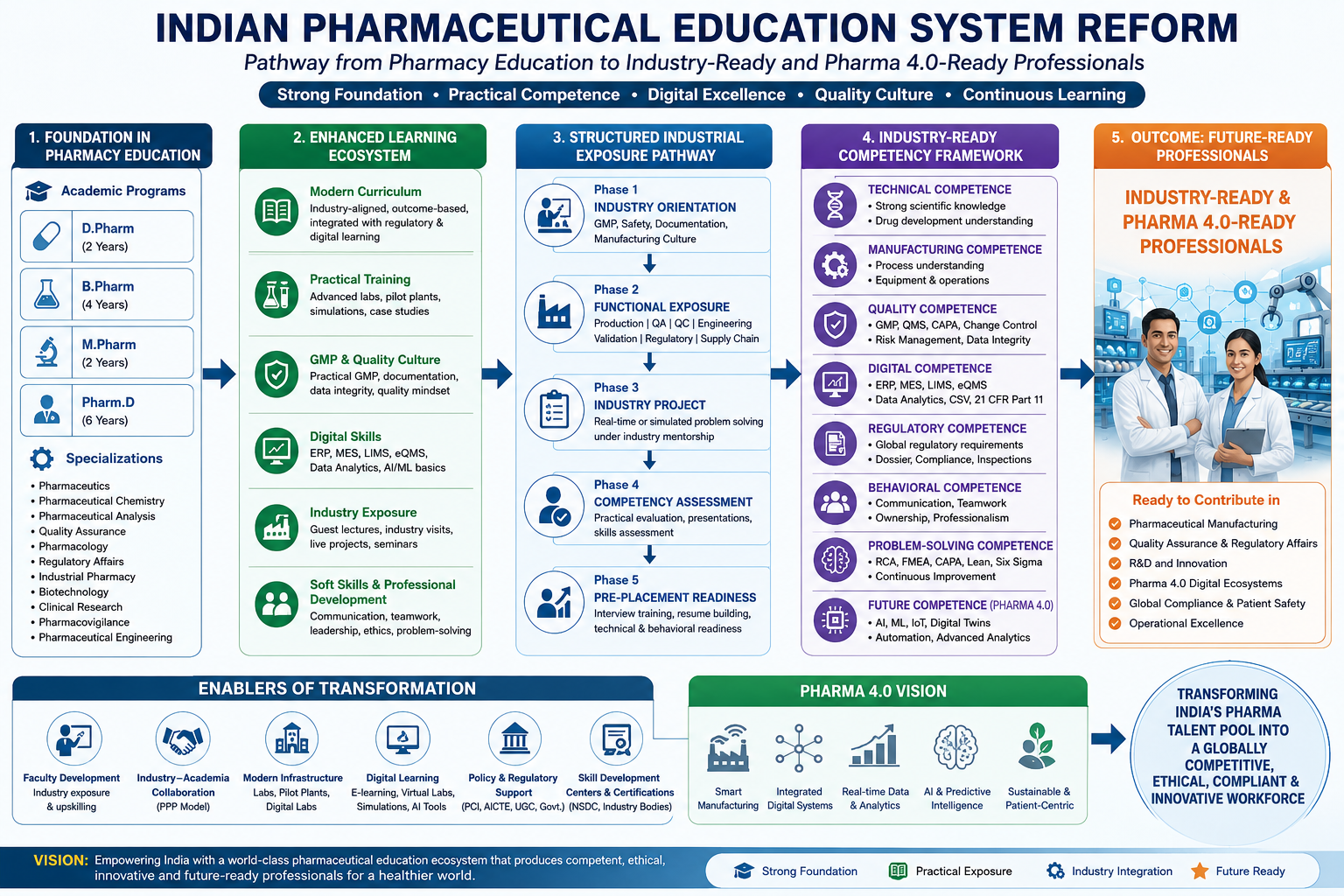
Executive Summary
India has built one of the world’s largest pharmaceutical ecosystems, supported by a substantial base of pharmacists, scientists, engineers, technicians and other professionals. Yet an important question continues to concern students, educators and employers:
Does the Indian pharmaceutical education system adequately prepare graduates for the realities of today’s pharmaceutical industry?
The answer is neither a simple yes nor no.
India’s pharmaceutical education system has important strengths. It provides students with a substantial foundation in pharmaceutics, pharmaceutical chemistry, pharmacology, pharmacognosy, analysis, microbiology and related sciences. It has also evolved over time through regulatory and curricular initiatives.
More importantly, the system is now undergoing a significant transition. The Pharmacy Council of India (PCI) has proposed a revised B.Pharm curriculum for implementation from academic year 2026–27, explicitly emphasizing experiential learning, professional competencies, emerging technologies including AI, projects, internships and industry exposure.
However, the implementation challenge remains.
The pharmaceutical industry does not hire graduates only for what they know. It increasingly expects them to apply knowledge in a controlled, compliant, data-driven and collaborative environment.
A graduate may understand the definition of GMP but struggle to interpret a batch record. The definition of CAPA may be known to them, yet they lack guidance on investigating a recurring deviation. They may understand validation theoretically but have never seen an IQ/OQ/PQ protocol. They may know computers but have no exposure to MES, LIMS, ERP, eQMS, data integrity or CSV.
Therefore, the real requirement is not to replace pharmaceutical education with vocational training.
It is to evolve from predominantly knowledge-based education toward competency-based, experiential and industry-connected education, while protecting the strong scientific foundation on which pharmacy education depends.
1. Introduction
The Indian pharmaceutical industry has transformed dramatically.
Modern pharmaceutical facilities increasingly operate through sophisticated manufacturing systems, automated equipment, electronic records, analytical technologies, quality-management systems and increasingly connected digital platforms. GMP expectations have also become more sophisticated. India’s Schedule M framework, for example, emphasizes documented systems, appropriate premises and equipment, qualified and trained personnel, quality assurance, qualification and validation.
At the same time, global pharmaceutical expectations increasingly emphasize data integrity, risk-based quality management and computerized systems. FDA guidance states that pharmaceutical data must be reliable and accurate, while ICH Q9(R1) places greater emphasis on effective quality-risk decision-making.
This creates an important education challenge.
Can a curriculum designed primarily around academic subjects prepare students for this increasingly integrated environment?
The answer depends heavily on the institution, curriculum, faculty, laboratory infrastructure, industry exposure and the student’s own initiative.
There are excellent institutions producing highly capable graduates. There are also institutions where students may receive limited practical exposure.
Therefore, the discussion should not be framed as:
“Indian pharmacy education is outdated.”
A more accurate question is:
“How can India’s pharmaceutical education system continuously evolve so that scientific knowledge is converted into practical professional competence?”
That is the real challenge.
2. Why This Question Matters
The pharmaceutical industry is different from many other industries because mistakes can directly affect product quality and ultimately patients.
A new employee entering a manufacturing, quality or laboratory environment therefore needs more than technical knowledge.
They need to understand:
- GMP culture
- Good Documentation Practices
- Safety
- Data integrity
- Quality systems
- Cross-functional working
- Risk management
- Problem solving
- Regulatory expectations
- Professional ethics
- Controlled documentation
- Continuous improvement
The industry also operates across increasingly interconnected functions.
Production interacts with QA, QC, engineering, validation, supply chain, IT, regulatory affairs and management.
Consequently, the future pharmaceutical professional needs both functional expertise and systems thinking.
3. Current State of Pharmaceutical Education in India
The Pharmacy Council of India recognizes several principal pharmacy education pathways, including D.Pharm, B.Pharm, B.Pharm (Practice), Pharm.D and M.Pharm under its applicable regulatory framework.
D.Pharm
D.Pharm provides an entry-level pharmaceutical qualification and supports pharmacist-related career pathways.
B.Pharm
B.Pharm provides a broader undergraduate foundation and is particularly important for careers in:
- Production
- QA
- QC
- Regulatory affairs
- Formulation
- Analytical functions
- Sales and marketing
- Research
- Pharmaceutical operations
M.Pharm
M.Pharm enables deeper specialization in selected pharmaceutical disciplines and can support careers in industry, research and academia.
Pharm.D
Pharm.D provides a longer, practice-oriented pathway with greater emphasis on clinical and patient-oriented pharmaceutical services.
Related Disciplines
The wider pharmaceutical talent ecosystem also includes:
- Pharmaceutical biotechnology
- Pharmaceutical chemistry
- Industrial pharmacy
- Regulatory affairs
- Clinical research
- Pharmacovigilance
- Biotechnology
- Pharmaceutical engineering
- Validation
- Data science
- Healthcare technology
The important point is that different qualifications should not necessarily produce identical competencies.
A manufacturing-oriented graduate, regulatory professional, clinical pharmacist and pharmaceutical data specialist require different combinations of knowledge and skills.
4. What the Pharmaceutical Industry Needs Today
The industry’s expectations can be divided into several layers.
4.1 Scientific Competence
The foundation remains essential:
- Pharmaceutics
- Pharmaceutical chemistry
- Pharmacology
- Pharmacognosy
- Microbiology
- Biochemistry
- Pharmaceutical analysis
- Formulation science
- Drug development
Technology should not replace these fundamentals.
Instead, digital and practical education should be built on top of them.
4.2 Manufacturing Competence
A graduate interested in manufacturing should understand how pharmaceutical products are actually produced.
For oral solid dosage manufacturing, this could include exposure to:
Dispensing → Granulation → Drying → Milling → Blending → Compression → Coating → Packing
Students should understand not just what each operation is, but also:
- critical process parameters
- critical quality attributes
- process controls
- equipment principles
- yield
- rejection
- deviations
- line clearance
- documentation
- contamination control
- troubleshooting
The same principle applies to liquid, sterile, biological and other manufacturing environments.
4.3 Quality and GMP Competence
GMP should move beyond textbook definitions.
Students should learn through scenarios such as:
“An operator records a process parameter incorrectly. What should happen?”
or:
“A tablet compression machine produces an unexpected increase in rejection. How should the investigation begin?”
or:
“A laboratory result is outside specification. What is the appropriate investigation approach?”
These exercises teach students how GMP actually works.
Important topics include:
- GMP
- GDP
- GLP
- QMS
- Deviations
- CAPA
- Change Control
- OOS
- OOT
- RCA
- FMEA
- Risk Management
- Data Integrity
- ALCOA principles
- Audit readiness
FDA’s data-integrity guidance reinforces the importance of reliable and accurate pharmaceutical data.
5. The Difference Between Academic Knowledge and Industry Competence
This distinction is central to the entire debate.
| Academic Knowledge | Industry Competence |
|---|---|
| Defines GMP | Applies GMP to a situation |
| Understands deviation terminology | Investigates a deviation |
| Knows CAPA definition | Develops effective CAPA |
| Knows validation stages | Participates in qualification/validation |
| Studies manufacturing | Understands process controls |
| Learns documentation theory | Completes controlled records correctly |
| Studies computers | Uses regulated digital systems appropriately |
| Writes examination answers | Makes risk-based decisions |
| Performs laboratory practicals | Works within laboratory quality systems |
| Studies theory | Solves real operational problems |
This does not mean academic knowledge is inadequate.
It means knowledge and competence are different outcomes.
A strong education system must develop both.
6. Where the Education–Industry Gap Can Occur
The gap varies considerably across institutions.
It is therefore inappropriate to generalize that every pharmacy college has the same problem.
Nevertheless, several recurring areas deserve attention.
| Academic Learning | Industry Requirement |
|---|---|
| Theoretical GMP | Practical GMP application |
| Textbook manufacturing | Industrial process understanding |
| Basic laboratory experiments | Industrial laboratory practices |
| Academic documentation | Controlled GMP documentation |
| Academic project | Industry-oriented problem solving |
| Basic computer literacy | Pharma digital-system literacy |
| Validation theory | Practical qualification/validation understanding |
| Examination assessment | Competency assessment |
| Limited exposure | Structured industry exposure |
| Traditional laboratories | Simulation and digital laboratories |
Research on pharmacy education has identified the importance of strengthening curriculum relevance, practical exposure and employability, while more recent work has examined training needs from the perspectives of students, faculty and industry experts.
7. Where the Current Indian System Performs Well
A balanced assessment must recognize what is already working.
7.1 Strong Scientific Foundation
Indian pharmacy graduates generally receive substantial exposure to core pharmaceutical sciences.
This foundation is valuable throughout a professional career.
7.2 Large Talent Pool
India has developed a significant pharmaceutical education ecosystem capable of supplying talent to manufacturing, research, quality, regulatory and other sectors.
7.3 Established Pharmaceutical Industry
India’s large pharmaceutical manufacturing and research ecosystem creates opportunities for industry exposure and collaboration.
7.4 Evolving Regulatory Curriculum
The current reform direction is particularly important.
PCI’s proposed 2026–27 B.Pharm curriculum explicitly emphasizes experiential learning, professional competencies, emerging technologies, projects, internships and industry exposure.
7.5 NEP 2020 Direction
The broader National Education Policy direction also emphasizes critical thinking, practical learning, internships, employability and stronger education–industry linkages.
Therefore, saying that nothing is changing would be inaccurate.
The system is already moving.
The challenge is making the transformation deep, consistent and measurable.
8. Where the System Needs Improvement
The most important opportunity is to move from curriculum coverage to competency development.
8.1 Practical GMP
Students should not merely memorize GMP terminology.
They should experience simulated:
- Batch documentation
- Line clearance
- Deviation reporting
- CAPA
- Change control
- SOP execution
- Data-integrity scenarios
- Audit interviews
8.2 Validation
Students interested in technical, engineering, QA or validation careers should understand:
- URS
- DQ
- FAT
- SAT
- IQ
- OQ
- PQ
- Process Validation
- Cleaning Validation
- Computer System Validation
The objective should not be to make every graduate a validation engineer.
The objective is to ensure that graduates understand why qualification and validation exist and how they fit into the pharmaceutical quality system.
8.3 Documentation
Good documentation practice deserves much greater practical attention.
A student should know why:
“If it isn’t documented correctly, it may be impossible to demonstrate that the activity was performed correctly.”
9. The Rise of Digital Pharmaceutical Skills
This is one of the largest changes facing pharmaceutical education.
A modern pharmaceutical facility may contain:
- ERP
- SAP
- MES
- LIMS
- eQMS
- eDMS
- SCADA
- HMI
- historians
- manufacturing analytics
- electronic batch records
- computerized laboratory systems
Students do not necessarily need expert-level skills in all these systems.
But graduates should understand:
what these systems do, how they interact, what data they generate, and why data integrity matters.
FDA guidance specifically emphasizes the importance of data reliability and accuracy in drug CGMP environments.
Computerized-system expectations are also embedded in international GMP thinking; EMA and PIC/S have been working on modernization of GMP Annex 11 expectations for computerized systems.
10. Pharma 4.0 and Future Skills
Pharma 4.0 should not be treated as simply another technology subject.
ISPE describes Pharma 4.0 as a broader transformation involving digitalization, connected processes, organizational capabilities, people and regulatory considerations.
Future pharmaceutical professionals may increasingly encounter:
- AI
- Machine Learning
- IoT
- Advanced analytics
- Predictive maintenance
- Digital twins
- PAT
- Robotics
- Automation
- Continuous manufacturing
- Cloud technologies
- Generative AI
However, these should be classified into two groups.
Already Increasingly Relevant
- Data analytics
- Automation
- Digital documentation
- ERP
- MES
- LIMS
- eQMS
- CSV
- Data integrity
- Cybersecurity awareness
Emerging/Future-Oriented
- Generative AI
- Agentic AI
- Digital twins
- Advanced machine learning
- Autonomous manufacturing
- AI-assisted quality systems
ISPE’s recent Pharma 4.0 work highlights AI/ML, IoT, advanced analytics and workforce skill gaps as important elements of the transformation.
Therefore, students should be introduced to these technologies without turning every pharmacy graduate into a software engineer.
11. Faculty Development: The Missing Link
Curriculum reform alone cannot solve the problem.
If the curriculum changes but teaching methods remain unchanged, the result will be limited.
Faculty members should receive opportunities for:
- Industry attachments
- GMP training
- Validation training
- Digital-system exposure
- Regulatory training
- Industry case-study development
- Joint research
- Plant visits
- Professional certifications
- Short-term industrial assignments
An industry-experienced professional should not merely deliver a guest lecture once a year.
Industry experts could participate throughout the learning cycle.
For example:
Faculty + QA Manager + Production Manager + Validation Engineer + Digital Transformation Specialist
could jointly design a semester-long industrial case study.
12. Rethinking Industrial Training and Internships
Traditional internships can sometimes become attendance-oriented exercises.
That model should evolve.
A better structure is:
Phase 1 — Academic Foundation
Scientific and pharmaceutical fundamentals.
Phase 2 — Industrial Orientation
GMP, safety, documentation and pharmaceutical culture.
Phase 3 — Functional Exposure
Production, QA, QC, Engineering, Validation, Regulatory or other relevant functions.
Phase 4 — Industry Project
A defined problem or simulation.
Phase 5 — Competency Assessment
Evaluation of what the student can actually demonstrate.
The objective should shift from:
“Did the student complete the internship?”
to:
“What did the student become capable of doing?”
13. Proposed Industry-Ready Pharma Graduate Model
A future-ready graduate should develop eight competency domains.
| Competency | Expected Capability |
|---|---|
| Scientific | Strong pharmaceutical fundamentals |
| Manufacturing | Understanding of industrial processes |
| Quality | Practical GMP/QMS awareness |
| Digital | Understanding of regulated digital systems |
| Regulatory | Awareness of major regulatory expectations |
| Problem-solving | RCA, CAPA, FMEA and risk-based thinking |
| Behavioural | Communication, teamwork and ownership |
| Future | AI, automation and Pharma 4.0 awareness |
This resembles the broader movement toward competency-based education, where learning outcomes define what learners should actually demonstrate rather than simply what content they have studied. WHO competency frameworks similarly emphasize competency-based approaches and defined professional capabilities.
14. A Future-Ready Pharmaceutical Curriculum
The objective should not be to keep adding subjects indefinitely.
Instead, existing subjects should become more applied.
Core Competencies
- Pharmaceutical sciences
- Pharmaceutics
- Pharmaceutical chemistry
- Pharmacology
- Pharmaceutical analysis
- Microbiology
- Pharmaceutical manufacturing
- GMP
- Quality systems
- Regulatory fundamentals
- Documentation
- Research methodology
Applied Professional Modules
- Deviation and CAPA
- Change Control
- Risk Management
- Validation and Qualification
- Data Integrity
- Computer System Validation
- Audit Readiness
- Lean Manufacturing
- Six Sigma fundamentals
- OEE and operational excellence
- Project Management
- Communication and leadership
Digital and Emerging Electives
- ERP/SAP fundamentals
- MES
- LIMS
- eQMS
- Power BI
- Pharmaceutical data analytics
- AI in pharmaceutical industry
- Pharma 4.0
- Automation
- IoT
- Digital twins
- Advanced manufacturing technologies
Not every student needs all of these.
The curriculum should allow career-oriented specialization.
15. Industry–Academia Collaboration Model
The future ecosystem should connect:
Universities + Pharmacy Colleges + Pharmaceutical Companies + Regulators + Technology Providers + Professional Associations
A practical model could include:
Industry Advisory Boards
Companies review curriculum annually.
Industry-Sponsored Laboratories
Companies and technology providers support realistic simulation environments.
Faculty Industry Attachments
Faculty members spend short periods in pharmaceutical facilities.
Student Industry Projects
Students solve practical problems under controlled conditions.
Industry Certifications
Graduates can earn recognized competency credentials alongside academic qualifications.
Joint Research
Universities and companies collaborate on applied research.
Shared Simulation Centres
Multiple colleges can share advanced pharmaceutical training infrastructure.
16. Should India Create Pharmaceutical Skill Centres?
Yes—provided they complement universities rather than replace them.
A Pharmaceutical Industry Skill Development Centre could provide facilities such as:
- Tablet manufacturing simulation
- Compression and coating simulation
- GMP documentation exercises
- QA/QC laboratories
- Validation laboratories
- SCADA/HMI simulation
- MES/LIMS/eQMS demonstrations
- Data-integrity exercises
- Cleanroom behaviour training
- Mock audits
- Mock regulatory inspections
- Manufacturing troubleshooting
- Digital manufacturing training
Such centres could potentially operate through public-private partnerships involving government, universities, pharmaceutical companies and technology providers.
This would be particularly useful for institutions that cannot independently afford expensive industrial-scale infrastructure.
17. India Compared With Global Approaches
India should not simply copy another country’s pharmacy education model.
Different countries have different healthcare systems, professional roles and regulatory environments.
However, several global principles are worth examining:
| Area | Direction India Can Learn From |
|---|---|
| Practical learning | Stronger experiential components |
| Apprenticeships | Structured work-based learning |
| Industry interaction | Continuous rather than occasional |
| Assessment | Demonstrated competency |
| Digital skills | Earlier exposure |
| Research | Stronger industry-linked projects |
| Faculty development | Greater professional-industry exchange |
| Lifelong learning | Micro-credentials and continuing development |
The key lesson is not that another country is “better.”
The lesson is that education systems must evolve with professional practice.
18. Role of Government and Regulators
Government and regulators can accelerate reform through:
- Competency-based curriculum frameworks
- Industry participation in curriculum design
- Standardized practical assessments
- Modern laboratory requirements
- Faculty-industry development programs
- Digital-learning infrastructure
- Industry-recognized certifications
- Employability measurement
- Internship quality standards
PCI’s 2026 B.Pharm curriculum initiative is particularly significant because it explicitly seeks stronger industry integration and employability while incorporating emerging technologies and flexible learning pathways.
The next challenge, however, is implementation consistency.
In addition, a progressive curriculum on paper will not automatically create progressive graduates.
19. Role of Pharmaceutical Companies
Industry must also accept responsibility.
Companies can contribute through:
- Graduate trainee programs
- Apprenticeships
- Structured internships
- Mentoring
- Sponsored laboratories
- Faculty development
- Industry projects
- Skill academies
- Joint research
- Guest faculty
- Competency assessments
There is a business benefit.
Companies that participate in education can help develop talent according to future requirements and reduce the distance between recruitment and functional readiness.
Instead of saying:
“Colleges are not producing industry-ready graduates.”
companies should also ask:
“What can industry do to help colleges understand the next generation of pharmaceutical work?”
20. Education vs Employability
This debate needs careful handling.
Should universities produce immediately employable employees?
Not exclusively.
A university should produce people who can:
- Think critically
- Understand science
- Solve problems
- Learn independently
- Apply knowledge
- Communicate
- Adapt to change
- Behave ethically
Industry should then provide:
- Site-specific training
- SOP training
- Equipment-specific competence
- Organizational systems
- Role-specific qualification
The ideal model is therefore:
University = Foundation + Competency
Industry = Application + Site-Specific Expertise
Neither can completely replace the other.
21. What Students Should Do Today
Curriculum reform takes time.
Students cannot wait.
For Freshers
Build a foundation in:
- GMP
- Documentation
- Excel
- Pharmaceutical manufacturing
- Data integrity
- Basic validation
- Communication
- Interview skills
For Final-Year Students
Add:
- Industry internships
- Plant visits
- Industry projects
- GMP case studies
- Technical presentations
- Professional certifications
- Excel/Power BI
- Resume and interview preparation
For Working Professionals
Focus on:
- Digital transformation
- Leadership
- Regulatory changes
- Quality systems
- Data analytics
- AI
- Automation
- Operational excellence
The strongest professional profile will increasingly be:
Pharmaceutical knowledge + practical experience + digital capability + problem-solving ability.
22. Five-Year Pharma Education Reform Roadmap
Year 1 — Diagnose
Conduct nationwide and institutional curriculum gap assessments.
Measure:
- Industry expectations
- Graduate competency
- Employer satisfaction
- Laboratory capability
- Faculty industry exposure
Year 2 — Build
Invest in:
- Faculty development
- Laboratories
- Simulation
- Digital infrastructure
- Industry partnerships
Year 3 — Integrate
Implement:
- Industry-designed modules
- Structured internships
- Industry projects
- Digital learning
- Practical GMP programs
Year 4 — Assess
Introduce:
- Competency examinations
- Simulation-based assessment
- Practical case studies
- Digital competency assessment
Year 5 — Institutionalize
Develop a nationally scalable framework for:
Industry-Ready Pharmaceutical Education
Potential KPIs include:
- Graduate employability
- Internship completion and quality
- Industry projects
- Certification rates
- Practical competency scores
- Faculty industry exposure
- Employer satisfaction
- Placement quality
- Graduate retention
23. Pharmaceutical Education Maturity Model
Institutions can assess themselves using five levels.
Level 1 — Traditional Education
Theory-focused
Primarily classroom and examination based.
Level 2 — Practical Education
Laboratory + industrial exposure
More practical learning and plant exposure.
Level 3 — Industry-Linked Education
Industry projects + internships
Companies actively participate in education.
Level 4 — Digital Pharma Education
ERP + MES + LIMS + CSV + analytics + automation
Students understand digital pharmaceutical operations.
Level 5 — Future-Ready Education
AI + Pharma 4.0 + advanced analytics + digital twins + continuous innovation
Education becomes dynamic and continuously connected to industry evolution.
The goal is not for every college to immediately reach Level 5.
The goal is to create a clear pathway for continuous improvement.
24. Hypothetical Case Study: A Pharmacy College Transforms
The following is a hypothetical example and does not represent a real institution.
Initial Situation
A pharmacy college has good faculty and laboratories but receives repeated feedback from employers that graduates lack:
- GMP application
- Documentation skills
- Industrial exposure
- Digital skills
- Problem-solving capability
Year 1
The college establishes an Industry Advisory Board containing:
- Production Manager
- QA Manager
- QC Manager
- Validation specialist
- Regulatory professional
- HR representative
The board identifies 20 competency gaps.
Year 2
The college introduces:
- GMP simulation
- Deviation/CAPA case studies
- Documentation exercises
- Manufacturing simulations
- Power BI basics
- Data-integrity training
Faculty members receive industrial exposure.
Year 3
Students complete structured projects such as:
“Investigation of recurring tablet compression rejection.”
Another team works on:
“Designing a risk assessment for a pharmaceutical process.”
A third team studies:
“Improving OEE through downtime analysis.”
Competency Assessment
Students are evaluated not only through written examinations but also through:
- Case-study analysis
- Documentation exercises
- Oral technical discussions
- GMP scenarios
- Project presentations
- Practical demonstrations
Expected Outcome
After three years, the institution should be able to demonstrate measurable improvement in:
- Practical competency
- Employer satisfaction
- Internship quality
- Industry participation
- Student confidence
- Technical communication
The most important transformation would not be a new building.
It would be a change from:
“What did the student study?”
to:
“What can the student demonstrate?”
25. SWOT Analysis
| Strengths | Weaknesses |
|---|---|
| Strong pharmaceutical science foundation | Theory–practice gap in some institutions |
| Large talent pool | Uneven infrastructure |
| Established pharmacy institutions | Variable industry exposure |
| Large domestic pharmaceutical industry | Variable faculty industry exposure |
| Increasing regulatory attention to curriculum | Digital skills not uniformly embedded |
| Growing research ecosystem | Internship quality can vary |
| Opportunities | Threats |
|---|---|
| India’s pharmaceutical growth | Global competition for talent |
| AI and digital transformation | Skill obsolescence |
| Industry-academia collaboration | Rapid technology changes |
| Pharma 4.0 | Employability challenges |
| Skill centres | Unequal access to advanced infrastructure |
| Micro-credentials | Fragmentation without quality control |
26. What Should Change?
| Current Situation | Required Change | Expected Outcome |
|---|---|---|
| Theory-heavy learning | Competency-based learning | Better employability |
| Limited industrial exposure | Structured internships | Practical competence |
| Traditional laboratories | Simulation/digital laboratories | Industry readiness |
| Limited GMP practice | Practical GMP training | Compliance awareness |
| Basic computer skills | Pharmaceutical digital skills | Digital readiness |
| Examination-focused assessment | Practical competency assessment | Better job readiness |
| Limited industry interaction | Industry advisory boards | Relevant curriculum |
| Limited faculty industry exposure | Faculty industrial assignments | Current teaching |
| Academic projects | Industry-oriented projects | Problem-solving skills |
| Emerging technologies taught theoretically | Applied digital modules | Future readiness |
27. The Most Important Reform: Change the Learning Philosophy
Perhaps the most important reform is not adding another subject.
It is changing the philosophy of education.
Instead of asking:
“Did we complete the syllabus?”
ask:
“Did students develop the competencies required to work safely, ethically and effectively?”
Instead of:
“Did students attend an internship?”
ask:
“What did they learn and demonstrate during the internship?”
Instead of:
“Can students define CAPA?”
ask:
“Can they propose a scientifically justified CAPA for a realistic scenario?”
This is the shift from content delivery to competency development.
28. Final Verdict
So, does the Indian pharmaceutical education system need an upgrade?
Yes—but not a complete replacement.
The statement:
“Indian pharmaceutical education is outdated.”
is too simplistic.
A more accurate conclusion is:
“The Indian pharmaceutical education system has a strong scientific foundation but requires targeted, continuous modernization to remain aligned with rapidly changing pharmaceutical industry practices.”
This distinction is important.
India does not need to discard its existing pharmaceutical education model.
It needs to strengthen it.
The next generation of pharmaceutical education should combine:
Scientific Foundation
+
Practical Competence
+
GMP Culture
+
Quality Systems
+
Digital Capability
+
Problem Solving
+
Industry Exposure
+
Regulatory Awareness
+
Communication & Leadership
+
Lifelong Learning
That combination can create genuinely industry-ready professionals.
29. Author’s Perspective
Pharmaceutical education should not merely produce degree holders.
It should develop professionals capable of contributing safely, ethically, compliantly and effectively to pharmaceutical manufacturing, quality, research, regulatory affairs, healthcare and digital transformation.
The objective should not be to make a graduate an expert on the first day of employment.
That is unrealistic.
The objective should be to ensure that when the graduate enters a pharmaceutical organization, they understand the science, responsibility, quality culture and professional mindset required to learn quickly and contribute effectively.
The industry must then complete that development through structured training and experience.
The future belongs neither exclusively to academia nor exclusively to industry.
It belongs to stronger academia–industry collaboration.
30. Frequently Asked Questions
1. Is pharmaceutical education in India industry-ready?
It is partially industry-ready, but readiness varies considerably among institutions. India’s scientific foundation is strong, while practical, digital and competency-based exposure requires further strengthening. The revised B.Pharm curriculum for 2026–27 represents an important move toward greater experiential learning and industry relevance.
2. Why is there a gap between pharmacy education and industry requirements?
Pharmaceutical manufacturing and quality systems evolve faster than traditional academic teaching. Industry increasingly requires practical GMP, documentation, digital systems, validation, data integrity and problem-solving skills in addition to pharmaceutical science.
3. What skills do pharmaceutical companies expect from fresh graduates?
Common expectations include pharmaceutical fundamentals, GMP awareness, documentation, communication, problem-solving, basic computer skills and functional understanding of production, QA, QC or other relevant areas.
4. Should GMP be taught more practically in pharmacy colleges?
Yes. Students should learn GMP through case studies, simulations, documentation exercises, deviations, CAPA, audit scenarios and realistic manufacturing examples rather than relying only on theoretical definitions.
5. What digital skills should pharmacy students learn?
Students should understand Excel and data analysis first, followed by appropriate exposure to Power BI, ERP/SAP, MES, LIMS, eQMS, eDMS, CSV, data integrity and automation depending on their career path.
6. Is Pharma 4.0 relevant to pharmacy education?
Yes, particularly for students interested in manufacturing, engineering, quality, IT and digital transformation. However, Pharma 4.0 should initially be taught as an interdisciplinary concept rather than as a specialist requirement for every student.
7. How can colleges improve pharmaceutical industry exposure?
They can establish industry advisory boards, structured internships, plant visits, industry projects, faculty attachments, guest teaching, simulation laboratories and joint competency assessments.
8. What should pharmaceutical companies do to support education?
Companies can provide internships, apprenticeships, mentors, industry projects, faculty development, laboratories, guest experts and structured graduate-training programs.
9. What skills should B.Pharm students learn for better jobs?
Along with core pharmacy knowledge, students should develop GMP, documentation, communication, Excel/data skills, practical manufacturing or quality knowledge, problem-solving and an understanding of their chosen career function.
10. How can India create industry-ready pharmaceutical graduates?
India needs coordinated action involving regulators, universities, colleges, pharmaceutical companies, technology providers and professional bodies. The focus should be competency-based learning, industry exposure, practical assessment, digital capability and continuous curriculum modernization.
11. Will AI replace pharmaceutical professionals?
AI is more likely to transform many pharmaceutical roles than simply eliminate them. Therefore, professionals who combine pharmaceutical knowledge with data, digital and AI literacy are better positioned for the changing workplace.
12. Should every pharmacy student learn advanced AI and digital technologies?
No. Every student should develop basic digital literacy and awareness, while advanced AI, analytics, automation and digital systems can be offered according to career interests and specialization.
13. Should colleges become pharmaceutical training centres?
Not completely. Universities and colleges should provide scientific education, critical thinking and foundational competencies. Industry should provide site-specific training and operational experience.
14. What is the biggest change needed in Indian pharmaceutical education?
The biggest change is moving from content-focused education toward competency-focused education—without weakening pharmaceutical science fundamentals.
Conclusion
The question is not whether Indian pharmaceutical education should be “replaced.”
The better question is:
How can India evolve its pharmaceutical education system fast enough to match the changing pharmaceutical workplace?
The answer lies in integration.
India needs pharmaceutical professionals who understand science and manufacturing; GMP and technology; quality and data; regulations and risk; operations and problem-solving.
The scientific foundation must remain strong.
But around that foundation, education needs to become more practical, experiential, digitally aware and industry connected.
The recent direction of PCI’s NEP-aligned B.Pharm curriculum—including experiential learning, emerging technologies, projects, internships and industry exposure—suggests that this transition has already begun.
The next challenge is implementation at scale.
If India can connect education + industry + regulation + technology + competency development, its enormous pharmaceutical talent pool can become a significant competitive advantage.
The ultimate goal should be simple:
Do not produce graduates who merely know about the pharmaceutical industry. Produce graduates who are prepared to learn, contribute and grow within it.
That is how India can transform its large pharmaceutical talent pool into a globally competitive, industry-ready and future-ready workforce.
Selected References and Authoritative Sources
- Pharmacy Council of India — B.Pharm curriculum and regulatory information.
- Pharmacy Council of India — NEP-aligned B.Pharm curriculum and curriculum reform information.
- Government of India, Ministry of Education — National Education Policy and employability/industry-academia direction.
- CDSCO — Schedule M, Good Manufacturing Practices and requirements for pharmaceutical premises, plant and equipment.
- U.S. FDA — Data Integrity and Compliance With Drug CGMP.
- ICH — Quality Risk Management Q9(R1).
- EMA/PIC/S — Computerized Systems and GMP Annex 11 modernization.
- ISPE — Pharma 4.0 framework and digital transformation guidance.
- ISPE — Recent Pharma 4.0 digital transformation and workforce considerations.
- WHO — Competency-based education and competency frameworks.
- Peer-reviewed literature on pharmacy education and curriculum/employability challenges in India.
About the Author
Ramesh Palav is a pharmaceutical manufacturing and quality professional with 21+ years of industry experience across pharmaceutical manufacturing, GMP, qualification and validation, QMS, compliance, CSV, audits, and operational excellence. With hands-on experience in OSD manufacturing, digital transformation and Pharma 4.0, he is passionate about strengthening pharmaceutical education, developing industry-ready talent, and promoting collaboration between academia and the pharmaceutical industry.
Published on: 19/08/2026