
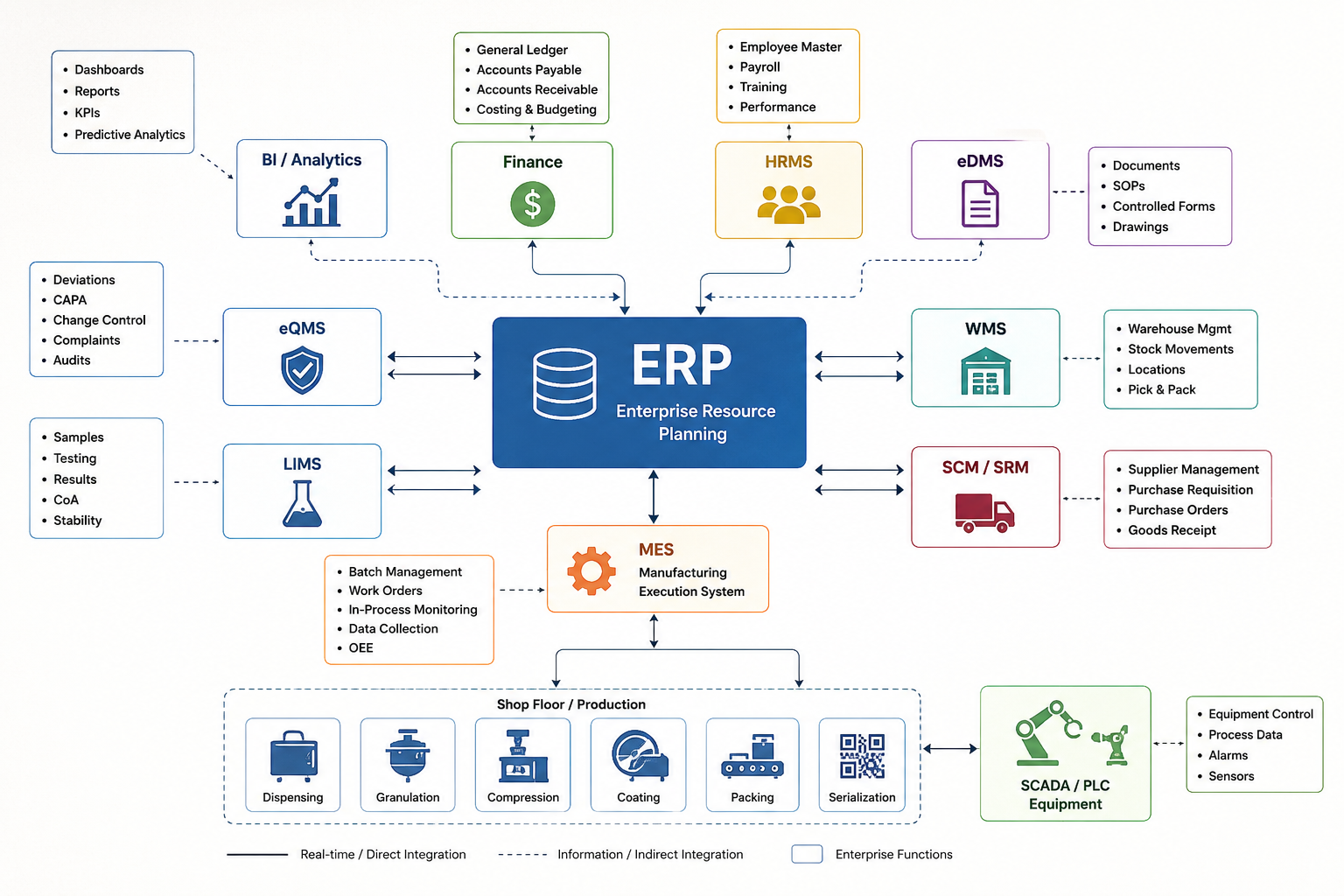
ERP System in Pharmaceutical Industry is no longer limited to finance, purchasing, or inventory control. In a modern pharmaceutical manufacturing organization, an ERP platform can connect demand planning, procurement, material management, production planning, warehouse operations, quality-related controls, supply chain, sales, finance, maintenance, master data, and management analytics.
For pharmaceutical companies, however, ERP implementation is fundamentally different from implementing an ordinary enterprise software platform. Pharmaceutical ERP processes may influence GMP operations, material status, batch traceability, electronic records, inventory decisions, production planning, costing, distribution, and data integrity. Consequently, the technology must be designed and governed within an appropriate quality, validation, cybersecurity, data-governance, and change-control framework.
An ERP system does not automatically make a pharmaceutical company GMP compliant. Compliance depends on the intended use of the system, configuration, procedures, controls, validation or assurance activities, user access, data governance, training, change management, supplier oversight, and ongoing lifecycle management.
This guide explains ERP in the pharmaceutical industry from basic concepts through advanced implementation, validation, data integrity, system integration, and Pharma 4.0.
1. Introduction to ERP Systems
A pharmaceutical organization operates through a complex network of interconnected activities.
A typical tablet manufacturing site may need to coordinate:
Demand → Planning → Procurement → Warehouse → Dispensing → Manufacturing → Quality → Release → Distribution → Finance
Historically, these activities were often managed through a combination of spreadsheets, standalone applications, paper records, emails, local databases, and departmental systems. Such an environment can create information silos and make it difficult to obtain a consistent enterprise-wide view.
An ERP system provides an integrated platform for managing many of these business processes.
The important word is integrated.
Instead of maintaining separate information about materials, vendors, production orders, inventory, customers, costs, and financial transactions, ERP creates a connected transaction environment in which information can move between business functions according to defined workflows and controls.
For pharmaceutical companies, this integration can provide significant operational value—but it must be implemented with pharmaceutical process knowledge rather than simply copying a generic ERP template.
2. What Is an ERP System?
ERP stands for Enterprise Resource Planning.
An ERP system is an integrated software platform used to manage and coordinate an organization’s resources and business processes.
Depending on the implementation, an ERP platform can manage:
- Materials
- Procurement
- Production planning
- Manufacturing transactions
- Inventory
- Warehouses
- Supply chain
- Sales
- Finance
- Maintenance
- Human resources
- Master data
- Reporting
- Business analytics
The fundamental principle is to create a single, controlled flow of enterprise information rather than isolated departmental data.
Simple example
Suppose a pharmaceutical company needs to manufacture 100,000 tablets.
The ERP may determine:
- What quantity must be manufactured
- Which raw materials are required
- Which packaging materials are required
- When materials are required
- Whether materials are available
- Whether procurement is necessary
- Which production order should be created
- What inventory will be consumed
- What finished-goods quantity will be produced
- What financial transactions should be generated
However, the ERP may not be the system responsible for every manufacturing activity.
Detailed equipment execution, laboratory testing, electronic batch execution, or quality workflows may reside in specialized systems such as MES, LIMS, eQMS, or SCADA.
3. What Does ERP Stand For?
ERP means Enterprise Resource Planning.
The three words are important:
- Enterprise: The system connects multiple business functions.
- Resource: It manages resources such as materials, money, people, capacity, suppliers, and inventory.
- Planning: It helps organizations plan and coordinate activities.
In pharmaceutical manufacturing, ERP therefore becomes an important enterprise-level platform rather than merely an accounting application.
4. How Does an ERP System Work?
An ERP normally operates around a centralized database or integrated data architecture.
A simplified transaction flow is:
Master Data → Transaction → Workflow → Validation/Control → Approval → Posting → Reporting
For example:
- Material master is created.
- Demand is entered.
- MRP calculates requirements.
- Purchase requisition is generated.
- Purchase order is created.
- Material is received.
- Inventory is updated.
- Quality status may be controlled through configured status-management processes.
- Material becomes available for an authorized business process.
- Production consumes the material.
- Finished goods are recorded.
- Sales and distribution processes are executed.
- Financial postings are generated.
The quality of this flow depends heavily on master data quality, configuration, user roles, workflow design, interfaces, and governance.
5. Why Is ERP Important in the Pharmaceutical Industry?
Pharmaceutical manufacturing combines:
- High regulatory expectations
- Complex material requirements
- Batch manufacturing
- Expiry and shelf-life control
- Supplier qualification
- Quality status management
- Traceability requirements
- Production scheduling
- Multiple manufacturing stages
- Packaging operations
- Distribution controls
- Financial requirements
- Data-integrity expectations
ERP can help connect these processes.
For example, a raw material may have:
- Material number
- Description
- Specification reference
- Vendor
- Batch/lot number
- Manufacturing date
- Expiry/retest date
- Quantity
- Storage location
- Inventory status
- Purchase information
- Cost
- Usage history
If this information is fragmented across systems, visibility becomes difficult.
A properly designed pharmaceutical ERP system can provide a structured enterprise record of material transactions and related business processes.
FDA CGMP requirements include controls around production, records, components, laboratory controls, and related manufacturing activities, making reliable computerized processes and records important where ERP supports regulated operations.
6. Key ERP Modules Used in Pharmaceutical Companies
6.1 Production Planning
Purpose
Production Planning determines what should be produced, when it should be produced, and what resources and materials are required.
Pharmaceutical functions
- Demand planning
- MRP
- Production orders
- Capacity planning
- Material availability
- Schedule planning
- Batch planning
- Production confirmations
- Planned versus actual production
Example
A company receives demand for 10 million tablets.
ERP can calculate:
- Number of batches required
- Active ingredient requirement
- Excipients
- Packaging components
- Planned manufacturing dates
- Required capacity
- Material availability
GMP relevance
Production planning may affect controlled manufacturing activities, but planning software itself does not replace approved master production records, SOPs, batch records, or quality controls.
6.2 Manufacturing
Manufacturing functionality may manage:
- Production orders
- Bills of material
- Recipes/formulas
- Routings
- Work centers
- Material consumption
- Yield
- Production confirmations
- Batch information
- Production costing
For an OSD facility, ERP may represent the enterprise-level production structure for:
Dispensing → Granulation → Compression → Coating → Packing
Detailed execution may instead be managed through MES or other manufacturing systems.
6.3 Procurement
ERP procurement functions typically include:
- Purchase requisition
- Request for quotation
- Supplier selection
- Purchase order
- Contract management
- Goods receipt
- Invoice processing
- Supplier performance
Pharmaceutical use case
If MRP identifies insufficient lactose for an upcoming batch:
MRP → Purchase Requisition → Approval → Purchase Order → Supplier → Goods Receipt → Quality/Status Process → Inventory
Supplier qualification and quality approval remain organizational quality processes. ERP can enforce approved supplier/status rules when appropriately configured.
6.4 Inventory Management
ERP for inventory management can control:
- Material quantities
- Batch/lot numbers
- Storage locations
- Stock status
- Expiry/retest dates
- Reservations
- Material movements
- Consumption
- Adjustments
- Transfers
This is especially important for pharmaceutical raw materials and packaging materials.
6.5 Warehouse Management
A WMS may provide more detailed warehouse execution than the ERP core.
Typical processes include:
- Receiving
- Put-away
- Bin management
- Picking
- Material staging
- Dispensing support
- Cycle counting
- Stock transfer
- Barcode scanning
- Dispatch
ERP and WMS integration should ensure that inventory transactions remain synchronized.
6.6 Supply Chain Management
ERP supports the broader supply chain through:
- Demand forecasting
- MRP
- Procurement
- Inventory planning
- Supplier management
- Production planning
- Distribution
- Order fulfillment
A connected system can provide better visibility from supplier to customer.
6.7 Quality Management
Depending on the ERP platform and implementation scope, quality-related functions may include:
- Inspection planning
- Material status
- Quality notifications
- Supplier quality information
- Inspection results integration
- Nonconformance workflows
- Quality-related approvals
However, a pharmaceutical organization should not assume that ERP replaces an eQMS.
Complex:
- Deviations
- CAPA
- Change controls
- Complaints
- Audits
- Training
- Quality risk management
may be better managed in a dedicated eQMS.
6.8 Finance and Accounting
Finance is one of the traditional ERP strengths.
Functions include:
- General ledger
- Accounts payable
- Accounts receivable
- Cost accounting
- Asset accounting
- Budgeting
- Product costing
- Cash management
- Financial reporting
ERP connects operational transactions to financial consequences.
For example:
Material receipt → Inventory value → Invoice → Accounts payable
and:
Production consumption → Manufacturing cost → Finished-goods valuation
6.9 Sales and Distribution
Functions include:
- Sales orders
- Customer master
- Pricing
- Delivery
- Shipment
- Invoicing
- Returns
- Distribution
Pharmaceutical organizations may also require integration with serialization, track-and-trace, and regulatory systems depending on market and product requirements.
6.10 Maintenance
ERP maintenance functionality can include:
- Equipment master
- Preventive maintenance
- Work orders
- Spare parts
- Maintenance history
- Maintenance cost
- Downtime records
A dedicated CMMS/EAM may provide deeper asset-management capability.
6.11 Human Resources
HR integration can provide:
- Employee master
- Organization structure
- Training information
- Time and attendance
- Payroll integration
- Role information
For GMP environments, training management often requires more specialized capabilities through an LMS/eQMS.
6.12 Regulatory and Compliance-Related Functions
ERP may support compliance-related controls through:
- Controlled workflows
- Role-based access
- Audit trails
- Electronic approvals
- Status controls
- Traceability
- Record retention
- Change control
But regulatory compliance is an organizational system, not a software feature.
6.13 Master Data Management
Master data includes:
- Materials
- Vendors
- Customers
- BOMs
- Recipes
- Routings
- Work centers
- Storage locations
- Units of measure
- Procurement parameters
- Shelf-life information
Poor master data can make an excellent ERP system perform badly.
6.14 Reporting and Analytics
ERP analytics can provide:
- Inventory dashboards
- Production performance
- Procurement performance
- Supplier performance
- Cost analysis
- Sales performance
- Working capital
- Forecast accuracy
- Management dashboards
Modern ERP environments can also connect with enterprise BI platforms and data lakes.
7. ERP Modules and Pharmaceutical Applications
| ERP Module | Pharmaceutical Application | Typical Data |
|---|---|---|
| Production Planning | Batch and capacity planning | Planned orders, quantities |
| Manufacturing | Production transactions | Orders, consumption, yield |
| Procurement | RM/PM purchasing | PO, supplier, receipt |
| Inventory | Batch and stock control | Lot, quantity, status |
| Warehouse | Material movement | Bin, picking, transfer |
| Supply Chain | End-to-end planning | Demand, supply |
| Quality | Quality-related controls | Status, inspection data |
| Finance | Cost and accounting | GL, cost, invoice |
| Sales | Order and distribution | Sales orders |
| Maintenance | Equipment management | Work orders |
| HR | Employee information | Employee master |
| Analytics | Decision support | KPIs, trends |
8. ERP and Pharmaceutical Manufacturing: Practical Example
Consider a tablet manufacturing company receiving a forecast for 10 million tablets.
The process could look like this:
Step 1 — Demand Forecast
Sales and supply chain enter expected demand.
Step 2 — MRP
ERP calculates:
- Active ingredient
- Excipients
- Packaging materials
- Required quantities
- Lead times
- Existing inventory
- Purchase requirements
Step 3 — Procurement
The system generates purchase requisitions and purchase orders where appropriate.
Step 4 — Material Receipt
Materials arrive and are recorded.
ERP captures:
- Material
- Quantity
- Batch/lot
- Vendor
- Receipt date
- Storage location
- Status
Step 5 — Quality Status
Where applicable, material remains under the organization’s defined quality status process until authorized for use.
This is an important example of why ERP should be integrated with quality processes rather than treated as an independent purchasing application.
Step 6 — Production Planning
ERP creates or supports production planning for the required batches.
Step 7 — Manufacturing
Production orders are executed.
Detailed shop-floor execution may be handled by MES.
Step 8 — Material Consumption
Approved materials are issued and consumption is recorded.
Step 9 — Finished Goods
Production output is recorded.
Step 10 — Quality Release
Quality processes determine whether the batch can be released according to approved procedures.
Step 11 — Distribution
Released product becomes available for authorized distribution processes.
Step 12 — Finance
Material consumption, production costs, inventory valuation, sales, and invoices generate corresponding financial transactions.
The overall architecture is therefore:
Demand → MRP → Procurement → Receipt → Quality Status → Production → Finished Goods → Release → Distribution → Finance
9. ERP and GMP
ERP can support GMP, but it does not create GMP compliance by itself.
The distinction is critical.
ERP functionality
Examples include:
- User access
- Workflow
- Batch/lot tracking
- Status control
- Audit trail
- Electronic approval
- Inventory control
- Transaction history
GMP-controlled processes
These include:
- SOPs
- Training
- Quality oversight
- Validation
- Change control
- Deviation management
- Data governance
- Periodic review
- Supplier qualification
- Record retention
Therefore:
ERP is a technology platform supporting controlled processes; it is not a substitute for the pharmaceutical quality system.
FDA guidance emphasizes the relationship between electronic records and applicable CGMP predicate requirements, including the need to maintain reliable records and apply appropriate controls to computerized systems.
10. ERP and Data Integrity in Pharmaceutical Manufacturing
Data integrity is one of the most important considerations when ERP supports GxP-relevant processes.
The commonly used ALCOA+ principles are:
- Attributable
- Legible
- Contemporaneous
- Original
- Accurate
- Complete
- Consistent
- Enduring
- Available
FDA’s drug CGMP data-integrity guidance addresses the importance of reliable and trustworthy data throughout the data lifecycle.
How ERP can support data integrity
User identification
Every transaction should be attributable to an authorized user.
Role-based access
Users should receive only the access necessary for their responsibilities.
Audit trails
Where applicable, system records should preserve information about changes.
Electronic approvals
Approvals can be linked to authorized individuals and controlled workflows.
Master data controls
Changes to materials, vendors, recipes, and other critical master data should be governed.
Transaction history
ERP can preserve the sequence of business transactions.
Backup and recovery
Appropriate backup and restoration controls help protect records.
Interface controls
Interfaces between ERP, MES, LIMS, WMS and other systems must preserve data accuracy and completeness.
Common ERP Data-Integrity Risks
| Risk | Potential Impact | Control |
| Shared accounts | Loss of attribution | Individual accounts |
| Excessive privileges | Unauthorized transactions | RBAC |
| Uncontrolled master data | Incorrect planning/production | Master-data governance |
| Manual data entry | Transcription errors | Automation and verification |
| Weak audit-trail review | Changes may go unnoticed | Risk-based review |
| Poor interfaces | Data mismatch | Interface validation/testing |
| Weak passwords | Unauthorized access | Security controls |
| Poor segregation of duties | Conflict of interest | SoD controls |
FDA’s CGMP materials specifically address computerized systems, electronic records, access, controls, and data reliability.
11. ERP Validation in the Pharmaceutical Industry
Not every ERP function has the same GxP impact.
The correct question is not:
“Is ERP software validated?”
The better question is:
“What is the intended use of this configured ERP environment, and what level of assurance is appropriate for the risks associated with that intended use?”
For a pharmaceutical organization, ERP validation/assurance should be risk-based.
WHO’s GMP resources include guidance on validation and computerized systems, while ISPE GAMP 5 provides industry good-practice guidance for risk-based approaches to GxP computerized systems.
Typical ERP Validation Lifecycle
GxP Impact Assessment
↓
URS
↓
Risk Assessment
↓
Functional/Configuration Requirements
↓
Design & Configuration
↓
Testing
↓
Traceability
↓
Release
↓
Operation
↓
Change Control
↓
Periodic Review
11.1 GxP Impact Assessment
Determine:
- What processes are supported?
- What records are generated?
- Does the system affect product quality?
- Does it affect patient safety?
- Does it support regulated records?
- Does it influence GMP decisions?
- Does it interface with other GxP systems?
11.2 User Requirements Specification
The URS should define intended business and compliance needs.
Examples:
- Batch traceability
- User authentication
- Material status control
- Audit trail
- Electronic approval
- Role-based access
- Data retention
- Reporting
- Interface requirements
11.3 Risk Assessment
Risk assessment should identify:
- Critical processes
- Critical data
- Failure modes
- Potential product-quality impact
- Data-integrity risks
- Business risks
Testing should be proportionate to risk.
11.4 Vendor Assessment
Assess:
- Supplier quality system
- Development practices
- Security
- Documentation
- Support
- Change management
- Release practices
- Incident management
- Business continuity
- Cloud controls where applicable
Supplier documentation can reduce duplication, but it does not eliminate the regulated organization’s responsibility to establish that the system is fit for its intended use.
GAMP 5 Second Edition specifically emphasizes supplier involvement, critical thinking, modern development methods, cloud computing, automation, and risk-based approaches.
11.5 Testing
Testing may include:
- Functional testing
- Configuration testing
- Negative testing
- Boundary testing
- Security testing
- Interface testing
- Data migration testing
- Workflow testing
- Report testing
- Audit-trail testing
- Backup/restore testing
11.6 IQ, OQ and PQ
Traditional terminology may still be used depending on the company’s validation methodology.
IQ — Installation Qualification
Confirms appropriate installation/configuration of relevant components.
OQ — Operational Qualification
Demonstrates operation against specified functional requirements and defined limits.
PQ / Business Process Verification
Demonstrates that the configured system supports intended business processes in the actual operating environment.
Modern lifecycle approaches may use different terminology and testing strategies. The objective should remain documented assurance that the system is fit for intended use and appropriately controlled.
11.7 Traceability Matrix
A typical matrix links:
URS → Risk → Requirement → Test → Result → Defect → Resolution
This demonstrates that critical requirements have been addressed.
11.8 Data Migration Validation
Data migration is frequently underestimated.
Critical data may include:
- Material master
- Vendor master
- Customer master
- BOM
- Recipes
- Inventory
- Batch information
- Open orders
- Financial balances
Migration controls should address:
- Data mapping
- Extraction
- Transformation
- Loading
- Reconciliation
- Completeness
- Accuracy
- Exception handling
- Approval
11.9 Periodic Review
After go-live, the system remains under lifecycle control.
Periodic review should consider:
- Changes
- Incidents
- Deviations
- Security events
- Audit findings
- User-access reviews
- System performance
- Supplier changes
- Regulatory changes
- Validation status
12. Regulatory Requirements Relevant to Pharmaceutical ERP
Several frameworks may be relevant depending on jurisdiction and intended use.
FDA 21 CFR Part 11
21 CFR Part 11 addresses electronic records and electronic signatures within its scope. FDA’s Part 11 guidance explains the scope and application of the regulation, including electronic records that are created, modified, maintained, archived, retrieved, or transmitted under applicable record requirements.
EU GMP Annex 11
EU GMP Annex 11 addresses Computerised Systems within the EU GMP framework. The European Commission lists Annex 11 separately from Annex 15, which covers qualification and validation.
Part 11 and Annex 11 should not be treated as identical regulations. They originate in different regulatory frameworks and should be assessed according to the jurisdiction and applicable requirements.
GAMP 5
GAMP 5 is an industry good-practice guidance framework, not a regulation. ISPE describes GAMP as a risk-based approach intended to support computerized systems that are fit for intended use and compliant with applicable regulations.
PIC/S
PIC/S provides international guidance and recommendations for pharmaceutical inspectors. Its publications include guidance on good practices for data management and integrity in regulated GMP/GDP environments.
WHO GMP
WHO provides international GMP and data-management guidance, including material addressing computerized systems and validation.
13. ERP Architecture in a Pharmaceutical Organization
A conceptual pharmaceutical digital architecture may look like this:
                         ENTERPRISE
                            │
                           ERP
       ┌───────────────┬────┼────┬───────────────┐
       │               │    │    │               │
     WMS             LIMS  eQMS MES            HRMS
       │                    │    │
       │                    │  SCADA
       │                    │    │
       │                    │  PLC
       │                    │    │
       │                    │ Equipment
       │
       └────────── Data / Integration Layer ──────────┐
                                                       │
                                      BI / Data Lake / AI
ERP ↔ MES
ERP typically provides:
- Production orders
- Material requirements
- Planning information
MES may return:
- Production execution
- Actual quantities
- Equipment/process data
- Electronic batch information
- Manufacturing status
ERP ↔ LIMS
ERP may send:
- Material/batch information
- Sample-related information
LIMS may return:
- Laboratory results
- Testing status
- Release-related information
ERP ↔ eQMS
Integration may involve:
- Quality status
- Quality events
- Approved workflows
- Reference information
ERP ↔ WMS
Integration may cover:
- Inventory
- Bin/location
- Picking
- Receiving
- Transfers
ERP ↔ Data Lake/BI
ERP transactions can become a source for:
- Dashboards
- Trend analysis
- Forecasting
- Business intelligence
- AI analytics
The exact architecture depends on the company’s process design and system landscape.
14. ERP vs MES vs LIMS vs eQMS vs WMS vs SCADA vs eDMS
| System | Primary Purpose | Main Users | Typical Data |
| ERP | Enterprise resource management | Business functions | Materials, orders, finance |
| MES | Manufacturing execution | Production | Operations, batches, equipment |
| LIMS | Laboratory management | QC/Lab | Samples, tests, results |
| eQMS | Quality management | QA/QC | Deviations, CAPA, change |
| WMS | Warehouse execution | Warehouse | Bins, movements, picking |
| SCADA | Process monitoring/control | Engineering/Production | Process/equipment data |
| eDMS | Document management | All functions | SOPs, records, documents |
ERP vs MES
ERP = What should the enterprise plan and procure?
MES = What is happening on the manufacturing floor?
ERP vs LIMS
ERP = Enterprise material/business transactions
LIMS = Laboratory testing and laboratory data
ERP vs eQMS
ERP = Enterprise processes and transactions
eQMS = Quality processes and quality records
A well-designed pharmaceutical digital ecosystem does not try to force every function into one application.
15. Role of ERP in Pharma 4.0
Pharma 4.0 represents the movement toward connected, intelligent, data-driven pharmaceutical operations.
ERP can act as an enterprise-level component of this ecosystem.
Key technologies include:
- IoT
- Cloud computing
- AI
- Machine learning
- Advanced analytics
- Digital twins
- Automation
- Real-time dashboards
- Mobile applications
- Intelligent workflows
- Predictive analytics
The strategic architecture becomes:
Connected Equipment → Connected Manufacturing → Connected Quality → Connected Supply Chain → Connected Enterprise
ERP can provide the enterprise context required to turn operational information into business decisions.
For example:
Equipment signal → MES → ERP production status → Supply-chain impact → Management dashboard
16. AI and ERP: Future of Pharmaceutical ERP
AI can enhance ERP decision support, but pharmaceutical organizations should distinguish between practical applications and emerging possibilities.
Current/practical opportunities
Demand forecasting
AI models can analyze historical demand, seasonality, market patterns, and other approved data sources.
Inventory optimization
AI can identify patterns in consumption and help planners evaluate inventory requirements.
Procurement analytics
AI can support supplier-risk analysis and purchasing decisions.
Intelligent reporting
Natural-language analytics can make ERP information easier for users to interrogate.
Anomaly detection
Algorithms can identify unusual transaction patterns for human review.
Emerging applications
- AI-assisted production planning
- Predictive supply-chain risk
- AI-assisted quality trend analysis
- Intelligent maintenance integration
- Digital twins
- Autonomous decision-support workflows
AI should not be treated as automatically reliable merely because it is connected to ERP.
For GxP-relevant applications, organizations need appropriate controls for intended use, data quality, model performance, human oversight, change management, and assurance.
ISPE’s current GAMP 5 framework explicitly discusses modern technologies including cloud computing, AI/ML, automation, and software tools.
17. Cloud ERP vs On-Premise ERP
| Factor | Cloud ERP | On-Premise ERP |
| Architecture | Hosted by provider | Company-controlled infrastructure |
| Initial infrastructure | Lower | Higher |
| Scalability | Generally easier | Requires infrastructure planning |
| Updates | Provider-managed | Organization-managed |
| Customization | Often more controlled | Generally greater flexibility |
| Data control | Shared responsibility | Greater infrastructure control |
| Disaster recovery | Provider capabilities + customer responsibilities | Customer responsibility |
| Cybersecurity | Shared responsibility | More direct responsibility |
| Validation | Requires supplier/cloud assessment and customer assurance | Requires infrastructure and application controls |
| Maintenance | Provider-led | Organization-led |
| Implementation | Potentially faster | Potentially longer |
| Integration | API/cloud integration | Enterprise integration |
| Long-term cost | Subscription/TCO dependent | Infrastructure + license + support |
| Upgrade management | Frequent/provider-controlled | Customer-controlled |
There is no universal answer that cloud is better or on-premise is better.
The appropriate choice depends on:
- Business model
- Regulatory strategy
- IT capability
- Security architecture
- Site requirements
- Integration needs
- Data governance
- Supplier capability
- Total cost of ownership
18. ERP Implementation in Pharma: Step-by-Step Roadmap
Phase 1 — Business Case
Define:
- Business problem
- Objectives
- Expected benefits
- Scope
- Budget
- Governance
Phase 2 — Stakeholder Identification
Include:
- Production
- QA
- QC
- Supply Chain
- Warehouse
- Procurement
- Finance
- Engineering
- IT
- CSV/Validation
Phase 3 — Current-State Assessment
Map current processes.
Ask:
- Where is data created?
- Where is data duplicated?
- Where are spreadsheets used?
- Where are manual approvals used?
- Where are quality risks?
- Where are integration gaps?
Phase 4 — Gap Analysis
Compare:
Current State vs Desired State
Phase 5 — URS
Define business, technical, regulatory, security, reporting, and integration requirements.
Phase 6 — Vendor Evaluation
Assess:
- Functionality
- Pharma experience
- Architecture
- Integration
- Supplier quality
- Security
- Validation support
- Support model
- TCO
Phase 7 — Solution Design
Design:
- Processes
- Roles
- Workflows
- Interfaces
- Master data
- Reporting
Phase 8 — Configuration
Configure the selected platform according to approved requirements.
Phase 9 — Master Data Preparation
Clean:
- Material master
- Vendor master
- BOMs
- Recipes
- Routings
- Inventory
- Customers
Phase 10 — Integration
Connect:
- MES
- LIMS
- eQMS
- WMS
- HRMS
- BI
- Serialization systems
Phase 11 — Testing
Execute risk-based testing.
Phase 12 — Validation/Assurance
Complete applicable assurance activities.
Phase 13 — Training
Train:
- End users
- Super users
- Administrators
- Support personnel
Phase 14 — Data Migration
Migrate approved data and reconcile results.
Phase 15 — Go-Live Readiness
Assess:
- Open defects
- Data
- Training
- Infrastructure
- Support
- Business continuity
- Validation status
Phase 16 — Go-Live
Move to production operation.
Phase 17 — Hypercare
Provide intensive post-go-live support.
Phase 18 — Continuous Improvement
Use:
Measure → Analyze → Improve → Control
19. Common ERP Implementation Challenges
| Problem | Impact | Recommended Solution |
| Poor master data | Planning/inventory errors | Data governance |
| Resistance to change | Low adoption | Change management |
| Poor requirements | Rework | Strong URS |
| Excessive customization | Cost and validation burden | Prefer controlled standard functionality |
| Integration complexity | Data mismatch | Interface architecture and testing |
| Migration errors | Incorrect transactions | Reconciliation and validation |
| Inadequate testing | Production failures | Risk-based testing |
| Poor training | User errors | Role-based training |
| Validation gaps | Compliance risk | Early QA/CSV involvement |
| Scope creep | Cost/time increase | Strong governance |
| Poor vendor management | Delays | Contractual governance |
| Cybersecurity weaknesses | Security/data risk | Security-by-design |
20. Pharmaceutical ERP Master Data
Master data is the foundation of ERP.
Important pharmaceutical master data includes:
Material Master
- Material code
- Description
- Unit of measure
- Storage requirements
- Shelf life
- Procurement parameters
- Planning parameters
Vendor Master
- Supplier identity
- Purchasing data
- Payment information
- Qualification status where integrated
Customer Master
- Customer information
- Distribution information
- Commercial terms
Bill of Materials
Defines components required for production.
Recipes
Define formulation or manufacturing requirements where supported.
Routings
Define process steps and work centers.
Work Centers
Represent manufacturing resources.
Storage Locations
Identify where materials are stored.
Batch Information
Supports lot/batch-level traceability.
Poor master data can result in:
- Incorrect MRP
- Wrong material consumption
- Inventory discrepancies
- Procurement problems
- Incorrect costing
- Production delays
- Reporting errors
Therefore:
ERP implementation is often a master-data transformation project as much as a software implementation project.
21. ERP KPIs for Pharmaceutical Organizations
Inventory Accuracy
Inventory Accuracy (%) = Accurate Inventory Records ÷ Total Inventory Records × 100
Forecast Accuracy
One commonly used approach is:
Forecast Accuracy (%) = 100 − Forecast Error (%)
The organization should define the specific error methodology consistently.
Production Plan Adherence
Plan Adherence (%) = Actual Production Completed as Planned ÷ Planned Production × 100
OTIF
OTIF (%) = Orders Delivered On Time and In Full ÷ Total Orders × 100
Procurement Cycle Time
Procurement Cycle Time = PO Date − Purchase Requirement Date
Inventory Turnover
Inventory Turnover = Cost of Goods Sold ÷ Average Inventory
Additional KPIs
- Material availability
- Purchase-order cycle time
- Batch release cycle time
- Order fulfillment
- Working capital
- System availability
- Transaction accuracy
- User adoption
- Master-data accuracy
- Supplier performance
KPIs should be standardized and defined in the company’s performance-management framework.
22. Practical Case Study: Pharmaceutical Tablet Manufacturer
Note: The following is a fictional educational case study. The improvements described are expected benefits, not guaranteed outcomes.
Company Profile
A fictional OSD pharmaceutical company operates:
- Multiple tablet products
- Multiple production lines
- Raw materials
- Packaging materials
- Multiple suppliers
- GMP-regulated manufacturing
Before ERP
The company experiences:
- Spreadsheet-based planning
- Manual inventory reconciliation
- Multiple material databases
- Delayed management reporting
- Duplicate data entry
- Limited supply-chain visibility
- Manual procurement tracking
ERP Transformation
The company implements an integrated ERP environment.
Planning
Demand is connected to MRP.
Procurement
Material requirements drive controlled procurement workflows.
Warehouse
Inventory transactions are integrated.
Production
Production orders are connected to material requirements.
Finance
Material and production transactions feed costing and accounting.
Management
Dashboards provide improved visibility.
Expected Benefits
Potential benefits include:
- Better planning visibility
- Reduced duplicate data
- Improved inventory visibility
- Faster reporting
- Better traceability
- Improved decision-making
- Greater process standardization
However, these benefits depend on successful implementation, user adoption, master-data quality, process design, system configuration, and governance.
23. ERP Implementation Team
| Role | Key Responsibility |
| Project Sponsor | Strategic ownership |
| Steering Committee | Governance and decisions |
| Business Process Owner | Process ownership |
| IT Lead | Technical architecture |
| ERP Consultant | Solution design/configuration |
| Production SME | Manufacturing requirements |
| QA SME | GMP/quality requirements |
| QC SME | Laboratory requirements |
| Warehouse SME | Warehouse processes |
| Supply Chain SME | Planning and logistics |
| Finance SME | Accounting/costing |
| CSV/CSA Specialist | Assurance strategy |
| Validation Lead | Validation governance |
| Data Migration Team | Data extraction and migration |
| Cybersecurity Team | Security controls |
| Vendor Team | Product and technical support |
| Change Management Team | Adoption and training |
A common implementation mistake is allowing IT and the ERP vendor to define pharmaceutical processes without sufficient participation from Production, QA, Supply Chain, Warehouse, Finance, and other business SMEs.
24. Cost of ERP Implementation
ERP cost should not be represented by a single universal price.
Major cost categories include:
- Software licensing
- Cloud subscription
- Implementation
- Consulting
- Infrastructure
- Integration
- Data migration
- Validation/assurance
- Testing
- Training
- Cybersecurity
- Support
- Maintenance
- Customization
Actual cost depends on:
- Company size
- Number of users
- Number of sites
- Modules
- Manufacturing complexity
- Integration requirements
- Regulatory scope
- Customization
- Deployment model
- Data volume
- Support model
The correct financial evaluation should therefore consider Total Cost of Ownership (TCO) rather than only software licensing.
25. Benefits of ERP in Pharmaceutical Companies
Operational Benefits
- Better production planning
- Improved material visibility
- Reduced manual transactions
- Better workflow control
Financial Benefits
- Improved cost visibility
- Better product costing
- Working-capital management
- Financial integration
Quality Benefits
- Traceability
- Controlled status
- Electronic workflows
- Better transaction history
Supply Chain Benefits
- Demand visibility
- Procurement visibility
- Inventory optimization
- Supplier performance monitoring
Management Benefits
- Dashboards
- Faster reporting
- Integrated information
- Better decision support
Compliance Benefits
ERP can support:
- Access controls
- Audit trails
- Electronic records
- Controlled workflows
- Traceability
But these are supporting capabilities, not automatic compliance guarantees.
26. Limitations of ERP
A pharmaceutical ERP system does not automatically:
- Replace GMP procedures
- Replace MES
- Replace LIMS
- Replace eQMS
- Guarantee data integrity
- Guarantee regulatory compliance
- Eliminate human error
- Eliminate validation
- Solve poor governance
- Fix poor master data
- Eliminate cybersecurity risks
Why?
Because technology operates within a larger quality system.
A well-configured ERP with poor procedures can still produce poor outcomes.
Likewise, a strong quality system can be undermined by poor system access, weak data governance, uncontrolled configuration, or ineffective change management.
27. Pharmaceutical ERP Selection Checklist
- GxP impact assessment
- Regulatory requirements
- Vendor qualification
- Functional requirements
- Technical requirements
- Integration capability
- Audit trail
- Electronic signatures where applicable
- Role-based access
- Data integrity
- Cybersecurity
- Data migration
- Validation/assurance approach
- Disaster recovery
- Business continuity
- Scalability
- Reporting
- Mobile capability
- AI/analytics roadmap
- Vendor support
- Total cost of ownership
A pharmaceutical company should also evaluate the supplier’s lifecycle management, release process, support model, incident management, cloud controls where relevant, and ability to provide appropriate documentation.
28. Top ERP Interview Questions for Pharmaceutical Professionals
1. What is ERP?
ERP is an integrated enterprise platform used to manage business processes such as planning, procurement, inventory, production, supply chain, sales, and finance.
2. Why is ERP important in pharma?
It connects critical enterprise processes and provides improved visibility, traceability, planning, inventory control, and decision support.
3. What are major ERP modules?
Production planning, manufacturing, procurement, inventory, warehouse, supply chain, quality-related functions, finance, sales, maintenance, HR, master data, and analytics.
4. What is MRP?
Material Requirements Planning calculates material requirements based on demand, inventory, BOMs, lead times, and planning parameters.
5. ERP vs MES?
ERP manages enterprise resources and planning; MES manages detailed manufacturing execution.
6. ERP vs LIMS?
ERP manages enterprise transactions; LIMS manages laboratory workflows and laboratory data.
7. What is ERP validation?
It is the documented assurance that a configured ERP environment is fit for its intended use and appropriately controlled according to applicable requirements and risk.
8. How does ERP support GMP?
Through controlled workflows, access control, traceability, status management, audit trails, electronic records, and controlled transactions where applicable.
9. How does ERP support data integrity?
Through individual accounts, role-based access, audit trails, controlled master data, workflows, transaction history, and appropriate security and backup controls.
10. What is master data?
Persistent business information such as materials, vendors, customers, BOMs, recipes, routings, and storage locations.
11. What is an audit trail?
A secure system record that can provide information about relevant actions or changes to electronic data, according to the system’s functionality and applicable requirements.
12. What is 21 CFR Part 11?
It is the U.S. FDA regulation addressing electronic records and electronic signatures within its scope.
13. What is Annex 11?
EU GMP Annex 11 provides requirements and expectations for computerized systems used in GMP-regulated environments.
14. What are major ERP implementation risks?
Poor requirements, bad master data, inadequate testing, integration problems, resistance to change, excessive customization, migration errors, validation gaps, and weak governance.
15. How does ERP support Pharma 4.0?
ERP provides enterprise-level data and processes that can connect with MES, IoT, analytics, AI, supply-chain systems, and other digital technologies.
16. What is a GxP impact assessment?
An assessment determining whether and how a computerized system or function can affect regulated processes, product quality, patient safety, or regulated data.
17. Why is master data important in pharma ERP?
Because incorrect materials, BOMs, recipes, suppliers, units, or planning parameters can directly affect procurement, inventory, production, costing, and reporting.
18. Does implementing SAP automatically make a company GMP compliant?
No. ERP software is a tool. GMP compliance depends on the organization’s processes, controls, validation/assurance, procedures, governance, training, and quality system.
29. Frequently Asked Questions About ERP in Pharmaceutical Industry
What is ERP in the pharmaceutical industry?
An ERP system in the pharmaceutical industry is an integrated platform used to manage enterprise processes such as planning, procurement, inventory, manufacturing, supply chain, finance, sales, and related business controls.
Why do pharmaceutical companies use ERP?
Pharmaceutical companies use ERP to integrate business processes, improve visibility, coordinate material and production planning, manage inventory, support supply chains, and provide enterprise-level reporting.
What are the main ERP modules in pharma?
Common modules include production planning, manufacturing, procurement, inventory, warehouse, supply chain, finance, sales, maintenance, quality-related functions, master data, and analytics.
Is ERP a GMP system?
ERP can support GMP-regulated processes, but ERP itself is not automatically a GMP system. Its compliance significance depends on intended use, configuration, controls, validation/assurance, procedures, and governance.
Does ERP require validation?
A pharmaceutical organization should assess the ERP according to its intended use and GxP impact. GxP-relevant functions may require appropriate validation or assurance activities based on risk and applicable requirements.
Is SAP an ERP system?
Yes. SAP provides enterprise resource planning platforms used across many industries, including pharmaceutical organizations. The pharmaceutical suitability of a particular implementation depends on configuration, modules, integrations, controls, and intended use.
What is the difference between ERP and MES?
ERP focuses on enterprise planning and resource management, while MES focuses on detailed manufacturing execution and shop-floor operations.
What is the difference between ERP and LIMS?
ERP manages enterprise transactions and resources; LIMS manages laboratory processes, samples, testing, results, and laboratory data.
How does ERP support data integrity?
ERP can support data integrity through individual user accounts, access controls, audit trails, workflow, master-data governance, transaction history, electronic approvals, and appropriate backup and security controls.
How does ERP support Pharma 4.0?
ERP can serve as an enterprise-level platform connected with MES, LIMS, eQMS, IoT, analytics, AI, WMS, and other digital technologies.
What are the challenges of ERP implementation?
Common challenges include poor master data, unclear requirements, integration complexity, user resistance, excessive customization, migration problems, inadequate testing, cybersecurity concerns, and insufficient governance.
What should pharma companies consider before selecting ERP?
They should evaluate functional requirements, GxP impact, supplier capability, data integrity, security, integration, scalability, validation/assurance, master data, disaster recovery, business continuity, analytics, support, and total cost of ownership.
30. ERP Validation Lifecycle at a Glance
| Phase | Key Output |
| GxP Assessment | Impact classification |
| URS | Approved requirements |
| Risk Assessment | Criticality and controls |
| Vendor Assessment | Supplier evaluation |
| Design | Approved architecture/configuration |
| Configuration | Configured solution |
| Testing | Documented evidence |
| Traceability | Requirement-to-test linkage |
| Data Migration | Reconciled data |
| Release | Approved production use |
| Operation | Controlled lifecycle |
| Change Control | Controlled changes |
| Periodic Review | Continued fitness |
The objective is not to create maximum paperwork. The objective is to provide appropriate evidence of control and fitness for intended use.
31. ERP Implementation: Benefits vs Business Functions
| Business Function | Potential ERP Benefit |
| Production | Better planning and resource visibility |
| Procurement | Controlled purchasing workflow |
| Warehouse | Improved inventory visibility |
| Supply Chain | Better demand/supply coordination |
| Quality | Controlled status and traceability support |
| Finance | Integrated costing and accounting |
| Management | Faster reporting |
| IT | Standardized enterprise platform |
| Engineering | Maintenance integration |
| Sales | Order and distribution visibility |
32. ERP Risks and Mitigation
| Risk | Mitigation |
| Poor master data | Data governance and cleansing |
| Wrong configuration | Design reviews and testing |
| Interface failure | Interface controls and monitoring |
| Unauthorized access | RBAC and access review |
| Migration errors | Reconciliation |
| Excessive customization | Standardization |
| User resistance | Change management |
| Validation gaps | Early QA/CSV involvement |
| Cybersecurity risk | Security-by-design |
| Supplier dependency | Vendor governance and contracts |
33. ERP and the Connected Pharmaceutical Enterprise
The long-term objective should not simply be:
“Replace the old ERP.”
It should be:
“Create an integrated, controlled, data-driven pharmaceutical enterprise.”
A mature architecture may connect:
ERP + MES + LIMS + eQMS + WMS + SCADA + eDMS + BI + AI + IoT
The value comes from appropriate integration rather than simply owning more
34. Authoritative External Sources
For regulatory and technical references, prioritize primary or recognized industry sources.
FDA
FDA’s official Part 11 guidance explains the scope and application of electronic records and electronic signatures. FDA — 21 CFR Part 11 Guidance
FDA’s pharmaceutical quality resources provide CGMP and data-integrity guidance. FDA — Pharmaceutical Quality Resources
European Commission
The European Commission’s EudraLex Volume 4 page provides access to EU GMP Annex 11 and related GMP annexes. European Commission — EudraLex Volume 4
PIC/S
PIC/S provides inspectorate guidance, including good practices for data management and integrity in regulated GMP/GDP environments. PIC/S — Publications
WHO
WHO provides GMP, validation, and data-management resources relevant to pharmaceutical manufacturing. WHO — Medicines GMP and Inspection Resources
ISPE
ISPE’s GAMP 5 Second Edition provides industry good-practice guidance for risk-based management of GxP computerized systems. ISPE — GAMP 5 Second Edition
35. Conclusion
An ERP System in the Pharmaceutical Industry is much more than accounting, purchasing, or inventory software.
When properly designed, ERP can act as a core enterprise platform connecting:
Planning
→ Procurement
→ Inventory
→ Manufacturing
→ Quality
→ Supply Chain
→ Finance
→ Analytics
Its greatest value comes from integration.
ERP can exchange information with:
- MES
- LIMS
- eQMS
- WMS
- SCADA
- eDMS
- HRMS
- BI platforms
- Data lakes
- AI/analytics platforms
This connected architecture can provide the foundation for a modern Pharma 4.0 ecosystem.
However, technology alone does not create pharmaceutical compliance.
A reliable pharmaceutical ERP environment requires:
People + Process + Technology + Data + Governance + Validation/Assurance + Training + Change Management
Data integrity must be designed into the system. Master data must be governed. User access must be controlled. Interfaces must be appropriately tested. Changes must be managed. Suppliers must be assessed. Systems must remain under lifecycle control.
For ERP validation, the emphasis should move away from documentation for its own sake and toward a risk-based demonstration that the system is fit for its intended use, consistent with applicable requirements and organizational procedures. ISPE GAMP 5 emphasizes risk-based approaches, critical thinking, supplier involvement, and modern technologies such as cloud computing and AI/ML.
The future pharmaceutical enterprise will not be defined by one software application.
It will be defined by how effectively multiple systems work together to provide trusted data, controlled processes, operational visibility and intelligent decision support.
Successful pharmaceutical ERP implementation is not primarily about installing software. It is about designing controlled, integrated, data-driven processes supported by the right technology, people, governance and compliance framework.
About the Author
Ramesh Palav is a pharmaceutical manufacturing professional with 21+ years of industry experience across pharmaceutical manufacturing, GMP compliance, qualification and validation, CSV, quality systems, production operations, and digital transformation.
With hands-on experience in OSD/tablet manufacturing, Granulation, Compression and Coating, he has worked extensively with GMP, regulatory audits, QMS, CAPA, FMEA, deviation management, root-cause analysis, validation, data integrity, and pharmaceutical technology systems.
Through Pharma Manufacturing Hub, he shares practical, experience-driven knowledge on pharmaceutical manufacturing, GMP, ERP, Pharma 4.0, AI, digital transformation, quality systems, validation, and pharma careers, helping professionals and students understand complex pharmaceutical concepts in a simple and practical way.
Published on : 18/08/2026.