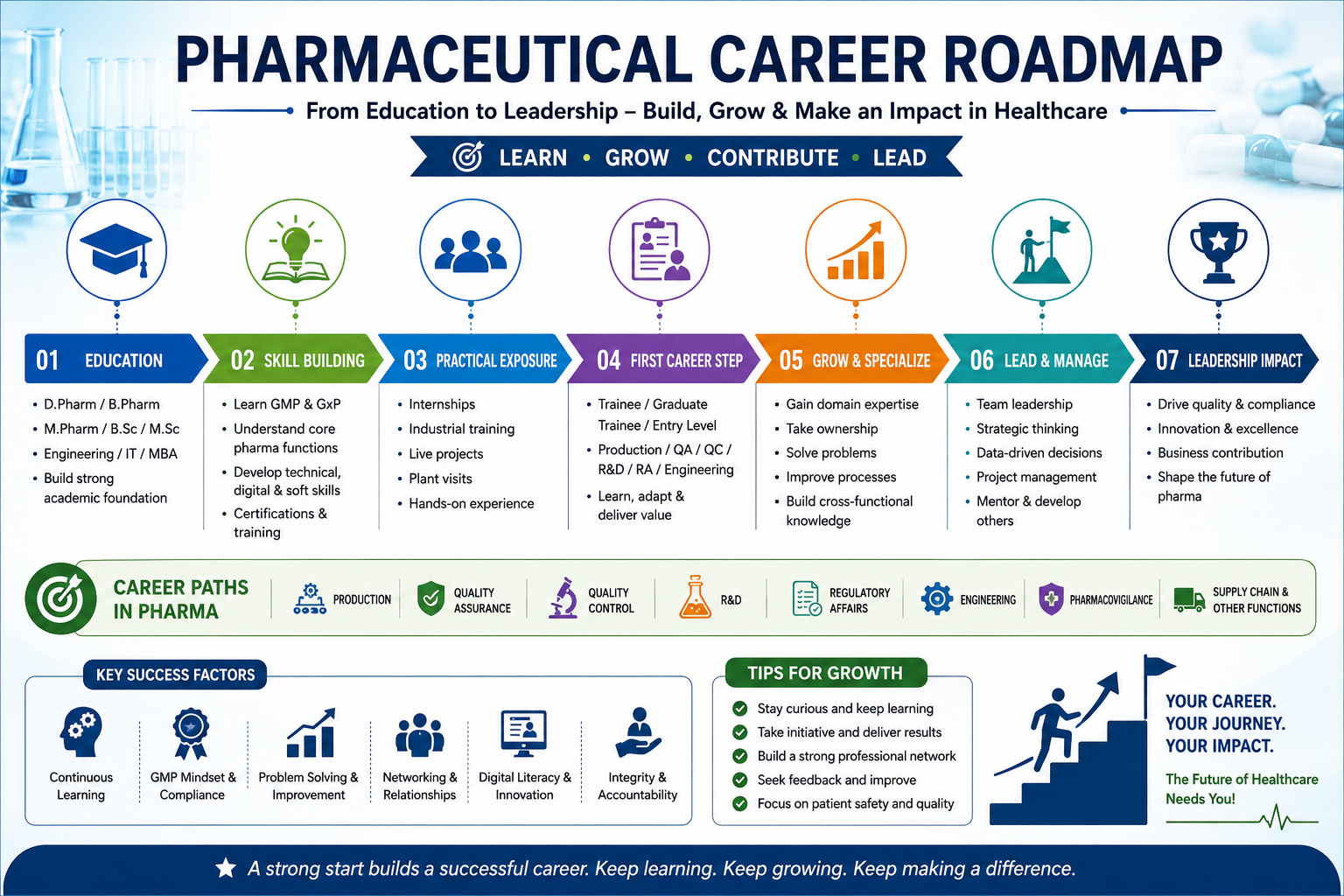
How to get a job in the pharmaceutical industry is one of the most important questions for pharmacy students, freshers, experienced professionals, career switchers, and professionals returning after a career break.
The pharmaceutical industry offers opportunities across Production, Quality Assurance, Quality Control, Regulatory Affairs, Research & Development, Engineering, Validation/CQV, Computer System Validation, Pharmacovigilance, Clinical Research, Supply Chain, Warehouse, EHS, Digital Transformation, Manufacturing Excellence, and Technical Services.
However, having a pharmaceutical qualification alone does not automatically lead to employment. Employers increasingly look for a combination of technical knowledge, GMP awareness, practical skills, communication, digital capability, problem-solving ability, and evidence that a candidate can contribute to the organization.
According to WHO, GMP is a fundamental part of pharmaceutical quality assurance and is intended to ensure medicines are consistently produced and controlled to appropriate quality standards. GMP therefore provides an important foundation for professionals working in pharmaceutical manufacturing and quality functions.
The good news is that getting a pharma job can become much more systematic when candidates stop applying randomly and instead follow a structured career strategy.
This guide explains how to get a job in the pharmaceutical industry, from selecting the right career path and developing skills to creating a strong resume, networking with recruiters, preparing for interviews, and building long-term career growth.
1. Introduction: How to Get a Job in the Pharmaceutical Industry
The pharmaceutical industry is much larger than manufacturing tablets or working in a quality-control laboratory.
A modern pharmaceutical organization requires professionals across the entire product lifecycle—from research and development to manufacturing, testing, regulatory approval, distribution, digital systems, and continuous improvement.
Production teams manufacture medicines. QA teams maintain quality systems. QC laboratories test materials and products. Engineering teams maintain reliable facilities and equipment. Validation professionals demonstrate that systems and processes perform as intended. Regulatory professionals interact with health authorities and maintain regulatory compliance.
This creates a wide range of pharmaceutical industry careers.
However, competition for attractive positions can be significant.
A candidate may have the correct degree but still struggle to obtain interviews because of:
- An unstructured resume
- Weak technical knowledge
- Poor LinkedIn visibility
- Limited networking
- Generic job applications
- Lack of interview preparation
- Outdated skills
- Inability to explain practical experience
- Poor communication
- Lack of understanding of GMP and pharmaceutical operations
The solution is not simply to submit more applications.
The better strategy is:
Choose the right career → Build relevant skills → Create a targeted professional profile → Network strategically → Apply consistently → Prepare for interviews → Continue learning.
WHO’s GMP guidance emphasizes that pharmaceutical quality depends on defined processes, suitable personnel, facilities, equipment, documentation, validation, and quality systems. This is why GMP knowledge is valuable well beyond the QA department.
2. Understand the Pharmaceutical Industry Before Searching for a Job
One of the biggest career mistakes is searching for “pharma jobs” without first deciding which pharmaceutical function matches your background.
The pharmaceutical sector contains multiple career paths.
Major Pharmaceutical Career Functions
| Department | Typical Roles | Educational Background | Key Skills |
|---|---|---|---|
| Production | Executive, Officer, Manager, Production Head | D.Pharm, B.Pharm, M.Pharm, Engineering | GMP, manufacturing, documentation, people management |
| QA | QA Executive, Officer, Manager | B.Pharm, M.Pharm, B.Sc. | QMS, GMP, deviations, CAPA, audits |
| QC | QC Analyst, Executive, Manager | B.Pharm, M.Pharm, M.Sc. | Analytical testing, GMP, instruments, documentation |
| Regulatory Affairs | RA Executive, Manager | B.Pharm, M.Pharm, Life Sciences | Regulatory submissions, dossiers, regulations |
| R&D | Scientist, Research Associate | M.Pharm, M.Sc., PhD, relevant technical degrees | Formulation, analytical development, research |
| Formulation Development | Scientist, Executive | M.Pharm, B.Pharm | Formulation, process development, QbD |
| Analytical Development | Scientist, Analyst | M.Pharm, M.Sc. | HPLC, GC, analytical methods, validation |
| Engineering | Engineer, Manager | Diploma, B.E./B.Tech | Utilities, equipment, maintenance |
| Validation/CQV | Validation Engineer, CQV Lead | Engineering, Pharmacy, Life Sciences | Qualification, validation, documentation |
| CSV | CSV Engineer, Specialist | IT, Engineering, Pharmacy | GAMP, Part 11, validation, data integrity |
| IT/Digital | IT Specialist, MES/LIMS Specialist | BCA, MCA, Engineering, IT | Systems, ERP, MES, LIMS, automation |
| Pharmacovigilance | Drug Safety Associate | Pharmacy, Life Sciences, Medicine | Case processing, safety databases |
| Clinical Research | CRA, Clinical Research Associate | Pharmacy, Life Sciences | GCP, clinical documentation |
| Supply Chain | Planner, Supply Chain Executive | Pharmacy, Engineering, MBA, relevant degree | Planning, ERP, inventory |
| Warehouse | Officer, Manager | D.Pharm, B.Pharm, relevant degree | GDP, inventory, documentation |
| Procurement | Buyer, Procurement Executive | Pharmacy, Engineering, MBA | Vendor management, ERP, purchasing |
| EHS | EHS Officer, Manager | Engineering, Environmental Science | Safety, environmental compliance |
| Project Management | Project Engineer, Project Manager | Engineering, Pharmacy, MBA | Planning, execution, stakeholder management |
| Technical Services | Technical Executive, Manager | Pharmacy, Engineering | Process, technology transfer, troubleshooting |
| Manufacturing Excellence | CI Specialist, Operational Excellence Manager | Engineering, Pharmacy, MBA | Lean, Six Sigma, OEE, data analysis |
Which Departments Are Suitable for Different Candidates?
For Freshers
Common entry points include:
- Production trainee
- QA trainee
- QC trainee
- Research associate
- Pharmacovigilance associate
- Clinical research associate
- Regulatory affairs trainee
- Warehouse/GDP roles
- Engineering trainee
- Validation trainee
- Manufacturing support roles
The best entry point depends on qualification, location, technical knowledge, and available vacancies.
For Experienced Professionals
Experienced candidates should generally target positions where their previous experience creates a clear advantage.
For example:
Production experience → Production Manager / Manufacturing Excellence / Technical Operations
QA experience → QA Manager / QMS / Compliance / Audit
Engineering experience → Engineering / Utilities / Projects / CQV
Validation experience → Validation Lead / CQV / CSV
3. Choose the Right Pharmaceutical Career
Before sending applications, answer five questions:
- What have I studied?
- What am I good at?
- What type of work do I enjoy?
- What experience do I already have?
- Where do I want my career to be in five years?
Do not choose a career solely because someone says that a particular department pays more.
Consider:
- Qualification
- Technical strengths
- Career interests
- Previous experience
- Location
- Shift requirements
- Travel requirements
- Salary expectations
- Leadership aspirations
- Work environment
- Long-term demand
- Opportunities for specialization
Career Decision Framework
Use this simple model:
Education → Interest → Existing Skills → Market Demand → Target Role → Skill Gap → Action Plan
For example:
B.Pharm + manufacturing interest + strong GMP knowledge
→ Production/QA/Technical Operations
Whereas:
BCA/MCA + pharmaceutical exposure + IT interest
→ CSV/MES/LIMS/eQMS/Pharma IT
A good career decision is one where your qualification, capability, interests, and market opportunity overlap.
4. Qualifications Required for Pharma Jobs
Different pharmaceutical roles have different educational requirements.
D.Pharm
Potential opportunities may include:
- Production support
- Warehouse
- Dispensing-related activities
- Retail/hospital pharmacy
- Selected quality and documentation roles
Eligibility depends on employer and applicable regulations.
B.Pharm
B.Pharm provides a broad foundation for:
- Production
- QA
- QC
- Regulatory Affairs
- R&D
- Pharmacovigilance
- Clinical research
- Manufacturing operations
M.Pharm
M.Pharm can provide additional specialization for:
- Formulation R&D
- Analytical development
- Regulatory Affairs
- Research
- Advanced technical positions
B.Sc./M.Sc.
Life-science and chemistry-related degrees can be relevant to:
- QC
- Analytical development
- R&D
- Clinical research
- Pharmacovigilance
- Laboratory functions
Engineering Degrees
Engineering qualifications can be highly relevant to:
- Manufacturing engineering
- Maintenance
- Utilities
- Automation
- Projects
- Validation/CQV
- Facilities
- Digital manufacturing
MBA
MBA qualifications can add value in:
- Supply Chain
- Procurement
- Operations
- Project Management
- Business functions
- Commercial functions
IT Qualifications
BCA, MCA, B.Tech IT/Computer Science and related qualifications can support careers in:
- CSV
- MES
- LIMS
- eQMS
- ERP
- Data Analytics
- Automation
- Digital transformation
- Pharma IT
Minimum Qualification vs Competitive Advantage
A qualification may make you eligible for a job.
Skills and experience can make you competitive for the job.
That distinction is critical.
5. Skills Required to Get a Pharma Job
A strong pharmaceutical candidate should develop three categories of capability:
Technical + Digital + Soft Skills
5.1 Technical Skills
Important foundational areas include:
- GMP
- GLP
- GDP
- SOP
- Good Documentation Practices
- Data Integrity
- ALCOA+
- Deviation Management
- CAPA
- Change Control
- Risk Management
- FMEA
- Root Cause Analysis
- Validation
- Qualification
- Audit Compliance
- QMS
- Process Understanding
GMP is not merely a QA concept. WHO describes GMP as part of pharmaceutical quality assurance covering production and quality control and emphasizing clearly defined, validated, reviewed and documented processes.
5.2 Digital Skills
The modern pharmaceutical professional should understand relevant digital systems.
Useful areas include:
- MS Excel
- Advanced Excel
- ERP/SAP
- LIMS
- MES
- eQMS
- eDMS
- SCADA/HMI
- Computer System Validation
- 21 CFR Part 11
- EU Annex 11
- Data Analytics
- Automation
- Artificial Intelligence
- Pharma 4.0
You do not need to become an expert in every system.
Instead, develop role-specific digital depth.
For example:
QA professional: eQMS + data integrity + analytics
Production professional: MES + SCADA + OEE + data analytics
Validation professional: CSV + GAMP principles + Part 11 + data integrity
IT professional entering pharma: CSV + GxP + Part 11 + Annex 11 + pharmaceutical QMS
6. Soft Skills That Pharmaceutical Employers Value
Technical knowledge alone is not enough for many positions.
Develop:
- Communication
- Teamwork
- Problem solving
- Leadership
- Time management
- Presentation
- Analytical thinking
- Conflict management
- Decision making
- Documentation discipline
- Stakeholder management
For leadership positions, add:
- People management
- Coaching
- Performance management
- Strategic thinking
- Budget awareness
- Cross-functional collaboration
- Change management
7. Certifications That Can Improve Employability
Certifications can strengthen a candidate’s profile, but they should not be treated as a guaranteed route to employment.
The right certification is one that fills a specific skill gap.
| Training Area | Suitable For | Career Value | Essential? |
| GMP/GxP | Most pharma candidates | Builds regulatory foundation | Highly useful |
| QMS | QA/QC/experienced professionals | Quality-system understanding | Role dependent |
| Data Integrity | QA/QC/CSV | Strong compliance capability | Highly useful |
| Validation | QA/Engineering/Production | Technical compliance | Role dependent |
| CSV | IT/QA/Validation | Digital GxP capability | Role specific |
| CQV | Engineering/Validation | Qualification expertise | Role specific |
| Six Sigma | Manufacturing/Quality | Process improvement | Optional |
| Lean Manufacturing | Production/Operations | Operational excellence | Optional |
| CAPA/RCA | QA/Manufacturing | Problem solving | Highly useful |
| Risk Management | QA/Manufacturing | Quality risk capability | Highly useful |
| Regulatory Affairs | RA professionals | Regulatory capability | Role specific |
| Pharmacovigilance | Drug safety candidates | Safety knowledge | Role specific |
| Project Management | Managers/Engineers | Execution and leadership | Useful |
| Excel/Data Analytics | Most functions | Productivity and decision support | Highly useful |
| AI/Digital Transformation | Future-focused professionals | Digital readiness | Increasingly useful |
A Better Certification Strategy
Instead of collecting ten certificates, choose one or two certifications that directly support your target job.
For example:
Target: QA Executive
→ GMP + QMS/Data Integrity
Target: Validation Engineer
→ Qualification/Validation + CSV fundamentals
Target: Production Manager
→ GMP + Lean/Six Sigma + Data Analytics
Target: Pharma IT
→ GxP + CSV + Part 11 + Data Integrity
8. How to Build a Pharma Resume
Your resume should answer one question:
Why should the employer interview you for this specific role?
A strong pharma resume should contain:
- Professional headline
- Career summary
- Core competencies
- Technical skills
- Professional experience
- Achievements
- Education
- Certifications
- Projects where relevant
- Relevant regulatory exposure
ATS-Friendly Resume Rules
Use:
- Simple formatting
- Standard headings
- Relevant keywords
- Consistent job titles
- Quantifiable achievements
- Clear dates
- Professional language
Avoid:
- Excessive graphics
- Complicated tables
- Unnecessary personal information
- Long paragraphs
- Generic objectives
- Keyword stuffing
Responsibility vs Achievement
Weak
Responsible for production operations.
Stronger
Managed pharmaceutical manufacturing operations while supporting GMP compliance, production targets, documentation accuracy and cross-functional problem solving.
Achievement-focused
Improved manufacturing efficiency by reducing equipment downtime through structured problem-solving and preventive improvement initiatives.
Use actual numbers whenever they are truthful and can be supported.
9. Resume Examples by Career Stage
Fresher
Focus on:
- Education
- Internship
- Academic projects
- GMP knowledge
- Technical skills
- Certifications
- Laboratory exposure
- Relevant software
Do not fabricate work experience.
Production Professional
Emphasize:
- Manufacturing processes
- Batch execution
- Yield
- OEE
- Productivity
- GMP
- Team size
- Equipment
- Deviations
- CAPA
- Audits
- Continuous improvement
QA Professional
Emphasize:
- QMS
- Deviations
- CAPA
- Change Controls
- Audit management
- Documentation
- Data Integrity
- Risk Management
- Validation
- Regulatory compliance
QC Professional
Emphasize:
- Analytical instruments
- Method validation
- Method transfer
- Stability
- Laboratory investigations
- OOS/OOT
- GMP
- Documentation
Validation Professional
Emphasize:
- URS
- DQ
- FAT
- SAT
- IQ
- OQ
- PQ
- CSV
- Risk Assessment
- Traceability Matrix
- 21 CFR Part 11
- GAMP principles
- Data Integrity
10. How to Optimize LinkedIn for a Pharma Job
LinkedIn can function as a professional career platform rather than simply an online resume.
Optimize Your Headline
Weak:
Looking for a job in pharma.
Better:
Pharmaceutical Manufacturing Professional | GMP | Production | QMS | Validation | Operational Excellence
For specialized professionals:
Pharma QA Professional | GMP | QMS | CAPA | Deviations | Audits | Data Integrity
Optimize Your About Section
Your About section should explain:
- Who you are
- Your experience
- Your specialization
- Major strengths
- Regulatory exposure
- Key achievements
- Target career direction
Do not simply copy your resume.
Optimize the Skills Section
Prioritize skills relevant to your target position.
For example, a production professional may prioritize:
- Pharmaceutical Manufacturing
- GMP
- Production Management
- OSD Manufacturing
- Granulation
- Compression
- Coating
- QMS
- CAPA
- OEE
- Lean Manufacturing
Use the Featured Section
Consider featuring:
- Professional certifications
- Technical articles
- Presentations
- Projects
- Publications
- Industry achievements
Sharing useful technical knowledge can help demonstrate professional credibility.
11. Where to Find Pharmaceutical Jobs
Use multiple channels rather than relying on a single website.
Job Platforms
- LinkedIn Jobs
- Naukri
- Indeed
- Other reputable job portals
Direct Company Recruitment
Check the careers pages of pharmaceutical companies.
This can be particularly useful because some vacancies may appear on company career pages before or differently from third-party job portals.
Networking
Use:
- Former colleagues
- Managers
- Alumni
- Professional associations
- Industry contacts
- Recruiters
- LinkedIn connections
- Industry conferences
Referrals
Employee referrals can be valuable because your application receives context from someone who knows the organization.
However, a referral should never be treated as a guarantee of selection.
12. Weekly Pharma Job Search Strategy
Instead of randomly applying to dozens of jobs, create a weekly system.
Monday
Identify new vacancies.
Tuesday
Customize resumes for priority positions.
Wednesday
Contact relevant recruiters.
Thursday
Network with professionals.
Friday
Prepare technical interview topics.
Saturday
Follow up on previous applications.
Sunday
Review results and update your strategy.
Track:
- Applications
- Interviews
- Recruiter responses
- Referrals
- Rejections
- Follow-ups
- Skills requiring improvement
13. How to Approach Pharma Recruiters
Recruiters receive many messages every day.
Your message should be:
- Short
- Relevant
- Professional
- Specific
- Respectful
Fresher Message
Hello [Name],
I am a [qualification] graduate interested in entry-level opportunities in the pharmaceutical industry, particularly in [department]. I have completed training in [relevant skills] and would appreciate being considered for suitable trainee or entry-level opportunities.
Thank you for connecting.
Experienced Professional
Hello [Name],
I am a pharmaceutical professional with [X] years of experience in [function], specializing in [2–3 key areas]. I am currently exploring opportunities for [target position]. I would appreciate it if you could consider my profile for relevant openings within your organization or network.
Thank you.
Senior Professional
Hello [Name],
I am an experienced pharmaceutical professional specializing in [function], with leadership experience across [key areas]. I am currently exploring senior opportunities in [target function/location]. I would be pleased to connect and discuss potential opportunities aligned with my background.
Regards,
[Name]
Career-Break Candidate
Hello [Name],
I am a pharmaceutical professional with previous experience in [function]. After a career break, I have refreshed my knowledge in [relevant areas] and am now actively seeking opportunities to return to the pharmaceutical industry. I would appreciate consideration for suitable roles aligned with my previous experience and current capabilities.
Thank you.
What Not to Do
Avoid sending:
“Sir job hai kya?”
or
“Please give me job.”
Instead, communicate:
Qualification + Experience + Specialization + Target Role
14. How to Get a Pharma Job Without Experience
Freshers often believe that companies only hire experienced professionals.
That is not correct.
Companies hire at different levels, including trainee and entry-level positions.
Consider:
- Internships
- Apprenticeships
- Trainee positions
- Contract positions
- Graduate programs
- Plant exposure
- Academic projects
- GMP training
- Industry certifications
- Networking
- Alumni connections
How to Demonstrate Job Readiness
If you have no work experience, demonstrate:
Knowledge + Projects + Skills + Professional Behavior + Willingness to Learn
For example, instead of writing:
“I am a fresher with no experience.”
Say:
“B.Pharm graduate with foundational knowledge of GMP, pharmaceutical documentation and manufacturing processes, supported by academic project experience and industry-focused training.”
Never claim experience you do not have.
15. How to Return to Pharma After a Career Break
A career break does not necessarily end a pharmaceutical career.
The important question is:
What have you done to become job-ready again?
Start with:
Step 1: Refresh Technical Knowledge
Review:
- GMP
- SOP
- Documentation
- QMS
- Deviations
- CAPA
- Change Control
- Risk Management
- Data Integrity
Step 2: Update Your Resume
Focus on your previous achievements rather than apologizing for the career break.
Step 3: Rebuild LinkedIn
Reconnect with:
- Former colleagues
- Former managers
- Recruiters
- Industry professionals
- Alumni
Step 4: Develop Current Skills
Learn relevant developments in:
- Digital manufacturing
- Data analytics
- AI
- Pharma 4.0
- Regulatory expectations
Step 5: Apply Strategically
Target positions where your previous experience is relevant.
How to Explain a Career Gap in an Interview
A professional response could be:
“I took a career break due to personal circumstances. During this period, I remained interested in the pharmaceutical industry and have now refreshed my technical knowledge and updated my skills in areas relevant to my target role. I am fully prepared and motivated to return to the industry and contribute using my previous experience.”
Keep the answer:
Honest + Brief + Positive + Future-focused
Do not invent employment or projects to conceal a career gap.
16. How to Prepare for a Pharma Interview
Interview preparation should cover both HR and technical areas.
HR Interview Questions
Prepare strong answers to:
Tell me about yourself.
Use:
Current/Most Recent Role → Experience → Expertise → Major Achievement → Target Role
Why do you want to join our company?
Research:
- Company products
- Manufacturing sites
- Therapeutic areas
- Recent developments
- Role requirements
Then connect your skills with the company’s needs.
Why should we hire you?
Use:
Relevant experience + Technical capability + Achievements + Problem solving + Role fit
What are your strengths?
Choose strengths relevant to the job.
What is your weakness?
Select a genuine but manageable development area and explain how you are improving it.
What are your salary expectations?
Research the market and role before answering.
17. Technical Pharma Interview Preparation
Every candidate should understand the fundamentals relevant to their target function.
GMP Questions
Examples:
- What is GMP?
- Why is GMP important?
- What is the difference between QA and QC?
- What is Good Documentation Practice?
- What is data integrity?
- What is ALCOA+?
- Why is validation important?
WHO explains that GMP is intended to minimize risks inherent in pharmaceutical manufacturing and that quality cannot simply be tested into a product after manufacturing.
Deviation and CAPA
Prepare for:
- What is a deviation?
- How do you investigate a deviation?
- What is root cause analysis?
- What is CAPA?
- How do you determine CAPA effectiveness?
- What is the difference between correction, corrective action and preventive action?
Change Control
Understand:
- What is change control?
- Why is impact assessment necessary?
- How is risk evaluated?
- When is validation required?
- What documents need updating?
Validation and Qualification
Understand:
- URS
- DQ
- FAT
- SAT
- IQ
- OQ
- PQ
- Process Validation
- Cleaning Validation
- Computer System Validation
- Risk-based validation
18. Department-Specific Interview Preparation
Production
Prepare:
- Manufacturing process
- Batch records
- Yield
- Productivity
- OEE
- Line clearance
- Equipment operation
- Deviations
- GMP
- Manpower management
- Troubleshooting
- Shift management
QA
Prepare:
- QMS
- Deviations
- CAPA
- Change Control
- Audit
- Documentation
- Data Integrity
- Risk Management
- Batch release
- Investigation
QC
Prepare:
- Analytical instruments
- HPLC
- GC
- Method validation
- OOS
- OOT
- Stability
- Laboratory investigations
- GMP
Validation/CQV
Prepare:
- URS
- DQ
- FAT/SAT
- IQ/OQ/PQ
- Risk Assessment
- Validation protocols
- Traceability
- Documentation
- Data Integrity
- CSV
Regulatory Affairs
Prepare:
- CTD/eCTD fundamentals
- Regulatory submissions
- Variations
- Regulatory agencies
- Product lifecycle
- Dossier management
Engineering
Prepare:
- HVAC
- Utilities
- Equipment
- Preventive maintenance
- Calibration
- Qualification
- Energy management
- Projects
- Safety
19. How to Stand Out From Other Candidates
One useful concept is the T-shaped pharmaceutical professional.
Think of it as:
Broad knowledge across pharma + deep expertise in one specialization
For example:
A production professional may understand:
GMP + QA + Engineering + Validation + Data Analytics + Production
but have deep specialization in:
OSD Manufacturing
This combination creates greater professional versatility.
Build Your Differentiation Around Five Areas
1. Measurable Achievements
Do not only describe responsibilities.
Show outcomes.
Examples:
- Improved OEE
- Reduced downtime
- Increased yield
- Reduced rejection
- Improved productivity
- Reduced deviations
- Improved audit readiness
- Reduced costs
2. Regulatory Knowledge
Understand the regulatory environment relevant to your role.
3. Digital Skills
Develop knowledge of:
- MES
- LIMS
- eQMS
- ERP
- Data Analytics
- AI
- Automation
4. Problem Solving
Demonstrate experience with:
- RCA
- CAPA
- FMEA
- Risk assessment
- Continuous improvement
5. Thought Leadership
Professionals can demonstrate expertise through:
- LinkedIn articles
- Technical posts
- Presentations
- Webinars
- Industry discussions
- Professional communities
20. Common Mistakes That Prevent Candidates From Getting Pharma Jobs
Mistake 1: Using a Generic Resume
A production resume should not look identical to a regulatory affairs resume.
Mistake 2: Applying Everywhere
Target roles matching your profile.
Mistake 3: Poor LinkedIn Profile
Recruiters may check LinkedIn before contacting candidates.
Mistake 4: Ignoring Company Career Pages
Not every opportunity depends on job portals.
Mistake 5: Weak GMP Knowledge
GMP is foundational to pharmaceutical manufacturing and quality.
Mistake 6: Poor Interview Preparation
Getting an interview is only half the process.
Mistake 7: Overclaiming Skills
Never claim expertise that you cannot demonstrate.
Mistake 8: Not Following Up
A professional follow-up can keep an application visible without becoming intrusive.
Mistake 9: Focusing Only on Salary
Evaluate:
- Role
- Learning
- Career path
- Company
- Location
- Leadership exposure
- Responsibilities
- Long-term opportunity
Mistake 10: Sending Identical Messages to Every Recruiter
Personalize the message according to the role.
21. 30-Day Pharma Job Search Plan
Week 1 — Build Your Professional Foundation
Day 1
Define your target job title.
Day 2
Review your qualifications and experience.
Day 3
Identify your top 10 professional strengths.
Day 4
Identify your skill gaps.
Day 5
Update your resume.
Day 6
Optimize your LinkedIn profile.
Day 7
Create a target-company list.
Week 2 — Build Skills and Target Roles
Focus on:
- GMP
- Role-specific technical knowledge
- Interview topics
- Industry terminology
- Digital skills
Identify:
20–30 target positions
rather than applying indiscriminately.
Week 3 — Networking and Applications
Each day:
- Review relevant vacancies
- Apply to suitable positions
- Contact selected recruiters
- Connect with professionals
- Request relevant referrals
- Participate in professional discussions
Focus on quality and relevance, not simply application volume.
Week 4 — Interview and Follow-Up
Practice:
- HR questions
- Technical questions
- STAR-based achievement examples
- Salary discussion
- Company research
Follow up professionally on suitable applications.
At the end of the month, evaluate:
Applications → Responses → Interviews → Offers
If applications are high but interviews are low, improve your resume/profile/targeting.
If interviews are high but offers are low, improve your interview preparation.
22. Pharma Job Search Tracker
Use a simple tracker to maintain discipline.
| Company | Position | Location | Application Date | Recruiter | Status | Follow-up Date |
| Company A | QA Executive | Location | Date | Name | Applied | Date |
| Company B | Production Officer | Location | Date | Name | Interview | Date |
| Company C | Validation Engineer | Location | Date | Name | Shortlisted | Date |
This prevents applications from becoming disorganized.
23. Pharmaceutical Career Roadmaps
Fresher Career Roadmap
Education
↓
Industry Knowledge
↓
GMP + Technical Skills
↓
Internship / Project / Training
↓
Trainee / Entry-Level Job
↓
Specialist
↓
Senior Executive
↓
Assistant Manager
↓
Manager
Experienced Professional
Current Role
↓
Identify Skill Gap
↓
Upgrade Technical/Digital Skills
↓
Build Professional Brand
↓
Network With Target Companies
↓
Apply for Target Role
↓
Interview
↓
Career Growth
Career-Break Professional
Previous Experience
↓
Knowledge Refresh
↓
Resume Update
↓
LinkedIn Rebuild
↓
Professional Networking
↓
Targeted Applications
↓
Interview Preparation
↓
Industry Re-entry
↓
Career Progression
24. Salary and Career Growth
Salary is an important consideration, but compensation varies substantially across pharmaceutical functions and employers.
Factors include:
- Qualification
- Experience
- Job function
- Location
- Company
- Regulatory exposure
- Technical specialization
- Leadership responsibilities
- Digital capabilities
- Market demand
- Business segment
Instead of asking only:
“How much salary will I get?”
also ask:
“What skills will I gain?”
“What responsibilities will I receive?”
“What is the career path?”
“Will this role increase my market value?”
A slightly lower initial salary may sometimes provide significantly better long-term career growth, although every candidate should evaluate their own financial needs and circumstances.
25. Top Pharma Career Skills for the Future
Pharmaceutical manufacturing is becoming increasingly digital, data-driven and risk-based.
Professionals should watch developments in:
Pharma 4.0
Integration of:
- Automation
- Data
- Connectivity
- Digital systems
- Advanced analytics
Artificial Intelligence
Potential applications include:
- Data analysis
- Predictive maintenance
- Process monitoring
- Quality investigations
- Knowledge management
- Document intelligence
Generative AI
Professionals should understand responsible applications in:
- Document drafting
- Knowledge retrieval
- Data interpretation
- Training support
- Workflow assistance
AI should be used appropriately within organizational procedures and applicable regulatory/data-integrity controls.
Digital Quality
Important technologies include:
- eQMS
- eDMS
- LIMS
- MES
- Digital workflows
- Analytics
Advanced Manufacturing
Professionals should also understand:
- Process Analytical Technology
- Quality by Design
- Continuous manufacturing
- Advanced Process Control
- Process monitoring
- Data-driven manufacturing
WHO’s current pharmaceutical guidance also reflects the evolving manufacturing environment, including guidance on continuous manufacturing, data integrity, validation, HVAC and other specialized manufacturing topics.
26. The Practical Pharma Job-Search Formula
A simple framework is:
QUALIFICATION + SKILLS + EXPERIENCE + RESUME + NETWORKING + INTERVIEW PREPARATION + CONSISTENT APPLICATION = BETTER JOB OPPORTUNITIES
Qualification
Provides the foundation.
Skills
Make you capable of performing the job.
Experience
Demonstrates practical application.
Resume
Communicates your value.
Networking
Creates professional visibility and potential referrals.
Interview Preparation
Converts opportunities into offers.
Consistent Application
Keeps the process moving.
No single factor guarantees employment.
The objective is to make every part of the candidate profile stronger and more relevant to the target role.
27. Frequently Asked Questions
1. How can I get a job in the pharmaceutical industry?
Identify a suitable career path, build relevant technical and soft skills, create a targeted resume, optimize LinkedIn, network with professionals, apply through multiple channels and prepare thoroughly for interviews.
2. Which qualification is best for pharma jobs?
There is no single best qualification. B.Pharm, M.Pharm, D.Pharm, B.Sc., M.Sc., engineering, IT and other qualifications can lead to different pharmaceutical careers depending on the role.
3. Can freshers get pharmaceutical jobs?
Yes. Freshers can target trainee, internship, apprenticeship and entry-level positions. Relevant knowledge, projects, training and communication can improve their employability.
4. Which pharma department is best for freshers?
There is no universally best department. Production, QA, QC, regulatory, pharmacovigilance, clinical research and other functions may offer entry-level opportunities depending on qualification and vacancies.
5. How can I get a pharma job without experience?
Build role-specific knowledge, complete relevant projects or internships, learn GMP fundamentals, develop technical skills, network with professionals and target trainee or entry-level roles.
6. Which certifications are useful for pharma jobs?
GMP, GxP, QMS, data integrity, validation, CSV, CAPA/RCA, risk management, Lean/Six Sigma, Excel/data analytics and role-specific regulatory training can be useful.
7. How can I prepare for a pharma interview?
Study the job description, revise technical fundamentals, understand GMP, prepare HR answers, research the company and practice explaining your experience using specific examples.
8. How can I find pharmaceutical jobs in India?
Use LinkedIn, Naukri, Indeed, company career pages, referrals, recruitment agencies, professional networks and industry contacts.
9. How can I get a pharma job after a career break?
Refresh technical knowledge, update your resume, rebuild your LinkedIn presence, reconnect with industry professionals and target roles aligned with your previous experience.
10. Is GMP certification useful for getting a pharma job?
GMP training can strengthen a candidate’s understanding of pharmaceutical quality and compliance. However, certification alone does not guarantee employment.
11. How can I approach pharma recruiters?
Send a short, personalized message containing your qualification, experience, specialization and target role.
12. How can I improve my pharma resume?
Customize it for the target role, emphasize relevant skills and achievements, use appropriate keywords, quantify genuine accomplishments and maintain an ATS-friendly structure.
13. Which skills are in demand in pharmaceutical manufacturing?
GMP, manufacturing knowledge, QMS, problem solving, validation, data integrity, digital systems, automation, data analytics and continuous-improvement capabilities are increasingly valuable.
14. How can I grow my pharmaceutical career?
Develop deep expertise in one area while building broad knowledge of related pharmaceutical functions, regulatory expectations, digital technologies, leadership and business operations.
28. Final Career Advice
Getting a pharmaceutical job is not simply a numbers game where success comes from submitting hundreds of applications.
A better approach is to build a career system.
Start by identifying the right role.
Then understand what employers expect.
Develop the required technical and digital skills.
Create a resume that communicates measurable value.
Build a professional LinkedIn presence.
Network with people in your target industry.
Apply strategically.
Prepare seriously for interviews.
And continue developing your skills even after getting the job.
For freshers, the priority should be learning, exposure and entering the industry.
For experienced professionals, the priority should be specialization, measurable achievements, leadership and career progression.
For career-break professionals, the priority should be knowledge refresh, confidence rebuilding, professional visibility and targeted re-entry.
The pharmaceutical industry is built around quality, safety, compliance, science, technology and competent people. WHO guidance emphasizes that pharmaceutical quality depends on appropriately designed systems, defined processes, competent personnel and effective quality assurance.
Therefore, the strongest long-term career strategy is:
Choose the right career → Build relevant skills → Create a strong professional profile → Network strategically → Apply consistently → Prepare for interviews → Keep learning.
Your first pharmaceutical job is not the final destination.
It is the beginning of your professional journey.
Recommended Authoritative External Resources
For regulatory and technical claims, prioritize authoritative sources such as:
- WHO — GMP, pharmaceutical quality, production and regulatory guidance
- FDA — U.S. pharmaceutical regulations and compliance guidance
- EMA — European pharmaceutical regulatory and GMP information
- ICH — International harmonized pharmaceutical guidelines
- PIC/S — Pharmaceutical inspection and GMP resources
- ISPE — Pharmaceutical engineering, manufacturing and technology resources
WHO’s pharmaceutical guidance is particularly useful because its current guidance covers production, quality assurance, inspection, quality control, regulatory standards and related pharmaceutical topics.
EMA also notes that EU and WHO GMP guidance can differ in detail while sharing core GMP principles, making it important for professionals to understand the regulatory framework relevant to their target market.
About the Author
Ramesh Palav is a pharmaceutical professional with 20+ years of industry experience in manufacturing, GMP, quality systems, validation, compliance, and operational excellence. Through Pharma Manufacturing Hub, he shares practical insights on pharmaceutical careers, manufacturing, quality, validation, Pharma 4.0, AI, and professional development.
His goal is to help students, freshers, experienced professionals, and career-break professionals build the knowledge and skills needed to succeed in the pharmaceutical industry.
Published on 16/08/2026