
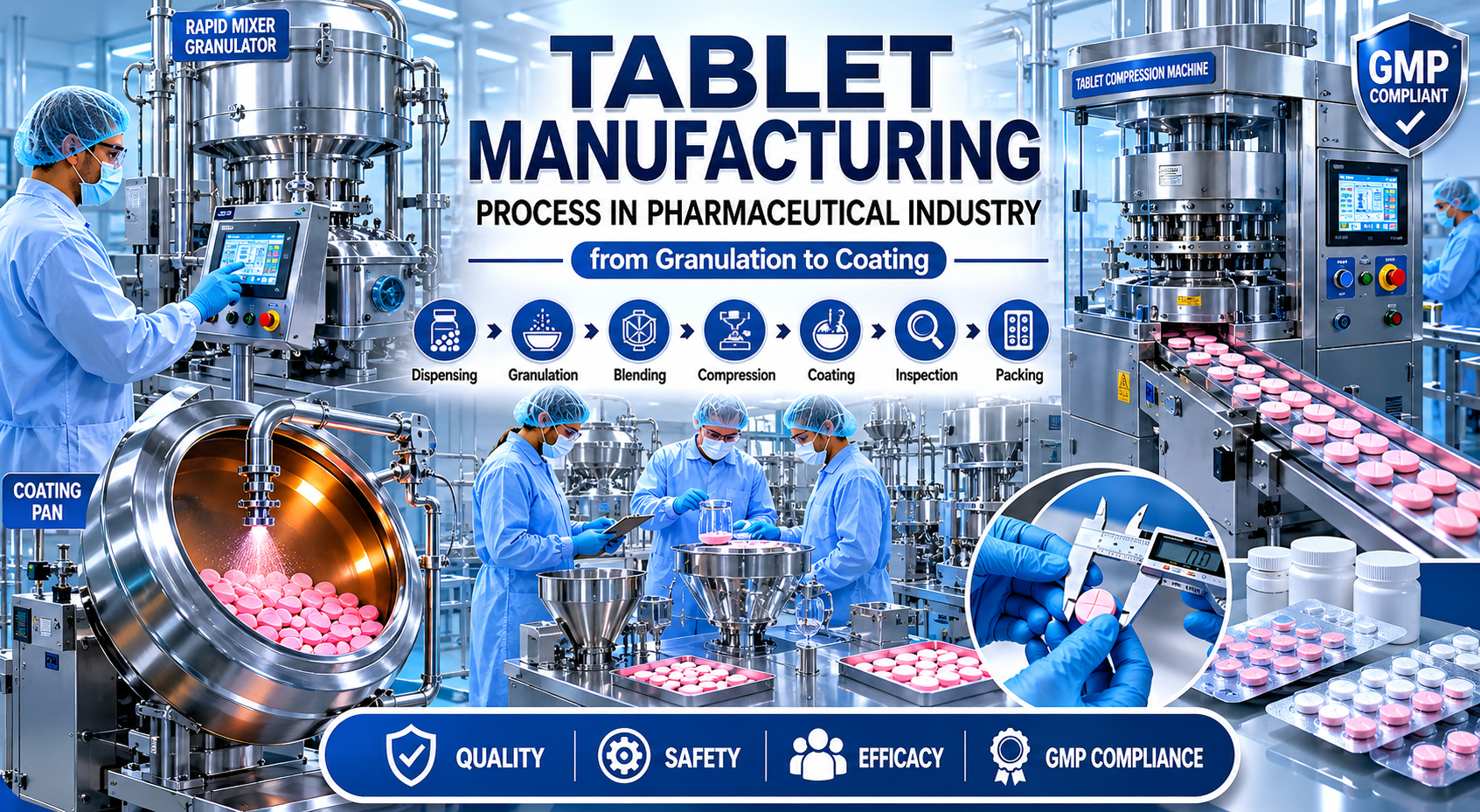
Introduction to Tablet Manufacturing
The Tablet Manufacturing Process is one of the most important operations in the pharmaceutical industry. Tablets are the most widely used dosage form because they are easy to administer, stable, cost-effective, and suitable for mass production.
In modern pharmaceutical manufacturing, tablet production involves multiple carefully controlled stages such as dispensing, granulation, blending, compression, coating, inspection, and packaging. Every step must comply with strict GMP (Good Manufacturing Practice) guidelines to ensure product quality, safety, efficacy, and consistency.
For pharma freshers, production operators, B.Pharm/M.Pharm students, QA/QC professionals, and interview candidates, understanding the pharmaceutical tablet production process is essential for career growth in the pharma industry.
What Is a Tablet in Pharmaceuticals?
A tablet is a solid pharmaceutical dosage form containing active pharmaceutical ingredients (API) along with excipients compressed into a specific shape and size.
Tablets are designed for:
- Oral administration
- Accurate dosing
- Better patient compliance
- Easy transportation and storage
- Longer shelf life
Tablets may contain:
- API (Active ingredient)
- Binders
- Disintegrants
- Lubricants
- Glidants
- Fillers
- Coating materials
Types of Tablets
Pharmaceutical tablets are classified based on their method of administration and release characteristics.
Common Types of Tablets
1. Compressed Tablets
Standard tablets manufactured by compression.
2. Film-Coated Tablets
Tablets coated with a thin polymer layer for protection and appearance.
3. Sugar-Coated Tablets
Tablets coated with sugar to mask taste.
4. Enteric-Coated Tablets
Prevent drug release in the stomach.
5. Chewable Tablets
Designed to be chewed before swallowing.
6. Effervescent Tablets
Dissolve in water before administration.
7. Sustained Release Tablets
Release drug slowly over time.
Overview Flowchart of Tablet Manufacturing Process
Raw Material Receipt
        ↓
Dispensing
        ↓
Sifting
        ↓
Granulation (Wet/Dry)
        ↓
Drying
        ↓
Milling
        ↓
Blending
        ↓
Lubrication
        ↓
Compression
        ↓
Coating
        ↓
Inspection
        ↓
Packing
        ↓
Finished Product Release
Step-by-Step Tablet Manufacturing Process
1. Dispensing
Dispensing is the process of weighing and collecting raw materials according to the Batch Manufacturing Record (BMR).
Purpose
- Ensure accurate quantity of API and excipients
- Prevent mix-ups
- Maintain traceability
Area Requirements
- Controlled dispensing booth
- Differential pressure monitoring
- Dust extraction system
Equipment Used
- Electronic weighing balance
- Dispensing booth
- SS containers
GMP Requirements
- Line clearance before operation
- Material status labels
- Double verification by QA
Pro Tip
Always verify:
- Material name
- Batch number
- Expiry date
- Weight accuracy
Incorrect dispensing can lead to batch rejection.
2. Sifting
Sifting removes foreign particles and breaks lumps to obtain uniform particle size.
Equipment Used
- Vibro sifter
- Sieve screens
Importance
- Improves flow property
- Enhances uniform mixing
- Prevents compression defects
Common Sieve Sizes
- #20
- #40
- #60
3. Dry Granulation
Dry granulation is used when materials are sensitive to heat or moisture.
Process
Powders are compacted without liquid addition.
Methods
Slugging
Large tablets called slugs are prepared and milled.
Roller Compaction
Powders are compressed between rollers.
Advantages
- Suitable for moisture-sensitive drugs
- Faster process
- Reduced drying requirement
Equipment Used
- Roller compactor
- Multi mill
4. Wet Granulation
Wet granulation is the most commonly used method in pharmaceutical tablet production.
What Is Wet Granulation?
In wet granulation, powders are mixed with binder solution to form granules.
The core principle of wet granulation can be represented as:
Powder Blend+Binder Solution→Wet Granules
Steps in Wet Granulation
- Dry mixing
- Binder preparation
- Wet mixing
- Granule formation
- Drying
- Milling
Advantages
- Better flow property
- Uniform drug distribution
- Improved compressibility
Equipment Used
- Rapid Mixer Granulator (RMG)
- Fluid Bed Dryer (FBD)
- Multi mill
Important Note
Over-wetting may produce hard granules and poor dissolution.
Under-wetting may lead to weak granules and tablet friability issues.
5. Blending
Blending ensures uniform distribution of API and excipients.
Purpose
- Achieve content uniformity
- Improve flow properties
Equipment Used
- Octagonal blender
- Double cone blender
- Bin blender
Critical Parameters
- Mixing time
- Blender RPM
- Load volume
6. Lubrication
Lubrication is the addition of lubricants and glidants before compression.
Common Lubricants
- Magnesium stearate
- Talc
Importance
- Prevent sticking
- Improve powder flow
- Reduce friction
Caution
Over-lubrication may reduce tablet hardness and dissolution rate.
7. Compression
The tablet compression process converts granules into tablets using compression force.
The basic compression relationship can be visualized as:
Granules+Compression Force→Tablet
Equipment Used
- Rotary tablet compression machine
- Single punch machine
Compression Stages
Filling
Die cavity fills with granules.
Compression
Upper and lower punches compress granules.
Ejection
Finished tablet is ejected.
Critical Compression Parameters
Tablet Weight
Must remain within specification.
Hardness
Determines tablet strength.
Thickness
Measured using vernier or thickness gauge.
Friability
Checks tablet resistance to breakage.
Disintegration Time
Ensures proper drug release.
Common Compression Defects
| Problem | Cause | Solution |
|---|---|---|
| Capping | Air entrapment | Reduce speed |
| Lamination | Over compression | Optimize force |
| Picking | Sticky granules | Improve drying |
| Sticking | Excess moisture | Reduce binder |
| Weight variation | Poor flow | Improve granulation |
Real Pharma Production Insight
Compression room humidity control is extremely important. Excess humidity can cause sticking and picking problems during tablet compression.
8. Coating
The tablet coating process improves appearance, stability, and patient compliance.
A simplified representation of the coating process:
Core Tablet+Coating Solution→Coated Tablet
Types of Coating
Film Coating
Thin polymer coating.
Sugar Coating
Traditional coating with sugar syrup.
Enteric Coating
Protects drug from stomach acid.
Equipment Used
- Auto coater
- Coating pan
- Spray guns
Critical Parameters
- Inlet temperature
- Exhaust temperature
- Spray rate
- Pan speed
Pro Tip
Improper spray rate may cause:
- Picking
- Orange peel effect
- Tablet twinning
9. Inspection
Tablets are visually inspected before packing.
Inspection Parameters
- Cracks
- Color variation
- Black spots
- Broken tablets
Equipment Used
- Visual inspection belt
- Metal detector
10. Packing
Packing protects tablets from moisture, contamination, and damage.
Types of Packing
Blister Packing
Most common pharmaceutical packaging.
Strip Packing
Used for moisture-sensitive products.
Bottle Packing
Used for bulk packaging.
Packing Equipment
- Blister packing machine
- Cartoning machine
- Labeling machine
Equipment Used in Tablet Manufacturing
| Process | Equipment |
|---|---|
| Dispensing | Weighing balance |
| Sifting | Vibro sifter |
| Granulation | RMG |
| Drying | FBD |
| Milling | Multi mill |
| Blending | Octagonal blender |
| Compression | Rotary tablet press |
| Coating | Auto coater |
| Packing | Blister machine |
Critical Process Parameters (CPP) in Tablet Manufacturing
Critical Process Parameters directly impact product quality.
Important CPPs
Granulation
- Binder quantity
- Mixing time
- Moisture content
Compression
- Compression force
- Turret speed
- Fill depth
Coating
- Spray rate
- Airflow
- Temperature
Monitoring CPPs is essential for consistent product quality.
In-Process Quality Checks
In-process checks ensure tablets meet quality standards during manufacturing.
Common IPC Checks
| Parameter | Frequency |
|---|---|
| Weight variation | Every 30 min |
| Hardness | Every hour |
| Thickness | Every hour |
| Friability | Per batch |
| Disintegration | Per batch |
GMP Requirements in Tablet Manufacturing
GMP in tablet manufacturing ensures product safety, quality, and regulatory compliance.
Key GMP Practices
1. Line Clearance
Ensure previous product residues are removed.
2. Documentation
Maintain accurate BMR and BPR records.
3. Personnel Hygiene
Use proper gowning procedures.
4. Equipment Cleaning
Validated cleaning procedures are mandatory.
5. Environmental Monitoring
Control temperature, humidity, and differential pressure.
Industry Best Practice
Always follow ALCOA principles in documentation:
- Attributable
- Legible
- Contemporaneous
- Original
- Accurate
Common Problems During Tablet Compression & Solutions
1. Capping
Cause
Air entrapment.
Solution
Optimize granule moisture and compression force.
2. Lamination
Cause
Excess fines.
Solution
Improve granule quality.
3. Picking
Cause
Sticky formulation.
Solution
Improve drying and lubrication.
4. Chipping
Cause
Low hardness.
Solution
Increase compression force.
5. Mottling
Cause
Uneven color distribution.
Solution
Improve mixing process.
Safety Precautions in Pharma Production
Safety is critical in pharmaceutical manufacturing.
Important Safety Practices
- Wear PPE
- Use gloves and masks
- Follow SOPs
- Handle chemicals carefully
- Avoid cross-contamination
- Follow lockout/tagout procedures
Tablet Manufacturing Interview Questions & Answers
1. What is tablet compression?
Tablet compression is the process of converting granules into tablets using compression force.
2. What is the purpose of granulation?
Granulation improves flow property and compressibility.
3. What is friability?
Friability measures tablet resistance to abrasion and breakage.
4. Why is lubrication important?
Lubrication prevents sticking and reduces friction during compression.
5. What is the difference between wet granulation and dry granulation?
Wet granulation uses binder solution while dry granulation does not require liquid addition.
Career Opportunities in Tablet Manufacturing
The pharmaceutical manufacturing sector offers excellent career opportunities.
Job Roles
Production Operator
Handles machine operation.
Production Officer
Monitors manufacturing activities.
QA Officer
Ensures GMP compliance.
QC Analyst
Performs testing and analysis.
Validation Executive
Handles process validation.
Production Manager
Manages overall production activities.
Future Scope in Pharmaceutical Tablet Production
The demand for skilled pharma professionals is increasing due to:
- Growing pharmaceutical market
- Increased generic drug manufacturing
- Automation in production
- Global GMP requirements
Freshers with strong manufacturing knowledge can build rewarding careers in pharmaceutical production.
FAQ Section
What is the tablet manufacturing process in the pharmaceutical industry?
The tablet manufacturing process includes dispensing, granulation, blending, compression, coating, inspection, and packaging.
What is wet granulation in tablet manufacturing?
Wet granulation is a process where binder solution is added to powders to form granules with improved flow and compressibility.
Which machine is used for tablet compression?
A rotary tablet compression machine is commonly used in pharmaceutical manufacturing.
Why is coating done on tablets?
Coating improves appearance, stability, taste masking, and protection from moisture.
What are the GMP requirements in tablet manufacturing?
GMP requirements include documentation, cleaning validation, hygiene, environmental monitoring, and line clearance.
Conclusion
The Tablet Manufacturing Process is a highly controlled and scientifically designed pharmaceutical operation that ensures production of safe, effective, and high-quality medicines. From dispensing to coating and packaging, every step plays a crucial role in maintaining product consistency and GMP compliance.
For pharma freshers, operators, QA/QC professionals, and interview candidates, mastering the pharmaceutical tablet production process is essential for building a successful career in the pharmaceutical industry.
As pharmaceutical technology continues to advance, modern tablet manufacturing is becoming more automated, efficient, and quality-driven.
Stay connected with Pharma Manufacturing Hub for more:
- Pharma manufacturing guides
- GMP articles
- Pharma interview questions
- Production troubleshooting tips
- QA/QC learning resources
Explore more pharma industry knowledge and grow your pharmaceutical career with Pharma Manufacturing Hub.
About the Author
Ramesh Palav is a pharmaceutical manufacturing professional with 21+ years of experience in Oral Solid Dosage manufacturing, production operations, GMP compliance, qualification, validation, QMS and operational excellence. Through Pharma Manufacturing Hub, he shares practical industry knowledge with pharmaceutical professionals, students and manufacturing leaders.
Published on : 06/07/2026