
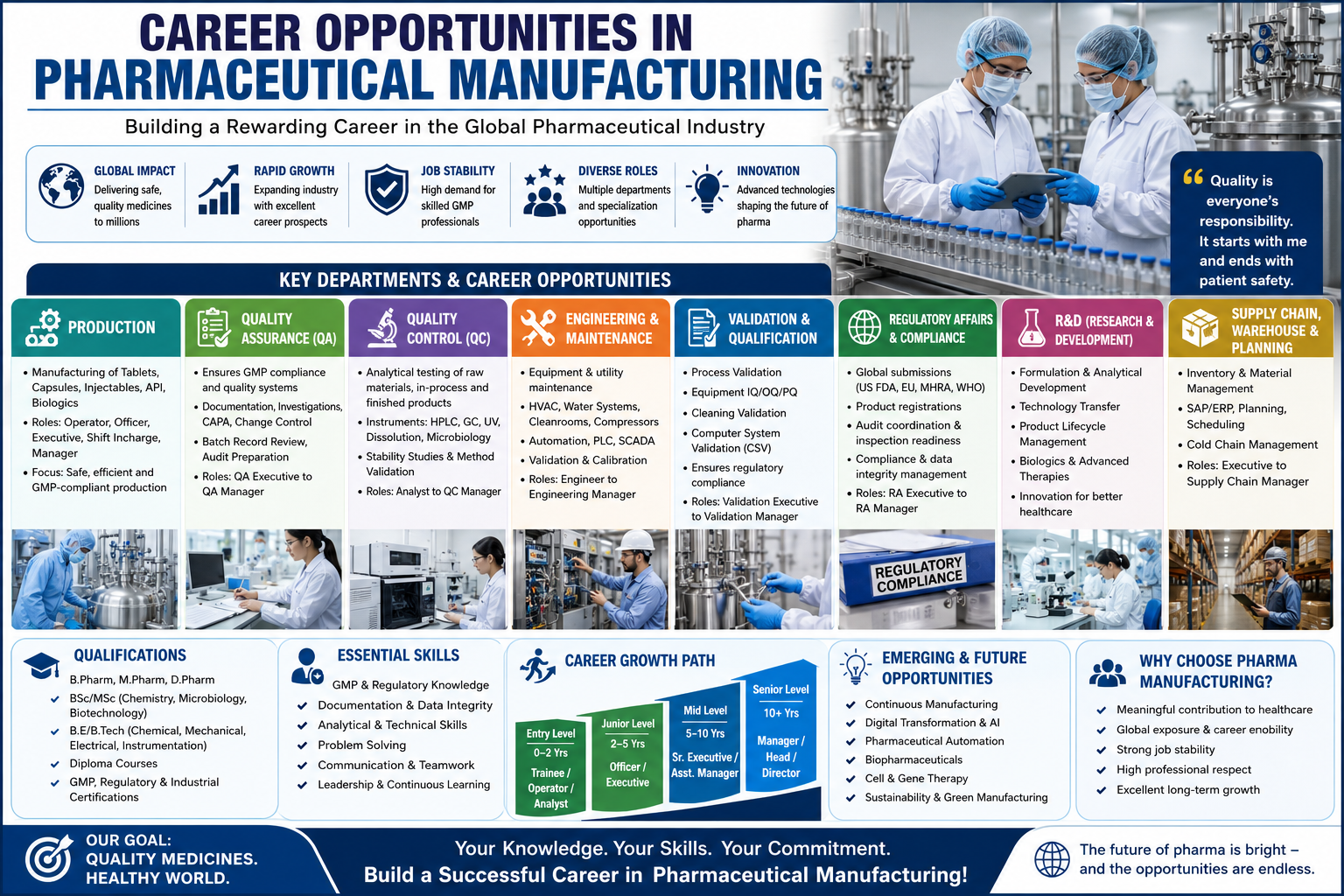
The pharmaceutical manufacturing industry is one of the fastest-growing industries in the world. Every year, thousands of freshers and experienced professionals apply for jobs in production departments of pharmaceutical companies. Roles such as Production Operator, Manufacturing Technician, and Production Supervisor are highly demanding positions in tablet, capsule, injectable, syrup, ointment, and API manufacturing plants.
If you are preparing for a pharmaceutical manufacturing interview, this complete guide will help you understand the most commonly asked Pharma Production Interview Questions along with practical answers.
This article is specially designed for:
- B.Pharm candidates
- M.Pharm candidates
- Diploma holders
- ITI candidates
- Production operators
- Manufacturing technicians
- Production supervisors
- Pharma freshers
Introduction to Pharmaceutical Production Department
The production department is the backbone of pharmaceutical manufacturing. It is responsible for manufacturing medicines according to approved procedures, GMP guidelines, and quality standards.
Role of Production Operator in Pharmaceutical Manufacturing
A Production Operator works directly on manufacturing equipment and production activities.
Main Responsibilities
- Operating production machines
- Cleaning equipment
- Following SOPs
- Maintaining documentation
- Performing line clearance
- Monitoring process parameters
- Wearing GMP garments properly
- Reporting deviations immediately
- Ensuring product quality and safety
Production operators work in:
- Granulation
- Compression
- Coating
- Capsule filling
- Packing
- Sterile manufacturing
- Injectable production
Role of Production Supervisor
A Production Supervisor manages production activities and manpower on the shop floor.
Main Responsibilities
- Supervising operators
- Managing production targets
- Ensuring GMP compliance
- Reviewing batch documents
- Handling deviations
- Coordinating with QA/QC
- Ensuring equipment availability
- Maintaining safety standards
- Conducting shift handovers
Production supervisors play a critical role in maintaining productivity and compliance.
Importance of GMP, SOP, Safety, Documentation, and Quality Compliance
GMP (Good Manufacturing Practices)
GMP ensures medicines are consistently manufactured and controlled according to quality standards.
SOP (Standard Operating Procedure)
SOPs provide step-by-step instructions for performing tasks correctly.
Safety
Safety protects employees, products, and equipment from hazards and contamination.
Documentation
Proper documentation ensures traceability and compliance with regulatory requirements.
Quality Compliance
Compliance ensures products meet required specifications and regulatory standards.
Section 1: Top 25 Pharma Production Operator Interview Questions and Answers
1. What is GMP?
Answer:
GMP stands for Good Manufacturing Practices. It is a system that ensures pharmaceutical products are consistently produced and controlled according to quality standards.
Key Points:
- Prevents contamination
- Ensures product quality
- Maintains documentation
- Controls manufacturing processes
2. What is line clearance?
Answer:
Line clearance is the process of checking and ensuring that the production area is free from previous product materials, labels, documents, and equipment before starting a new batch.
Purpose:
- Prevents mix-ups
- Prevents cross-contamination
- Ensures batch accuracy
3. What is BMR/BPR?
Answer:
- BMR: Batch Manufacturing Record
- BPR: Batch Packaging Record
These documents contain complete details of manufacturing and packaging activities.
4. What is the difference between QA and QC?
| QA | QC |
|---|---|
| Quality Assurance | Quality Control |
| Process-oriented | Product-oriented |
| Prevents defects | Detects defects |
| Ensures compliance | Performs testing |
5. What is SOP?
Answer:
SOP stands for Standard Operating Procedure. It is a written instruction for performing tasks consistently and safely.
6. What is deviation?
Answer:
Deviation is any departure from approved procedures, specifications, or standards during manufacturing.
Example:
If compression machine speed exceeds the approved limit, it is considered a deviation.
7. How do you clean equipment?
Answer:
Equipment cleaning is done according to approved SOPs.
Steps:
- Switch off equipment
- Remove product residues
- Use approved cleaning agents
- Wash and dry properly
- Inspect cleanliness
- Affix “Cleaned” status label
8. What is contamination?
Answer:
Contamination is the unwanted presence of foreign materials, microorganisms, or chemicals in a product.
9. Explain status labels.
Answer:
Status labels indicate equipment or material status.
Types:
- Under Cleaning
- Cleaned
- Under Process
- Approved
- Rejected
10. What precautions are taken during production?
Answer:
- Wear PPE properly
- Follow SOPs
- Maintain cleanliness
- Avoid mix-ups
- Perform line clearance
- Record data properly
11. What is cross-contamination?
Answer:
Cross-contamination occurs when one product contaminates another product.
12. What is PPE?
Answer:
PPE means Personal Protective Equipment such as gloves, masks, goggles, and gowns.
13. What is calibration?
Answer:
Calibration ensures instruments provide accurate readings.
14. Why is documentation important?
Answer:
Documentation provides traceability and regulatory compliance.
15. What is batch numbering?
Answer:
Batch numbering identifies each manufactured batch uniquely.
16. What is dispensing?
Answer:
Dispensing is the process of weighing and issuing raw materials according to BMR.
17. What is reconciliation?
Answer:
Reconciliation compares issued material quantity with used and remaining quantity.
18. What is a cleanroom?
Answer:
A cleanroom is a controlled environment with low contamination levels.
19. What is environmental monitoring?
Answer:
Environmental monitoring checks air, temperature, humidity, and microbial levels.
20. Why is gowning important?
Answer:
Gowning prevents contamination from operators.
21. What should you do if a machine breaks down?
Answer:
- Stop operation safely
- Inform supervisor
- Record breakdown
- Call maintenance team
22. What is yield?
Answer:
Yield is the quantity of product obtained after manufacturing.
23. What is hold time?
Answer:
Hold time is the allowed storage duration between manufacturing stages.
24. What is process validation?
Answer:
Process validation ensures the manufacturing process consistently produces quality products.
25. Why do you want to work in pharma production?
Answer:
“I want to work in pharma production because it allows me to contribute to manufacturing quality medicines that improve patient health.”
Section 2: Top 25 Production Supervisor Interview Questions and Answers
1. How do you handle manpower?
Answer:
I assign duties based on skill, monitor productivity, and maintain team coordination.
2. What is batch reconciliation?
Answer:
Batch reconciliation compares theoretical and actual quantities to identify losses.
3. How do you manage deviations?
Answer:
- Identify root cause
- Inform QA
- Document properly
- Implement CAPA
4. Explain CAPA.
Answer:
CAPA means Corrective and Preventive Action.
- Corrective Action solves existing issues
- Preventive Action avoids future recurrence
5. What is change control?
Answer:
Change control is a formal process for managing modifications in equipment, process, or documents.
6. How do you ensure GMP compliance?
Answer:
- Conduct training
- Monitor documentation
- Maintain cleanliness
- Follow SOPs strictly
7. How do you face audits?
Answer:
- Maintain accurate records
- Answer confidently
- Provide factual information
- Ensure compliance readiness
8. How do you improve production efficiency?
Answer:
- Reduce downtime
- Improve planning
- Train operators
- Monitor OEE
9. How do you reduce downtime?
Answer:
- Preventive maintenance
- Spare part availability
- Operator training
10. Explain shift handover procedure.
Answer:
Shift handover includes:
- Machine status
- Batch status
- Deviations
- Pending activities
11. What is OEE?
Answer:
OEE means Overall Equipment Effectiveness.
12. How do you handle conflicts among operators?
Answer:
I listen to both sides and resolve issues professionally.
13. How do you maintain safety?
Answer:
- Conduct safety training
- Ensure PPE usage
- Follow EHS guidelines
14. What is risk assessment?
Answer:
Risk assessment identifies potential hazards and control measures.
15. What is root cause analysis?
Answer:
It identifies the actual reason behind a problem.
16. What is preventive maintenance?
Answer:
Scheduled maintenance performed to avoid equipment breakdown.
17. How do you ensure documentation accuracy?
Answer:
- Review entries
- Avoid overwriting
- Follow GDP practices
18. Explain GDP.
Answer:
GDP means Good Documentation Practices.
19. What is escalation procedure?
Answer:
Escalation means reporting critical issues to higher management.
20. How do you motivate your team?
Answer:
- Appreciation
- Communication
- Training
- Team involvement
21. What is inventory control?
Answer:
Managing material availability and usage efficiently.
22. How do you handle production pressure?
Answer:
I prioritize tasks and maintain calm communication.
23. How do you ensure quality during production?
Answer:
By monitoring critical parameters and following SOPs.
24. What is lean manufacturing?
Answer:
Lean manufacturing reduces waste and improves productivity.
25. Why should we hire you as Production Supervisor?
Answer:
“I have strong GMP knowledge, leadership skills, and experience managing production operations efficiently.”
Section 3: Technical Pharma Production Questions
Compression Machine
Common Questions:
- What is tablet compression?
- What are compression defects?
- Explain turret speed.
Answer:
Compression converts granules into tablets using punches and dies.
Common Defects:
- Capping
- Lamination
- Picking
- Sticking
Granulation
Types:
- Wet granulation
- Dry granulation
Purpose:
Improves flow and compressibility.
Coating
Types:
- Film coating
- Sugar coating
- Enteric coating
Purpose:
- Taste masking
- Product protection
- Controlled release
HVAC System
Answer:
HVAC controls:
- Temperature
- Humidity
- Air filtration
- Pressure
It prevents contamination in cleanrooms.
Differential Pressure
Answer:
Differential pressure prevents contamination flow between rooms.
Temperature & Humidity
Answer:
Controlled temperature and humidity maintain product stability.
Preventive Maintenance
Answer:
Regular maintenance reduces machine failure and downtime.
Equipment Qualification
Types:
- DQ – Design Qualification
- IQ – Installation Qualification
- OQ – Operational Qualification
- PQ – Performance Qualification
Section 4: HR Interview Questions and Sample Answers
1. Tell me about yourself.
Sample Answer:
“My name is Rahul Sharma. I completed B.Pharm from XYZ University. I have strong interest in pharmaceutical manufacturing and GMP practices. I am hardworking, quick learner, and eager to build my career in pharma production.”
2. Why should we hire you?
Sample Answer:
“I have good technical knowledge, positive attitude, and strong willingness to learn and contribute.”
3. Why do you want to join the pharma industry?
Sample Answer:
“The pharmaceutical industry gives an opportunity to contribute to healthcare and patient safety.”
4. What are your strengths?
Sample Answer:
- Teamwork
- Discipline
- Fast learning
- Positive attitude
5. What is your weakness?
Sample Answer:
“I sometimes focus too much on details, but I am improving my time management skills.”
6. What are your career goals?
Sample Answer:
“I want to grow into a leadership role in pharmaceutical manufacturing.”
7. Are you comfortable working in shifts?
Sample Answer:
“Yes, I am comfortable working in rotational shifts.”
8. How do you handle stress?
Sample Answer:
“I stay calm, prioritize work, and focus on solutions.”
9. Can you relocate?
Sample Answer:
“Yes, I am open to relocation for career growth.”
10. What do you know about our company?
Sample Answer:
Mention:
- Company products
- Manufacturing facilities
- Market reputation
Section 5: Tips to Crack Pharma Production Interview
1. Dress Professionally
Recommended Dress Code:
- Formal shirt
- Formal trousers
- Clean shoes
- Proper grooming
2. Carry Important Documents
Documents Checklist:
- Resume
- Educational certificates
- ID proof
- Experience letters
- Passport-size photos
3. Learn Basic GMP
Important GMP topics:
- SOP
- Deviation
- CAPA
- Line clearance
- Documentation
4. Improve Communication Skills
Tips:
- Speak clearly
- Maintain eye contact
- Be confident
5. Revise Technical Concepts
Focus on:
- Compression
- Granulation
- HVAC
- QA/QC basics
6. Be Honest During Interview
Never provide false information.
7. Stay Confident
Confidence creates a positive impression.
Important GMP Terms for Quick Revision
| Term | Meaning |
|---|---|
| GMP | Good Manufacturing Practices |
| SOP | Standard Operating Procedure |
| CAPA | Corrective and Preventive Action |
| BMR | Batch Manufacturing Record |
| BPR | Batch Packaging Record |
| HVAC | Heating Ventilation Air Conditioning |
| QA | Quality Assurance |
| QC | Quality Control |
Frequently Asked Questions (FAQ)
Which department is best in pharma manufacturing?
Production, QA, QC, and Regulatory Affairs are highly demanding departments.
Is pharma production a good career?
Yes, pharmaceutical production offers strong career growth and stable job opportunities.
What is the salary of a pharma production operator?
Salary depends on experience, company, and location.
What should freshers study before pharma interviews?
Freshers should study:
- GMP
- SOP
- QA/QC basics
- Manufacturing process
- Documentation
Which machines are commonly used in tablet manufacturing?
- Rapid Mixer Granulator
- Fluid Bed Dryer
- Compression Machine
- Coating Machine
- Blister Packing Machine
Conclusion
Preparing for a Pharmaceutical Manufacturing Interview requires both technical knowledge and confidence. Candidates applying for Production Operator Interview Questions or Production Supervisor Interview Questions should have a clear understanding of GMP, SOP, documentation, equipment handling, safety, and quality systems.
Whether you are a fresher or experienced professional, regularly revising these Pharma Job Interview Questions will improve your confidence and help you perform better during interviews.
Strong knowledge of GMP Interview Questions and practical production operations can significantly increase your chances of getting selected in top pharmaceutical companies.
About the Author
Ramesh Palav is a pharmaceutical manufacturing professional with 21+ years of experience in Oral Solid Dosage manufacturing, production operations, GMP compliance, qualification, validation, QMS and operational excellence. Through Pharma Manufacturing Hub, he shares practical industry knowledge with pharmaceutical professionals, students and manufacturing leaders.