
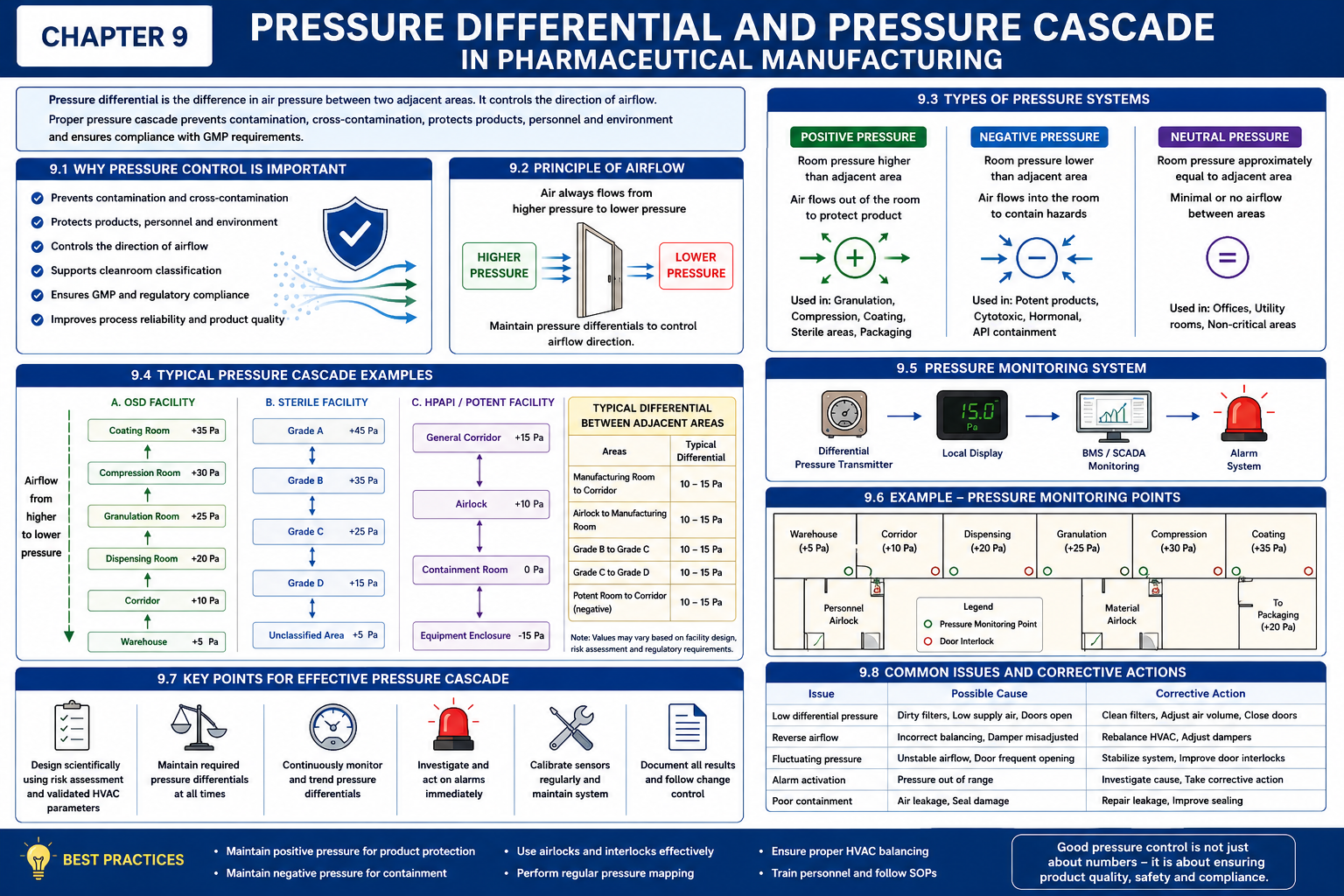
9.1 Introduction
Pressure differential and pressure cascade are among the most critical engineering controls in pharmaceutical manufacturing facilities. Along with HVAC systems and cleanroom classification, they form the foundation of an effective Contamination Control Strategy (CCS) by controlling the direction of airflow between adjacent rooms.
Proper pressure cascade design ensures that air consistently moves from areas of lower contamination risk to areas of higher contamination control (for product protection) or from cleaner areas into containment rooms (for operator and environmental protection), depending on the manufacturing process and product hazard.
Incorrect pressure differentials can result in:
- Cross-contamination
- Product contamination
- Microbial ingress
- Regulatory observations
- Batch rejection
- Product recalls
- Increased occupational exposure
A scientifically designed and validated pressure cascade is therefore essential for compliance with WHO GMP, US FDA, EU GMP Annex 1, PIC/S GMP, ISPE, and ISO 14644.
9.2 What is Pressure Differential?
A pressure differential is the measurable difference in air pressure between two adjacent areas. It is expressed in Pascals (Pa).
The pressure differential determines the direction of airflow when doors or openings are present.
Example
| Room | Pressure |
|---|---|
| Corridor | +10 Pa |
| Compression Room | +20 Pa |
In this example, air flows from the Compression Room to the Corridor, helping to protect the product from contaminants entering the room.
9.3 What is a Pressure Cascade?
A pressure cascade is a planned sequence of increasing or decreasing room pressures designed to maintain controlled airflow throughout the facility.
Objectives
- Prevent contamination
- Prevent cross-contamination
- Protect products
- Protect personnel
- Support cleanroom classification
- Maintain GMP compliance
9.4 Importance of Pressure Cascade
A properly designed pressure cascade provides:
- Product protection
- Personnel protection
- Environmental protection
- Controlled airflow
- Improved HVAC performance
- Reduced contamination risks
- Easier qualification
- Better inspection readiness
9.5 Principles of Airflow
Air naturally moves:
- From higher pressure to lower pressure
- Through open doors, gaps, or leakage paths
Therefore:
- Positive pressure protects the product.
- Negative pressure contains hazardous materials.
9.6 Types of Pressure Systems
Positive Pressure
Positive pressure means the room pressure is higher than adjacent areas.
Applications
- Tablet compression
- Granulation
- Sterile manufacturing
- Coating
- Packaging
- Finished product storage
Example
Manufacturing Room (+30 Pa)
          │
          ▼
Corridor (+20 Pa)
          │
          ▼
Outside (+5 Pa)
Air always flows outward, preventing contaminants from entering the manufacturing room.
Negative Pressure
Negative pressure means the room pressure is lower than surrounding areas.
Applications
- Potent products
- Cytotoxic drugs
- Hormonal products
- API containment
- Dust collection rooms
Example
Corridor (+15 Pa)
       │
       ▼
Containment Room (0 Pa)
       │
       ▼
Isolator (-15 Pa)
Air flows into the containment area, preventing hazardous materials from escaping.
Neutral Pressure
Neutral pressure exists when adjacent rooms have approximately the same pressure.
Applications
- Utility rooms
- Engineering areas
- Administrative offices
- Certain warehouses
Neutral pressure is generally avoided between manufacturing areas where airflow direction is important.
9.7 Typical Pressure Hierarchy
Oral Solid Dosage (OSD)
Compression Room      +30 Pa
        │
Coating Room          +25 Pa
        │
Granulation           +20 Pa
        │
Corridor              +15 Pa
        │
Warehouse             +10 Pa
Sterile Facility
Grade A
   │
Grade B
   │
Grade C
   │
Grade D
   │
Unclassified Area
Each transition is maintained by validated pressure differentials to support the intended airflow direction.
Potent Product Facility
Corridor
      │
Airlock
      │
Containment Room
      │
Equipment Enclosure
Pressure decreases progressively toward the highest containment zone.
9.8 Typical Pressure Differential Values
| Adjacent Areas | Typical Differential* |
|---|---|
| Manufacturing to Corridor | 10–15 Pa |
| Airlock to Manufacturing | 10–15 Pa |
| Grade B to Grade C | 10–15 Pa |
| Grade C to Grade D | 10–15 Pa |
| Potent Room to Corridor | 10–15 Pa (negative relative to corridor) |
*Values should be established by facility design and risk assessment.
9.9 Pressure Cascade Design for OSD Facility
Warehouse
   +5 Pa
      │
Corridor
 +10 Pa
      │
Dispensing
 +20 Pa
      │
Granulation
 +25 Pa
      │
Compression
 +30 Pa
      │
Coating
 +35 Pa
This arrangement supports airflow from cleaner manufacturing areas toward less clean adjacent areas while maintaining product protection.
9.10 Pressure Cascade Design for Sterile Manufacturing
Grade A
 +45 Pa
     │
Grade B
 +35 Pa
     │
Grade C
 +25 Pa
     │
Grade D
 +15 Pa
     │
Unclassified
  +5 Pa
This simplified example illustrates a positive pressure gradient; actual pressure setpoints should be defined during facility design and qualification.
9.11 Pressure Cascade for HPAPI Facility
General Corridor
 +15 Pa
      │
Airlock
 +10 Pa
      │
Containment Room
 0 Pa
      │
Isolator
 -15 Pa
This configuration contains hazardous materials while protecting adjacent areas.
9.12 Airlocks and Pressure Cascade
Airlocks maintain pressure stability during entry and exit.
Personnel Airlock (PAL)
Functions:
- Maintains pressure gradient
- Prevents contamination
- Supports gowning
- Minimizes air mixing
Material Airlock (MAL)
Functions:
- Controlled material transfer
- Maintains pressure
- Reduces contamination risk
9.13 Pressure Monitoring System
Continuous monitoring is recommended for critical manufacturing areas.
Typical components include:
- Differential pressure transmitters
- Pressure gauges
- Digital displays
- Building Management System (BMS)
- Alarm system
- Data logging
9.14 Pressure Monitoring Locations
Pressure should typically be monitored between:
- Adjacent manufacturing rooms
- Manufacturing room and corridor
- Airlock and manufacturing room
- Sterile rooms
- Potent manufacturing suites
- Isolators and surrounding areas
9.15 Pressure Alarm Limits
Typical approach:
| Status | Example Action |
|---|---|
| Normal | Within validated operating range |
| Alert | Investigate trend and system performance |
| Action | Stop affected operations if product quality or containment may be compromised; investigate, correct, and document before restart |
Alert and action limits should be established during qualification based on process needs and risk assessment.
9.16 HVAC Relationship
Pressure differentials are controlled by:
- Supply air volume
- Return air volume
- Exhaust air volume
- Air balancing
- Fan speed
- Dampers
Maintaining the correct balance is essential for stable pressure cascades.
9.17 Pressure Mapping
Pressure mapping verifies that the designed pressure cascade is achieved throughout the facility.
Typical procedure:
- Measure pressures between adjacent rooms.
- Compare results with approved design values.
- Identify deviations.
- Correct HVAC imbalances.
- Document results.
Pressure mapping is typically performed during qualification and repeated after significant modifications or according to the site’s requalification program.
9.18 Qualification Requirements
Pressure differential verification is included within HVAC qualification.
Qualification Activities
- Design Qualification (DQ)
- Installation Qualification (IQ)
- Operational Qualification (OQ)
- Performance Qualification (PQ)
- Pressure mapping
- Alarm verification
- Door opening studies (where applicable)
- Airflow visualization (smoke studies)
9.19 Common Causes of Pressure Failure
Common issues include:
- Dirty filters
- Blocked return air grilles
- Incorrect damper settings
- Fan malfunction
- Door left open
- Door seal damage
- HVAC imbalance
- Excessive leakage through penetrations
- Simultaneous opening of interlocked doors
9.20 Troubleshooting Guide
| Problem | Possible Cause | Corrective Action |
|---|---|---|
| Low pressure | Fan issue | Inspect and repair fan |
| Pressure fluctuation | Damper instability | Rebalance airflow |
| Reverse airflow | Incorrect balancing | Adjust supply/return air |
| Alarm activation | Door open | Close door and verify interlocks |
| Poor containment | Air leakage | Repair seals and verify room integrity |
9.21 Common Inspection Observations
Inspectors frequently identify:
- Incorrect pressure cascade.
- Missing pressure monitoring records.
- Differential pressure gauges out of calibration.
- Alarm systems not functioning.
- Open doors disrupting airflow.
- Inadequate pressure recovery after door opening.
- Lack of documented pressure mapping.
- Unexplained pressure excursions.
9.22 Best Practices
- Design pressure cascades using documented Quality Risk Management (QRM).
- Verify pressure relationships during HVAC qualification.
- Continuously monitor critical pressure differentials.
- Maintain calibrated pressure sensors and transmitters.
- Trend pressure data to identify deterioration.
- Investigate all unexplained excursions.
- Include pressure verification in preventive maintenance and periodic requalification.
9.23 Case Study – Pressure Cascade in an OSD Tablet Facility
Facility
Tablet Manufacturing Plant
Pressure Design
| Area | Pressure |
|---|---|
| Warehouse | +5 Pa |
| Corridor | +10 Pa |
| Dispensing | +20 Pa |
| Granulation | +25 Pa |
| Compression | +30 Pa |
| Coating | +35 Pa |
Results
- Controlled airflow direction.
- Reduced dust migration.
- Improved environmental consistency.
- Enhanced product protection.
- Successful qualification and regulatory inspections.
9.24 Case Study – Pressure Cascade in a Sterile Injectable Facility
Facility
Sterile Injectable Manufacturing
Pressure Strategy
| Area | Pressure Relationship |
|---|---|
| Grade A | Highest positive pressure in critical zone |
| Grade B | Positive relative to Grade C |
| Grade C | Positive relative to Grade D |
| Grade D | Positive relative to surrounding unclassified areas |
Benefits
- Reduced microbial ingress.
- Protection of exposed sterile product.
- Stable environmental conditions during aseptic processing.
- Compliance with cleanroom qualification requirements.
Chapter Summary
Pressure differentials and pressure cascades are essential engineering controls that govern airflow direction within pharmaceutical facilities. Whether the objective is protecting products through positive pressure or containing hazardous materials through negative pressure, pressure strategies must be scientifically justified, validated, continuously monitored, and integrated with HVAC design and the overall Contamination Control Strategy (CCS). Effective pressure management reduces contamination risks, enhances operational reliability, and supports global GMP compliance.
Key Takeaways
- Pressure differentials control airflow between adjacent rooms and are fundamental to contamination control.
- Positive pressure is primarily used for product protection, while negative pressure is used for containment of hazardous materials.
- Pressure cascades should be established using documented Quality Risk Management (QRM) and verified through qualification.
- Continuous monitoring, alarm management, calibration, and periodic pressure mapping help ensure sustained performance.
- Properly designed pressure systems improve product quality, operator safety, and regulatory inspection readiness.
Next Chapter
Chapter 10 – Material Flow in Pharmaceutical Manufacturing, covering raw material movement, quarantine, sampling, dispensing, manufacturing, packaging, finished goods flow, waste management, material airlocks (MAL), pass boxes, segregation principles, layout design, risk assessment, and GMP best practices for preventing mix-ups and cross-contamination.
About the Author
Ramesh Palav is a pharmaceutical manufacturing professional with 21+ years of experience in Oral Solid Dosage manufacturing, production operations, GMP compliance, qualification, validation, QMS and operational excellence. Through Pharma Manufacturing Hub, he shares practical industry knowledge with pharmaceutical professionals, students and manufacturing leaders.