
10.1 Introduction
Material flow is one of the most important aspects of pharmaceutical facility design and Good Manufacturing Practices (GMP). A well-designed material flow system ensures that raw materials, packaging materials, intermediates, bulk products, finished products, and waste move through the facility in a logical, controlled, and unidirectional manner without creating opportunities for contamination, cross-contamination, product mix-ups, or operational inefficiencies.
Material flow should be designed during the early stages of facility planning and integrated with:
- Facility layout
- Cubicle classification
- HVAC design
- Pressure cascade
- Personnel flow
- Warehouse management
- Quality Management System (QMS)
- Contamination Control Strategy (CCS)
Regulatory authorities expect manufacturers to demonstrate that material movement is scientifically designed, validated, and effectively controlled.
10.2 Objectives of Material Flow Design
The objectives of a pharmaceutical material flow system are to:
- Prevent contamination and cross-contamination.
- Prevent product mix-ups.
- Maintain material identity and traceability.
- Protect product quality.
- Improve manufacturing efficiency.
- Reduce unnecessary movement.
- Minimize handling errors.
- Support GMP compliance.
- Facilitate inspections and audits.
10.3 GMP Requirements
Material flow requirements are addressed in:
| Guideline | Requirement |
|---|---|
| WHO GMP | Controlled movement of materials |
| US FDA 21 CFR Parts 210 & 211 | Prevention of contamination and mix-ups |
| EU GMP Chapter 3 | Premises and material handling |
| PIC/S Guide | Material movement and segregation |
| ISPE Baseline Guides | Facility layout and logistics |
| ICH Q9 | Risk-based facility design |
| ICH Q10 | Pharmaceutical Quality System |
10.4 Principles of Material Flow
An effective material flow system should follow these principles:
- Unidirectional movement from receipt to dispatch.
- Segregation of different material categories.
- Controlled access to manufacturing areas.
- Clear material identification and status labeling.
- No crossing of clean and dirty materials.
- Minimized manual handling where practical.
- Documented transfer procedures.
10.5 Material Categories
Pharmaceutical materials are typically classified as follows:
| Material Category | Examples |
|---|---|
| Raw Materials | APIs, excipients |
| Packaging Materials | Blister foil, bottles, cartons, labels |
| Intermediate Products | Wet granules, dried granules, blends |
| Bulk Products | Unpacked tablets, capsules, sterile bulk solution |
| Finished Products | Packed and released medicines |
| Returned Materials | Customer returns, production returns |
| Rejected Materials | Failed raw materials or products |
| Waste Materials | Dust, rejected tablets, contaminated disposables |
Each category should have defined storage, handling, and movement procedures.
10.6 Overall Material Flow
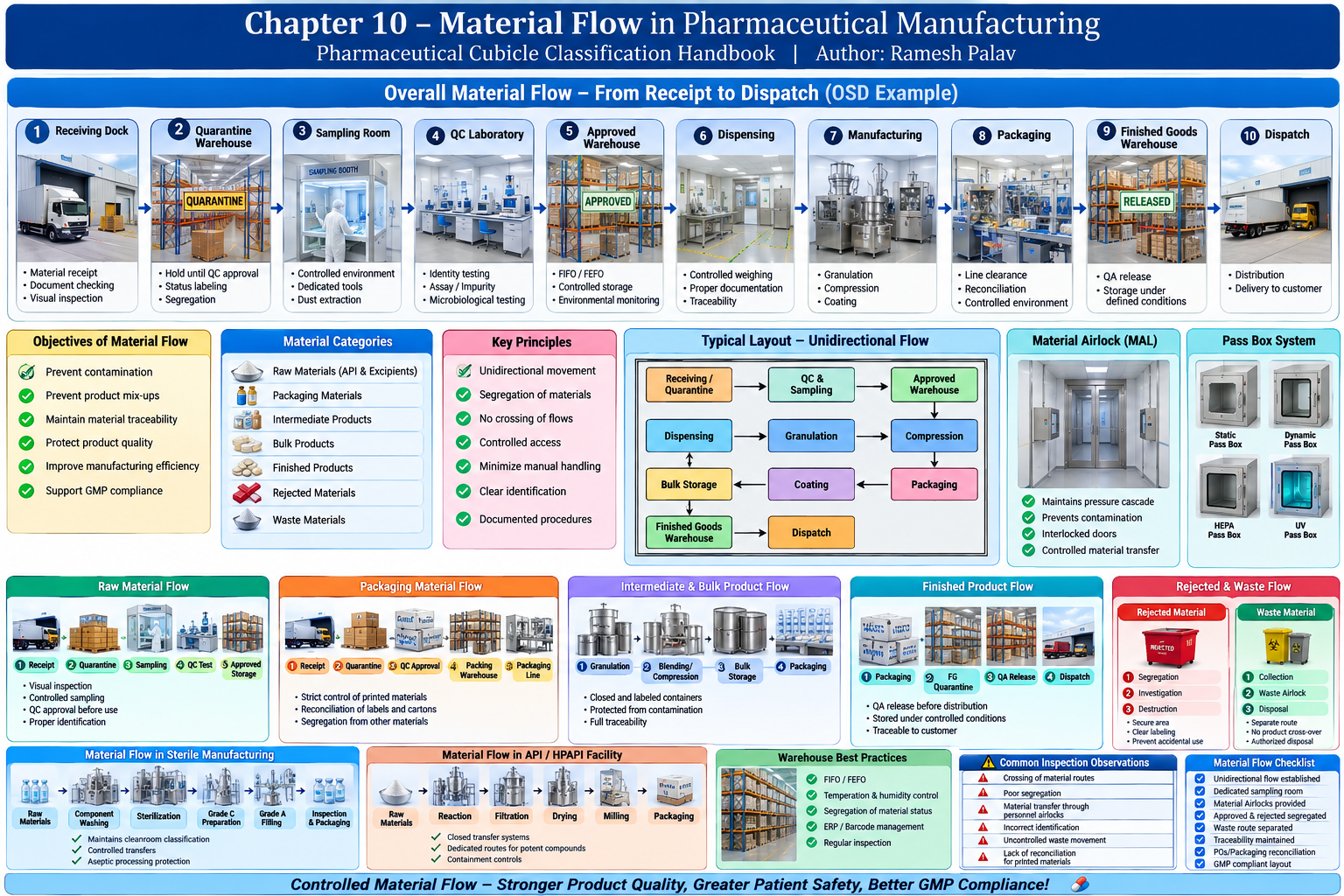
A typical material flow for an OSD facility is shown below.
Supplier
    │
    ▼
Receiving Bay
    │
    ▼
Quarantine Warehouse
    │
    ▼
Sampling Room
    │
    ▼
Quality Control Approval
    │
    ▼
Approved Warehouse
    │
    ▼
Dispensing
    │
    ▼
Manufacturing
    │
    ▼
Packaging
    │
    ▼
Finished Goods Warehouse
    │
    ▼
Dispatch
This sequence should avoid backtracking and unnecessary crossings.
10.7 Raw Material Flow
Step 1 – Receipt
Raw materials are received at the receiving dock.
Activities include:
- Visual inspection
- Verification of documentation
- Counting and identification
- Damage inspection
Step 2 – Quarantine
All incoming materials should be placed in a quarantine area until released by Quality Control (QC).
Status labels commonly include:
- Quarantine
- Approved
- Rejected
- Under Test
Step 3 – Sampling
Sampling is performed in a designated sampling cubicle.
Typical controls include:
- HEPA-filtered sampling booth
- Dust extraction
- Dedicated sampling tools
- Controlled environmental conditions
Step 4 – Quality Control
QC performs:
- Identity testing
- Assay
- Impurity testing
- Microbiological testing (where applicable)
Only approved materials are released for production.
10.8 Approved Material Storage
Approved materials should be stored in designated warehouse locations.
Typical controls:
- FIFO (First In, First Out)
- FEFO (First Expiry, First Out)
- Temperature monitoring
- Humidity monitoring
- Segregation of different materials
- Barcode or ERP-based inventory control
10.9 Material Flow into Manufacturing
Approved materials move to manufacturing through a controlled process.
Approved Warehouse
        │
        ▼
Material Airlock (MAL)
        │
        ▼
Dispensing Cubicle
        │
        ▼
Manufacturing Cubicles
Material Airlocks (MALs) help maintain pressure cascades and minimize contamination.
10.10 Intermediate Material Flow
Intermediate products include:
- Wet granules
- Dried granules
- Milled granules
- Blends
- Bulk tablets
- Bulk capsules
Movement should be:
- Clearly identified
- Fully traceable
- Protected from contamination
- Performed in closed containers where appropriate
10.11 Bulk Product Flow
After manufacturing, bulk products move to packaging.
Example:
Compression
     │
     ▼
Tablet Inspection
     │
     ▼
Bulk Storage
     │
     ▼
Packaging
Bulk products should be:
- Covered
- Labeled
- Protected from environmental exposure
- Stored under defined conditions
10.12 Packaging Material Flow
Packaging materials require strict control due to the risk of mix-ups.
Typical flow:
Receiving
     │
     ▼
Quarantine
     │
     ▼
QC Approval
     │
     ▼
Packaging Warehouse
     │
     ▼
Packaging Line
Printed packaging components (labels, cartons, inserts) should receive additional reconciliation controls.
10.13 Finished Product Flow
After packaging, products move to the finished goods warehouse.
Packaging
     │
     ▼
Finished Goods Quarantine
     │
     ▼
Quality Assurance Release
     │
     ▼
Dispatch Warehouse
     │
     ▼
Customer
Finished products should not be distributed until QA release is complete.
10.14 Rejected Material Flow
Rejected materials should be isolated to prevent accidental use.
Manufacturing
     │
     ▼
Rejected Material Area
     │
     ▼
Investigation
     │
     ▼
Destruction or Approved Disposition
The rejected material area should be secure and clearly identified.
10.15 Waste Material Flow
Waste should never move through clean manufacturing routes.
Examples include:
- Dust
- Packaging waste
- Cleaning waste
- Used garments
- Rejected products
Recommended flow:
Manufacturing
     │
     ▼
Waste Collection Point
     │
     ▼
Waste Airlock
     │
     ▼
Waste Holding Area
     │
     ▼
Authorized Disposal
Separate routes for hazardous and non-hazardous waste should be considered where applicable.
10.16 Material Airlocks (MAL)
Material Airlocks maintain environmental control during transfers.
Functions
- Preserve pressure differentials.
- Reduce contamination.
- Separate clean and less-clean areas.
- Facilitate controlled movement.
Typical Features
- Interlocked doors
- Smooth, cleanable surfaces
- Pressure monitoring
- Status indication
- Pass-through capability
10.17 Pass Boxes
Pass boxes are used for transferring small materials.
Types
| Type | Application |
|---|---|
| Static Pass Box | Same classification areas |
| Dynamic Pass Box | Different classification areas |
| HEPA Pass Box | High-risk transfers |
| UV Pass Box | Supplemental surface disinfection (not a replacement for cleaning) |
10.18 Material Identification
Every material should be clearly identified.
Typical information:
- Material name
- Material code
- Batch number
- Quantity
- Status
- Expiry or retest date
- Storage conditions
Electronic systems (e.g., barcode or RFID) can improve traceability and reduce manual errors.
10.19 Material Traceability
Complete traceability should be maintained from receipt to distribution.
Typical records include:
- Goods receipt records
- Sampling records
- QC results
- Dispensing records
- Batch Manufacturing Record (BMR)
- Packaging records
- Distribution records
Traceability supports investigations, recalls, and regulatory compliance.
10.20 Material Flow in Sterile Manufacturing
Typical flow:
Raw Materials
      │
      ▼
Component Washing
      │
      ▼
Sterilization
      │
      ▼
Grade C Preparation
      │
      ▼
Grade A Filling
      │
      ▼
Inspection
      │
      ▼
Packaging
Transfers between cleanroom grades should occur through appropriately designed airlocks and follow the established pressure cascade.
10.21 Material Flow in API Manufacturing
Typical sequence:
Raw Materials
      │
      ▼
Reaction
      │
      ▼
Filtration
      │
      ▼
Drying
      │
      ▼
Milling
      │
      ▼
Packaging
Closed transfer systems should be considered for hazardous or potent compounds.
10.22 Common Material Flow Mistakes
Common inspection observations include:
- Crossing of raw and finished product routes.
- Inadequate segregation of approved and rejected materials.
- Material transfers through personnel airlocks.
- Incorrect material identification.
- Poor warehouse organization.
- Uncontrolled movement of waste.
- Lack of reconciliation for printed packaging materials.
10.23 Best Practices
- Design unidirectional material flow from receipt to dispatch.
- Separate material and personnel routes wherever practical.
- Use dedicated Material Airlocks (MALs) and pass boxes.
- Clearly identify all materials and their status.
- Implement barcode or ERP-based inventory management.
- Apply FIFO/FEFO inventory principles.
- Perform regular warehouse inspections and reconciliation.
- Validate material transfer procedures and train personnel.
10.24 Case Study – Material Flow in an OSD Tablet Facility
Facility Layout
Receiving
    │
Quarantine Warehouse
    │
Sampling
    │
Approved Warehouse
    │
Dispensing
    │
Granulation
    │
Compression
    │
Coating
    │
Packaging
    │
Finished Goods Warehouse
    │
Dispatch
Key Controls
| Activity | Control Measure |
|---|---|
| Receipt | Documentation and visual inspection |
| Quarantine | Status labeling and segregation |
| Sampling | HEPA-filtered sampling booth |
| Dispensing | Controlled weighing with traceability |
| Manufacturing | Closed, labeled containers |
| Packaging | Line clearance and reconciliation |
| Finished Goods | QA release before dispatch |
Benefits
- Reduced contamination risk.
- Improved traceability.
- Prevention of product mix-ups.
- Efficient manufacturing logistics.
- Compliance with GMP expectations.
10.25 Material Flow Checklist
| Checkpoint | Status |
|---|---|
| Separate receiving and dispatch areas | ☐ |
| Quarantine area available | ☐ |
| Approved and rejected materials segregated | ☐ |
| Dedicated sampling room provided | ☐ |
| Material Airlocks (MALs) installed where required | ☐ |
| Material status labeling implemented | ☐ |
| FIFO/FEFO system operational | ☐ |
| Waste route separated from product flow | ☐ |
| Printed packaging materials reconciled | ☐ |
| Material movement documented and traceable | ☐ |
Chapter Summary
Material flow is a fundamental element of GMP-compliant pharmaceutical facility design. A well-planned, risk-based, and unidirectional material flow system minimizes contamination, prevents mix-ups, improves traceability, and enhances operational efficiency. Integration of material flow with cubicle classification, HVAC systems, pressure cascades, warehousing, and Quality Management Systems ensures consistent product quality and regulatory compliance across the manufacturing lifecycle.
Key Takeaways
- Material flow should be unidirectional, controlled, and fully traceable.
- Raw materials, intermediates, bulk products, finished products, packaging materials, rejected materials, and waste require defined movement pathways.
- Material Airlocks (MALs), pass boxes, and status labeling are critical engineering and operational controls.
- Warehouse practices such as FIFO/FEFO and segregation of material status support GMP compliance.
- Effective material flow design reduces contamination risks, improves efficiency, and strengthens inspection readiness.
Next Chapter
Chapter 11 – Personnel Flow in Pharmaceutical Manufacturing, covering personnel entry and exit procedures, change rooms, gowning and de-gowning, personnel airlocks (PAL), movement between classified areas, hygiene practices, contamination prevention, qualification, and GMP requirements for personnel flow in pharmaceutical manufacturing facilities.
About the Author
Ramesh Palav is a pharmaceutical manufacturing professional with 21+ years of experience in Oral Solid Dosage manufacturing, production operations, GMP compliance, qualification, validation, QMS and operational excellence. Through Pharma Manufacturing Hub, he shares practical industry knowledge with pharmaceutical professionals, students and manufacturing leaders.