
11.1 Introduction
Personnel are recognized as one of the largest potential sources of contamination in pharmaceutical manufacturing. Every individual entering a manufacturing area introduces particles, microorganisms, and other contaminants through skin cells, hair, clothing, footwear, and movement. Therefore, controlling personnel movement is a fundamental aspect of Good Manufacturing Practices (GMP) and an essential element of a facility’s Contamination Control Strategy (CCS).
Personnel flow refers to the planned, controlled, and documented movement of employees, contractors, visitors, and inspectors from facility entry to exit. It encompasses entry procedures, gowning, movement through manufacturing areas, transfer between classified zones, and de-gowning before leaving controlled environments.
An effective personnel flow system minimizes contamination risks, protects products and operators, maintains pressure cascades, and ensures compliance with regulatory expectations.
11.2 Objectives of Personnel Flow Design
The primary objectives are to:
- Prevent contamination of pharmaceutical products.
- Prevent cross-contamination between manufacturing areas.
- Protect personnel from hazardous materials.
- Maintain cleanroom classifications.
- Preserve pressure cascades.
- Ensure controlled access to manufacturing areas.
- Facilitate efficient manufacturing operations.
- Support GMP compliance and inspection readiness.
11.3 Regulatory Requirements
Personnel flow should comply with international regulatory expectations.
| Guideline | Personnel Flow Requirement |
|---|---|
| WHO GMP | Hygienic entry and controlled movement |
| US FDA 21 CFR Parts 210 & 211 | Personnel hygiene and contamination prevention |
| EU GMP Volume 4 | Personnel and premises |
| EU GMP Annex 1 | Gowning, cleanroom behavior, personnel qualification |
| PIC/S GMP Guide | Personnel access and contamination control |
| ISO 14644 | Cleanroom operational practices |
| ICH Q9 | Risk-based facility design |
11.4 Principles of Personnel Flow
A GMP-compliant personnel flow system should follow these principles:
- Unidirectional movement where practical.
- Separate personnel and material routes.
- Controlled entry through designated access points.
- Appropriate gowning before entering classified areas.
- Restricted access to authorized personnel.
- No unnecessary movement between manufacturing areas.
- Controlled exit through de-gowning areas.
- Documented procedures for entry and exit.
11.5 Sources of Personnel Contamination
Personnel generate contaminants through:
- Skin flakes
- Hair
- Respiratory droplets
- Clothing fibers
- Footwear
- Cosmetics and jewelry
- Hand contact with surfaces
- Excessive movement
Even with cleanroom garments, personnel remain a major contamination source, making training and disciplined behavior essential.
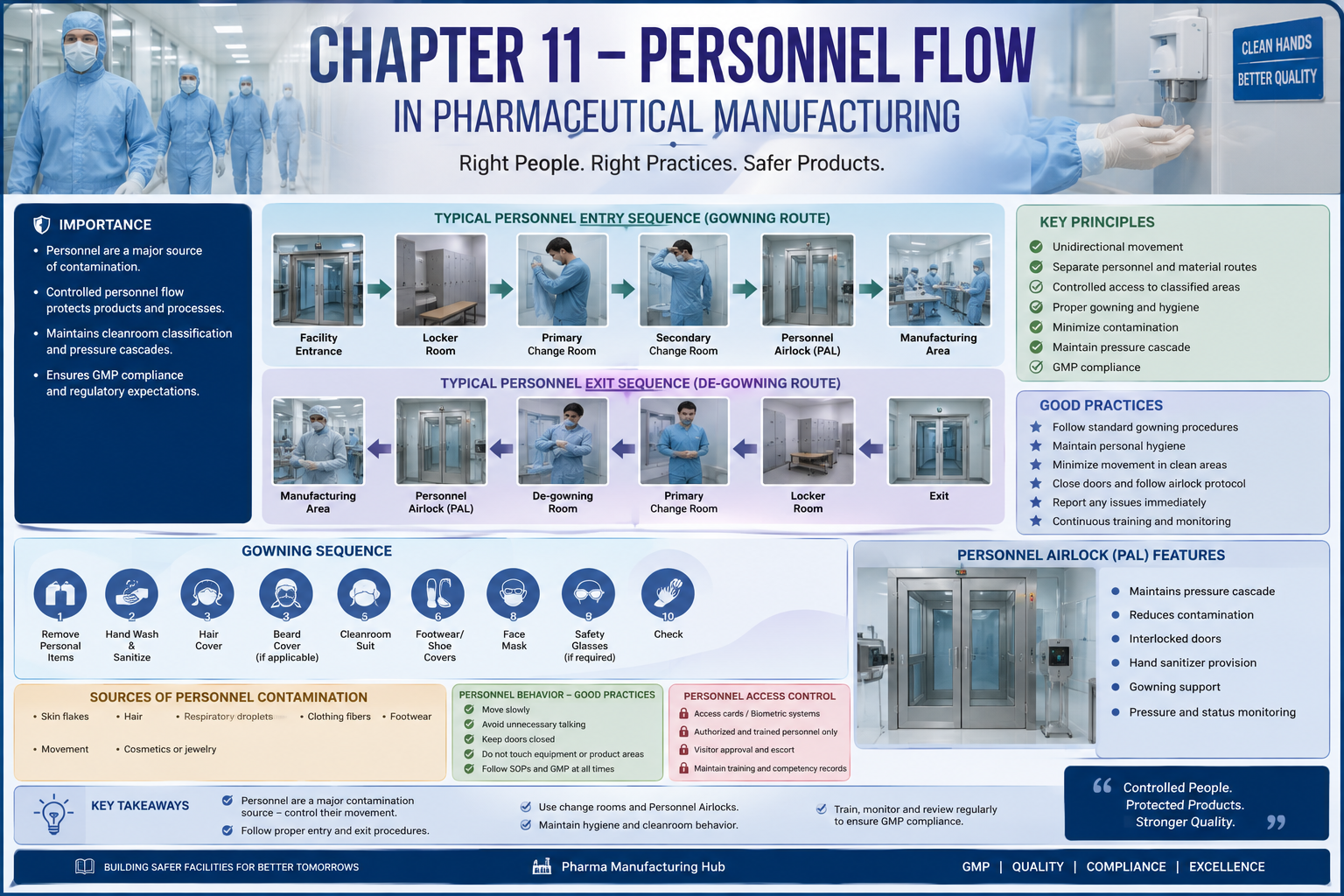
11.6 Personnel Entry Sequence
A typical personnel entry sequence is shown below.
Facility Entrance
        │
Reception
        │
Locker Room
        │
Primary Change Room
        │
Secondary Change Room
        │
Personnel Airlock (PAL)
        │
Manufacturing Cubicle
Each stage progressively reduces the contamination burden before personnel enter production areas.
11.7 Personnel Exit Sequence
Personnel should exit through a controlled route.
Manufacturing Area
        │
Personnel Airlock
        │
De-gowning Room
        │
Primary Change Room
        │
Locker Room
        │
Exit
For hazardous product facilities, additional decontamination steps may be required before personnel leave the manufacturing suite.
11.8 Change Rooms
Change rooms provide controlled transition from uncontrolled to classified areas.
Types
| Change Room | Purpose |
|---|---|
| Primary Change Room | Remove street clothing and footwear |
| Secondary Change Room | Wear cleanroom garments |
| Final Gowning Room | Final preparation before entering manufacturing |
Design Features
- Smooth, cleanable finishes.
- Benches separating clean and dirty sides.
- Hand-wash stations.
- Hand sanitizers.
- Mirrors.
- Garment storage.
- Waste bins.
- Differential pressure monitoring.
11.9 Gowning Procedures
Proper gowning minimizes contamination from personnel.
Typical Gowning Sequence
- Remove jewelry and personal items.
- Wash and sanitize hands.
- Wear hair cover.
- Wear beard cover (if applicable).
- Put on cleanroom suit.
- Wear dedicated footwear or shoe covers.
- Wear face mask.
- Wear safety glasses if required.
- Wear sterile or cleanroom gloves.
- Perform final gown inspection.
The gowning sequence may vary depending on the cleanroom classification and manufacturing process.
11.10 De-gowning Procedures
Before leaving classified areas:
- Remove gloves.
- Remove gown in the prescribed order.
- Dispose of single-use garments appropriately.
- Place reusable garments in designated containers.
- Wash and sanitize hands.
- Exit through the approved route.
Improper de-gowning can transfer contaminants into cleaner or uncontrolled areas.
11.11 Personnel Airlocks (PAL)
A Personnel Airlock (PAL) is a controlled transition area between rooms of different classifications.
Functions
- Maintain pressure cascade.
- Reduce contamination transfer.
- Facilitate gowning and de-gowning.
- Control access.
- Minimize simultaneous door opening.
Typical Features
- Interlocked doors.
- Pressure differential display.
- Hand sanitizer.
- Gown storage.
- Seating for shoe changes.
- Visual inspection mirror.
11.12 Personnel Flow in OSD Manufacturing
Typical flow:
Entry
   │
Primary Change
   │
Secondary Change
   │
PAL
   │
Dispensing
   │
Granulation
   │
Compression
   │
Coating
   │
Packaging
   │
Exit
Personnel should avoid unnecessary movement between different manufacturing operations, particularly between dusty and cleaner processes.
11.13 Personnel Flow in Sterile Manufacturing
Sterile manufacturing requires the highest level of personnel discipline.
Typical flow:
Entry
   │
Primary Change
   │
Secondary Change
   │
Sterile Gowning
   │
Grade D
   │
Grade C
   │
Grade B
   │
Grade A Work Zone
Movement should always progress from lower to higher cleanliness levels. Re-entry into cleaner areas after moving to lower-grade areas should follow approved procedures.
11.14 Personnel Flow in Potent Product Facilities
Facilities handling HPAPIs, hormones, or cytotoxic products require additional controls.
Typical flow:
Entry
   │
Change Room
   │
Containment Gowning
   │
PAL
   │
Containment Suite
   │
Decontamination
   │
De-gowning
   │
Exit
Additional PPE and decontamination procedures should be determined through occupational risk assessments.
11.15 Personnel Hygiene Requirements
Personnel should:
- Maintain good personal hygiene.
- Keep fingernails clean and short.
- Avoid cosmetics that may shed particles.
- Report illnesses that could affect product quality.
- Avoid wearing jewelry in manufacturing areas.
- Follow handwashing procedures before entry.
- Wear only approved garments and PPE.
11.16 Personnel Behavior in Cleanrooms
Personnel behavior directly affects contamination levels.
Good Practices
- Move slowly.
- Keep doors closed.
- Minimize talking.
- Avoid unnecessary movement.
- Do not touch product-contact surfaces.
- Follow aseptic techniques where applicable.
- Report damaged garments immediately.
Poor Practices
- Running.
- Leaning on equipment.
- Touching walls.
- Frequent door opening.
- Bringing unauthorized items into cleanrooms.
- Improper glove use.
11.17 Personnel Access Control
Access should be restricted through:
- Electronic access cards.
- Biometric systems.
- Password-controlled entry.
- Visitor authorization.
- Training records verification.
Only trained and authorized personnel should enter classified manufacturing areas.
11.18 Personnel Training
Training should include:
- GMP requirements.
- Personal hygiene.
- Gowning procedures.
- Cleanroom behavior.
- Contamination control.
- Emergency procedures.
- Material handling.
- Product-specific hazards.
- Refresher training.
Training effectiveness should be periodically evaluated and documented.
11.19 Environmental Monitoring of Personnel
Personnel are routinely monitored in sterile manufacturing.
Typical monitoring includes:
- Glove prints.
- Finger dab plates.
- Gown contact plates.
- Sleeve monitoring.
- Operator qualification during aseptic process simulations.
Results should be trended to identify recurring issues.
11.20 Risk Assessment for Personnel Flow
Quality Risk Management (QRM) should evaluate:
- Crossing of personnel and material routes.
- Shared change rooms.
- High personnel traffic.
- Transfer between different manufacturing suites.
- Visitor access.
- Maintenance activities.
- Contractor movement.
Appropriate engineering and procedural controls should be implemented to reduce identified risks.
11.21 Common Inspection Observations
Regulatory agencies frequently observe:
- Poor gowning practices.
- Personnel crossing material routes.
- Door interlocks bypassed.
- Inadequate hand hygiene.
- Excessive movement in cleanrooms.
- Unauthorized personnel access.
- Improper use of PPE.
- Lack of personnel monitoring records.
- Insufficient training documentation.
11.22 Best Practices
- Design dedicated personnel routes separate from material flow.
- Provide appropriately sized change rooms and Personnel Airlocks (PALs).
- Standardize gowning and de-gowning procedures with visual instructions.
- Continuously train personnel on GMP and contamination control.
- Monitor compliance through routine observations and environmental monitoring.
- Use electronic access systems to control entry.
- Periodically review personnel flow during facility risk assessments.
11.23 Case Study – Personnel Flow in an OSD Tablet Manufacturing Facility
Facility Layout
Entrance
    │
Locker Room
    │
Primary Change
    │
Secondary Change
    │
PAL
    │
Granulation
    │
Compression
    │
Coating
    │
Packaging
    │
Exit
Key Controls
| Area | Control Measure |
|---|---|
| Locker Room | Street clothing removed |
| Change Rooms | Sequential gowning |
| PAL | Door interlocking and pressure monitoring |
| Manufacturing | Restricted access |
| Exit | Controlled de-gowning |
Benefits
- Reduced contamination risk.
- Improved operator discipline.
- Better cleanroom performance.
- Compliance with GMP requirements.
- Improved audit readiness.
11.24 Personnel Flow Checklist
| Checkpoint | Status |
|---|---|
| Separate personnel and material routes | ☐ |
| Primary and secondary change rooms available | ☐ |
| Personnel Airlocks (PALs) installed | ☐ |
| Approved gowning SOPs available | ☐ |
| Hand hygiene facilities provided | ☐ |
| Access control implemented | ☐ |
| Personnel monitoring program established | ☐ |
| Training records current | ☐ |
| Visitor access controlled | ☐ |
| De-gowning procedures validated | ☐ |
Chapter Summary
Personnel flow is a critical component of pharmaceutical facility design and contamination control. By establishing controlled entry and exit routes, providing appropriate change rooms and Personnel Airlocks (PALs), implementing effective gowning procedures, and enforcing disciplined cleanroom behavior, manufacturers can significantly reduce contamination risks while protecting both products and personnel. Integration of personnel flow with cubicle classification, HVAC systems, pressure cascades, and Quality Risk Management supports robust GMP compliance and operational excellence.
Key Takeaways
- Personnel are a major potential source of contamination and require carefully controlled movement.
- Separate personnel and material flow wherever practical to reduce contamination and mix-up risks.
- Change rooms, Personnel Airlocks (PALs), and standardized gowning procedures are essential engineering and operational controls.
- Personnel training, hygiene, behavior, and environmental monitoring play key roles in maintaining cleanroom performance.
- Risk-based design and periodic review of personnel flow improve product quality, regulatory compliance, and facility efficiency.
Next Chapter
Chapter 12 – Airlocks in Pharmaceutical Manufacturing, covering Personnel Airlocks (PAL), Material Airlocks (MAL), Dynamic Airlocks, Static Airlocks, interlocking systems, pressure cascades, HVAC integration, design principles, qualification, validation, operational procedures, troubleshooting, and GMP regulatory expectations for pharmaceutical manufacturing facilities.
About the Author
Ramesh Palav is a pharmaceutical manufacturing professional with 21+ years of experience in Oral Solid Dosage manufacturing, production operations, GMP compliance, qualification, validation, QMS and operational excellence. Through Pharma Manufacturing Hub, he shares practical industry knowledge with pharmaceutical professionals, students and manufacturing leaders.