
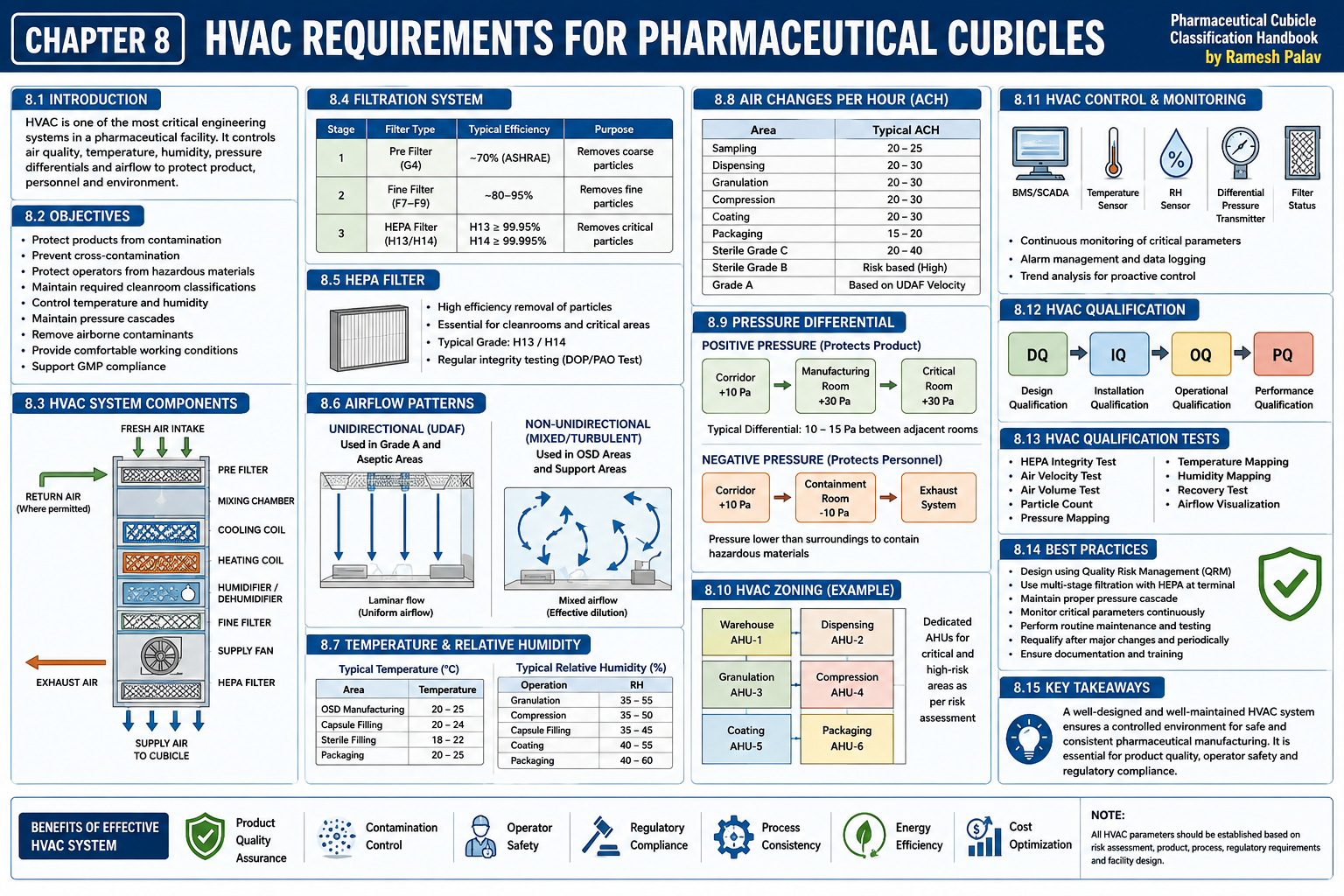
8.1 Introduction
The Heating, Ventilation, and Air Conditioning (HVAC) system is one of the most critical engineering systems in a pharmaceutical manufacturing facility. It is often referred to as the “heart of the cleanroom” because it directly influences product quality, contamination control, personnel comfort, equipment performance, and regulatory compliance.
A properly designed HVAC system maintains:
- Air cleanliness
- Temperature
- Relative Humidity (RH)
- Pressure differentials
- Airflow patterns
- Air changes per hour (ACH)
- Removal of airborne particles and microorganisms
HVAC systems are fundamental to the Contamination Control Strategy (CCS) required by modern GMP regulations and must be designed, qualified, monitored, and maintained throughout the facility lifecycle.
8.2 Objectives of HVAC Systems
The primary objectives of pharmaceutical HVAC systems are:
- Protect pharmaceutical products from contamination.
- Prevent cross-contamination.
- Protect operators from hazardous materials.
- Maintain required cleanroom classifications.
- Control temperature and humidity.
- Maintain pressure cascades.
- Remove airborne contaminants.
- Provide comfortable working conditions.
- Support GMP compliance.
- Ensure consistent manufacturing performance.
8.3 Regulatory Requirements
Pharmaceutical HVAC systems should comply with:
| Guideline | HVAC Requirements |
|---|---|
| WHO GMP | Environmental control |
| US FDA 21 CFR Parts 210 & 211 | Adequate ventilation |
| EU GMP Volume 4 | HVAC design and qualification |
| EU GMP Annex 1 | Sterile HVAC requirements |
| PIC/S Guide | Air handling systems |
| ISO 14644 | Cleanroom classification |
| ISPE Baseline Guides | HVAC engineering |
| ICH Q9 | Risk-based HVAC design |
8.4 Components of a Pharmaceutical HVAC System
A typical HVAC system consists of the following components:
Fresh Air Intake
        │
        ▼
Pre-Filter
        │
        ▼
Air Handling Unit (AHU)
        │
        ▼
Cooling Coil
        │
        ▼
Heating Coil
        │
        ▼
Humidifier / Dehumidifier
        │
        ▼
Fine Filter
        │
        ▼
Supply Fan
        │
        ▼
HEPA Filter
        │
        ▼
Manufacturing Cubicle
        │
        ▼
Return Air / Exhaust Air
8.5 Air Handling Unit (AHU)
The AHU is the central component of the HVAC system and is responsible for conditioning and distributing air.
Functions
- Air filtration
- Temperature control
- Humidity control
- Air circulation
- Fresh air introduction
- Air mixing
- Pressure maintenance
Typical AHU Components
- Fresh air damper
- Return air damper
- Mixing chamber
- Pre-filter
- Fine filter
- Cooling coil
- Heating coil
- Humidifier
- Dehumidification system
- Supply fan
- Instrumentation
8.6 Air Filtration System
Air filtration removes airborne particles before air enters the manufacturing area.
Three-Stage Filtration
| Filter Stage | Typical Efficiency | Purpose |
|---|---|---|
| Pre Filter | G4/MERV equivalent | Remove coarse dust |
| Fine Filter | F7–F9/MERV equivalent | Remove fine particles |
| HEPA Filter | H13/H14 | Remove critical particles |
8.7 HEPA Filters
HEPA filters are essential in pharmaceutical cleanrooms.
Typical Efficiency
| Filter | Minimum Efficiency (MPPS) |
|---|---|
| H13 | ≥99.95% |
| H14 | ≥99.995% |
Applications
- Sterile filling
- Dispensing booths
- Sampling booths
- Dynamic pass boxes
- Laminar airflow units
8.8 Terminal HEPA Filters
Terminal HEPA filters are installed immediately before conditioned air enters the cleanroom.
Advantages
- Highest filtration efficiency
- Reduced contamination risk
- Easier integrity testing
- Uniform air distribution
- Improved cleanroom performance
8.9 Fresh Air System
Fresh air is required to:
- Maintain oxygen levels
- Dilute contaminants
- Control carbon dioxide
- Maintain building pressure
Typical Fresh Air Sources
- Outdoor air
- Treated fresh air unit (TFA)
Fresh air should be filtered and conditioned before entering the AHU.
8.10 Return Air System
Return air reduces energy consumption by recirculating conditioned air where appropriate.
Benefits
- Lower operating costs
- Stable temperature
- Stable humidity
- Reduced cooling load
Note: Return air recirculation should be evaluated through a documented risk assessment. Certain hazardous or sensitizing products may require dedicated exhaust systems with no recirculation.
8.11 Exhaust Air System
Exhaust systems remove:
- Dust
- Solvents
- Heat
- Moisture
- Hazardous vapors
Dedicated exhaust systems are commonly required for:
- Potent products
- Cytotoxic products
- Solvent-based coating
- API manufacturing
- Dust collectors
8.12 Air Changes per Hour (ACH)
ACH indicates how many times the room air is replaced in one hour.
Typical Recommendations
| Area | Typical ACH |
|---|---|
| Sampling | 20–25 |
| Dispensing | 20–30 |
| Granulation | 20–30 |
| Compression | 20–30 |
| Coating | 20–30 |
| Packaging | 15–20 |
| Sterile Grade C | 20–40 |
| Sterile Grade B | Risk-based (typically high) |
| Grade A | Based on unidirectional airflow velocity |
ACH should be determined by engineering calculations and qualification studies.
8.13 Airflow Patterns
Unidirectional Airflow (UDAF)
Used in:
- Grade A cleanrooms
- Aseptic filling
- Sterile compounding
Advantages:
- Uniform airflow
- Minimal turbulence
- Continuous sweeping of contaminants
Non-Unidirectional (Mixed/Turbulent) Airflow
Used in:
- OSD manufacturing
- Packaging
- Warehouses
- Support areas
Provides effective dilution of airborne contaminants for lower-risk operations.
8.14 Temperature Control
Temperature affects:
- Product stability
- Process consistency
- Operator comfort
- Equipment performance
Typical Values
| Area | Temperature |
|---|---|
| OSD Manufacturing | 20–25°C |
| Capsule Filling | 20–24°C |
| Sterile Filling | 18–22°C |
| Packaging | 20–25°C |
Certain products may require tighter temperature limits based on process validation.
8.15 Relative Humidity (RH)
Humidity significantly influences pharmaceutical manufacturing.
High RH Can Cause
- Tablet sticking
- Capsule deformation
- Moisture absorption
- Microbial growth
Low RH Can Cause
- Static electricity
- Powder segregation
- Dust generation
- Tablet friability
Typical RH
| Operation | RH |
|---|---|
| Granulation | 35–55% |
| Compression | 35–50% |
| Capsule Filling | 35–45% |
| Coating | 40–55% |
| Packaging | 40–60% |
8.16 Pressure Differential
Pressure differentials maintain airflow direction.
Positive Pressure
Protects products.
Corridor (+10 Pa)
        │
        ▼
Manufacturing Room (+20 Pa)
        │
        ▼
Critical Room (+30 Pa)
Negative Pressure
Protects personnel.
Corridor (+10 Pa)
        │
        ▼
Containment Room (-10 Pa relative to corridor)
Typical Differential
- 10–15 Pa between adjacent rooms unless otherwise justified.
8.17 HVAC Zoning
Facilities are divided into HVAC zones based on:
- Product type
- Process
- Contamination risk
- Pressure requirements
Example
AHU-1 → Warehouse

AHU-2 → Dispensing

AHU-3 → Granulation

AHU-4 → Compression

AHU-5 → Sterile Facility

AHU-6 → Potent Product Facility
Dedicated AHUs are generally preferred for sterile, potent, or highly hazardous manufacturing areas where justified by risk.
8.18 HVAC Control System
Modern HVAC systems are controlled using:
- Building Management System (BMS)
- SCADA
- PLC
- Differential pressure transmitters
- Temperature sensors
- RH sensors
- Airflow sensors
Typical monitored parameters include:
- Temperature
- Relative humidity
- Pressure differential
- Filter status
- Fan status
- Alarm conditions
8.19 HVAC Qualification
HVAC systems should undergo lifecycle qualification.
Design Qualification (DQ)
        │
Installation Qualification (IQ)
        │
Operational Qualification (OQ)
        │
Performance Qualification (PQ)
8.20 HVAC Qualification Tests
| Test | Purpose |
|---|---|
| HEPA Integrity Test | Verify filter performance |
| Air Velocity Test | Confirm airflow |
| Air Volume Test | Verify airflow quantity |
| Particle Count | Verify cleanliness |
| Pressure Mapping | Confirm pressure cascade |
| Temperature Mapping | Verify temperature uniformity |
| Humidity Mapping | Verify RH control |
| Recovery Test | Demonstrate recovery after contamination challenge |
| Airflow Visualization | Verify airflow patterns |
8.21 Energy Efficiency
Modern HVAC systems should balance GMP compliance with energy performance.
Recommended Practices
- Variable Frequency Drives (VFDs)
- Demand-controlled ventilation (where appropriate)
- Heat recovery systems
- High-efficiency motors
- Optimized filter replacement schedules
- Building automation systems
Any energy-saving measure should not compromise contamination control or regulatory compliance.
8.22 Common HVAC Design Deficiencies
Common inspection findings include:
- Incorrect pressure cascade.
- Inadequate fresh air supply.
- Improper return air design.
- Dirty or damaged filters.
- Poor HVAC balancing.
- Inadequate air change rates.
- Lack of HEPA integrity testing.
- Incomplete qualification documentation.
- Poor alarm management.
8.23 Best Practices
- Design HVAC systems using a documented Quality Risk Management (QRM) approach.
- Select filtration stages based on process and cleanroom requirements.
- Provide dedicated HVAC systems for high-risk products where required.
- Continuously monitor critical environmental parameters through a validated BMS or equivalent system.
- Perform routine preventive maintenance and filter integrity testing.
- Requalify HVAC systems after significant modifications and at defined intervals.
- Trend environmental and HVAC performance data to support continuous improvement.
8.24 Case Study – HVAC Design for an OSD Manufacturing Facility
Facility
- Tablet Manufacturing Plant
AHU Distribution
| AHU | Area Served |
|---|---|
| AHU-1 | Dispensing |
| AHU-2 | Granulation |
| AHU-3 | Compression |
| AHU-4 | Coating |
| AHU-5 | Packaging |
Design Parameters
| Parameter | Value |
|---|---|
| Temperature | 22 ± 2°C |
| RH | 45 ± 5% (process dependent) |
| Pressure Differential | 10–15 Pa |
| HEPA Filter | H13 (where required by design) |
| Air Changes | 20–30 ACH |
Outcome
- Stable environmental conditions
- Effective dust control
- Reduced cross-contamination risk
- Improved product quality
- Successful qualification and regulatory inspections
Chapter Summary
HVAC systems are the foundation of contamination control in pharmaceutical manufacturing. By integrating effective air filtration, temperature and humidity control, pressure cascades, airflow management, and lifecycle qualification, HVAC systems create and maintain environments suitable for the manufacture of pharmaceutical products. A risk-based HVAC design aligned with GMP, ISO 14644, and EU GMP Annex 1 ensures product quality, operator safety, and regulatory compliance while supporting efficient facility operation.
Key Takeaways
- HVAC systems are essential for maintaining cleanroom performance and GMP compliance.
- Air filtration, temperature, humidity, pressure differentials, and airflow patterns must be designed according to product and process risk.
- Dedicated HVAC systems are often required for sterile, potent, or hazardous manufacturing operations.
- HVAC qualification—including HEPA integrity testing, airflow verification, and environmental mapping—is necessary before routine use.
- Continuous monitoring, preventive maintenance, and periodic requalification help ensure sustained system performance throughout the facility lifecycle.
Next Chapter
Chapter 9 – Pressure Differential and Pressure Cascade in Pharmaceutical Manufacturing, covering pressure cascade principles, positive and negative pressure strategies, room pressure hierarchy, differential pressure monitoring systems, pressure mapping, airflow direction, containment design, qualification, troubleshooting, and regulatory expectations for pharmaceutical manufacturing facilities.
About the Author
Ramesh Palav is a pharmaceutical manufacturing professional with 21+ years of experience in Oral Solid Dosage manufacturing, production operations, GMP compliance, qualification, validation, QMS and operational excellence. Through Pharma Manufacturing Hub, he shares practical industry knowledge with pharmaceutical professionals, students and manufacturing leaders.