
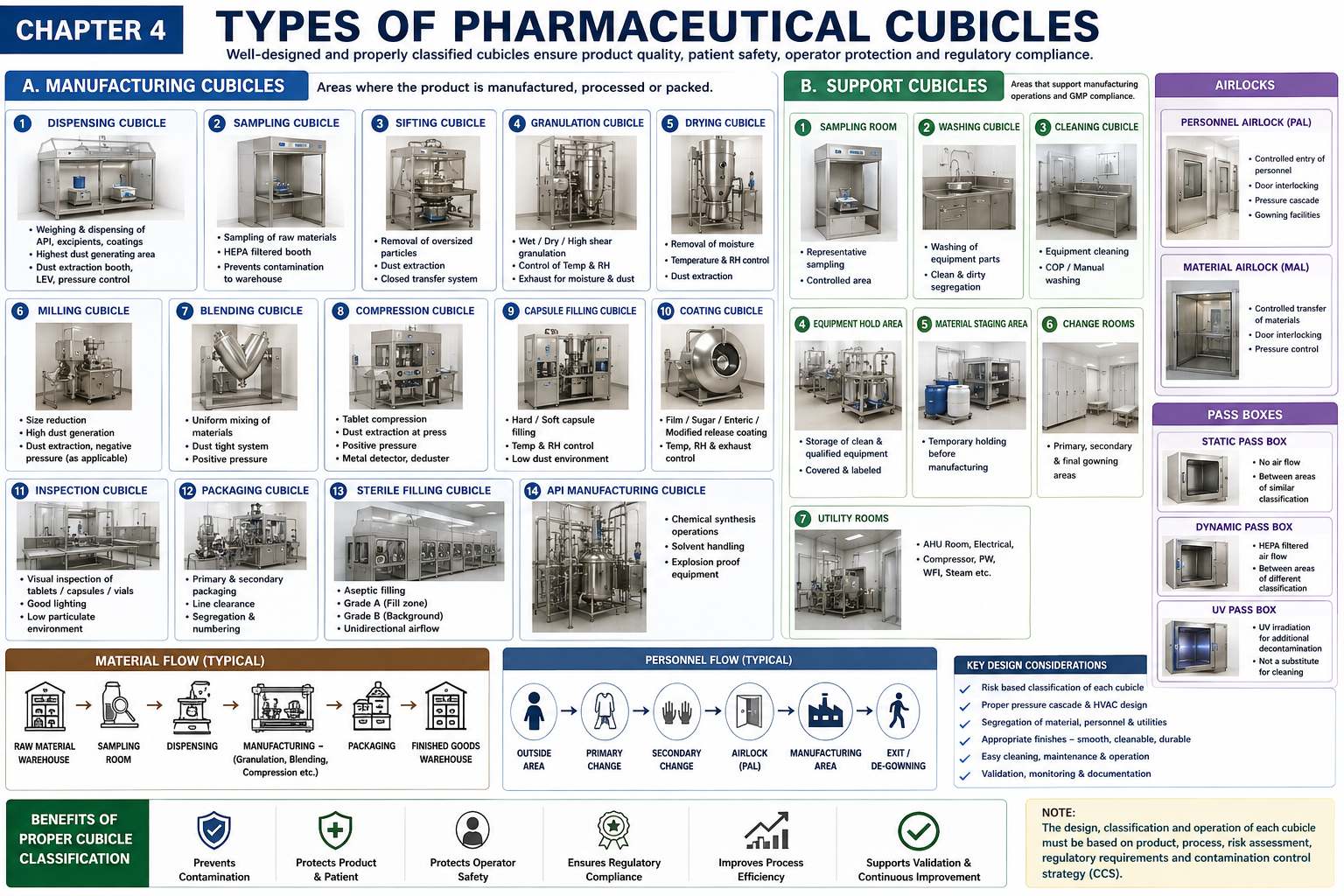
4.1 Introduction
A pharmaceutical manufacturing facility is composed of numerous cubicles (rooms), each designed to perform a specific operation under controlled environmental conditions. Every cubicle has a unique purpose, environmental classification, HVAC design, pressure differential, and operational controls based on the manufacturing activity and associated contamination risks.
The proper classification and design of these cubicles are essential for:
- Compliance with Good Manufacturing Practices (GMP)
- Prevention of contamination and cross-contamination
- Protection of personnel and products
- Efficient manufacturing operations
- Regulatory inspection readiness
- Validation and qualification activities
This chapter provides a detailed overview of the different types of pharmaceutical cubicles used in OSD, Sterile, Injectable, API, Biotechnology, and Packaging facilities.
4.2 Classification of Pharmaceutical Cubicles
Pharmaceutical cubicles are generally categorized into:
                    Pharmaceutical Cubicles
                              │
        ┌─────────────────────┴─────────────────────┐
        │                                           │
 Manufacturing Cubicles                     Support Cubicles
        │                                           │
 Dispensing                               Sampling
 Granulation                              Washing
 Compression                              Cleaning
 Coating                                  Equipment Hold
 Capsule Filling                          Material Staging
 Sterile Filling                          Change Rooms
 API Processing                           Airlocks
 Packaging                                Pass Boxes
 Inspection                               Utility Rooms
PART A – MANUFACTURING CUBICLES
Manufacturing cubicles are areas where pharmaceutical products undergo processing or transformation.
4.3 Dispensing Cubicle
Purpose
The dispensing cubicle is used for weighing and dispensing:
- Active Pharmaceutical Ingredients (APIs)
- Excipients
- Coating materials
- Packaging components
This operation is one of the highest dust-generating activities in pharmaceutical manufacturing.
Design Features
- Dust extraction booth
- HEPA-filtered supply air
- Local exhaust ventilation (LEV)
- Differential pressure monitoring
- Stainless steel dispensing booth
- Anti-static flooring (where required)
Typical Environmental Conditions
| Parameter | Typical Requirement |
|---|---|
| Temperature | 20–25°C |
| RH | 40–60% |
| Pressure | Positive for non-potent, Negative for potent products |
| Air Changes | 20–30 ACH |
4.4 Sampling Cubicle
Purpose
Sampling rooms are used for collecting representative samples from incoming raw materials without contaminating the warehouse or the material.
Design Considerations
- Sampling booth with HEPA filtration
- Dust extraction
- Controlled airflow
- Separate material entry
- Easy-to-clean surfaces
Typical Applications
- API sampling
- Excipient sampling
- Packaging material sampling
4.5 Sifting Cubicle
Purpose
Sifting removes oversized particles and foreign materials before further processing.
Major Risks
- Dust generation
- Cross-contamination
- Product loss
Design Features
- Local exhaust system
- Dust-tight equipment
- Pressure-controlled room
- Stainless steel construction
4.6 Granulation Cubicle
Purpose
Granulation improves powder flow, compressibility, and content uniformity.
Types include:
- Wet Granulation
- Dry Granulation
- High Shear Granulation
- Fluid Bed Granulation
Environmental Requirements
| Parameter | Typical Requirement |
|---|---|
| Temperature | 20–25°C |
| RH | 35–55% (process dependent) |
| Air Changes | 20–30 ACH |
| Pressure | Positive |
Equipment
- Rapid Mixer Granulator (RMG)
- Fluid Bed Processor (FBP)
- Binder preparation vessel
4.7 Drying Cubicle
Purpose
Drying removes moisture from granules to achieve the required moisture content.
Equipment may include:
- Fluid Bed Dryer (FBD)
- Vacuum Tray Dryer (VTD)
- Tray Dryer
Design Considerations
- Temperature control
- Humidity control
- Dust extraction
- Heat load management
4.8 Milling Cubicle
Purpose
Milling reduces particle size to improve blend uniformity and compression characteristics.
Risks
- High dust generation
- Heat generation
- Cross-contamination
Engineering Controls
- Dust extraction
- Local containment
- Negative pressure (where appropriate)
- Explosion protection (for combustible dust, where applicable)
4.9 Blending Cubicle
Purpose
Blending ensures uniform distribution of APIs and excipients.
Equipment
- Bin Blender
- Double Cone Blender
- Octagonal Blender
- Conta Blender
Design Features
- Controlled airflow
- Dust-tight transfer systems
- Positive pressure
- Environmental monitoring
4.10 Compression Cubicle
Purpose
Compression converts granules into tablets.
Risks
- Tablet dust
- Cross-contamination
- Weight variation due to environmental changes
Design Features
- Dust extraction at press
- HEPA-filtered supply air
- Positive pressure
- Differential pressure monitoring
Equipment
- Rotary Tablet Press
- Metal Detector
- Deduster
4.11 Capsule Filling Cubicle
Purpose
Manufacturing hard or soft gelatin capsules.
Environmental Requirements
- Controlled temperature
- Controlled humidity
- Low dust
- Product protection
Typical Equipment
- Capsule Filling Machine
- Capsule Polisher
- Capsule Sorter
4.12 Tablet Coating Cubicle
Purpose
Application of functional or cosmetic coating.
Types include:
- Film coating
- Sugar coating
- Enteric coating
- Modified-release coating
Design Features
- Controlled RH
- Solvent exhaust (if applicable)
- Temperature control
- Dust collection
Equipment
- Auto Coater
- Coating Solution Preparation Tank
- Air Handling System
4.13 Inspection Cubicle
Purpose
Inspection of tablets, capsules, vials, or ampoules for defects.
Environmental Controls
- Adequate lighting
- Controlled environment
- Ergonomic workstation
- Minimal dust
4.14 Packaging Cubicle
Purpose
Primary and secondary packaging.
Operations include:
- Blister Packing
- Strip Packing
- Bottle Filling
- Cartoning
- Serialization
Design Features
- Line clearance
- Material segregation
- Environmental control
- Barcode verification
4.15 Sterile Filling Cubicle
Used for aseptic manufacturing.
Requires:
- Grade A environment
- Grade B background
- Unidirectional airflow
- HEPA H14 filters
- Continuous particle monitoring
4.16 API Manufacturing Cubicle
Operations include:
- Charging
- Reaction
- Filtration
- Drying
- Milling
Design considerations:
- Solvent handling
- Explosion-proof equipment
- Dedicated HVAC
- Negative pressure (where required)
PART B – SUPPORT CUBICLES
Support cubicles do not directly manufacture products but are essential for GMP compliance.
4.17 Washing Cubicle
Purpose:
Cleaning of:
- Product-contact parts
- Containers
- Change parts
- Utensils
Design Features
- Stainless steel sinks
- Clean and dirty segregation
- Drainage
- Ventilation
4.18 Cleaning Cubicle
Used for:
- Equipment cleaning
- COP (Clean-Out-of-Place)
- Manual washing
- Storage after cleaning
4.19 Equipment Hold Area
Purpose:
Temporary storage of:
- Clean equipment
- Qualified equipment
- Ready-to-use change parts
Equipment should be:
- Covered
- Labeled
- Protected from contamination
4.20 Material Staging Area
Used before manufacturing.
Typical materials:
- APIs
- Excipients
- Packaging materials
- Printed materials
4.21 Change Rooms
Personnel gowning areas.
Types include:
- Primary Change Room
- Secondary Change Room
- Final Gowning Area
Typical sequence:
Outside
    │
Primary Change
    │
Secondary Change
    │
Airlock
    │
Manufacturing
4.22 Personnel Airlock (PAL)
Purpose:
Prevent contamination through personnel movement.
Features:
- Door interlocking
- Pressure cascade
- Gowning station
- Hand sanitization
- Mirror
- Shoe changing
4.23 Material Airlock (MAL)
Purpose:
Controlled transfer of materials.
Features:
- Door interlocks
- Pass-through arrangement
- Pressure control
- Cleaning facilities
4.24 Pass Box
Used for transferring materials without allowing personnel movement.
Types
Static Pass Box
- No airflow
- Between similar classified areas
Dynamic Pass Box
- HEPA filtration
- Continuous airflow
- Between different classified areas
UV Pass Box
- Includes UV disinfection
- Used only as a supplementary measure; UV is not a substitute for validated cleaning and disinfection.
4.25 Utility Rooms
Examples:
- AHU Room
- Electrical Room
- Compressor Room
- PW Plant
- WFI Plant
- Clean Steam Generator Room
These should generally be separated from manufacturing areas to reduce contamination and maintenance impacts.
4.26 Comparison of Manufacturing and Support Cubicles
| Parameter | Manufacturing Cubicle | Support Cubicle |
|---|---|---|
| Product Exposure | Yes | Usually No |
| GMP Classification | High | Moderate |
| Environmental Monitoring | Extensive | Risk-based |
| HVAC Control | Critical | Controlled |
| Validation | Comprehensive | As applicable |
| Cleaning Frequency | High | Scheduled |
4.27 Cubicle Selection Matrix
| Manufacturing Activity | Recommended Cubicle |
|---|---|
| Raw Material Sampling | Sampling Cubicle |
| Dispensing | Dispensing Cubicle |
| Granulation | Granulation Cubicle |
| Drying | Drying Cubicle |
| Milling | Milling Cubicle |
| Blending | Blending Cubicle |
| Compression | Compression Cubicle |
| Capsule Filling | Capsule Cubicle |
| Coating | Coating Cubicle |
| Inspection | Inspection Cubicle |
| Packaging | Packaging Cubicle |
| Sterile Filling | Grade A Filling Cubicle |
| Reactor Charging | API Reactor Cubicle |
4.28 Best Practices
- Design cubicles according to product and process risk assessments.
- Provide dedicated cubicles for highly potent, sensitizing, or hazardous products where required.
- Separate manufacturing and support functions to reduce contamination risks.
- Integrate HVAC, pressure cascades, and room finishes with the intended cubicle classification.
- Ensure cubicles are easy to clean, maintain, and inspect.
- Periodically review cubicle suitability as products, equipment, or processes change.
4.29 Common Inspection Observations
Regulatory agencies frequently identify:
- Inadequate segregation between manufacturing and support areas.
- Insufficient dust extraction in dispensing and milling cubicles.
- Poorly maintained door interlocks in airlocks.
- Inadequate labeling of equipment in hold areas.
- Incorrect pressure differentials between adjacent cubicles.
- Damaged wall or floor finishes that compromise cleanability.
- Inappropriate use of shared pass boxes without documented risk assessment.
Chapter Summary
Pharmaceutical cubicles form the functional building blocks of a GMP-compliant manufacturing facility. Manufacturing cubicles support product processing under controlled environmental conditions, while support cubicles facilitate safe material handling, personnel movement, equipment management, and cleaning activities. Each cubicle must be designed according to its intended function, product risk, contamination potential, and regulatory expectations, with appropriate HVAC systems, pressure differentials, cleanroom finishes, and operational controls.
Key Takeaways
- Manufacturing cubicles are designed for specific pharmaceutical operations such as dispensing, granulation, compression, coating, capsule filling, sterile filling, and packaging.
- Support cubicles—including sampling rooms, washing areas, equipment hold rooms, change rooms, airlocks, and pass boxes—are essential to maintaining GMP compliance.
- Cubicle design should be based on Quality Risk Management (QRM), considering product characteristics, process hazards, and contamination control needs.
- Effective integration of room design, HVAC, pressure cascades, and material/personnel flows is fundamental to product quality and patient safety.
Next Chapter
Chapter 5 – Classification of Pharmaceutical Cubicles Based on Product Risk, covering risk-based classification for conventional products, highly potent APIs, hormones, cytotoxic drugs, beta-lactam antibiotics, cephalosporins, sterile products, biological products, vaccines, and the associated segregation, containment, HVAC, and regulatory requirements.
About the Author
Ramesh Palav is a pharmaceutical professional with 20+ years of industry experience in manufacturing, GMP, quality systems, validation, compliance, and operational excellence. Through Pharma Manufacturing Hub, he shares practical insights on pharmaceutical careers, manufacturing, quality, validation, Pharma 4.0, AI, and professional development.
His goal is to help students, freshers, experienced professionals, and career-break professionals build the knowledge and skills needed to succeed in the pharmaceutical industry.
Pingback: Handbook on Pharma Cubicle Classification and Facility Design.