
Chapter 1-Introduction to Pharmaceutical Cubicle Classification
1.1 Introduction
Pharmaceutical manufacturing is one of the most highly regulated industries in the world because the products directly affect patient health and safety. Unlike many other manufacturing sectors, pharmaceutical facilities must be designed not only for operational efficiency but also to minimize contamination risks, maintain product quality, and comply with stringent regulatory requirements.
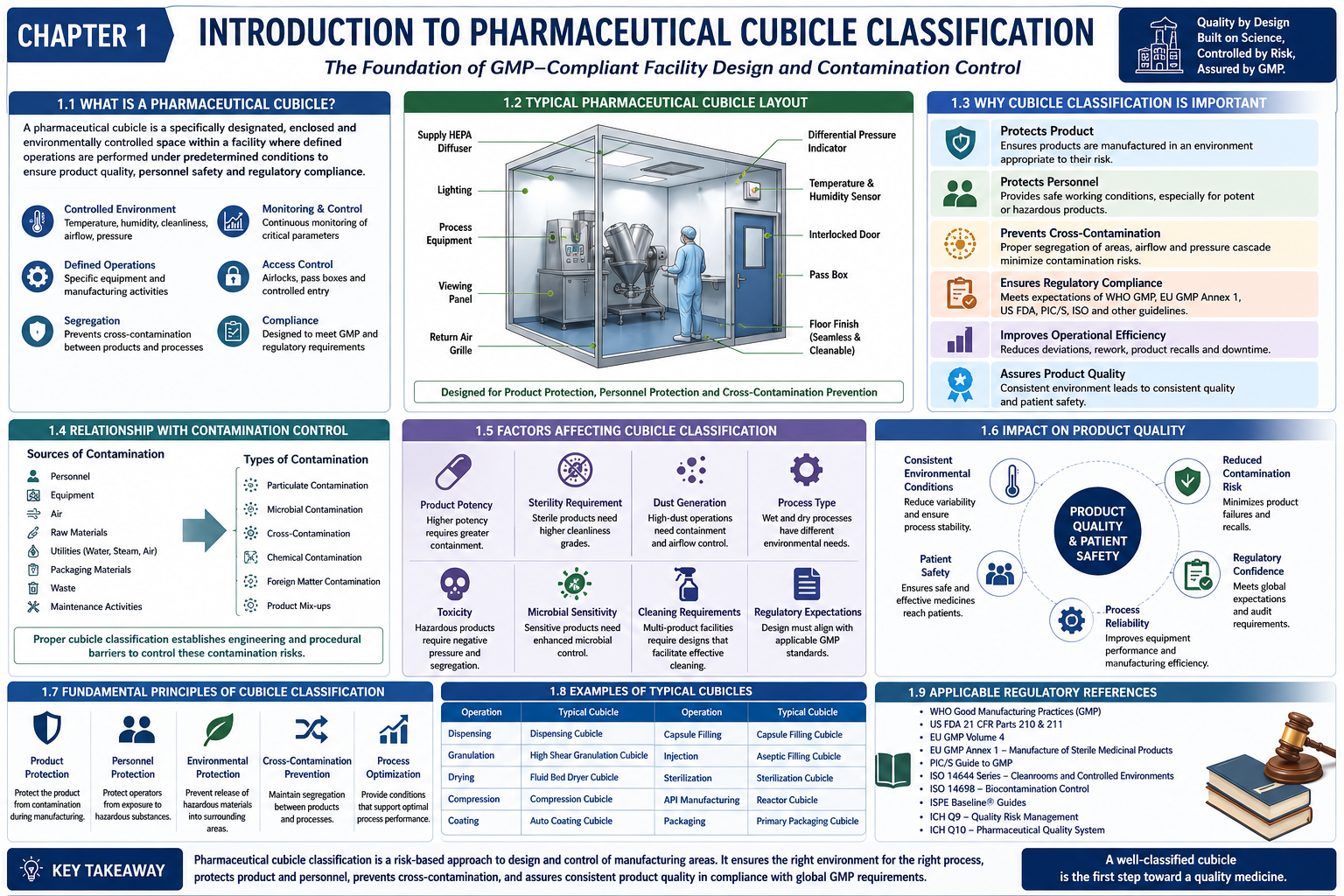
A pharmaceutical cubicle is a specifically designated and controlled manufacturing space within a pharmaceutical facility where defined operations are performed under predetermined environmental conditions. Each cubicle is engineered to provide an appropriate level of cleanliness, temperature, humidity, air pressure, airflow, and containment based on the manufacturing activity and the characteristics of the product being handled.
The classification of pharmaceutical cubicles is a critical element of Good Manufacturing Practices (GMP) and forms the foundation of an effective Contamination Control Strategy (CCS). Proper cubicle classification helps ensure:
- Protection of the product from contamination.
- Protection of personnel from hazardous materials.
- Prevention of cross-contamination between products.
- Compliance with regulatory expectations.
- Consistent manufacturing performance.
- Reliable environmental control.
- Efficient material and personnel movement.
Modern pharmaceutical facilities utilize risk-based cubicle classification, considering factors such as product potency, dust generation, sterility requirements, manufacturing process, and contamination risks.
1.2 What is a Pharmaceutical Cubicle?
A pharmaceutical cubicle is a physically enclosed, environmentally controlled manufacturing area designed to perform one or more specific pharmaceutical operations under validated conditions.
A cubicle may contain:
- Manufacturing equipment
- Utility connections
- HVAC supply and return systems
- Environmental monitoring points
- Differential pressure monitoring devices
- Pass boxes
- Material transfer systems
- Personnel access systems
- Safety equipment
Each cubicle is designed according to the process requirements and the level of contamination control needed.
Typical Pharmaceutical Cubicles
| Manufacturing Area | Typical Cubicle |
|---|---|
| Warehouse | Sampling Room |
| Dispensing | Dispensing Cubicle |
| Granulation | High Shear Granulation Cubicle |
| Drying | Fluid Bed Dryer Cubicle |
| Compression | Tablet Compression Cubicle |
| Coating | Auto Coating Cubicle |
| Capsule Manufacturing | Capsule Filling Cubicle |
| Sterile Manufacturing | Aseptic Filling Cubicle |
| API Manufacturing | Reactor Cubicle |
| Packaging | Primary Packaging Cubicle |
1.3 Why Cubicle Classification is Important
Every pharmaceutical process has different environmental requirements. A weighing operation generates airborne powder, whereas aseptic filling requires an ultraclean environment. Cubicle classification ensures that each activity is performed under conditions appropriate to its risk.
Primary Objectives
- Prevent contamination
- Prevent cross-contamination
- Protect operators
- Protect the environment
- Maintain product quality
- Improve process efficiency
- Meet regulatory expectations
Without proper classification, contamination can spread through:
- Airflow
- Personnel
- Equipment
- Raw materials
- Waste streams
- Utilities
This can lead to product failures, recalls, and regulatory observations.
1.4 Relationship Between Cubicle Classification and Contamination Control
Contamination control is the primary objective of pharmaceutical facility design. Cubicle classification establishes physical and engineering barriers that reduce contamination risks.
Sources of Contamination
- Personnel
- Equipment
- Air
- Water
- Utilities
- Raw materials
- Packaging materials
- Cleaning tools
- Maintenance activities
Types of Contamination
- Particulate contamination
- Microbial contamination
- Cross-contamination
- Chemical contamination
- Foreign matter contamination
- Product mix-ups
Each cubicle is classified based on the contamination risks associated with its intended use.
1.5 Impact on Product Quality
Proper cubicle classification directly affects:
Product Safety
Controlled environments minimize contamination, reducing the risk of unsafe products reaching patients.
Product Quality
Environmental control supports consistent manufacturing conditions and reduces variability.
Regulatory Compliance
Regulatory authorities expect facilities to demonstrate scientifically justified room classifications supported by risk assessments.
Manufacturing Efficiency
Well-designed cubicles reduce deviations, contamination incidents, and downtime.
Equipment Performance
Controlled temperature, humidity, and cleanliness improve equipment reliability and process consistency.
1.6 Fundamental Principles of Cubicle Classification
Cubicle classification is based on several engineering and GMP principles:
1. Product Protection
Protect the product from contamination during manufacturing.
2. Personnel Protection
Protect operators from exposure to hazardous substances.
3. Environmental Protection
Prevent release of hazardous materials into surrounding areas.
4. Cross-Contamination Prevention
Maintain segregation between products and processes.
5. Process Optimization
Provide environmental conditions that support optimal process performance.
1.7 Factors Affecting Cubicle Classification
The classification of a cubicle depends on multiple risk-based factors.
| Factor | Influence on Classification |
|---|---|
| Product potency | Higher potency requires greater containment. |
| Sterility requirement | Sterile products require higher cleanliness grades. |
| Dust generation | High-dust operations need containment and airflow control. |
| Process type | Wet and dry processes have different environmental needs. |
| Toxicity | Hazardous products require negative pressure and segregation. |
| Microbial sensitivity | Products susceptible to microbial contamination need enhanced controls. |
| Cleaning requirements | Multi-product facilities require designs that facilitate effective cleaning. |
| Regulatory expectations | Facility design must align with applicable GMP standards. |
1.8 Classification Based on Manufacturing Activity
Different manufacturing operations require different environmental controls.
| Operation | Environmental Requirement |
|---|---|
| Dispensing | Dust containment |
| Sifting | Powder control |
| Granulation | Moderate cleanliness |
| Drying | Controlled temperature and humidity |
| Milling | High dust extraction |
| Blending | Uniform airflow |
| Compression | Dust extraction and positive pressure |
| Coating | Solvent control (if applicable) |
| Packaging | Lower cleanliness requirements than manufacturing areas |
| Sterile Filling | Highest cleanliness and unidirectional airflow |
1.9 Classification Based on Product Type
Product characteristics determine facility requirements.
Non-Potent Products
Typically handled in standard GMP environments with positive pressure.
Potent Products
Require dedicated containment and negative pressure systems to protect personnel and prevent cross-contamination.
Hormonal Products
Often manufactured in dedicated facilities due to their high biological activity.
Cytotoxic Products
Require specialized containment, dedicated HVAC systems, and strict segregation.
Beta-Lactam Products
Must be manufactured in dedicated, self-contained facilities to prevent sensitization risks.
Sterile Products
Require cleanrooms classified according to EU GMP Annex 1 and ISO 14644.
1.10 Engineering Components of a Pharmaceutical Cubicle
A typical cubicle includes:
- HVAC supply diffusers
- Return air grilles
- HEPA filters (where required)
- Differential pressure monitoring
- Temperature and humidity sensors
- Interlocked doors
- Viewing panels
- Cleanroom lighting
- Utility connections
- Process equipment
- Environmental monitoring locations
1.11 Typical Cubicle Layout
                  Personnel Corridor
                         │
               ┌─────────▼─────────┐
               │ Personnel Airlock │
               └─────────┬─────────┘
                         │
         ┌───────────────▼────────────────┐
         │        Manufacturing Cubicle    │
         │                                 │
         │  Equipment       Operator Zone  │
         │                                 │
         │  Material Area   Return Air     │
         └───────────────┬────────────────┘
                         │
               ┌─────────▼─────────┐
               │ Material Airlock  │
               └─────────┬─────────┘
                         │
                  Material Corridor
This simplified layout demonstrates the separation of personnel and material movements, reducing the risk of contamination and mix-ups.
1.12 Benefits of Proper Cubicle Classification
- Enhanced product quality
- Improved patient safety
- Reduced contamination incidents
- Better personnel protection
- Compliance with global GMP requirements
- Improved audit readiness
- Easier environmental monitoring
- Simplified validation and qualification
- Reduced operational risks
- Greater manufacturing efficiency
1.13 Applicable Regulatory References
Pharmaceutical cubicle classification should be based on current regulatory and industry guidance, including:
- WHO Good Manufacturing Practices (GMP)
- US FDA 21 CFR Parts 210 & 211
- EU GMP Volume 4
- EU GMP Annex 1 – Manufacture of Sterile Medicinal Products
- PIC/S Guide to GMP
- ISO 14644 (Cleanrooms and Associated Controlled Environments)
- ISO 14698 (Biocontamination Control)
- ISPE Baseline® Guides
- ICH Q9 – Quality Risk Management
- ICH Q10 – Pharmaceutical Quality System
Chapter Summary
Pharmaceutical cubicle classification is a cornerstone of GMP-compliant facility design. By assigning appropriate environmental controls based on product risk, process characteristics, and contamination potential, manufacturers can safeguard product quality, protect personnel, and meet regulatory expectations. A risk-based approach—supported by robust HVAC design, pressure cascades, validated cleanroom performance, and effective material and personnel flow—provides the foundation for reliable and compliant pharmaceutical manufacturing.
Key Takeaways
- A pharmaceutical cubicle is a controlled manufacturing space designed for specific operations under validated environmental conditions.
- Classification is driven by product risk, process requirements, contamination potential, and regulatory expectations.
- Effective cubicle classification supports contamination control, cross-contamination prevention, and consistent product quality.
- Facility design should integrate HVAC systems, pressure cascades, material and personnel segregation, and environmental monitoring.
- International guidance from WHO GMP, US FDA, EU GMP Annex 1, PIC/S, ISO 14644, and ICH Q9/Q10 should be considered throughout the design and operation of pharmaceutical facilities.
Next Chapter: Chapter 2 – GMP Requirements for Pharmaceutical Facility Design, which will examine facility design principles, regulatory expectations, zoning concepts, cleanroom architecture, and engineering controls that underpin compliant pharmaceutical manufacturing.
About the Author
Ramesh Palav is a pharmaceutical professional with 20+ years of industry experience in manufacturing, GMP, quality systems, validation, compliance, and operational excellence. Through Pharma Manufacturing Hub, he shares practical insights on pharmaceutical careers, manufacturing, quality, validation, Pharma 4.0, AI, and professional development.
His goal is to help students, freshers, experienced professionals, and career-break professionals build the knowledge and skills needed to succeed in the pharmaceutical industry.