
13.1 Introduction
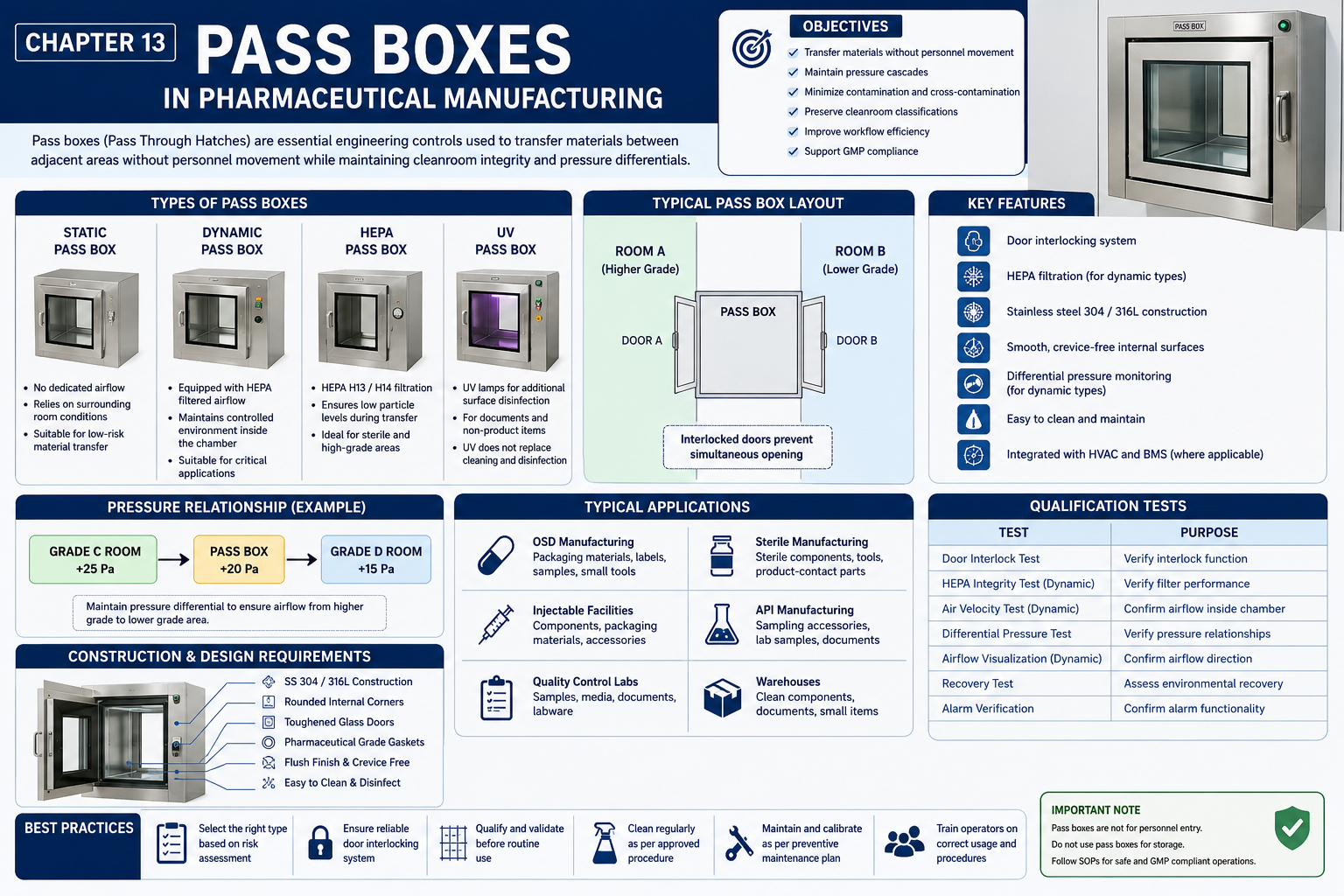
A Pass Box (also known as a Pass Through Hatch or Transfer Hatch) is a controlled transfer device used to move materials, tools, documents, samples, and small equipment between adjacent pharmaceutical areas without allowing personnel movement.
Pass boxes are one of the most effective engineering controls for minimizing contamination and preserving the integrity of cleanrooms. They reduce unnecessary personnel traffic, maintain pressure cascades, and decrease the risk of airborne contamination during material transfer.
Properly designed pass boxes are essential in:
- Oral Solid Dosage (OSD) facilities
- Sterile manufacturing plants
- Injectable facilities
- Biotechnology facilities
- API manufacturing
- Quality Control laboratories
- Sampling areas
- Warehouses
They are a key component of a facility’s Contamination Control Strategy (CCS) and should be designed, qualified, and operated according to WHO GMP, US FDA, EU GMP Annex 1, PIC/S GMP, ISO 14644, and ISPE guidance.
13.2 Objectives of Pass Boxes
The primary objectives are to:
- Transfer materials without personnel movement.
- Reduce contamination risks.
- Maintain pressure cascades.
- Preserve cleanroom classifications.
- Prevent cross-contamination.
- Improve workflow efficiency.
- Reduce door openings between classified areas.
- Support GMP compliance.
13.3 What is a Pass Box?
A Pass Box is an enclosed chamber with doors on opposite sides, installed within a wall separating two rooms.
The doors are interlocked so that only one door can be opened at a time, reducing uncontrolled air exchange between adjacent areas.
13.4 Types of Pass Boxes
Pharmaceutical facilities typically use the following pass box types:
                     PASS BOXES
                          │
      ┌───────────────────┼────────────────────┐
      │                   │                    │
 Static Pass Box    Dynamic Pass Box     HEPA Pass Box
                                              │
                                              ▼
                                        UV Pass Box*
*A UV-equipped pass box is not a separate engineering category but a pass box fitted with UV lamps as an additional surface disinfection feature. UV treatment does not replace validated cleaning and disinfection.
13.5 Static Pass Box
Definition
A Static Pass Box has no dedicated airflow or filtration system. It relies on the environmental conditions of the adjoining rooms.
Applications
- Packaging materials
- Documents
- Clean utensils
- Components moving between areas of similar cleanliness
Advantages
- Simple design
- Low maintenance
- Low operating cost
- Easy installation
Limitations
- No active contamination control
- Not suitable for critical sterile transfers
- Dependent on surrounding room conditions
13.6 Dynamic Pass Box
Definition
A Dynamic Pass Box incorporates its own airflow system and HEPA filtration to actively control the transfer environment.
Features
- HEPA-filtered airflow
- Positive pressure within the chamber (as designed)
- Continuous or controlled airflow
- Air recirculation system
- Differential pressure control
Applications
- Sterile manufacturing
- Injectable production
- High-grade cleanrooms
- Transfer between different cleanroom classifications
13.7 HEPA Pass Box
A HEPA Pass Box is designed to provide high-efficiency air filtration during material transfer.
Typical Components
- HEPA H13 or H14 filter
- Supply blower
- Differential pressure gauge
- Magnehelic gauge or digital indicator
- Stainless steel chamber
- Door interlocking system
Benefits
- Reduced airborne particles
- Enhanced contamination control
- Improved cleanroom integrity
13.8 UV Pass Box
Some pass boxes include UV lamps for additional surface disinfection.
Typical Applications
- Document transfer
- Small clean accessories
- Non-product-contact items
Important GMP Considerations
- UV irradiation supplements routine cleaning; it does not replace validated cleaning and disinfection.
- UV effectiveness depends on exposure time, lamp condition, shadowing, and surface characteristics.
- Product quality should not rely solely on UV treatment.
13.9 Construction Requirements
Pass boxes should be constructed using materials suitable for pharmaceutical environments.
| Component | Recommended Material |
|---|---|
| Chamber | SS 304 or SS 316L (product/process dependent) |
| Internal Corners | Rounded (radiused) |
| Doors | Toughened glass with flush finish |
| Gaskets | Pharmaceutical-grade sealing material |
| Hinges | Stainless steel |
| Surface Finish | Smooth, non-shedding, easy to clean |
13.10 Door Interlocking System
Door interlocking is one of the most important safety features.
Types
- Electromagnetic interlocks
- Mechanical interlocks
- PLC-controlled interlocks
Functions
- Prevent simultaneous door opening.
- Maintain pressure differentials.
- Reduce contamination risk.
- Improve operator safety.
13.11 Typical Pass Box Layout
Room A
   │
┌───────────────┐
│ Door A        │
├───────────────┤
│               │
│   Pass Box    │
│               │
├───────────────┤
│ Door B        │
└───────────────┘
   │
Room B
13.12 Dynamic Pass Box Layout
         HEPA Filter
             │
             ▼
        Supply Fan
             │
             ▼
 ┌─────────────────────┐
 │                     │
 │     Pass Box        │
 │                     │
 └─────────────────────┘
        │
    Return Air
13.13 HVAC Integration
Dynamic pass boxes should be integrated with the facility HVAC system or have a dedicated airflow system, depending on design.
Typical controls include:
- HEPA filtration
- Air balancing
- Pressure monitoring
- Temperature compatibility
- Alarm integration
- Filter integrity testing
13.14 Pressure Relationship
Dynamic pass boxes are generally designed to maintain appropriate pressure relationships with adjacent rooms.
Example:
Grade C Room
    +25 Pa
       │
Dynamic Pass Box
    +20 Pa
       │
Grade D Room
    +15 Pa
Actual pressure values should be established during HVAC design and qualification.
13.15 Selection Criteria
| Requirement | Recommended Pass Box |
|---|---|
| Document transfer | Static Pass Box |
| Packaging materials | Static Pass Box |
| Sterile components | Dynamic HEPA Pass Box |
| High-risk manufacturing | Dynamic Pass Box |
| API sampling | Dynamic Pass Box |
| Laboratory samples | Static or Dynamic (risk-based) |
Selection should always be based on product risk, room classification, and contamination control requirements.
13.16 Typical Applications
OSD Manufacturing
- Transfer of cleaned change parts
- Transfer of labels
- Transfer of samples
- Transfer of small tools
Sterile Manufacturing
- Sterilized components
- Sterile tools
- Product-contact accessories
- Documentation (where permitted)
API Manufacturing
- Sampling accessories
- Documentation
- Laboratory samples
- Clean equipment parts
13.17 Qualification of Pass Boxes
Pass boxes should undergo lifecycle qualification.
Design Qualification (DQ)
         │
Installation Qualification (IQ)
         │
Operational Qualification (OQ)
         │
Performance Qualification (PQ)
13.18 Qualification Tests
| Test | Purpose |
|---|---|
| Door Interlock Test | Verify interlock function |
| HEPA Integrity Test (Dynamic) | Verify filter performance |
| Air Velocity Test | Confirm airflow where applicable |
| Differential Pressure Test | Verify pressure relationships |
| Recovery Test | Assess environmental recovery |
| Alarm Verification | Confirm alarm operation |
| Airflow Visualization | Verify airflow direction (dynamic systems) |
13.19 Cleaning and Sanitization
Pass boxes should be cleaned according to approved procedures.
Typical Cleaning Steps
- Inspect chamber.
- Remove debris.
- Clean with approved cleaning agent.
- Disinfect using validated disinfectant.
- Allow contact time.
- Dry if required.
- Record completion.
UV cycles (if installed) should only be used as an additional step where defined by procedure.
13.20 Operational Procedure
Material Transfer Sequence
- Verify material identity and status.
- Open Door A.
- Place material inside.
- Close Door A completely.
- Verify door interlock.
- Open Door B.
- Remove material.
- Close Door B.
- Clean the pass box if required.
13.21 Common Inspection Observations
Regulatory inspectors frequently observe:
- Simultaneous opening of both doors.
- Door interlock failures.
- Damaged door seals.
- Dirty internal surfaces.
- Lack of cleaning records.
- Missing HEPA integrity test reports.
- Expired calibration of pressure indicators.
- Use of pass boxes as storage areas.
- Inadequate qualification documentation.
13.22 Best Practices
- Select pass box type based on documented Quality Risk Management (QRM).
- Use dynamic pass boxes for critical cleanroom transfers.
- Install reliable door interlocking systems.
- Qualify pass boxes before routine use.
- Include pass boxes in preventive maintenance and calibration programs.
- Perform routine cleaning and disinfection.
- Periodically verify HEPA filter integrity for dynamic systems.
- Train operators on approved transfer procedures.
- Avoid prolonged storage of materials inside pass boxes.
13.23 Case Study – Dynamic Pass Box in a Sterile Injectable Facility
Facility
Sterile Injectable Manufacturing Plant
Application
Transfer of sterilized rubber stoppers and aluminum seals from the preparation area to the aseptic filling suite.
Design Features
| Parameter | Specification |
|---|---|
| Pass Box Type | Dynamic |
| Filter | HEPA H14 |
| Door Interlock | Electromagnetic |
| Pressure Monitoring | Continuous |
| Chamber Material | SS 316L |
| Alarm System | Integrated with BMS |
Qualification
- HEPA integrity testing passed.
- Airflow visualization demonstrated appropriate airflow.
- Door interlock functionality verified.
- Pressure differential maintained within validated limits.
Benefits
- Reduced contamination risk.
- Maintained cleanroom integrity.
- Improved operational efficiency.
- Enhanced regulatory compliance.
13.24 Pass Box Audit Checklist
| Checkpoint | Status |
|---|---|
| Correct pass box type selected | ☐ |
| Door interlocks functional | ☐ |
| HEPA filter qualified (if applicable) | ☐ |
| Cleaning records available | ☐ |
| Pressure monitoring operational | ☐ |
| Qualification reports approved | ☐ |
| Preventive maintenance completed | ☐ |
| Operators trained | ☐ |
| No materials stored unnecessarily | ☐ |
| SOPs available at point of use | ☐ |
Chapter Summary
Pass boxes are essential contamination control devices that enable the safe transfer of materials between pharmaceutical areas while minimizing personnel movement and preserving cleanroom integrity. Selection of static or dynamic pass boxes should be based on product risk, room classification, and process requirements. Through proper design, qualification, cleaning, maintenance, and operator training, pass boxes contribute significantly to GMP compliance, contamination control, and efficient pharmaceutical operations.
Key Takeaways
- Pass boxes reduce contamination risks by allowing material transfer without personnel movement.
- Static pass boxes are suitable for lower-risk transfers, while dynamic HEPA-filtered pass boxes are appropriate for higher-risk and sterile applications.
- Door interlocking, HEPA filtration (where applicable), pressure control, and qualification are critical to reliable performance.
- UV systems may provide supplementary surface disinfection but should never replace validated cleaning and disinfection processes.
- Routine maintenance, qualification, cleaning, and operator training ensure sustained GMP compliance and cleanroom performance.
Next Chapter
Chapter 14 – Cubicle Classification for Oral Solid Dosage (OSD) Manufacturing, covering complete room-by-room classification for dispensing, sifting, granulation, drying, milling, blending, compression, coating, inspection, packaging, HVAC requirements, pressure cascade, cleanroom classification, environmental conditions, qualification requirements, and GMP best practices for OSD pharmaceutical facilities.
About the Author
Ramesh Palav is a pharmaceutical manufacturing professional with 21+ years of experience in Oral Solid Dosage manufacturing, production operations, GMP compliance, qualification, validation, QMS and operational excellence. Through Pharma Manufacturing Hub, he shares practical industry knowledge with pharmaceutical professionals, students and manufacturing leaders.