
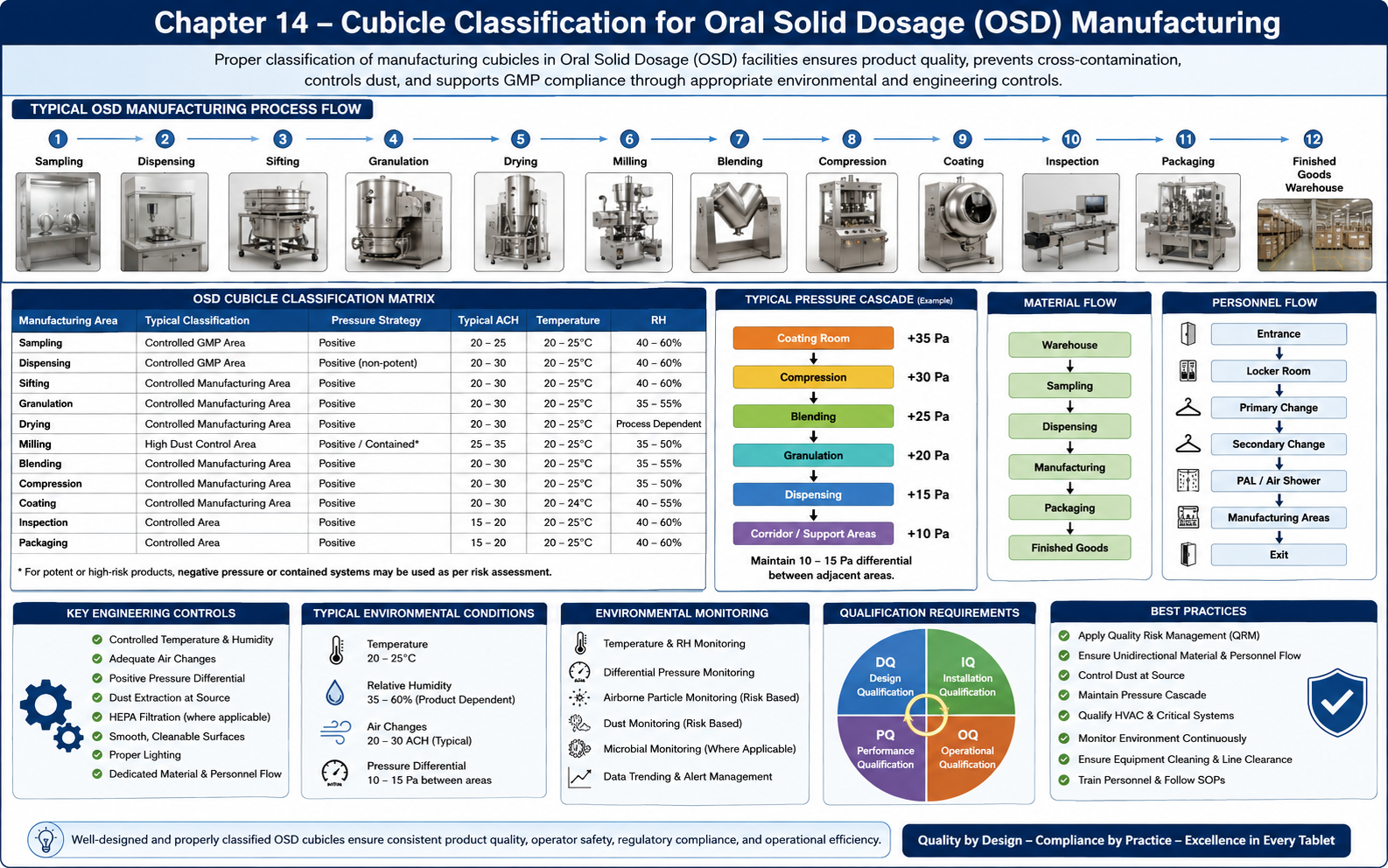
14.1 Introduction
Oral Solid Dosage (OSD) manufacturing is the most widely used pharmaceutical manufacturing process worldwide. It includes the production of tablets, capsules, sachets, and powders through operations such as dispensing, granulation, drying, milling, blending, compression, coating, and packaging.
Although OSD manufacturing does not generally require aseptic environments, it presents significant challenges related to:
- Dust generation
- Cross-contamination
- Product mix-ups
- Moisture control
- Static electricity
- Operator exposure
- Product degradation
The design and classification of OSD cubicles should be based on Quality Risk Management (ICH Q9) and should comply with:
- WHO GMP
- US FDA 21 CFR Parts 210 & 211
- EU GMP Volume 4
- PIC/S GMP Guide
- ISPE Baseline Guides
- ISO 14644 (where applicable)
Proper cubicle classification ensures product quality, operator safety, operational efficiency, and regulatory compliance.
14.2 Objectives of OSD Cubicle Classification
The objectives are to:
- Prevent contamination and cross-contamination.
- Control dust generation.
- Maintain product quality.
- Ensure efficient material and personnel flow.
- Support HVAC performance.
- Maintain pressure differentials.
- Facilitate cleaning and maintenance.
- Meet GMP requirements.
14.3 Typical OSD Manufacturing Process
Raw Material Warehouse
          │
          ▼
Sampling
          │
          ▼
Dispensing
          │
          ▼
Sifting
          │
          ▼
Granulation
          │
          ▼
Drying
          │
          ▼
Milling
          │
          ▼
Blending
          │
          ▼
Compression
          │
          ▼
Coating
          │
          ▼
Inspection
          │
          ▼
Packaging
          │
          ▼
Finished Goods Warehouse
The layout should support unidirectional flow with no crossing of materials, personnel, or waste.
14.4 Typical OSD Facility Layout
Warehouse
    │
Sampling
    │
Dispensing
    │
Granulation
    │
Drying
    │
Milling
    │
Blending
    │
Compression
    │
Coating
    │
Inspection
    │
Packaging
    │
Finished Goods
Manufacturing operations should be arranged logically to minimize unnecessary movement and contamination risks.
14.5 OSD Cubicle Classification Matrix
The table below provides typical engineering recommendations. Actual values should be confirmed through process development, HVAC design calculations, and Quality Risk Management.
| Manufacturing Area | Typical Classification | Pressure Strategy | Typical ACH | Temperature | RH |
|---|---|---|---|---|---|
| Sampling | Controlled GMP Area | Positive | 20–25 | 20–25°C | 40–60% |
| Dispensing | Controlled GMP Area | Positive (non-potent) | 20–30 | 20–25°C | 40–60% |
| Sifting | Controlled Manufacturing Area | Positive | 20–30 | 20–25°C | 40–60% |
| Granulation | Controlled Manufacturing Area | Positive | 20–30 | 20–25°C | 35–55% |
| Drying | Controlled Manufacturing Area | Positive | 20–30 | 20–25°C | Process dependent |
| Milling | High Dust Control Area | Positive or contained (risk-based) | 25–35 | 20–25°C | 35–50% |
| Blending | Controlled Manufacturing Area | Positive | 20–30 | 20–25°C | 35–55% |
| Compression | Controlled Manufacturing Area | Positive | 20–30 | 20–25°C | 35–50% |
| Coating | Controlled Manufacturing Area | Positive | 20–30 | 20–24°C | 40–55% |
| Inspection | Controlled Area | Positive | 15–20 | 20–25°C | 40–60% |
| Packaging | Controlled Area | Positive | 15–20 | 20–25°C | 40–60% |
14.6 Sampling Cubicle
Purpose
Sampling is performed to obtain representative samples from incoming raw materials for Quality Control testing.
Design Requirements
- Sampling booth
- HEPA-filtered supply air
- Dust extraction
- Stainless steel work surfaces
- Controlled access
Equipment
- Sampling booth
- Sampling thief
- Weighing balance
- Material containers
14.7 Dispensing Cubicle
Purpose
Accurate weighing and dispensing of APIs and excipients.
Major Risks
- Airborne dust
- Cross-contamination
- Weighing errors
Engineering Controls
- Dispensing booth
- Local exhaust ventilation
- Differential pressure monitoring
- Barcode or ERP verification
- Dust-tight transfer containers
14.8 Sifting Cubicle
Purpose
To remove oversized particles and foreign matter before processing.
Typical Equipment
- Vibro Sifter
- Dust Collector
- Metal Detector (where applicable)
Design Considerations
- Dust extraction
- Positive pressure
- Easy-to-clean surfaces
- Product segregation
14.9 Granulation Cubicle
Granulation improves powder flowability and compressibility.
Equipment
- Rapid Mixer Granulator (RMG)
- Fluid Bed Processor (FBP)
- Binder preparation tank
Environmental Conditions
| Parameter | Typical Requirement |
|---|---|
| Temperature | 20–25°C |
| RH | 35–55% |
| Pressure | Positive |
| Air Changes | 20–30 ACH |
14.10 Drying Cubicle
Purpose:
Remove moisture from granules.
Equipment
- Fluid Bed Dryer (FBD)
- Vacuum Tray Dryer
- Tray Dryer
HVAC Considerations
- Moisture removal
- Heat load management
- Air balancing
- Temperature control
14.11 Milling Cubicle
Purpose:
Reduce particle size.
Risks
- High dust generation
- Heat generation
- Product loss
Engineering Controls
- Local exhaust ventilation
- Dust collector
- Closed transfer systems (where appropriate)
- Explosion protection for combustible dust where applicable
14.12 Blending Cubicle
Purpose:
Produce a homogeneous blend before compression.
Equipment
- Bin Blender
- Octagonal Blender
- Double Cone Blender
Design Features
- Controlled RH
- Positive pressure
- Dust-tight charging
- Environmental monitoring
14.13 Compression Cubicle
Compression converts granules into tablets.
Equipment
- Rotary Tablet Press
- Tablet Deduster
- Metal Detector
- Weight Control System
Major Risks
- Tablet dust
- Weight variation
- Product contamination
Recommended Conditions
| Parameter | Typical Value |
|---|---|
| Pressure | Positive |
| Temperature | 20–25°C |
| RH | 35–50% |
| Air Changes | 20–30 ACH |
14.14 Coating Cubicle
Purpose:
Apply protective or functional coatings.
Types
- Film coating
- Sugar coating
- Enteric coating
- Modified-release coating
Engineering Features
- Controlled temperature
- Controlled RH
- Exhaust ventilation
- Solvent exhaust (where organic solvents are used)
14.15 Inspection Cubicle
Purpose:
Visual inspection of tablets or capsules.
Requirements
- High illumination
- Dust-free environment
- Ergonomic workstations
- Controlled temperature
14.16 Packaging Cubicle
Operations include:
- Blister packing
- Strip packing
- Bottle filling
- Cartoning
- Serialization
Risks
- Product mix-up
- Incorrect labeling
- Packaging defects
Controls
- Line clearance
- Barcode verification
- Packaging material reconciliation
- Segregated storage of printed components
14.17 HVAC Requirements
OSD manufacturing requires robust HVAC systems to manage dust and maintain environmental consistency.
Typical Requirements
| Parameter | Recommendation |
|---|---|
| Filtration | Multi-stage filtration with HEPA where required |
| Temperature | 20–25°C |
| Relative Humidity | Product dependent |
| Pressure Differential | 10–15 Pa between adjacent rooms |
| Air Changes | 20–30 ACH (typical manufacturing areas) |
14.18 Pressure Cascade
A typical pressure cascade for an OSD facility is illustrated below.
Coating Room          +35 Pa
        │
Compression           +30 Pa
        │
Blending              +25 Pa
        │
Granulation           +20 Pa
        │
Dispensing            +15 Pa
        │
Corridor              +10 Pa
Pressure strategies should be adjusted for potent or hazardous products based on documented risk assessments.
14.19 Material Flow
Warehouse
     │
Sampling
     │
Dispensing
     │
Manufacturing
     │
Packaging
     │
Finished Goods
Material flow should always progress from receipt to dispatch without backtracking.
14.20 Personnel Flow
Entrance
     │
Locker Room
     │
Primary Change
     │
Secondary Change
     │
PAL
     │
Manufacturing
     │
Exit
Personnel and material routes should be separated wherever practical.
14.21 Environmental Monitoring
Typical monitoring includes:
| Parameter | Monitoring |
|---|---|
| Temperature | Continuous or scheduled |
| Relative Humidity | Continuous or scheduled |
| Differential Pressure | Continuous in critical areas |
| Airborne Particles | Risk-based |
| Dust Levels | Risk-based |
| Microbial Monitoring | Where justified by product and process risk |
Trending of environmental data supports early detection of deviations.
14.22 Qualification Requirements
The OSD facility should undergo:
- Design Qualification (DQ)
- Installation Qualification (IQ)
- Operational Qualification (OQ)
- Performance Qualification (PQ)
Supporting tests include:
- HEPA filter integrity (where applicable)
- Airflow visualization
- Pressure mapping
- Air volume verification
- Temperature mapping
- Humidity mapping
- Recovery testing (where applicable)
14.23 Common Inspection Observations
Inspectors frequently identify:
- Poor dust control during dispensing.
- Incorrect pressure differentials.
- Shared equipment without adequate cleaning validation.
- Inadequate environmental monitoring.
- Poor line clearance in packaging.
- Inappropriate storage of intermediates.
- Damaged wall and floor finishes.
- Incomplete HVAC qualification records.
14.24 Best Practices
- Design cubicles using documented Quality Risk Management (QRM).
- Maintain logical and unidirectional material and personnel flow.
- Provide effective dust extraction at source.
- Validate HVAC performance before routine production.
- Use closed transfer systems where practical.
- Trend environmental and process data.
- Periodically review cubicle classifications when products or processes change.
- Integrate facility design with the site’s Contamination Control Strategy (CCS).
14.25 Case Study – OSD Tablet Manufacturing Facility
Product
Immediate-release Paracetamol Tablets
Manufacturing Sequence
Sampling
     │
Dispensing
     │
Granulation
     │
Drying
     │
Milling
     │
Blending
     │
Compression
     │
Coating
     │
Packaging
Environmental Design
| Area | Pressure | Temperature | RH |
|---|---|---|---|
| Dispensing | +15 Pa | 22°C | 45% |
| Granulation | +20 Pa | 22°C | 45% |
| Compression | +30 Pa | 22°C | 40% |
| Coating | +35 Pa | 22°C | 45% |
| Packaging | +15 Pa | 22°C | 50% |
Benefits
- Reduced dust migration.
- Improved tablet quality.
- Stable environmental conditions.
- Efficient manufacturing flow.
- Compliance with GMP and successful regulatory inspections.
14.26 OSD Cubicle Audit Checklist
| Checkpoint | Status |
|---|---|
| Sampling room qualified | ☐ |
| Dispensing booth operational | ☐ |
| Dust extraction verified | ☐ |
| Pressure cascade maintained | ☐ |
| HVAC qualified | ☐ |
| Temperature/RH within limits | ☐ |
| Environmental monitoring current | ☐ |
| Material flow unidirectional | ☐ |
| Personnel flow controlled | ☐ |
| Cleaning validation completed | ☐ |
Chapter Summary
The classification of cubicles in Oral Solid Dosage (OSD) manufacturing is fundamental to maintaining product quality, controlling contamination, and ensuring GMP compliance. Each manufacturing operation—from sampling and dispensing to compression, coating, and packaging—has unique environmental and engineering requirements. A risk-based approach integrating cubicle classification, HVAC systems, pressure cascades, material and personnel flow, environmental monitoring, and lifecycle qualification creates a robust manufacturing environment capable of consistently producing high-quality pharmaceutical products.
Key Takeaways
- OSD manufacturing requires operation-specific cubicle classifications based on product and process risk.
- Dust-generating operations such as dispensing, milling, and compression require enhanced containment and extraction controls.
- HVAC systems, pressure cascades, and environmental conditions should be designed to support each manufacturing step.
- Unidirectional material and personnel flow minimizes contamination and mix-up risks.
- Ongoing qualification, monitoring, and periodic review ensure that cubicles continue to meet GMP and operational requirements.
Next Chapter
Chapter 15 – Cubicle Classification for Sterile Pharmaceutical Manufacturing, covering room-by-room classification for component preparation, washing, sterilization, aseptic filling, stoppering, capping, visual inspection, Grade A/B/C/D cleanrooms, unidirectional airflow, HVAC design, pressure cascades, environmental monitoring, qualification, and regulatory expectations for sterile manufacturing facilities.
About the Author
Ramesh Palav is a pharmaceutical manufacturing professional with 21+ years of experience in Oral Solid Dosage manufacturing, production operations, GMP compliance, qualification, validation, QMS and operational excellence. Through Pharma Manufacturing Hub, he shares practical industry knowledge with pharmaceutical professionals, students and manufacturing leaders.