
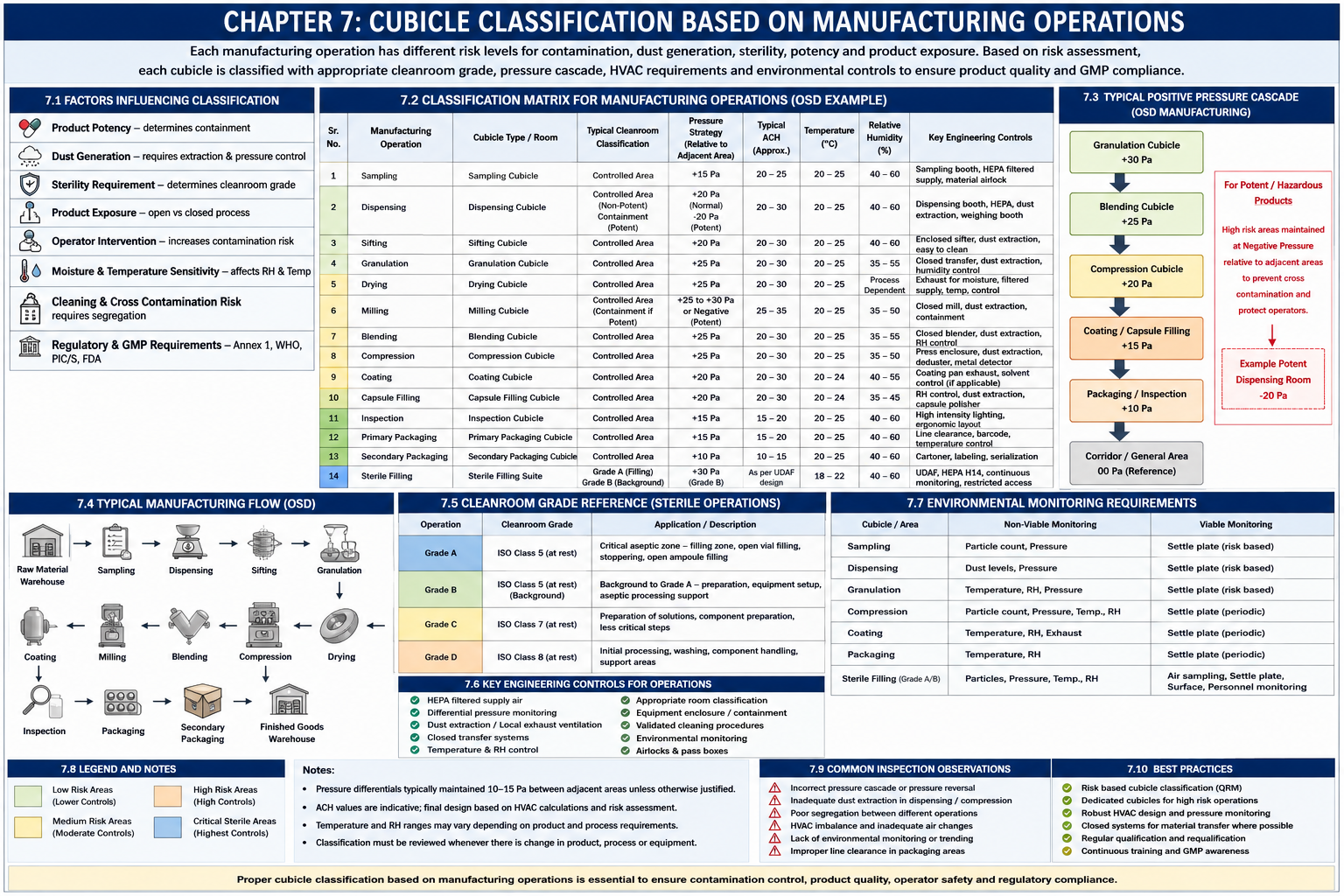
7.1 Introduction
Each pharmaceutical manufacturing operation presents unique risks related to contamination, dust generation, microbial control, operator exposure, product sensitivity, and process requirements. Consequently, cubicle classification should not be standardized across all operations; instead, it should be established through a documented Quality Risk Management (QRM) process.
The environmental controls for a dispensing room differ significantly from those required for aseptic filling or tablet compression. This chapter explains how pharmaceutical cubicles should be classified according to the specific manufacturing operation while considering GMP requirements, HVAC design, cleanroom classification, pressure cascade, environmental monitoring, and qualification.
7.2 Objectives of Operational Cubicle Classification
Operational cubicle classification aims to:
- Protect products from contamination.
- Prevent cross-contamination between operations.
- Protect personnel from hazardous exposure.
- Maintain validated manufacturing conditions.
- Support process consistency.
- Facilitate effective cleaning.
- Simplify qualification and environmental monitoring.
- Comply with global GMP regulations.
7.3 Factors Influencing Operational Classification
Each manufacturing operation is evaluated using the following criteria:
| Evaluation Parameter | Importance |
|---|---|
| Product potency | Determines containment requirements |
| Dust generation | Determines extraction and pressure strategy |
| Sterility requirement | Determines cleanroom classification |
| Product exposure | Influences environmental control |
| Operator intervention | Determines contamination risk |
| Moisture sensitivity | Influences RH requirements |
| Temperature sensitivity | Determines HVAC control |
| Cleaning complexity | Influences room segregation |
7.4 Classification Matrix for Manufacturing Operations
The table below provides typical engineering recommendations for oral solid dosage (OSD) manufacturing. Actual values should be established through process-specific risk assessments and facility design calculations.
| Operation | Typical Room Classification | Pressure Strategy | Typical ACH | Temperature | RH |
|---|---|---|---|---|---|
| Sampling | Controlled GMP Area | Positive | 20–25 | 20–25°C | 40–60% |
| Dispensing | Controlled GMP Area | Positive (non-potent) / Negative (potent) | 20–30 | 20–25°C | 40–60% |
| Sifting | Controlled GMP Area | Slight Positive | 20–30 | 20–25°C | 40–60% |
| Granulation | Controlled Manufacturing Area | Positive | 20–30 | 20–25°C | 35–55% |
| Drying | Controlled Manufacturing Area | Positive | 20–30 | 20–25°C | Process dependent |
| Milling | High Dust Control Area | Positive or contained (risk-based) | 25–35 | 20–25°C | 35–50% |
| Blending | Controlled Manufacturing Area | Positive | 20–30 | 20–25°C | 35–55% |
| Compression | Controlled Manufacturing Area | Positive | 20–30 | 20–25°C | 35–50% |
| Coating | Controlled Manufacturing Area | Positive | 20–30 | 20–24°C | 40–55% |
| Capsule Filling | Controlled Manufacturing Area | Positive | 20–30 | 20–24°C | 35–45% |
| Inspection | Controlled Area | Positive | 15–20 | 20–25°C | 40–60% |
| Primary Packaging | Controlled Area | Positive | 15–20 | 20–25°C | 40–60% |
| Secondary Packaging | Controlled Area | Positive | 10–15 | 20–25°C | 40–60% |
| Sterile Filling | Grade A with Grade B Background | Positive | Based on UDAF design | 18–22°C | 40–60% |
7.5 Sampling Cubicle
Purpose
Sampling is the first manufacturing activity performed after receipt of raw materials.
Risks
- Airborne dust
- Product mix-up
- Material contamination
Recommended Design
- Sampling booth
- HEPA-filtered supply air
- Dust extraction
- Stainless steel workbench
- Material airlock
Typical Layout
Warehouse
     │
     ▼
Sampling Airlock
     │
     ▼
Sampling Cubicle
     │
     ▼
Approved Material Store
7.6 Dispensing Cubicle
Purpose
Weighing and dispensing of:
- APIs
- Excipients
- Coating materials
Major Risks
- Powder dispersion
- Cross-contamination
- Incorrect weighing
Recommended Engineering Controls
- Dispensing booth
- Local exhaust ventilation
- Differential pressure monitoring
- Dust-tight weighing station
7.7 Sifting Cubicle
Sifting removes oversized particles and foreign matter.
Engineering Requirements
- Dust extraction
- Enclosed sifter
- Controlled airflow
- Easy-to-clean construction
Common Equipment
- Vibro Sifter
- Dust Collector
- Metal Detector (where applicable)
7.8 Granulation Cubicle
Granulation improves powder characteristics before compression.
Types
- Wet Granulation
- Dry Granulation
- High Shear Granulation
- Fluid Bed Granulation
Environmental Controls
| Parameter | Recommendation |
|---|---|
| Temperature | 20–25°C |
| RH | 35–55% |
| Pressure | Positive |
| ACH | 20–30 |
7.9 Drying Cubicle
Drying removes residual moisture after granulation.
Equipment
- Fluid Bed Dryer
- Tray Dryer
- Vacuum Dryer
Design Considerations
- Heat removal
- Moisture control
- Exhaust air management
- Dust extraction
7.10 Milling Cubicle
Milling reduces particle size and improves blend uniformity.
Risks
- High dust generation
- Heat generation
- Cross-contamination
Recommended Controls
- Local exhaust ventilation
- Dust collection
- Containment where appropriate
- Closed transfer systems for potent compounds
7.11 Blending Cubicle
Blending ensures homogeneous mixing of APIs and excipients.
Equipment
- Bin Blender
- Double Cone Blender
- Octagonal Blender
Environmental Controls
- Positive pressure
- Controlled humidity
- Dust-tight transfers
- Environmental monitoring
7.12 Compression Cubicle
Compression is among the most critical OSD operations.
Risks
- Fine tablet dust
- Weight variation
- Product contamination
Typical Equipment
- Rotary Tablet Press
- Tablet Deduster
- Metal Detector
Recommended Design
- Positive pressure
- Dust extraction at the press
- HEPA-filtered supply air
- Pressure monitoring
7.13 Coating Cubicle
Coating applies protective or functional films to tablets.
Types
- Film coating
- Enteric coating
- Sustained-release coating
Design Requirements
- Controlled temperature
- Controlled RH
- Exhaust ventilation
- Solvent handling controls (if organic solvents are used)
7.14 Capsule Filling Cubicle
Capsule filling requires tight environmental control because gelatin capsules are sensitive to moisture.
Typical Conditions
| Parameter | Typical Value |
|---|---|
| Temperature | 20–24°C |
| RH | 35–45% |
| Pressure | Positive |
Equipment
- Capsule Filling Machine
- Capsule Polisher
- Capsule Sorter
7.15 Inspection Cubicle
Inspection identifies visual defects before packaging.
Requirements
- High-intensity lighting
- Ergonomic workstations
- Controlled environment
- Minimal airborne dust
7.16 Packaging Cubicle
Packaging protects finished products and prevents mix-ups.
Operations
- Blister Packing
- Strip Packing
- Bottle Filling
- Cartoning
- Serialization
Main Risks
- Product mix-up
- Incorrect labeling
- Foreign material
Controls
- Line clearance
- Barcode verification
- Segregated packaging materials
- Controlled access
7.17 Sterile Filling Cubicle
Sterile filling requires the highest environmental classification.
Typical Cleanroom Grades
| Operation | Grade |
|---|---|
| Filling Zone | Grade A |
| Background | Grade B |
Engineering Features
- HEPA H14 filters
- Unidirectional airflow
- Continuous particle monitoring
- Pressure cascade
- Restricted personnel access
7.18 API Manufacturing Cubicles
Typical operations include:
- Reactor charging
- Filtration
- Drying
- Milling
- Packaging
Design Requirements
- Dedicated HVAC (where justified)
- Solvent exhaust systems
- Explosion protection where applicable
- Negative pressure for hazardous compounds
7.19 Typical OSD Manufacturing Flow
Raw Material Warehouse
          │
          ▼
Sampling
          │
          ▼
Dispensing
          │
          ▼
Sifting
          │
          ▼
Granulation
          │
          ▼
Drying
          │
          ▼
Milling
          │
          ▼
Blending
          │
          ▼
Compression
          │
          ▼
Coating
          │
          ▼
Inspection
          │
          ▼
Packaging
          │
          ▼
Finished Goods Warehouse
7.20 Pressure Cascade Example
A typical positive pressure cascade for OSD manufacturing:
Packaging          +10 Pa
        │
Inspection         +15 Pa
        │
Coating            +20 Pa
        │
Compression        +25 Pa
        │
Granulation        +30 Pa
For potent or hazardous products, pressure strategies should be modified based on containment requirements and documented risk assessments.
7.21 Environmental Monitoring Requirements
| Cubicle | Monitoring Requirement |
|---|---|
| Sampling | Particle count (risk-based), differential pressure |
| Dispensing | Dust levels, differential pressure |
| Granulation | Temperature, RH, pressure |
| Compression | Particle monitoring, temperature, RH |
| Coating | Temperature, RH, exhaust performance |
| Packaging | Temperature, RH |
| Sterile Filling | Viable and non-viable monitoring, pressure, temperature, RH |
7.22 Qualification Requirements
Operational cubicles should be included in the facility qualification program.
Typical activities include:
- Design Qualification (DQ)
- Installation Qualification (IQ)
- Operational Qualification (OQ)
- Performance Qualification (PQ)
- Airflow visualization (smoke studies)
- HEPA filter integrity testing
- Air change verification
- Pressure mapping
- Temperature and humidity mapping
7.23 Common Inspection Observations
Regulatory inspections frequently identify:
- Incorrect room pressure differentials.
- Poor dust control in dispensing and compression rooms.
- Inadequate HVAC balancing.
- Shared equipment without appropriate cleaning validation.
- Insufficient environmental monitoring.
- Inadequate line clearance in packaging areas.
- Poor personnel movement between operations.
7.24 Best Practices
- Classify cubicles using documented Quality Risk Management (QRM).
- Design HVAC systems to support the operational requirements of each room.
- Install continuous differential pressure monitoring where appropriate.
- Minimize manual material transfers through closed systems where feasible.
- Validate environmental conditions before commercial production.
- Review cubicle classifications whenever products or processes change.
- Trend environmental monitoring data to detect deterioration before it affects product quality.
7.25 Operational Cubicle Selection Matrix
| Manufacturing Operation | Cubicle Type | Product Risk | Typical Pressure | Typical Monitoring |
|---|---|---|---|---|
| Sampling | Sampling Cubicle | Medium | Positive | Particle & Pressure |
| Dispensing | Dispensing Cubicle | High (dust) | Positive/Negative | Dust & Pressure |
| Granulation | Granulation Cubicle | Medium | Positive | Temperature & RH |
| Drying | Drying Cubicle | Medium | Positive | Temperature |
| Milling | Milling Cubicle | High | Containment (risk-based) | Dust |
| Blending | Blending Cubicle | Medium | Positive | Temperature & RH |
| Compression | Compression Cubicle | High | Positive | Dust & Pressure |
| Coating | Coating Cubicle | Medium | Positive | Temperature & RH |
| Packaging | Packaging Cubicle | Low | Positive | Temperature |
| Sterile Filling | Grade A/B | Critical | Positive | Viable & Non-viable |
Chapter Summary
Each pharmaceutical manufacturing operation has unique environmental, engineering, and contamination control requirements. A risk-based approach to cubicle classification ensures that sampling, dispensing, granulation, drying, milling, blending, compression, coating, packaging, and sterile filling are performed under conditions appropriate to their specific hazards. Proper alignment of room classification, HVAC performance, pressure cascade, environmental monitoring, and qualification activities is essential for GMP compliance, product quality, and patient safety.
Key Takeaways
- Operational cubicle classification should be based on process risk rather than applying uniform controls across all manufacturing areas.
- Dust-generating operations require enhanced containment and extraction, while sterile operations require classified cleanrooms and stringent environmental controls.
- HVAC design, temperature, relative humidity, pressure differentials, and monitoring programs must be tailored to each operation.
- Qualification and periodic review are necessary to ensure that cubicles continue to perform as intended throughout the facility lifecycle.
Next Chapter
Chapter 8 – HVAC Requirements for Pharmaceutical Cubicles, covering HVAC system design, air handling units (AHUs), HEPA filtration, terminal filters, fresh air, return air, exhaust systems, air change calculations, airflow patterns, temperature and humidity control, pressure cascades, energy efficiency, qualification, and GMP expectations for pharmaceutical manufacturing facilities.
About the Author
Ramesh Palav is a pharmaceutical professional with 20+ years of industry experience in manufacturing, GMP, quality systems, validation, compliance, and operational excellence. Through Pharma Manufacturing Hub, he shares practical insights on pharmaceutical careers, manufacturing, quality, validation, Pharma 4.0, AI, and professional development.
His goal is to help students, freshers, experienced professionals, and career-break professionals build the knowledge and skills needed to succeed in the pharmaceutical industry.