
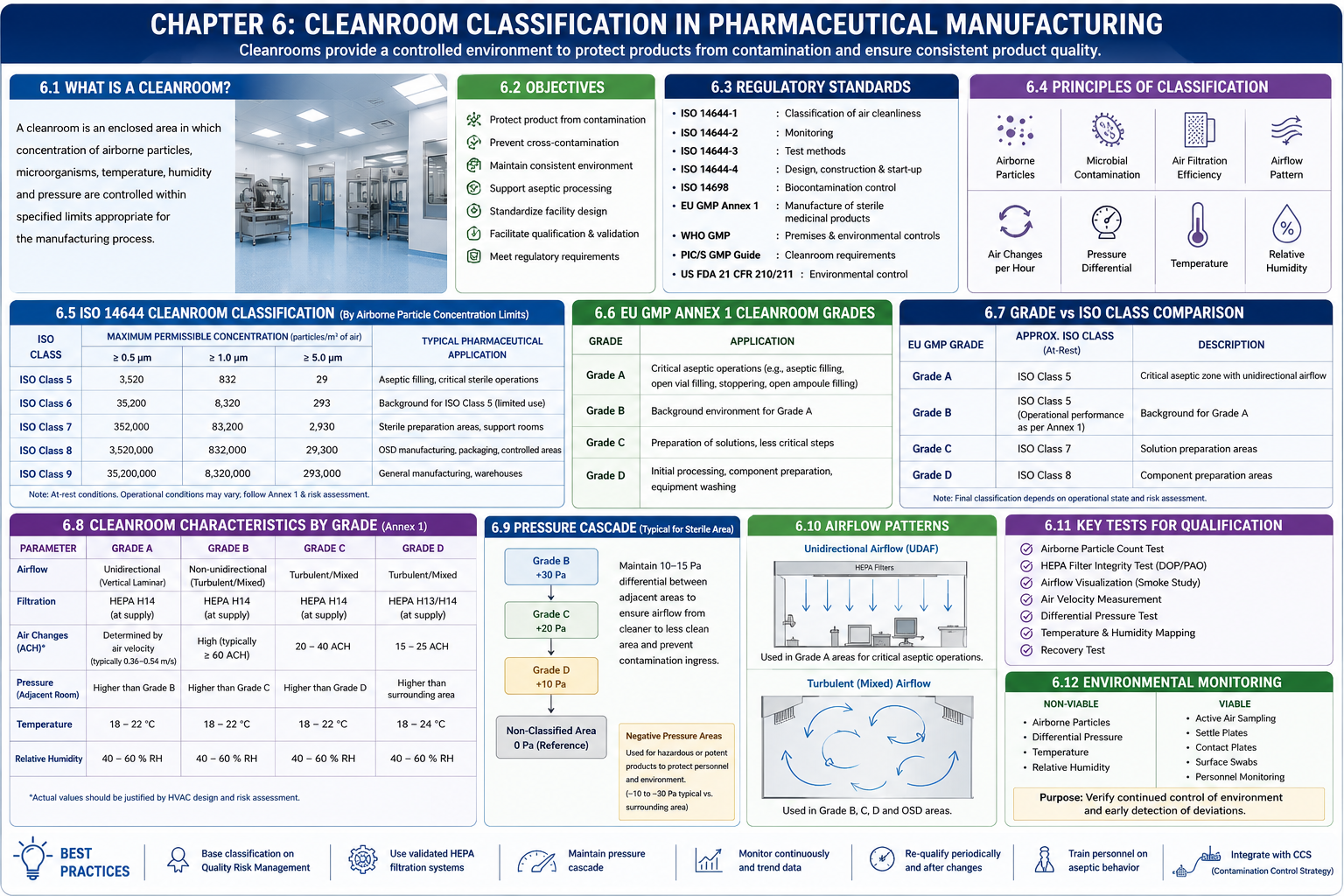
6.1 Introduction
Cleanrooms are the cornerstone of pharmaceutical manufacturing, providing a controlled environment where airborne particles, microorganisms, temperature, humidity, and pressure are maintained within defined limits. Their primary purpose is to protect products from contamination and ensure consistent manufacturing quality.
Cleanroom classification is one of the most critical aspects of pharmaceutical facility design and forms an essential component of Good Manufacturing Practices (GMP). It determines the environmental conditions required for different manufacturing operations based on the level of contamination risk.
International standards such as ISO 14644, EU GMP Annex 1, WHO GMP, and PIC/S GMP establish the framework for cleanroom classification, qualification, monitoring, and maintenance.
Proper cleanroom classification supports:
- Product quality
- Patient safety
- Regulatory compliance
- Contamination control
- Process consistency
- Facility qualification
6.2 What is a Cleanroom?
A cleanroom is an enclosed area in which the concentration of airborne particles, microorganisms, temperature, humidity, and pressure are controlled to specified limits appropriate for the manufacturing process.
Unlike conventional manufacturing rooms, cleanrooms are designed to:
- Minimize airborne contamination.
- Prevent microbial ingress.
- Control environmental parameters.
- Facilitate cleaning and disinfection.
- Support validated manufacturing processes.
6.3 Objectives of Cleanroom Classification
The objectives of classifying cleanrooms include:
- Protecting pharmaceutical products.
- Preventing cross-contamination.
- Maintaining consistent environmental conditions.
- Supporting aseptic processing.
- Standardizing facility design.
- Facilitating qualification and validation.
- Meeting global regulatory requirements.
6.4 Regulatory Standards
Several international standards govern pharmaceutical cleanrooms.
| Standard | Scope |
|---|---|
| ISO 14644-1 | Classification of air cleanliness by particle concentration |
| ISO 14644-2 | Monitoring to demonstrate continued compliance |
| ISO 14644-3 | Test methods for cleanrooms |
| ISO 14644-4 | Design, construction, and start-up |
| ISO 14698 | Biocontamination control |
| EU GMP Annex 1 | Manufacture of sterile medicinal products |
| WHO GMP | Premises and environmental controls |
| PIC/S GMP Guide | Cleanroom requirements |
| US FDA 21 CFR Parts 210 & 211 | Environmental control requirements |
6.5 Principles of Cleanroom Classification
Cleanroom classification is based on:
- Airborne particle concentration
- Microbiological contamination
- Air filtration efficiency
- Airflow pattern
- Air change rate
- Pressure differential
- Temperature
- Relative humidity
These parameters are selected according to the manufacturing process and contamination risk.
6.6 ISO 14644 Cleanroom Classification
ISO 14644-1 classifies cleanrooms based on the maximum allowable concentration of airborne particles of specified sizes.
ISO Cleanroom Classes
| ISO Class | Typical Pharmaceutical Application |
|---|---|
| ISO Class 5 | Aseptic filling, critical sterile operations |
| ISO Class 6 | Background for critical operations (limited use) |
| ISO Class 7 | Sterile preparation areas, support rooms |
| ISO Class 8 | OSD manufacturing, packaging, controlled areas |
| ISO Class 9 | General manufacturing, warehouses |
6.7 ISO Class 5–8 Comparison
| ISO Class | Typical Use | Air Cleanliness |
|---|---|---|
| ISO 5 | Grade A critical zone | Extremely high cleanliness |
| ISO 6 | Intermediate clean areas | High cleanliness |
| ISO 7 | Grade B/C support | Controlled environment |
| ISO 8 | OSD manufacturing | General clean manufacturing |
6.8 EU GMP Annex 1 Cleanroom Grades
For sterile medicinal products, EU GMP Annex 1 defines four grades:
| Grade | Application |
|---|---|
| Grade A | Critical aseptic operations |
| Grade B | Background to Grade A |
| Grade C | Preparation of solutions, less critical steps |
| Grade D | Initial processing, component preparation |
6.9 Grade A Cleanroom
Typical Applications
- Aseptic filling
- Open vial filling
- Stoppering
- Open ampoule filling
Requirements
- Unidirectional airflow (UDAF)
- HEPA H14 filters
- Continuous particle monitoring
- Strict environmental monitoring
- Highest level of operator gowning
- Background Grade B
6.10 Grade B Cleanroom
Grade B serves as the background environment for Grade A operations.
Typical operations:
- Preparation for aseptic filling
- Equipment assembly
- Sterile component staging
Requirements:
- High air change rate
- HEPA filtration
- Continuous monitoring
- Controlled personnel access
6.11 Grade C Cleanroom
Typical uses:
- Preparation of sterile solutions before sterilization
- Equipment preparation
- Intermediate processing
Requirements:
- HEPA-filtered supply air
- Positive pressure
- Environmental monitoring based on risk
6.12 Grade D Cleanroom
Typical applications:
- Washing of components
- Initial preparation
- Handling of cleaned equipment
- Support activities
Grade D provides controlled conditions but with less stringent requirements than Grades A–C.
6.13 Relationship Between EU GMP Grades and ISO Classes
The following table provides commonly accepted correlations for airborne particle cleanliness. Final classification should always follow current regulatory guidance and process-specific risk assessments.
| EU GMP Grade | Approximate ISO Class* | Typical Application |
|---|---|---|
| Grade A | ISO Class 5 | Critical aseptic zone |
| Grade B | ISO Class 5 (at rest); operational performance defined by Annex 1 | Background for Grade A |
| Grade C | Approximately ISO Class 7 (at rest) | Solution preparation |
| Grade D | Approximately ISO Class 8 (at rest) | Component preparation |
*Equivalent classifications depend on the operational state (at-rest or operational) and applicable regulatory requirements.
6.14 Air Filtration
High Efficiency Particulate Air (HEPA) filters are essential for pharmaceutical cleanrooms.
Typical efficiencies:
| Filter Type | Minimum Efficiency |
|---|---|
| HEPA H13 | ≥99.95% (MPPS) |
| HEPA H14 | ≥99.995% (MPPS) |
| ULPA | Higher efficiency for specialized applications |
6.15 Airflow Patterns
Unidirectional Airflow (UDAF)
Used in:
- Grade A filling
- Sterile compounding
- Open aseptic operations
Benefits:
- Sweeps contaminants away from the critical zone.
- Minimizes turbulence around exposed product.
Non-Unidirectional (Turbulent/Mixed) Airflow
Used in:
- OSD manufacturing
- Packaging
- Warehouses
- General cleanrooms
Provides adequate dilution of contaminants for lower-risk operations.
6.16 Air Changes per Hour (ACH)
Air changes help remove airborne contaminants and maintain environmental conditions.
| Area | Typical ACH* |
|---|---|
| Grade A (UDAF) | Determined by airflow velocity, not ACH alone |
| Grade B | Typically high air change rates, justified by design |
| Grade C | Approximately 20–40 ACH |
| Grade D | Approximately 15–25 ACH |
| OSD Manufacturing | Approximately 20–30 ACH |
*Actual values should be determined through HVAC design calculations and risk assessment.
6.17 Temperature and Relative Humidity
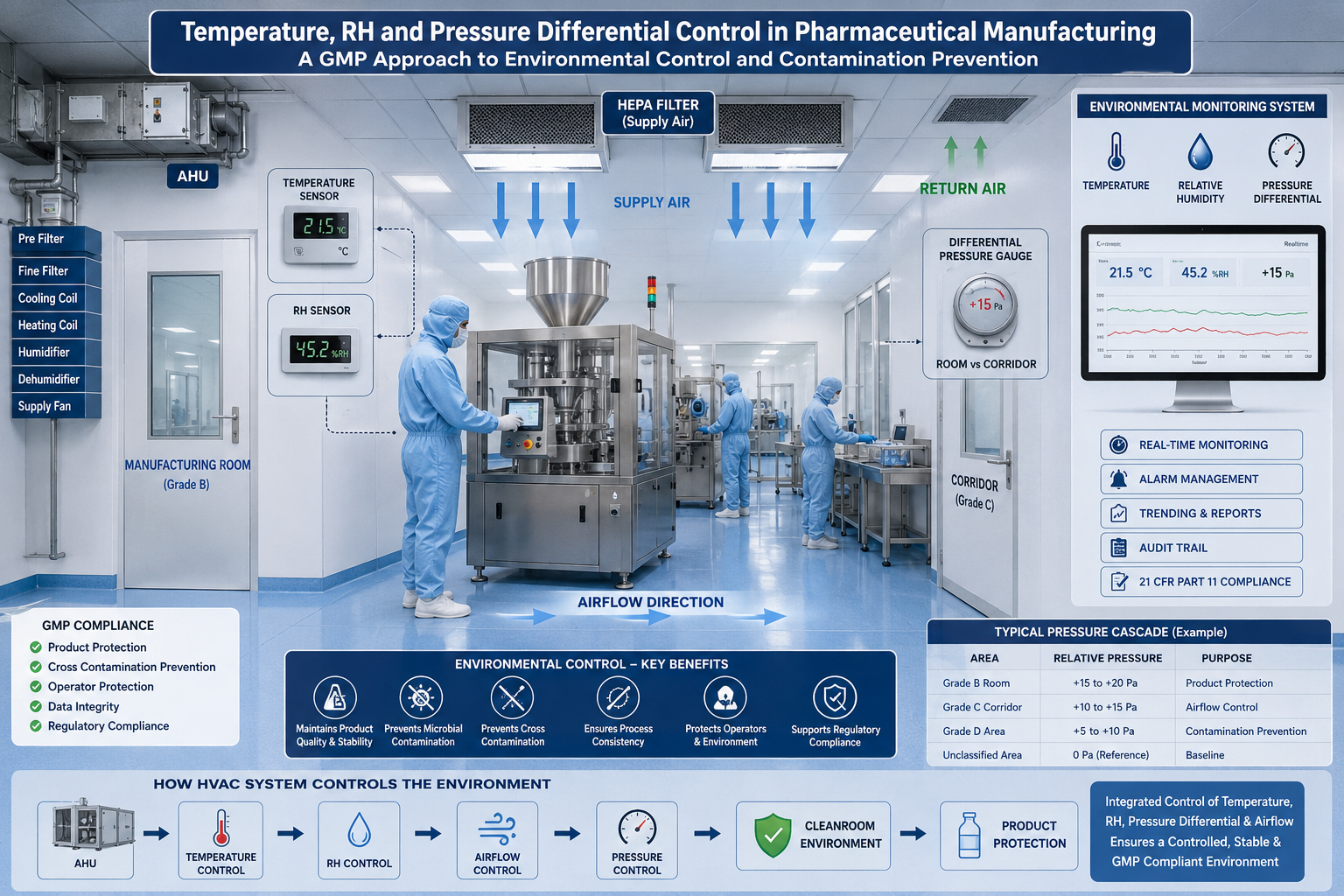
Typical environmental conditions:
| Area | Temperature | RH |
|---|---|---|
| OSD Manufacturing | 20–25°C | 40–60% (process dependent) |
| Sterile Manufacturing | 18–22°C | 40–60% (process dependent) |
| Packaging | 20–25°C | 45–60% |
Specific products (e.g., moisture-sensitive materials) may require tighter environmental controls.
6.18 Pressure Differential
Pressure differentials maintain airflow direction and reduce contamination risks.
Positive Pressure
Protects products by ensuring airflow from cleaner to less clean areas.
Grade B (+30 Pa)
        │
        ▼
Grade C (+20 Pa)
        │
        ▼
Grade D (+10 Pa)
Negative Pressure
Used for hazardous products to protect personnel and contain contaminants.
Pressure differentials between adjacent rooms are commonly maintained around 10–15 Pa, unless a different value is scientifically justified.
6.19 Cleanroom Qualification
Cleanrooms should be qualified before routine use.
Typical qualification stages:
Design Qualification (DQ)
          │
Installation Qualification (IQ)
          │
Operational Qualification (OQ)
          │
Performance Qualification (PQ)
6.20 Cleanroom Performance Tests
Common qualification tests include:
| Test | Purpose |
|---|---|
| Airborne Particle Count | Verify cleanliness classification |
| HEPA Filter Integrity Test | Confirm filter performance |
| Airflow Visualization (Smoke Study) | Demonstrate airflow patterns |
| Air Velocity Measurement | Verify unidirectional airflow where required |
| Differential Pressure Test | Confirm pressure cascade |
| Temperature Mapping | Verify uniform temperature |
| Humidity Mapping | Verify RH control |
| Recovery Test | Evaluate room recovery after contamination challenge |
6.21 Environmental Monitoring
A comprehensive environmental monitoring program should include:
Non-Viable Monitoring
- Airborne particles
- Differential pressure
- Temperature
- Relative humidity
Viable Monitoring
- Active air sampling
- Settle plates
- Contact plates
- Surface swabs
- Personnel monitoring (e.g., gloves and gown sleeves)
Alert and action limits should be established based on room classification, process risk, historical data, and applicable regulatory guidance.
6.22 Common Cleanroom Design Deficiencies
Regulatory inspections often identify:
- Incorrect HEPA filter placement.
- Inadequate pressure cascade.
- Poor airflow around critical operations.
- Excessive turbulence in Grade A zones.
- Difficult-to-clean surfaces.
- Inadequate environmental monitoring locations.
- Improper door interlocking.
- Insufficient HVAC capacity.
6.23 Best Practices
- Base cleanroom classification on documented Quality Risk Management (QRM).
- Integrate cleanroom design with the Contamination Control Strategy (CCS).
- Use validated HEPA filtration systems.
- Qualify cleanrooms before production.
- Perform routine environmental monitoring and trend analysis.
- Conduct periodic airflow visualization studies.
- Requalify cleanrooms after significant changes or at defined intervals.
- Train personnel on aseptic behavior and cleanroom discipline.
6.24 Case Study – Cleanroom Classification for a Sterile Injectable Facility
Facility Layout:
| Area | Classification |
|---|---|
| Component Washing | Grade D |
| Sterilization Preparation | Grade C |
| Aseptic Filling Background | Grade B |
| Filling Zone | Grade A |
| Stoppering | Grade A |
| Visual Inspection | Controlled area (risk-based) |
| Secondary Packaging | Controlled area |
Engineering Features:
- HEPA H14 terminal filters.
- Unidirectional airflow over exposed product.
- Pressure cascade from Grade B to surrounding areas.
- Continuous particle monitoring in Grade A.
- Routine viable and non-viable environmental monitoring.
- Qualified HVAC with periodic requalification.
Chapter Summary
Cleanroom classification provides the environmental framework necessary to manufacture pharmaceutical products safely and consistently. By applying internationally recognized standards such as ISO 14644 and EU GMP Annex 1, manufacturers can define appropriate cleanliness levels, airflow patterns, pressure cascades, filtration systems, and monitoring programs. Properly designed, qualified, and maintained cleanrooms are fundamental to contamination control, regulatory compliance, and the production of high-quality pharmaceutical products.
Key Takeaways
- Cleanroom classification should be based on product and process risk.
- ISO 14644 defines airborne particle cleanliness classes, while EU GMP Annex 1 specifies cleanroom grades for sterile manufacturing.
- HEPA filtration, airflow design, pressure cascades, and environmental monitoring are essential components of cleanroom performance.
- Qualification (DQ, IQ, OQ, PQ) and ongoing monitoring demonstrate continued compliance throughout the facility lifecycle.
- Effective cleanroom design and operation directly support patient safety, product quality, and global GMP compliance.
Next Chapter
Chapter 7 – Cubicle Classification Based on Manufacturing Operations, providing a detailed room-by-room classification for dispensing, sampling, granulation, drying, milling, blending, compression, coating, capsule filling, sterile filling, packaging, and support operations, including recommended cleanroom grades, pressure strategies, HVAC requirements, temperature, relative humidity, and air change recommendations.
About the Author
Ramesh Palav is a pharmaceutical professional with 20+ years of industry experience in manufacturing, GMP, quality systems, validation, compliance, and operational excellence. Through Pharma Manufacturing Hub, he shares practical insights on pharmaceutical careers, manufacturing, quality, validation, Pharma 4.0, AI, and professional development.
His goal is to help students, freshers, experienced professionals, and career-break professionals build the knowledge and skills needed to succeed in the pharmaceutical industry.