
Introduction
Environmental Monitoring in Pharma is one of the most important systems used to understand and control the manufacturing environment in pharmaceutical facilities. It provides objective information about airborne particles, microorganisms, surfaces, personnel and other environmental conditions that may influence product quality.
However, environmental monitoring should not be viewed simply as a program of taking air and surface samples.
A scientifically designed environmental monitoring program is part of a broader contamination-control system. It should help the pharmaceutical manufacturer understand environmental conditions, identify potential contamination routes, recognize adverse trends and initiate appropriate investigation and corrective action before product quality is compromised.
For sterile manufacturing, this philosophy is particularly important. The current EU GMP Annex 1 framework places environmental and process monitoring within the broader Contamination Control Strategy (CCS) and requires monitoring programs to be scientifically justified and risk based. The revised Annex 1 has been fully applicable in the EU since 25 August 2024.
The FDA similarly describes environmental monitoring as an important laboratory control in aseptic processing because it can provide information about the quality of the processing environment and environmental trends and help identify potential contamination routes.
This article explains environmental monitoring from fundamentals through implementation, sampling, limits, investigation, trending, contamination control, data integrity and digital transformation.
1. What Is Environmental Monitoring in Pharma?
Environmental monitoring is a planned system for collecting and evaluating information about the manufacturing environment to determine whether environmental conditions remain appropriate for the intended pharmaceutical process.
Depending on the process and risk, an environmental monitoring program can include:
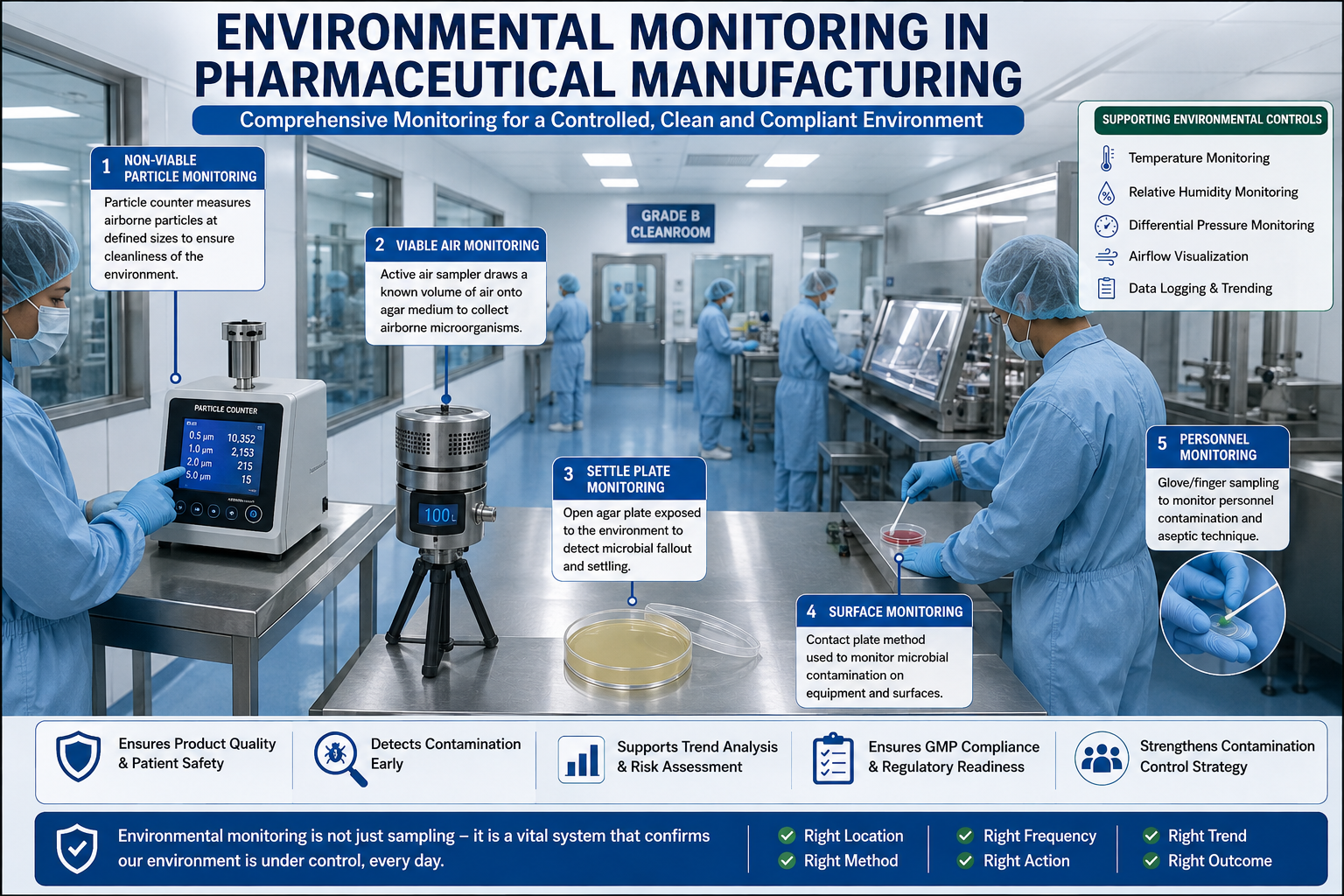
- Non-viable airborne particle monitoring
- Viable airborne microbial monitoring
- Settle plate monitoring
- Surface monitoring
- Personnel monitoring
- Temperature monitoring
- Relative humidity monitoring
- Differential pressure monitoring
- Other environmental parameters relevant to the process
In sterile manufacturing, environmental monitoring is closely associated with maintaining control of cleanrooms and critical processing areas.
For non-sterile pharmaceutical manufacturing, environmental monitoring may be designed differently according to product risk, process characteristics, facility design and the potential for microbial contamination.
A simple way to understand EM
Think of environmental monitoring as the early-warning system for the manufacturing environment.
It does not replace:
- HVAC control
- Cleaning and disinfection
- Personnel hygiene
- Facility qualification
- Process controls
- Equipment qualification
- Validation
- Proper gowning
- Material and personnel flow controls
Instead, it provides evidence that these controls are working together as intended.
2. Why Is Environmental Monitoring Important?
A pharmaceutical product can be affected by environmental contamination during manufacturing, particularly when materials or product are exposed to the environment.
Environmental monitoring helps organizations:
2.1 Detect potential contamination
Microorganisms and particles can originate from:
- Personnel
- Materials
- Equipment
- HVAC systems
- Building surfaces
- Cleaning activities
- Maintenance activities
- Poor gowning practices
- Poor aseptic technique
2.2 Identify adverse trends
One isolated result may not tell the complete story.
For example:
| Week | Room | Result |
|---|---|---|
| Week 1 | Room 201 | 2 CFU |
| Week 2 | Room 201 | 3 CFU |
| Week 3 | Room 201 | 5 CFU |
| Week 4 | Room 201 | 7 CFU |
Even if every individual result is below the applicable action limit, the increasing trend may deserve attention.
This is why trend analysis is a fundamental part of a mature EM program.
2.3 Support contamination control
EM results can help determine whether contamination-control measures remain effective.
These can include:
- HVAC performance
- Cleaning and disinfection
- Personnel behavior
- Gowning
- Room pressure cascades
- Material transfer practices
- Equipment design
- Facility layout
2.4 Support GMP compliance
GMP requires manufacturers to establish appropriate controls for preventing contamination and maintaining suitable manufacturing conditions.
WHO describes GMP as a system designed to ensure that medicines are consistently produced and controlled according to appropriate quality standards, with premises, equipment, personnel and processes controlled appropriately.
3. Environmental Monitoring Program
A robust environmental monitoring program should be formally documented and scientifically justified.
For sterile manufacturing, PIC/S guidance describes the EM program as including risk-based decisions concerning sampling locations, monitoring frequency, methods and incubation conditions, using knowledge of the process, facility, equipment, operations and historical monitoring data.
A typical program includes:
- Scope
- Applicable areas
- Room classification
- Monitoring locations
- Sampling methods
- Sampling frequency
- Alert levels
- Action limits
- Sampling equipment
- Culture media
- Incubation strategy
- Microbial identification
- Data review
- Trending
- Excursion management
- Investigation
- CAPA
- Effectiveness verification
- Periodic program review
Key principle
The number of samples is not what makes an EM program strong. The scientific justification behind the program does.
4. Environmental Monitoring in Different Pharmaceutical Areas
Environmental monitoring should be tailored to the manufacturing process.
4.1 Grade A
Grade A represents the critical zone used for high-risk operations in sterile manufacturing.
Examples include:
- Aseptic filling
- Open container exposure
- Critical aseptic connections
- Other operations where sterile product or sterile product-contact surfaces are exposed
Monitoring should be designed around locations presenting the highest contamination risk.
The current EU/PIC/S approach emphasizes monitoring locations and sampling arrangements that provide meaningful information about critical zones without compromising the process itself.
4.2 Grade B
Grade B commonly provides the background environment for Grade A aseptic processing.
Monitoring may include:
- Airborne particles
- Viable air
- Surfaces
- Personnel
- Temperature/RH where relevant
4.3 Grade C and Grade D
Grade C and D areas are used for less critical operations in sterile manufacturing and may also have different applications depending on facility design.
Monitoring should reflect:
- Process risk
- Product exposure
- Room classification
- Personnel activity
- Material movement
- Historical data
4.4 OSD Manufacturing Areas
For oral solid dosage manufacturing, EM requirements should not automatically be copied from sterile manufacturing.
Areas may include:
- Dispensing
- Granulation
- Compression
- Coating
- Tablet inspection
- Primary packing
The monitoring strategy should be based on microbial risk, product characteristics, environmental conditions, facility design and applicable GMP requirements.
For example, a tablet compression room may require environmental controls very different from an aseptic filling room.
5. Types of Environmental Monitoring
| Monitoring Type | What It Measures | Typical Method | Primary Purpose |
| Non-viable particle monitoring | Airborne particles | Particle counter | Cleanliness control |
| Viable air monitoring | Airborne microorganisms | Active air sampling | Microbial control |
| Settle plate monitoring | Microbial fallout | Passive sedimentation | Environmental microbial assessment |
| Surface monitoring | Microbial contamination | Contact plates/swabs | Surface hygiene |
| Personnel monitoring | Personnel contamination | Glove/finger/gown monitoring | Personnel contamination control |
| Differential pressure | Pressure relationship | Differential pressure gauge/transmitter | Airflow control |
| Temperature | Temperature | Calibrated sensor | Environmental control |
| Relative humidity | Humidity | Calibrated RH sensor | Environmental/process control |
6. Non-Viable Particle Monitoring
Non-viable particle monitoring measures airborne particles that are not necessarily living microorganisms.
Particle monitoring is important because airborne particles can:
- Indicate changes in environmental control
- Reflect personnel activity
- Indicate HVAC problems
- Highlight abnormal process conditions
- Provide evidence of cleanroom performance
Common particle sizes
Cleanroom particle monitoring commonly evaluates defined particle-size channels according to the applicable cleanroom classification standard and regulatory framework.
The particle counter should be:
- Suitable for the intended application
- Calibrated
- Properly maintained
- Used according to approved procedures
Sampling location
Locations should be selected based on risk and knowledge of the room.
Consider:
- Personnel activity
- Product exposure
- Airflow pattern
- Equipment arrangement
- Material movement
- Critical processing locations
PIC/S specifically cautions against placing sampling probes so that they primarily sample HEPA-filter discharge rather than the air around the critical zone.
Continuous versus periodic monitoring
Continuous particle monitoring may be appropriate for certain critical sterile processing environments.
Periodic monitoring may be appropriate for other areas depending on:
- Risk
- Process
- Room classification
- Historical performance
- Regulatory expectations
The monitoring strategy should always be scientifically justified.
7. Viable Environmental Monitoring
Viable monitoring evaluates microorganisms in the environment.
Major methods include:
- Active air sampling
- Settle plate monitoring
- Surface monitoring
- Personnel monitoring
7.1 Active Air Sampling
Active air sampling uses a calibrated microbial air sampler to draw a defined volume of air across an appropriate culture medium.
The result is commonly expressed in terms such as:
CFU/m³
where CFU means colony-forming units.
Basic procedure
- Verify equipment status.
- Confirm calibration.
- Verify sampling location.
- Verify appropriate media.
- Set required sample volume.
- Perform sampling.
- Close/protect the exposed medium.
- Identify sample information.
- Transfer for incubation.
- Incubate according to the approved method.
- Count colonies.
- Record results.
- Evaluate against applicable limits.
- Trend the result.
Advantages
- Quantitative approach
- Defined air volume
- Useful for trending
- Can provide comparable results between locations
Limitations
- Does not recover every microorganism present
- Sampling itself may introduce operational risk if poorly performed
- Equipment requires qualification/calibration and appropriate maintenance
- Results are influenced by sampling and microbiological methods
8. Settle Plate Monitoring
Settle plate monitoring is a passive method in which exposed culture media allow microorganisms carried by air movement and gravity to settle onto the medium.
It can provide information about microbial fallout over a defined exposure period.
Advantages
- Simple
- Low equipment complexity
- Useful for passive monitoring
- Can provide information during operations
Limitations
- Not a direct measurement of airborne concentration
- Results depend on exposure conditions
- Excessively long exposure can affect media performance
- Placement must be scientifically justified
A settle plate should therefore not be interpreted as simply another form of active air sampling.
9. Surface Monitoring
Surface monitoring assesses microbial contamination on:
- Equipment surfaces
- Work surfaces
- Walls
- Floors
- Doors
- Frequently touched areas
- Product-contact-related environments where appropriate
Common methods include:
Contact plates
A prepared agar surface is pressed against a defined surface area.
Swabbing
A sterile swab is used to sample an irregular or difficult-to-access surface.
Surface sampling locations should be selected using risk assessment.
High-value locations may include areas that:
- Are frequently touched
- Are difficult to clean
- Are close to exposed product
- Have complex geometry
- Have demonstrated historical contamination
10. Personnel Monitoring
Personnel are one of the most significant potential sources of microbial contamination in controlled environments.
Personnel monitoring may involve:
- Gloves
- Fingers
- Sleeves
- Gowns
- Other appropriate garment locations
Personnel monitoring can provide useful information about:
- Gowning effectiveness
- Operator technique
- Hand hygiene
- Aseptic behavior
- Individual trends
Repeated recovery of microorganisms from the same operator should be evaluated scientifically rather than automatically assuming individual fault.
The investigation should consider:
- Gowning procedure
- Training
- Sampling technique
- Work activity
- Cleaning/disinfection
- Environmental conditions
- Microbial identity
11. Environmental Monitoring Sampling Locations
Sampling locations should be selected using a science- and risk-based approach.
Consider:
11.1 Product exposure
The closer the monitoring point is to exposed product or critical surfaces, the more important its risk assessment becomes.
11.2 Personnel movement
Areas with significant operator activity may present higher contamination risk.
11.3 Material movement
Transfer points can introduce contamination.
11.4 Airflow
Airflow visualization/smoke studies can help understand:
- Air movement
- Turbulence
- Potential contamination pathways
- Critical zones
- Operator impact
11.5 Equipment
Equipment configuration can create:
- Dead spaces
- Difficult-to-clean areas
- Airflow disturbances
11.6 Historical data
Historical EM results should influence the monitoring program.
A location that repeatedly demonstrates adverse trends deserves appropriate attention.
12. Environmental Monitoring Frequency
There is no single universal sampling frequency suitable for every pharmaceutical facility.
Frequency should be established considering:
- Room classification
- Process risk
- Product exposure
- Facility design
- Regulatory requirements
- Historical EM performance
- Personnel activity
- Process duration
- Contamination Control Strategy
Illustrative frequency matrix
Important: The following is an example framework for designing a site program, not a universal regulatory requirement.
| Area | Example Monitoring Approach | Frequency Basis |
| Critical sterile Grade A | Continuous/appropriate viable and particle monitoring plus other applicable methods | Criticality and regulatory requirements |
| Grade B | Viable, particle, surface and personnel monitoring as justified | Routine operations/risk |
| Grade C | Viable/particle/surface monitoring as applicable | Risk and historical data |
| Grade D | Appropriate environmental monitoring | Risk/process |
| OSD dispensing | Microbial/environmental controls as justified | Product/process risk |
| Compression | Environmental controls as justified | Product/process risk |
| Coating | Environmental controls as justified | Product/process risk |
| Packing | Monitoring based on contamination risk | Process risk |
For sterile manufacturing, the current PIC/S framework explicitly links sampling locations, frequency and methods to risk assessment and the site contamination-control strategy.
13. Environmental Monitoring Limits
One of the most misunderstood subjects in pharmaceutical environmental monitoring is the difference between alert levels and action limits.
Alert level
An alert level is generally an early warning threshold.
It may indicate that the process or environment is beginning to move away from its expected state.
An alert result does not necessarily mean that the product is contaminated.
Action limit
An action limit represents a more significant excursion requiring investigation and assessment according to the site’s approved procedures.
Important distinction
A company should not simply copy numerical values from another facility and call them regulatory limits.
Limits should be established according to applicable regulations, standards, process risk, room classification and scientifically justified site procedures.
For sterile manufacturing, applicable regulatory tables and requirements should be consulted directly.
PIC/S states that appropriate alert levels and action limits should be established for viable and total particle monitoring.
14. Regulatory Requirements and Guidelines
Environmental monitoring should be interpreted within the applicable regulatory framework.
EU GMP Annex 1
The revised EU GMP Annex 1 focuses strongly on contamination control and requires an appropriately designed environmental and process monitoring program for sterile manufacturing.
The European Commission lists Annex 1 as fully applicable since 25 August 2024.
European Commission — EudraLex Volume 4
PIC/S
PIC/S provides harmonized GMP guidance and inspection expectations.
Its Annex 1 material emphasizes risk-based selection of:
- Sampling locations
- Frequency
- Monitoring methods
- Incubation conditions
- Critical monitoring locations
FDA
The FDA’s guidance on sterile drug products produced by aseptic processing describes environmental monitoring as an important laboratory control and expects scientifically sound monitoring programs for aseptic environments.
FDA — Sterile Drug Products Produced by Aseptic Processing
WHO
WHO GMP establishes internationally recognized principles for pharmaceutical manufacturing and quality assurance. WHO also publishes specific GMP guidance for sterile pharmaceutical products.
WHO — Good Manufacturing Practices
ISO 14644
ISO cleanroom standards are important for cleanroom classification and related engineering controls. However, an ISO cleanroom classification requirement should not automatically be interpreted as a complete pharmaceutical GMP environmental monitoring program.
USP and industry guidance
USP chapters and industry organizations such as PDA can provide additional microbiological and pharmaceutical technical guidance.
Regulatory hierarchy matters
Always distinguish between:
Regulatory requirement → Applicable standard → Industry guidance → Company procedure
A company SOP must not contradict an applicable regulatory requirement.
15. Contamination Control Strategy (CCS)
One of the most important concepts in modern sterile manufacturing is the Contamination Control Strategy.
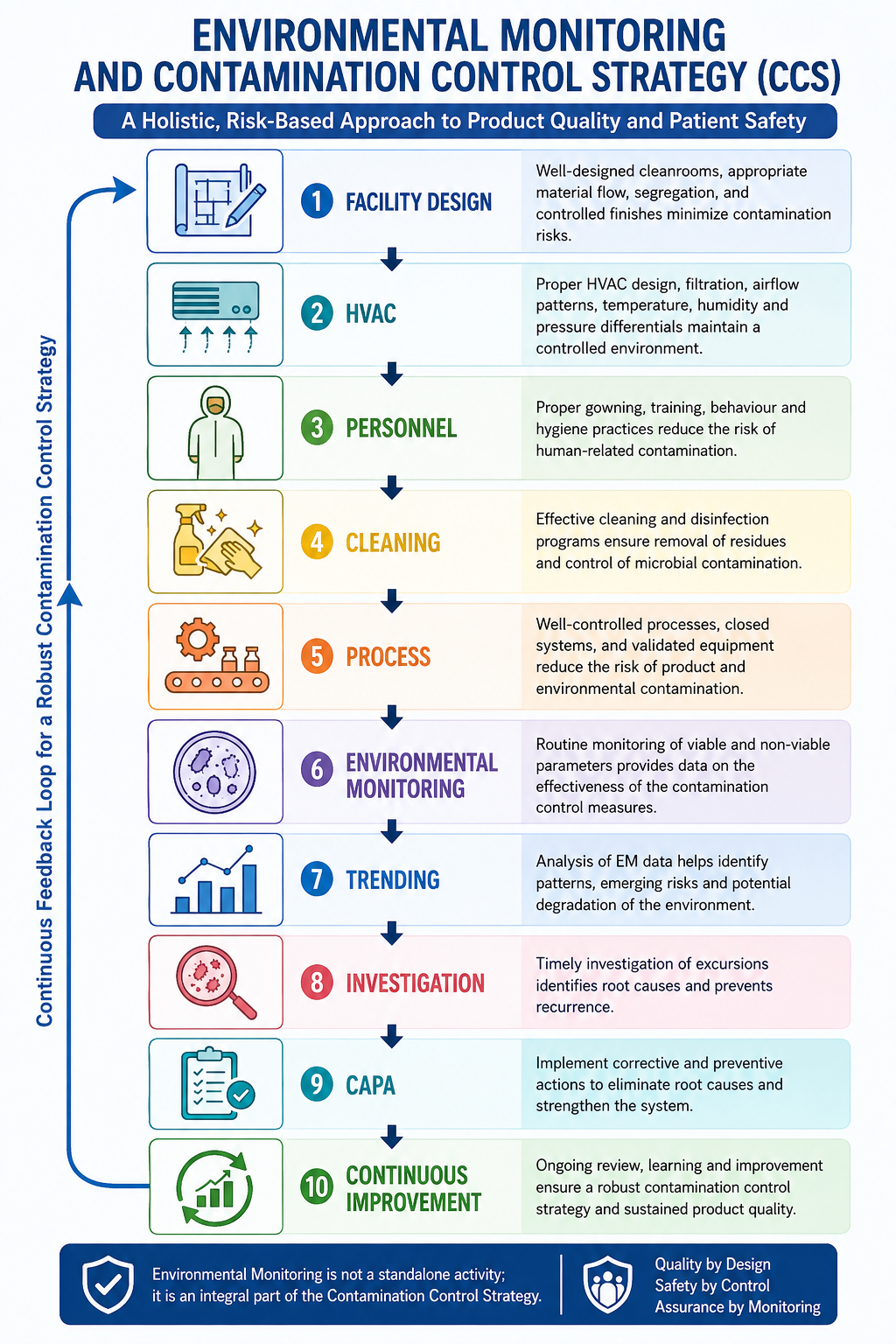
A simplified model is:
Facility Design
↓
HVAC
↓
Airflow Control
↓
Personnel Practices
↓
Cleaning & Disinfection
↓
Equipment & Process Controls
↓
Environmental Monitoring
↓
Trending & Investigation
↓
CAPA
↓
Continuous Improvement
Environmental monitoring is therefore one element of the contamination-control system, not the entire system.
Why this matters
A facility can have acceptable EM results today and still have a weak contamination-control system.
For example:
- Poor gowning
- Inadequate cleaning
- Poor HVAC maintenance
- Poor material transfer
- Uncontrolled interventions
may create latent contamination risks that are not necessarily captured by every routine sample.
The goal should therefore be contamination prevention, not simply obtaining acceptable EM results.
16. Environmental Monitoring Sampling Procedure

A practical EM workflow can be structured as follows.
Step 1 — Review the approved EM plan
Confirm:
- Area
- Sampling points
- Method
- Frequency
- Applicable limits
Step 2 — Verify sampling equipment
Check:
- Equipment identification
- Calibration
- Cleaning
- Status
- Battery/function where applicable
Step 3 — Verify media
Check:
- Media identity
- Lot number
- Expiry
- Storage
- Growth-promotion status
- Container integrity
Step 4 — Verify room conditions
Review relevant:
- Room status
- Pressure
- Temperature
- RH
- Cleaning status
- Personnel activity
Step 5 — Perform sampling
Follow the approved sampling method.
Avoid unnecessary disturbance of the manufacturing environment.
Step 6 — Record sample information
Document:
- Date
- Time
- Location
- Operator
- Method
- Equipment ID
- Sample ID
- Relevant batch/process information
Step 7 — Transfer samples
Maintain sample integrity and identification.
Step 8 — Incubate
Use the validated/approved incubation strategy.
Step 9 — Observe and count
Record microbial recovery appropriately.
Step 10 — Identify microorganisms where required
Identification strategy should follow approved procedures and applicable regulatory expectations.
Step 11 — Compare with limits
Evaluate:
- Alert
- Action
- Historical trend
Step 12 — Trend
Compare against:
- Location history
- Room history
- Organism trends
- Personnel trends
Step 13 — Investigate
Initiate the appropriate investigation when required.
Step 14 — Implement CAPA
CAPA should address the actual or probable root cause rather than simply repeating sampling.
Step 15 — Verify effectiveness
Demonstrate that corrective actions have worked.
17. Media and Microbiological Considerations
Culture media are fundamental to viable environmental monitoring.
Important controls include:
Media suitability
Media should be suitable for recovery of relevant microorganisms.
Growth promotion
Appropriate growth-promotion testing should be performed according to the approved microbiological procedure and applicable pharmacopoeial requirements.
Storage
Media should be stored under specified conditions.
Expiry
Expired or compromised media should not be used.
Media preparation
Prepared media should be controlled through approved procedures.
Incubation
Incubation conditions should be scientifically justified and validated/qualified as appropriate for the intended recovery strategy.
The exact incubation strategy should not be copied blindly from another site.
18. Microbial Identification
Microbial identification adds significant value to environmental monitoring.
A simple result such as:
5 CFU
provides less information than:
5 CFU – identified microbial population with an emerging trend
Identification can help answer:
- Is the microorganism environmental?
- Is it associated with personnel?
- Is the same organism recurring?
- Is there a potential source?
- Is the organism objectionable?
- Does the finding indicate a change in microbial ecology?
PIC/S material emphasizes identification of contaminating microorganisms to at least genus and preferably species where practicable in the relevant context.
Identification should therefore be integrated with investigation and trending rather than treated as a standalone laboratory exercise.
19. Environmental Monitoring Excursions
An EM excursion can involve:
- Alert-level excursion
- Action-level excursion
- Repeated alert results
- Unusual microbial identification
- Increasing particle counts
- Repeated personnel monitoring failures
- Unexpected contamination pattern
Investigation flow
EM Excursion
↓
Immediate Assessment
↓
Verify Data
↓
Review Sampling/Test Technique
↓
Review Cleaning & Disinfection
↓
Review HVAC
↓
Review Personnel
↓
Review Material Movement
↓
Review Equipment/Process
↓
Microbial Identification
↓
Historical Trend Review
↓
Root Cause Analysis
↓
CAPA
↓
Effectiveness Verification
The investigation should be proportional to the risk.
20. Root Cause Analysis of EM Excursions
A useful framework is the 6M approach.
| Category | Potential Cause |
| Man | Poor gowning, technique, training |
| Machine | HVAC malfunction, equipment disturbance |
| Method | Incorrect sampling or cleaning method |
| Material | Contaminated material introduced |
| Measurement | Sampling/testing error |
| Environment | Pressure, airflow, temperature or humidity issue |
Example
Suppose microbial recovery increases repeatedly near a material transfer point.
Potential causes may include:
- Poor transfer procedure
- Inadequate disinfection
- High personnel traffic
- Door opening frequency
- Airflow disturbance
- Material packaging contamination
- Poor cleaning technique
A strong investigation does not immediately select one cause.
It collects evidence and evaluates competing hypotheses.
21. Environmental Monitoring Trending
Trending transforms individual EM results into useful quality information.
Useful trends include:
Monthly trends
Monitor monthly performance.
Quarterly trends
Useful for management review and periodic assessment.
Location-wise trends
Identify problematic locations.
Room-wise trends
Compare room performance.
Organism-wise trends
Identify recurring microorganisms.
Personnel trends
Identify repeated operator-related patterns.
Seasonal trends
Environmental conditions can change with:
- Temperature
- Humidity
- Monsoon
- HVAC loading
- Maintenance activity
Statistical trend analysis
Organizations can use statistical methods to identify:
- Increasing trends
- Clustering
- Outliers
- Repeated excursions
- Shift in microbial population
Modern digital systems can automate much of this analysis.
22. Common Environmental Monitoring Failures
Here are 15 common weaknesses.
1. Poor sampling locations
Samples are collected because locations are easy to access rather than because they represent meaningful risk.
2. Inadequate frequency
Sampling frequency is not supported by risk assessment or historical performance.
3. Poor sampling technique
Incorrect handling can invalidate results.
4. Incorrect media handling
Improper storage, expiry or handling can compromise microbiological testing.
5. Poor personnel technique
Sampling can itself become a contamination source.
6. Ignoring trends
Organizations focus only on individual results.
7. Treating each excursion independently
Repeated low-level signals may represent a systemic problem.
8. Weak investigations
The investigation simply concludes “operator error” without evidence.
9. Poor microbial identification strategy
Identification data are not used effectively.
10. Weak CAPA
CAPA consists only of retraining.
11. Failure to review HVAC
Environmental excursions may have an HVAC component that is overlooked.
12. Inadequate cleaning review
Cleaning effectiveness is assumed rather than demonstrated.
13. Poor documentation
Missing sample information weakens traceability.
14. Sampling only convenient locations
Difficult or high-risk locations may be ignored.
15. Over-reliance on EM
Acceptable EM results are incorrectly treated as proof that contamination cannot occur.
23. Environmental Monitoring vs Environmental Qualification
| Parameter | Environmental Monitoring | Cleanroom Qualification | HVAC Qualification |
| Main purpose | Routine environmental control | Demonstrate cleanroom performance | Demonstrate HVAC performance |
| Typical timing | Routine operations | Initial/periodic qualification | Qualification/requalification |
| Focus | Ongoing environmental conditions | Facility performance | HVAC system performance |
| Examples | CFU, particles, surfaces | Classification, recovery, airflow | Air volume, pressure, temperature |
| Main output | EM trend/result | Qualification report | Qualification report |
| Primary use | Routine control | Demonstration of qualified state | Demonstration of system capability |
These systems are related but should not be confused.
24. Environmental Monitoring vs Contamination Control Strategy
| EM | CCS |
| Measures environmental conditions | Controls contamination risks holistically |
| Generates data | Integrates multiple controls |
| Provides warning signals | Establishes prevention strategy |
| Includes sampling | Includes facility, process, personnel and monitoring controls |
| Supports investigations | Provides overall contamination-control framework |
The CCS should explain how environmental monitoring supports the overall contamination-control approach.
25. Roles and Responsibilities
| Activity | QA | QC/Micro | Production | Engineering | Validation |
| EM program approval | A | R | C | C | C |
| Sampling | C | R | C | C | C |
| Microbiological testing | C | R | – | – | – |
| Room condition monitoring | C | C | R | R | C |
| HVAC investigation | C | C | C | R | C |
| EM excursion investigation | A/R | R | R | R | C |
| CAPA | A | R | R | R | C |
| Trend review | A/R | R | C | C | C |
| EM procedure | A | R | C | C | C |
| Qualification | A | C | C | R | R |
R = Responsible
A = Accountable
C = Consulted
Actual responsibilities should always follow the site’s approved organizational structure.
26. Environmental Monitoring Documentation
A mature EM system generates substantial documentation.
Typical records include:
- EM SOP
- Environmental monitoring plan
- Sampling map
- Sampling schedule
- Sample labels
- Equipment records
- Calibration records
- Media records
- Growth-promotion records
- Incubation records
- Microbial identification records
- Raw data
- Trend reports
- Excursion reports
- Investigation reports
- CAPA
- Effectiveness checks
- Periodic review
- CCS documentation
Documentation should provide traceability from:
Sample → Result → Investigation → CAPA → Effectiveness
27. Digital Environmental Monitoring
Pharma 4.0 is changing environmental monitoring.
Modern facilities may use:
- Continuous particle monitoring
- Automated environmental monitoring systems
- IoT sensors
- Electronic monitoring dashboards
- Data historians
- Automated alarms
- Electronic records
- Real-time trend analysis
- AI-assisted anomaly detection
AI-assisted trend detection
AI can potentially identify patterns such as:
- Gradual microbial increases
- Repeated location-specific events
- Correlation with personnel activity
- Seasonal environmental changes
- HVAC-related patterns
However, AI should support—not replace—qualified scientific and GMP decision-making.
28. Data Integrity in Environmental Monitoring
Environmental monitoring data may be generated electronically or manually.
Data integrity principles include:
ALCOA+
Data should be:
- Attributable
- Legible
- Contemporaneous
- Original
- Accurate
Plus:
- Complete
- Consistent
- Enduring
- Available
Electronic EM systems should be appropriately controlled and validated according to their intended use.
Where applicable, organizations should consider:
- Audit trails
- User access
- Electronic signatures
- Data backup
- System validation
- Change control
- 21 CFR Part 11
- EU Annex 11
The applicable requirements depend on the system and regulatory jurisdiction.

29. Practical Case Study: Repeated Microbial Increase in a Grade C Area
Scenario
A Grade C manufacturing room shows increasing microbial recovery over four consecutive monitoring periods.
Historical results:
| Period | Average Recovery |
| Month 1 | 2 CFU |
| Month 2 | 3 CFU |
| Month 3 | 5 CFU |
| Month 4 | 8 CFU |
No single result necessarily provides the complete picture, but the trend deserves investigation.
Step 1 — Initial assessment
QA and QC Microbiology review:
- Results
- Sampling locations
- Personnel
- Batch activity
- Cleaning status
- Room conditions
Step 2 — Location review
The increase is concentrated near a material transfer point.
Step 3 — Personnel review
Personnel movement during material transfer is reviewed.
Step 4 — Cleaning review
Cleaning records are reviewed.
The team discovers inconsistent execution of disinfection contact time.
Step 5 — HVAC review
Engineering reviews:
- Pressure differential
- Airflow
- HVAC alarms
- Recent maintenance
No significant HVAC abnormality is identified.
Step 6 — Microbial identification
Recovered microorganisms are identified and compared against historical isolates.
Step 7 — Root cause
The investigation concludes that inadequate execution of the material-transfer disinfection process is the most probable root cause, supported by observed procedural gaps and the location-specific trend.
Step 8 — CAPA
Possible CAPA includes:
- Revision of transfer procedure
- Operator retraining
- Practical competency assessment
- Increased supervision
- Cleaning/disinfection effectiveness review
- Temporary enhanced monitoring
Step 9 — Effectiveness verification
The area is trended for subsequent monitoring periods.
A successful CAPA should demonstrate sustained improvement rather than merely producing one acceptable sample.
Important: This is an educational hypothetical example and does not represent an actual pharmaceutical facility.
30. Environmental Monitoring Checklist
Before sampling
☐ Review approved sampling plan
☐ Confirm room status
☐ Confirm sampling locations
☐ Check equipment calibration
☐ Check media status
☐ Verify sample labels
☐ Confirm required PPE
☐ Check sampling equipment cleanliness
During sampling
☐ Follow approved technique
☐ Avoid unnecessary disturbance
☐ Record actual sampling time
☐ Maintain sample identity
☐ Follow required sample volume/exposure
☐ Avoid contamination of media
After sampling
☐ Secure samples
☐ Complete documentation
☐ Transfer samples appropriately
☐ Start incubation according to procedure
☐ Record equipment/media details
Laboratory testing
☐ Verify incubation conditions
☐ Record observations
☐ Count colonies appropriately
☐ Perform required identification
☐ Review controls
Data review
☐ Compare with alert level
☐ Compare with action limit
☐ Review historical trend
☐ Review location history
☐ Review organism trend
☐ Assess product/process impact where applicable
Excursion management
☐ Initiate investigation
☐ Verify data
☐ Review sampling technique
☐ Review cleaning
☐ Review HVAC
☐ Review personnel
☐ Review material movement
☐ Perform RCA
☐ Establish CAPA
☐ Verify effectiveness
31. Environmental Monitoring Interview Questions and Answers
1. What is environmental monitoring?
Environmental monitoring is a planned program for evaluating environmental conditions such as viable microorganisms, airborne particles, surfaces and other relevant parameters to demonstrate environmental control.
2. Why is EM important?
It provides information about environmental control, identifies potential contamination risks and supports trend analysis and investigation.
3. What are the main types of EM?
Common methods include active air sampling, settle plates, surface monitoring, personnel monitoring and non-viable particle monitoring.
4. What is active air sampling?
It is a quantitative method in which a defined volume of air is sampled onto an appropriate microbiological medium.
5. What is a settle plate?
A settle plate passively collects microorganisms that settle from the surrounding air onto exposed culture medium.
6. What is surface monitoring?
It is the assessment of microbial contamination on defined surfaces using contact plates or swabs.
7. What is personnel monitoring?
It evaluates microbial contamination associated with personnel garments, gloves or other appropriate locations.
8. What is the difference between viable and non-viable monitoring?
Viable monitoring assesses microorganisms; non-viable particle monitoring assesses airborne particles regardless of whether they are living organisms.
9. What is an alert limit?
An alert limit is an early-warning level indicating that environmental performance may be moving away from its expected state.
10. What is an action limit?
An action limit is a defined threshold that triggers investigation and assessment according to the approved procedure.
11. What happens after an EM excursion?
The result is assessed, data and sampling are verified, potential sources are investigated, product/process impact is evaluated where applicable, and CAPA is initiated when justified.
12. Why is microbial identification important?
Identification can help determine whether microorganisms are recurring, unusual or associated with a particular contamination source.
13. What is EM trending?
It is systematic evaluation of EM results over time to identify patterns, shifts, repeated excursions and emerging contamination risks.
14. How are sampling locations selected?
Locations should be selected using risk assessment, process knowledge, personnel activity, airflow, product exposure, facility design and historical data.
15. What is CCS?
A Contamination Control Strategy is a holistic strategy that integrates facility, equipment, process, personnel, cleaning, monitoring and other controls to prevent contamination.
16. Can acceptable EM results guarantee product sterility?
No. EM is one element of contamination control and cannot by itself guarantee sterility or absence of contamination.
17. What is the role of HVAC in EM?
HVAC supports control of airflow, pressure, temperature, humidity and particulate conditions. HVAC performance can therefore influence environmental monitoring results.
18. Why should EM results be trended?
Trending can identify gradual deterioration that may not be apparent from individual results.
19. What are common causes of EM excursions?
Potential causes include personnel practices, cleaning, material movement, HVAC issues, sampling errors, facility conditions and process-related factors.
20. What is the most important principle of environmental monitoring?
The most important principle is that monitoring should be scientifically justified, risk based and integrated into a broader contamination-control strategy.
32. Frequently Asked Questions
What is environmental monitoring in pharma?
Environmental monitoring in pharma is a systematic program used to assess environmental conditions, including viable microorganisms, airborne particles, surfaces and other relevant parameters.
Why is environmental monitoring important?
It helps demonstrate environmental control, identify contamination risks, detect adverse trends and support GMP compliance.
What are the types of environmental monitoring?
Major types include viable air monitoring, non-viable particle monitoring, settle plates, surface monitoring and personnel monitoring.
What is viable particle monitoring?
The term is commonly used informally for monitoring viable microorganisms in air. Strictly speaking, viable monitoring evaluates microorganisms, while particle counters measure non-viable airborne particles.
What is non-viable particle monitoring?
It measures airborne particles of specified sizes using an appropriate particle counter.
What is active air sampling?
Active air sampling uses a microbial air sampler to collect microorganisms from a defined volume of air.
What is settle plate monitoring?
Settle plate monitoring uses exposed culture media to collect microorganisms that settle from the environment.
What is surface monitoring?
Surface monitoring assesses microorganisms present on selected surfaces.
What is personnel monitoring?
Personnel monitoring evaluates contamination associated with operators’ gloves, garments or other defined sampling locations.
What are alert and action limits?
Alert limits provide an early warning, while action limits represent a defined threshold requiring investigation and assessment according to the approved program.
How often should environmental monitoring be performed?
Frequency should be established based on applicable requirements, risk, room classification, process characteristics, product exposure, historical data and the contamination-control strategy.
What happens when an EM action limit is exceeded?
The result should be investigated according to the site’s approved procedure, including assessment of sampling validity, contamination source, historical trends and potential impact on product/process.
How is EM trending performed?
Results can be trended by location, room, microorganism, personnel, time period and environmental parameter to identify adverse patterns.
What is the relationship between EM and CCS?
EM is one component of the broader Contamination Control Strategy. CCS integrates EM with facility, HVAC, cleaning, personnel, equipment and process controls.
Can EM replace cleaning validation?
No. Environmental monitoring and cleaning validation have different purposes and should not be treated as substitutes.
33. Internal Linking Strategy for Pharma Manufacturing Hub
The article should become a central pillar page connecting related pharmaceutical manufacturing content.
| Anchor Text | Suggested Target Article | Recommended Placement |
| Pharmaceutical HVAC System | HVAC article | HVAC section |
| What Is GMP? | GMP article | Introduction |
| Cleaning Validation | Cleaning validation article | Excursion section |
| Equipment Qualification | Qualification article | EM vs qualification |
| Process Validation | Process validation article | Contamination control |
| Contamination Control Strategy | CCS article | CCS section |
| Data Integrity in Pharma | Data integrity article | Digital EM |
| 21 CFR Part 11 | Part 11 article | Data integrity |
| Pharma 4.0 | Pharma 4.0 article | Digital EM |
| CAPA in Pharmaceutical Industry | CAPA article | Excursion section |
| Root Cause Analysis | RCA article | Investigation section |
| OSD Manufacturing Process | OSD article | OSD section |
SEO tip: Use descriptive anchor text such as “pharmaceutical HVAC system” rather than generic anchors such as “click here.”
Do not create links to articles that do not actually exist. Add the links after confirming the target URLs in WordPress.
34. External Linking Strategy
For regulatory content, prioritize authoritative sources.
European Commission
Use for:
- EU GMP
- EudraLex
- Annex 1
European Commission — EudraLex Volume 4
FDA
Use for:
- Aseptic processing
- CGMP
- Sterile manufacturing expectations
FDA — Sterile Drug Products Produced by Aseptic Processing
WHO
WHO provides GMP guidance and specific sterile-product guidance.
WHO — Good Manufacturing Practices
PIC/S
Important
Do not use a third-party blog as the primary source for a regulatory claim when the original regulator or standards body is available.
35. SEO FAQ Schema Content
The following questions can be considered for FAQ structured data where appropriate:
Q: What is environmental monitoring in pharma?
A: Environmental monitoring is a systematic program used to assess environmental conditions such as microorganisms, airborne particles, surfaces and other relevant parameters.
Q: Why is environmental monitoring important in pharmaceutical manufacturing?
A: It helps demonstrate environmental control, detect contamination risks, identify trends and support GMP requirements.
Q: What are the main types of environmental monitoring?
A: Common methods include active air sampling, settle plates, surface monitoring, personnel monitoring and non-viable particle monitoring.
Q: What is the difference between viable and non-viable monitoring?
A: Viable monitoring evaluates microorganisms, whereas non-viable particle monitoring measures airborne particles irrespective of whether they are living.
Q: What is an environmental monitoring action limit?
A: It is a defined threshold that triggers investigation and assessment according to the approved environmental monitoring program.
Q: What is the relationship between EM and CCS?
A: Environmental monitoring is one component of the broader Contamination Control Strategy, which integrates multiple contamination-prevention measures.
36. Five Key Takeaways
1. EM is more than sampling
Environmental monitoring is a management system for understanding environmental control.
2. Risk assessment drives the program
Sampling locations and frequency should be scientifically justified.
3. Trending is essential
Repeated small signals can be more informative than one isolated excursion.
4. EM does not replace contamination prevention
HVAC, cleaning, gowning, personnel behavior, facility design and process controls remain essential.
5. The future is digital
Continuous monitoring, automated data collection, advanced analytics and AI-assisted trend detection can strengthen environmental control when implemented within a validated and controlled GMP framework.
37. Final Conclusion
Environmental Monitoring in Pharma is not simply a requirement to collect microbiological samples or particle counts. It is a critical component of pharmaceutical contamination control and a source of information for understanding the state of the manufacturing environment.
A mature environmental monitoring program should be:
- Scientifically justified
- Risk based
- Clearly documented
- Properly executed
- Supported by qualified equipment
- Supported by appropriate microbiological methods
- Routinely trended
- Integrated with investigations
- Connected to CAPA
- Integrated with the Contamination Control Strategy
For sterile manufacturing, modern GMP expectations increasingly emphasize the relationship between environmental monitoring and the overall contamination-control system rather than treating EM as an isolated laboratory activity. The current EU GMP Annex 1 framework and related PIC/S guidance reflect this risk-based approach.
For non-sterile pharmaceutical manufacturing, the program should likewise be proportionate to the microbiological and process risks rather than copied directly from sterile manufacturing.
The ultimate objective is not simply:
“Did the sample pass?”
The better question is:
“Does the total body of environmental data demonstrate that our contamination-control system remains in a state of control?”
That mindset transforms environmental monitoring from a routine testing activity into a powerful pharmaceutical quality and manufacturing-control tool.
Disclaimer: This article is intended for educational and professional reference purposes. Specific environmental monitoring limits, sampling frequencies, locations, methods and acceptance criteria must be established and approved according to the applicable regulatory requirements, pharmacopoeial standards, facility/process risk assessments, validated methods and the company’s approved procedures. Regulatory documents should always be consulted for current requirements.
Pingback: Chapter 18-Environmental Monitoring in Pharma Manufacturing.