Introduction
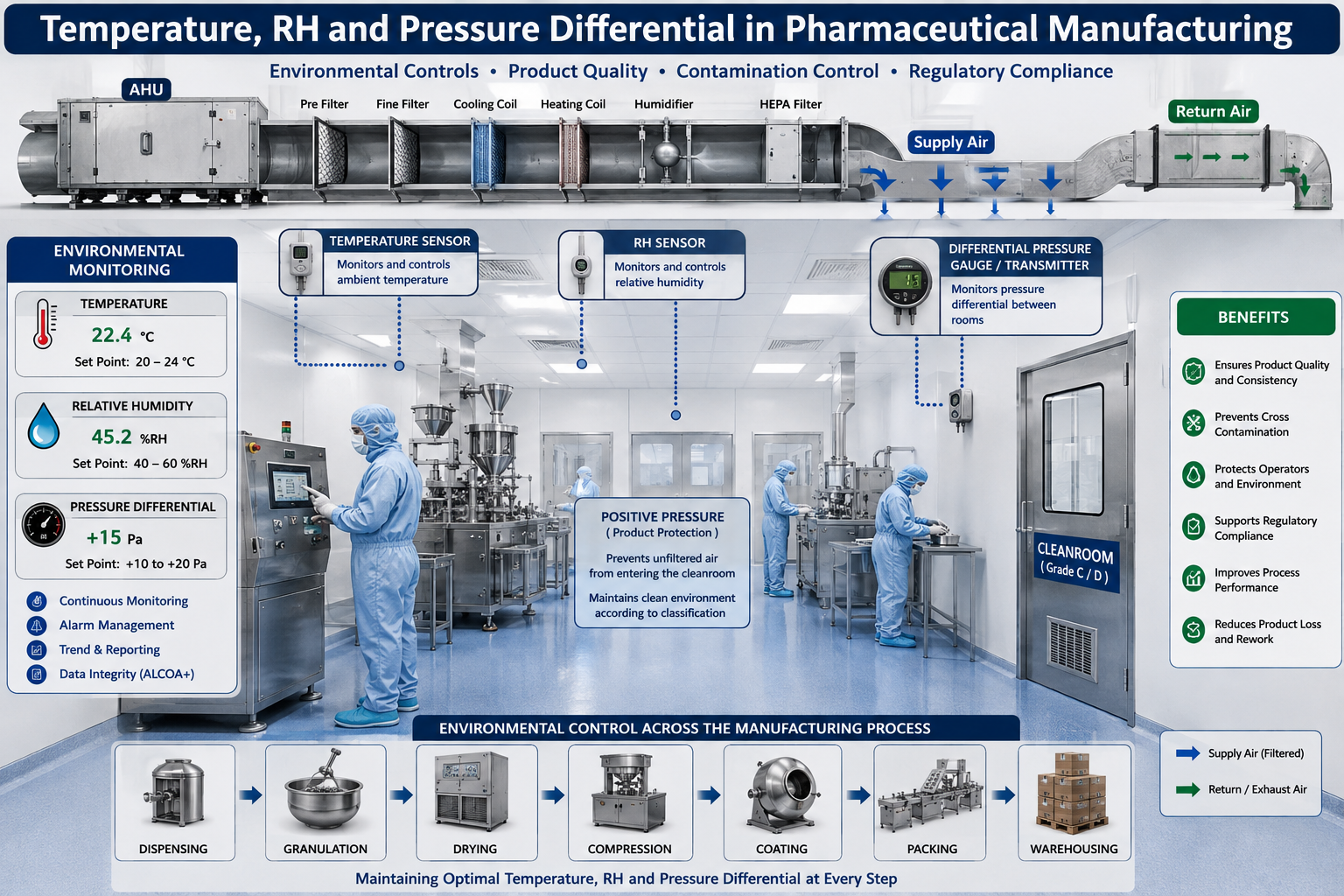
Temperature, Relative Humidity (RH), and Pressure Differential (PD) are three fundamental environmental parameters used to control pharmaceutical manufacturing environments.
They are sometimes treated simply as HVAC parameters displayed on a Building Management System (BMS) or Environmental Monitoring System (EMS). In a GMP facility, however, their significance is much broader.
Proper control of these parameters can influence:
- Product quality
- Product stability
- Powder flow
- Granulation
- Compression
- Coating
- Capsule filling
- Microbial control
- Cross-contamination prevention
- Sterile manufacturing
- Packaging performance
- Warehouse conditions
- Equipment performance
- Operator comfort
- Cleanroom performance
- HVAC efficiency
- Containment
- Data integrity
- Regulatory compliance
US GMP requirements specifically recognize the need for adequate control of air pressure, microorganisms, dust, humidity and temperature when appropriate to manufacture, process, pack or hold drug products.
WHO HVAC guidance similarly emphasizes that HVAC design affects room pressure, pressure differentials, pressure cascades, filtration, humidification/dehumidification, heating and cooling, and that environmental conditions should be appropriate for the storage, manufacture and use of materials, products, equipment and instruments.
The key GMP principle is therefore:
Temperature + RH + Pressure Differential + Airflow + Filtration + Monitoring + Qualification + Risk Management = Controlled Pharmaceutical Environment
There is, however, an important distinction: there is no single universal temperature, RH or pressure-differential value that applies to every pharmaceutical facility, dosage form or manufacturing process.
The appropriate limits should be scientifically justified based on the product, process, facility design, HVAC system, regulatory expectations and quality risk assessment.
1. What Are Temperature, RH and Pressure Differential?
1.1 Temperature
Temperature is a measure of the thermal condition of the environment.
In pharmaceutical manufacturing, temperature is commonly expressed in:
- °C
- °F
Temperature affects physical, chemical and biological phenomena throughout the manufacturing process.
It can influence:
- Product stability
- Chemical reaction rates
- Moisture transfer
- Drying
- Viscosity
- Solubility
- Microbial growth
- Powder behavior
- Coating performance
- Equipment operation
- Packaging performance
Temperature can also influence Relative Humidity. Therefore, temperature and RH should not be evaluated independently.
2. What Is Relative Humidity?
Relative Humidity is the ratio between the actual amount of water vapor present in air and the maximum amount of water vapor the air can hold at that temperature, normally expressed as a percentage.
For example:
50% RH means the air contains approximately half of the moisture it could hold at that temperature before reaching saturation.
RH is temperature-dependent.
This is extremely important in pharmaceutical manufacturing because the same quantity of water vapor can correspond to different RH values at different temperatures.
Therefore:
Temperature change → Moisture-holding capacity changes → RH changes
This is one reason why pharmaceutical HVAC systems need integrated temperature and humidity control.
3. Absolute Humidity, RH and Dew Point
Three terms are frequently confused.
Relative Humidity
Percentage of saturation at the existing temperature.
Absolute Humidity
Actual quantity of water vapor present in a given volume or mass of air.
Dew Point
The temperature at which air becomes saturated and condensation begins under the relevant conditions.
Dew point is particularly useful for:
- HVAC engineering
- Dehumidification
- Compressed air systems
- Cold rooms
- Condensation-risk assessment
- Moisture-sensitive processes
A pharmaceutical facility may therefore monitor temperature and RH while HVAC engineers may also use dew point for system design and troubleshooting.
4. What Is Pressure Differential?
Pressure Differential is the difference in air pressure between two adjacent spaces.
It is normally expressed in:
- Pascal (Pa)
- millimeter water gauge (mmWC)
- inch water gauge (in. w.g.)
For example, if Room A is at a higher pressure than Room B, air tends to move from Room A toward Room B when a leakage path exists.
This creates an important GMP principle:
Pressure difference → Airflow direction → Contamination-control strategy
Pressure differential is therefore not an isolated number. Its real purpose is to support the intended direction of airflow.
5. Positive, Negative and Neutral Pressure
5.1 Positive Pressure
A room is maintained at higher pressure than the adjacent less-clean area.
Typical objective:
Protect the product or clean environment from ingress of less-clean air.
Common applications may include:
- Clean manufacturing areas
- Certain packaging areas
- Clean corridors
- Certain sterile processing environments
5.2 Negative Pressure
A room is maintained at lower pressure than adjacent areas.
Typical objective:
Contain contaminants within the room.
It may be appropriate for:
- Potent compounds
- Toxic compounds
- Certain cytotoxic operations
- Hazardous materials
- Dust-generating processes
- Containment applications
Negative pressure should not be interpreted as automatically providing adequate containment. Containment effectiveness depends on the complete system, including airflow, pressure cascade, exhaust, room integrity, equipment containment and process design.
5.3 Neutral Pressure
A space may be operated close to the pressure of an adjacent area where no significant pressure cascade is required.
The appropriate pressure strategy depends on the facility’s contamination-control and containment strategy.
6. Why Temperature, RH and PD Matter in GMP Manufacturing
The three parameters address different but interconnected risks.
| Parameter | Primary Function | Major Risks if Poorly Controlled |
|---|---|---|
| Temperature | Thermal/environmental control | Stability, process variability, microbial growth, equipment issues |
| RH | Moisture/environmental control | Moisture uptake, poor flow, sticking, degradation, microbial risk |
| PD | Airflow/contamination control | Cross-contamination, ingress, containment failure |
| Airflow | Direction and dilution/removal | Contamination migration, poor cleanroom performance |
| Filtration | Particle/microbial control | Airborne contamination |
The pharmaceutical HVAC system integrates these controls.
7. Relationship Between Temperature, RH and Pressure Differential
A simplified relationship can be represented as:
AHU → Temperature Control → Humidity Control → Airflow → Room Pressure → Contamination Control
For example:
- AHU conditions incoming air.
- Cooling/heating controls temperature.
- Dehumidification or humidification controls moisture.
- Supply and return/exhaust airflow are balanced.
- The airflow balance establishes room pressure.
- The pressure cascade controls the direction of air movement.
- HEPA filtration and airflow patterns support cleanliness.
This is why changing one HVAC parameter can affect others.
For example:
Cooling coil performance decreases → Temperature rises → RH may change → Air density/airflow conditions change → Room pressure may fluctuate.
8. Scientific Principles Behind Environmental Control
8.1 Sensible Heat
Sensible heat changes air temperature without changing its moisture content.
Example:
An AHU cooling coil removes sensible heat and reduces air temperature.
8.2 Latent Heat
Latent heat is associated with moisture removal or addition.
Dehumidification removes moisture from air.
Humidification adds moisture.
8.3 Psychrometrics
Psychrometrics is the study of the thermodynamic properties of moist air.
Important parameters include:
- Dry-bulb temperature
- Wet-bulb temperature
- Relative humidity
- Humidity ratio
- Dew point
- Enthalpy
Psychrometric analysis is particularly important for HVAC design and troubleshooting.
9. Effect of Temperature and RH on Oral Solid Dosage Manufacturing
Oral Solid Dosage (OSD) manufacturing is one of the areas where environmental conditions can have a significant effect on processing.
Major OSD processes include:
- Dispensing
- Sieving
- Milling
- Granulation
- Drying
- Blending
- Compression
- Coating
- Capsule filling
- Packing
9.1 Dispensing
Temperature and RH can affect:
- Powder flow
- Hygroscopic materials
- Electrostatic charging
- Material sticking
- Weighing operations
- Material handling
Highly hygroscopic APIs or excipients may require tighter environmental control than relatively stable materials.
9.2 Granulation
Environmental conditions can affect:
- Binder behavior
- Granule moisture
- Drying performance
- Powder flow
- Granule strength
However, process parameters such as:
- Binder quantity
- Granulation endpoint
- Mixing time
- Impeller speed
- Drying temperature
- Product moisture
are usually more directly related to granulation performance than room RH alone.
9.3 Fluid-Bed Drying
Temperature and humidity affect:
- Drying rate
- Final moisture
- Product temperature
- Drying efficiency
The process itself should therefore be controlled using qualified process parameters rather than relying solely on room environmental conditions.
9.4 Compression
RH can have a significant influence on certain formulations.
Possible effects include:
- Sticking
- Picking
- Capping
- Lamination
- Poor flow
- Static charge
- Weight variation
- Compression behavior
The relationship is product-specific.
A high RH does not automatically cause every compression problem, and low RH does not automatically cause every static or flow problem.
Investigation should consider formulation, equipment, tooling, process parameters and environmental conditions together.
10. Capsules and RH
Capsules can be particularly sensitive to moisture.
Environmental conditions may influence:
- Shell flexibility
- Brittleness
- Dimensional behavior
- Filling performance
- Locking
- Defects
The appropriate environment should therefore be established based on:
Capsule material + formulation + process + equipment + product requirements.
11. Coating Operations
Environmental conditions may influence:
- Coating solution/suspension behavior
- Drying
- Film formation
- Tackiness
- Tablet appearance
- Coating defects
Potential defects include:
- Picking
- Sticking
- Twinning
- Roughness
- Cracking
- Orange peel
- Poor film formation
However, coating defects should not automatically be attributed to room RH or temperature. Investigations should also consider:
- Spray rate
- Atomization
- Inlet temperature
- Outlet temperature
- Pan speed
- Airflow
- Exhaust
- Coating formulation
- Solvent system
- Product bed temperature
12. Liquid Dosage Forms
Liquid dosage forms include:
- Solutions
- Syrups
- Suspensions
- Emulsions
- Oral liquids
Temperature can influence:
- Viscosity
- Solubility
- Mixing
- Suspension stability
- Emulsion stability
- Microbial growth
- Preservative behavior
RH is generally less directly critical to an aqueous bulk product than to hygroscopic powders, but it can still be important for room conditions, packaging materials, microbial control and personnel/environmental requirements.
13. Semisolid Dosage Forms
Examples include:
- Creams
- Ointments
- Gels
- Lotions
- Pastes
Temperature can affect:
- Viscosity
- Melting behavior
- Mixing
- Homogeneity
- Filling
- Product consistency
Environmental conditions should be established based on the formulation and process.
14. Sterile Pharmaceutical Manufacturing
Sterile manufacturing requires a much more comprehensive environmental-control strategy.
Areas may include:
- Sterile compounding
- Aseptic filling
- Terminal sterilization
- Vial filling
- Ampoule filling
- PFS filling
- BFS
- Component preparation
- Sterile corridors
- Gowning areas
- Personnel airlocks
- Material airlocks
For sterile manufacturing, Temperature/RH/PD must be considered together with:
- Cleanroom classification
- Airflow pattern
- HEPA filtration
- Airflow visualization
- Air changes
- Personnel movement
- Material movement
- Cleaning
- Disinfection
- Environmental monitoring
- Contamination Control Strategy (CCS)
The EU GMP framework for sterile medicinal products is therefore not simply a question of maintaining a particular temperature or RH value.
15. Grade A, B, C and D Areas
In sterile manufacturing, environmental controls are linked to cleanroom grades.
The grades should not be interpreted as temperature/RH classifications.
They primarily relate to the required level of environmental cleanliness and associated controls.
For example:
- Grade A: critical zone
- Grade B: background to Grade A in traditional aseptic processing
- Grade C: less critical stages
- Grade D: less critical controlled areas
The applicable environmental conditions must be established within the facility’s overall CCS, process design and regulatory framework.
16. Biologics and Vaccine Manufacturing
Biological products can have highly specific environmental requirements.
Examples include:
- Cell culture
- Fermentation
- Purification
- Formulation
- Filling
- Cold storage
- Vaccine manufacturing
Temperature can be particularly important because biological materials may be sensitive to:
- Temperature excursions
- Protein denaturation
- Aggregation
- Biological activity loss
For such products, environmental limits should be derived from product knowledge, process requirements and stability data rather than applying generic cleanroom values.
17. API Manufacturing
API facilities can involve:
- Powder handling
- Milling
- Drying
- Solvent handling
- Intermediate processing
- Dispensing
- Crystallization
- Final API processing
Environmental control may be required for:
- Product quality
- Moisture control
- Dust control
- Containment
- Cross-contamination prevention
- Operator protection
For potent or hazardous materials, negative-pressure containment strategies may be appropriate.
18. High-Potency, Cytotoxic and Hazardous Products
Special products may require enhanced containment.
Examples include:
- Cytotoxic compounds
- Highly potent APIs
- Hormonal products
- Sensitizing compounds
- Certain beta-lactams
- Other hazardous materials
Potential engineering controls include:
- Dedicated HVAC
- Negative pressure
- Dedicated exhaust
- Airlocks
- Safe-change filters
- Containment equipment
- Pressure cascades
The pressure strategy should be based on a documented containment and contamination-control assessment.
19. Packaging Areas
Packaging may involve:
- Blister packing
- Strip packing
- Bottle filling
- Sachets
- Cartoning
- Labeling
Environmental conditions may affect:
- PVC
- PVDC
- Aluminium foil
- HDPE
- PET
- Rubber components
- Adhesives
- Labels
For moisture-sensitive products, packaging-room environmental control can become particularly important.
20. Warehouses and Storage Areas
Environmental controls may apply to:
- Raw materials
- APIs
- Excipients
- Packaging materials
- Finished products
- Quarantine materials
- Released materials
- Rejected materials
- Cold rooms
- Controlled-temperature rooms
Warehouse environmental control should be based on the specified storage conditions for the materials/products.
21. Temperature Mapping
Temperature mapping demonstrates how temperature is distributed throughout a defined space over time.
It can identify:
- Hot spots
- Cold spots
- Temperature gradients
- Areas affected by doors
- Areas affected by HVAC supply
- Seasonal variation
A typical mapping program includes:
- Define the area.
- Review the layout.
- Conduct risk assessment.
- Determine logger quantity.
- Identify locations.
- Calibrate loggers.
- Install loggers.
- Record the mapping conditions.
- Conduct mapping.
- Analyze data.
- Identify hot/cold spots.
- Determine routine monitoring locations.
- Prepare the report.
- QA review/approval.
22. RH Mapping
RH mapping follows similar principles.
It can identify:
- High-RH zones
- Low-RH zones
- Seasonal variation
- Moisture gradients
- Areas influenced by doors
- HVAC distribution problems
Temperature and RH mapping should be considered together because RH is temperature-dependent.
WHO guidance specifically recognizes temperature and relative humidity as HVAC parameters requiring consideration and qualification, alongside room pressures and airflow patterns.
23. Seasonal Mapping
Depending on facility location and risk assessment, mapping may need to consider:
- Summer
- Winter
- Monsoon/wet season
- Transitional periods
For facilities in humid climates, seasonal humidity variation can be especially significant.
Mapping strategy should be scientifically justified rather than based solely on a generic frequency.
24. Pressure Differential and Pressure Cascade
Pressure cascade is the planned relationship between the pressure of interconnected rooms.
A simplified product-protection cascade may be:
Cleanest area
↓
Cleaner corridor
↓
Less-clean area
↓
Unclassified area
The objective is to establish airflow in the intended direction.
A containment strategy can intentionally reverse the relationship around a hazardous process.
25. Typical Pressure Differential
One of the most frequently misunderstood pharmaceutical HVAC questions is:
“What is the GMP requirement for room pressure differential?”
There is no universal GMP value applicable to every room.
ISO 14644-4:2022 addresses cleanroom design and start-up and does not prescribe one universal technological method for achieving cleanroom performance.
The commonly referenced industry design range for adjacent cleanrooms of different cleanliness levels is approximately 5–20 Pa, but this should be treated as a design/reference concept, not as a universal pharmaceutical GMP mandate.
The actual site value should consider:
- Room classification
- Leakage
- Door configuration
- Airflow balance
- Airlock design
- Process requirements
- Containment
- Personnel movement
- Material movement
- HVAC design
- Risk assessment
Too little differential can risk unstable airflow direction.
Too much differential can create:
- Door-opening difficulties
- Excessive leakage
- Turbulence
- HVAC energy consumption
- Personnel discomfort
- Unstable room control
26. Temperature and RH: Typical Industry Ranges
A major GMP mistake is to state:
“GMP requires 20–25°C and 40–60% RH.”
This is not a universal GMP rule.
Such ranges may be used as site-specific or industry design/operating conditions, but the actual values must be scientifically justified.
A practical reference framework is:
| Area | Temperature | RH | Basis |
| OSD manufacturing | Commonly controlled within product/process-defined range | Often controlled where moisture affects process | Product/process requirement |
| Dispensing | Controlled based on material sensitivity | Often important for hygroscopic powders | Material/process risk |
| Compression | Product/process dependent | Often important for powder behavior | Formulation/process |
| Coating | Process dependent | Process dependent | Coating process |
| Sterile areas | Facility/process dependent | Facility/process dependent | CCS/process |
| Packaging | Product/material dependent | Product/material dependent | Packaging risk |
| Warehouse | Based on labeled/storage condition | Based on material/product sensitivity | Stability/storage |
| Cold room | Product-specific | Product-specific | Stability/product |
| Laboratory | Test-method dependent | Test-method dependent | Analytical requirement |
WHO HVAC guidance deliberately avoids prescribing one fixed value for every facility because multiple parameters affect clean-area conditions.
27. HVAC System Components
A pharmaceutical HVAC system may include:
- Fresh-air intake
- Return air
- Exhaust
- AHU
- Pre-filters
- Fine filters
- HEPA filters
- Cooling coils
- Heating coils
- Humidifiers
- Dehumidification systems
- Supply fans
- Return fans
- Exhaust fans
- Dampers
- VFDs
- Ductwork
- Terminal HEPA units
- Sensors
- Controllers
The system should be designed as an integrated environmental-control system.
28. Temperature Control Through HVAC
Temperature can be controlled through:
- Cooling
- Heating
- Reheat
- Airflow adjustment
- Mixing
- VAV/CAV strategies where appropriate
The control system should maintain the defined operating range under expected load and environmental conditions.
29. RH Control Through HVAC
Humidity can be controlled by:
Dehumidification
Often achieved through cooling below the air dew point followed by appropriate reheating or other engineered methods.
Humidification
Can involve:
- Steam humidification
- Clean steam systems where applicable
- Other validated humidification technologies
The humidification system should be designed to avoid introducing contamination.
30. Pressure Control
Room pressure depends largely on the relationship between:
Supply Air – Return Air – Exhaust Air – Leakage
If supply airflow exceeds return/exhaust plus leakage, room pressure generally tends to increase.
If return/exhaust exceeds supply, room pressure generally tends to decrease.
This is why pressure control is closely linked to HVAC air balancing.
31. Airflow and Pressure Are Not the Same Thing
A common mistake is to assume:
“High pressure differential means good airflow.”
Not necessarily.
Pressure differential indicates a pressure relationship.
Airflow direction and performance must also be demonstrated.
For cleanroom systems, appropriate testing may include:
- Airflow measurements
- Airflow visualization
- Pressure differential testing
- Recovery testing
- HEPA filter integrity testing
- Particle classification
- Other applicable cleanroom qualification tests
32. Sensor Selection
Temperature Sensors
Common technologies include:
- RTD
- Thermocouple
- Temperature transmitters
- Digital temperature sensors
- Data loggers
RTDs are widely used where stable and accurate temperature measurement is required.
RH Sensors
Common technologies include:
- Capacitive RH sensors
- Temperature/RH transmitters
- Electronic data loggers
The sensor should be selected according to:
- Accuracy
- Range
- Stability
- Response time
- Calibration capability
- Environmental compatibility
Pressure Sensors
Common instruments include:
- Magnehelic gauges
- Differential pressure transmitters
- Electronic pressure sensors
- Digital manometers
Electronic transmitters are commonly integrated with BMS/EMS systems.
33. Sensor Location
Sensor location should be based on qualification and risk assessment.
Consider:
- Room geometry
- Product location
- Personnel height
- Supply air
- Return air
- Heat-generating equipment
- Doors
- Equipment
- Hot/cold spots
- Mapping results
Avoid automatically installing sensors:
- Directly under supply diffusers
- Immediately beside doors
- Near heat sources
- In abnormal airflow locations
Pressure sensors should have clearly defined reference points.
Incorrect reference-point selection can generate misleading pressure readings.
34. BMS vs EMS
BMS
Building Management System generally manages facility and engineering systems such as:
- HVAC
- Temperature
- Pressure
- AHU operation
- Alarms
- Equipment status
EMS
Environmental Monitoring System is typically focused on monitored environmental conditions and their associated records, alarms, trends and data review.
Depending on facility architecture, BMS and EMS may interact or share data.
35. BMS, EMS, SCADA and PLC Comparison
| System | Primary Function |
| PLC | Real-time control |
| SCADA | Supervisory control and visualization |
| BMS | Building/HVAC management |
| EMS | Environmental monitoring |
| Data Logger | Local data acquisition/storage |
The actual architecture varies between facilities.
36. Data Integrity
Automated environmental monitoring systems create GMP data that should be managed appropriately.
Important considerations include:
- Unique user access
- Audit trails where applicable
- Time synchronization
- Data backup
- Electronic records
- Electronic signatures where applicable
- Alarm records
- Trend records
- Data review
- Retention
- Access control
ALCOA+ principles should be applied where applicable.
Manual transcription creates additional risks such as:
- Transcription errors
- Missing records
- Incorrect timestamps
- Data manipulation
- Delayed recording
37. Calibration
Temperature, RH and pressure instruments should be calibrated according to an approved program.
A calibration program should define:
- Frequency
- Reference standards
- Traceability
- Acceptance criteria
- Calibration method
- As-found results
- As-left results
- Out-of-tolerance assessment
38. Calibration vs Verification vs Qualification
| Activity | Purpose |
| Calibration | Establish relationship between instrument indication and reference standard |
| Verification | Confirm that equipment/instrument meets defined criteria |
| Qualification | Demonstrate that system/equipment is capable of performing as intended |
| Validation | Demonstrate that a process/system consistently produces intended results |
These activities should not be used interchangeably.
39. HVAC Qualification
Typical HVAC qualification activities may include:
- URS
- DQ
- FAT
- SAT
- IQ
- OQ
- PQ
Depending on the system, qualification/testing may cover:
- Temperature
- RH
- Airflow quantity
- Air changes
- Room pressure
- Airflow patterns
- HEPA filter integrity
- Particle classification
- Recovery
- Alarm operation
- Control-system functionality
WHO HVAC guidance identifies parameters such as temperature, RH, supply/return/exhaust quantities, room air-change rates, room pressures, airflow patterns and warning/alarm systems among parameters that may require qualification.
40. Airflow Visualization / Smoke Study
Airflow visualization can help demonstrate:
- Direction of airflow
- Potential turbulence
- Airflow reversal
- Contamination risk
- Impact of doors
- Critical-area protection
In sterile facilities, airflow visualization is an important element of contamination-control verification.
It should be designed and executed using an approved protocol and appropriate acceptance criteria.
41. Recovery Testing
Recovery testing assesses how quickly an area returns to an established cleanliness condition after a defined disturbance, where applicable.
Recovery testing may be considered during cleanroom qualification.
It should not be confused with temperature/RH recovery.
42. Routine Monitoring
Monitoring can be:
- Continuous
- Periodic
- Manual
- Automated
The frequency should be based on:
Risk + Product Sensitivity + Process Requirements + Facility History + Regulatory Expectations + Qualification Data
Monitoring should include:
- Actual values
- Trends
- Alarms
- Excursions
- Sensor status
- Calibration status
43. Alarm Management
Environmental monitoring alarms may include:
Temperature
- High
- Low
RH
- High
- Low
PD
- High
- Low
- Pressure reversal
Alarm systems should define:
- Warning limits
- Action limits
- Alarm delay
- Deadband/hysteresis where appropriate
- Acknowledgement
- Escalation
- Response
- Documentation
Alarm limits should not be arbitrarily selected.
44. Warning Limit vs Action Limit
Warning Limit
Indicates movement toward an undesirable condition.
It provides an opportunity for preventive intervention.
Action Limit
Indicates a condition requiring formal action according to the applicable procedure.
The relationship among:
Design Condition → Normal Operating Range → Alert/Warning Limit → Action Limit
should be clearly defined.
45. Temperature Excursion
A temperature excursion should trigger a structured response.
Step 1: Confirm the reading
Check:
- Sensor status
- Calibration
- Duplicate/independent measurement where appropriate
Step 2: Determine duration
Identify:
- Start time
- End time
- Maximum/minimum value
- Total exposure
Step 3: Identify affected materials
Determine:
- Raw materials
- In-process materials
- Finished products
- Packaging materials
Step 4: Assess impact
Consider:
- Stability
- Product specification
- Process sensitivity
- Storage requirements
- Exposure duration
Step 5: Investigate root cause
Check:
- AHU
- Cooling/heating
- Sensor
- BMS
- Power
- Door opening
- Maintenance
- Seasonal conditions
Step 6: CAPA
Implement corrective/preventive action based on the root cause.
46. RH Excursion
Potential impacts include:
- Moisture uptake
- Powder flow problems
- Tablet defects
- Capsule shell issues
- Microbial risk
- Product degradation
Investigation should consider both:
Magnitude + Duration
A short excursion slightly outside an operational range may not have the same product impact as a prolonged major excursion.
47. Pressure Differential Excursion
Potential causes include:
- AHU failure
- Exhaust failure
- Fan failure
- VFD problem
- Damper position
- Filter blockage
- Door opening
- Door seal failure
- HVAC balancing issue
- Power failure
- Sensor failure
The investigation should determine whether the intended airflow direction was compromised.
48. Pressure Reversal
Pressure reversal is potentially more significant than a simple numerical excursion.
For example:
If Room A is intended to be cleaner than Room B and air should flow from A → B, but the pressure relationship reverses, air may potentially move from B → A.
The investigation should therefore assess:
- Duration
- Airflow direction
- Door status
- Personnel/material movement
- Process activity
- Environmental monitoring results
- Potential contamination pathway
49. Excursion Investigation Flow
Alarm
↓
Verify reading
↓
Check sensor/calibration
↓
Check BMS/EMS
↓
Determine duration
↓
Identify affected area
↓
Identify affected product/material
↓
Assess process/product impact
↓
Assess contamination/microbial risk where applicable
↓
Root Cause Analysis
↓
CAPA
↓
QA disposition
50. Root Cause Analysis
Common tools include:
5 Why
Useful for relatively straightforward failures.
Fishbone
Categories may include:
- Man
- Machine
- Method
- Material
- Measurement
- Environment
FMEA
Useful for prospective risk assessment.
Fault Tree Analysis
Useful for complex system failures.
51. Common HVAC Root Causes
Possible causes include:
- Cooling coil failure
- Heating coil failure
- Humidifier failure
- Dehumidification failure
- Fan failure
- VFD failure
- Damper failure
- Filter blockage
- Sensor drift
- Calibration failure
- Incorrect setpoint
- BMS communication failure
- EMS communication failure
- Power interruption
- Excessive door opening
- Poor room sealing
- Exhaust imbalance
- Seasonal environmental changes
52. Impact Assessment
When an excursion occurs, QA should consider:
Material
Was the raw material exposed?
Product
Was the product exposed?
Duration
How long did the condition exist?
Magnitude
How far outside the defined range was it?
Process
Was manufacturing active?
Stability
Could the excursion affect product stability?
Microbiology
Could environmental conditions affect microbial risk?
Contamination
Could pressure reversal create contamination/cross-contamination risk?
Historical Data
Have similar excursions occurred previously?
53. Common GMP Mistakes
Top 20 mistakes
- Treating generic values as universal GMP requirements.
- Using arbitrary temperature setpoints.
- Using arbitrary RH limits.
- Using arbitrary pressure-differential limits.
- Poor sensor placement.
- Inadequate calibration.
- Ignoring seasonal variation.
- Failure to perform mapping.
- Poor alarm management.
- Failure to investigate excursions properly.
- Ignoring door-opening effects.
- Ignoring pressure cascade.
- Confusing pressure with airflow.
- Ignoring HVAC balancing.
- Excessive manual data transcription.
- Poor trend analysis.
- Weak BMS/EMS data controls.
- Inadequate change control.
- Inadequate HVAC qualification.
- Failure to reassess the system after HVAC modification.
54. Practical Case Study 1: High RH During Compression
Situation
A tablet compression area experiences sustained high RH.
Observation
Operators report:
- Increased sticking
- Picking
- Poor powder flow
Investigation
Review:
- RH trend
- Temperature trend
- HVAC performance
- Formulation
- Lubrication
- Compression parameters
- Tooling condition
Possible Root Cause
Dehumidification performance deteriorated, resulting in an environmental condition outside the established operating range.
Corrective Action
Restore HVAC performance and evaluate affected batches/materials.
CAPA
- Preventive maintenance improvement
- Alarm review
- Dehumidification monitoring
- Trend review
55. Practical Case Study 2: Low RH and Static Electricity
Situation
A powder dispensing area experiences unusually low RH.
Observation
Operators report:
- Static charge
- Powder adherence
- Handling difficulties
Investigation
Check:
- RH sensor
- Calibration
- HVAC
- Material properties
- Equipment grounding
- Process conditions
Conclusion
Low RH may contribute to electrostatic behavior, but the investigation should not assume RH is the sole cause.
56. Practical Case Study 3: Pressure Differential Loss
Situation
A clean manufacturing room loses pressure differential against the corridor.
Immediate Actions
- Verify pressure reading.
- Check door status.
- Check AHU.
- Check exhaust.
- Check fan/VFD.
- Check dampers.
- Check sensor.
- Assess whether airflow direction was compromised.
QA Assessment
Evaluate:
- Duration
- Production status
- Material exposure
- Environmental monitoring
- Potential contamination pathway
57. Practical Case Study 4: Warehouse Temperature Excursion
Situation
A warehouse temperature exceeds its approved storage condition.
Investigation
Review:
- Mapping data
- Monitoring data
- Duration
- HVAC operation
- Door openings
- Power interruption
- Product stability data
QA Decision
Product disposition should be based on scientifically justified impact assessment rather than simply assuming that every excursion automatically requires rejection.
58. Practical Case Study 5: Simultaneous Temperature, RH and PD Excursion
Situation
An AHU fails.
Consequences
Potentially:
Temperature ↑
RH changes
Pressure differential ↓
Investigation
Review:
- AHU failure
- Fan status
- HVAC interlocks
- BMS alarms
- EMS data
- Door opening
- Product exposure
- Environmental monitoring
This demonstrates why temperature, RH and PD should be considered as an interconnected system.
59. GMP Audit Checklist
| No. | Audit Question | Evidence Expected | GMP Risk |
| 1 | Are environmental limits scientifically justified? | Approved specification/rationale | High |
| 2 | Are sensors calibrated? | Calibration certificates | High |
| 3 | Are sensors correctly located? | Qualification/mapping data | High |
| 4 | Is temperature monitored? | EMS/BMS records | High |
| 5 | Is RH monitored where required? | EMS/BMS records | High |
| 6 | Is PD monitored? | Pressure records | High |
| 7 | Is mapping performed where required? | Approved mapping report | High |
| 8 | Are alarms qualified? | Alarm challenge records | High |
| 9 | Are excursions investigated? | Deviations | High |
| 10 | Is HVAC qualified? | IQ/OQ/PQ documentation | High |
| 11 | Are trends reviewed? | Trend reports | Medium |
| 12 | Are sensors protected from unauthorized adjustment? | Access controls | Medium |
| 13 | Is data integrity maintained? | Audit trails/access controls | High |
| 14 | Are changes controlled? | Change controls | High |
| 15 | Are CAPAs effective? | Effectiveness checks | High |
60. Troubleshooting Guide
| Problem | Possible Cause | Investigation | Immediate Action |
| High temperature | Cooling failure | Check AHU/cooling coil | Restore cooling |
| Low temperature | Excess cooling | Check control loop | Adjust system |
| High RH | Dehumidification failure | Review dew point/cooling coil | Restore dehumidification |
| Low RH | Excessive dry-air condition | Review HVAC controls | Adjust humidity control |
| Low PD | Supply/exhaust imbalance | Check fans/dampers | Restore cascade |
| High PD | Excess supply air | Check airflow balance | Correct balance |
| Pressure reversal | HVAC imbalance | Check adjacent rooms | Assess contamination risk |
| Fluctuating PD | Variable airflow/doors | Review trends | Investigate source |
| Sensor failure | Instrument fault | Calibration/diagnostics | Replace/repair |
| Alarm failure | EMS/BMS issue | Alarm challenge | Restore alarm |
| BMS communication loss | Network/controller fault | IT/automation review | Restore communication |
| EMS communication loss | System fault | System diagnostics | Restore monitoring |
61. SOP Framework
SOP Title
Monitoring and Control of Temperature, Relative Humidity and Pressure Differential
1. Purpose
To define the procedure for monitoring and controlling temperature, RH and pressure differential in GMP-controlled areas.
2. Scope
Applicable to designated manufacturing, storage, packaging and support areas.
3. Responsibilities
Define responsibilities of:
- Production
- QA
- Engineering
- Validation
- Microbiology where applicable
- Warehouse
4. Definitions
Include:
- Temperature
- RH
- PD
- Warning limit
- Action limit
- Excursion
- BMS
- EMS
5. Equipment
List:
- Temperature sensors
- RH sensors
- PD gauges/transmitters
- Data loggers
- BMS
- EMS
6. Procedure
Define:
- Monitoring
- Review
- Recording
- Alarm handling
- Excursion handling
7. Calibration
Define calibration requirements.
8. Excursion
Define escalation and investigation requirements.
9. Documentation
Define records to be maintained.
10. Training
Personnel should be trained before performing activities.
62. Interview Questions and Answers
Q1. Why are temperature and RH important in pharmaceutical manufacturing?
Because they can affect product stability, process performance, material properties, microbial risk and equipment operation.
Q2. Is there one universal GMP temperature requirement?
No. Requirements are generally established based on product, process, facility, regulatory and risk considerations.
Q3. What is pressure differential?
It is the difference in air pressure between two spaces and is used to help establish intended airflow direction.
Q4. Why is positive pressure used?
Generally to reduce ingress from less-clean surrounding areas into cleaner areas.
Q5. Why is negative pressure used?
Generally for containment applications where preventing contaminants from escaping is a priority.
Q6. What is pressure cascade?
A planned sequence of pressure relationships between interconnected areas.
Q7. What happens if PD reverses?
Potentially, air can flow in an unintended direction. The impact depends on the areas involved, duration, door status, process activity and contamination risk.
Q8. What is temperature mapping?
A documented study used to determine temperature distribution within a defined area over time.
Q9. What is RH mapping?
A study used to evaluate spatial and temporal humidity distribution.
Q10. Why is sensor location important?
Because a sensor installed near a supply diffuser, door or heat source may not represent the environmental condition relevant to the product/process.
Q11. What is the difference between BMS and EMS?
BMS generally manages building/HVAC systems, while EMS focuses on environmental monitoring and associated data. Actual architecture varies by facility.
Q12. What is calibration?
Calibration establishes the relationship between an instrument’s indication and a reference standard.
Q13. What is HVAC qualification?
Demonstration that the HVAC system can perform according to predefined requirements.
Q14. What is a smoke study?
Airflow visualization used to demonstrate airflow patterns and potential contamination pathways.
Q15. What is the first action during an environmental excursion?
Verify the reading and assess the situation while initiating the approved response procedure.
Q16. Should every temperature excursion result in batch rejection?
No. Product disposition should be based on a documented scientific impact assessment.
Q17. What causes high RH?
Possible causes include:
- Dehumidification failure
- High outdoor moisture load
- Cooling-coil performance issues
- Incorrect HVAC control
- Door opening
- Sensor issues
Q18. What causes low PD?
Possible causes include:
- Supply fan failure
- Exhaust imbalance
- Damper problem
- Door opening
- HVAC control failure
- Filter blockage
Q19. What is ALCOA+?
A set of principles used to support trustworthy, complete and reliable GMP data.
Q20. What is the most important principle for environmental limits?
The limits should be scientifically justified, risk-based, product/process appropriate and supported by qualification and regulatory expectations.
63. Temperature vs RH vs PD
| Parameter | Temperature | RH | PD |
| Primary purpose | Thermal control | Moisture control | Airflow/contamination control |
| Unit | °C/°F | % | Pa/mmWC |
| Main risk | Stability/process | Moisture/process | Contamination |
| Sensor | RTD/thermocouple | RH transmitter | DP transmitter |
| Mapping | Often applicable | Often applicable | Pressure verification |
| Alarm | High/Low | High/Low | High/Low |
| Qualification | Yes, where applicable | Yes, where applicable | Yes, where applicable |
| Trend | Important | Important | Important |
64. BMS vs EMS
| Feature | BMS | EMS |
| HVAC control | Yes | Usually monitoring-focused |
| Temperature monitoring | Yes | Yes |
| RH monitoring | Yes | Yes |
| Pressure monitoring | Yes | Yes |
| Alarm | Yes | Yes |
| Environmental trending | Yes | Yes |
| GMP data review | Depending on system | Common |
| Audit trail | System dependent | System dependent |
The specific architecture and regulatory controls should be assessed for the actual computerized system.
65. Calibration vs Qualification
| Calibration | Qualification |
| Instrument-focused | System/equipment-focused |
| Uses reference standard | Uses predefined acceptance criteria |
| Establishes measurement accuracy | Demonstrates intended performance |
| Usually periodic | Lifecycle activity |
| Example: calibrating RTD | Example: HVAC OQ |
66. Product Protection vs Personnel Protection
Product Protection
Often supported by:
Cleaner area → Higher pressure → Air flows outward
Personnel/Containment Protection
May require:
Containment area → Lower pressure → Air flows inward
Neither approach should be selected automatically. The correct strategy comes from the contamination-control and containment assessment.
67. Practical Decision Tree
Temperature/RH/PD Excursion Detected
↓
Verify reading
↓
Check sensor/calibration
↓
Check BMS/EMS
↓
Determine duration
↓
Determine affected area
↓
Identify affected materials/products
↓
Assess product/process/microbial/contamination impact
↓
Initiate deviation
↓
Perform RCA
↓
Implement CAPA
↓
QA disposition
68. Practical Numerical Example: Pressure Differential
Suppose:
Room A = +15 Pa relative to corridor
Corridor = +5 Pa relative to adjacent area
Then Room A has a 10 Pa pressure difference relative to the corridor.
The important point is not merely the number.
The facility should demonstrate that:
- The pressure relationship is stable.
- The intended airflow direction is maintained.
- Doors can function correctly.
- There is no unacceptable turbulence.
- The system remains within qualified conditions.
69. Practical Numerical Example: Temperature Conversion
To convert Celsius to Fahrenheit:
°F = (°C × 9/5) + 32
For example:
25°C = 77°F
For pharmaceutical environmental control, however, the important question is not simply whether the temperature is expressed in °C or °F, but whether it remains within the scientifically justified approved range.
70. Practical RH Concept
Suppose air at a given temperature can hold 20 units of water vapor at saturation.
If it actually contains 10 units:
RH = 10 / 20 × 100 = 50%
If temperature changes, the saturation capacity changes, so RH may change even if the actual moisture content has not changed.
This explains why temperature and RH should be evaluated together.
71. Regulatory Framework
Important references include:
US FDA GMP
21 CFR 211.46 requires adequate control over air pressure, microorganisms, dust, humidity and temperature when appropriate to manufacturing, processing, packing or holding operations.
WHO GMP
WHO GMP emphasizes controlled manufacturing environments and risk-based GMP principles.
WHO HVAC Guidance
WHO HVAC guidance covers design, qualification and maintenance and specifically addresses temperature, RH, pressure differential, airflow and related HVAC parameters.
ISO 14644
ISO 14644-4:2022 addresses cleanroom design, construction and start-up and provides a framework for cleanroom performance rather than imposing a single universal environmental recipe.
EU GMP
EU GMP requirements should be interpreted together with applicable annexes, particularly Annex 1 for sterile manufacturing and Annex 11 when computerized systems are relevant.
72. Regulatory Requirement vs Industry Practice
Always classify numerical values correctly.
| Category | Meaning |
| Regulatory requirement | Explicit applicable regulatory expectation |
| Regulatory guidance | Official guidance supporting interpretation |
| Industry standard | Recognized technical standard |
| Engineering practice | Common design/engineering approach |
| Site specification | Approved facility requirement |
| Product requirement | Requirement based on product/stability |
| Process requirement | Requirement based on manufacturing process |
This distinction is essential during GMP audits.
73. Key Principle for Setting Environmental Limits
A scientifically sound approach is:
URS
↓
Product Requirements
↓
Process Requirements
↓
Quality Risk Assessment
↓
HVAC Design
↓
Engineering Specification
↓
Qualification
↓
Operating Range
↓
Warning/Alert Limits
↓
Action Limits
↓
Routine Monitoring
↓
Trend Review
This is much more defensible than simply selecting “20–25°C / 40–60% RH” because it is commonly used in the industry.
74. Top 10 Practical Questions an Auditor May Ask
- How were your temperature limits established?
- How were your RH limits established?
- How were your pressure-differential limits established?
- Where is your scientific justification?
- Show me your mapping report.
- Why is this sensor located here?
- What happens if pressure differential is lost?
- How do you investigate an RH excursion?
- How do you ensure environmental data integrity?
- How do you demonstrate continued HVAC performance?
A strong GMP system should be able to answer all ten using controlled documentation and objective evidence.
75. Recommended Environmental Control Strategy
An effective pharmaceutical facility should establish an integrated strategy covering:
1. Design
HVAC and facility design.
2. Risk Assessment
Identify environmental risks.
3. Qualification
Demonstrate system capability.
4. Calibration
Ensure reliable measurement.
5. Monitoring
Collect reliable environmental data.
6. Trending
Identify deterioration and seasonal patterns.
7. Alarm Management
Respond promptly to abnormal conditions.
8. Excursion Management
Assess impact scientifically.
9. CAPA
Prevent recurrence.
10. Periodic Review
Confirm continued suitability.
76. Frequently Asked Questions
What is the importance of temperature in pharmaceutical manufacturing?
Temperature can affect product stability, process performance, microbial risk, material behavior and equipment operation.
What is RH in pharmaceutical manufacturing?
RH is the percentage of moisture present in air relative to the maximum moisture the air can hold at that temperature.
Why is RH important in tablet manufacturing?
RH can affect moisture-sensitive formulations, powder flow, static electricity, sticking, picking and other process characteristics.
What is pressure differential in a cleanroom?
It is the pressure difference between adjacent spaces used to help establish intended airflow direction.
Why are pharmaceutical cleanrooms maintained under positive pressure?
Positive pressure can reduce ingress of air from less-clean adjacent spaces into cleaner spaces.
When is negative pressure required?
Negative pressure may be appropriate when containment of hazardous or potent materials is required.
What is a typical cleanroom pressure differential?
A commonly referenced cleanroom design range is approximately 5–20 Pa between adjacent spaces of different cleanliness levels, but this should not be treated as a universal GMP mandate.
What temperature is normally maintained in pharmaceutical manufacturing?
There is no single universal GMP temperature. The approved range should be based on product, process, facility and risk.
What RH is normally maintained in pharma manufacturing?
There is no universal GMP RH value for all pharmaceutical operations.
Is there one universal GMP temperature requirement?
No.
Is there one universal GMP RH requirement?
No.
Is there one universal GMP pressure differential requirement?
No.
How is temperature mapping performed?
By strategically placing calibrated data loggers throughout the area and evaluating temperature distribution over a defined period under representative/worst-case conditions.
How frequently should temperature and RH be monitored?
The frequency should be risk-based and established by the approved monitoring program.
What happens during a pressure differential excursion?
The reading should be verified, the cause investigated and potential contamination/containment impact assessed.
What is the difference between BMS and EMS?
BMS generally manages building/HVAC systems, while EMS is generally focused on environmental monitoring and associated records.
How are temperature and RH sensors calibrated?
They are compared against traceable reference standards using an approved calibration procedure.
What is the relationship between RH and product stability?
Moisture-sensitive products may experience physical or chemical changes when exposed to unsuitable humidity conditions.
How does pressure differential prevent cross-contamination?
It helps establish airflow from cleaner/product-protected areas toward less-clean areas or, in containment applications, inward toward the containment zone.
What should be done during HVAC failure?
Initiate the approved response, verify environmental conditions, assess affected materials/products, investigate the failure and document the impact through the pharmaceutical quality system.
77. Conclusion
Temperature, Relative Humidity and Pressure Differential are not merely three numbers displayed on an HVAC dashboard.
They are interconnected environmental controls supporting:
Product Quality
Process Performance
Contamination Control
Containment
Cleanroom Performance
GMP Compliance
A robust pharmaceutical environmental-control program should therefore be:
- Scientifically justified
- Risk-based
- Product-specific
- Process-specific
- Facility-specific
- Qualified
- Calibrated
- Monitored
- Alarmed
- Trended
- Investigated
- Controlled through the pharmaceutical quality system
The most important principle is that there is no universal temperature, RH or pressure-differential number that can simply be copied from one pharmaceutical facility to another.
The appropriate operating ranges should be established using:
URS + Product Requirements + Process Requirements + Quality Risk Assessment + HVAC Design + Qualification + Regulatory Requirements + Historical Data
For non-sterile pharmaceutical manufacturing, WHO’s HVAC guidance itself emphasizes that HVAC parameters and design should be approached scientifically and that the guidance is not intended to prescribe one fixed set of design parameters.
For US-regulated manufacturing, 21 CFR 211.46 establishes the requirement for adequate environmental control where appropriate to the manufacturing, processing, packing or holding operation.
Ultimately:
Good environmental control is not about maintaining a number. It is about demonstrating that the pharmaceutical facility consistently maintains an environment suitable for the product, process, personnel, contamination-control strategy and intended GMP outcome.