Part 4A – Cleaning Validation Execution Strategy and Performance Qualification
Article Series Navigation
← Part 1: Cleaning Validation in Pharmaceutical Manufacturing: Complete Beginner’s Guide
← Part 2: Risk Assessment and Acceptance Criteria in Cleaning Validation
← Part 3: Cleaning Validation Protocol, Sampling and Analytical Methods
Current: Part 4A – Executing Cleaning Validation
Next: Part 4B – Continued Process Verification, Revalidation and Audit Readiness
Table of Contents
- Introduction
- From Protocol to Execution
- Cleaning Validation Execution Strategy
- Pre-Execution Readiness
- Cleaning Validation Runs
- Performance Qualification (PQ) Runs
- Execution Checklist
- Roles and Responsibilities During Execution
- Practical Industrial Example
- Best Practices
- Summary Table
- Continue to Part 4B
Introduction
In Part 3, we discussed how to develop a scientifically sound Cleaning Validation Protocol, perform swab and rinse sampling, validate analytical methods, and conduct recovery studies.
The next critical phase is execution.
Even the best-designed protocol will fail if execution is inconsistent, poorly documented, or not performed according to approved procedures. Regulatory agencies such as the US FDA, EMA, MHRA, WHO-GMP, and PIC/S place significant emphasis on execution because it demonstrates whether the cleaning process is truly reproducible under routine manufacturing conditions.
Execution is more than simply cleaning equipment—it is a controlled, documented activity that proves a validated cleaning procedure consistently removes residues to predefined acceptance limits.
From Protocol to Execution
Before beginning the validation study, all prerequisites should be completed.
The execution phase confirms that:
- Approved cleaning procedures are followed.
- Operators are trained.
- Equipment is qualified.
- Analytical methods are validated.
- Sampling personnel are competent.
- Acceptance criteria are established.
- Documentation is complete.
Cleaning validation execution should always follow the approved protocol. Any deviation must be documented, investigated, and assessed for product quality impact.
Cleaning Validation Execution Strategy
A structured execution strategy ensures consistency across validation studies.
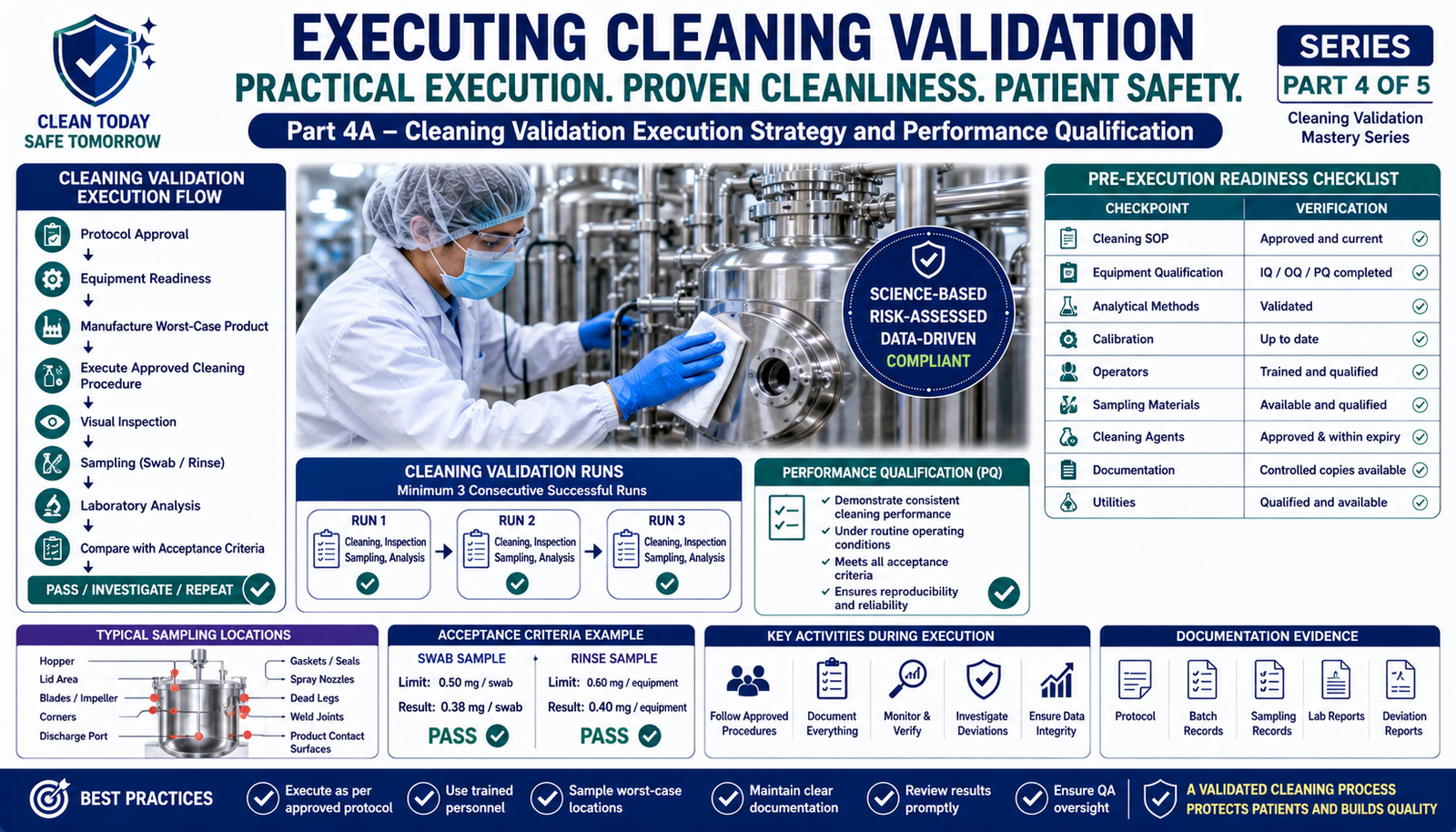
The typical workflow includes:
Protocol Approval
        │
        ▼
Equipment Qualification Review
        │
        ▼
Operator Training Verification
        │
        ▼
Manufacture Worst-Case Product
        │
        ▼
Execute Approved Cleaning Procedure
        │
        ▼
Visual Inspection
        │
        ▼
Swab & Rinse Sampling
        │
        ▼
Laboratory Analysis
        │
        ▼
Compare Results with Acceptance Criteria
        │
        ▼
Pass / Investigate / Repeat
This systematic approach minimizes variability and ensures compliance with regulatory expectations.
Pre-Execution Readiness
Before initiating the first validation run, verify that all supporting systems are ready.
Pre-Execution Checklist
| Item | Verification Required |
|---|---|
| Cleaning SOP | Approved and current |
| Validation Protocol | Approved by QA |
| Equipment Qualification | IQ/OQ/PQ completed |
| Calibration | Instruments within calibration due date |
| Analytical Methods | Validated |
| Sampling Materials | Available and qualified |
| Operators | Trained and qualified |
| Cleaning Agents | Approved and within expiry |
| Utilities | Water, compressed air, steam qualified |
| Documentation | Controlled copies available |
Starting a validation study without confirming readiness can invalidate results and require costly repetition.
Cleaning Validation Runs
What is a Validation Run?
A validation run is one complete cycle consisting of:
- Manufacturing the selected worst-case product.
- Cleaning the equipment using the approved SOP.
- Conducting visual inspection.
- Collecting swab and/or rinse samples.
- Performing laboratory analysis.
- Comparing results against acceptance criteria.
The objective is to demonstrate consistent cleaning performance.
Number of Validation Runs
Industry practice and regulatory expectations generally require three consecutive successful cleaning validation runs performed under routine operating conditions.
These runs should:
- Be independent.
- Represent normal production.
- Use the same approved cleaning procedure.
- Meet all predefined acceptance criteria.
If any run fails, the cause should be investigated before additional studies are conducted.
Factors That Influence Validation Runs
The number and scope of validation runs may depend on:
- Product potency
- Equipment complexity
- Cleaning method (manual or CIP)
- Process risk assessment
- Historical cleaning performance
- Regulatory commitments
Manufacturers should justify their approach using documented scientific rationale.
Performance Qualification (PQ) Runs
Performance Qualification (PQ) demonstrates that the cleaning process consistently performs as intended under actual manufacturing conditions.
During PQ, the following should be evaluated:
- Operator performance
- Cleaning consistency
- Equipment design
- Cleaning time
- Contact time of cleaning agents
- Rinse effectiveness
- Residue removal
- Analytical results
PQ provides evidence that routine production cleaning can reliably achieve validated cleanliness levels.
Typical PQ Acceptance Criteria
| Parameter | Acceptance Requirement |
|---|---|
| Visual Inspection | No visible residue |
| Swab Results | Within established limits |
| Rinse Results | Within established limits |
| Recovery Factor | Validated |
| Analytical Method | Meets validation requirements |
| Documentation | Complete and approved |
| Deviations | None impacting study validity |
All criteria must be satisfied before PQ is considered successful.
Execution Checklist
The following checklist can be used during execution:
| Activity | Status |
|---|---|
| Protocol approved | □ |
| Equipment cleaned according to SOP | □ |
| Cleaning agent verified | □ |
| Visual inspection completed | □ |
| Swab samples collected | □ |
| Rinse samples collected (if applicable) | □ |
| Samples labeled correctly | □ |
| Samples submitted to QC | □ |
| Analytical testing completed | □ |
| Results reviewed | □ |
| Deviations documented | □ |
| QA review completed | □ |
This checklist helps ensure consistency and inspection readiness.
Roles and Responsibilities During Execution
Successful execution requires coordination across multiple departments.
| Department | Responsibilities |
|---|---|
| Production | Perform cleaning according to approved SOPs |
| Validation | Coordinate execution, monitor compliance, collect evidence |
| Quality Assurance (QA) | Witness critical activities, review documentation, approve deviations |
| Quality Control (QC) | Analyze samples using validated methods |
| Engineering | Maintain equipment and utilities |
| Microbiology | Perform microbial testing where required |
Clear communication between departments reduces execution errors and supports timely completion.
Practical Industrial Example
A pharmaceutical company manufactures several oral solid dosage products using a shared tablet compression machine.
Following the risk assessment:
- A highly potent product is selected as the worst-case product.
- The approved cleaning SOP is executed by trained production personnel.
- QA witnesses the cleaning process.
- Validation engineers collect swab samples from punches, dies, feed frame, hopper, and discharge chute.
- QC performs HPLC analysis and all results meet the established acceptance criteria.
- Three consecutive validation runs are successfully completed without deviations.
The validation team concludes that the cleaning procedure is reproducible and suitable for routine manufacturing.
Best Practices for Execution
✔ Execute only approved protocols.
✔ Use trained and qualified personnel.
✔ Perform validation under routine operating conditions.
✔ Follow the cleaning SOP exactly as written.
✔ Collect samples from predefined worst-case locations.
✔ Record all observations in real time.
✔ Investigate deviations immediately.
✔ Ensure QA oversight during critical activities.
✔ Maintain complete traceability for all samples and records.
Summary Table
| Execution Stage | Key Objective |
|---|---|
| Protocol Approval | Ensure study is authorized |
| Equipment Readiness | Confirm qualification and calibration |
| Cleaning Execution | Follow approved SOP |
| Visual Inspection | Verify no visible residue |
| Sampling | Collect representative evidence |
| Laboratory Analysis | Quantify residues accurately |
| PQ Runs | Demonstrate reproducibility |
| Documentation | Create inspection-ready records |
Looking Ahead
Executing a cleaning validation study is only one part of the lifecycle. To maintain compliance, manufacturers must continuously verify that the validated process remains effective throughout routine production.
In Part 4B, we’ll cover:
- Cleaning Validation Report Preparation
- Trending of Cleaning Validation Data
- Continued Process Verification (CPV)
- Revalidation Strategy
- Change Control
- Deviation Management
- CAPA
- Out-of-SSpecification (OOS) and Out-of-Trend (OOT) Handling
- Annual Product Review
- Audit Readiness
- Practical Case Studies
These activities ensure that a validated cleaning process remains effective throughout the equipment lifecycle and continues to meet global GMP expectations.
Continue to Part 4B → Continued Process Verification, Revalidation, and Audit Readiness
About Author
Ramesh Palav is a pharmaceutical manufacturing and quality professional with 20+ years of industry experience across pharmaceutical manufacturing, GMP, validation, qualification, quality systems, regulatory compliance, digital transformation and Pharma 4.0. Through Pharma Manufacturing Hub, he focuses on practical pharmaceutical knowledge, industry readiness, technology, compliance and professional development for students and pharma professionals.
Pingback: Risk Assessment and Acceptance Criteria in Cleaning Validation.