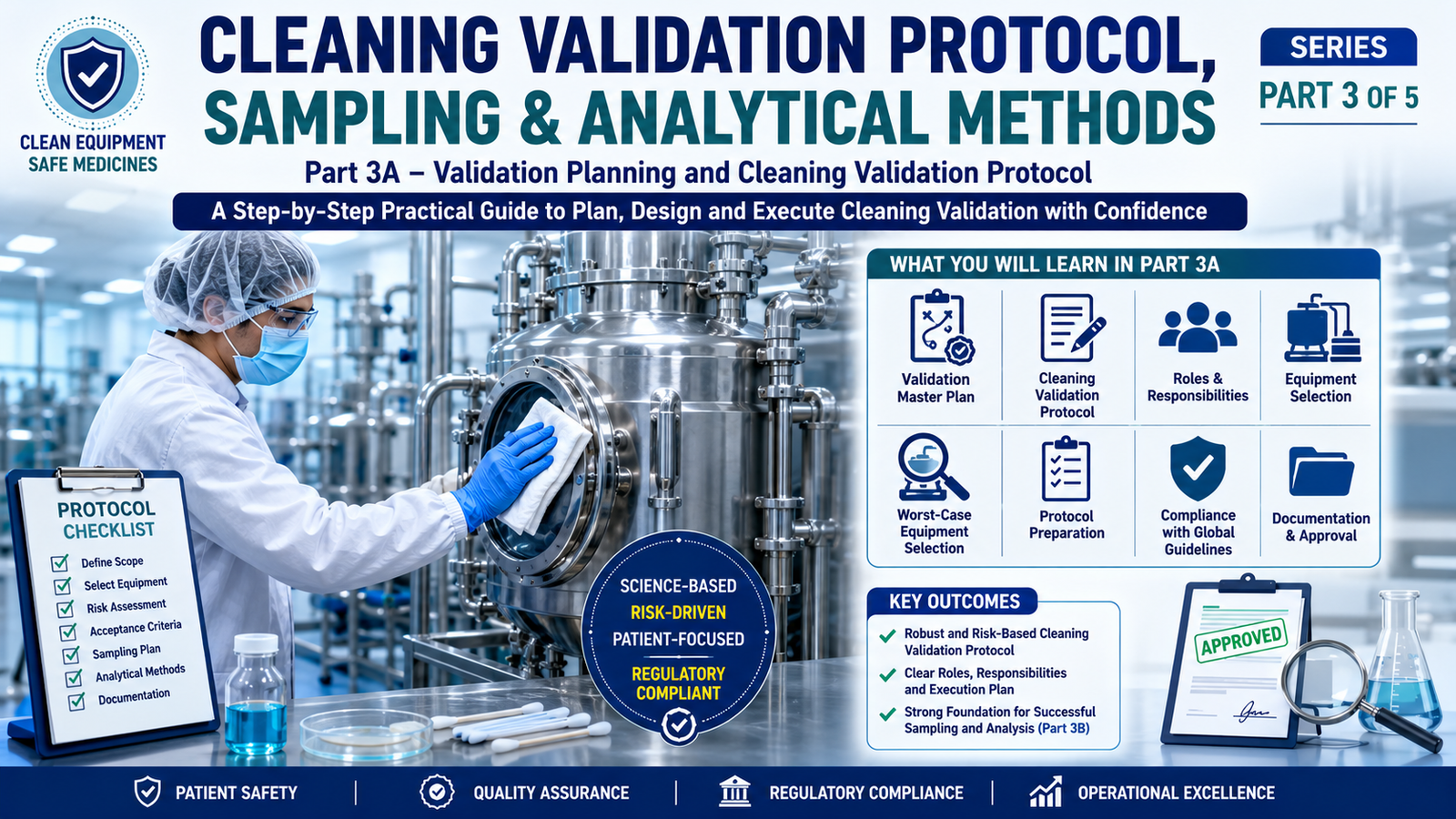
Part 3A – Validation Planning and Cleaning Validation Protocol
Article Series Navigation
← Part 1: Cleaning Validation in Pharmaceutical Manufacturing: Complete Beginner’s Guide
← Part 2: Risk Assessment and Acceptance Criteria in Cleaning Validation
Current: Part 3A – Cleaning Validation Protocol and Planning
Next: Part 3B – Sampling and Analytical Methods
Table of Contents
- Introduction
- From Risk Assessment to Execution
- Validation Master Plan (VMP)
- Cleaning Validation Protocol
- Scope of Cleaning Validation
- Roles and Responsibilities
- Equipment Selection
- Worst-Case Equipment Selection
- Protocol Preparation
- Practical Industrial Example
- Protocol Template
- Best Practices
- Summary Table
- Continue to Part 3B
Introduction
In Part 2, we learned how Quality Risk Management (ICH Q9(R1)), HBEL, PDE, and MACO are used to establish scientifically justified cleaning acceptance criteria.
Once these acceptance limits have been defined, the next step is to plan and document the cleaning validation study.
A well-designed Cleaning Validation Protocol serves as the blueprint for the entire validation exercise. It ensures that every activity—from equipment selection and sampling to analytical testing and documentation—is performed consistently, scientifically, and in compliance with GMP requirements.
Regulatory agencies such as the US FDA, EMA, MHRA, WHO-GMP, and PIC/S expect cleaning validation activities to be planned, approved, executed, and documented according to written procedures. An incomplete or poorly designed protocol can lead to failed validation studies, inspection observations, and costly rework.
This article explains how to develop a robust cleaning validation protocol that aligns with global regulatory expectations and industry best practices.
From Risk Assessment to Execution
Cleaning validation follows a structured lifecycle.
In the previous article, we identified:
- Worst-case products
- Risk ranking
- Acceptance criteria
- MACO
- HBEL
- PDE
These outputs now become inputs for the validation protocol.
The protocol answers essential questions such as:
- Which equipment will be validated?
- Which products will be included?
- Which cleaning procedure will be evaluated?
- Where will samples be collected?
- Which analytical methods will be used?
- What acceptance criteria must be achieved?
- How many successful validation runs are required?
Without a structured protocol, cleaning validation cannot demonstrate reproducibility or regulatory compliance.
Validation Master Plan (VMP)
What is a Validation Master Plan?
A Validation Master Plan (VMP) is a high-level document that defines the overall validation strategy for a pharmaceutical facility.
It provides a roadmap for qualification and validation activities, including:
- Facility Qualification
- Utility Qualification
- Equipment Qualification
- Process Validation
- Cleaning Validation
- Computer System Validation (CSV)
- Analytical Method Validation
The VMP ensures that all validation activities follow a consistent, risk-based, and lifecycle approach.
Cleaning Validation within the VMP
The Cleaning Validation section of the VMP typically includes:
| Section | Description |
|---|---|
| Objective | Purpose of the cleaning validation program |
| Scope | Equipment and products covered |
| Regulatory References | FDA, EMA, WHO, PIC/S, ISPE |
| Risk Assessment Strategy | Worst-case product and equipment selection |
| Acceptance Criteria | HBEL, PDE, MACO-based limits |
| Sampling Strategy | Swab and rinse sampling approach |
| Analytical Methods | HPLC, TOC, Conductivity, Microbiology |
| Revalidation Strategy | Conditions requiring revalidation |
| Documentation | Protocols, reports, deviations, CAPA |
A well-written VMP establishes the foundation for all individual cleaning validation protocols.
Cleaning Validation Protocol
What is a Cleaning Validation Protocol?
A Cleaning Validation Protocol is a controlled document that describes exactly how a cleaning validation study will be performed.
It defines:
- Study objectives
- Equipment to be evaluated
- Cleaning procedures
- Sampling locations
- Acceptance criteria
- Analytical methods
- Responsibilities
- Documentation requirements
The protocol must be approved before any validation activities begin.
Objectives of the Protocol
The protocol should demonstrate that the cleaning process consistently removes:
- Product residues
- Active pharmaceutical ingredients (APIs)
- Cleaning agent residues
- Lubricants
- Microorganisms (where applicable)
- Endotoxins (if required)
- Foreign particles
to scientifically established acceptance limits.
Scope of Cleaning Validation
The protocol should clearly define what is included and excluded from the study.
Typical Scope
- Shared manufacturing equipment
- Product contact surfaces
- Manual cleaning procedures
- Clean-in-Place (CIP) systems
- Equipment changeover
- Product-to-product changeover
- Cleaning agent verification
Out of Scope
- Dedicated equipment (unless specified)
- Non-product contact surfaces
- Building cleaning activities
- Routine housekeeping
A clearly defined scope prevents ambiguity during execution and regulatory inspections.
Roles and Responsibilities
Successful cleaning validation requires collaboration across multiple departments.
| Department | Responsibilities |
|---|---|
| Production | Perform cleaning according to approved SOPs |
| Quality Assurance (QA) | Review and approve protocols, oversee execution, assess deviations |
| Quality Control (QC) | Analyze swab and rinse samples using validated methods |
| Validation | Prepare protocols, coordinate execution, compile reports |
| Engineering | Ensure equipment is qualified and maintained |
| Regulatory Affairs | Verify compliance with global regulatory expectations |
| Microbiology | Conduct microbial monitoring when required |
Clear accountability ensures that each stage of the validation process is properly managed and documented.
Equipment Selection
Not every piece of equipment requires individual cleaning validation.
Equipment selection should be based on a documented risk assessment considering:
- Product contact surfaces
- Shared equipment
- Equipment complexity
- Cleaning difficulty
- Surface finish
- Dead legs and crevices
- Accessibility
- Product retention potential
Equipment Commonly Included
Examples include:
- Rapid Mixer Granulators (RMG)
- Fluid Bed Dryers (FBD)
- Multi Mills
- Cone Mills
- Bin Blenders
- Tablet Compression Machines
- Coating Pans
- Transfer Bins
- IBC Containers
- Sieves
- Product Transfer Lines
Each item should be uniquely identified in the protocol using equipment ID numbers.
Worst-Case Equipment Selection
Just as products are ranked based on risk, equipment should also be assessed to identify the most challenging items to clean.
Typical Evaluation Criteria
| Parameter | Higher Risk |
|---|---|
| Complex geometry | High |
| Large product contact area | High |
| Dead legs | Present |
| Gaskets and seals | Multiple |
| Surface roughness | High |
| Accessibility | Poor |
| Manual cleaning | Required |
| Product retention | Significant |
Equipment with these characteristics generally represents the worst-case cleaning challenge and should be prioritized for validation.
Practical Industrial Example
A pharmaceutical company manufactures multiple tablet formulations using shared oral solid dosage equipment.
Following the risk assessment:
- A tablet press with numerous punches, dies, feed frames, and enclosed surfaces is identified as the most difficult equipment to clean.
- A highly potent, low-solubility oncology product is selected as the worst-case product.
- The cleaning validation protocol specifies three consecutive successful cleaning runs, swab sampling of critical locations, rinse sampling, and HPLC analysis.
This focused approach demonstrates regulatory compliance while minimizing unnecessary validation effort.
Typical Cleaning Validation Protocol Format
A well-structured protocol should include the following sections:
| Section | Description |
|---|---|
| Title | Cleaning Validation Protocol |
| Document Number | Controlled document identifier |
| Objective | Purpose of the study |
| Scope | Equipment, products, and cleaning procedures |
| References | SOPs, VMP, regulatory guidelines |
| Responsibilities | Roles of Production, QA, QC, Validation |
| Equipment Details | IDs, descriptions, product contact surfaces |
| Cleaning Procedure | Approved cleaning SOP reference |
| Sampling Plan | Swab, rinse, and sampling locations |
| Analytical Methods | HPLC, TOC, Conductivity, Microbial tests |
| Acceptance Criteria | HBEL, PDE, MACO-derived limits |
| Deviation Handling | Procedure for unexpected events |
| Approval Section | Signatures from relevant departments |
Best Practices for Protocol Development
✔ Base the protocol on documented risk assessment.
✔ Reference the approved Validation Master Plan.
✔ Use current cleaning SOPs and equipment drawings.
✔ Include scientifically justified acceptance criteria.
✔ Define sampling locations with photographs or diagrams.
✔ Ensure analytical methods are validated before execution.
✔ Specify the number of successful validation runs required.
✔ Obtain approvals from Production, QA, QC, Validation, and Engineering before starting the study.
Summary Table
| Component | Purpose |
|---|---|
| Validation Master Plan | Overall validation strategy |
| Cleaning Validation Protocol | Detailed execution plan |
| Risk Assessment | Scientific basis for study design |
| Equipment Selection | Identify representative equipment |
| Roles & Responsibilities | Define accountability |
| Acceptance Criteria | Establish measurable cleanliness limits |
| Sampling Plan | Ensure representative residue assessment |
| Analytical Methods | Verify residue removal accurately |
Looking Ahead
A robust cleaning validation protocol provides the framework for successful execution, but its effectiveness depends on proper sampling and analytical testing.
In Part 3B, we will explore:
- Swab Sampling Techniques
- Rinse Sampling Methods
- Worst-Case Sampling Locations
- Recovery Studies
- Recovery Factor Calculations
- TOC Testing
- HPLC Analysis
- Conductivity Testing
- Microbial Testing
- Worked Calculation Examples
- Sampling Diagrams
These practical techniques ensure that cleaning validation results are scientifically reliable and acceptable to global regulatory agencies.
Continue to Part 3B → Sampling and Analytical Methods
About Author
Ramesh Palav is a pharmaceutical manufacturing and quality professional with 20+ years of industry experience across pharmaceutical manufacturing, GMP, validation, qualification, quality systems, regulatory compliance, digital transformation and Pharma 4.0. Through Pharma Manufacturing Hub, he focuses on practical pharmaceutical knowledge, industry readiness, technology, compliance and professional development for students and pharma professionals.