Executive Summary
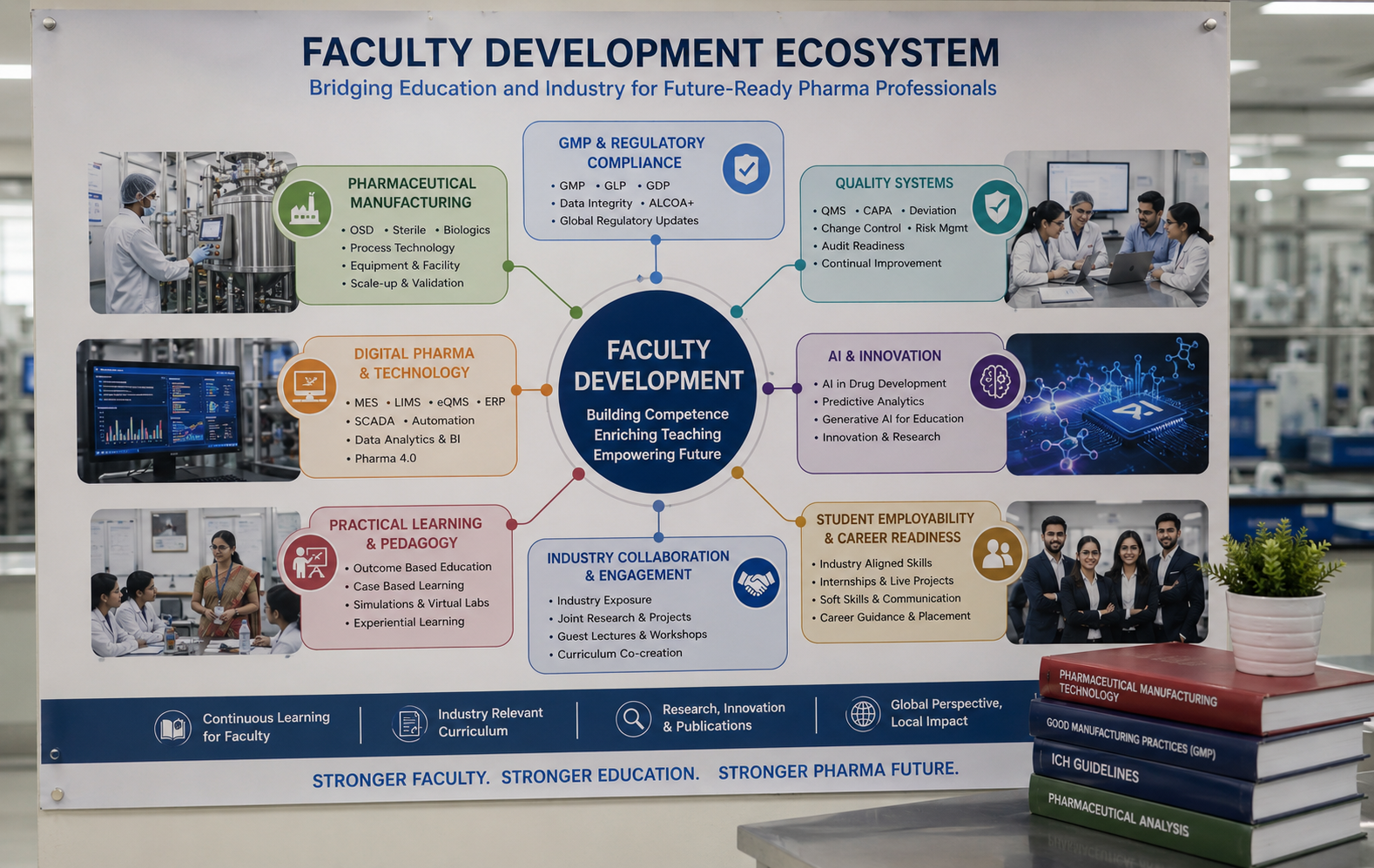
Pharmaceutical education is standing at an important transition point. The pharmaceutical industry is becoming more regulated, digital, automated, data-driven and technology-intensive, while pharmacy education must prepare graduates for workplaces that increasingly involve GMP, quality systems, validation, data integrity, automation, artificial intelligence, advanced manufacturing, regulatory science and multidisciplinary collaboration.
This creates a fundamental question:
Can pharmaceutical education become truly industry-ready if faculty development does not evolve at the same pace as the pharmaceutical industry?
Faculty development is therefore much more than attending conferences, completing refresher courses or accumulating certificates. It should develop the technical, regulatory, digital, pedagogical and industry-facing capabilities required to translate academic knowledge into professional competence.
In India, the Pharmacy Council of India (PCI) maintains education regulations and, as of 2026, its published resources include the B.Pharm syllabus under NEP 2020 as well as guidelines related to Indian Knowledge Systems. The National Education Policy (NEP) 2020 also emphasizes that professional education should include education for practice, critical and interdisciplinary thinking, research and innovation rather than existing in isolation from broader higher education.
The opportunity, therefore, is not simply to update the curriculum. India needs a coordinated ecosystem in which faculty, curriculum, laboratories, industry exposure, technology, assessment and employability evolve together.
A useful strategic equation is:
Industry-Ready Pharmaceutical Education = Industry-Ready Faculty + Relevant Curriculum + Practical Learning + Digital Competence + Regulatory Awareness + Industry Collaboration
1. What is Faculty Development in Pharmaceutical Education?
Faculty development is the continuous process of improving an educator’s:
- Subject knowledge
- Teaching capability
- Practical competence
- Industry awareness
- Regulatory knowledge
- Research capability
- Digital skills
- Leadership capability
- Assessment methods
- Mentoring capability
- Professional network
In pharmaceutical education, however, faculty development needs to go further.
A faculty member teaching pharmaceutical manufacturing, for example, should ideally understand not only the theoretical principles of granulation, compression and coating but also how those processes operate within:
GMP → SOPs → BMR/BPR → Process Parameters → In-process Controls → Yield → OEE → Deviations → CAPA → Validation → Data Integrity → Regulatory Compliance.
Similarly, a faculty member teaching quality assurance should understand the relationship between:
QMS → Deviation → Investigation → Root Cause → CAPA → Change Control → Risk Management → Effectiveness Check → Management Review.
This is the difference between teaching a subject and preparing someone to perform a professional role.
2. Why Faculty Development Matters
A student can memorize the definition of GMP and still be unprepared to work in a GMP environment.
A graduate may know what validation means but have never seen:
- URS
- Risk Assessment
- DQ
- FAT
- SAT
- IQ
- OQ
- PQ
- Validation Protocol
- Traceability Matrix
- Deviation
- Change Control
- Validation Report.
Similarly, a student may know that data integrity means reliable data but not understand the practical implications of:
ALCOA+ → user access → audit trails → electronic records → backup → review → segregation of duties → computerized systems.
FDA’s current CGMP resources emphasize the importance of reliable and accurate data and risk-based approaches to preventing and detecting data-integrity problems.
This demonstrates why faculty development must connect theoretical knowledge with professional application.
3. The Changing Pharmaceutical Industry
The pharmaceutical industry of today is significantly different from the environment in which many existing academic curricula and teaching methods evolved.
Modern pharmaceutical organizations increasingly operate through interconnected systems such as:
ERP + MES + LIMS + eQMS + eDMS + SCADA/HMI + WMS + BI + AI
alongside traditional pharmaceutical technologies.
Manufacturing is also becoming more:
- Automated
- Data-driven
- Integrated
- Risk-based
- Digitized
- Connected
- Analytics-enabled
Quality organizations increasingly depend upon:
- Risk management
- Data integrity
- Process understanding
- Lifecycle management
- Digital quality systems
- Continuous improvement
- Regulatory intelligence
ICH Q10 provides a lifecycle-oriented model for an effective Pharmaceutical Quality System and connects quality management with GMP, pharmaceutical development and quality risk management.
Therefore, faculty development cannot remain limited to conventional subject knowledge.
4. Current Faculty Development: What Is Missing?
Traditional academic development commonly includes:
- PhD and postgraduate education
- Conferences
- Seminars
- Workshops
- Webinars
- Research publications
- FDPs
- Refresher courses
- Online certifications
- Academic technology training
These activities remain valuable.
The problem is that academic development and industry development are not always the same thing.
A faculty member can be academically strong but have limited recent exposure to:
- Pharmaceutical manufacturing
- Regulatory inspections
- Modern QMS
- Digital manufacturing
- Validation lifecycle management
- Industry data systems
- Production challenges
- Current recruitment requirements.
UGC itself describes faculty development as a mechanism for upgrading faculty knowledge and skills, while institutional-development guidance also recognizes training in pedagogy, research methodology and academic technology.
The next step should be to extend this philosophy into industry-relevant professional development.
5. Academic Development vs Industry-Relevant Development
| Academic Development | Industry-Relevant Development |
|---|---|
| Subject knowledge | Application of subject knowledge |
| Research methodology | Industrial problem-solving |
| Publications | Real-world projects |
| Conferences | Industry workshops |
| Theoretical GMP | Practical GMP |
| Validation theory | Qualification/validation lifecycle |
| QA concepts | QMS execution |
| Pharmaceutical machinery | Manufacturing operation |
| Laboratory practicals | GMP laboratory practices |
| Regulatory theory | Regulatory application |
| Computer fundamentals | ERP/MES/LIMS/eQMS exposure |
| Classroom assessment | Competency assessment |
| Academic projects | Industry-sponsored projects |
| Seminar presentation | Professional communication |
| Generic career guidance | Role-specific employability |
| Certificate collection | Demonstrated competency |
The objective should not be to replace academic development with industry training.
It should be:
Academic Excellence + Industrial Competence
6. The Pharmaceutical Faculty Competency Framework
A modern pharmaceutical faculty competency framework can be divided into six major domains.
Domain 1: Pharmaceutical Technical Competence
Faculty should maintain current knowledge in relevant areas such as:
Manufacturing
- OSD
- Sterile products
- Biologics
- Packaging
- Process technology
- Continuous manufacturing
- PAT
- Advanced manufacturing
Analytical Sciences
- Instrumental analysis
- Chromatography
- Stability
- Method development
- Method validation
- Analytical data integrity
The depth should depend upon the faculty member’s discipline.
7. GMP and Regulatory Competence
Faculty should progressively develop practical understanding of:
- GMP
- GLP
- GDP
- ICH
- WHO GMP
- US FDA expectations
- EMA expectations
- PIC/S
- Indian regulatory requirements
- Data Integrity
- ALCOA+
- Risk Management
- Pharmaceutical Quality Systems
This does not mean every faculty member needs to become a regulatory-affairs specialist.
It means educators should understand the regulatory environment sufficiently to teach students how their academic knowledge translates into compliant professional practice.
WHO’s competency frameworks illustrate the broader value of competency-based approaches that define knowledge, skills and behaviours required for professional practice.
8. Quality Systems Competence
Faculty involved in industrial pharmacy, QA, regulatory science and related disciplines should understand practical quality systems.
Important topics include:
- Deviation Management
- CAPA
- Change Control
- FMEA
- Risk Assessment
- Root Cause Analysis
- Audit Management
- Supplier Qualification
- Validation
- Qualification
- Process Validation
- Cleaning Validation
- Computer System Validation
- Annual Product Quality Review
- Quality Risk Management
For example, instead of asking students:
“Define CAPA.”
Faculty can present:
“A tablet batch shows recurring compression defects. The same problem has appeared in three consecutive batches. How would you investigate it?”
Students then learn to move from:
Problem → Evidence → Investigation → Root Cause → CAPA → Effectiveness Check
That is competency-based education.
9. Digital Competence: The Missing Layer
The future pharmaceutical educator cannot remain digitally passive.
Faculty development should progressively introduce:
- ERP/SAP
- MES
- LIMS
- eQMS
- eDMS
- SCADA/HMI
- Data analytics
- Power BI or equivalent tools
- AI
- Machine Learning
- Digital Twins
- Automation
- Electronic Batch Records
- Computer System Validation
- Data Integrity
The faculty member does not necessarily need to become a programmer.
Instead, they should understand:
What the technology does → why industry uses it → what risks it creates → what controls are required → what competencies students need.
10. Pedagogical Competence
Technical knowledge alone does not make someone an effective educator.
Faculty development should include:
- Outcome-Based Education
- Competency-Based Education
- Active learning
- Case-based learning
- Problem-based learning
- Simulation
- Project-based learning
- Experiential learning
- Peer learning
- Digital learning
- Competency assessment
WHO’s competency-based education approach emphasizes connecting learning outcomes to the ability to integrate and apply knowledge, skills and attitudes in practice.
This principle is highly relevant to pharmaceutical education.
11. From “Teaching” to “Demonstrating Competence”
Consider two approaches.
Traditional approach
Teacher explains:
“Deviation is a departure from an approved procedure or expected result.”
Student memorizes the definition.
Competency-based approach
The faculty provides:
A manufacturing batch has failed an in-process test.
Students must:
- Identify the deviation.
- Collect evidence.
- Determine immediate actions.
- Conduct a preliminary risk assessment.
- Perform root-cause analysis.
- Propose CAPA.
- Determine effectiveness checks.
- Assess whether change control is required.
- Present the investigation to a mock QA review committee.
The second approach develops professional thinking.
12. The Industry–Academia Gap
The central challenge can be represented as:
Classroom
↓
Laboratory
↓
Industrial Internship
↓
Manufacturing/QA/QC/RA Workplace
There can be a substantial transition between these stages.
| Academic Exposure | Industry Expectation |
|---|---|
| GMP theory | Practical GMP implementation |
| Validation definitions | Validation documentation and execution |
| QA concepts | QMS operation |
| Manufacturing theory | Shop-floor decision-making |
| SOP knowledge | SOP drafting, review and execution |
| Laboratory practicals | GMP laboratory practices |
| Computer fundamentals | Enterprise and laboratory systems |
| Regulatory theory | Regulatory compliance |
| Project report | Problem-solving and data interpretation |
| Presentation | Professional communication |
| Chemistry knowledge | Application to product/process quality |
| Pharmacy calculations | Manufacturing and analytical application |
| Internship observation | Demonstrated practical competence |
| Final-year project | Evidence-based problem solving |
The answer is not to remove theory.
The answer is to connect theory with practice.
13. Faculty Industry Exposure Model
One of the strongest mechanisms for closing this gap is structured industry exposure.
Level 1: Industrial Visits
Short visits should expose faculty to:
- Manufacturing
- QA
- QC
- Warehouse
- Engineering
- Utilities
- Packaging
- Documentation
- Regulatory systems
Level 2: Industry Immersion
A structured 1–2 week program can cover:
Day 1: GMP and site orientation
Day 2: Manufacturing
Day 3: QA/QMS
Day 4: QC
Day 5: Engineering/utilities
Day 6: Validation
Day 7: Digital systems
Day 8: Regulatory compliance
Day 9: Case studies
Day 10: Faculty-industry curriculum workshop
Level 3: Industry Projects
Faculty can participate in controlled projects such as:
- Process improvement
- Training effectiveness
- Documentation improvement
- GMP gap assessment
- Digitalization assessment
- Data analytics
- QMS improvement
Confidential company information must, of course, remain protected.
Level 4: Industry Fellowship
Selected faculty could undertake longer assignments or sabbatical-style industry exposure.
14. Faculty–Industry–Student Triangle
A powerful model is:
FACULTY
↙︎ ↘︎
INDUSTRY ↔ STUDENT
Instead of students receiving industry exposure only during internships, industry professionals can participate throughout the academic journey.
For example:
Semester 1: Industry orientation
Semester 2: Manufacturing case study
Semester 3: QA/QC case study
Semester 4: Regulatory case
Semester 5: Industry project
Semester 6: Digital pharma project
Semester 7: Internship
Semester 8: Industry problem-solving project
Faculty become the bridge connecting these experiences.
15. Faculty 4.0
The concept of Faculty 4.0 can provide a useful future-oriented framework.
Faculty Evolution
Teacher
↓
Educator
↓
Mentor
↓
Industry Facilitator
↓
Digital Educator
↓
Innovation Leader
A Faculty 4.0 professional should combine:
- Subject expertise
- Industry awareness
- Regulatory intelligence
- Digital literacy
- AI literacy
- Pedagogical capability
- Research
- Innovation
- Mentoring
- Professional networking
The goal is not to make every faculty member an industry executive.
It is to ensure that faculty understand the professional ecosystem in which their graduates will work.
16. AI in Faculty Development
Artificial intelligence can become a major faculty-development tool.
AI can support:
- Lesson-plan development
- Case-study generation
- Question-bank development
- Assessment design
- Personalized learning
- Simulation scenarios
- Research assistance
- Literature analysis
- Curriculum mapping
- Competency-gap analysis
- Student-performance analysis
- Industry trend monitoring
For example, faculty can ask AI to create a simulated investigation:
“Generate a realistic tablet manufacturing deviation involving weight variation, with batch data, investigation evidence and possible root causes.”
The faculty then validates and adapts the scenario before using it.
But AI Requires Governance
Faculty must understand:
- Hallucination
- Bias
- Data privacy
- Intellectual property
- Academic integrity
- Confidential information
- Verification of AI-generated content
AI should therefore be treated as:
Faculty augmentation—not faculty replacement.
17. Faculty Regulatory Intelligence Program
Institutions should consider establishing a structured Faculty Regulatory Intelligence Program (FRIP).
The program could include a monthly regulatory review.
Example
January: GMP developments
February: Data Integrity
March: Validation
April: QMS
May: FDA developments
June: ICH updates
July: Digital systems
August: Audit observations
September: Manufacturing technology
October: Regulatory case studies
November: AI and pharmaceutical regulation
December: Annual regulatory review
Faculty should then convert important developments into:
Lecture → Case Study → Student Assignment → Assessment Question
This creates a continuous connection between regulatory intelligence and classroom learning.
18. A 12-Month Faculty Development Roadmap
| Month | Development Activity | Competency | Industry Role | Assessment |
|---|---|---|---|---|
| 1 | Faculty competency assessment | Baseline | Industry/academic panel | Gap assessment |
| 2 | GMP refresher | GMP | QA professional | Case study |
| 3 | Manufacturing immersion | Technical | Production | Practical assignment |
| 4 | QMS workshop | Quality | QA | Deviation exercise |
| 5 | Validation | Qualification/validation | Validation expert | Protocol exercise |
| 6 | Regulatory intelligence | Regulatory | RA/QA | Regulatory review |
| 7 | Digital pharma | Digital | IT/MES/LIMS | Digital case |
| 8 | Data Integrity | Compliance | QA/CSV | Audit-trail case |
| 9 | AI in education | AI | Digital expert | AI teaching project |
| 10 | Modern pedagogy | Teaching | Academic expert | Demonstration class |
| 11 | Employability | Career | HR/industry | Student competency map |
| 12 | Capstone | Integration | Industry panel | Final assessment |
The key is that the program should produce evidence of competency, not merely certificates.
19. Industry-Ready Faculty Development Centre
Each major pharmacy institution could eventually establish an:
Industry-Ready Faculty Development Centre (IFDC)
Core functions
1. Faculty Competency Assessment
Identify individual gaps.
2. Industry Partnerships
Develop relationships with pharmaceutical companies.
3. Training
Deliver technical and pedagogical programs.
4. Industry Immersion
Facilitate faculty exposure.
5. Curriculum Review
Bring industry requirements into academic planning.
6. Digital Learning
Create simulations, case studies and virtual laboratories.
7. Regulatory Intelligence
Track relevant changes.
8. Employability
Map academic outcomes to job competencies.
20. Faculty Development KPIs
Institutions should stop measuring success solely by:
“How many faculty attended FDPs?”
Better KPIs include:
Faculty KPIs
- Industry exposure hours
- Technical training completion
- Regulatory training completion
- Digital competency score
- Pedagogical competency score
- Industry projects
- Updated teaching materials
- Case studies developed
- Industry sessions delivered
Student KPIs
- Competency assessment
- Internship performance
- Placement rate
- Employer satisfaction
- Industry project performance
- Interview readiness
- Practical skills
Institutional KPIs
- Industry collaborations
- Joint projects
- Curriculum reviews
- Industry-led teaching sessions
- Faculty-industry programs
- Student-industry interaction
The ultimate KPI should be:
Are graduates becoming more capable of performing professional roles?
21. Faculty Development Maturity Model
| Level | Faculty Type | Characteristics |
|---|---|---|
| Level 1 | Traditional Faculty | Primarily theory-focused |
| Level 2 | Academically Updated | Current subject and pedagogical knowledge |
| Level 3 | Industry-Aware | Understands current industry practices |
| Level 4 | Industry-Integrated | Regular industry collaboration and practical teaching |
| Level 5 | Faculty 4.0 | Industry + digital + AI + regulatory + innovation capability |
The objective should be to move institutions progressively toward Levels 4 and 5.
Not every faculty member needs identical competencies. The model should be role-based.
22. Ideal Faculty Development Program
A comprehensive program could be structured around eight modules.
Module 1 — Pharmaceutical Industry
- Industry structure
- Manufacturing
- QA/QC
- Regulatory affairs
- Supply chain
Module 2 — GMP and Quality
- GMP
- QMS
- CAPA
- Deviations
- Risk Management
- Data Integrity
Module 3 — Manufacturing
- OSD
- Sterile
- Biologics
- Packaging
- Process validation
Module 4 — Validation and Compliance
- URS
- DQ
- IQ/OQ/PQ
- CSV
- Cleaning validation
- Process validation
Module 5 — Digital Pharma
- ERP
- MES
- LIMS
- eQMS
- SCADA
- Data analytics
- Pharma 4.0
Module 6 — AI
- Generative AI
- AI-assisted teaching
- AI assessment
- Research
- AI governance
Module 7 — Modern Pedagogy
- Case-based learning
- Problem-based learning
- Simulation
- Competency assessment
Module 8 — Employability
- Industry roles
- Skills mapping
- Interview preparation
- Communication
- Leadership
- Professional behaviour
23. Realistic Case Study 1: GMP Teaching
Problem
A faculty member teaches GMP primarily through definitions and textbook examples.
Intervention
An industry QA professional provides anonymized examples of:
- Deviations
- CAPA
- Audit observations
- Documentation errors
- Data-integrity risks
Implementation
Students analyse the cases and present corrective actions.
Outcome
The learning shifts from:
“What is GMP?”
to:
“How do I behave in a GMP environment?”
Lesson
Practical context dramatically improves the value of theoretical knowledge.
24. Case Study 2: Industry–Academia Manufacturing Partnership
Problem
Students understand tablet manufacturing theoretically but have limited exposure to industrial operations.
Intervention
A manufacturing organization collaborates with a pharmacy institution.
Implementation
Faculty receive structured plant exposure and subsequently develop case-based teaching material.
Outcome
Students learn:
Granulation → Compression → Coating → IPC → Yield → Documentation → Deviation → QA Release
rather than studying each topic independently.
Lesson
Faculty industry exposure can indirectly multiply its value by improving the learning experience of hundreds of students.
25. Case Study 3: AI-Enabled Faculty Development
Problem
Faculty have limited time to develop customized case studies.
Intervention
Faculty are trained to use AI responsibly.
Implementation
AI assists in generating:
- Manufacturing scenarios
- Regulatory cases
- Assessment questions
- Simulation exercises
Faculty validate every output against authoritative sources.
Outcome
Teaching becomes more personalized and scenario-based.
Lesson
The value of AI depends on faculty judgment and subject expertise.
26. Case Study 4: Industry Participation in Curriculum Review
Problem
Academic curriculum updates may not always capture every emerging industry competency quickly enough.
Intervention
An Industry Advisory Board is established.
Participants
- Production
- QA
- QC
- Regulatory
- Engineering
- Digital/IT
- HR
- Academia
Outcome
The institution periodically maps:
Curriculum → Competency → Industry Requirement → Employability
Lesson
Curriculum development should become a continuous dialogue rather than an occasional event.
27. Major Challenges
Faculty development will not succeed simply because a framework has been designed.
Several barriers must be acknowledged.
Faculty workload
Faculty already balance:
- Teaching
- Research
- Administration
- Examination
- Student mentoring
Solution: protected professional-development time.
Funding
Industry immersion and advanced training require resources.
Solution: institutional-industry partnerships and shared training models.
Industry confidentiality
Companies cannot expose sensitive information.
Solution: anonymized cases and controlled learning environments.
Resistance to change
Some educators may be comfortable with established teaching approaches.
Solution: demonstrate measurable benefits rather than imposing technology.
Rapid technology changes
AI and digital technologies evolve faster than academic curriculum cycles.
Solution: annual competency review rather than five-year-only review.
Unequal institutional resources
Not every college has access to major pharmaceutical companies.
Solution: shared digital platforms, virtual industry sessions, regional industry networks and consortium-based training.
28. What Should Regulators and Academic Bodies Do?
The objective should not be to create additional paperwork.
Instead, regulators and academic bodies can encourage:
- Competency-based faculty development
- Industry engagement
- Continuous professional development
- Outcome-based education
- Industry participation in curriculum review
- Digital competency
- Practical learning
- Faculty-industry projects
- Periodic competency assessment
Importantly, these should be distinguished from existing regulatory requirements unless formally established as such.
PCI’s current public resources show an evolving regulatory and curricular environment, including Education Regulations 2020 and a B.Pharm syllabus identified by PCI as 2026 and aligned with NEP 2020.
That evolution makes continuous faculty updating increasingly important.
29. Recommendations for Different Stakeholders
Government and Regulators
- Encourage competency-based faculty development.
- Support industry-academia programs.
- Promote digital and AI literacy.
- Encourage measurable professional development.
- Facilitate national competency frameworks.
Pharmacy Institutions
- Establish Faculty 4.0 development plans.
- Conduct annual competency assessments.
- Build pharmaceutical-industry partnerships.
- Introduce faculty industry immersion.
- Develop industry case libraries.
Faculty Members
- Maintain continuous professional development.
- Seek industry exposure.
- Learn digital tools.
- Follow regulatory developments.
- Develop practical case studies.
- Build industry networks.
Pharmaceutical Companies
- Open structured faculty-industry programs.
- Provide subject-matter experts.
- Support anonymized case studies.
- Participate in curriculum review.
- Provide industry projects.
Students
Students should actively seek:
- Internships
- Projects
- Industry certifications
- GMP knowledge
- Digital skills
- Communication skills
- Problem-solving capability
Professional Associations
They can provide:
- Faculty certification
- Technical workshops
- Industry networking
- Regulatory updates
- Competency frameworks
- Continuing professional development
30. Faculty Development Should Be Continuous
A common mistake is treating faculty development as an event.
For example:
Two-day FDP → Certificate → Completed
This is not enough.
A better model is:
Assess → Train → Apply → Demonstrate → Review → Improve → Reassess
This creates a continuous improvement loop.
It mirrors the philosophy of pharmaceutical quality systems themselves.
31. The Future Faculty
Over the next 5–10 years, pharmaceutical educators will increasingly need knowledge of:
- AI
- Automation
- Digital manufacturing
- Advanced analytics
- Smart laboratories
- Digital quality
- Continuous manufacturing
- Biologics
- Personalized medicine
- Advanced therapies
- Digital twins
- Regulatory technology
- Cybersecurity
- Data governance
But technology will not eliminate the need for educators.
Instead, it will increase the importance of educators who can:
Interpret → Validate → Explain → Mentor → Challenge → Apply
The future faculty member will therefore be less like a textbook instructor and more like a knowledge orchestrate and professional mentor.
32. A New Model for Pharmaceutical Education
The future model should look like this:
Traditional Model
Curriculum → Classroom → Examination → Degree
Future Model
Industry Needs
↓
Competency Framework
↓
Faculty Development
↓
Curriculum
↓
Practical Learning
↓
Industry Exposure
↓
Competency Assessment
↓
Employability
↓
Industry Feedback
↓
Curriculum & Faculty Improvement
This creates a closed-loop education system.
33. The Strategic Equation
A modern pharmaceutical education system should recognize:
Curriculum alone is not enough.
If the curriculum is modern but faculty are not adequately prepared to deliver it, implementation becomes superficial.
Similarly:
Faculty development alone is not enough.
If faculty receive industry training but the curriculum, laboratory infrastructure and assessment system remain unchanged, the impact will be limited.
Therefore:
Curriculum + Faculty + Infrastructure + Industry + Technology + Assessment must evolve together.
34. Conclusion: Build Industry-Ready Faculty Before Expecting Industry-Ready Graduates
The pharmaceutical industry does not simply need graduates who know pharmaceutical science.
It needs professionals who can:
- Think critically
- Work within GMP
- Understand quality
- Follow procedures
- Investigate problems
- Interpret data
- Use technology
- Communicate professionally
- Understand regulatory expectations
- Work across functions
- Continuously learn
Faculty are the most important bridge between academic knowledge and these capabilities.
India has an established regulatory and higher-education framework for pharmacy education, while NEP 2020 explicitly places importance on professional education being connected to practice, critical thinking, research and innovation.
The next step is to make faculty development more deliberately industry-connected.
The goal should not be to turn every professor into an industrial practitioner.
The goal is to create educators who understand enough of the real pharmaceutical environment to answer the student’s most important question:
“How will I actually use what I am learning when I enter the pharmaceutical industry?”
That is the real test of industry-ready education.
And the transformation can be summarized simply:
If we want industry-ready pharmacy graduates, we must first build industry-ready faculty.
Faculty development should therefore be treated not as an annual academic activity, but as a continuous pharmaceutical workforce-development ecosystem connecting education, industry, technology, regulation, research and employability.
Suggested Authoritative External References
- Pharmacy Council of India — Education Regulations
- Pharmacy Council of India — Regulations and Syllabus Resources
- National Education Policy 2020 — Government of India
- WHO Global Competency Framework for Regulators of Medicines
- ICH Q10 Pharmaceutical Quality System
- FDA Data Integrity and CGMP Guidance
FAQs
1. What is faculty development in pharmaceutical education?
It is the continuous development of faculty knowledge, teaching capability, industry awareness, regulatory understanding, digital competence and professional skills required to prepare pharmacy students for practice.
2. Why is faculty development important in pharmacy education?
Because pharmaceutical industry requirements continuously change. Faculty must remain current if students are expected to graduate with relevant technical, regulatory, digital and professional competencies.
3. How can pharmacy faculty gain industry experience?
Through structured industry visits, short-term immersion programs, industry projects, fellowships, guest lectures, joint research, curriculum-development partnerships and industry mentoring.
4. What skills should pharmaceutical faculty develop?
Technical pharmaceutical knowledge, GMP, quality systems, regulatory awareness, digital pharma, AI literacy, modern pedagogy, assessment, communication, research and employability-focused mentoring.
5. How can pharmaceutical companies support faculty development?
Companies can provide subject-matter experts, plant exposure, anonymized case studies, industry projects, guest lectures, curriculum feedback and structured faculty-industry programs.
6. What is Faculty 4.0?
Faculty 4.0 is a proposed future-oriented model in which educators combine subject expertise with industry exposure, digital capability, AI literacy, regulatory knowledge, modern pedagogy and innovation.
7. How can AI be used in faculty development?
AI can support lesson planning, case-study development, assessment creation, research, personalized learning, curriculum mapping and simulation. Faculty must validate AI outputs before using them.
8. How often should pharmacy faculty receive industry exposure?
There is no universal frequency that should be presented as a regulatory requirement. As an institutional recommendation, annual industry engagement combined with periodic deeper immersion can provide a practical continuous-development model.
9. How can faculty make pharmacy education more industry-oriented?
By using industry case studies, simulations, real-world problem-solving, industry experts, practical assignments, plant exposure, regulatory examples and competency-based assessments.
10. How should institutions measure faculty-development effectiveness?
Measure not only participation or certificates but also competency improvement, industry engagement, teaching effectiveness, updated courses, student performance, internship outcomes and employer feedback.
About Author
Ramesh Palav is a pharmaceutical manufacturing and quality professional with 20+ years of industry experience across pharmaceutical manufacturing, GMP, validation, qualification, quality systems, regulatory compliance, digital transformation and Pharma 4.0. Through Pharma Manufacturing Hub, he focuses on practical pharmaceutical knowledge, industry readiness, technology, compliance and professional development for students and pharma professionals.
Published on: 20/08/2026