
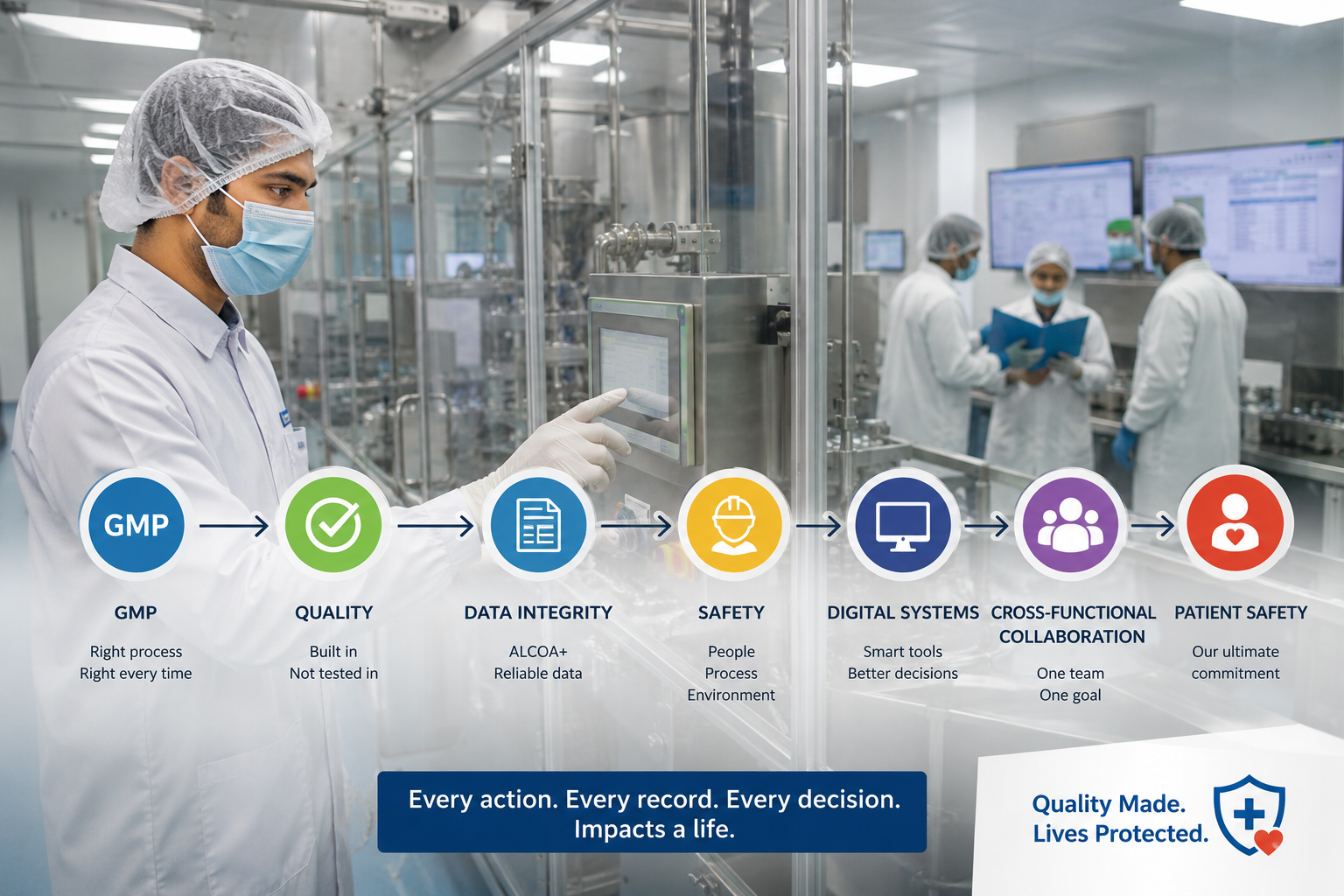
Introduction
Entering the pharmaceutical industry is very different from entering many other manufacturing or service industries.
In pharmaceuticals, an employee’s actions can influence much more than productivity or operational efficiency. A documentation error, incorrect process decision, equipment failure, data-integrity issue, laboratory mistake or failure to follow an approved procedure can potentially affect product quality, regulatory compliance and, ultimately, patient safety.
The World Health Organization (WHO) describes Good Manufacturing Practices (GMP) as a component of quality assurance intended to ensure that medicinal products are consistently produced and controlled according to appropriate quality standards. GMP covers production, quality control, documentation, validation, personnel, premises, equipment and other elements that can influence product quality.
This is why pharmaceutical organizations need professionals who possess more than technical knowledge.
A successful pharmaceutical professional needs:
Functional expertise + GMP mindset + quality consciousness + systems thinking + professional integrity + continuous learning
Technical knowledge may teach an employee how to perform a task. Industry maturity teaches them why the task matters, what could go wrong, and how their actions affect the larger pharmaceutical quality system.
Why is the Pharmaceutical Industry Different?
A useful way to understand pharmaceutical operations is:
Employee Action → Process → Product Quality → Patient Safety
Consider a simple example.
An operator records a process parameter incorrectly. The error may initially appear to be a documentation problem. However, if the incorrect record hides a process deviation, the issue can potentially affect batch assessment, investigation, product disposition and regulatory compliance.
Similarly:
Incorrect laboratory data → Wrong interpretation → Incorrect quality decision → Potential product-quality risk
This interconnected nature of pharmaceutical operations is why GMP is not simply a collection of procedures.
WHO emphasizes that GMP is intended to reduce risks inherent in pharmaceutical production, including contamination, mix-ups and incorrect labelling, and that quality must be built into manufacturing rather than relying only on final-product testing.
For a new employee, therefore, the first lesson should be:
Never think of your job as an isolated activity. Understand where your work fits into the complete product and quality lifecycle.
1. GMP is a Culture, Not Just a Set of Rules
One of the first concepts every new pharmaceutical employee should understand is GMP culture.
It is easy to think of GMP as:
- SOPs
- Checklists
- Training
- Audits
- Documentation
- Inspections
But GMP is much more than compliance paperwork.
A strong GMP culture means employees consistently make decisions that protect quality, safety, integrity and compliance, even when nobody is watching.
What Does GMP Culture Look Like?
A GMP-oriented employee:
- Follows approved procedures.
- Records information at the time the activity occurs.
- Reports abnormalities promptly.
- Does not hide mistakes.
- Does not bypass controls for convenience.
- Uses only approved and current documents.
- Understands the reason behind critical controls.
- Escalates potential quality risks.
- Takes responsibility for their work.
- Treats quality as everyone’s responsibility.
WHO’s GMP framework links quality management, GMP, quality control and quality risk management, emphasizing their interrelationship and the need for competent personnel.
A Practical Example
Suppose a production operator notices an unusual machine vibration during compression.
A weak response might be:
“The machine is still running, so I will complete the batch.”
A GMP-oriented response is:
“The equipment condition is abnormal. I need to follow the applicable procedure, inform the responsible function and ensure the potential product impact is assessed.”
The second response demonstrates quality ownership.
2. Good Documentation Practices: If You Do It, Record It Correctly
One of the most important skills required for pharmaceutical industry professionals is Good Documentation Practice (GDP).
Pharmaceutical documentation provides evidence of what happened, when it happened, who performed it and, where applicable, what decisions were made.
A useful principle is:
If an activity affects GMP, the record should accurately reflect what actually happened.
Good documentation requires attention to:
- Accuracy
- Legibility
- Traceability
- Timeliness
- Completeness
- Controlled forms
- Appropriate corrections
- Review and approval
- Electronic records
- Audit trails
The statement often heard in pharmaceutical organizations—
“If it is not documented correctly, it may be considered not done.”
—is therefore more than a slogan. Documentation is an important part of demonstrating that processes were performed according to approved requirements.
New employees should learn to avoid:
- Backdating entries
- Recording activities from memory when contemporaneous recording is required
- Using unofficial notebooks for GMP records
- Leaving unexplained blanks
- Using obsolete forms
- Making unclear corrections
- Recording information on behalf of another person
- Destroying or hiding original records
3. Data Integrity and ALCOA+
Data integrity has become one of the most important pharmaceutical industry skills in both traditional and digital environments.
FDA defines data integrity in its drug CGMP guidance in terms of the completeness, consistency and accuracy of data and identifies the ALCOA characteristics of being attributable, legible, contemporaneously recorded, original or a true copy, and accurate. FDA also expects firms to use meaningful, risk-based strategies to prevent and detect data-integrity issues.
The commonly used expanded ALCOA+ principles are:
| Principle | Practical Meaning |
|---|---|
| Attributable | It should be clear who performed the activity or generated the data. |
| Legible | The information should remain readable and understandable. |
| Contemporaneous | Data should be recorded when the activity occurs. |
| Original | The original record or an appropriate true copy should be maintained. |
| Accurate | Information must reflect what actually occurred. |
| Complete | Relevant data should not be selectively omitted. |
| Consistent | Data should follow logical and chronological expectations. |
| Enduring | Records should remain available throughout their required retention period. |
| Available | Authorized personnel should be able to retrieve the information when required. |
Data integrity applies to:
- Batch records
- Laboratory results
- Equipment logs
- SCADA/HMI systems
- LIMS
- MES
- ERP
- Electronic batch records
- Audit trails
- Electronic signatures
- Training records
- Validation documents
It is not only a responsibility of the QA or IT department.
Every person who creates, modifies, reviews, approves or uses GMP data has a role in maintaining its integrity.
4. Safety Comes Before Productivity
A pharmaceutical professional must understand that production targets never justify unsafe practices.
Safety includes:
- Personnel safety
- Chemical safety
- Equipment safety
- Electrical safety
- Process safety
- Ergonomics
- Environmental protection
- Emergency response
- Material handling
- Fire safety
A mature organization does not ask employees to choose between safety and productivity.
Instead, it asks:
How can we achieve the business objective safely, compliantly and sustainably?
New employees should be encouraged to stop and escalate when they encounter an unsafe condition.
This is particularly important in manufacturing environments involving:
- High-speed equipment
- Powders
- Solvents
- Pressurized systems
- Electrical equipment
- HVAC systems
- Cleaning chemicals
- Moving machinery
- Thermal processes
5. Understand the Pharmaceutical Quality System
A new professional should not view QA as the department that “checks production.”
Modern pharmaceutical quality systems are interconnected.
They may include:
- Deviations
- CAPA
- Change Control
- OOS
- OOT
- Risk Management
- FMEA
- Root Cause Analysis
- Training
- Document Control
- Internal Audits
- Supplier Management
- Complaints
- Product Quality Review/APQR
- Management Review
- Validation and qualification
These systems interact with one another.
For example:
Deviation → Investigation → Root Cause → CAPA → Change Control → Training → Effectiveness Check → Trend Review
Understanding this chain gives a new employee a much stronger perspective than simply knowing the definitions of individual quality systems.
6. Cross-Functional Collaboration is Essential
Modern pharmaceutical manufacturing cannot function through departmental silos.
Consider a recurring compression-machine problem.
A mature cross-functional approach could look like this:
Production identifies the issue
↓
Engineering investigates equipment performance
↓
QA evaluates GMP and product-quality impact
↓
Validation evaluates whether the validated state could be affected
↓
QC evaluates relevant analytical or product-quality implications
↓
Supply Chain assesses potential supply impact
↓
Management evaluates operational and business implications
This is systems thinking in practice.
The objective is not to determine:
“Which department caused the problem?”
The better question is:
“What happened, why did it happen, what is the impact, and what must we do to prevent recurrence?”
7. Develop Risk-Based Thinking
Pharmaceutical professionals should learn to think in terms of risk.
Instead of asking only:
“Is this procedure being followed?”
also ask:
“What could happen if this control fails?”
Useful questions include:
- What can go wrong?
- What could be the impact?
- How severe could that impact be?
- How likely is it?
- How detectable is it?
- What controls currently exist?
- Are additional controls required?
ICH Q9(R1) provides a structured framework for Quality Risk Management, including risk assessment, risk control, risk communication and risk review. It also identifies tools such as FMEA, Fault Tree Analysis and HACCP among possible risk-management methodologies.
Risk-based thinking is useful in:
- Manufacturing
- Validation
- Equipment qualification
- Cleaning
- Computerized systems
- Data integrity
- Laboratory operations
- Change control
- Deviations
- Supplier qualification
- Process improvement
8. Learn to Solve Problems—Not Just Fix Symptoms
One of the biggest differences between an inexperienced employee and an experienced professional is their approach to problems.
An inexperienced approach often asks:
“How can I get this problem fixed quickly?”
An experienced approach asks:
“Why did this happen, and how can we prevent it from happening again?”
Useful problem-solving tools include:
5 Why
Repeatedly asking “Why?” helps move from symptom toward potential root cause.
Fishbone/Ishikawa
Useful categories may include:
- Man
- Machine
- Method
- Material
- Measurement
- Environment
Pareto Analysis
Helps identify the relatively small number of causes contributing to a large proportion of problems.
Trend Analysis
Helps identify recurring or emerging patterns.
Fault Tree Analysis
Can help analyze how combinations of failures may lead to an undesired event.
CAPA Effectiveness
Closing a CAPA is not the same as demonstrating that the corrective and preventive actions actually worked.
The goal should be:
Problem → Evidence → Root Cause → Corrective Action → Preventive Action → Effectiveness → Sustainable Improvement
9. Understand Regulatory Expectations
A new pharmaceutical professional does not need to become a regulatory-affairs specialist on day one.
However, they should understand the regulatory environment in which their organization operates.
Depending on the market and product, this may include:
- WHO GMP
- US FDA CGMP
- EU GMP
- PIC/S
- ICH guidelines
- 21 CFR Part 11
- EU GMP Annex 11
- Applicable national regulatory requirements
The important point is not memorizing regulatory clauses.
It is understanding how regulatory expectations translate into everyday behavior.
For example:
Regulatory expectation → Company procedure → Employee action → Documentation → Evidence of compliance
WHO’s current pharmaceutical quality-assurance resources cover areas ranging from development and manufacturing through quality control and post-marketing surveillance.
10. Professional Ethics: The Most Important Invisible Competency
Technical skills can be trained.
Professional integrity must be demonstrated through behavior.
A pharmaceutical professional should understand that:
- Mistakes must be reported.
- Records must never be falsified.
- Deviations must not be hidden.
- Unofficial testing must not replace approved procedures.
- Data must not be selectively presented.
- Shortcuts must not compromise GMP.
- Pressure must not override quality decisions.
- Concerns should be escalated appropriately.
FDA’s laboratory CGMP guidance emphasizes that relevant laboratory data—including passing, failing and suspect data—must be appropriately retained and reviewed.
The right mindset is:
“I would rather report a problem today than allow a hidden problem to become a product-quality issue tomorrow.”
11. Controlled Documentation is a Quality Control
A new employee should learn the difference between a document and a controlled document.
Important controlled documents may include:
- SOPs
- Work instructions
- Specifications
- Master batch records
- Batch manufacturing records
- Forms
- Logbooks
- Protocols
- Reports
- Validation documents
- Electronic documents
Employees should always verify that they are using the current approved version.
Using an obsolete SOP may result in an activity being performed according to an outdated instruction, even when the employee genuinely intended to comply.
The European Commission’s EudraLex Volume 4 includes specific GMP provisions covering documentation, computerized systems and qualification/validation, illustrating the importance of controlled information and computerized-system governance within the European GMP framework.
12. Continuous Improvement Must Remain GMP-Compliant
Continuous improvement is essential—but pharmaceutical improvement cannot mean “change anything that makes the process faster.”
Improvement should consider:
Quality + Compliance + Safety + Productivity + Cost + Sustainability
Professionals can contribute through:
- Lean manufacturing
- Kaizen
- 5S
- OEE improvement
- Waste reduction
- Process optimization
- Right First Time
- Downtime reduction
- Yield improvement
- Digital transformation
However, changes to GMP-relevant processes, equipment, systems or controls should be appropriately evaluated through the applicable quality and change-control framework.
A good improvement is not simply one that saves money.
A good pharmaceutical improvement is one that creates measurable value without compromising product quality, patient safety or compliance.
13. The Digital Pharmaceutical Professional
The pharmaceutical workplace is becoming increasingly digital.
Professionals may encounter:
- ERP
- MES
- LIMS
- eQMS
- eDMS
- SCADA/HMI
- Electronic Batch Records
- Data Analytics
- Automation
- AI
- Cloud technologies
- Computerized systems
- Computer System Validation
This means future professionals need digital literacy in addition to pharmaceutical knowledge.
The European Commission has also been consulting on revisions concerning GMP documentation and computerized systems, alongside a proposed framework addressing AI in pharmaceutical manufacturing. The consultation highlights issues such as data integrity, audit trails, electronic signatures, system security and lifecycle management.
The future employee therefore needs to understand both:
Pharmaceutical science + Digital technology
14. Functional Expertise vs Systems Thinking
This is perhaps the most important distinction for a new pharmaceutical professional.
Functional Expertise
Functional expertise means knowing your specific job.
For example:
Production:
Understanding manufacturing processes, equipment, process parameters, yields and productivity.
QA:
Understanding QMS, deviations, CAPA, change control and compliance.
QC:
Understanding analytical methods, laboratory controls, specifications and testing.
Engineering:
Understanding equipment, utilities, maintenance and reliability.
Validation:
Understanding qualification, validation, risk assessment and lifecycle approaches.
IT/CSV:
Understanding computerized systems, data integrity, validation and system controls.
Systems Thinking
Systems thinking means understanding how your work affects other functions and the final product.
A production professional should understand how a process change may affect:
- Quality
- Validation
- QA
- QC
- Regulatory commitments
- Documentation
- Training
- Supply
A QC professional should understand that laboratory data may directly influence:
- Batch disposition
- Investigations
- Stability decisions
- Regulatory submissions
- Product release
An IT professional working with GMP systems should understand that system availability, audit trails, access controls and data integrity can affect pharmaceutical compliance.
Therefore, every employee should ask two questions:
“What do I need to do?”
and
“Why am I doing it, what could be affected, and how does my action impact the overall pharmaceutical quality system?”
What Should a New Pharmaceutical Employee Learn During the First 90 Days?
The first three months should be treated as a structured learning period—not simply an orientation exercise.
First 30 Days: Build the Foundation
Focus on:
- GMP fundamentals
- Safety
- SOPs
- Documentation practices
- Department processes
- Quality culture
- Basic regulatory expectations
- Organizational structure
- Escalation pathways
The objective is to understand:
“How does this organization work?”
Days 31–60: Understand the Quality System
Develop knowledge of:
- Deviations
- CAPA
- Change Control
- Data Integrity
- Risk Management
- Cross-functional processes
- Investigation methodology
- Regulatory expectations
- Relevant computerized systems
The objective becomes:
“How does my work connect with the quality system?”
Days 61–90: Start Thinking Like an Owner
Develop capability in:
- Process ownership
- Problem-solving
- Continuous improvement
- Performance monitoring
- Digital systems
- Trend analysis
- Cross-functional decision-making
- Risk-based thinking
The objective becomes:
“How can I contribute to a safer, more compliant and more effective process?”
Competency Framework for New Pharmaceutical Professionals
| Competency | Why It Matters | Workplace Application | Expected Behaviour |
| GMP Knowledge | Protects product quality | Following approved procedures | Compliant execution |
| Documentation | Creates reliable evidence | Batch records/logbooks | Accurate, timely records |
| Data Integrity | Protects reliability of information | Electronic and paper records | Complete and truthful data |
| Safety | Protects employees and processes | Equipment/process operation | Stop and escalate unsafe conditions |
| Quality Mindset | Prevents quality failures | Daily decision-making | Quality-first behaviour |
| Risk Management | Helps prevent failures | FMEA/change control | Evidence-based risk decisions |
| Problem Solving | Prevents recurrence | Deviations/CAPA | Root-cause thinking |
| Communication | Enables coordination | Cross-functional investigations | Clear escalation |
| Collaboration | Breaks departmental silos | Production/QA/QC/Engineering | Team-oriented behaviour |
| Ethics | Protects organizational integrity | Reporting mistakes | Honest and transparent conduct |
| Digital Literacy | Supports modern operations | MES/LIMS/eQMS/ERP | Responsible technology use |
| Continuous Improvement | Improves performance | Kaizen/OEE/5S | Sustainable improvement |
Five Realistic Situations Every New Employee Should Understand
Scenario 1: Documentation Error
Situation
An employee notices that an entry in a GMP record was made incorrectly.
Wrong Approach
Erase the entry, rewrite it and avoid telling anyone.
Correct Approach
Follow the approved correction procedure, preserve traceability and inform the responsible person where required.
Lesson
Never sacrifice data integrity to make documentation look perfect.
Scenario 2: Equipment Abnormality
Situation
An operator notices abnormal vibration from manufacturing equipment during operation.
Wrong Approach
Continue production because the batch is already running.
Correct Approach
Follow the applicable procedure, assess the equipment condition and escalate the issue for appropriate technical and quality evaluation.
Lesson
Early escalation can prevent a small equipment issue from becoming a larger quality or safety problem.
Scenario 3: Unexpected Laboratory Result
Situation
A laboratory result does not meet an expected result or trend.
Wrong Approach
Repeat the test informally until a satisfactory result is obtained.
Correct Approach
Follow the approved laboratory and investigation procedure. Preserve relevant data and allow an appropriate scientific assessment to determine what happened.
Lesson
Do not test until you get the answer you want. Investigate the result scientifically and according to procedure.
FDA specifically emphasizes the importance of retaining and reviewing relevant laboratory data, including passing, failing and suspect results.
Scenario 4: Data-Integrity Concern
Situation
An employee discovers that someone recorded information after the actual activity rather than contemporaneously.
Wrong Approach
Ignore it because the final result appears correct.
Correct Approach
Raise the concern through the appropriate organizational process and allow the impact to be assessed.
Lesson
Data integrity concerns are quality concerns, even when the final number appears acceptable.
Scenario 5: Production Pressure vs GMP
Situation
A batch is behind schedule and someone suggests bypassing a procedural step to save time.
Wrong Approach
“We have to complete the batch today.”
Correct Approach
“Let’s identify a compliant way to address the delay.”
Escalate the issue and involve the appropriate functions.
Lesson
Production urgency does not eliminate GMP requirements.
What Skills Will Define the Future Pharmaceutical Professional?
Over the next 5–10 years, pharmaceutical professionals will increasingly need a combination of technical, quality, digital and leadership capabilities.
1. Digital Literacy
Understand how digital systems support manufacturing and quality.
2. AI Awareness
Understand the opportunities and risks associated with AI without assuming that AI-generated information is automatically reliable.
3. Data Analytics
Learn to interpret trends, patterns and performance indicators.
4. Automation Awareness
Understand how automation affects process control, data generation and system reliability.
5. Risk-Based Thinking
Make decisions based on scientific understanding and potential impact.
6. Regulatory Intelligence
Develop the ability to understand changing regulatory expectations.
7. Communication
Communicate problems clearly and escalate them appropriately.
8. Leadership
Take ownership even without formal managerial authority.
9. Systems Thinking
Understand the connection between departments and processes.
10. Continuous Learning
Remain adaptable as technology, regulations and manufacturing methods evolve.
Career Perspective: From Employee to Pharmaceutical Professional
These competencies create the foundation for long-term careers in:
- Production
- QA
- QC
- Engineering
- Validation
- Regulatory Affairs
- Supply Chain
- Manufacturing Excellence
- CSV
- Digital Transformation
- Quality Systems
- Pharmaceutical Operations Management
The strongest professionals eventually move beyond simply performing assigned tasks.
They begin to:
Understand → Analyze → Anticipate → Improve → Lead
That is the transition from being a task performer to becoming a pharmaceutical professional.
The Pharmaceutical Professional of the Future
The future pharmaceutical professional will not be defined by technical knowledge alone.
They will need to combine:
Pharmaceutical Knowledge
+
GMP Culture
+
Data Integrity
+
Quality Systems
+
Risk Management
+
Digital Literacy
+
Problem Solving
+
Communication
+
Ethics
+
Systems Thinking
This combination will become increasingly important as pharmaceutical organizations become more digital, interconnected and globally regulated.
10-Point Checklist for New Pharmaceutical Professionals
Before considering yourself industry-ready, ask:
- Do I understand the basic principles of GMP?
- Can I follow and correctly interpret an SOP?
- Do I understand Good Documentation Practices?
- Do I understand ALCOA+ and data integrity?
- Do I know when and how to escalate a deviation?
- Can I distinguish a symptom from a potential root cause?
- Do I understand basic quality risk management?
- Can I work effectively with other departments?
- Am I prepared to speak up about safety or compliance concerns?
- Do I understand how my work affects product quality and patient safety?
If several answers are “no,” that does not mean you are not ready for a career.
It means you have identified your learning roadmap.
Key Takeaways
- Pharmaceutical manufacturing is ultimately connected to patient safety.
- Technical knowledge alone is not sufficient.
- GMP must become part of everyday behaviour.
- Documentation is evidence, not administrative paperwork.
- Data integrity applies to everyone who handles GMP information.
- Safety must never be compromised for productivity.
- Quality systems work together as an integrated system.
- Cross-functional collaboration is essential.
- Risk-based thinking improves decision-making.
- Root-cause thinking is more valuable than repeatedly fixing symptoms.
- Professional ethics are fundamental to pharmaceutical careers.
- Digital and AI literacy will increasingly complement pharmaceutical expertise.
- Systems thinking differentiates future leaders from task-focused employees.
- Continuous improvement must remain aligned with GMP and validated processes.
- Every pharmaceutical professional contributes to the quality chain.
Frequently Asked Questions
What are the most important skills required for pharmaceutical industry professionals?
The most important skills include GMP knowledge, documentation practices, data integrity, quality-system awareness, safety, risk management, problem-solving, communication, ethics, teamwork, digital literacy and systems thinking.
Is technical knowledge enough to build a career in pharmaceutical manufacturing?
No. Technical knowledge is essential, but professionals also need GMP awareness, quality consciousness, documentation skills, problem-solving ability, communication and cross-functional understanding.
What should a pharma fresher learn first?
A fresher should begin with GMP, safety, SOPs, Good Documentation Practices, data integrity, basic quality systems and an understanding of their department’s role in the overall pharmaceutical process.
Why is data integrity important in pharmaceutical manufacturing?
Data is used to make quality and compliance decisions. FDA states that CGMP data should be reliable and accurate and recommends risk-based strategies for managing data-integrity risks.
What is systems thinking in the pharmaceutical industry?
Systems thinking means understanding how an individual’s work affects other departments, processes, product quality, compliance, supply and ultimately the patient.
How important is digital knowledge for future pharma professionals?
It is increasingly important. Modern pharmaceutical operations use systems such as ERP, MES, LIMS, eQMS, SCADA/HMI and other computerized technologies. Digital literacy will increasingly complement pharmaceutical expertise.
Should a fresher learn regulations in detail?
A fresher does not need to memorize every regulation. They should understand the basic principles and learn how applicable regulatory requirements are translated into company procedures and daily activities.
What is more important—productivity or quality?
In pharmaceutical manufacturing, productivity must be achieved within the boundaries of quality, safety and compliance. Sustainable productivity cannot depend on bypassing GMP controls.
Conclusion
The pharmaceutical industry needs professionals who understand that their responsibilities extend beyond completing assigned tasks.
An operator, analyst, engineer, QA professional, validation specialist, IT professional or manager may perform very different activities—but their work ultimately contributes to one interconnected objective:
Delivering medicines that meet the required standards of quality, safety and efficacy.
WHO’s GMP principles emphasize consistent production and control, appropriate quality systems, competent personnel and risk reduction throughout pharmaceutical operations.
That is why the skills required for pharmaceutical industry success go far beyond technical competence.
The professional of the future must be able to connect the dots:
People → Process → Equipment → Data → Quality → Compliance → Patient
Technical competence helps you perform your job.
GMP mindset helps you perform it correctly.
Integrity helps you do it honestly.
Systems thinking helps you understand its impact.
Continuous learning helps you remain relevant.
And together, these qualities help create a pharmaceutical professional who does not merely work in the industry—but contributes responsibly to the quality system that protects patients.
References
- WHO — Good Manufacturing Practices
- WHO — Quality Assurance of Pharmaceuticals, Volume 2
- FDA — Data Integrity and Compliance With Drug CGMP
- ICH — Quality Risk Management Q9(R1)
- European Commission — EudraLex Volume 4 GMP
About the Author
Ramesh Palav is a pharmaceutical manufacturing and quality systems professional with 21+ years of experience in OSD manufacturing, GMP compliance, qualification & validation, CSV, QMS, and regulatory audits. He shares practical industry insights to help pharma professionals, students, and freshers build industry-ready skills and embrace quality-driven, future-ready pharmaceutical practices.
Published on :21/08/2026