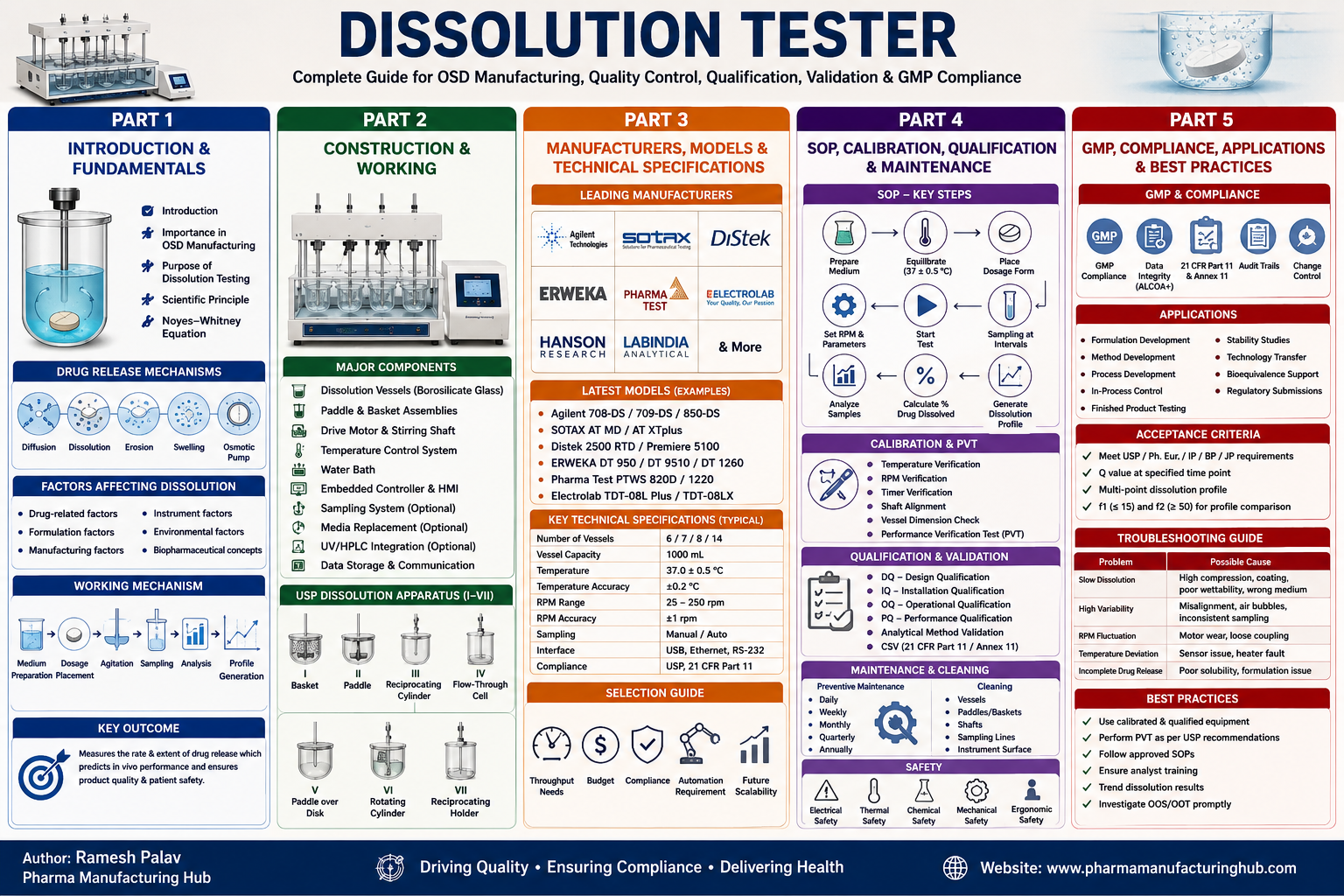
Part 1: Introduction, Fundamentals, Scientific Principles, Drug Release Mechanisms, Biopharmaceutical Concepts, and Working Mechanism
Chapter Overview
Dissolution testing is one of the most scientifically significant analytical tests in pharmaceutical manufacturing. It determines the rate and extent of drug release from tablets, capsules, and other oral solid dosage forms under standardized laboratory conditions. The dissolution profile generated during the test is a critical indicator of product performance, manufacturing consistency, formulation robustness, and potential in vivo behavior.
Unlike hardness, friability, or disintegration testing, dissolution testing directly evaluates the availability of the Active Pharmaceutical Ingredient (API) for absorption after administration. Consequently, dissolution is considered a Critical Quality Attribute (CQA) and is routinely used during formulation development, process validation, batch release, stability studies, technology transfer, and regulatory submissions.
A Dissolution Tester (Dissolution Apparatus) consists of temperature-controlled vessels, precision stirring mechanisms, automated speed control, and optional online sampling systems connected to UV-Visible spectrophotometers or HPLC systems for quantitative analysis.
1. Introduction
What is Dissolution?
Dissolution is the process by which an Active Pharmaceutical Ingredient (API) dissolves from a solid dosage form into a surrounding liquid medium under controlled conditions.
The dissolution test measures:
- Rate of drug release
- Extent of drug release
- Dissolution profile over time
Results are generally expressed as:
- Percentage drug dissolved (%)
- Drug concentration (mg/L or µg/mL)
- Dissolution profile versus time
Difference Between Disintegration and Dissolution
| Parameter | Disintegration | Dissolution |
|---|---|---|
| Purpose | Physical breakup of dosage form | Drug release into solution |
| Instrument | Disintegration Tester | Dissolution Tester |
| Measurement | Time | Percentage drug dissolved |
| Unit | Minutes | % Released |
| Importance | Initial stage of drug release | Predicts bioavailability |
A tablet may disintegrate rapidly but still exhibit slow dissolution if the drug substance has poor aqueous solubility or limited wettability.
Why Dissolution Testing is Important
Dissolution testing provides scientific evidence that a dosage form releases the drug in a controlled and reproducible manner.
The test helps ensure:
- Therapeutic efficacy
- Batch consistency
- Manufacturing quality
- Process capability
- Product stability
- Bioavailability prediction
- Regulatory compliance
- Patient safety
Failure to meet dissolution specifications may result in:
- Delayed drug release
- Reduced bioavailability
- Therapeutic failure
- Batch rejection
- Regulatory observations
- Product recalls
Importance in Oral Solid Dosage (OSD) Manufacturing
Dissolution testing is performed throughout the product lifecycle.
Research & Development (R&D)
During formulation development, dissolution testing supports:
- API characterization
- Excipient selection
- Binder optimization
- Coating evaluation
- Prototype screening
- Formulation optimization
Process Development
Engineers use dissolution data to optimize:
- Granulation process
- Compression force
- Coating process
- Drying conditions
- Process robustness
Commercial Manufacturing
Routine testing confirms:
- Batch consistency
- Product quality
- Manufacturing reproducibility
- Process capability
Finished Product Testing
QC laboratories perform dissolution testing before batch release according to approved product specifications.
Stability Studies
Dissolution profiles are monitored throughout product shelf life to detect changes caused by:
- Aging
- Moisture uptake
- Excipient interactions
- Coating changes
- Storage conditions
Process Validation
Dissolution testing demonstrates that validated manufacturing processes consistently produce products meeting predefined quality attributes.
Importance During Manufacturing
| Manufacturing Stage | Purpose |
|---|---|
| API Characterization | Evaluate solubility |
| Formulation Development | Optimize composition |
| Process Development | Optimize manufacturing process |
| In-Process Control | Monitor consistency |
| Process Validation | Demonstrate reproducibility |
| Finished Product Testing | Batch release |
| Stability Studies | Shelf-life evaluation |
| Technology Transfer | Site comparison |
Regulatory Importance
Dissolution testing is one of the most highly regulated pharmaceutical analytical tests.
Applicable regulations include:
- USP General Chapter <711> Dissolution
- USP <724> Drug Release
- USP <1092> The Dissolution Procedure
- European Pharmacopoeia (Ph. Eur.)
- Indian Pharmacopoeia (IP)
- British Pharmacopoeia (BP)
- Japanese Pharmacopoeia (JP)
- US FDA Dissolution Guidance
- WHO Technical Reports
- EMA Bioequivalence Guidelines
- ICH Q6A
- ICH Q8
- ICH Q9
- ICH Q10
Manufacturers must establish validated dissolution methods with scientifically justified acceptance criteria.
Impact on Product Quality
Dissolution is closely related to multiple Critical Quality Attributes (CQAs).
Drug Release
The dissolution profile determines how rapidly the drug becomes available for absorption.
Bioavailability
For immediate-release products, dissolution is often correlated with in vivo drug availability.
Therapeutic Performance
Consistent dissolution supports reproducible clinical performance and therapeutic outcomes.
Manufacturing Consistency
Changes in formulation or process parameters can significantly affect dissolution behavior.
Regulatory Compliance
Routine dissolution testing demonstrates compliance with approved specifications and regulatory requirements.
2. Purpose of Dissolution Testing
The primary purpose is to determine the rate and extent of drug release under standardized laboratory conditions.
Additional objectives include:
- Evaluating formulation performance
- Supporting product development
- Establishing dissolution specifications
- Comparing formulations
- Demonstrating batch consistency
- Supporting bioequivalence
- Monitoring stability
- Verifying manufacturing changes
- Supporting regulatory submissions
Product Attributes Evaluated
Dissolution testing provides information regarding:
- Drug release rate
- Drug release extent
- Release profile
- Product consistency
- Batch variability
- Manufacturing robustness
- Formulation performance
3. Scientific Principle of Dissolution Testing
Fundamental Principle
A dissolution tester measures the amount of drug dissolved into a specified medium over time under controlled hydrodynamic conditions.
The dosage form is placed into a vessel containing dissolution medium maintained at:
37.0 ± 0.5°C
The medium is stirred using a paddle or rotating basket at a controlled speed. Samples are withdrawn at predetermined intervals and analyzed using validated analytical techniques such as UV-Visible spectrophotometry or HPLC.
Noyes–Whitney Equation
The dissolution process is described by the Noyes–Whitney Equation:dtdC=hVDA(Cs−C)
Where:
- dC/dt = Dissolution rate
- D = Diffusion coefficient
- A = Surface area of the drug
- Cs = Saturation solubility
- C = Drug concentration at time t
- h = Thickness of diffusion layer
- V = Volume of dissolution medium
The equation demonstrates that dissolution rate increases with:
- Larger surface area
- Higher solubility
- Greater diffusion coefficient
and decreases with:
- Increased diffusion layer thickness.
Drug Release Mechanisms
Different dosage forms release drugs through different mechanisms.
1. Diffusion
Drug molecules diffuse through hydrated polymer matrices into the dissolution medium.
Typical Examples:
- Matrix tablets
- Controlled-release tablets
2. Dissolution-Controlled Release
The dosage form gradually dissolves, releasing the drug.
Examples:
- Immediate-release tablets
- Capsules
3. Erosion
The matrix gradually erodes, exposing fresh drug particles.
Examples:
- Hydrophilic matrix tablets
4. Swelling
Hydrophilic polymers absorb water, swell, and control drug release.
Examples:
- Hydroxypropyl methylcellulose (HPMC) matrices
5. Osmotic Pump Mechanism
Drug release occurs through osmotic pressure.
Examples:
- Osmotic controlled-release tablets
Biopharmaceutical Concepts
Dissolution testing is closely related to the Biopharmaceutics Classification System (BCS).
| BCS Class | Solubility | Permeability |
|---|---|---|
| Class I | High | High |
| Class II | Low | High |
| Class III | High | Low |
| Class IV | Low | Low |
Dissolution testing is particularly important for BCS Class II drugs, where dissolution is often the rate-limiting step for absorption.
Factors Affecting Dissolution
Drug-Related Factors
- Solubility
- Particle size
- Crystal form (polymorphism)
- Wettability
- Salt form
Formulation Factors
- Binder concentration
- Disintegrant type
- Lubricant level
- Excipient interactions
- Coating thickness
Manufacturing Factors
- Compression force
- Granulation process
- Drying conditions
- Particle size distribution
- Tablet hardness
Instrument Factors
- Paddle/basket speed
- Vessel geometry
- Medium volume
- Medium temperature
- Sampling position
- Apparatus alignment
Environmental Factors
- Storage conditions
- Relative humidity
- Temperature
- Product aging
4. Working Mechanism
Modern dissolution testers perform testing through a controlled sequence of operations.
Step 1 – Medium Preparation
Prepare the required dissolution medium according to the validated analytical method.
Common media include:
- Purified Water
- 0.1 N hydrochloride Acid
- Phosphate Buffer
- Acetate Buffer
- Simulated Gastric Fluid
- Simulated Intestinal Fluid
Step 2 – Temperature Stabilization
The medium is maintained at:
37.0 ± 0.5°C
to simulate physiological conditions.
Step 3 – Dosage Form Placement
The tablet or capsule is placed into:
- USP Apparatus I (Basket)
- USP Apparatus II (Paddle)
depending on the validated analytical method.
Step 4 – Agitation
The stirring mechanism rotates at the specified speed (e.g., 50 rpm, 75 rpm, or 100 rpm), creating controlled hydrodynamic conditions that facilitate drug release.
Step 5 – Drug Dissolution
The dissolution medium penetrates the dosage form, initiating disintegration (if applicable) and dissolution of the API. Drug molecules diffuse into the surrounding medium according to the formulation characteristics and physicochemical properties of the API.
Step 6 – Sample Collection
Aliquots are withdrawn at predefined time points using:
- Manual sampling
- Semi-automatic sampling
- Fully automated sampling systems
Sampling schedules are defined in the validated analytical method.
Step 7 – Sample Analysis
Collected samples are analyzed using validated analytical techniques such as:
- UV–Visible Spectrophotometry
- High-Performance Liquid Chromatography (HPLC)
- Ultra-Performance Liquid Chromatography (UPLC)
The concentration of dissolved drug is determined, and the percentage dissolved is calculated.
Step 8 – Dissolution Profile Generation
The analytical software generates a dissolution profile by plotting:
- Time (X-axis)
- Percentage Drug Dissolved (Y-axis)
This profile is compared against the approved product specification or reference product where applicable.
Relationship Between Hardness, Friability, Disintegration, and Dissolution
| Test | Measures | Unit | Primary Purpose |
|---|---|---|---|
| Hardness | Crushing strength | Newton (N) | Mechanical integrity |
| Friability | Resistance to abrasion | % Weight Loss | Surface durability |
| Disintegration | Time to break apart | Minutes | Initial drug release step |
| Dissolution | Drug release into solution | % Drug Released | Predicts in vivo performance |
Each test evaluates a different aspect of dosage form quality, and together they provide a comprehensive assessment of pharmaceutical product performance.
Part 1 Summary
This section introduced the fundamentals of dissolution testing, including its importance in pharmaceutical manufacturing, scientific principles, the Noyes–Whitney equation, drug release mechanisms, biopharmaceutical concepts, and the complete working mechanism of a dissolution tester. It also highlighted the critical factors affecting dissolution behavior and its relationship with other physical quality tests.
Part 2: Construction, Components, Functional Description, USP Dissolution Apparatus I–VII, Paddle & Basket Assemblies, Vessel Design, Temperature Control System, Automation Systems, and Engineering Design
5. Construction of a Dissolution Tester
Overview
A Dissolution Tester is a precision analytical instrument designed to evaluate the rate and extent of drug release from oral solid dosage forms under controlled laboratory conditions. It combines mechanical engineering, thermal control, analytical instrumentation, automation, and software to provide accurate, reproducible, and pharmacopeially compliant dissolution testing.
Modern dissolution testers are designed in accordance with USP <711>, USP <724>, USP <1092>, IP, BP, Ph. Eur., and JP requirements and incorporate advanced features such as automatic sampling, media replacement, online UV/HPLC integration, electronic records, audit trails, and 21 CFR Part 11 compliance.
A typical dissolution tester consists of the following major assemblies:
- Instrument Housing
- Dissolution Vessels
- Water Bath
- Heating System
- Temperature Sensor
- Paddle Assembly (USP Apparatus II)
- Basket Assembly (USP Apparatus I)
- Drive Motor
- Stirring Shaft
- Shaft Alignment System
- Vessel Positioning System
- Embedded Controller
- Human Machine Interface (HMI)
- Automatic Sampling System (optional)
- Media Replacement System (optional)
- UV/HPLC Integration Module (optional)
- Data Storage Module
- USB/Ethernet Communication Ports
- Power Supply Unit
General Construction Layout
                    ┌──────────────────────────┐
                    │     Touchscreen HMI      │
                    └────────────┬─────────────┘
                                 │
                     Embedded Controller
                                 │
        ┌───────────────┬────────┴─────────┬──────────────┐
        │               │                  │              │
 Temperature     Motor Controller    Sampling System  Data Storage
 Controller            │                  │
        │              │                  │
 Heating System   Drive Motor        Sampling Probe
        │              │                  │
 Water Bath     Paddle/Basket Shaft      UV/HPLC
        │              │
 Dissolution Vessel
        │
 Drug Release into Medium
5.1 Instrument Housing
Function
The housing supports and protects the instrument’s internal electrical, mechanical, and electronic systems while providing a cleanable, GMP-compliant exterior.
Construction Materials
Modern dissolution testers typically use:
- SS304 Stainless Steel
- SS316 Stainless Steel (premium systems)
- Powder-coated steel
- Engineering-grade polymers
Design Features
- Smooth surfaces
- Rounded corners
- Corrosion resistance
- Easy cleaning
- Chemical-resistant finish
5.2 Dissolution Vessels
The dissolution vessel is the most critical component because it establishes standardized hydrodynamic conditions.
Function
The vessel contains the dissolution medium in which the dosage form releases the API.
Construction
Typical material:
- Borosilicate Glass
Advantages
- Excellent chemical resistance
- High thermal stability
- Optical clarity
- Pharmacopoeial compliance
Typical Vessel Specifications
| Parameter | Typical Value |
|---|---|
| Capacity | 1000 mL |
| Working Volume | 500–1000 mL |
| Material | Borosilicate Glass |
| Shape | Hemispherical Bottom |
5.3 Water Bath
The water bath surrounds the dissolution vessels and maintains a constant temperature.
Function
Provides uniform heating to ensure the dissolution medium remains at:
37.0 ± 0.5°C
throughout the test.
5.4 Heating System
The heating system includes:
- Electric heater
- Digital temperature controller
- Circulation pump
- Over-temperature protection
Importance
Stable temperature is essential because dissolution rate is temperature dependent.
5.5 Temperature Sensor
Most modern systems use:
- Pt100 RTD sensors
- Digital temperature probes
Functions
- Continuous temperature monitoring
- Heater regulation
- Alarm generation
- Data recording
Typical Accuracy
| Parameter | Typical Value |
|---|---|
| Accuracy | ±0.2°C |
| Resolution | 0.1°C |
5.6 Paddle Assembly (USP Apparatus II)
The paddle assembly is the most widely used dissolution apparatus for immediate-release tablets.
Function
The paddle rotates above the dosage form, generating controlled hydrodynamic conditions that promote drug release.
Components
- Stainless steel paddle
- Drive shaft
- Coupling
- Alignment fixture
Construction Material
Typically:
- SS316 Stainless Steel
Applications
- Immediate-release tablets
- Capsules
- Most conventional OSD products
5.7 Basket Assembly (USP Apparatus I)
The basket assembly is designed for dosage forms that tend to float or require containment during testing.
Components
- Stainless steel mesh basket
- Shaft
- Basket holder
- Coupling
Applications
- Capsules
- Floating tablets
- Delayed-release formulations
- Soft gelatin capsules (where applicable)
5.8 Drive Motor
The drive motor rotates the paddle or basket at a precisely controlled speed.
Modern systems typically use:
Stepper Motors
Advantages:
- High precision
- Stable RPM
- Low maintenance
- Excellent repeatability
Servo Motors
Premium systems provide:
- Closed-loop speed control
- High positioning accuracy
- Smooth rotation
- Minimal vibration
5.9 Stirring Shaft
The shaft transfers rotational motion from the motor to the paddle or basket.
Requirements
- Straightness
- Proper alignment
- Corrosion resistance
- Smooth surface finish
5.10 Shaft Alignment System
Proper shaft alignment is essential for reproducible hydrodynamic conditions.
Misalignment may result in:
- Variable dissolution profiles
- Increased test variability
- Regulatory observations
5.11 Embedded Controller
The controller functions as the instrument’s central processing unit.
Responsibilities include:
- Motor control
- RPM regulation
- Temperature control
- Timer management
- Alarm handling
- Method storage
- User management
- Data communication
5.12 Human Machine Interface (HMI)
Modern dissolution testers feature:
- LCD displays
- Color touchscreens
- Graphical user interfaces
Functions
- Method setup
- User login
- RPM display
- Temperature display
- Timer
- Calibration menu
- Alarm messages
- Historical data review
5.13 Automatic Sampling System
High-end dissolution testers may include automatic sampling systems.
Advantages
- Reduced analyst intervention
- Improved repeatability
- Accurate sampling intervals
- Lower contamination risk
- Higher throughput
Components
- Sampling probe
- Syringe pump
- Peristaltic pump
- Sampling manifold
- Collection tubes
- Filtration unit
5.14 Media Replacement System
Automatic media replacement maintains constant vessel volume after sample withdrawal.
Benefits include:
- Accurate dissolution profiles
- Reduced manual intervention
- Improved repeatability
5.15 Online UV/HPLC Integration
Advanced systems integrate directly with:
- UV–Visible Spectrophotometers
- HPLC
- UPLC
Benefits
- Automated analysis
- Reduced handling errors
- Real-time dissolution profiles
- Increased laboratory productivity
5.16 Communication Interfaces
Modern dissolution testers provide:
- USB
- Ethernet
- RS-232
- Printer support
- Barcode reader integration
- LIMS connectivity
- MES integration
5.17 Software
Advanced software provides:
- Method management
- User authentication
- Electronic signatures
- Audit trails
- Automated calculations
- Dissolution profile plotting
- Report generation
- Data export
Premium software supports:
- FDA 21 CFR Part 11
- EU Annex 11
- ALCOA+
- GAMP 5 lifecycle principles
6. Functional Description of Major Components
| Component | Function | Importance |
|---|---|---|
| Housing | Supports instrument | Stability |
| Vessel | Holds dissolution medium | Hydrodynamic control |
| Water Bath | Maintains temperature | Test reproducibility |
| Heating System | Controls temperature | Regulatory compliance |
| Temperature Sensor | Monitors temperature | Accuracy |
| Paddle | Creates controlled fluid flow | Drug release |
| Basket | Holds floating dosage forms | Standardized testing |
| Drive Motor | Rotates paddle/basket | Repeatability |
| Shaft | Transfers motion | Mechanical precision |
| Controller | Controls system | Automation |
| HMI | User interaction | Ease of operation |
| Sampling System | Withdraws samples | Automation |
| UV/HPLC Interface | Drug quantification | Analytical integration |
7. USP Dissolution Apparatus
USP recognizes seven official dissolution apparatus, each intended for specific dosage forms.
| USP Apparatus | Name | Typical Applications |
|---|---|---|
| Apparatus I | Basket | Capsules, floating tablets |
| Apparatus II | Paddle | Immediate-release tablets |
| Apparatus III | Reciprocating Cylinder | Modified-release products |
| Apparatus IV | Flow-Through Cell | Poorly soluble drugs, implants |
| Apparatus V | Paddle over Disk | Transdermal patches |
| Apparatus VI | Rotating Cylinder | Transdermal systems |
| Apparatus VII | Reciprocating Holder | Non-traditional dosage forms |
USP Apparatus I – Basket
Features
- Rotating wire mesh basket
- Suitable for floating dosage forms
- Standard speeds: 50–100 rpm
USP Apparatus II – Paddle
Features
- Rotating paddle
- Most commonly used apparatus
- Suitable for immediate-release tablets and capsules
USP Apparatus III – Reciprocating Cylinder
Applications
- Extended-release tablets
- Multiparticulates
- Beads
USP Apparatus IV – Flow-Through Cell
Applications
- Poorly soluble drugs
- Controlled-release products
- Medical devices
- Implants
USP Apparatus V & VI
Used primarily for:
- Transdermal delivery systems
- Drug-eluting products
USP Apparatus VII
Designed for:
- Novel dosage forms
- Reciprocating sample holder applications
8. Engineering Design Considerations
Modern dissolution testers emphasize precision, reliability, and compliance.
Mechanical Design
- Low vibration
- Precision shaft alignment
- Corrosion-resistant materials
- Smooth motor operation
Thermal Design
- Uniform bath circulation
- Rapid temperature recovery
- Stable control algorithms
- Over-temperature protection
Electrical Design
- EMC compliance
- Surge protection
- Stable power supply
- Motor protection
Software Design
- User authentication
- Audit trails
- Electronic signatures
- Secure data storage
- Automated calculations
- Backup functionality
Ergonomic Design
- Easy vessel loading
- Simple paddle replacement
- User-friendly interface
- Easy cleaning
- Reduced analyst fatigue
Engineering Workflow
Medium Preparation
        │
        ▼
Temperature Stabilization (37 ± 0.5°C)
        │
        ▼
Tablet/Capsule Placement
        │
        ▼
Paddle/Basket Rotation
        │
        ▼
Drug Release into Medium
        │
        ▼
Sample Collection
        │
        ▼
UV/HPLC Analysis
        │
        ▼
Dissolution Profile Generation
Advantages of Modern Dissolution Testers
- Excellent temperature stability
- Precise RPM control
- Automated sampling
- Online analytical integration
- High repeatability
- Regulatory compliance
- Electronic documentation
- Secure audit trails
- Reduced analyst intervention
- Improved laboratory productivity
Part 2 Summary
This section described the construction, components, engineering design, and functional architecture of modern dissolution testers. It covered dissolution vessels, paddle and basket assemblies, temperature control systems, automatic sampling modules, software functionality, and the official USP Dissolution Apparatus I–VII. Understanding these systems is essential for proper operation, calibration, qualification, validation, and regulatory compliance.
Part 3: Major Manufacturers, Latest Models, Technical Specifications, Model Comparison, Selection Guide, Automation Options, and Emerging Technologies
9. Major Manufacturers of Dissolution Testers
Dissolution testers are among the most critical analytical instruments used in pharmaceutical quality control laboratories. Because dissolution testing is closely regulated by USP <711>, Ph. Eur., IP, BP, JP, FDA, EMA, and WHO, pharmaceutical companies generally prefer globally recognized manufacturers that provide validated equipment, regulatory documentation, software compliance, and worldwide service support.
Selection of a dissolution tester should consider:
- Regulatory compliance
- Qualification documentation
- Performance Verification Test (PVT) support
- Automation capability
- Analytical integration
- Software validation
- Global service network
- Spare parts availability
- Total cost of ownership
9.1 Agilent Technologies
Company Overview
Agilent Technologies is one of the world’s leading manufacturers of pharmaceutical analytical instruments. Its dissolution systems are widely used in FDA-approved laboratories, pharmaceutical companies, CROs, and research institutions.
Headquarters
- California, USA
Product Portfolio
- Dissolution Testers
- UV–Visible Spectrophotometers
- HPLC
- UPLC
- LC-MS
- GC
- ICP-MS
Major Advantages
- Excellent analytical accuracy
- Advanced automation
- Integrated UV/HPLC systems
- Global service support
- Regulatory-ready software
- 21 CFR Part 11 compliance
Representative Models
| Model | Description |
|---|---|
| 708-DS | Manual Dissolution System |
| 709-DS | Semi-Automated Dissolution Tester |
| 850-DS | High-End Automated Dissolution System |
Major Features
- 6 or 8 vessel configuration
- Automatic temperature monitoring
- Automatic sampling
- UV integration
- HPLC integration
- Dissolution Workstation Software
- Electronic signatures
- Audit trails
9.2 SOTAX
Company Overview
SOTAX is one of the world’s leading pharmaceutical testing equipment manufacturers and is widely recognized for premium dissolution systems.
Headquarters
- Switzerland
Advantages
- Swiss precision engineering
- Excellent temperature control
- High automation
- Extensive validation documentation
- Global regulatory acceptance
Representative Models
| Model | Description |
|---|---|
| AT MD | Manual Dissolution Tester |
| AT XTplus | Fully Automated Dissolution System |
| CE 7smart | USP Apparatus III System |
Features
- Automatic sampling
- Automatic media replacement
- Online UV
- HPLC compatibility
- LIMS integration
- Robotic automation
9.3 Distek
Company Overview
Distek is one of the most respected manufacturers of dissolution testing systems in regulated pharmaceutical laboratories.
Headquarters
- USA
Major Strengths
- Premium automation
- Excellent software
- Robust engineering
- Extensive regulatory support
- High throughput
Representative Models
| Model | Description |
|---|---|
| 2500 Select | Manual System |
| 2500 RTD | Automated Dissolution Tester |
| Premiere 5100 | High-Performance Automated Platform |
9.4 ERWEKA
Company Overview
ERWEKA manufactures high-precision pharmaceutical testing equipment with strong acceptance across Europe and international regulated markets.
Headquarters
- Germany
Advantages
- Excellent engineering quality
- Precision shaft alignment
- Stable RPM
- Reliable temperature control
- Premium software
Representative Models
| Model | Description |
|---|---|
| DT 950 | Manual Dissolution Tester |
| DT 9510 | Automated System |
| DT 1260 | High-End Dissolution Platform |
9.5 Pharma Test
Headquarters
- Germany
Major Strengths
- Precision engineering
- High repeatability
- Advanced automation
- Excellent software
- Regulatory-ready documentation
Representative Models
- PTZ-S 820D
- PTZ-S 1220
- PTZ-S 620
Major Features
- Automatic sampling
- Automatic vessel lifting
- Online UV
- Audit trail
- Electronic signatures
- LIMS connectivity
9.6 Electrolab
Headquarters
- Mumbai, India
Electrolab is one of the most widely used dissolution tester manufacturers in Asia and emerging pharmaceutical markets.
Advantages
- Competitive pricing
- Reliable operation
- Good automation
- Excellent local service
- GMP-compliant design
Representative Models
| Model | Description |
|---|---|
| TDT-08L | 8 Vessel Dissolution Tester |
| TDT-08L Plus | Automated Sampling System |
| TDT-08LX | High-End GMP System |
9.7 Hanson Research
Headquarters
- USA
Hanson Research has decades of experience manufacturing dissolution systems for pharmaceutical research and quality control.
Advantages
- Excellent vessel design
- High analytical precision
- Strong automation
- Advanced software
Representative Models
- Vision G2 Classic 6
- Vision Elite 8
- AutoPlus System
9.8 Labindia
Headquarters
- India
Advantages
- Affordable
- Reliable
- Easy maintenance
- Good local support
Representative Models
- DS 8000
- DS 14000
Global Manufacturer Comparison
| Company | Country | Market Position |
|---|---|---|
| Agilent | USA | Premium |
| SOTAX | Switzerland | Premium |
| Distek | USA | Premium |
| ERWEKA | Germany | Premium |
| Pharma Test | Germany | Premium |
| Electrolab | India | Mid to Premium |
| Hanson Research | USA | Premium |
| Labindia | India | Mid-range |
10. Available Instrument Configurations
Dissolution testers are available in multiple configurations depending on laboratory requirements.
Manual Systems
Characteristics
- Manual sampling
- Manual media replacement
- Basic operation
- Suitable for small laboratories
Semi-Automatic Systems
Provide:
- Automatic sampling
- Digital control
- Temperature monitoring
- Data storage
Fully Automated Systems
Features include:
- Robotic sampling
- Automatic media replacement
- Automatic filtration
- Online analysis
- Electronic documentation
High-Throughput Systems
Designed for:
- Commercial QC laboratories
- Stability testing
- Multiple product testing
- Continuous operation
21 CFR Part 11 Compliant Systems
Support:
- Electronic records
- Electronic signatures
- Audit trail
- User authentication
- Secure backup
- LIMS integration
11. Technical Specifications
Typical specifications for modern dissolution testers are summarized below.
| Parameter | Typical Specification |
|---|---|
| Number of Vessels | 6, 7, 8, or 14 |
| Vessel Capacity | 1000 mL |
| Medium Volume | 500–1000 mL |
| Temperature | 37.0 ± 0.5°C |
| Temperature Accuracy | ±0.2°C |
| RPM Range | 25–250 rpm |
| RPM Accuracy | ±1 rpm |
| Apparatus | USP I–VII (model dependent) |
| Display | LCD / Touchscreen |
| User Levels | Administrator, Supervisor, Analyst |
| Data Storage | Up to 100,000 methods/results (advanced systems) |
| Communication | USB, Ethernet, RS-232 |
| Barcode Reader | Optional |
| Audit Trail | Available |
| Electronic Signature | Available |
| LIMS Integration | Available |
| Power Supply | 100–240 VAC |
| Operating Temperature | 15–35°C |
12. Comparison of Leading Manufacturers
| Manufacturer | Automation | Analytical Integration | Software | Audit Trail | Price Category | Best Application |
|---|---|---|---|---|---|---|
| Agilent | Excellent | UV/HPLC | Advanced | Yes | Premium | Global QC Labs |
| SOTAX | Excellent | UV/HPLC | Advanced | Yes | Premium | R&D & Validation |
| Distek | Excellent | UV/HPLC | Advanced | Yes | Premium | High Throughput QC |
| ERWEKA | Excellent | UV/HPLC | Advanced | Yes | Premium | Stability & QC |
| Pharma Test | Excellent | UV/HPLC | Advanced | Yes | Premium | Regulated Laboratories |
| Electrolab | Very Good | UV | Good | Yes | Mid-range | Routine QC |
| Hanson Research | Excellent | UV/HPLC | Advanced | Yes | Premium | Research & Development |
| Labindia | Good | UV | Good | Optional | Mid-range | Commercial Manufacturing |
13. Selection Guide
Selecting the appropriate dissolution tester depends on laboratory workload, regulatory expectations, analytical requirements, and future expansion.
Laboratory Throughput
| Daily Sample Volume | Recommended System |
|---|---|
| <20 samples | Manual 6 Vessel |
| 20–100 samples | Semi-Automatic 8 Vessel |
| 100–300 samples | Fully Automated 8 Vessel |
| >300 samples | Robotic High-Throughput System |
Regulatory Environment
For laboratories inspected by:
- US FDA
- EMA
- MHRA
- PMDA
- TGA
Recommended features include:
- 21 CFR Part 11 compliance
- Audit trails
- Electronic signatures
- Role-based access
- Automatic backup
- LIMS compatibility
- Secure electronic records
Budget-Based Selection
| Budget | Recommended Manufacturers |
|---|---|
| Moderate | Labindia, Electrolab |
| High | ERWEKA, Pharma Test |
| Premium | Agilent, SOTAX, Distek, Hanson Research |
14. Emerging Technologies
Modern dissolution laboratories are rapidly adopting Pharma 4.0 technologies.
Artificial Intelligence (AI)
AI supports:
- Trend analysis
- Predictive quality analytics
- Intelligent alarm management
- Root cause analysis
- Dissolution profile prediction
Internet of Things (IoT)
IoT-enabled dissolution systems provide:
- Remote monitoring
- Predictive maintenance
- Centralized quality dashboards
- Equipment health monitoring
Cloud Connectivity
Cloud platforms enable:
- Automatic backup
- Multi-site access
- Centralized reporting
- Secure data sharing
Machine Learning
Machine learning models correlate dissolution behavior with:
- Compression force
- Particle size
- Hardness
- Disintegration time
- Moisture content
- Coating thickness
This enables improved process optimization and formulation development.
Digital Twin Technology
Digital twins simulate dissolution behavior under different process conditions, supporting formulation optimization, equipment lifecycle management, and Quality by Design (QbD).
Automated Trending
Advanced software generates:
- Dissolution profile overlays
- Control charts
- Statistical Process Control (SPC)
- Capability indices (Cp/Cpk)
- Out-of-Specification (OOS) alerts
- Out-of-Trend (OOT) analysis
Integration with Pharma 4.0
Modern dissolution testers integrate seamlessly with:
- Laboratory Information Management Systems (LIMS)
- Manufacturing Execution Systems (MES)
- Enterprise Resource Planning (ERP)
- Electronic Laboratory Notebooks (ELN)
This enhances workflow efficiency, data integrity, traceability, and regulatory compliance.
Advantages of Modern Dissolution Testers
- Excellent temperature stability
- Precise RPM control
- Automatic sampling and media replacement
- Online UV/HPLC integration
- High repeatability and reproducibility
- Electronic records and audit trails
- Reduced operator intervention
- GMP and regulatory compliance
- Support for high-throughput laboratories
- Improved productivity and data reliability
Part 3 Summary
This section reviewed the leading manufacturers of dissolution testers, representative models, technical specifications, automation options, comparison of major brands, selection criteria, and emerging technologies. Choosing the right dissolution tester requires balancing analytical performance, regulatory compliance, automation requirements, software capabilities, service support, and total lifecycle cost.
Part 4: Standard Operating Procedure (SOP), Calibration, Performance Verification Test (PVT), Qualification (DQ, IQ, OQ, PQ), Validation, Maintenance, Cleaning, Safety, and Documentation
15. Standard Operating Procedure (SOP)
15.1 Objective
To establish a standardized procedure for operating the Dissolution Tester to accurately determine the rate and extent of drug release from oral solid dosage forms while ensuring reproducible results, GMP compliance, data integrity, and operator safety.
15.2 Scope
This SOP applies to:
- Research & Development (R&D)
- Analytical Method Development
- Method Validation
- In-Process Quality Control (IPQC)
- Finished Product Testing
- Stability Studies
- Process Validation
- Technology Transfer
- Bioequivalence Support
- Commercial Manufacturing
15.3 Responsibilities
| Department | Responsibility |
|---|---|
| QC Analyst | Perform dissolution testing and document results |
| QC Supervisor | Review and approve results |
| QA Department | Verify GMP compliance and documentation |
| Engineering | Preventive maintenance and repairs |
| Calibration Team | Calibration and Performance Verification |
| Validation Team | DQ, IQ, OQ & PQ |
| Production | Provide representative product samples |
16. Pre-Operational Checks
Before starting the instrument, verify:
| Check | Acceptance Criteria |
|---|---|
| Instrument cleanliness | Clean and residue-free |
| Dissolution vessels | No cracks or scratches |
| Paddle/Basket | Clean and undamaged |
| Shaft alignment | Within manufacturer specification |
| Water bath | Filled to proper level |
| Medium temperature | 37.0 ± 0.5°C |
| Calibration status | Current |
| Qualification status | Valid |
| Display | No alarms or system errors |
| RPM display | Functional |
| Timer | Functional |
17. Environmental Requirements
The test should be performed in a controlled laboratory environment.
| Parameter | Recommended Range |
|---|---|
| Laboratory Temperature | 20–25°C |
| Relative Humidity | 40–60% RH |
| Vibration | Minimal |
| Airflow | No direct drafts |
| Lighting | Adequate for observation |
Environmental controls reduce analytical variability and improve reproducibility.
18. Preparation of Dissolution Medium
Prepare the dissolution medium according to the validated analytical method.
Common media include:
- Purified Water
- 0.1 N hydrochloride Acid
- Phosphate Buffer
- Acetate Buffer
- Simulated Gastric Fluid (SGF)
- Simulated Intestinal Fluid (SIF)
The medium should be:
- Correctly prepared
- Properly degassed (if required by the method)
- Filtered when specified
- Equilibrated to 37.0 ± 0.5°C before use
19. Sample Preparation
The dosage units should:
- Be representative of the batch
- Be free from visible defects
- Be stored under recommended conditions
- Reach laboratory temperature before testing
The number of dosage units tested should comply with the applicable pharmacopoeia and the approved analytical method.
20. Operating Procedure
Step 1 – Instrument Startup
- Switch ON the instrument.
- Allow self-diagnostics to complete.
- Verify no alarms are present.
- Confirm calibration validity.
Step 2 – User Login
For computerized systems:
- Log in using authorized credentials.
- Verify user role.
- Ensure audit trail functionality is enabled.
Step 3 – Vessel Preparation
- Fill vessels with the specified volume of dissolution medium.
- Verify medium temperature.
- Remove air bubbles if necessary.
- Position vessels correctly.
Step 4 – Install Paddle or Basket
Depending on the validated analytical method:
- Install USP Apparatus I (Basket), or
- Install USP Apparatus II (Paddle)
Verify:
- Shaft alignment
- Paddle/Basket height
- Rotation without vibration
Step 5 – Set Test Parameters
Typical parameters include:
| Parameter | Typical Setting* |
|---|---|
| Temperature | 37.0 ± 0.5°C |
| RPM | 50, 75, or 100 rpm |
| Medium Volume | 500–1000 mL |
| Sampling Time Points | As per validated method |
| Test Duration | Product-specific |
*Actual settings shall be based on the approved analytical procedure.
Step 6 – Introduce Dosage Units
Carefully place one tablet or capsule into each vessel.
Start the test immediately after introducing the dosage units.
Step 7 – Sampling
Collect samples at predefined intervals using:
- Manual sampling
- Semi-automatic sampling
- Fully automated sampling
Replace the withdrawn volume when required by the analytical method.
Step 8 – Sample Analysis
Analyze samples using validated analytical techniques such as:
- UV–Visible Spectrophotometry
- High-Performance Liquid Chromatography (HPLC)
- Ultra-Performance Liquid Chromatography (UPLC)
Calculate:
- Drug concentration
- Percentage dissolved
- Dissolution profile
Step 9 – Documentation
Record:
- Product name
- Batch number
- Method number
- Instrument ID
- Vessel identification
- Paddle/Basket type
- Medium used
- RPM
- Temperature
- Sampling schedule
- Analytical results
- Observations
- Analyst and reviewer approval
Electronic records should comply with data integrity requirements.
21. Calibration
Objective
Calibration verifies that the dissolution tester performs within specified limits for temperature, rotational speed, vessel geometry, shaft alignment, and timing.
Calibration Frequency
| Activity | Frequency |
|---|---|
| Temperature Verification | Daily or before use (as per SOP) |
| RPM Verification | Monthly |
| Timer Verification | Monthly |
| Shaft Alignment | Quarterly |
| Vessel Inspection | Quarterly |
| Comprehensive Calibration | Every 6–12 months |
| After Repair | Before returning to service |
| After Relocation | Before qualification |
Calibration Parameters
Temperature
Verify using a certified reference thermometer.
Acceptance:
37.0 ± 0.5°C
RPM
Verify using a calibrated tachometer.
Typical acceptance:
±1 rpm
Timer
Verify using a calibrated stopwatch.
Shaft Alignment
Verify shaft centering and verticality using qualified alignment tools in accordance with USP recommendations.
Vessel Dimensions
Inspect:
- Internal diameter
- Vessel height
- Hemispherical bottom
- Glass integrity
against manufacturer specifications and applicable USP dimensional requirements.
22. Performance Verification Test (PVT)
The Performance Verification Test (PVT) confirms that the dissolution apparatus performs as intended under standardized conditions.
Objectives
- Verify system suitability
- Confirm hydrodynamic performance
- Detect mechanical deviations
- Ensure reproducible results
PVT should be conducted using appropriate USP Performance Verification Test Reference Standard materials in accordance with the current USP recommendations and the laboratory’s approved procedures.
23. Qualification
Qualification demonstrates that the dissolution tester is suitable for its intended use.
23.1 Design Qualification (DQ)
Confirm that the selected instrument satisfies the User Requirement Specification (URS).
Typical DQ activities include:
- Vendor evaluation
- Compliance with USP requirements
- Review of software capabilities
- Assessment of automation features
- Service support evaluation
23.2 Installation Qualification (IQ)
Typical IQ Checklist
| Verification Item | Status |
|---|---|
| Instrument model | Verified |
| Serial number | Verified |
| Utilities connected | Verified |
| Installation location | Approved |
| User manuals | Available |
| Calibration certificates | Available |
| Software version | Documented |
| Environmental conditions | Acceptable |
23.3 Operational Qualification (OQ)
Typical OQ Tests
- Temperature accuracy
- RPM verification
- Timer accuracy
- Shaft alignment
- Vessel positioning
- Alarm verification
- User access control
- Audit trail functionality
- Communication interfaces
23.4 Performance Qualification (PQ)
PQ confirms that the instrument performs consistently under routine laboratory conditions.
Typical PQ studies include:
- Repeatability
- Intermediate precision
- Product-specific verification
- Analyst-to-analyst comparison
- Long-term performance monitoring
24. Validation Considerations
Analytical Method Validation
Evaluate:
- Accuracy
- Precision
- Repeatability
- Intermediate precision
- Specificity
- Linearity
- Robustness
- Range
Computerized System Validation (CSV)
For software-controlled dissolution systems:
Validation documentation should include:
- User Requirement Specification (URS)
- Functional Specification (FS)
- Design Specification (DS)
- Risk Assessment
- IQ/OQ/PQ
- Traceability Matrix
- User Acceptance Testing (UAT)
Validation should follow a lifecycle approach consistent with GAMP 5.
25. GMP Documentation
Maintain the following records:
- Standard Operating Procedure (SOP)
- Instrument Logbook
- Calibration Procedure
- Calibration Certificates
- Performance Verification Records
- IQ/OQ/PQ Protocols
- Qualification Reports
- Validation Reports
- Preventive Maintenance Records
- Breakdown Records
- Change Control Records
- Deviation Reports
- CAPA Records
- Audit Trail Reviews
- Backup and Restore Records
26. Preventive Maintenance
Daily
- Clean vessels
- Clean paddles/baskets
- Verify bath temperature
- Inspect shafts
- Check display
Weekly
- Inspect vessel positioning
- Verify shaft movement
- Review instrument logbook
- Inspect cables and connectors
Monthly
- Verify RPM
- Inspect motor
- Check temperature sensor
- Verify sampling system (if installed)
Quarterly
- Inspect shaft alignment
- Verify vessel dimensions
- Review software performance
- Check communication interfaces
Annually
- Complete preventive maintenance by qualified personnel
- Comprehensive calibration
- Performance Verification Test (PVT)
- Replacement of worn components as required
- Software review and updates
- Regulatory compliance review
27. Cleaning Procedure
Proper cleaning prevents cross-contamination and ensures consistent analytical performance.
Cleaning Materials
- Purified water
- Laboratory-grade detergent
- 70% IPA (where compatible with manufacturer recommendations)
- Lint-free cloth
Avoid abrasive materials that may scratch glass vessels or stainless-steel components.
Cleaning Frequency
| Component | Frequency |
|---|---|
| Dissolution vessels | After each test |
| Paddle/Basket | After each test |
| Water bath | Daily |
| Instrument housing | Daily |
| Touchscreen | Daily |
| Sampling lines | As per SOP or after each applicable run |
| Internal components | As per maintenance schedule |
Cleaning Verification
Confirm:
- No visible residue
- No scratches or damage
- Proper vessel clarity
- Free rotation of paddles/baskets
- Normal instrument operation
28. Safety Precautions
Operator Safety
- Wear appropriate PPE.
- Handle hot dissolution media with care.
- Avoid splashing during vessel filling.
- Follow approved laboratory procedures.
Electrical Safety
- Ensure proper grounding.
- Inspect power cords before use.
- Disconnect power before maintenance.
- Do not operate damaged equipment.
Mechanical Safety
- Keep hands away from rotating shafts during operation.
- Verify paddle/basket installation before starting.
- Stop rotation before making adjustments.
Chemical Safety
- Handle acidic or buffered media using appropriate PPE.
- Follow laboratory chemical handling procedures.
- Dispose of media according to environmental and laboratory guidelines.
Ergonomics
- Lift vessels carefully.
- Position the instrument at an appropriate working height.
- Minimize repetitive strain during sampling.
Part 4 Summary
This section provided a comprehensive guide to the operation and lifecycle management of dissolution testers, including the Standard Operating Procedure (SOP), calibration, Performance Verification Test (PVT), qualification (DQ, IQ, OQ, PQ), validation, preventive maintenance, cleaning, safety practices, and GMP documentation. Following these practices ensures accurate and reproducible dissolution testing while maintaining compliance with USP requirements, global regulatory expectations, and pharmaceutical quality systems.
Part 5: GMP Requirements, Regulatory Compliance, Applications, Acceptance Criteria, Dissolution Profile Comparison, Troubleshooting, Audit Readiness, AI Integration, FAQs, Interview Questions, and Key Takeaways
29. GMP Requirements for Dissolution Testing
Dissolution testing is one of the most critical analytical procedures in pharmaceutical quality control because it directly measures the release of the Active Pharmaceutical Ingredient (API) from the dosage form. Since dissolution is a Critical Quality Attribute (CQA), pharmaceutical companies must establish scientifically justified procedures that comply with global GMP regulations and pharmacopeial standards.
A GMP-compliant dissolution testing program should include:
- Qualified dissolution equipment (DQ, IQ, OQ & PQ)
- Approved Standard Operating Procedures (SOPs)
- Valid calibration and Performance Verification Test (PVT) status
- Controlled laboratory environment
- Validated analytical methods
- Trained analysts
- Representative sample selection
- Complete documentation
- Investigation of OOS (Out-of-Specification) and OOT (Out-of-Trend) results
- Preventive maintenance program
- Data integrity controls
- Periodic audit trail review
Applicable Regulations and Guidelines
Dissolution testing should comply with:
- USP General Chapter <711> Dissolution
- USP <724> Drug Release
- USP <1092> The Dissolution Procedure
- US FDA 21 CFR Parts 210 & 211
- 21 CFR Part 11
- EU GMP Volume 4
- EU Annex 11
- WHO GMP
- PIC/S Guide to GMP
- ICH Q6A – Specifications
- ICH Q8 – Pharmaceutical Development
- ICH Q9 – Quality Risk Management
- ICH Q10 – Pharmaceutical Quality System
- FDA SUPAC Guidance
- EMA Bioequivalence Guidelines
- Indian Pharmacopoeia (IP)
- British Pharmacopoeia (BP)
- European Pharmacopoeia (Ph. Eur.)
- Japanese Pharmacopoeia (JP)
30. Data Integrity Requirements
Computerized dissolution systems should comply with ALCOA+ principles.
ALCOA+ Principles
| Principle | Requirement |
|---|---|
| Attributable | Record analyst identity |
| Legible | Records remain readable throughout retention |
| Contemporaneous | Record data at the time of testing |
| Original | Preserve original electronic records |
| Accurate | Instrument output reflects actual results |
| Complete | Include all data, including failed or repeated tests |
| Consistent | Maintain chronological sequence |
| Enduring | Securely archive records |
| Available | Retrieve records during inspections |
21 CFR Part 11 Compliance
Modern dissolution software should provide:
- Unique user IDs
- Password-protected access
- Electronic signatures
- Secure audit trails
- Time-stamped records
- Role-based permissions
- Automatic backup
- Data protection against unauthorized modification
31. Applications of Dissolution Testing
Dissolution testing is performed throughout the pharmaceutical product lifecycle.
Research & Development (R&D)
Applications include:
- API characterization
- Excipient screening
- Prototype formulation comparison
- Optimization of immediate-release and modified-release formulations
Method Development
Used to establish:
- Dissolution medium
- Agitation speed
- Sampling intervals
- Analytical conditions
- Acceptance criteria
Process Development
Supports optimization of:
- Granulation parameters
- Compression force
- Coating process
- Drying conditions
Commercial Manufacturing
Routine dissolution testing confirms:
- Batch-to-batch consistency
- Process capability
- Product quality
Finished Product Release
Dissolution testing is a routine QC release test used to verify that finished products meet approved specifications.
Stability Studies
Monitors changes caused by:
- Product aging
- Moisture uptake
- Excipient interactions
- Packaging
- Storage conditions
Technology Transfer
Compares dissolution profiles between:
- Manufacturing sites
- Scale-up batches
- Equipment changes
- Process modifications
Bioequivalence Studies
Dissolution testing supports:
- Formulation comparison
- In vitro–in vivo correlation (IVIVC)
- Regulatory submissions
- bio waiver strategies (where applicable)
32. Acceptance Criteria
Acceptance criteria are established during product development and approved in the product specification.
Typical examples include:
| Dosage Form | Typical Requirement* |
|---|---|
| Immediate-Release Tablets | Meet the approved Q value at the specified sampling time |
| Modified-Release Tablets | Conform to the approved multi-point dissolution profile |
| Delayed-Release Tablets | Resist acid stage and subsequently meet buffer-stage release criteria |
| Capsules | Meet the approved dissolution profile |
Q = Percentage of labeled amount of drug that should be dissolved at the specified time.
Always follow the approved product specification and applicable pharmacopoeial monograph.
Dissolution Profile Comparison
During formulation development and technology transfer, dissolution profiles are commonly compared using:
Difference Factor (f1)
Measures the percentage difference between two dissolution profiles.
Typical target:
f1 ≤ 15
Similarity Factor (f2)
Measures the similarity between two dissolution profiles.
Typical target:
f2 ≥ 50
These statistical tools are widely used for formulation comparison and post-approval change evaluations.
Relationship Between Critical Quality Attributes
| Quality Attribute | Influence on Dissolution |
|---|---|
| Hardness | Higher hardness may slow dissolution if porosity decreases |
| Friability | Excessive friability may indicate formulation weakness |
| Disintegration | Delayed disintegration can delay dissolution |
| Particle Size | Smaller particles generally dissolve faster |
| Coating Thickness | Increased coating may delay drug release |
| Moisture Content | Can alter dissolution behavior depending on formulation |
33. Common Problems
1. Slow Dissolution
Possible Causes
- High compression force
- Thick coating
- Poor wettability
- Incorrect medium
- Low agitation speed
Impact
- Out-of-specification results
- Delayed drug release
- Batch rejection
2. High Variability
Possible Causes
- Vessel misalignment
- Paddle wobble
- Air bubbles
- Sampling inconsistency
- Temperature variation
3. Incomplete Drug Release
Possible Causes
- Poor API solubility
- Formulation defects
- Improper medium selection
- Inadequate mixing
4. Instrument Problems
Examples include:
- RPM deviation
- Temperature drift
- Shaft misalignment
- Vessel defects
- Sampling pump malfunction
34. Troubleshooting Guide
| Problem | Possible Cause | Root Cause | Corrective Action | Preventive Measure |
|---|---|---|---|---|
| Temperature not maintained | Heater or sensor malfunction | Controller failure | Recalibrate or replace sensor | Routine verification |
| RPM unstable | Motor wear | Drive malfunction | Repair or replace motor | Preventive maintenance |
| Paddle wobble | Shaft misalignment | Mechanical wear | Realign or replace shaft | Alignment checks |
| Air bubbles on dosage form | Inadequate medium degassing | Poor preparation | Degas medium properly | Follow SOP |
| High variability | Sampling inconsistency | Analyst technique | Retrain analyst | Standardized sampling |
| Low dissolution values | Formulation or process issue | Product-related | Investigate manufacturing process | Trend monitoring |
| Software communication failure | Network or interface issue | Hardware/software fault | Verify connections and restart | Routine IT maintenance |
35. Audit Readiness
During internal and regulatory inspections, auditors typically review:
Equipment
- Calibration status
- PVT records
- IQ/OQ/PQ documentation
- Preventive maintenance records
- Instrument identification
Documentation
- SOPs
- Instrument logbook
- Calibration certificates
- Validation reports
- Qualification reports
- Change control
- Deviation reports
- CAPA records
- Audit trail review
- Backup records
Analytical Methods
Inspectors may verify:
- Approved dissolution method
- Method validation
- Sampling procedure
- Medium preparation
- Acceptance criteria
Data Integrity
Inspectors expect:
- Secure electronic records
- Role-based access
- Audit trail review
- No unauthorized data changes
- Proper backup and archival
36. Regulatory Inspection Expectations
Common inspection questions include:
- How was the dissolution method developed?
- Why was the selected dissolution medium chosen?
- How is vessel alignment verified?
- How often is RPM calibrated?
- How is PVT performed?
- How are OOS dissolution results investigated?
- How are dissolution profiles trended?
- How is data integrity maintained?
- How are electronic records protected?
- How are analysts qualified?
37. AI and Pharma 4.0 Integration
Modern dissolution laboratories increasingly use digital technologies.
Artificial Intelligence (AI)
AI applications include:
- Dissolution trend analysis
- Predictive quality analytics
- Intelligent alarm management
- Root cause analysis
- Automated report generation
Internet of Things (IoT)
IoT-enabled systems support:
- Remote monitoring
- Instrument health diagnostics
- Predictive maintenance
- Enterprise-wide dashboards
Cloud Connectivity
Cloud-based systems provide:
- Secure backup
- Multi-site access
- Centralized reporting
- Remote review of dissolution data
Machine Learning
Machine learning models correlate dissolution behavior with:
- Compression force
- Particle size
- Tablet hardness
- Disintegration time
- Moisture content
- Coating thickness
These insights support Quality by Design (QbD) and continuous process improvement.
Digital Twin Technology
Digital twins simulate dissolution performance under varying formulation and process conditions, enabling optimization without extensive physical experimentation.
Automated Trending
Modern software generates:
- Dissolution profile overlays
- Statistical Process Control (SPC) charts
- Capability indices (Cp/Cpk)
- OOS/OOT alerts
- Long-term trend reports
Integration with Pharma 4.0
Advanced dissolution systems integrate with:
- Laboratory Information Management Systems (LIMS)
- Manufacturing Execution Systems (MES)
- Enterprise Resource Planning (ERP)
- Electronic Laboratory Notebooks (ELN)
This improves workflow efficiency, traceability, and regulatory compliance.
38. Advantages
- Direct measurement of drug release
- Critical for batch release testing
- Supports formulation development
- Predicts product performance
- Supports bioequivalence studies
- Facilitates regulatory compliance
- Compatible with automated analytical systems
- High reproducibility when properly controlled
- Supports Quality by Design (QbD)
39. Limitations
- Requires validated analytical methods
- Sensitive to hydrodynamic conditions
- Time-consuming for extended-release products
- Equipment requires regular calibration and PVT
- Destructive analytical test
40. Frequently Asked Questions (Selected)
Q1. What is dissolution testing?
Dissolution testing measures the rate and extent of drug release from a dosage form into a specified dissolution medium under controlled conditions.
Q2. Why is dissolution testing important?
It ensures consistent product quality, therapeutic performance, regulatory compliance, and batch-to-batch reproducibility.
Q3. What is the standard dissolution medium temperature?
37.0 ± 0.5°C, simulating physiological body temperature.
Q4. What is the difference between USP Apparatus I and II?
- USP Apparatus I: Rotating Basket, commonly used for floating dosage forms and capsules.
- USP Apparatus II: Paddle Apparatus, commonly used for immediate-release tablets and capsules.
Q5. What is a Q value?
The Q value is the specified percentage of labeled drug amount that should be dissolved at a defined time point according to the approved specification.
Q6. What is PVT?
Performance Verification Test (PVT) confirms that the dissolution apparatus performs within acceptable limits using USP reference materials and approved procedures.
Q7. What are f1 and f2?
- f1 (Difference Factor): Measures the percentage difference between two dissolution profiles.
- f2 (Similarity Factor): Measures the similarity between two dissolution profiles.
Q8. How often should a dissolution tester be calibrated?
According to the laboratory’s approved calibration program, typically at defined intervals and after major maintenance or relocation.
41. Interview Questions
Basic
- What is dissolution testing?
- Why is dissolution testing performed?
- What is the difference between dissolution and disintegration?
- What is the standard medium temperature?
- What is the Q value?
Intermediate
- Explain the Noyes–Whitney equation.
- Describe USP Apparatus I–VII.
- What factors affect dissolution?
- Explain Performance Verification Test (PVT).
- How is a dissolution profile generated?
Advanced
- Explain f1 and f2 profile comparison.
- How does dissolution support IVIVC?
- Describe qualification of a dissolution tester (DQ, IQ, OQ & PQ).
- Explain computerized system validation (CSV) for dissolution software.
- How is dissolution data used in Continued Process Verification (CPV)?
Audit-Based
- Which documents should be available during a regulatory inspection?
- How do you verify shaft alignment?
- How is RPM calibration performed?
- How are OOS dissolution results investigated?
- How do you demonstrate ongoing compliance of the dissolution tester?
42. Key Takeaways
- Dissolution testing is a Critical Quality Attribute (CQA) that directly evaluates drug release and plays a central role in ensuring product quality and therapeutic performance.
- Modern dissolution testers combine precise temperature control, accurate agitation, automated sampling, and analytical integration with UV–Visible spectrophotometers or HPLC systems.
- Reliable results depend on qualified equipment, validated methods, calibrated instruments, Performance Verification Testing (PVT), and robust GMP documentation.
- Compliance with USP <711>, 21 CFR Part 11, EU Annex 11, ALCOA+, WHO GMP, and ICH guidelines is essential for regulatory acceptance.
- Dissolution profile comparison (f1 and f2), trend analysis, and Continued Process Verification (CPV) are valuable tools for lifecycle management, technology transfer, and post-approval changes.
- Integration with AI, IoT, cloud platforms, digital twins, and Pharma 4.0 is transforming dissolution testing into a predictive, data-driven quality assurance process.
Conclusion
The Dissolution Tester is one of the most important analytical instruments in pharmaceutical quality control because it directly measures drug release—the critical link between dosage form performance and therapeutic efficacy. From formulation development to commercial manufacturing and regulatory submissions, dissolution testing provides scientifically robust evidence that products consistently meet predefined quality standards. When supported by proper qualification, calibration, Performance Verification Testing (PVT), method validation, and data integrity controls, dissolution testing strengthens pharmaceutical quality systems, supports global regulatory compliance, and contributes to the delivery of safe, effective, and high-quality medicines.