Part 1: Introduction, Fundamentals, Scientific Principles, and Working Mechanism
Chapter Overview
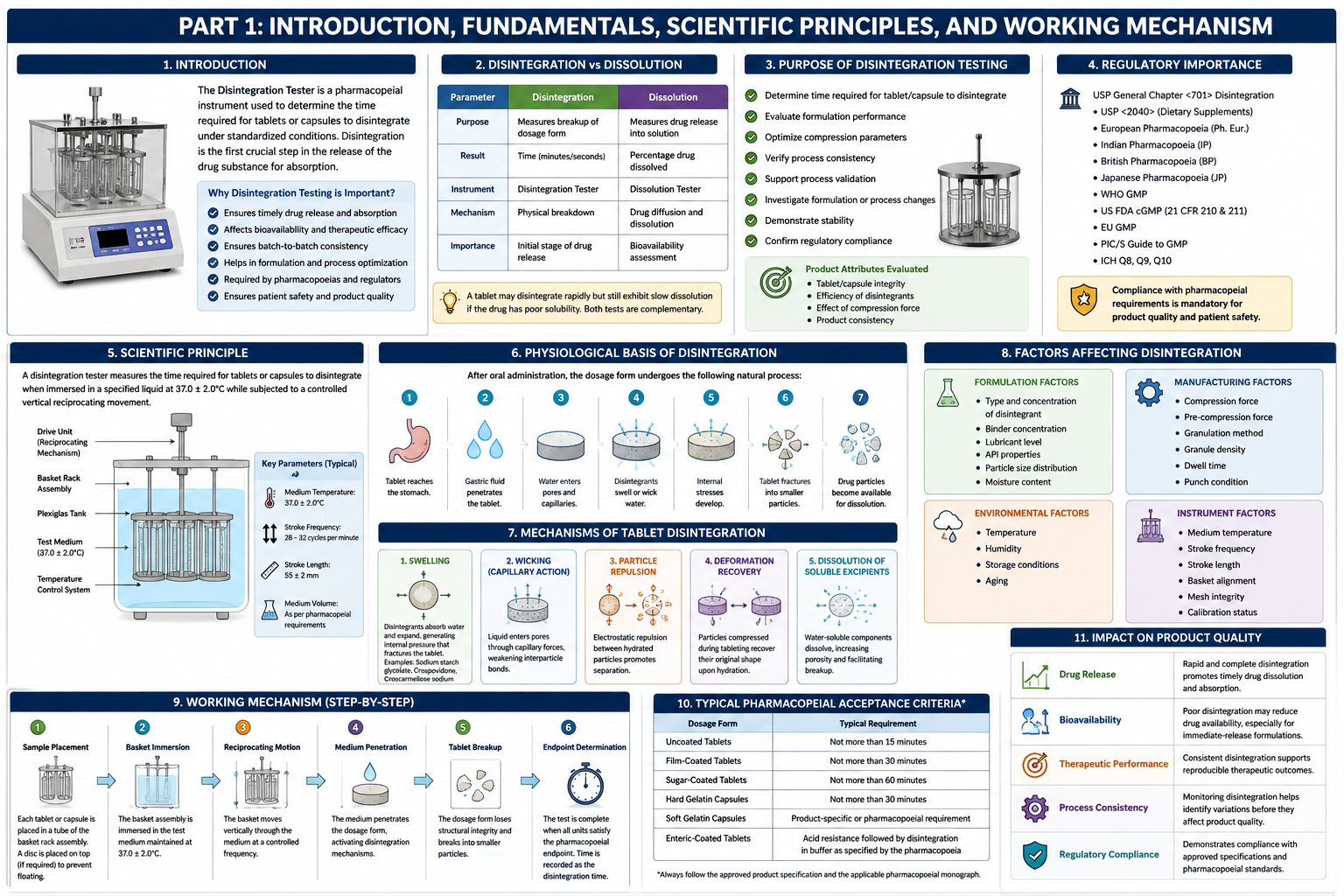
Disintegration is the first and one of the most critical steps in the release of an Active Pharmaceutical Ingredient (API) from an oral solid dosage (OSD) form. Before a tablet or capsule can dissolve and release its drug substance, it must first break down into smaller fragments. Failure of a dosage form to disintegrate within the specified time may delay or reduce drug release, affecting therapeutic efficacy and regulatory compliance.
The Disintegration Tester is a pharmacopeial quality control instrument designed to evaluate the time required for tablets or capsules to disintegrate under standardized laboratory conditions. It simulates the physiological environment of the gastrointestinal tract by immersing dosage units in a temperature-controlled medium while subjecting them to a defined reciprocating motion.
Modern disintegration testers incorporate digital temperature control, programmable test methods, automatic basket movement, electronic data storage, audit trails, and connectivity features compliant with 21 CFR Part 11 and EU Annex 11.
1. Introduction
What is Tablet Disintegration?
Tablet disintegration is the process by which a tablet or capsule breaks down into smaller particles when exposed to an aqueous medium under specified conditions. It is a physical process and should not be confused with dissolution, which measures the rate and extent of drug release into solution.
The disintegration test determines the time required for the dosage form to disintegrate completely under controlled conditions defined by pharmacopeial standards.
Difference Between Disintegration and Dissolution
| Parameter | Disintegration | Dissolution |
|---|---|---|
| Purpose | Measures breakup of dosage form | Measures drug release into solution |
| Result | Time (minutes/seconds) | Percentage drug dissolved |
| Instrument | Disintegration Tester | Dissolution Tester |
| Mechanism | Physical breakdown | Drug diffusion and dissolution |
| Importance | Initial stage of drug release | Bioavailability assessment |
A tablet may disintegrate rapidly but still exhibit slow dissolution if the drug has poor solubility. Therefore, both tests are complementary.
Why is Disintegration Testing Important?
Disintegration testing ensures that tablets and capsules break apart within a specified time, enabling subsequent dissolution and absorption of the drug.
Failure to meet disintegration specifications may result in:
- Delayed drug release
- Reduced bioavailability
- Therapeutic failure
- Batch rejection
- Regulatory observations
- Product recalls
- Patient dissatisfaction
Importance in Oral Solid Dosage (OSD) Manufacturing
Disintegration testing is performed at multiple stages of the product lifecycle.
Research & Development (R&D)
During formulation development, disintegration testing helps:
- Select suitable disintegrants
- Optimize binder concentration
- Evaluate excipient compatibility
- Compare prototype formulations
Process Development
Engineers use disintegration data to establish:
- Compression force limits
- Granulation parameters
- Moisture content specifications
- Process robustness
Commercial Manufacturing
Routine testing confirms consistent manufacturing performance and batch-to-batch uniformity.
Finished Product Testing
QC laboratories perform disintegration testing as part of release testing according to approved specifications.
Stability Studies
Disintegration testing monitors changes in tablet performance throughout the product shelf life.
Process Validation
Disintegration results demonstrate that the manufacturing process consistently produces dosage forms meeting predefined acceptance criteria.
Importance During Manufacturing
| Manufacturing Stage | Purpose |
|---|---|
| Formulation Development | Optimize composition |
| Granulation Development | Assess granule quality |
| Compression Setup | Optimize compression force |
| In-Process Control | Monitor process consistency |
| Process Validation | Demonstrate reproducibility |
| Finished Product Testing | Batch release |
| Stability Testing | Monitor long-term performance |
| Technology Transfer | Compare manufacturing sites |
Regulatory Importance
Disintegration testing is required by major pharmacopoeias and regulatory agencies worldwide.
Applicable guidance includes:
- USP General Chapter <701> Disintegration
- USP General Chapter <2040> (Dietary Supplements)
- European Pharmacopoeia (Ph. Eur.)
- Indian Pharmacopoeia (IP)
- British Pharmacopoeia (BP)
- Japanese Pharmacopoeia (JP)
- WHO GMP
- US FDA cGMP (21 CFR Parts 210 & 211)
- EU GMP
- PIC/S Guide to GMP
- ICH Q8 (Pharmaceutical Development)
- ICH Q9 (Quality Risk Management)
- ICH Q10 (Pharmaceutical Quality System)
Manufacturers must establish validated acceptance criteria based on the product formulation and applicable pharmacopoeial requirements.
Impact on Product Quality
Disintegration directly affects several Critical Quality Attributes (CQAs).
Drug Release
Rapid and complete disintegration promotes timely drug dissolution and absorption.
Bioavailability
Poor disintegration may reduce drug availability, particularly for immediate-release formulations.
Therapeutic Performance
Consistent disintegration supports reproducible therapeutic outcomes.
Process Consistency
Monitoring disintegration helps identify formulation or process variations before they affect product quality.
Regulatory Compliance
Routine disintegration testing demonstrates compliance with approved specifications and pharmacopoeial standards.
2. Purpose of Disintegration Testing
The primary purpose of disintegration testing is to determine the time required for a dosage form to break down into particles under standardized conditions.
Additional objectives include:
- Evaluating formulation performance
- Optimizing compression parameters
- Verifying process consistency
- Supporting process validation
- Investigating formulation changes
- Demonstrating stability
- Confirming regulatory compliance
- Assessing product robustness
Product Attributes Evaluated
Disintegration testing provides information on:
- Tablet integrity
- Capsule integrity
- Disintegration efficiency
- Performance of disintegrants
- Effect of compression force
- Influence of binder concentration
- Product consistency
- Manufacturing capability
3. Scientific Principle of Disintegration Testing
Fundamental Principle
A disintegration tester measures the time required for tablets or capsules to disintegrate completely when immersed in a specified liquid maintained at 37.0 ± 2.0°C while subjected to a controlled vertical reciprocating movement.
The dosage form is placed inside a cylindrical basket-rack assembly fitted with stainless steel mesh screens. During testing, the basket moves up and down through the medium at a controlled frequency, simulating conditions within the gastrointestinal tract.
Physiological Basis
Following oral administration:
- Tablet reaches the stomach.
- Gastric fluid penetrates the tablet.
- Water enters pores and capillaries.
- Disintegrants swell or wick water.
- Internal stresses develop.
- Tablet fractures into smaller particles.
- Drug particles become available for dissolution.
The disintegration tester reproduces this process under controlled laboratory conditions.
Mechanisms of Tablet Disintegration
Several mechanisms contribute to tablet breakup.
1. Swelling
Superdisintegrants absorb water and expand, generating internal pressure that fractures the tablet.
Examples:
- Sodium starch glycolate
- Crospovidone
- Croscarmellose sodium
2. Wicking (Capillary Action)
Liquid enters pores within the tablet through capillary forces, weakening interparticle bonds.
3. Particle Repulsion
Electrostatic repulsion between hydrated particles promotes separation.
4. Deformation Recovery
Particles compressed during tableting recover their original shape upon hydration, contributing to disintegration.
5. Dissolution of Soluble Excipients
Water-soluble components dissolve, increasing porosity and facilitating breakup.
Scientific Factors Affecting Disintegration
Formulation Factors
- Type and concentration of disintegrant
- Binder concentration
- Lubricant level
- API properties
- Particle size distribution
- Moisture content
Manufacturing Factors
- Compression force
- Pre-compression force
- Granulation method
- Granule density
- Dwell time
- Punch condition
Environmental Factors
- Temperature
- Humidity
- Storage conditions
- Aging
Instrument Factors
- Medium temperature
- Stroke frequency
- Stroke length
- Basket alignment
- Mesh integrity
- Calibration status
4. Working Mechanism
Modern disintegration testers operate through a controlled sequence of actions.
Step 1 – Sample Placement
Each tablet or capsule is placed into an individual tube of the basket-rack assembly.
If specified by the pharmacopeia or analytical method, a disc is placed on top of the dosage unit to prevent floating.
Step 2 – Basket Immersion
The basket assembly is immersed in the test medium maintained at 37.0 ± 2.0°C.
Common media include:
- Purified water
- Simulated gastric fluid
- Simulated intestinal fluid
- Buffer solutions
The medium depends on the dosage form and approved analytical method.
Step 3 – Reciprocating Motion
The basket moves vertically through the medium at a controlled frequency, exposing the dosage units to repeated immersion and drainage.
This motion simulates the hydrodynamic conditions of the gastrointestinal tract.
Step 4 – Medium Penetration
The test medium penetrates the tablet or capsule, activating the disintegration mechanisms such as swelling, wicking, and deformation recovery.
Step 5 – Tablet Breakup
The dosage form progressively loses structural integrity until only insoluble fragments or coating residues (where permitted) remain on the mesh screen.
Step 6 – Endpoint Determination
The test is complete when all dosage units satisfy the applicable pharmacopoeial endpoint criteria.
The total elapsed time is recorded as the disintegration time.
Factors Affecting Disintegration Results
Several variables influence the measured disintegration time.
Formulation Variables
- Disintegrant type and concentration
- Binder level
- Lubricant quantity
- Tablet hardness
- Friability
- API characteristics
Process Variables
- Compression force
- Granulation quality
- Moisture content
- Tablet thickness
- Coating thickness
Instrument Variables
- Medium temperature
- Basket stroke frequency
- Stroke length
- Basket alignment
- Mesh condition
- Calibration status
Environmental Variables
- Relative humidity
- Storage conditions
- Product aging
- Moisture uptake
Relationship Between Hardness, Friability, and Disintegration
| Test | Measures | Unit | Purpose |
|---|---|---|---|
| Hardness | Crushing strength | Newton (N) | Mechanical strength |
| Friability | Resistance to abrasion | % Weight Loss | Surface durability |
| Disintegration | Time to break apart | Minutes/Seconds | Drug release initiation |
These tests complement each other and collectively provide a comprehensive evaluation of tablet mechanical performance and functionality.
Part 1 Summary
This first part introduced the fundamentals of disintegration testing, including its role in oral solid dosage manufacturing, scientific principles, physiological basis, working mechanism, and the formulation, process, environmental, and instrument factors that influence test results.
Part 2: Construction, Components, Functional Description, Types of Disintegration Testers, Basket-Rack Assembly, Temperature Control System, and Engineering Design
5. Construction of a Disintegration Tester
Overview
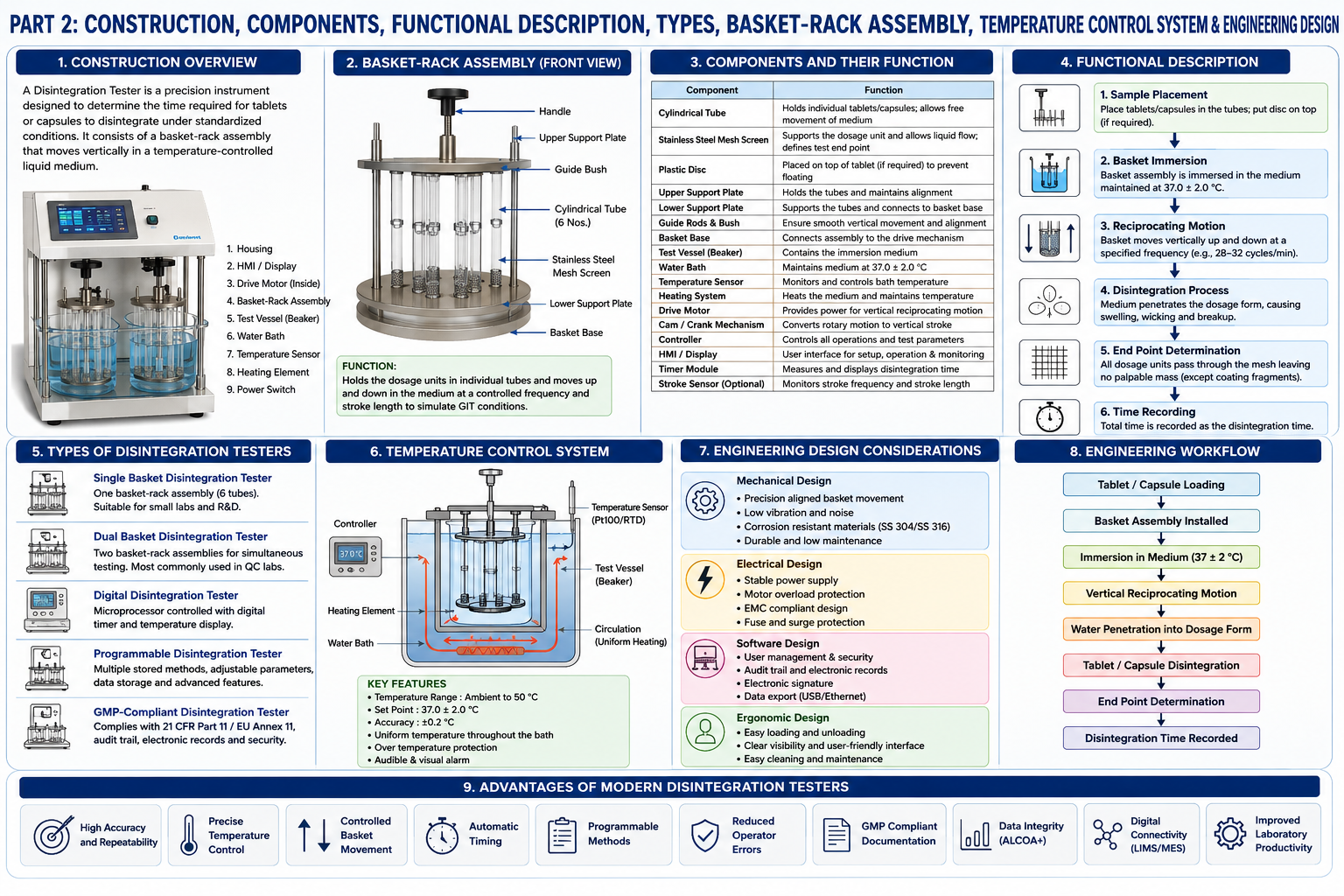
A Disintegration Tester is a precision electromechanical laboratory instrument designed to determine the time required for tablets and capsules to disintegrate under controlled conditions specified by pharmacopeias such as USP, Ph. Eur., IP, BP, and JP.
The instrument consists of a basket-rack assembly that moves vertically in a temperature-controlled liquid medium. The controlled reciprocating motion, combined with the specified medium temperature, simulates the environment of the gastrointestinal tract.
Modern disintegration testers combine precision mechanics, temperature control, sensors, electronics, and software to provide highly accurate, repeatable, and GMP-compliant testing.
A typical disintegration tester consists of the following major assemblies:
- Instrument Housing
- Basket-Rack Assembly
- Cylindrical Tubes
- Stainless Steel Mesh Screens
- Plastic Discs
- Beaker or Test Vessel
- Water Bath
- Heating System
- Temperature Sensor
- Circulation System
- Drive Motor
- Cam or Crank Mechanism
- Vertical Reciprocating Assembly
- Stroke Sensor
- Embedded Controller
- Human Machine Interface (HMI)
- Timer Module
- Data Storage Module
- USB/Ethernet Communication Ports
- Power Supply Unit
General Construction Layout
              ┌──────────────────────────────┐
              │      Touchscreen Display     │
              └──────────────┬───────────────┘
                             │
                  Embedded Controller
                             │
       ┌─────────────────────┼─────────────────────┐
       │                     │                     │
 Temperature Sensor     Timer Module       Stroke Sensor
       │
  Heating Controller
       │
   Heating Element
       │
 Temperature-Controlled Water Bath
       │
   Basket-Rack Assembly
       │
 Cylindrical Tubes with Tablets
       │
 Stainless Steel Mesh Screens
       │
 Vertical Reciprocating Motion
       │
 Disintegration Observation
5.1 Instrument Housing
Function
The housing provides mechanical support and protects the internal electrical and mechanical assemblies from dust, moisture, and accidental damage.
Construction Materials
Most pharmaceutical-grade disintegration testers are manufactured using:
- SS304 Stainless Steel
- SS316 Stainless Steel (premium models)
- Powder-coated steel
- Engineering-grade polymers (outer covers)
Design Features
- Smooth GMP-compliant surfaces
- Rounded corners
- Corrosion-resistant finish
- Easy-to-clean construction
- Chemical-resistant exterior
5.2 Basket-Rack Assembly
The basket-rack assembly is the most important component of the disintegration tester.
Function
It holds the dosage units and moves them vertically through the immersion medium at a controlled frequency and stroke length.
The assembly simulates the hydrodynamic conditions experienced by tablets and capsules within the gastrointestinal tract.
Major Components
- Basket support frame
- Six cylindrical tubes (standard configuration)
- Stainless steel mesh screens
- Upper support plate
- Lower support plate
- Guide rods
- Disc retainers
5.3 Cylindrical Tubes
Each dosage unit is placed in an individual transparent cylindrical tube.
Construction
Typical materials:
- Borosilicate glass
- Transparent acrylic (selected models)
Functions
- Hold individual tablets or capsules
- Allow unrestricted movement of the medium
- Permit visual observation throughout the test
Typical Dimensions
| Parameter | Typical Value |
|---|---|
| Number of Tubes | 6 |
| Tube Material | Borosilicate Glass |
| Tube Length | As per pharmacopoeial specification |
| Internal Diameter | As specified by USP/IP/Ph. Eur. |
5.4 Stainless Steel Mesh Screens
The mesh screen forms the lower end of each tube.
Function
- Supports the dosage unit
- Allows liquid flow
- Determines endpoint criteria
- Retains undisintegrated fragments
Construction Material
Typically:
- SS316 Stainless Steel
- Corrosion resistant
- Precision woven mesh
Requirements
- Uniform mesh size
- No distortion
- No corrosion
- Secure attachment
5.5 Plastic Discs
Certain dosage forms require plastic discs placed on top of the tablet during testing.
Purpose
The disc:
- Prevents tablet floating
- Maintains consistent contact with the medium
- Promotes uniform testing
- Meets pharmacopoeial testing requirements
Construction Material
Usually manufactured from:
- Transparent acrylic
- Polycarbonate
- PTFE (selected designs)
5.6 Test Vessel (Beaker)
The basket-rack assembly moves inside a glass test vessel containing the immersion medium.
Construction
Typical material:
- Borosilicate glass
Advantages
- Thermal resistance
- Chemical resistance
- Transparency
- Easy cleaning
5.7 Water Bath
The water bath surrounds the test vessel and maintains the immersion medium at the required temperature.
Functions
- Uniform heating
- Stable temperature
- Minimized temperature fluctuations
- Compliance with pharmacopoeial requirements
5.8 Heating System
The heating system maintains the medium at:
37.0 ± 2.0°C
Components
- Electric heater
- Temperature controller
- Thermostat
- Over-temperature protection
Importance
Temperature significantly affects:
- Tablet swelling
- Capsule shell softening
- Disintegration rate
- Reproducibility
5.9 Temperature Sensor
Modern instruments employ:
- Platinum Resistance Thermometer (Pt100)
- RTD sensors
- Digital temperature probes
Functions
- Continuous temperature monitoring
- Heater control
- Alarm generation
- Temperature recording
Typical Accuracy
| Parameter | Typical Value |
|---|---|
| Accuracy | ±0.2°C |
| Resolution | 0.1°C |
5.10 Drive Motor
The drive motor generates the reciprocating motion.
Modern instruments generally use:
Stepper Motor
Advantages:
- Accurate stroke control
- Reliable operation
- Low maintenance
- Excellent repeatability
Servo Motor
Premium systems may use servo motors for:
- Closed-loop motion control
- High positioning accuracy
- Smooth movement
- Minimal vibration
5.11 Cam or Crank Mechanism
The motor’s rotary motion is converted into vertical reciprocating motion using:
- Cam mechanism
- Crank mechanism
- Eccentric drive
Functions
- Generate vertical movement
- Maintain constant stroke length
- Ensure repeatable motion
- Reduce vibration
5.12 Stroke Mechanism
The basket-rack assembly moves vertically through the medium.
Typical characteristics include:
- Controlled stroke length
- Uniform frequency
- Smooth acceleration
- Stable movement
These parameters are verified during calibration and qualification.
5.13 Embedded Controller
The controller functions as the instrument’s central processing unit.
Responsibilities
- Motor control
- Stroke regulation
- Temperature control
- Timer operation
- Alarm management
- Data storage
- User management
- Communication
5.14 Human Machine Interface (HMI)
Modern disintegration testers feature digital displays or color touchscreens.
Typical HMI functions include:
- Test setup
- User login
- Method selection
- Timer
- Temperature display
- Calibration menu
- Historical results
- Alarm messages
- Diagnostics
5.15 Communication Interfaces
Many modern systems provide:
- USB
- Ethernet
- RS-232
- Printer connection
- Barcode reader integration
- LIMS compatibility
- MES integration (selected models)
5.16 Internal Software
Advanced software performs:
- Instrument control
- Temperature monitoring
- Stroke monitoring
- Timer management
- User authentication
- Electronic records
- Audit trail generation
- Report creation
- Data export
Premium models support:
- FDA 21 CFR Part 11
- EU Annex 11
- ALCOA+
- GAMP 5 lifecycle principles
6. Functional Description of Each Component
| Component | Function | Importance |
|---|---|---|
| Housing | Supports and protects instrument | Stability |
| Basket-Rack Assembly | Holds dosage units | Core testing component |
| Cylindrical Tubes | Hold tablets/capsules | Individual testing |
| Mesh Screens | Support dosage units | Defines endpoint |
| Plastic Discs | Prevent floating | Test consistency |
| Water Bath | Maintains temperature | Pharmacopoeial compliance |
| Heating System | Controls bath temperature | Reproducibility |
| Temperature Sensor | Monitors temperature | Accuracy |
| Drive Motor | Produces movement | Repeatability |
| Cam Mechanism | Converts rotary motion | Vertical stroke |
| Controller | Controls entire system | Automation |
| HMI | User interaction | Ease of operation |
| Communication Ports | Data transfer | LIMS/MES integration |
7. Types of Disintegration Testers
Disintegration testers are classified according to automation level and testing capacity.
7.1 Single Basket Disintegration Tester
Characteristics
- One basket-rack assembly
- Six tubes
- Compact design
- Suitable for routine testing
Applications
- Small QC laboratories
- Research laboratories
- Academic institutions
Advantages
- Economical
- Easy operation
- Small footprint
- Simple maintenance
Limitations
- Lower throughput
- One test at a time
7.2 Dual Basket Disintegration Tester
The most common configuration used in commercial pharmaceutical laboratories.
Advantages
- Two basket-rack assemblies
- Simultaneous testing
- Increased productivity
- Reduced analysis time
Applications
- Commercial manufacturing
- Stability laboratories
- Validation batches
- Contract testing organizations
7.3 Digital Disintegration Tester
Modern digital systems include:
- Microprocessor control
- Digital timer
- Digital temperature display
- Automatic stroke control
- Alarm system
- Method storage
7.4 Programmable Disintegration Tester
Premium instruments provide:
- Multiple stored methods
- Password-protected access
- Adjustable parameters
- Electronic signatures
- Audit trails
- Data export
- Network connectivity
7.5 GMP-Compliant Disintegration Tester
Designed for regulated pharmaceutical environments.
Features
- 21 CFR Part 11 compliance
- EU Annex 11 compliance
- Role-based access
- Electronic records
- Audit trails
- LIMS integration
- Barcode support
8. Engineering Design Considerations
Modern disintegration testers are designed to maximize precision, reliability, and regulatory compliance.
Mechanical Design
- Precision basket alignment
- Low vibration
- High-quality bearings
- Durable reciprocating mechanism
- Corrosion-resistant materials
Temperature Control Design
- Uniform bath circulation
- Rapid temperature recovery
- High-accuracy sensors
- Stable control algorithms
- Over-temperature protection
Electrical Design
- Stable power supply
- Motor protection
- EMC compliance
- Surge protection
- Fuse protection
Software Design
- User authentication
- Audit trails
- Electronic signatures
- Alarm handling
- Secure data storage
- Automatic backups (advanced models)
Ergonomic Design
- Easy basket loading
- Clear visibility
- User-friendly interface
- Easy cleaning
- Reduced operator fatigue
Engineering Workflow
Tablet/Capsule Loading
        │
        ▼
Basket Assembly Installed
        │
        ▼
Immersion in Medium (37 ± 2°C)
        │
        ▼
Vertical Reciprocating Motion
        │
        ▼
Water Penetration into Dosage Form
        │
        ▼
Tablet/Capsule Disintegration
        │
        ▼
Endpoint Determination
        │
        ▼
Disintegration Time Recorded
Advantages of Modern Disintegration Testers
- High measurement repeatability
- Accurate temperature control
- Controlled basket movement
- Automated timing
- Programmable methods
- Reduced operator error
- GMP-compliant documentation
- Secure electronic records
- Integration with digital laboratory systems
- Improved laboratory productivity
Part 2 Summary
This section covered the construction, components, engineering design, and operating architecture of modern disintegration testers. Understanding the basket-rack assembly, temperature control system, reciprocating mechanism, and software functions is essential for proper operation, maintenance, calibration, qualification, and regulatory compliance.
Part 3: Major Manufacturers, Latest Models, Technical Specifications, Model Comparison, Selection Guide, and Emerging Technologies
9. Major Manufacturers of Disintegration Testers
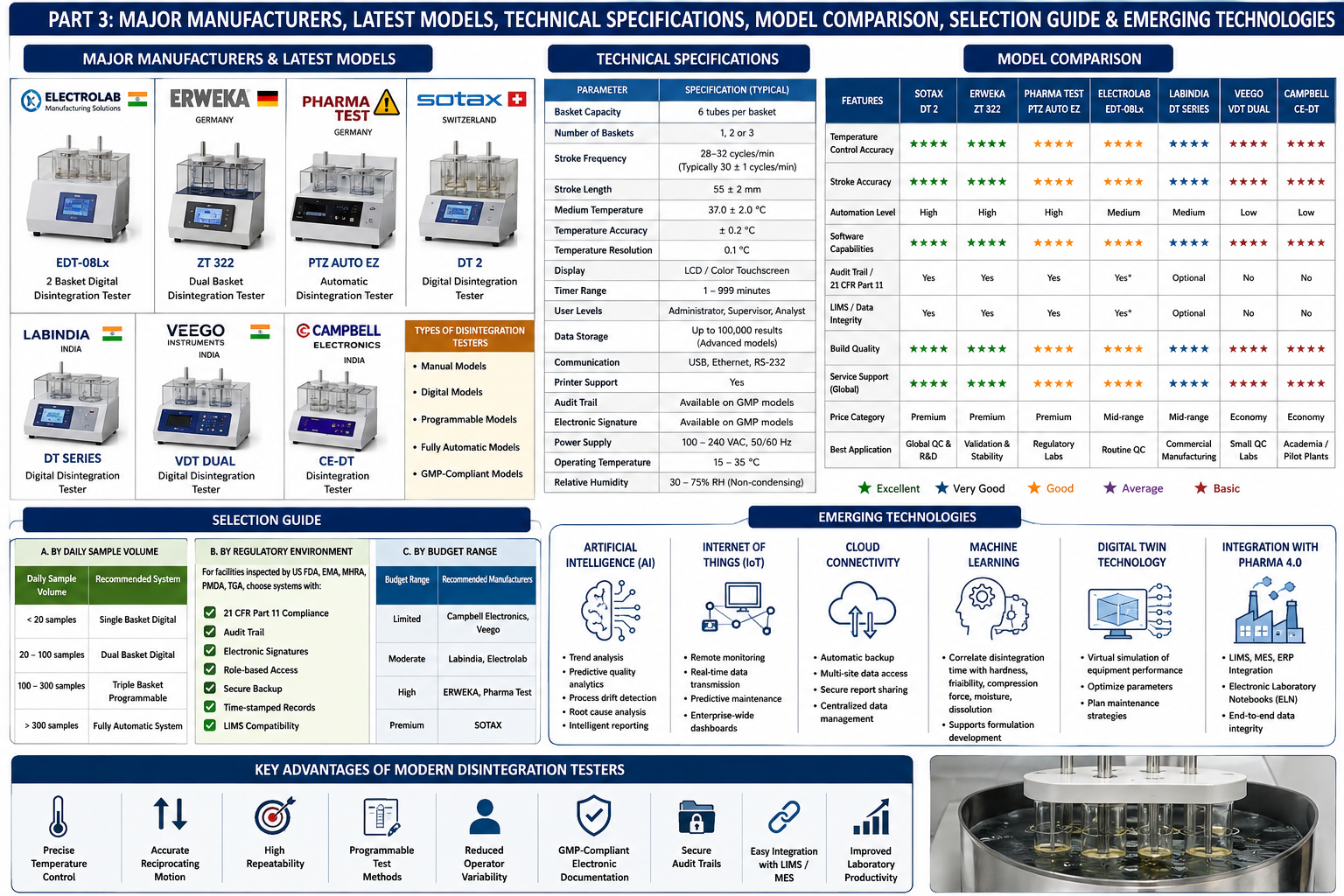
The pharmaceutical industry depends on internationally recognized manufacturers for disintegration testers that comply with USP <701>, IP, BP, Ph. Eur., JP, and global GMP requirements. Instrument selection should consider analytical performance, regulatory compliance, software functionality, automation, service support, and total cost of ownership.
9.1 Electrolab
Company Overview
Electrolab is one of the leading manufacturers of pharmaceutical testing instruments with a strong global presence in regulated and semi-regulated markets.
Headquarters
- Mumbai, India
Product Portfolio
- Disintegration Tester
- Dissolution Tester
- Friability Tester
- Hardness Tester
- Tap Density Tester
- Bulk Density Tester
- Leak Test Apparatus
Major Advantages
- Cost-effective
- GMP-compliant design
- Reliable temperature control
- Excellent service support
- Easy calibration
- User-friendly software
Representative Models
| Model | Description |
|---|---|
| EDT-08Lx | 2 Basket Digital Disintegration Tester |
| EDT-14Lx | 3 Basket Disintegration Tester |
| EDT-14Sx | Advanced GMP-Compliant Model |
Major Features
- Dual/Triple basket configuration
- Automatic temperature control
- Microprocessor control
- USB communication
- Electronic documentation
- Audit trail support (selected models)
9.2 ERWEKA
Company Overview
ERWEKA is a globally recognized German manufacturer known for premium pharmaceutical testing equipment and exceptional engineering quality.
Headquarters
- Germany
Strengths
- High precision
- Long equipment life
- Excellent temperature stability
- Comprehensive validation documentation
- Worldwide service support
Representative Models
| Model | Description |
|---|---|
| ZT 121 Light | Single Basket Digital Model |
| ZT 322 | Dual Basket Disintegration Tester |
| ZT 730 | High-End GMP System |
Key Features
- Automatic stroke control
- Digital temperature monitoring
- Programmable methods
- Touchscreen operation
- Electronic records
- LIMS connectivity
9.3 Pharma Test
Company Overview
Pharma Test manufactures high-quality pharmaceutical testing instruments widely used in Europe, North America, and Asia.
Headquarters
- Germany
Major Strengths
- Precision engineering
- Advanced automation
- Excellent software platform
- High repeatability
- GMP-ready documentation
Representative Models
| Model | Description |
|---|---|
| PTZ AUTO EZ | Automatic Disintegration Tester |
| PTZ-S | Single Basket System |
| PTZ-3E | Triple Basket Premium Model |
Major Features
- Automatic basket lifting
- Temperature monitoring
- Electronic signatures
- Audit trail
- User management
- Network connectivity
9.4 SOTAX
Company Overview
SOTAX is one of the world’s leading manufacturers of pharmaceutical testing equipment and integrated laboratory automation systems.
Headquarters
- Switzerland
Advantages
- Swiss precision engineering
- Advanced automation
- Premium software
- Excellent validation support
- Long service life
Representative Models
| Model | Description |
|---|---|
| DT 2 | Digital Disintegration Tester |
| DT 50 | Fully Automated System |
Features
- Automatic basket movement
- Multi-language interface
- Temperature monitoring
- Electronic records
- Network integration
9.5 Labindia
Company Overview
Labindia manufactures and supplies pharmaceutical laboratory equipment across India and international markets.
Advantages
- Affordable
- Good local support
- Reliable operation
- User-friendly software
Representative Models
- DT Series
- Digital Disintegration Tester
- Dual Basket Models
9.6 Veego Instruments
Headquarters
- India
Product Specialization
- Physical testing instruments
- Pharmaceutical QC equipment
- Tablet testing systems
Advantages
- Economical
- Reliable
- Easy maintenance
- Compact design
Representative Models
- VDT Series
- VDT Dual Basket
- VDT Digital
9.7 Campbell Electronics
Campbell Electronics manufactures pharmaceutical testing instruments for educational institutions, pilot plants, and routine laboratory testing.
Advantages
- Simple operation
- Cost-effective
- Compact footprint
- Low maintenance
Global Manufacturer Comparison
| Company | Country | Market Position |
|---|---|---|
| SOTAX | Switzerland | Premium |
| ERWEKA | Germany | Premium |
| Pharma Test | Germany | Premium |
| Electrolab | India | Mid to Premium |
| Labindia | India | Mid-range |
| Veego | India | Economy to Mid-range |
| Campbell Electronics | India | Economy |
10. Available Instrument Configurations
Disintegration testers are available in several configurations depending on testing volume and regulatory requirements.
Manual Models
Characteristics
- Basic controls
- Mechanical timer
- Manual parameter setting
- Suitable for educational institutions
Digital Models
Features include:
- Digital display
- Automatic timer
- Electronic temperature control
- Microprocessor operation
- Audible alarms
Programmable Models
Designed for GMP-regulated laboratories.
Capabilities include:
- Multiple stored methods
- User-defined parameters
- Password protection
- Audit trail
- Electronic signatures
- Data export
Fully Automatic Models
Premium instruments provide:
- Automatic basket movement
- Automatic endpoint detection (selected models)
- Electronic documentation
- LIMS integration
- Remote diagnostics
GMP-Compliant Models
These systems support:
- 21 CFR Part 11
- EU Annex 11
- Role-based access
- Electronic records
- Audit trail
- Secure backup
- Barcode integration
11. Technical Specifications
The following table summarizes typical specifications for modern disintegration testers.
| Parameter | Typical Specification |
|---|---|
| Basket Capacity | 6 tubes per basket |
| Number of Baskets | 1, 2, or 3 |
| Stroke Frequency | 28–32 cycles/min (typically 30 ± 1 cycles/min) |
| Stroke Length | 55 ± 2 mm |
| Medium Temperature | 37.0 ± 2.0°C |
| Temperature Accuracy | ±0.2°C |
| Temperature Resolution | 0.1°C |
| Display | LCD or Color Touchscreen |
| Timer Range | 1–999 minutes |
| User Levels | Administrator, Supervisor, Analyst |
| Data Storage | Up to 100,000 results (advanced models) |
| Communication | USB, Ethernet, RS-232 |
| Printer Support | Yes |
| Barcode Reader | Optional |
| Audit Trail | Available on GMP models |
| Electronic Signature | Available on GMP models |
| Power Supply | 100–240 VAC, 50/60 Hz |
| Operating Temperature | 15–35°C |
| Relative Humidity | 30–75% RH (non-condensing) |
12. Comparison of Leading Manufacturers
| Manufacturer | Temperature Control | Automation | Software | Audit Trail | Price Category | Best Application |
|---|---|---|---|---|---|---|
| SOTAX | Excellent | Excellent | Advanced | Yes | Premium | Global QC & R&D |
| ERWEKA | Excellent | Excellent | Advanced | Yes | Premium | Validation & Stability |
| Pharma Test | Excellent | Excellent | Advanced | Yes | Premium | Regulatory Laboratories |
| Electrolab | Very Good | Very Good | Good | Yes (selected models) | Mid-range | Routine QC |
| Labindia | Very Good | Good | Good | Optional | Mid-range | Commercial Manufacturing |
| Veego | Good | Basic | Basic | Limited | Economy | Small QC Labs |
| Campbell Electronics | Good | Basic | Basic | No | Economy | Academic & Pilot Plants |
13. Selection Guide
Selecting a disintegration tester should be based on regulatory requirements, workload, software capabilities, and future laboratory expansion.
Laboratory Throughput
| Daily Sample Volume | Recommended System |
|---|---|
| <20 samples | Single Basket Digital |
| 20–100 samples | Dual Basket Digital |
| 100–300 samples | Triple Basket Programmable |
| >300 samples | Fully Automated System |
Regulatory Environment
Facilities inspected by:
- US FDA
- EMA
- MHRA
- PMDA
- TGA
should consider systems with:
- 21 CFR Part 11 compliance
- Audit trail
- Electronic signatures
- Role-based access
- Secure backup
- Time-stamped records
- LIMS compatibility
Budget-Based Selection
| Budget | Recommended Manufacturers |
|---|---|
| Limited | Campbell Electronics, Veego |
| Moderate | Labindia, Electrolab |
| High | ERWEKA, Pharma Test |
| Premium | SOTAX |
14. Emerging Technologies
Modern disintegration testers are evolving with digital manufacturing and Pharma 4.0 initiatives.
Artificial Intelligence (AI)
AI applications include:
- Trend analysis
- Predictive quality analytics
- Process drift detection
- Root cause analysis support
- Intelligent reporting
Internet of Things (IoT)
IoT-enabled systems allow:
- Remote monitoring
- Real-time data transmission
- Predictive maintenance
- Enterprise-wide quality dashboards
Cloud Connectivity
Cloud-based solutions provide:
- Automatic backup
- Multi-site data access
- Secure report sharing
- Centralized data management
Machine Learning
Machine learning algorithms can correlate disintegration time with:
- Tablet hardness
- Friability
- Compression force
- Moisture content
- Dissolution profile
This supports improved formulation development and process optimization.
Digital Twin Technology
Digital twins enable virtual simulation of equipment performance, allowing optimization of operating parameters and maintenance strategies before implementation.
Automated Trending
Modern software automatically generates:
- Control charts
- Statistical Process Control (SPC) reports
- Trend analyses
- Capability indices (Cp, Cpk)
- Out-of-specification alerts
Integration with Pharma 4.0
Advanced disintegration testers integrate with:
- Laboratory Information Management Systems (LIMS)
- Manufacturing Execution Systems (MES)
- Enterprise Resource Planning (ERP)
- Electronic Laboratory Notebooks (ELN)
These integrations improve workflow efficiency, traceability, and data integrity.
Advantages of Modern Disintegration Testers
- Precise temperature control
- Accurate reciprocating motion
- High repeatability
- Programmable test methods
- Reduced operator variability
- GMP-compliant electronic documentation
- Secure audit trails
- Easy integration with laboratory information systems
- Improved laboratory productivity
Part 3 Summary
This section covered the leading manufacturers of disintegration testers, representative models, technical specifications, instrument configurations, comparison of major brands, selection criteria, and emerging technologies. Selecting the appropriate disintegration tester requires evaluating laboratory throughput, regulatory expectations, automation level, software functionality, validation support, and long-term service capability.
Part 4: Standard Operating Procedure (SOP), Calibration, Performance Verification, Qualification (DQ, IQ, OQ, PQ), Validation, Maintenance, Cleaning, Safety, and Documentation
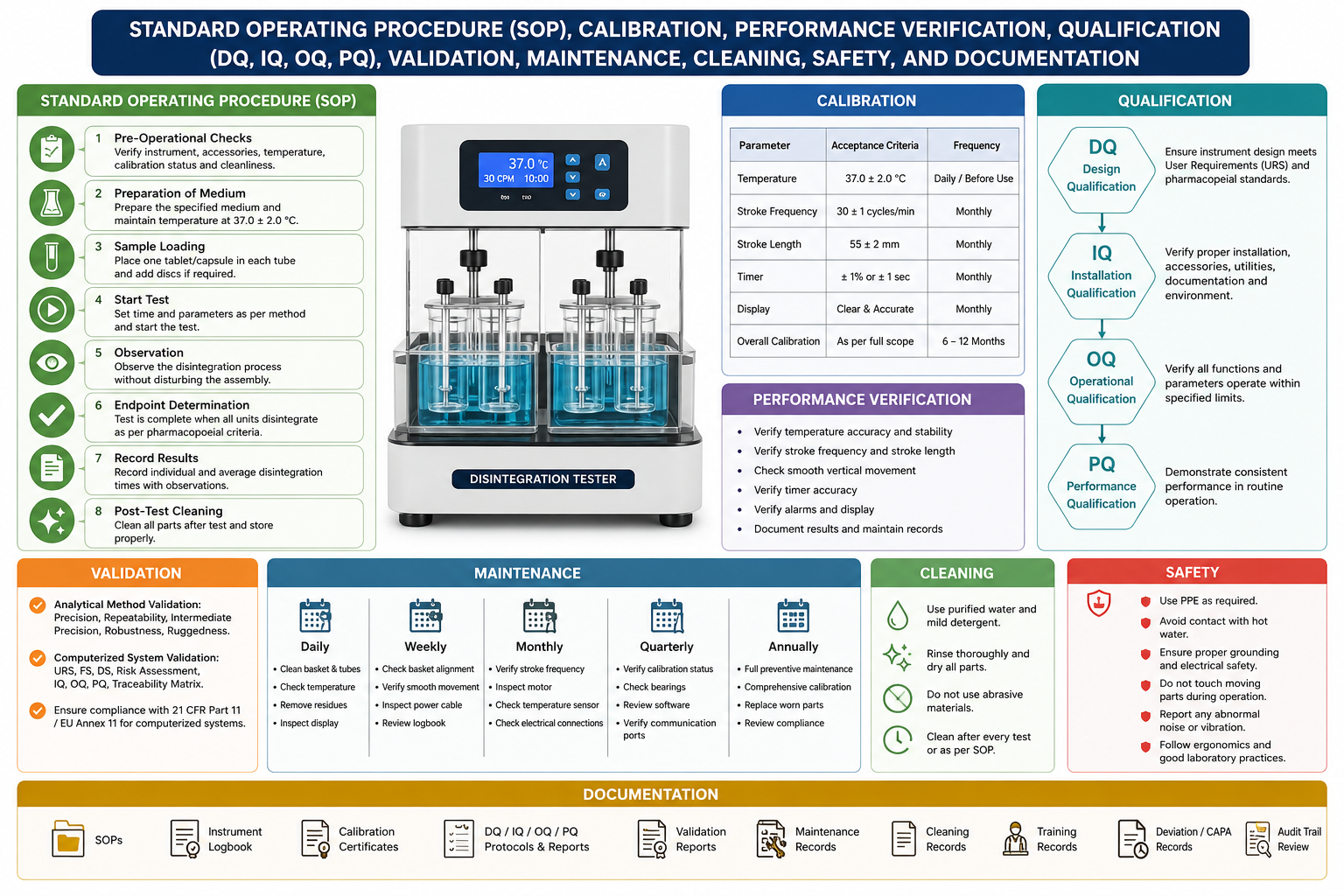
15. Standard Operating Procedure (SOP)
15.1 Objective
To establish a standardized procedure for operating the Disintegration Tester to accurately determine the disintegration time of tablets and capsules in accordance with pharmacopeial requirements while ensuring GMP compliance, data integrity, operator safety, and reproducible results.
15.2 Scope
This SOP applies to:
- Research & Development (R&D)
- Formulation Development
- Process Development
- In-Process Quality Control (IPQC)
- Finished Product Testing
- Stability Studies
- Process Validation
- Cleaning Validation (supporting studies)
- Technology Transfer
- Commercial Manufacturing
15.3 Responsibilities
| Department | Responsibility |
|---|---|
| QC Analyst | Perform testing and document results |
| QC Supervisor | Review and approve test results |
| QA Department | Verify GMP compliance and documentation |
| Engineering | Preventive maintenance and repairs |
| Calibration Team | Calibration and performance verification |
| Validation Team | DQ, IQ, OQ & PQ |
| Production | Provide representative samples |
16. Pre-Operational Checks
Before testing, verify the following:
| Check | Acceptance Criteria |
|---|---|
| Instrument cleanliness | No visible residue |
| Basket assembly | Clean and undamaged |
| Mesh screens | Intact and free from blockage |
| Glass beaker | Clean and free from cracks |
| Water bath | Filled to required level |
| Medium temperature | 37.0 ± 2.0°C |
| Calibration status | Valid |
| Qualification status | Current |
| Display | No system errors |
| Timer | Functional |
| Stroke movement | Smooth and uniform |
17. Environmental Requirements
Disintegration testing should be conducted under controlled laboratory conditions.
| Parameter | Recommended Range |
|---|---|
| Temperature | 20–25°C |
| Relative Humidity | 40–60% RH |
| Vibration | Minimal |
| Airflow | No direct drafts |
| Lighting | Adequate for observation |
18. Sample Preparation
Proper sample preparation ensures representative and reproducible results.
Sample Requirements
- Representative of the batch
- Free from visible defects unrelated to manufacturing
- Stored under recommended conditions
- Equilibrated to room temperature before testing
Sample Quantity
Unless otherwise specified:
- 6 tablets or capsules are tested simultaneously (one per tube), following the applicable pharmacopoeial method or approved product specification.
19. Operating Procedure
Step 1 – Instrument Startup
- Switch ON the instrument.
- Allow system initialization.
- Verify display and self-diagnostic status.
- Confirm calibration validity.
Step 2 – User Login
For computerized systems:
- Login using authorized credentials.
- Confirm user role.
- Verify audit trail is enabled.
Step 3 – Preparation of Medium
Prepare the required immersion medium according to the approved method.
Examples:
- Purified Water
- Simulated Gastric Fluid
- Simulated Intestinal Fluid
- Buffer Solution
Adjust the bath temperature to:
37.0 ± 2.0°C
Allow sufficient time for temperature stabilization.
Step 4 – Basket Preparation
Inspect:
- Basket assembly
- Tubes
- Mesh screens
- Plastic discs (if required)
Replace damaged components before testing.
Step 5 – Sample Loading
- Place one tablet or capsule into each tube.
- Place discs if required by the analytical method or pharmacopoeia.
- Secure the basket assembly.
Step 6 – Start Test
Program the required parameters:
| Parameter | Typical Value |
|---|---|
| Medium Temperature | 37.0 ± 2.0°C |
| Stroke Frequency | 30 ± 1 cycles/min |
| Stroke Length | 55 ± 2 mm |
Press START.
Step 7 – Observation
Observe:
- Tablet swelling
- Capsule shell rupture
- Fragmentation
- Complete disintegration
Record any unusual observations.
Step 8 – Endpoint Determination
The test is complete when all dosage units meet the pharmacopeial endpoint criteria.
Record:
- Individual disintegration times
- Average disintegration time
- Observations
Step 9 – Documentation
Record:
- Product name
- Batch number
- Instrument ID
- Medium used
- Temperature
- Analyst
- Date
- Test results
- Observations
- Reviewer approval
Electronic records should comply with data integrity requirements.
20. Calibration
Objective
Calibration ensures that the disintegration tester operates accurately with respect to:
- Temperature
- Stroke frequency
- Stroke length
- Timer
- Basket movement
Calibration Frequency
| Activity | Frequency |
|---|---|
| Temperature Verification | Daily or before use (as per SOP) |
| Stroke Frequency Verification | Monthly |
| Stroke Length Verification | Monthly |
| Timer Verification | Monthly |
| Comprehensive Calibration | Every 6–12 months |
| After Repair | Before use |
| After Relocation | Before qualification |
Calibration Parameters
Temperature
Verify using a certified reference thermometer.
Acceptance:
37.0 ± 2.0°C
Stroke Frequency
Verify basket movement using:
- Calibrated tachometer
- Electronic cycle counter
Acceptance:
30 ± 1 cycles/min
Stroke Length
Measure using a calibrated measuring device.
Typical acceptance:
55 ± 2 mm
Timer
Verify using a calibrated stopwatch.
Calibration Records
Calibration records should include:
- Instrument ID
- Calibration date
- Reference standards
- Calibration results
- Acceptance criteria
- Adjustments performed
- Reviewer approval
- Next calibration due date
21. Performance Verification
Routine performance verification confirms continued instrument suitability.
Typical checks include:
- Basket movement
- Temperature stability
- Stroke frequency
- Stroke length
- Timer accuracy
- Visual inspection
- Alarm verification
22. Qualification
Qualification confirms that the instrument is fit for its intended use.
22.1 Design Qualification (DQ)
Objective:
Verify that the selected instrument satisfies the User Requirement Specification (URS).
Typical DQ activities:
- Review vendor documentation
- Confirm pharmacopeial compliance
- Assess software capabilities
- Review service support
- Verify spare part availability
22.2 Installation Qualification (IQ)
Verify proper installation.
Typical IQ Checklist
| Verification Item | Status |
|---|---|
| Instrument model | Verified |
| Serial number | Verified |
| Utilities connected | Verified |
| Installation location | Approved |
| Operating manuals | Available |
| Calibration certificates | Available |
| Software version | Documented |
| Environmental conditions | Acceptable |
22.3 Operational Qualification (OQ)
Verify proper operation across the specified operating range.
Typical OQ tests include:
- Temperature accuracy
- Stroke frequency
- Stroke length
- Timer accuracy
- Alarm verification
- User access control
- Audit trail
- Communication ports
22.4 Performance Qualification (PQ)
Demonstrate consistent performance during routine operation.
Typical PQ studies include:
- Repeatability testing
- Reproducibility
- Product-specific verification
- Analyst-to-analyst comparison
- Long-term performance monitoring
23. Validation Considerations
Analytical Method Validation
Evaluate:
- Precision
- Repeatability
- Intermediate precision
- Robustness
- Ruggedness
- Measurement uncertainty
Computerized System Validation (CSV)
For software-controlled systems:
Validation documentation should include:
- User Requirement Specification (URS)
- Functional Specification (FS)
- Design Specification (DS)
- Risk Assessment
- IQ/OQ/PQ
- Traceability Matrix
- User Acceptance Testing (UAT)
Validation should follow a lifecycle approach consistent with GAMP 5.
24. GMP Documentation
Essential documents include:
- Standard Operating Procedure (SOP)
- Instrument Logbook
- Calibration Procedure
- Calibration Certificates
- DQ/IQ/OQ/PQ Protocols
- Qualification Reports
- Validation Reports
- Preventive Maintenance Records
- Breakdown Records
- Change Control
- Deviation Reports
- CAPA Records
- Audit Trail Review
- Backup and Restore Records
25. Preventive Maintenance
Daily
- Clean basket assembly
- Inspect mesh screens
- Verify bath temperature
- Remove residues
- Check display
Weekly
- Inspect basket alignment
- Verify stroke movement
- Inspect power cable
- Review instrument logbook
Monthly
- Verify stroke frequency
- Inspect motor
- Check temperature sensor
- Inspect electrical connections
Quarterly
- Verify calibration status
- Inspect bearings
- Review software functionality
- Verify communication interfaces
Annually
- Full preventive maintenance
- Comprehensive calibration
- Replacement of worn parts
- Software update review
- Regulatory compliance review
26. Cleaning Procedure
Proper cleaning minimizes contamination and ensures consistent performance.
Cleaning Materials
- Lint-free cloth
- Purified water
- Neutral laboratory detergent
- 70% IPA (if compatible with manufacturer recommendations)
Avoid abrasive materials that may damage acrylic or glass components.
Cleaning Frequency
| Component | Frequency |
|---|---|
| Basket assembly | After each test |
| Glass beakers | After each use |
| Water bath | Daily |
| Instrument housing | Daily |
| Touchscreen | Daily |
| Internal components | As per maintenance schedule |
Cleaning Verification
Confirm:
- No visible residue
- Clean mesh screens
- Clean glassware
- Correct basket movement
- Normal instrument operation
27. Safety Precautions
Operator Safety
- Wear appropriate PPE.
- Avoid contact with hot water.
- Ensure basket is secured before starting.
- Operate only after appropriate training.
Electrical Safety
- Ensure proper grounding.
- Inspect power cords regularly.
- Disconnect power before maintenance.
- Do not operate with damaged electrical components.
Mechanical Safety
- Keep hands away from moving basket assembly.
- Do not obstruct basket movement.
- Report abnormal vibration or noise immediately.
Thermal Safety
- Exercise caution when handling heated media.
- Allow hot components to cool before maintenance or cleaning.
Ergonomics
- Position the instrument at a comfortable working height.
- Handle glass vessels carefully.
- Minimize repetitive strain during sample loading.
Part 4 Summary
This section provided a comprehensive guide to the operation and lifecycle management of disintegration testers, including the Standard Operating Procedure (SOP), calibration, performance verification, qualification (DQ, IQ, OQ, PQ), validation, preventive maintenance, cleaning, safety practices, and GMP documentation. Adherence to these procedures ensures accurate, reproducible, and pharmacopeially compliant disintegration testing while supporting regulatory compliance and long-term instrument reliability.
Part 5: GMP Requirements, Regulatory Compliance, Applications, Acceptance Criteria, Troubleshooting, Audit Readiness, AI Integration, FAQs, Interview Questions, and Key Takeaways
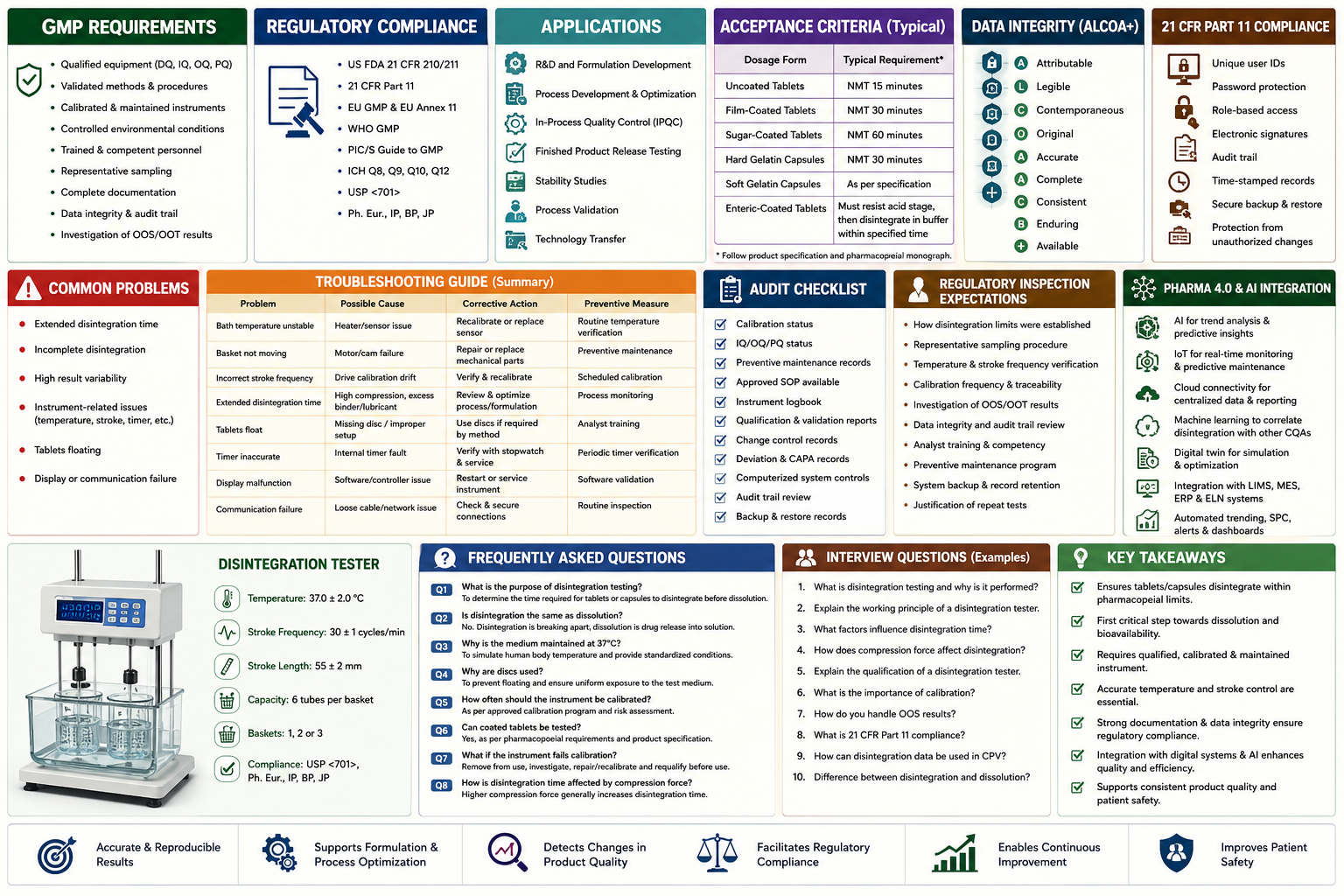
28. GMP Requirements for Disintegration Testing
Disintegration testing is a Critical Quality Control (QC) activity that verifies whether tablets and capsules disintegrate within established pharmacopeial limits. It supports product quality, patient safety, process consistency, and regulatory compliance throughout the product lifecycle.
A GMP-compliant disintegration testing program should include:
- Qualified equipment (DQ, IQ, OQ & PQ)
- Approved Standard Operating Procedures (SOPs)
- Valid calibration status
- Controlled environmental conditions
- Trained analysts
- Representative sampling
- Approved analytical methods
- Complete documentation
- Investigation of OOS/OOT results
- Preventive maintenance
- Secure electronic records
- Audit trail review
Applicable Regulations and Guidelines
Disintegration testing should comply with the principles described in:
- US FDA 21 CFR Parts 210 & 211
- 21 CFR Part 11 (Electronic Records & Electronic Signatures)
- EU GMP Volume 4
- EU Annex 11
- WHO GMP
- PIC/S Guide to GMP
- ICH Q8 – Pharmaceutical Development
- ICH Q9 – Quality Risk Management
- ICH Q10 – Pharmaceutical Quality System
- ICH Q12 – Product Lifecycle Management
- USP General Chapter <701> Disintegration
- USP <2040> (Dietary Supplements)
- European Pharmacopoeia (Ph. Eur.)
- Indian Pharmacopoeia (IP)
- British Pharmacopoeia (BP)
- Japanese Pharmacopoeia (JP)
29. Data Integrity Requirements
Modern computerized disintegration testers should comply with ALCOA+ principles.
ALCOA+ Principles
| Principle | Requirement |
|---|---|
| Attributable | Record the identity of the analyst performing the test |
| Legible | Ensure results remain readable throughout retention |
| Contemporaneous | Record results at the time of testing |
| Original | Preserve original electronic records |
| Accurate | Ensure data correctly reflects instrument output |
| Complete | Include all results, including failed and repeated tests |
| Consistent | Maintain correct date and time sequence |
| Enduring | Securely retain records |
| Available | Make records readily retrievable during inspections |
21 CFR Part 11 Compliance
Computerized disintegration testers should provide:
- Unique user IDs
- Password protection
- Role-based access
- Electronic signatures
- Secure audit trails
- Time-stamped records
- Backup and restore capability
- Protection against unauthorized data modification
30. Applications of Disintegration Testing
Disintegration testing is performed throughout pharmaceutical development and commercial manufacturing.
Research & Development (R&D)
- Formulation screening
- Disintegrant selection
- Binder optimization
- Excipient compatibility studies
- Prototype evaluation
Process Development
- Compression force optimization
- Granulation optimization
- Process robustness evaluation
- Design Space development
Commercial Manufacturing
Routine testing verifies:
- Batch consistency
- Process capability
- Compression performance
- Product quality
Finished Product Release
Disintegration testing is a routine QC release test for immediate-release tablets and capsules according to approved product specifications.
Stability Studies
Monitoring disintegration over time helps detect:
- Aging effects
- Moisture uptake
- Changes in coating performance
- Packaging-related influences
Process Validation
Disintegration data demonstrate that the manufacturing process consistently produces dosage forms meeting predefined specifications.
Technology Transfer
Comparative disintegration results confirm process equivalence across manufacturing sites.
31. Typical Acceptance Criteria
Acceptance criteria depend on the dosage form, formulation, and applicable pharmacopoeial monograph.
Typical pharmacopeial expectations include:
| Dosage Form | Typical Requirement* |
|---|---|
| Uncoated Tablets | Generally NMT 15 minutes |
| Film-Coated Tablets | Generally NMT 30 minutes |
| Sugar-Coated Tablets | Generally NMT 60 minutes |
| Hard Gelatin Capsules | Generally NMT 30 minutes |
| Soft Gelatin Capsules | As per approved specification |
| Enteric-Coated Tablets | Must resist acid stage, then disintegrate in buffer within specified time |
nit = Not More Than
*Always follow the product-specific specification and applicable pharmacopoeial monograph.
Relationship Between Disintegration and Other Critical Quality Attributes
| Quality Attribute | Effect of Slow Disintegration | Effect of Rapid Disintegration |
|---|---|---|
| Dissolution | May be delayed | Usually improves dissolution initiation |
| Bioavailability | May decrease | May improve for immediate-release products |
| Therapeutic Effect | Delayed onset possible | Supports timely drug release |
| Process Consistency | May indicate formulation/process issues | Indicates appropriate formulation performance |
| Patient Satisfaction | Potential variability | More consistent product performance |
32. Common Problems
1. Extended Disintegration Time
Possible Causes
- Excessive compression force
- High binder concentration
- Inadequate disintegrant
- Excess lubricant
- Thick coating
- Low tablet porosity
Impact
- Delayed drug release
- Possible specification failure
- Batch rejection
2. Incomplete Disintegration
Possible Causes
- Improper formulation
- Inadequate swelling of disintegrant
- Coating defects
- Manufacturing variability
3. High Result Variability
Possible Causes
- Non-representative sampling
- Incorrect medium temperature
- Basket misalignment
- Stroke frequency variation
- Environmental fluctuations
4. Instrument-Related Issues
Possible causes include:
- Temperature deviation
- Stroke frequency drift
- Basket movement obstruction
- Timer malfunction
- Sensor failure
- Calibration overdue
33. Troubleshooting Guide
| Problem | Possible Cause | Root Cause | Corrective Action | Preventive Measure |
|---|---|---|---|---|
| Bath temperature unstable | Heater or sensor issue | RTD failure or controller malfunction | Recalibrate or replace sensor | Routine temperature verification |
| Basket not moving | Motor or cam mechanism failure | Mechanical wear | Repair or replace drive components | Preventive maintenance |
| Incorrect stroke frequency | Drive calibration drift | Motor speed variation | Verify and recalibrate | Scheduled calibration |
| Tablets float | Missing disc or formulation issue | Incorrect test setup | Use discs if required by method | Analyst training |
| Extended disintegration time | Excess compression or binder | Process deviation | Review manufacturing parameters | Process monitoring |
| Timer inaccurate | Internal timer fault | Electronic failure | Verify with calibrated stopwatch | Periodic timer verification |
| Display malfunction | Software or controller issue | Hardware fault | Restart or service instrument | Software validation |
| Communication failure | Loose cable or network issue | Interface problem | Verify connections | Routine inspection |
34. Audit Checklist
During internal and regulatory audits, inspectors typically verify:
Instrument Status
- Current calibration label
- IQ/OQ/PQ status
- Preventive maintenance records
- Instrument identification
Documentation
- Approved SOP
- Instrument logbook
- Calibration certificates
- Qualification reports
- Validation reports
- Maintenance records
- Change control records
- Deviation reports
- CAPA records
Computerized Systems
Data Integrity
- User access controls
- Audit trail functionality
- Electronic signatures
- Backup and restore procedures
- No unexplained deleted records
- Correct date and time settings
- Audit trail review
- Secure electronic storage
35. Regulatory Inspection Expectations
Inspectors frequently ask:
- How were disintegration limits established?
- How is representative sampling performed?
- How is bath temperature verified?
- How often is stroke frequency calibrated?
- How are OOS results investigated?
- How are computerized records protected?
- Is the audit trail reviewed periodically?
- How is analyst competency maintained?
- How is preventive maintenance scheduled?
- How are repeat tests justified?
All responses should be supported by approved procedures and documented evidence.
36. Pharma 4.0 and AI Integration
Modern disintegration testers are increasingly integrated into digital pharmaceutical laboratories.
Artificial Intelligence (AI)
AI applications include:
- Trend analysis
- Prediction of process drift
- Intelligent alarm management
- Root cause analysis
- Formulation optimization
Internet of Things (IoT)
IoT-enabled systems provide:
- Real-time monitoring
- Remote diagnostics
- Predictive maintenance
- Enterprise-wide quality dashboards
Cloud Connectivity
Cloud-based platforms support:
- Automatic backup
- Multi-site data access
- Centralized reporting
- Secure record management
Machine Learning
Machine learning algorithms can correlate disintegration time with:
- Tablet hardness
- Friability
- Compression force
- Moisture content
- Dissolution behavior
These correlations enhance formulation development and process optimization.
Digital Twin Technology
Digital twins allow simulation of instrument performance and manufacturing conditions, supporting optimization and lifecycle management.
Automated Trending
Modern software automatically generates:
- Control charts
- Statistical Process Control (SPC) reports
- Trend analyses
- Capability indices (Cp/Cpk)
- OOS/OOT alerts
Integration with Pharma 4.0
Advanced systems integrate with:
- Laboratory Information Management Systems (LIMS)
- Manufacturing Execution Systems (MES)
- Enterprise Resource Planning (ERP)
- Electronic Laboratory Notebooks (ELN)
These integrations improve efficiency, traceability, and regulatory compliance.
37. Advantages
- Pharmacopeially standardized method
- Accurate and reproducible results
- Supports formulation development
- Essential for batch release testing
- Detects formulation and process changes
- Facilitates GMP compliance
- Compatible with digital laboratory systems
- Supports regulatory inspections
- Improves product quality assurance
38. Limitations
- Does not measure drug dissolution
- Endpoint determination may require analyst judgment on some dosage forms
- Specialized formulations may require modified methods
- Requires periodic calibration and qualification
- Destructive test
39. Frequently Asked Questions (Selected)
Q1. What is the purpose of a disintegration test?
To determine the time required for tablets or capsules to disintegrate under standardized conditions before dissolution.
Q2. Is disintegration the same as dissolution?
No. Disintegration measures physical breakup, whereas dissolution measures drug release into solution.
Q3. Why is the medium maintained at 37°C?
To simulate human body temperature and provide standardized test conditions.
Q4. Why are plastic discs used?
To prevent floating and ensure consistent exposure of the dosage form to the test medium when required by the analytical method or pharmacopoeia.
Q5. What happens if temperature deviates?
Incorrect temperature may significantly alter disintegration time, leading to unreliable results.
Q6. How often should the instrument be calibrated?
According to the approved calibration program and risk assessment, typically at defined intervals and after major maintenance or relocation.
Q7. Can coated tablets be tested?
Yes. Acceptance criteria depend on the coating type and applicable pharmacopoeial requirements.
Q8. What should be done if the instrument fails calibration?
Remove it from service, investigate the cause, perform repair or recalibration, and complete re-qualification before returning it to routine use.
40. Interview Questions
Basic
- What is disintegration testing?
- Why is disintegration testing performed?
- What is the standard medium temperature?
- What is the purpose of the basket-rack assembly?
- What is the difference between disintegration and dissolution?
Intermediate
- Explain the working principle of a disintegration tester.
- How does compression force affect disintegration?
- Why are discs used during testing?
- What factors influence disintegration time?
- How do you investigate prolonged disintegration?
Advanced
- Explain ALCOA+ with respect to disintegration testing.
- Describe qualification of a disintegration tester (DQ, IQ, OQ & PQ).
- Explain computerized system validation (CSV).
- How does disintegration testing support process validation?
- How can disintegration data be used in Continued Process Verification (CPV)?
Audit-Based
- Which qualification documents should be available during inspection?
- How is calibration traceability maintained?
- How is audit trail review performed?
- How are OOS disintegration results investigated?
- How do you demonstrate that the instrument remains in a qualified state?
41. Key Takeaways
- Disintegration is a Critical Quality Attribute (CQA) and an essential prerequisite for dissolution and drug absorption.
- A Disintegration Tester evaluates the time required for tablets and capsules to break apart under standardized pharmacopeial conditions.
- Reliable testing requires qualified equipment, validated procedures, accurate temperature control, calibrated stroke frequency, representative sampling, and preventive maintenance.
- Modern instruments provide electronic records, audit trails, user management, and LIMS connectivity, supporting 21 CFR Part 11, EU Annex 11, and ALCOA+ data integrity principles.
- Trending disintegration results as part of Continued Process Verification (CPV) enables early detection of process drift and supports lifecycle quality management.
- Integration with AI, IoT, cloud platforms, and Pharma 4.0 technologies enhances predictive maintenance, digital quality systems, and data-driven process optimization.
Conclusion
The Disintegration Tester is a fundamental quality control instrument in oral solid dosage manufacturing. It confirms that tablets and capsules disintegrate within scientifically justified and pharmacopeially accepted limits, ensuring the first critical step toward drug dissolution and therapeutic effectiveness. When supported by robust qualification, calibration, validation, maintenance, and data integrity practices, disintegration testing strengthens pharmaceutical quality systems, facilitates regulatory compliance, and contributes to consistent product performance and patient safety.
This completes Disintegration Tester, providing a publication-quality technical reference for pharmaceutical manufacturing professionals, QA/QC laboratories, validation engineers, auditors, regulatory inspectors, and pharmaceutical students.