
Verifying Equipment Performance Within Defined Operating Limits
Series: Part 6 of 20
Introduction
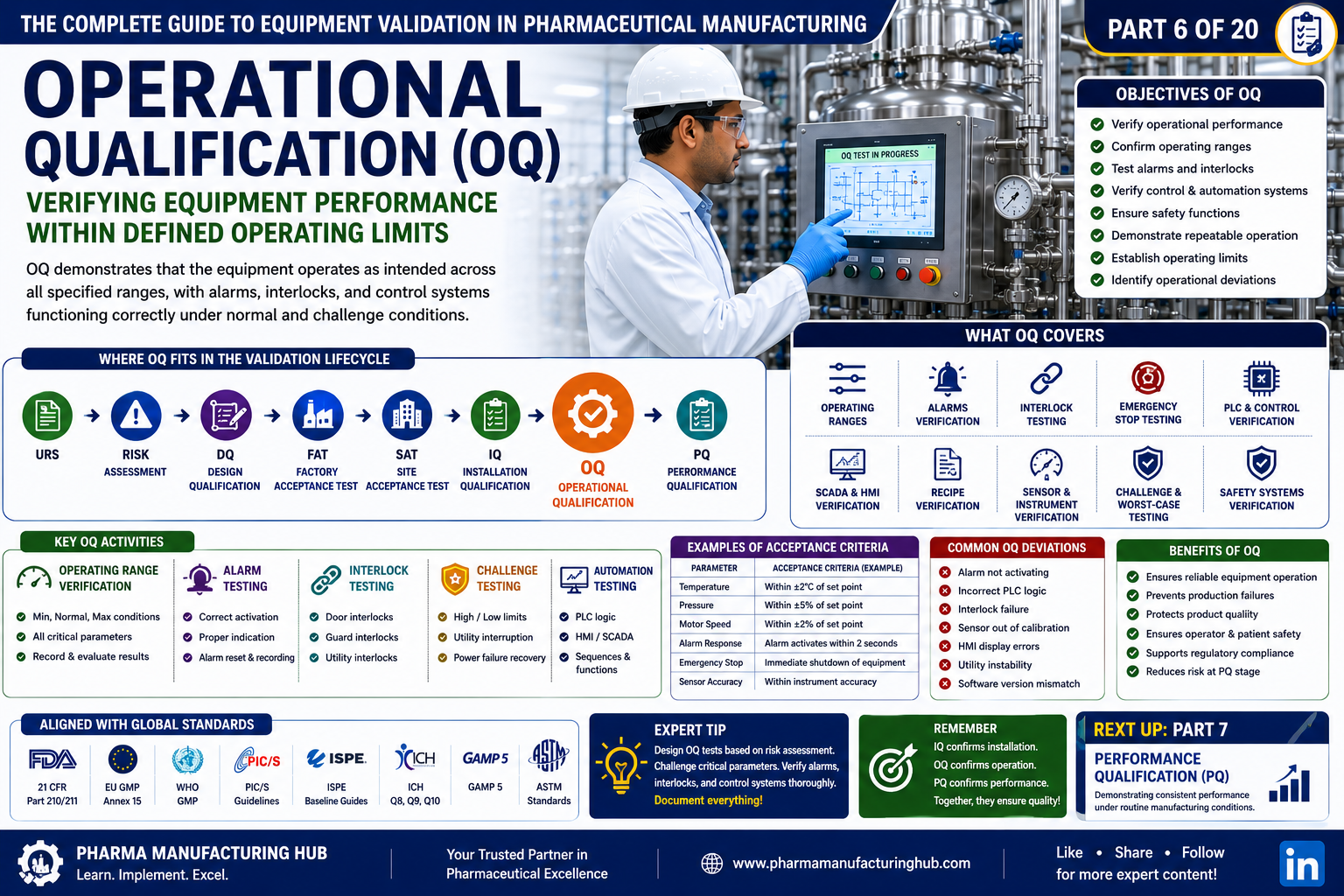
After successful completion of Installation Qualification (IQ), the next critical phase in the equipment qualification lifecycle is Operational Qualification (OQ). While IQ confirms that equipment has been installed correctly, OQ demonstrates that the equipment operates consistently, safely, and reliably throughout its predetermined operating ranges.
Operational Qualification is one of the most scrutinized stages during regulatory inspections because it verifies that the equipment can function under both normal and worst-case operating conditions before it is used for manufacturing commercial products.
Regulatory authorities such as the US FDA, EMA, MHRA, WHO, PIC/S, and guidance documents including EU GMP Annex 15, ISPE Baseline Guides, ASTM, and GAMP 5 require scientifically justified OQ testing supported by documented evidence.
This article provides a practical guide to planning, executing, documenting, and maintaining Operational Qualification for pharmaceutical manufacturing equipment.
What is Operational Qualification (OQ)?
Operational Qualification (OQ) is the documented verification that equipment operates as intended throughout all specified operating ranges under controlled conditions.
OQ confirms that:
- Equipment functions according to the approved design.
- Operating parameters remain within defined limits.
- Control systems perform correctly.
- Safety systems function as intended.
- Alarms and interlocks are effective.
- Instrumentation is accurate.
- Automation systems operate reliably.
- Equipment is ready for Performance Qualification (PQ).
Objectives of Operational Qualification
The primary objectives of OQ are to:
- Verify operational performance.
- Confirm operating ranges.
- Test alarms and interlocks.
- Verify control systems.
- Challenge safety functions.
- Confirm software functionality.
- Verify automation sequences.
- Demonstrate repeatable operation.
- Identify operational deviations.
- Establish operating limits.
Position of OQ in Equipment Lifecycle
URS
   │
Risk Assessment
   │
DQ
   │
FAT
   │
SAT
   │
IQ
   │
▼
Operational Qualification (OQ)
   │
Performance Qualification (PQ)
   │
Commercial Manufacturing
Regulatory Expectations
During OQ, regulators expect documented evidence that:
- Equipment performs according to design.
- Critical parameters are challenged.
- Operating limits are justified.
- Acceptance criteria are predefined.
- Test results are traceable.
- Deviations are investigated.
- Automation systems are validated.
- Electronic records are protected (where applicable).
OQ Protocol Structure
A comprehensive OQ protocol typically includes:
- Purpose
- Scope
- Equipment Description
- Responsibilities
- References
- Prerequisites
- Test Procedures
- Acceptance Criteria
- Data Recording Sheets
- Deviation Handling
- Approval Signatures
OQ Prerequisites
Before starting OQ, ensure:
- IQ has been approved.
- Calibration is current.
- Utilities are available.
- SOPs are approved.
- Operators are trained.
- Software is installed.
- Safety systems are verified.
- Punch list items are closed.
Operating Range Verification
One of the primary objectives of OQ is to verify equipment performance across the full operating range.
Examples include:
| Parameter | Typical Verification |
|---|---|
| Temperature | Minimum, nominal, maximum |
| Pressure | Low, normal, high |
| RPM | Minimum, set point, maximum |
| Flow Rate | Low to maximum |
| Vacuum | Operating range |
| Load | Empty, partial, full |
Testing at these limits demonstrates consistent operation under expected conditions.
Alarm Verification
Each alarm should be challenged to confirm:
- Correct activation.
- Accurate display.
- Operator notification.
- Proper reset functionality.
- Recording in the audit trail (where applicable).
Typical alarms include:
- High temperature
- Low pressure
- High pressure
- Motor overload
- Low vacuum
- Utility failure
- Door open
- Sensor failure
Interlock Testing
Interlocks protect personnel, equipment, and product.
Examples include:
- Door interlocks
- Guard interlocks
- Emergency stop interlocks
- Utility interlocks
- Product level interlocks
- Pressure interlocks
Each interlock should be intentionally challenged and verified.
Emergency Stop Testing
Emergency stop testing should confirm that:
- Equipment stops immediately.
- Hazardous motion ceases safely.
- Restart requires deliberate operator action.
- Alarm is generated.
- Reset procedure functions correctly.
PLC Verification
For automated equipment, verify:
- Program version.
- Sequence logic.
- Timer functions.
- Counter operations.
- Digital inputs.
- Digital outputs.
- Analog signals.
- Error handling.
Software versions should match approved documentation.
SCADA Verification
Where SCADA is used, verify:
- Screen navigation.
- Data acquisition.
- Alarm logging.
- Trend displays.
- User access.
- Audit trails.
- Electronic records.
- Backup and recovery.
HMI Verification
Human Machine Interface (HMI) testing should include:
- Display accuracy.
- Button functionality.
- Recipe selection.
- User authentication.
- Alarm acknowledgment.
- Data entry validation.
- Language selection (if applicable).
Recipe Verification
For recipe-driven equipment:
Verify:
- Recipe creation.
- Recipe editing.
- Recipe selection.
- Password protection.
- Recipe storage.
- Recipe retrieval.
- Version control.
Sensor Verification
Typical sensors include:
- Temperature probes
- Pressure transmitters
- Flow meters
- Load cells
- Level sensors
- Proximity switches
- RPM sensors
Verify:
- Accuracy
- Response time
- Signal stability
- Calibration status
Challenge Testing
Challenge testing intentionally pushes equipment to predetermined limits to verify safe and reliable operation.
Examples:
- High-speed operation
- Low-speed operation
- Maximum load
- Utility interruption
- Alarm activation
- Power failure recovery
- Emergency stop activation
Challenge tests demonstrate equipment robustness.
Worst-Case Testing
Worst-case conditions should be selected based on risk assessment.
Examples:
| Equipment | Worst Case |
|---|---|
| Blender | Maximum batch size |
| Tablet Press | Maximum compression force |
| Fluid Bed Dryer | Maximum product load |
| Coating Machine | Highest spray rate |
| Mixer | Maximum viscosity |
Worst-case testing provides confidence that equipment remains under control under the most demanding conditions.
Load Testing
Verify performance under:
- No load
- Partial load
- Full load
- Maximum design load
Acceptance criteria should be defined before execution.
Acceptance Criteria
Acceptance criteria should be:
- Objective.
- Measurable.
- Based on URS.
- Scientifically justified.
- Approved before testing.
Example
| Test | Acceptance Criteria |
|---|---|
| Motor Speed | ±2% of set point |
| Temperature | Within validated range |
| Alarm Response | <2 seconds |
| PLC Logic | Executes correctly |
| Emergency Stop | Immediate shutdown |
OQ Documentation Package
Typical documentation includes:
- OQ Protocol
- Approved IQ Report
- Calibration Certificates
- Test Records
- Alarm Test Results
- Interlock Verification
- PLC Verification
- SCADA Screenshots
- Deviations
- CAPA (if required)
- OQ Report
Sample OQ Checklist
Mechanical
- Motor operation verified
- Rotation correct
- Vibration acceptable
- Noise within limits
Automation
- PLC verified
- HMI tested
- SCADA communication confirmed
- Recipe management functional
Safety
- Emergency stop tested
- Guards verified
- Interlocks challenged
- Alarm functions verified
Instrumentation
- Temperature sensors verified
- Pressure transmitters verified
- Load cells verified
- Flow meters verified
Common OQ Deviations
Typical deviations include:
- Alarm not functioning.
- Incorrect PLC logic.
- HMI display errors.
- Sensor calibration drift.
- Interlock failure.
- Utility instability.
- Software mismatch.
- Recipe errors.
All deviations should be documented, investigated, and resolved before PQ.
OQ vs PQ
| Operational Qualification | Performance Qualification |
|---|---|
| Equipment-focused | Process-focused |
| Simulated conditions | Routine production |
| Functional testing | Product manufacturing |
| Operating limits | Commercial batches |
| Challenge testing | Consistency verification |
Inspector’s Perspective
During inspections, regulators frequently review OQ protocols to ensure that equipment has been challenged under defined operating conditions.
Inspectors commonly verify:
- Approved OQ protocol.
- Defined operating ranges.
- Alarm and interlock testing.
- Automation verification.
- Acceptance criteria.
- Deviation investigations.
- Traceability to URS.
- Approval records.
Evidence of scientifically justified testing and complete documentation demonstrates a mature qualification program.
Expert Tips
Expert Tip 1: Base OQ test cases on the critical equipment parameters identified during risk assessment. Focus on functions that directly impact product quality and patient safety.
Expert Tip 2: Include both normal operating conditions and worst-case challenges in the OQ protocol. This provides stronger evidence of equipment reliability and supports regulatory expectations.
Expert Tip 3: Capture electronic evidence such as PLC logs, HMI screenshots, alarm histories, and SCADA trends where applicable. These records strengthen the qualification package and improve audit readiness.
Common Pitfalls
Avoid these frequent mistakes:
- Starting OQ before IQ approval.
- Testing only nominal conditions and ignoring operating limits.
- Poorly defined or subjective acceptance criteria.
- Incomplete alarm and interlock verification.
- Failure to verify software versions after updates.
- Inadequate documentation of deviations.
- Lack of traceability between URS requirements and OQ tests.
Frequently Asked Questions (FAQs)
1. What is the purpose of Operational Qualification?
To demonstrate that equipment operates correctly throughout its specified operating ranges under controlled conditions.
2. Can PQ begin before OQ is approved?
No. OQ should be successfully completed and approved before Performance Qualification (PQ) begins.
3. What is challenge testing in OQ?
Challenge testing intentionally introduces predefined conditions—such as high temperature, maximum load, or utility interruption—to verify that equipment and safety systems respond correctly.
4. Why are alarms and interlocks tested during OQ?
They are critical controls that protect product quality, equipment integrity, and operator safety, and must function reliably before commercial production.
5. Does OQ include computerized systems?
Yes. Where applicable, PLCs, HMIs, SCADA, recipe management, audit trails, and electronic records should be verified in accordance with GAMP 5 and applicable data integrity requirements.
6. What is the difference between IQ and OQ?
IQ confirms that equipment is installed correctly, while OQ confirms that the installed equipment operates correctly within predefined limits.
7. How are operating ranges established?
They are derived from the URS, equipment design specifications, engineering studies, and quality risk assessments.
8. What documentation should be retained after OQ?
The approved protocol, raw data, calibration records, electronic evidence, deviations, CAPA (if applicable), and the final OQ report should all be retained according to document retention procedures.
Key Takeaways
- Operational Qualification (OQ) verifies that pharmaceutical equipment operates consistently and safely across all defined operating ranges.
- OQ includes verification of operating parameters, alarms, interlocks, emergency stops, automation systems, instrumentation, and worst-case operating conditions.
- Well-designed OQ protocols use objective acceptance criteria, robust documentation, and risk-based testing aligned with international GMP expectations.
- Successful completion of OQ provides the documented evidence required to proceed confidently to Performance Qualification (PQ).
Coming Up in Part 7
Performance Qualification (PQ): Demonstrating Consistent Equipment Performance Under Routine Manufacturing Conditions
In Part 7, we will cover the complete Performance Qualification (PQ) process, including commercial product selection, placebo versus product batches, worst-case product evaluation, batch size justification, consecutive batch requirements, sampling plans, statistical analysis, acceptance criteria, documentation, and final qualification reports. This article will explain how to demonstrate that qualified equipment consistently produces products meeting predefined quality specifications under routine manufacturing conditions.
About the Author
Ramesh Palav is a pharmaceutical manufacturing professional with 21+ years of industry experience across pharmaceutical manufacturing, GMP compliance, qualification and validation, CSV, quality systems, production operations, and digital transformation.
With hands-on experience in OSD/tablet manufacturing, Granulation, Compression and Coating, he has worked extensively with GMP, regulatory audits, QMS, CAPA, FMEA, deviation management, root-cause analysis, validation, data integrity, and pharmaceutical technology systems.
Through Pharma Manufacturing Hub, he shares practical, experience-driven knowledge on pharmaceutical manufacturing, GMP, ERP, Pharma 4.0, AI, digital transformation, quality systems, validation, and pharma careers, helping professionals and students understand complex pharmaceutical concepts in a simple and practical way.