
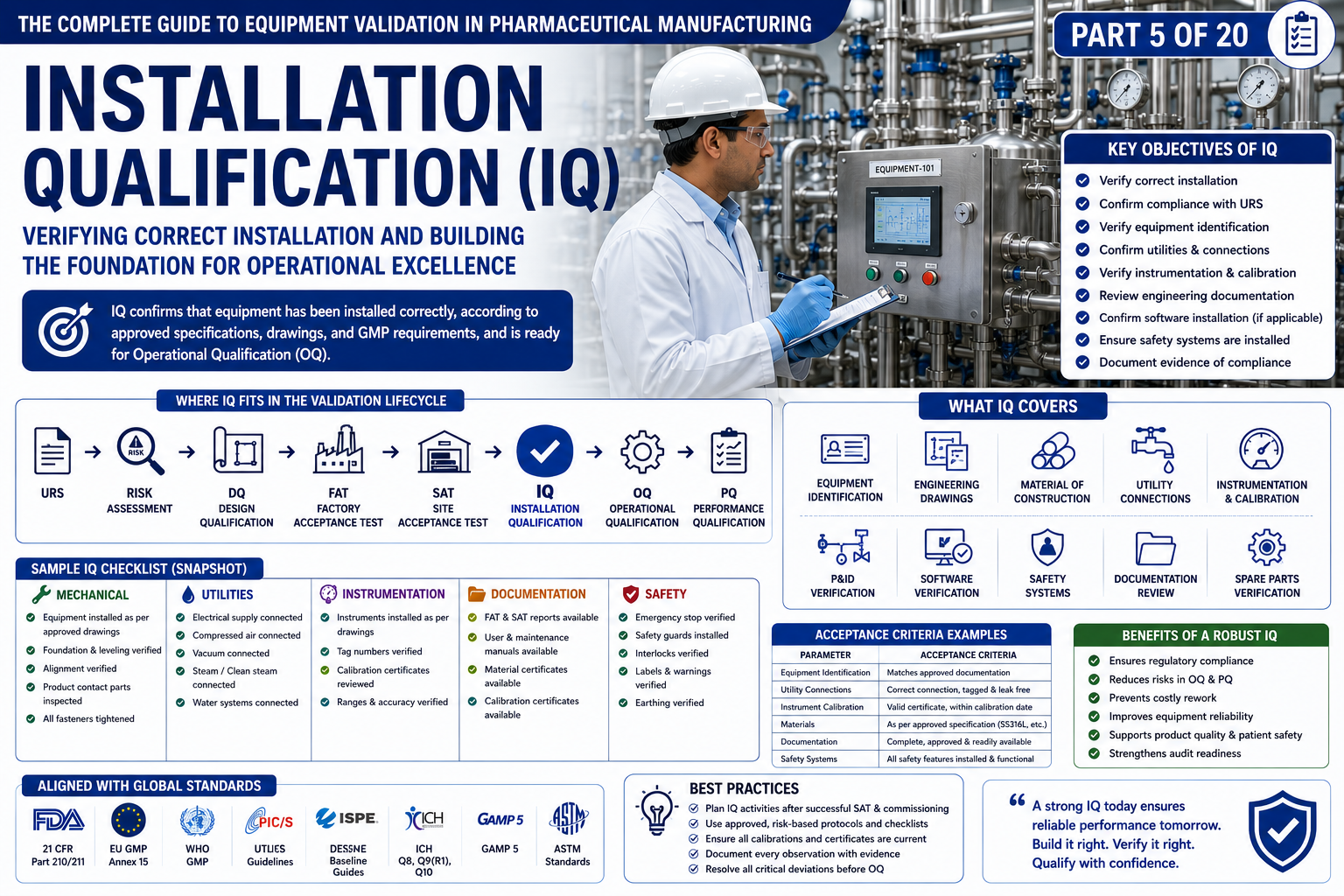
Verifying Correct Installation and Building the Foundation for Operational Excellence
Series: Part 5 of 20
Introduction
Installation Qualification (IQ) is the first formal qualification activity performed after the successful completion of Factory Acceptance Testing (FAT) and Site Acceptance Testing (SAT). It provides documented evidence that pharmaceutical equipment has been installed correctly, according to approved engineering drawings, manufacturer specifications, User Requirement Specifications (URS), and Good Manufacturing Practice (GMP) requirements.
A properly executed IQ establishes the foundation for all subsequent qualification activities. Errors that go undetected during IQ can compromise Operational Qualification (OQ), Performance Qualification (PQ), process validation, and ultimately product quality.
Regulatory agencies including the US FDA, EMA, WHO, MHRA, PIC/S, and ISPE expect IQ to be a comprehensive, well-documented process demonstrating that equipment is installed in a controlled manner and is ready for operational testing.
What is Installation Qualification (IQ)?
Installation Qualification (IQ) is the documented verification that equipment, utilities, instrumentation, software, and associated systems have been installed correctly and comply with approved specifications, engineering drawings, regulatory requirements, and manufacturer recommendations.
IQ confirms that:
- Equipment has been installed according to approved designs.
- Utilities are correctly connected.
- Materials of construction meet specifications.
- Instruments are calibrated.
- Safety features are present.
- Documentation is complete.
- Equipment is ready for Operational Qualification (OQ).
Objectives of IQ
The primary objectives of IQ are to:
- Verify correct installation.
- Confirm compliance with the URS.
- Verify equipment identification.
- Confirm utilities are connected properly.
- Verify instrumentation and calibration.
- Review engineering documentation.
- Confirm software installation (where applicable).
- Ensure safety systems are installed.
- Document evidence of compliance.
Where IQ Fits in the Validation Lifecycle
URS
   │
Risk Assessment
   │
Design Qualification (DQ)
   │
Factory Acceptance Test (FAT)
   │
Site Acceptance Test (SAT)
   │
Commissioning
   │
▼
INSTALLATION QUALIFICATION (IQ)
   │
Operational Qualification (OQ)
   │
Performance Qualification (PQ)
   │
Routine Production
IQ bridges engineering activities and formal validation.
Regulatory Expectations
Global regulatory agencies expect IQ documentation to demonstrate:
- Installation according to approved drawings.
- Equipment suitability for intended use.
- Availability of supporting documentation.
- Calibration of critical instruments.
- Utility verification.
- Traceability to the URS.
- Approved acceptance criteria.
- Controlled execution and review.
IQ Protocol Structure
A comprehensive IQ protocol generally includes:
- Document Approval
- Purpose
- Scope
- Responsibilities
- References
- Equipment Description
- Acceptance Criteria
- Test Procedures
- Data Collection Forms
- Deviation Handling
- Attachments
- Approval Signatures
Equipment Identification Verification
The first IQ activity is confirming the identity of the equipment.
Verify:
- Equipment Name
- Equipment Number
- Manufacturer
- Model Number
- Serial Number
- Asset Number
- Location
- Equipment Tag Number
Sample Checklist
| Item | Status |
|---|---|
| Equipment Name | ✔ |
| Serial Number | ✔ |
| Asset Number | ✔ |
| Location | ✔ |
| Nameplate | ✔ |
Nameplate Verification
Verify information displayed on the equipment nameplate:
- Manufacturer
- Equipment Model
- Serial Number
- Voltage
- Frequency
- Current
- Power Rating
- Year of Manufacture
This information should match procurement and engineering documentation.
Verification of Engineering Drawings
Review and verify:
- General Arrangement (GA) Drawings
- Piping & Instrumentation Diagrams (P&ID)
- Electrical Drawings
- Wiring Diagrams
- Instrument Loop Drawings
- Utility Layouts
- Foundation Drawings
All drawings should be current, approved, and reflect the installed equipment.
Material of Construction Verification
Product-contact materials should comply with the approved design.
Typical checks include:
- SS316L product-contact parts
- SS304 non-product-contact parts (where applicable)
- Surface finish certificates
- Elastomer compatibility
- Welding records
- Material traceability certificates
Utility Connection Verification
Confirm that all required utilities are correctly connected and identified.
Utilities may include:
- Electrical Power
- Compressed Air
- Purified Water (PW)
- Water for Injection (WFI)
- Clean Steam
- Plant Steam
- Nitrogen
- Vacuum
- Chilled Water
- HVAC
Utility Verification Table
| Utility | Verified |
|---|---|
| Electrical Supply | ✔ |
| Compressed Air | ✔ |
| Vacuum | ✔ |
| Nitrogen | ✔ |
| PW | ✔ |
| Steam | ✔ |
Instrumentation Verification
Critical instruments should be verified for:
- Correct installation
- Identification tags
- Calibration status
- Range
- Accuracy
- Manufacturer
- Serial number
Typical instruments include:
- Pressure transmitters
- Temperature sensors
- Flow meters
- Load cells
- Level sensors
- Vacuum gauges
- RPM indicators
Calibration Verification
Calibration is a key IQ requirement.
Verify:
- Calibration certificates
- Calibration labels
- Calibration due dates
- Traceability to national/international standards
- Instrument accuracy
Any instrument without valid calibration should not be used for qualification.
Lubricant Verification
Where applicable, verify:
- Food-grade lubricants
- Approved lubricant list
- Lubrication points
- Lubrication schedule
- Records of initial lubrication
Improper lubricants can contaminate pharmaceutical products.
P&ID Verification
Review the installed piping system against approved P&IDs.
Confirm:
- Correct pipe routing
- Valve identification
- Instrument locations
- Flow direction
- Utility connections
- Drain points
- Isolation valves
Spare Parts Verification
Confirm that essential spare parts have been received.
Typical items:
- Gaskets
- O-rings
- Filters
- Bearings
- Sensors
- Belts
- Fuses
- Lubricants
- Special tools
Proper spare parts management supports equipment reliability.
Software Verification
For automated equipment, verify:
- PLC version
- HMI version
- SCADA configuration
- Recipe management
- User access levels
- Software backups
- Network configuration
- Cybersecurity settings
Safety Verification
Confirm the installation and functionality of:
- Emergency stop buttons
- Safety guards
- Interlocks
- Pressure relief valves
- Door switches
- Warning labels
- Earthing
- Lockout/Tagout provisions
Safety is an integral part of GMP compliance.
Documentation Verification
The following documents should be available and approved:
- User Manual
- Maintenance Manual
- Spare Parts List
- Calibration Certificates
- Material Certificates
- FAT Report
- SAT Report
- DQ Report
- Electrical Drawings
- P&IDs
- Software Documentation
Incomplete documentation is a common cause of IQ delays.
Acceptance Criteria
Acceptance criteria should be:
- Defined before IQ execution.
- Objective and measurable.
- Based on the URS and design specifications.
- Scientifically justified.
Examples
| Parameter | Acceptance Criteria |
|---|---|
| Equipment Identification | Matches approved documentation |
| Utility Connections | Correctly installed and labeled |
| Instrument Calibration | Valid certificates available |
| Materials | As per approved specifications |
| Documentation | Complete and approved |
IQ Documentation Package
A complete IQ package typically includes:
- IQ Protocol
- Approved URS
- Traceability Matrix
- Equipment Drawings
- Material Certificates
- Calibration Certificates
- Utility Verification Records
- Instrument List
- Deviation Reports
- IQ Report
- Approval Signatures
Sample IQ Checklist
Mechanical
- Equipment installed correctly
- Foundation complete
- Alignment verified
- Fasteners tightened
- Product-contact surfaces inspected
Utilities
- Electrical supply verified
- Compressed air connected
- Vacuum connected
- Nitrogen connected
- Water systems connected
Documentation
- Drawings approved
- Manuals available
- Certificates reviewed
- Calibration records complete
Safety
- Emergency stop operational
- Guards installed
- Interlocks verified
- Labels applied
Common IQ Deviations
Typical deviations include:
- Missing calibration certificates
- Incorrect equipment labeling
- Utility connection errors
- Missing documentation
- Incomplete P&IDs
- Software version mismatch
- Incorrect material certificates
- Damaged components
- Missing spare parts
All deviations should be investigated, documented, and resolved before proceeding to OQ.
IQ vs OQ
| Installation Qualification (IQ) | Operational Qualification (OQ) |
|---|---|
| Verifies installation | Verifies operation |
| Static checks | Dynamic testing |
| Engineering focus | Functional focus |
| Drawings & documentation | Operating ranges & alarms |
| Utilities | Performance testing |
| Calibration | Challenge testing |
IQ answers the question: “Was the equipment installed correctly?”
OQ answers: “Does the equipment operate correctly?”
Inspector’s Perspective
During inspections, regulators frequently review IQ documentation to ensure that equipment installation has been controlled and documented.
Inspectors commonly verify:
- Approved IQ protocol.
- Equipment identification.
- Utility verification records.
- Calibration certificates.
- Material certificates.
- Drawing revisions.
- Deviation handling.
- Traceability to the URS.
- Approval signatures.
Well-organized IQ documentation demonstrates strong engineering and quality system controls.
Expert Tips
Expert Tip 1: Perform a detailed documentation review before IQ execution. Missing manuals or certificates are among the most common causes of delays.
Expert Tip 2: Ensure all critical instruments are calibrated and labeled before starting IQ. This avoids unnecessary protocol deviations.
Expert Tip 3: Maintain a live punch list during installation and close all critical items before initiating IQ to streamline qualification activities.
Common Pitfalls
Avoid these frequent mistakes:
- Beginning IQ before installation is complete.
- Using outdated engineering drawings.
- Missing or expired calibration certificates.
- Incomplete verification of utility connections.
- Failure to review software versions.
- Poor traceability between the URS and IQ tests.
- Inadequate documentation of deviations.
Frequently Asked Questions (FAQs)
1. What is the purpose of Installation Qualification?
To verify and document that equipment has been installed correctly according to approved specifications and is ready for operational testing.
2. Can OQ begin before IQ is complete?
No. IQ should be successfully completed and approved before starting OQ.
3. Who is responsible for IQ?
IQ is typically executed by Engineering and Validation teams, with review and approval by Quality Assurance.
4. Are calibration certificates mandatory for IQ?
Yes. Critical instruments must have valid calibration certificates traceable to recognized standards.
5. Does IQ include software verification?
Yes, for automated equipment. Software versions, PLC configurations, HMI, SCADA, and backups should be verified.
6. What happens if deviations are identified during IQ?
Deviations should be documented, investigated, corrected, and assessed for their impact before qualification proceeds.
7. Is commissioning the same as IQ?
No. Commissioning confirms basic functionality, while IQ is a formal, documented qualification activity performed under GMP.
8. Why is traceability important in IQ?
Traceability links URS requirements to qualification evidence, demonstrating that all critical installation requirements have been verified.
Key Takeaways
- Installation Qualification (IQ) provides documented evidence that pharmaceutical equipment has been installed correctly and complies with approved specifications.
- IQ verifies equipment identification, engineering drawings, materials, utilities, instrumentation, calibration, software, safety systems, and documentation.
- Successful IQ establishes the foundation for Operational Qualification (OQ) and Performance Qualification (PQ).
- Thorough documentation, cross-functional collaboration, and robust deviation management are essential for maintaining regulatory compliance and ensuring equipment readiness.
Coming Up in Part 6
Operational Qualification (OQ): Demonstrating Equipment Performance Within Defined Operating Limits
In Part 6, we will explore Operational Qualification in depth, covering operating ranges, alarm verification, interlocks, challenge testing, PLC and SCADA validation, HMI verification, sensors, load testing, worst-case conditions, acceptance criteria, protocol development, and global regulatory expectations. This section will provide the detailed guidance needed to demonstrate that qualified equipment consistently operates as intended under controlled conditions.
About the Author
Ramesh Palav is a pharmaceutical manufacturing professional with 21+ years of industry experience across pharmaceutical manufacturing, GMP compliance, qualification and validation, CSV, quality systems, production operations, and digital transformation.
With hands-on experience in OSD/tablet manufacturing, Granulation, Compression and Coating, he has worked extensively with GMP, regulatory audits, QMS, CAPA, FMEA, deviation management, root-cause analysis, validation, data integrity, and pharmaceutical technology systems.
Through Pharma Manufacturing Hub, he shares practical, experience-driven knowledge on pharmaceutical manufacturing, GMP, ERP, Pharma 4.0, AI, digital transformation, quality systems, validation, and pharma careers, helping professionals and students understand complex pharmaceutical concepts in a simple and practical way.