
Part 1
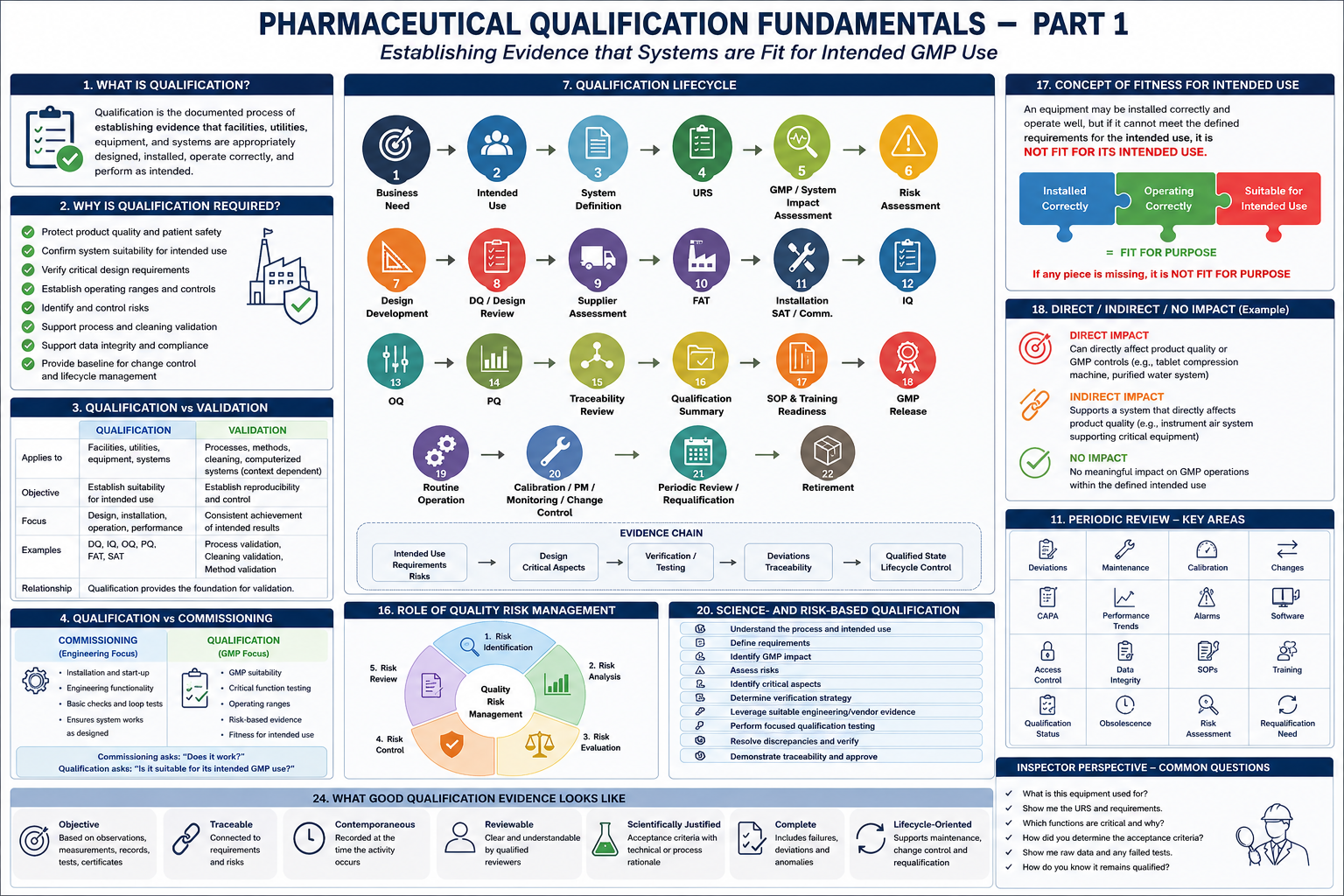
1. Introduction
Qualification is one of the fundamental elements of pharmaceutical Good Manufacturing Practice (GMP). A pharmaceutical manufacturer must have justified confidence that facilities, utilities, equipment, and supporting systems used for GMP activities are suitable for their intended purpose and operate in a controlled and reproducible manner.
Qualification should therefore answer a simple but powerful question:
What objective evidence demonstrates that this system is fit for its intended GMP use?
A mature qualification program does not begin with IQ, OQ, or PQ protocols. It begins with understanding:
Intended use → GMP impact → requirements → risks → critical aspects → design → verification → qualified state → lifecycle control
The qualification package is the documented evidence supporting this lifecycle.
2. What is Qualification?
Definition
Qualification is the documented process of establishing evidence that facilities, utilities, equipment, and systems are appropriately designed, installed, operate correctly, and perform as intended.
In practical pharmaceutical engineering, qualification commonly progresses through:
| Stage | Fundamental Question |
|---|---|
| URS | What does the user/process require? |
| Risk Assessment | What could affect product quality, patient safety, or GMP compliance? |
| DQ | Is the proposed design suitable? |
| FAT | Does the equipment/system perform appropriately before shipment? |
| SAT | Has it arrived and been installed at site without unacceptable issues? |
| IQ | Is it installed correctly and adequately documented? |
| OQ | Does it operate correctly throughout the intended/challenged operating range? |
| PQ | Does it perform consistently under routine or appropriately simulated operating conditions? |
| Summary/Release | Does the total evidence support GMP use? |
| Lifecycle review | Does it remain in the qualified state? |
The exact combination of documents is risk-, system-, lifecycle-, and company-dependent. A company should not mechanically create every document simply because it appears in a standard validation template.
3. Why is Qualification Required?
Qualification supports the pharmaceutical quality system by providing objective evidence that systems influencing GMP operations are suitable for their intended use.
Its primary purposes include:
- protecting product quality and ultimately patient safety;
- demonstrating that equipment and utilities can perform their intended functions;
- confirming that critical design requirements have been implemented;
- verifying appropriate installation;
- challenging critical operating functions;
- establishing documented operating ranges and controls;
- demonstrating repeatable performance where applicable;
- identifying and controlling risks before routine GMP use;
- supporting process validation and cleaning validation;
- supporting data integrity where computerized functionality is involved;
- establishing the baseline against which future changes are assessed.
Example
Consider a tablet compression machine.
It is not sufficient to show that:
“The machine switches ON and produces tablets.”
The qualification strategy may need to establish that relevant functions such as the following operate appropriately:
- turret speed;
- feeder operation;
- fill depth;
- pre-compression;
- main compression;
- tablet weight-control functions;
- reject mechanisms;
- machine guards;
- interlocks;
- emergency stops;
- alarms;
- lubrication;
- recipes;
- user access;
- electronic records;
- audit trails, where applicable;
- interfaces;
- power-failure recovery.
Which functions are critical and how extensively they are tested should follow from intended use and documented risk assessment.
4. Qualification vs Validation
Qualification and validation are closely related but are not interchangeable.
| Qualification | Validation |
|---|---|
| Commonly applies to facilities, utilities, equipment and systems | Commonly applies to processes, methods, procedures, cleaning and computerized applications/systems depending on context |
| Establishes suitability of the system for intended use | Establishes that a process/system consistently achieves intended results |
| Includes design, installation, operation and performance verification | Often evaluates reproducibility and continued control |
| Common terminology: DQ/IQ/OQ/PQ | Examples: process validation, cleaning validation, analytical method validation |
| Provides an important foundation for process validation | Often depends upon appropriately qualified supporting equipment/utilities |
Relationship
A simplified relationship is:
Qualified Equipment + Qualified Utilities + Approved Procedures + Trained Personnel + Controlled Materials + Process Knowledge → Foundation for Process Validation
Qualification cannot compensate for an inadequately developed process, and process validation cannot compensate for unsuitable equipment.
5. Qualification vs Commissioning
This distinction is important in pharmaceutical projects.
Commissioning
Commissioning is an engineering activity demonstrating that equipment and systems have been installed, configured, started up, and function according to design and engineering requirements.
Examples include:
- motor rotation checks;
- electrical continuity;
- valve operation;
- utility connection verification;
- loop checks;
- pump rotation;
- basic sequence testing;
- engineering alarm testing;
- communication checks;
- equipment startup.
Qualification
Qualification applies a GMP-focused approach to establishing documented suitability for intended use.
Examples may include:
- verifying critical materials of construction;
- confirming critical instrumentation;
- challenging GMP-critical alarms and interlocks;
- verifying operating ranges;
- testing controls affecting critical process parameters;
- assessing computerized controls and data integrity;
- confirming traceability to approved requirements.
Key distinction
Commissioning asks whether the engineered system works. Qualification asks whether sufficient documented evidence demonstrates that the system is suitable for its intended GMP use.
The two activities should be integrated where scientifically and procedurally appropriate rather than unnecessarily duplicating testing.
6. Commissioning & Qualification — C&Q
Modern pharmaceutical projects increasingly integrate commissioning and qualification activities.
A well-designed C&Q strategy can use good-quality engineering evidence to support qualification where the evidence is:
- predefined;
- appropriately controlled;
- technically sound;
- attributable;
- contemporaneous;
- reviewed;
- traceable;
- performed using suitable calibrated instruments where required;
- executed against approved specifications or criteria;
- retained appropriately.
Traditional approach
Commissioning → Repeat similar checks during IQ → Repeat functions during OQ
This can create unnecessary duplication.
Risk-based integrated approach
Requirements → Risk Assessment → Critical Aspects → Commissioning/FAT/SAT Testing → Evidence Assessment → Qualification Testing of Remaining/Critical Requirements
The principle is:
Do not repeat testing merely because the document title is different. Verify that the existing evidence is reliable and adequate for its intended qualification purpose.
7. Verification vs Qualification
Verification is a broader concept.
It means confirming, through objective evidence, that specified requirements have been fulfilled.
Qualification is a structured GMP lifecycle activity that may use multiple verification activities.
For example:
URS-025
All product-contact surfaces shall be manufactured from the specified suitable material.
Verification could include:
- drawing review;
- material certificates;
- vendor records;
- visual inspection;
- equipment identification;
- PMI where justified by risk.
The collected evidence can then form part of DQ, FAT, IQ, or other qualification documentation.
Therefore:
Not every requirement needs a separate physical challenge test. The verification method should be appropriate to the requirement and its risk.
8. Qualification Lifecycle
Qualification should be treated as a lifecycle rather than a one-time project.
A practical lifecycle is:
Business Need
↓
Intended Use
↓
System Definition
↓
URS
↓
GMP/System Impact Assessment
↓
Quality Risk Assessment
↓
Design Development
↓
DQ / Design Review
↓
Supplier Assessment
↓
FAT
↓
Installation
↓
SAT / Commissioning
↓
IQ
↓
OQ
↓
PQ
↓
Traceability Review
↓
Qualification Summary
↓
SOP & Training Readiness
↓
GMP Release
↓
Routine Operation
↓
Calibration + PM + Monitoring + Change Control
↓
Periodic Review / Requalification
↓
Retirement
The actual lifecycle should be scaled to the complexity, novelty, criticality, and risk of the system.
9. Prospective Qualification
Prospective qualification is performed before routine GMP use of the system.
This is generally the preferred lifecycle approach for new facilities, utilities, and equipment.
Example
For a new tablet compression machine:
- URS approved.
- GMP impact determined.
- Risk assessment performed.
- Design reviewed.
- FAT completed.
- Machine delivered.
- SAT/commissioning completed.
- IQ completed.
- OQ completed.
- PQ performed where applicable.
- Deviations resolved or appropriately dispositioned.
- Traceability completed.
- Summary report approved.
- Required SOPs/training completed.
- GMP release authorized.
This creates a clear evidence chain before routine operation.
10. Concurrent Approaches
The uploaded master prompt specifically requests consideration of concurrent approaches where applicable.
A concurrent approach should not be interpreted as permission to use unqualified equipment routinely and create documentation later.
Where exceptional lifecycle approaches are scientifically and procedurally justified, they require appropriate:
- documented justification;
- risk assessment;
- predefined controls;
- quality oversight;
- acceptance criteria;
- review and approval;
- data evaluation.
Routine reliance on “we will qualify it while using it” is a weak control strategy.
11. Requalification
Qualification does not last indefinitely without lifecycle controls.
Requalification is performed to provide evidence that a system continues to satisfy defined requirements following a specified period or event.
Two broad approaches are common.
Periodic requalification
Performed at defined or justified intervals where appropriate.
Examples may include periodic qualification activities for:
- HVAC systems;
- cleanrooms;
- certain controlled environments;
- critical utilities;
- equipment where periodic verification is justified.
Event-based requalification
Triggered by a significant event or change.
Examples:
- equipment relocation;
- critical component replacement;
- PLC modification;
- major software upgrade;
- operating-range change;
- capacity increase;
- significant utility modification;
- major maintenance;
- recurring failures;
- adverse performance trend.
Important principle
Requalification does not automatically mean repeating the entire original IQ/OQ/PQ.
The scope should be determined through:
Event/Change → Impact Assessment → Risk Assessment → Affected Requirements/Functions → Required Verification → Approval
12. Periodic Review
Periodic review evaluates whether the system continues to remain suitable and controlled.
A periodic review may consider:
| Area | Review |
|---|---|
| Deviations | Significant/recurring failures |
| Maintenance | Breakdown and PM history |
| Calibration | Failures and out-of-tolerance events |
| Changes | Changes since previous review |
| CAPA | Open/closed CAPAs |
| Performance | Critical trends |
| Alarms | Recurring critical alarms |
| Software | Changes and patches where relevant |
| Access | User/administrator controls |
| Data Integrity | Relevant events and audit-trail issues |
| SOPs | Current procedural controls |
| Training | Personnel qualification |
| Qualification | Current qualification status |
| Obsolescence | Hardware/software lifecycle risks |
Periodic review and periodic requalification should not automatically be treated as identical activities.
A periodic review may determine that additional qualification testing is or is not required, depending on risk and evidence.
13. Qualification Following Modification or Change
A qualified system should remain under formal change control.
The lifecycle is:
Proposed Change
→ Technical Assessment
→ GMP Impact Assessment
→ Risk Assessment
→ Qualification Impact
→ Required Testing
→ Document Updates
→ Implementation
→ Verification
→ Approval
→ Closure
Example
Suppose the HMI of a compression machine is replaced.
It would be inappropriate to automatically conclude:
“Only the screen changed; no qualification required.”
The assessment should consider whether the change affects:
- software version;
- configuration;
- user access;
- recipes;
- alarms;
- audit trail;
- data storage;
- interfaces;
- communication;
- displayed critical parameters;
- electronic records;
- security settings.
The resulting requalification scope should reflect the actual impact.
14. Relationship with Process Validation
Equipment qualification and process validation are connected but have different objectives.
Equipment qualification asks:
Can this equipment operate appropriately for its intended use?
Process validation asks:
Can the manufacturing process reproducibly deliver product meeting predetermined quality requirements?
Consider compression.
Equipment qualification may verify:
- turret-speed operating range;
- compression controls;
- feeder operation;
- reject function;
- alarms;
- interlocks.
Process validation evaluates the manufacturing process using appropriate process parameters, material characteristics, sampling plans, and product quality results.
Therefore:
Equipment Capability ≠ Validated Manufacturing Process
But equipment capability is an important prerequisite for a defensible process-validation program.
15. Relationship with Cleaning Validation
Equipment qualification supports cleaning validation.
Qualification may verify design features such as:
- cleanability;
- product-contact materials;
- surface characteristics;
- accessibility;
- dismantling arrangements;
- drainability where applicable;
- automated cleaning functions where applicable;
- cleaning sequence controls;
- spray devices where applicable.
Cleaning validation then demonstrates that the approved cleaning process consistently achieves predefined acceptance criteria.
Example
For a coating pan:
Qualification
Verifies that cleaning-related equipment functions and design features work as intended.
Cleaning validation
Demonstrates that the cleaning process controls residues/contamination to scientifically justified limits.
16. Relationship with Computerized System Validation / Assurance
Modern pharmaceutical equipment frequently contains computerized components.
Examples:
- PLC;
- HMI;
- SCADA;
- DCS;
- IPC;
- recipe-management systems;
- electronic batch functions;
- data historians;
- interfaces.
Qualification therefore needs to consider computerized functionality proportionate to its intended use and risk.
Potential considerations include:
- user access;
- administrator privileges;
- password controls;
- recipe controls;
- audit trails;
- electronic records;
- electronic signatures where applicable;
- alarm history;
- data storage;
- data transfer;
- interfaces;
- backup;
- restore;
- time synchronization;
- data retention.
Critical principle
A machine passing mechanical IQ/OQ does not automatically demonstrate that its GMP-relevant computerized functions are adequately controlled.
Conversely, every software function does not necessarily require the same level of testing. Testing should be based on intended use and risk.
17. Quality Risk Management in Qualification
Risk management is central to efficient qualification.
The master prompt identifies ICH Q9(R1) and requests a science- and risk-based approach.
Risk assessment helps determine:
What should be verified?
Why should it be verified?
How extensively should it be tested?
What evidence is acceptable?
What can appropriately rely upon supplier or commissioning evidence?
Basic lifecycle
Risk Identification
↓
Risk Analysis
↓
Risk Evaluation
↓
Risk Control
↓
Verification
↓
Risk Review
Risk management should support decisions rather than merely generate an RPN spreadsheet.
18. Fitness for Intended Use
“Fit for intended use” is one of the most important concepts in qualification.
An equipment item may function perfectly from an engineering perspective yet still be unsuitable for a particular GMP application.
Example
Consider a weighing system.
It may be:
- mechanically sound;
- properly installed;
- calibrated;
- electrically safe.
But if the required process range is 0.5–5.0 kg and the weighing system cannot provide suitable performance across the intended range, it may not be fit for that specific use.
Therefore:
Installed correctly + operating correctly does not automatically equal suitable for intended GMP use.
Qualification must remain connected to the approved intended use and requirements.
19. Critical Aspects and Critical Parameters
A strong qualification program distinguishes critical from non-critical aspects.
Critical aspect
A function, feature, component, or condition whose failure could adversely affect relevant GMP requirements, product quality, process control, patient safety, or data integrity.
Examples can include:
- product-contact material;
- temperature control;
- compression-force control;
- critical alarm;
- reject mechanism;
- HEPA filter integrity;
- differential-pressure control;
- recipe-management control;
- GMP data recording.
Critical process parameter
A process parameter whose variability has an impact on a critical quality attribute and therefore should be monitored or controlled to ensure the process produces the desired quality.
The precise designation should arise from process knowledge and risk assessment rather than from habit.
20. Direct-Impact, Indirect-Impact and No-Impact Concepts
Some organizations use system-impact categorization as part of their qualification strategy.
A typical conceptual model is:
Direct impact
The system can directly affect product quality or relevant GMP controls.
Potential examples:
- tablet compression machine;
- purified-water system;
- product-contact equipment;
- critical HVAC serving classified/controlled areas.
Indirect impact
The system supports another system that directly affects product quality.
Potential examples depend heavily on facility design and company methodology.
No impact
The system has no meaningful GMP impact within the defined intended use.
Important caution
These categories are useful risk-management/industry-practice concepts, not universal regulatory labels that every company must use.
The classification methodology should be defined within the company’s quality/validation system.
21. Science and Risk-Based Qualification
Traditional qualification programs sometimes test every function with similar depth.
That approach can create large quantities of documentation without necessarily improving product assurance.
A stronger approach is:
Understand the process
↓
Define intended use
↓
Establish requirements
↓
Identify GMP impact
↓
Assess risks
↓
Identify critical aspects
↓
Determine verification strategy
↓
Leverage suitable engineering/supplier evidence
↓
Perform focused qualification testing
↓
Resolve discrepancies
↓
Demonstrate traceability
↓
Approve qualified state
This concentrates resources where failure matters most.
22. Prospective Risk-Based Example — Tablet Compression Machine
Consider a new compression machine.
Step 1 — Intended use
Manufacture compressed tablets within approved product/process operating requirements.
Step 2 — Identify important functions
Potential functions include:
- fill-depth adjustment;
- feeder;
- turret speed;
- pre-compression;
- main compression;
- tablet weight-control functions;
- lubrication;
- guards;
- emergency stop;
- rejection;
- recipes;
- user access;
- audit trail where applicable.
Step 3 — Assess risk
Suppose failure of the reject mechanism could permit nonconforming tablets to continue downstream.
This becomes a significant qualification consideration.
Step 4 — Define verification
OQ could challenge:
- Reject mechanism enabled.
- Defined reject condition generated.
- Machine identifies the relevant condition.
- Rejection occurs.
- Rejected tablet follows the intended path.
- Relevant indication/alarm is generated where designed.
- Electronic record is generated where applicable.
Step 5 — Record objective evidence
Evidence may include:
- executed protocol;
- actual observations;
- machine records;
- printouts;
- screenshots where appropriate;
- electronic records;
- signatures/date/time;
- deviation references.
This produces a defensible connection between risk and test evidence.
23. Qualification Should Not Be a Documentation Exercise
One of the most damaging qualification practices is treating successful protocol completion as the objective.
For example:
URS written because SOP requires URS
↓
DQ generated from template
↓
IQ copied from previous machine
↓
OQ tests normal operation only
↓
All boxes marked PASS
↓
Summary report says “Equipment Qualified”
This may create extensive documentation without providing meaningful assurance.
The correct question is not:
“Have we completed IQ/OQ/PQ?”
It is:
“Do we have sufficient, reliable, traceable evidence that the system is suitable for its intended GMP use and its important risks are appropriately controlled?”
24. What Good Qualification Evidence Looks Like
Strong qualification evidence should be:
Objective
Based on observations, measurements, records, tests, certificates, or other defensible evidence.
Traceable
Connected to requirements and risk.
Contemporaneous
Recorded when the activity occurs.
Reviewable
Another qualified person should be able to understand what was done and what occurred.
Scientifically justified
Acceptance criteria should have an appropriate technical, process, regulatory, or quality basis.
Complete
Failures, deviations, anomalies, and unexpected results should not disappear from the record.
Lifecycle-oriented
The qualification baseline should support future maintenance, change control, periodic review, and requalification.
25. Responsibilities
Actual responsibilities must be defined by the company’s Pharmaceutical Quality System.
A typical model is:
| Function | Typical Responsibility |
|---|---|
| User/Production | Define intended use and operational requirements |
| Engineering | Technical/design/installation requirements |
| Validation/CQV | Qualification strategy and execution |
| Automation/IT | Computerized/automation controls |
| Maintenance | Maintainability, PM and technical support |
| QC | Analytical/testing support where applicable |
| EHS | Safety requirements |
| Vendor | Design information and supplier testing |
| QA | GMP oversight, review and approval as defined |
| Project Team | Project integration and delivery |
QA involvement should provide appropriate quality oversight without replacing technical ownership by engineering, users, automation, or other SMEs.
26. Inspector Perspective
During an inspection, qualification may be examined through questions such as:
| Inspector Question | What It Tests |
|---|---|
| What is this equipment used for? | Intended-use understanding |
| Show me the URS. | Requirements definition |
| Which functions are critical? | Risk understanding |
| How did you determine criticality? | Scientific justification |
| Why was this test performed? | Risk-to-test connection |
| How was this acceptance criterion established? | Scientific rationale |
| Show me the raw data. | Data integrity |
| Show me a failed qualification test. | Failure management |
| Why was it repeated? | Re-test control |
| Show requirement traceability. | Completeness |
| What has changed since qualification? | Lifecycle control |
| How do you know it remains qualified? | Continued state of control |
A particularly strong qualification package allows these questions to be answered from the documentation without reconstructing the rationale years later.
27. Common Qualification Mistakes
| Mistake | Potential Concern |
|---|---|
| URS created after equipment purchase | Requirements may be retrospective |
| Generic copied URS | Intended use not adequately defined |
| Every function called critical | Weak risk differentiation |
| Critical functions not identified | Inadequate assurance |
| FAT blindly repeated during OQ | Inefficient qualification |
| Vendor FAT accepted without assessment | Evidence may not meet qualification needs |
| Acceptance criteria arbitrary | Weak scientific justification |
| Normal operation only tested | Failure/challenge conditions overlooked |
| Deviations hidden through re-testing | Data-integrity/GMP concern |
| IQ/OQ passed but traceability incomplete | Requirements may remain unverified |
| Software ignored | Computerized GMP risks overlooked |
| SOP/training incomplete at release | Operational control may be inadequate |
| No change assessment after modification | Qualified baseline compromised |
| Automatic full requalification | Poor risk-based lifecycle management |
| Qualification treated as paperwork | Fundamental purpose lost |
28. Qualification Decision Model
A practical decision tree is:
Does the system have a defined intended use?
↓ Yes
Can it affect GMP operations/product quality/data?
↓ Yes
What requirements are necessary for that intended use?
↓
Which requirements/functions carry meaningful risk?
↓
How can each critical requirement best be verified?
↓
Is reliable supplier/commissioning evidence available?
→ Yes: Assess and leverage where justified
→ No: Generate qualification evidence
↓
Were acceptance criteria met?
→ No: Deviation → Investigation/Assessment → Correction → Approved Re-test
→ Yes: Continue
↓
Are requirements, risks and tests traceable?
↓
Are deviations/open risks appropriately dispositioned?
↓
Are SOPs, training, calibration and maintenance controls ready?
↓
Qualified / Released for Intended GMP Use
29. Regulatory Requirement vs Good Practice
An inspection-ready qualification handbook should carefully distinguish these categories.
| Category | Meaning |
|---|---|
| Regulatory requirement | Requirement arising from applicable law/regulation |
| Regulatory/GMP guidance | Regulatory authority or recognized GMP guidance describing expectations |
| Industry good practice | Established approaches such as ISPE/GAMP/ASTM methodologies |
| Company requirement | Internal procedure or quality-system requirement |
| Project strategy | Project-specific implementation decision |
This distinction matters.
For example, a particular internal document title such as “System Impact Assessment Form QV-001” should not be presented as though a regulation universally requires a document with that exact name.
The regulatory concern is normally the underlying GMP objective and evidence.
30. The Qualification Evidence Chain
The most important principle from Part 1 can be summarized as:
1. Intended Use
What must the system do?
↓
2. Requirements
What specific capabilities are required?
↓
3. Risks
What could go wrong and what matters to GMP?
↓
4. Design
How will the system satisfy those requirements?
↓
5. Critical Aspects
Which components/functions require particular assurance?
↓
6. Verification
What evidence demonstrates conformity?
↓
7. Deviations
What happened when expectations were not met?
↓
8. Traceability
Can every important requirement be connected to evidence?
↓
9. Qualified State
Does the total evidence demonstrate fitness for intended use?
↓
10. Lifecycle Control
How will that qualified state be maintained?
31. Part 1 — Practical GMP Checklist
Qualification Strategy
- □ Intended use clearly defined
- □ System boundaries established
- □ GMP impact assessed
- □ Requirements defined before testing
- □ Critical requirements identified
- □ Risk assessment completed
- □ Qualification scope risk-based
- □ Supplier evidence assessed before leverage
- □ Commissioning and qualification appropriately integrated
- □ Acceptance criteria predefined and justified
Execution
- □ Approved protocols available
- □ Prerequisites satisfied
- □ Test instruments suitable and calibrated where required
- □ Critical functions challenged
- □ Actual results documented
- □ Raw data retained
- □ Deviations documented contemporaneously
- □ Re-testing appropriately controlled
- □ Evidence attributable and traceable
- □ Data-integrity principles maintained
Release
- □ Required tests completed
- □ Deviations appropriately closed/dispositioned
- □ Traceability complete
- □ Outstanding risks assessed
- □ Required SOPs available
- □ Required training completed
- □ Calibration/PM arrangements established
- □ Qualification summary approved
- □ GMP release documented where required
Lifecycle
- □ Change control active
- □ Calibration maintained
- □ Preventive maintenance maintained
- □ Relevant performance monitored
- □ Deviations/trends reviewed
- □ Periodic review performed where required
- □ Requalification triggers established
- □ Computerized changes controlled
- □ Qualified state maintained
32. Key Takeaway
Qualification should not be measured by the number of protocols generated or number of pages executed.
A strong pharmaceutical qualification program establishes a logical and scientifically defensible evidence chain:
Intended Use → Requirements → GMP Impact → Risks → Design → Critical Aspects → Verification → Objective Evidence → Deviations → Traceability → Qualification Decision → GMP Release → Lifecycle Control
The ultimate goal is to demonstrate—and continue to demonstrate—that a facility, utility, equipment item, or system is fit for its intended GMP use and remains in a state of control throughout its lifecycle.
This principle becomes the foundation for Part 2 — Qualification Document Hierarchy, where the individual documents from Validation Policy/VMP → Qualification Plan → URS → Impact Assessment → Risk Assessment → DQ → FAT → SAT → IQ → OQ → PQ → Traceability → Summary Report → GMP Release → Requalification are defined and connected into one integrated qualification package.
About the Author
Ramesh Palav is a pharmaceutical professional with 20+ years of industry experience in manufacturing, GMP, quality systems, validation, compliance, and operational excellence. Through Pharma Manufacturing Hub, he shares practical insights on pharmaceutical careers, manufacturing, quality, validation, Pharma 4.0, AI, and professional development.
His goal is to help students, freshers, experienced professionals, and career-break professionals build the knowledge and skills needed to succeed in the pharmaceutical industry.