
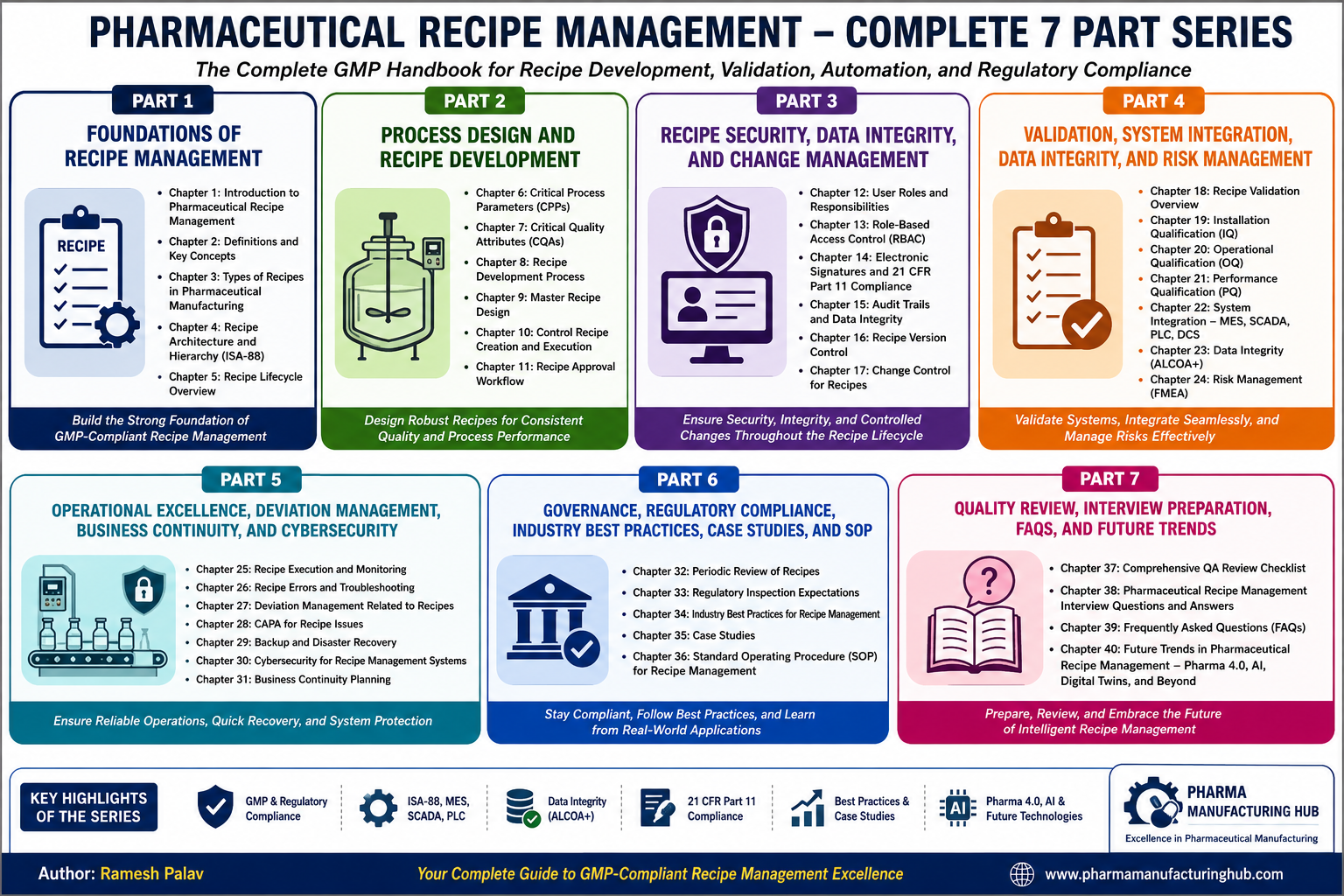
Part 1: Foundations of Recipe Management
Chapters 1–4
Table of Contents
Chapter 1
- Introduction to Recipe Management
Chapter 2
- Definitions and Terminology
Chapter 3
- Types of Manufacturing Recipes
Chapter 4
- Recipe Architecture
Chapter 1
Introduction to Recipe Management
1.1 Introduction
Modern pharmaceutical manufacturing has evolved from manually controlled processes to highly automated, data-driven production systems. In today’s Good Manufacturing Practice (GMP) environment, manufacturing recipes serve as the digital instructions that define how a pharmaceutical product is manufactured, ensuring that every batch is produced consistently, safely, and in compliance with regulatory requirements.
Recipe management is one of the most critical elements of automated manufacturing systems, controlling everything from raw material addition and mixing times to compression force, coating parameters, packaging configurations, and cleaning cycles.
In Oral Solid Dosage (OSD) manufacturing, recipes are implemented through integrated automation systems such as:
- PLC (Programmable Logic Controllers)
- SCADA (Supervisory Control and Data Acquisition)
- HMI (Human-Machine Interface)
- MES (Manufacturing Execution System)
- Electronic Batch Record (EBR)
- ERP Integration
- Historian Systems
- Batch Control Systems (ISA-88)
A well-designed recipe management system ensures that every batch follows the approved manufacturing process while maintaining complete traceability and data integrity.
1.2 What is a Manufacturing Recipe?
A manufacturing recipe is a structured set of process instructions, parameters, limits, sequences, equipment settings, operator actions, and quality checkpoints used to manufacture a pharmaceutical product.
It defines:
- Which equipment to use
- Which materials to use
- Material quantities
- Process sequence
- Equipment settings
- Critical process parameters
- Alarm limits
- Interlocks
- Operator instructions
- Electronic signatures
- Batch documentation
The recipe is often referred to as the digital manufacturing brain of an automated production process.
1.3 Objectives of Recipe Management
Recipe management aims to:
- Ensure product quality
- Standardize manufacturing processes
- Reduce operator variability
- Prevent human error
- Maintain regulatory compliance
- Enable batch traceability
- Improve process efficiency
- Facilitate electronic batch records
- Support process validation
- Enable continuous improvement
1.4 Importance in GMP Manufacturing
Recipe management supports the principles of GMP by ensuring:
| GMP Principle | Recipe Contribution |
|---|---|
| Consistency | Same process for every batch |
| Traceability | Complete electronic records |
| Data Integrity | Secure audit trails |
| Validation | Controlled execution |
| Quality | Reduced process variability |
| Compliance | Regulatory adherence |
| Patient Safety | Controlled manufacturing |
1.5 Benefits of Automated Recipe Management
Production
- Reduced setup time
- Faster batch changeover
- Higher productivity
- Lower operator dependency
Quality Assurance
- Improved consistency
- Reduced deviations
- Simplified investigations
- Better batch review
Engineering
- Centralized configuration
- Easier maintenance
- Version control
- Standardization
Regulatory Compliance
- Audit trails
- Electronic signatures
- Change control
- Data integrity
1.6 Recipe Lifecycle
Product Development
        │
        ▼
Recipe Design
        │
        ▼
Risk Assessment
        │
        ▼
Recipe Creation
        │
        ▼
Verification
        │
        ▼
Approval
        │
        ▼
Validation
        │
        ▼
Production Release
        │
        ▼
Execution
        │
        ▼
Periodic Review
        │
        ▼
Revision / Retirement
1.7 Regulatory Expectations
Recipe management should align with the intent of:
- US FDA 21 CFR Parts 210 & 211 (manufacturing controls and documentation)
- FDA 21 CFR Part 11 (electronic records and signatures)
- EU GMP Annex 11 (computerized systems)
- EU GMP Annex 15 (qualification and validation)
- WHO GMP
- PIC/S GMP
- ISPE GAMP® 5 (Second Edition)
- ISA-88 Batch Control principles
- ICH Q8, Q9, Q10, and Q12
- ALCOA+ Data Integrity principles
These frameworks collectively emphasize controlled processes, validated computerized systems, secure records, and effective lifecycle management.
1.8 Recipe Management Workflow
Master Recipe
      │
QA Approval
      │
MES Release
      │
Operator Selection
      │
Equipment Verification
      │
Material Verification
      │
Recipe Download
      │
Batch Execution
      │
Electronic Batch Record
      │
QA Review
      │
Batch Release
Key Takeaways
- Recipes are controlled manufacturing instructions used by automated systems.
- Effective recipe management improves consistency, compliance, and efficiency.
- Automation and recipe governance are central to modern GMP manufacturing.
Common Audit Findings
- Unauthorized recipe changes
- Missing approvals
- Outdated recipe versions
- Incomplete audit trail review
- Weak access controls
Best Practices
- Maintain a single approved master recipe.
- Restrict editing through role-based access.
- Validate recipe changes before release.
- Perform periodic reviews of active recipes.
Knowledge Check
- Why is recipe management critical in automated pharmaceutical manufacturing?
- How does recipe management support data integrity?
- What is the relationship between recipes and electronic batch records?
Chapter 2
Definitions and Terminology
A common vocabulary is essential for effective recipe governance.
Key Definitions
| Term | Definition |
|---|---|
| Recipe | Complete manufacturing instructions for producing a batch |
| Formula | List of ingredients and quantities |
| Manufacturing Formula | Approved formulation with process instructions |
| Batch Formula | Formula adjusted to a specific batch size |
| Master Batch Record | Controlled document describing the approved manufacturing process |
| Electronic Batch Record (EBR) | Electronic execution record capturing manufacturing data |
| Batch Parameters | Configurable values used during execution |
| Process Variables | Measured or controlled process conditions |
| CPP | Critical Process Parameter impacting product quality |
| CQA | Critical Quality Attribute that defines product quality |
Recipe vs Formula
| Formula | Recipe |
|---|---|
| Ingredient list | Complete manufacturing process |
| Raw materials only | Materials + process |
| Static | Dynamic |
| No automation | Automation ready |
| No equipment logic | Includes equipment sequencing |
CPP vs CQA
| CPP | CQA |
|---|---|
| Process setting | Product characteristic |
| Compression force | Tablet hardness |
| Inlet air temperature | Moisture content |
| Spray rate | Coating uniformity |
| Blender speed | Content uniformity |
Relationship: CPPs are controlled to consistently achieve the desired CQAs.
Master Batch Record vs Electronic Batch Record
| Master Batch Record | Electronic Batch Record |
|---|---|
| Template | Execution record |
| Approved instructions | Actual batch data |
| Controlled document | Generated during manufacturing |
| Rarely changes | Created for every batch |
Key Takeaways
- A recipe encompasses much more than a formulation.
- Distinguishing between CPPs and CQAs is fundamental to process understanding.
- The Master Batch Record provides the approved instructions; the EBR documents actual execution.
Chapter 3
Types of Manufacturing Recipes
Recipe management commonly follows the ISA-88 model, where recipes are organized hierarchically.
3.1 Master Recipe
The approved, generic manufacturing process for a product.
Contains:
- Product information
- Formula
- CPPs
- CQAs
- Process sequence
- Equipment requirements
- Sampling points
- Cleaning requirements
3.2 General Recipe
Corporate-level recipe defining how a product is manufactured independent of a specific site.
3.3 Site Recipe
Adaptation of the general recipe to the capabilities and procedures of a particular manufacturing site.
3.4 Equipment Recipe
Machine-specific configuration for individual equipment.
Example:
Tablet Press:
- Turret speed
- Compression force
- Pre-compression force
- Fill depth
- Ejection force
3.5 Control Recipe
Generated for an individual production batch. It includes:
- Batch number
- Batch size
- Material lots
- Operator assignment
- Production schedule
3.6 Batch Recipe
The recipe executed during manufacturing. It records:
- Start/stop times
- Operator actions
- Actual process values
- Deviations
- Alarms
- Electronic signatures
3.7 Cleaning Recipe
Defines validated cleaning parameters, such as:
- Wash duration
- Rinse sequence
- Conductivity limits
- Final rinse criteria
- Drying cycle
3.8 Calibration Recipe
Automates calibration activities for instruments and equipment where supported.
3.9 Maintenance Recipe
Defines standardized preventive maintenance tasks for automated execution or guided workflows.
ISA-88 Recipe Hierarchy
General Recipe
        │
        ▼
Site Recipe
        │
        ▼
Master Recipe
        │
        ▼
Control Recipe
        │
        ▼
Batch Execution
Key Takeaways
- Different recipe types serve different lifecycle stages.
- ISA-88 promotes consistency and scalability.
- Separating general, site, and control recipes simplifies change management.
Chapter 4
Recipe Architecture
Recipe architecture defines how a manufacturing process is structured and executed within an automation system.
4.1 Hierarchical Structure
Enterprise
     │
Site
     │
Area
     │
Process Cell
     │
Unit
     │
Equipment Module
     │
Control Module
4.2 Functional Recipe Model
Recipe
 │
 ├── Unit Procedure
 │      │
 │      ├── Operation
 │      │       │
 │      │       ├── Phase
 │      │       │
 │      │       └── Parameters
Example: Tablet Coating
Unit Procedure: Coating
- Operation 1: Pre-heating
- Operation 2: Spray Application
- Operation 3: Drying
- Operation 4: Cooling
Each operation consists of phases with defined setpoints, limits, and logic.
4.3 Automation Components
| Component | Function |
|---|---|
| PLC | Executes equipment control logic |
| HMI | Operator interface for monitoring and control |
| SCADA | Supervisory control, alarms, and data collection |
| MES | Manages recipes, workflows, and electronic batch records |
| ERP | Production planning and material management |
| Historian | Long-term storage of process data |
4.4 Data Flow
ERP
 │
 ▼
MES
 │
 ▼
Recipe Server
 │
 ▼
SCADA
 │
 ▼
PLC
 │
 ▼
Equipment
 │
 ▼
Sensors
 │
 ▼
Historian
 │
 ▼
Electronic Batch Record
4.5 Typical Recipe Elements
A robust recipe typically includes:
- Product identification
- Product code
- Recipe version
- Batch size
- Equipment ID
- Material requirements
- Process sequence
- Setpoints
- Acceptable operating ranges
- Alarm limits
- Interlocks
- Sampling instructions
- In-process controls
- Hold times
- Cleaning requirements
- Electronic signature requirements
- Audit trail configuration
Key Takeaways
- Recipe architecture should align with ISA-88 principles.
- Separation of procedural logic and equipment logic improves flexibility and maintainability.
- Integration among ERP, MES, SCADA, PLC, and EBR systems supports end-to-end traceability.
Common Audit Findings
- Inconsistent recipe structures across equipment.
- Uncontrolled parameter changes.
- Missing linkage between approved recipes and executed batches.
- Insufficient documentation of equipment-specific configurations.
Best Practices
- Standardize recipe templates across manufacturing lines.
- Use modular design for unit procedures, operations, and phases.
- Maintain synchronization between recipe versions and validated system configurations.
- Review architecture periodically as part of the computerized system lifecycle.
Knowledge Check
- Describe the ISA-88 recipe hierarchy.
- What is the role of the MES in recipe execution?
- Why is modular recipe architecture advantageous in pharmaceutical manufacturing?
Part 1 Summary
This first part established the foundation of pharmaceutical recipe management by covering:
- The purpose and importance of recipe management in GMP manufacturing.
- Core terminology, including recipes, formulas, CPPs, CQAs, Master Batch Records, and Electronic Batch Records.
- The major types of manufacturing recipes and their roles throughout the product lifecycle.
- The architecture of modern recipe management systems, including ISA-88 concepts and integration with ERP, MES, SCADA, PLC, HMI, and historians.
These concepts provide the groundwork for Part 2, which will focus on Critical Process Parameters (CPPs), Critical Quality Attributes (CQAs), Recipe Development, and Recipe Approval Workflows, moving from foundational principles to practical implementation.
Part 2: Process Design and Recipe Development
Chapters 5–8
Table of Contents
Chapter 5
- Critical Process Parameters (CPPs)
Chapter 6
- Critical Quality Attributes (CQAs)
Chapter 7
- Recipe Development Process
Chapter 8
- Recipe Approval Workflow
Chapter 5
Critical Process Parameters (CPPs)
5.1 Introduction
Critical Process Parameters (CPPs) are process variables that have a direct and significant impact on the Critical Quality Attributes (CQAs) of a pharmaceutical product. According to ICH Q8 and ICH Q9, CPPs should be scientifically identified, justified, monitored, and controlled throughout the product lifecycle.
In automated manufacturing, CPPs are embedded within the manufacturing recipe and executed by PLCs, SCADA systems, and MES platforms. Maintaining CPPs within validated operating ranges is essential to ensure consistent product quality, process robustness, and regulatory compliance.
5.2 Definition of CPP
A Critical Process Parameter is:
A process parameter whose variability has a significant impact on a Critical Quality Attribute (CQA) and therefore should be monitored or controlled to ensure the process produces the desired quality.
5.3 Characteristics of a CPP
A parameter is generally considered critical when it:
- Directly affects product quality.
- Has scientifically demonstrated impact through process development.
- Requires predefined operating limits.
- Is routinely monitored during manufacturing.
- Is documented in the Master Recipe and Electronic Batch Record (EBR).
- Is subject to change control and validation.
5.4 Identification of CPPs
CPPs are identified through:
- Pharmaceutical development studies (ICH Q8)
- Design of Experiments (DoE)
- Risk assessments (ICH Q9)
- Process characterization studies
- Scale-up studies
- Validation batches
- Historical manufacturing data
- Continued Process Verification (CPV)
5.5 CPP Identification Workflow
Process Development
        │
Design of Experiments (DoE)
        │
Risk Assessment (FMEA)
        │
Process Characterization
        │
Validation Studies
        │
Approved CPP List
        │
Recipe Configuration
        │
Routine Monitoring
5.6 Typical CPPs by Equipment
High Shear Granulator (RMG)
| Parameter | Typical Operating Range | Alarm Limits | Criticality |
|---|---|---|---|
| Impeller Speed | 80–250 rpm | ±10% | High |
| Chopper Speed | 1000–3000 rpm | ±10% | Medium |
| Binder Addition Rate | Product-specific | High/Low | High |
| Mixing Time | 3–15 min | ±1 min | High |
| Granulation Endpoint | Torque-based | High/Low | Critical |
Interlocks:
- Bowl lid closed.
- Chopper operational.
- Dust extraction ON.
- Emergency stop released.
Operator Actions:
- Verify recipe download.
- Confirm raw material identity.
- Monitor torque trend.
- Record any deviations.
Fluid Bed Dryer (FBD)
| Parameter | Typical Range | Alarm |
|---|---|---|
| Inlet Air Temperature | 55–80°C | High/Low |
| Product Temperature | 40–55°C | High |
| Airflow | Validated range | Low |
| Drying Time | Product-specific | Timeout |
| Exhaust Humidity | Product-specific | High |
Blender
| Parameter | Typical Range |
|---|---|
| Blend Speed | 8–20 rpm |
| Blend Time | 10–30 min |
| Fill Volume | 40–70% |
| Sampling Frequency | Defined in BMR |
Tablet Compression Machine
| CPP | Typical Range |
|---|---|
| Main Compression Force | Product-specific |
| Pre-compression Force | Product-specific |
| Turret Speed | 15–80 rpm |
| Feeder Speed | Product-specific |
| Fill Depth | Product-specific |
Tablet Coating Machine
| CPP | Typical Range |
|---|---|
| Pan Speed | 4–12 rpm |
| Spray Rate | Product-specific |
| Inlet Air Temperature | Product-specific |
| Exhaust Temperature | Product-specific |
| Atomization Pressure | Product-specific |
Capsule Filling Machine
Typical CPPs include:
- Dosing disk speed
- Capsule separation vacuum
- Fill weight
- Capsule orientation
- Powder level
Packaging Line
Typical CPPs:
- Conveyor speed
- Bottle count
- Vision inspection sensitivity
- Torque settings
- Label position
5.7 CPP Monitoring
Modern MES and SCADA systems continuously monitor:
- Real-time trends
- Alarm conditions
- Operator interventions
- Recipe deviations
- Equipment performance
Trending enables early detection of process drift.
5.8 Alarm Strategy
Typical alarm categories:
| Alarm Type | Action |
|---|---|
| Advisory | Operator notification |
| Warning | Increased monitoring |
| Critical | Immediate operator action |
| Interlock | Automatic process stop |
5.9 CPP Validation
CPPs should be challenged during:
- Installation Qualification (IQ)
- Operational Qualification (OQ)
- Performance Qualification (PQ)
- Continued Process Verification (CPV)
Testing should include:
- Normal operating conditions
- Upper and lower operating limits
- Alarm verification
- Interlock verification
- Worst-case conditions
Key Takeaways
- CPPs are the foundation of process control.
- They are scientifically established and validated.
- Continuous monitoring supports consistent manufacturing.
Common Audit Findings
- Undefined CPP rationale.
- Inadequate monitoring.
- Unvalidated parameter changes.
- Alarm limits inconsistent with validation.
Best Practices
- Link every CPP to one or more CQAs.
- Review CPP trends periodically.
- Ensure CPPs are protected by recipe access controls.
Chapter 6
Critical Quality Attributes (CQAs)
6.1 Introduction
Critical Quality Attributes (CQAs) are the measurable physical, chemical, biological, or microbiological properties that must remain within predefined limits to ensure the safety, efficacy, and quality of a pharmaceutical product.
CQAs are established during pharmaceutical development and are controlled indirectly through well-managed CPPs.
6.2 Examples of CQAs for Tablets
| CQA | Acceptance Criteria (Example) |
|---|---|
| Assay | Product-specific specification |
| Dissolution | Product-specific specification |
| Uniformity of Dosage Units | Product-specific specification |
| Hardness | Product-specific specification |
| Friability | Product-specific specification |
| Thickness | Product-specific specification |
| Moisture Content | Product-specific specification |
| Appearance | Approved standard |
Note: Acceptance criteria should always follow the approved product specification and validated manufacturing process.
6.3 Relationship Between CPPs and CQAs
Recipe Parameter
        │
        ▼
Equipment Setting
        │
        ▼
Process Execution
        │
        ▼
CPP Control
        │
        ▼
Product Quality
        │
        ▼
CQA Achievement
6.4 Example Relationship
| CPP | Affected CQA |
|---|---|
| Compression Force | Hardness |
| Blend Time | Content Uniformity |
| Drying Temperature | Moisture Content |
| Spray Rate | Coating Uniformity |
| Granulation Endpoint | Dissolution |
6.5 CQA Monitoring
CQAs are monitored through:
- In-process controls (IPC)
- Laboratory testing
- PAT (where implemented)
- Statistical Process Control (SPC)
- Continued Process Verification
6.6 Trending
Quality trends include:
- Tablet hardness
- Tablet weight
- Moisture content
- Assay results
- Dissolution performance
- OOS trends
Key Takeaways
- CQAs define the quality requirements of the finished product.
- Robust CPP control is essential to consistently achieve CQAs.
- Ongoing trending supports lifecycle management and continuous improvement.
Chapter 7
Recipe Development Process
7.1 Overview
Recipe development translates the approved manufacturing process into executable instructions for automated equipment. It should follow a structured lifecycle and incorporate quality risk management principles.
7.2 Recipe Development Lifecycle
URS
 │
Risk Assessment
 │
Functional Specification (FS)
 │
Design Specification (DS)
 │
Recipe Configuration
 │
Simulation
 │
Verification
 │
Validation
 │
QA Approval
 │
Production Release
 │
Periodic Review
7.3 User Requirements Specification (URS)
The URS should define:
- Product identification
- Batch sizes
- Equipment compatibility
- Process sequence
- CPPs
- CQAs
- Alarm requirements
- Interlocks
- Electronic signatures
- Audit trail requirements
- Data storage and reporting
7.4 Functional Specification (FS)
The FS describes:
- Recipe logic
- Equipment sequencing
- Control philosophy
- Alarm management
- User interactions
- Batch reporting
7.5 Design Specification (DS)
The DS details:
- PLC logic
- SCADA screens
- HMI navigation
- Database structure
- Parameter mapping
- Integration interfaces
7.6 Recipe Configuration
Typical recipe fields:
| Parameter | Example |
|---|---|
| Product Code | TAB001 |
| Product Name | Paracetamol 500 mg |
| Batch Size | 500 kg |
| Recipe Version | V1.0 |
| Equipment ID | RMG-01 |
| Approved By | QA Manager |
| Effective Date | DD-MMM-YYYY |
7.7 Simulation and Dry Run
Prior to production:
- Verify process sequence.
- Test parameter downloads.
- Confirm alarm functionality.
- Validate interlocks.
- Check electronic signatures.
- Review audit trail generation.
7.8 Recipe Verification Checklist
| Item | Status |
|---|---|
| Product Code | ✓ |
| Batch Size | ✓ |
| Material List | ✓ |
| CPPs | ✓ |
| Alarm Limits | ✓ |
| Interlocks | ✓ |
| Audit Trail | ✓ |
| Electronic Signatures | ✓ |
| Version Number | ✓ |
7.9 Validation
Recipe validation should demonstrate that:
- The configured recipe matches approved specifications.
- Equipment responds correctly.
- All alarms and interlocks function as intended.
- Electronic records and signatures comply with applicable regulations.
- Process outputs remain within validated ranges.
Key Takeaways
- Recipe development follows a documented lifecycle from URS through validation.
- Verification before release minimizes production risk.
- Configuration management and documentation are essential.
Chapter 8
Recipe Approval Workflow
8.1 Purpose
Recipe approval ensures that only authorized, reviewed, and validated recipes are released for manufacturing.
8.2 Typical Approval Workflow
Recipe Draft
      │
Automation Review
      │
Engineering Review
      │
Validation Review
      │
Production Review
      │
QA Approval
      │
Electronic Signature
      │
MES Release
      │
Production Execution
8.3 Roles and Responsibilities
| Department | Responsibility |
|---|---|
| Production | Define manufacturing requirements |
| Engineering | Verify equipment compatibility |
| Automation | Configure and test recipe |
| Validation | Confirm validated state |
| QA | Final review and approval |
| IT/CSV | Ensure system integrity and compliance |
8.4 Approval Criteria
Before release, confirm:
- Approved Master Formula.
- Current recipe version.
- Validated configuration.
- Verified alarm limits.
- Confirmed interlocks.
- Approved electronic signatures.
- Active audit trail.
- Completed change control (if applicable).
- Required training completed.
8.5 Electronic Approval Matrix
| Role | Review | Approve |
|---|---|---|
| Automation Engineer | ✓ | |
| Production Manager | ✓ | |
| Engineering Manager | ✓ | |
| Validation Lead | ✓ | |
| QA Manager | ✓ | ✓ |
| System Administrator | Release |
8.6 Recipe Release Checklist
| Item | Verification |
|---|---|
| Recipe Tested | ✓ |
| Version Approved | ✓ |
| Audit Trail Enabled | ✓ |
| Electronic Signature Verified | ✓ |
| Backup Completed | ✓ |
| User Access Confirmed | ✓ |
| Change Control Closed | ✓ |
| Validation Complete | ✓ |
8.7 Periodic Review
Approved recipes should undergo periodic review to verify:
- Continued suitability.
- Alignment with current product specifications.
- Compatibility with validated equipment and software.
- No unauthorized changes.
- Ongoing effectiveness of alarms and interlocks.
Key Takeaways
- Formal approval workflows protect the integrity of manufacturing recipes.
- QA plays a central role in final approval and release.
- Electronic signatures, audit trails, and change control are essential elements of a compliant recipe lifecycle.
Common Audit Findings
- Missing electronic approvals.
- Use of superseded recipe versions.
- Incomplete change control documentation.
- Inadequate review of recipe modifications.
Best Practices
- Use standardized approval workflows within the MES or document management system.
- Require independent QA approval before production release.
- Maintain complete traceability from recipe development through retirement.
Part 2 Summary
This section covered the scientific and operational foundations of recipe design and governance:
- Identification, control, and validation of Critical Process Parameters (CPPs).
- Definition and monitoring of Critical Quality Attributes (CQAs) and their relationship to process control.
- A structured recipe development lifecycle, from URS through configuration, verification, and validation.
- A GMP-compliant recipe approval workflow, including roles, electronic approvals, release criteria, and periodic review.
These principles establish the framework for implementing controlled, validated, and compliant manufacturing recipes. Part 3 will build on this by addressing Role-Based Access Control (RBAC), Electronic Signatures, Audit Trail Requirements, Recipe Version Control, and Change Control, which are critical for maintaining data integrity and regulatory compliance throughout the recipe lifecycle.
Part 3: Recipe Security, Data Integrity, and Change Management
Chapters 9–13
Table of Contents
Chapter 9
- Role-Based Access Control (RBAC)
Chapter 10
- Electronic Signatures
Chapter 11
- Audit Trail Requirements
Chapter 12
- Recipe Version Control
Chapter 13
- Change Control Process
Chapter 9
Role-Based Access Control (RBAC)
9.1 Introduction
Role-Based Access Control (RBAC) is a fundamental security mechanism that restricts system access based on an individual’s job responsibilities. In pharmaceutical manufacturing, RBAC ensures that only authorized personnel can create, modify, approve, execute, or retire manufacturing recipes.
A well-designed RBAC framework supports compliance with:
- FDA 21 CFR Part 11
- EU GMP Annex 11
- ISPE GAMP® 5
- ICH Q10
- ALCOA+ Data Integrity Principles
Proper RBAC minimizes unauthorized changes, protects validated systems, and maintains complete accountability.
9.2 Objectives of RBAC
The primary objectives are to:
- Protect recipe integrity.
- Prevent unauthorized modifications.
- Maintain data integrity.
- Enforce segregation of duties.
- Support electronic signatures.
- Facilitate regulatory compliance.
- Ensure complete traceability.
9.3 Typical User Roles
| Role | Responsibilities | Recipe Access |
|---|---|---|
| Operator | Execute approved recipes | Execute Only |
| Line Supervisor | Batch supervision | Execute + View |
| Production Manager | Manufacturing oversight | View + Request Changes |
| QA Officer | Review batch records | View |
| QA Manager | Final approval | Approve |
| Automation Engineer | Configure recipes | Create & Modify |
| Validation Engineer | Verify recipe validation | Verify |
| Maintenance Engineer | Equipment maintenance | Maintenance Mode Only |
| CSV Engineer | System validation | Test Environment |
| IT Administrator | Infrastructure support | No recipe modification |
| System Administrator | User administration | User Management Only |
9.4 Access Matrix
| Function | Operator | Supervisor | QA | Automation | Admin |
|---|---|---|---|---|---|
| View Recipe | ✓ | ✓ | ✓ | ✓ | ✓ |
| Execute Recipe | ✓ | ✓ | |||
| Pause Batch | ✓ | ✓ | |||
| Resume Batch | ✓ | ||||
| Modify Recipe | ✓ | ||||
| Approve Recipe | ✓ | ||||
| Create User | ✓ | ||||
| Delete User | ✓ | ||||
| Backup Recipes | ✓ |
9.5 RBAC Principles
Least Privilege
Users receive only the minimum permissions required to perform assigned tasks.
Example
An operator should:
✓ Start batch
✓ Pause batch
✓ View alarms
✗ Modify compression force
✗ Change recipe
✗ Delete batch records
Separation of Duties
Recipe lifecycle should involve independent personnel.
Example:
Automation Engineer → Creates Recipe
↓
Validation Engineer → Tests Recipe
↓
Production Manager → Reviews
↓
QA Manager → Approves
↓
Operator → Executes
9.6 Password Policy
Typical GMP requirements:
Minimum length: ≥ 8–12 characters (per site policy)
Complexity requirements
Password expiration (risk-based)
Account lockout after repeated failed attempts
No shared accounts
Unique user IDs
9.7 Session Controls
System should:
- Automatic logout after inactivity
- Screen lock
- Re-authentication before critical actions
- Secure login history
9.8 User Lifecycle
User Request
      │
Manager Approval
      │
IT Creates Account
      │
QA Verification
      │
Training Completed
      │
Access Activated
      │
Periodic Review
      │
Access Removed
9.9 Periodic User Review
QA and System Administrator should periodically review:
- Active users
- Inactive users
- Privileged accounts
- Temporary accounts
- Vendor accounts
- Password compliance
- Failed login attempts
9.10 Best Practices
✓ Use Active Directory integration where appropriate.
✓ Disable generic accounts.
✓ Implement multi-factor authentication (where supported and risk-assessed).
✓ Review access quarterly or per company procedures.
✓ Document all user privilege changes.
Common Audit Findings
- Shared user IDs
- Generic administrator accounts
- Excessive privileges
- Inactive accounts not removed
- Weak password policies
Chapter 10
Electronic Signatures
10.1 Introduction
Electronic signatures demonstrate that an identified individual has reviewed, approved, or executed a regulated action within a computerized system. They are intended to be the legally binding equivalent of handwritten signatures when implemented in compliance with applicable regulations.
Electronic signatures are widely used in:
- Recipe approval
- Batch release
- Deviation approval
- Change control
- SOP approval
- Validation documentation
10.2 Signature Types
| Type | Example |
|---|---|
| Approval | QA Recipe Approval |
| Verification | Validation Review |
| Execution | Operator Batch Start |
| Review | Supervisor Review |
| Release | QA Batch Release |
10.3 Signature Components
Each signature should include:
- User ID
- Full Name
- Date
- Time
- Meaning of signature (e.g., Review, Approval)
- Electronic authentication
10.4 Example Workflow
Recipe Draft
      │
Automation Signature
      │
Validation Signature
      │
Engineering Signature
      │
Production Signature
      │
QA Signature
      │
Recipe Released
10.5 Dual Electronic Signature
Critical actions may require two independent signatures.
Example:
Change compression force
↓
Production Approval
↓
QA Approval
↓
Recipe Released
10.6 Signature Verification
System should verify:
- Password
- Identity
- User privilege
- Session validity
- Account status
10.7 Invalid Signature Conditions
- Wrong password
- Disabled account
- Expired account
- Unauthorized role
- Network interruption during signing
- Duplicate approval by same individual where independent review is required
10.8 Best Practices
- Use individual credentials.
- Require re-authentication for critical approvals.
- Record signature meaning.
- Include signatures in audit trails.
Common Audit Findings
- Shared passwords
- Missing signature meaning
- No independent approval
- Inadequate signature controls
Chapter 11
Audit Trail Requirements
11.1 Introduction
Audit trails provide a secure, computer-generated, chronological record of activities affecting electronic records. They support data integrity, facilitate investigations, and demonstrate compliance during inspections.
Audit trails should not be editable by end users and should be retained according to record retention requirements.
11.2 Audit Trail Contents
Every entry should record:
| Field | Example |
|---|---|
| User ID | RPALAV |
| Date | 12-Jul-2026 |
| Time | 09:14:22 |
| Action | Recipe Modified |
| Parameter | Compression Force |
| Old Value | 15 kN |
| New Value | 16 kN |
| Reason | Process Optimization |
| Electronic Signature | QA Approved |
11.3 Events to Capture
- Recipe creation
- Recipe modification
- Recipe approval
- Parameter changes
- Login/logout
- Alarm acknowledgments
- Batch start/stop
- Batch abort
- Electronic signatures
- User account changes
- Backup and restore activities
11.4 Audit Trail Flow
User Action
      │
Authentication
      │
Action Executed
      │
Audit Entry Generated
      │
Database Storage
      │
Review
      │
Archive
11.5 Audit Trail Review
QA should review:
- Unauthorized changes
- Recipe modifications
- Failed login attempts
- Deleted records (if permitted by system design)
- Alarm overrides
- Security events
11.6 Audit Trail Example
| Time | Event |
|---|---|
| 09:01 | User Login |
| 09:05 | Recipe Opened |
| 09:08 | Parameter Changed |
| 09:09 | Electronic Signature |
| 09:10 | Recipe Approved |
| 09:12 | Batch Started |
11.7 Retention
Audit trail records should be:
- Protected against unauthorized alteration.
- Readily retrievable.
- Retained for the required record retention period.
- Included in backup and disaster recovery strategies.
Common Audit Findings
- Audit trail disabled
- Missing reason for change
- Audit trail not reviewed
- Audit trail not backed up
- Time synchronization issues
Chapter 12
Recipe Version Control
12.1 Introduction
Recipe Version Control ensures that only the current, approved, and validated recipe is available for production while preserving the complete history of previous versions.
Version control supports traceability, investigations, and lifecycle management.
12.2 Version Numbering
Example:
Major Version
V1.0
V2.0
V3.0
Minor Version
V1.1
V1.2
V1.3
Patch Version
V1.1.1
V1.1.2
12.3 Version Lifecycle
Draft
 │
Review
 │
Approved
 │
Released
 │
Production
 │
Periodic Review
 │
Revision
 │
Archived
 │
Retired
12.4 Revision History Example
| Version | Description | Approved By | Date |
|---|---|---|---|
| 1.0 | Initial Release | QA | 15-Jan-2026 |
| 1.1 | Updated Blend Time | QA | 12-Apr-2026 |
| 2.0 | New Product Formula | QA | 20-Aug-2026 |
12.5 Version Control Rules
- One approved version for production.
- Draft versions isolated from production.
- Archived versions remain read-only.
- Every revision linked to approved change control.
- Validation status maintained for each released version.
12.6 Rollback
Rollback may be required when:
- Critical defect discovered
- Validation failure
- Equipment incompatibility
- Incorrect parameter release
Rollback should follow documented procedures and be approved through change control.
Common Audit Findings
- Multiple active versions
- Missing revision history
- Incomplete archival
- Uncontrolled rollback
Chapter 13
Change Control Process
13.1 Introduction
Recipe modifications must be managed through a formal Change Control process to ensure that product quality, patient safety, and the validated state of computerized systems are maintained.
Typical reasons include:
- Process optimization
- New regulatory requirements
- Equipment upgrades
- Software updates
- Corrective actions
- CAPA implementation
13.2 Change Control Workflow
Change Request
      │
Impact Assessment
      │
Risk Assessment (FMEA)
      │
QA Review
      │
Automation Configuration
      │
Validation Testing
      │
Approval
      │
Implementation
      │
Effectiveness Verification
      │
Closure
13.3 Impact Assessment
Assess potential impact on:
- Product quality
- Patient safety
- Process performance
- CPPs
- CQAs
- Equipment
- MES/SCADA/PLC
- Validation status
- Regulatory submissions
- Training requirements
13.4 Change Categories
| Type | Example |
|---|---|
| Minor | Alarm text correction |
| Moderate | Blend time adjustment within validated range |
| Major | New coating process or formula change |
13.5 Example Change Request
| Item | Example |
|---|---|
| Change No. | CC-2026-001 |
| Product | Paracetamol 500 mg |
| Equipment | Compression Machine |
| Parameter | Main Compression Force |
| Existing Value | 15 kN |
| Proposed Value | 16 kN |
| Reason | Improve Tablet Hardness |
| Risk Assessment | Medium |
| Validation Required | Yes |
| QA Approval | Required |
13.6 Validation After Change
The extent of validation depends on the risk and impact of the change.
Possible activities include:
- Configuration review
- Functional testing
- OQ regression testing
- PQ verification
- Electronic signature verification
- Audit trail verification
- Recipe execution testing
13.7 Effectiveness Check
Following implementation, confirm:
- No increase in deviations
- CPPs remain within limits
- CQAs continue to meet specifications
- No adverse impact on equipment performance
- No recurring alarms related to the change
13.8 Change Control Checklist
| Requirement | Status |
|---|---|
| Change Request Approved | ✓ |
| Risk Assessment Completed | ✓ |
| Impact Assessment Completed | ✓ |
| Validation Completed | ✓ |
| QA Approval Obtained | ✓ |
| Training Completed | ✓ |
| SOP Updated | ✓ |
| Recipe Released | ✓ |
| Effectiveness Verified | ✓ |
| Change Closed | ✓ |
Common Audit Findings
- Recipe changes implemented without formal approval
- Incomplete impact assessments
- Missing validation evidence
- Lack of training documentation
- Poor linkage between change control and recipe versions
Part 3 Summary
Part 3 established the governance framework required to maintain recipe integrity throughout the computerized system lifecycle.
Topics Covered
- Chapter 9: Role-Based Access Control (RBAC)
- User roles and permissions
- Least privilege
- Segregation of duties
- User lifecycle management
- Chapter 10: Electronic Signatures
- Approval workflows
- Signature components
- Authentication requirements
- Dual approvals for critical actions
- Chapter 11: Audit Trail Requirements
- Audit trail contents
- Required events
- Review practices
- Data retention
- Chapter 12: Recipe Version Control
- Version numbering
- Revision history
- Archiving
- Rollback management
- Chapter 13: Change Control
- Change workflow
- Impact and risk assessment
- Validation following changes
- Effectiveness verification
Best Practices Summary
- Restrict recipe modification to authorized personnel using RBAC.
- Ensure every regulated action is supported by compliant electronic signatures.
- Maintain secure, complete, and regularly reviewed audit trails.
- Control recipe versions through formal approval and archiving.
- Link every recipe change to a documented change control, risk assessment, validation activity, and QA approval.
Next in Part 4 (Chapters 14–18)
The next section will focus on the technical execution and validation of recipe management systems, including:
- Chapter 14: Validation Requirements (URS, FS, DS, Configuration Specification, Traceability Matrix, IQ/OQ/PQ, CSV Deliverables)
- Chapter 15: Recipe Testing During IQ/OQ/PQ (test protocols, boundary testing, alarms, interlocks, security, audit trails)
- Chapter 16: Integration with ERP, MES, SCADA, PLC, HMI, LIMS, Historians, and Electronic Batch Records
- Chapter 17: Data Integrity Controls (ALCOA+, metadata, backup, disaster recovery, review)
- Chapter 18: Risk Assessment (FMEA) with equipment-specific pharmaceutical examples and comprehensive risk matrices.
Part 4: Validation, System Integration, Data Integrity, and Risk Management
Chapters 14–18
Table of Contents
- Chapter 14: Validation Requirements
- Chapter 15: Recipe Testing During IQ/OQ/PQ
- Chapter 16: Integration with ERP, MES, SCADA, PLC, HMI, LIMS, and EBR
- Chapter 17: Data Integrity Controls
- Chapter 18: Risk Assessment (FMEA)
Chapter 14
Validation Requirements for Pharmaceutical Recipes
14.1 Introduction
A manufacturing recipe used in a computerized pharmaceutical manufacturing system is a GxP-controlled configuration item. Any recipe that influences Critical Process Parameters (CPPs), Critical Quality Attributes (CQAs), batch documentation, or electronic records must be validated before release for commercial manufacturing.
Recipe validation demonstrates that:
- The recipe accurately reflects the approved Master Batch Record.
- The recipe performs consistently within validated operating ranges.
- The automated control system executes the manufacturing process as intended.
- Electronic records generated during execution are complete, accurate, attributable, and secure.
- The validated state is maintained throughout the recipe lifecycle.
Validation follows a lifecycle approach consistent with GAMP® 5 (Second Edition), incorporating risk management principles from ICH Q9.
14.2 Validation Lifecycle
User Requirements Specification (URS)
            │
            ▼
Functional Specification (FS)
            │
            ▼
Design Specification (DS)
            │
            ▼
Configuration Specification
            │
            ▼
Risk Assessment (FMEA)
            │
            ▼
Traceability Matrix
            │
            ▼
IQ
            │
            ▼
OQ
            │
            ▼
PQ
            │
            ▼
Process Verification
            │
            ▼
Periodic Review
14.3 Validation Documentation
Typical documentation includes:
| Document | Purpose |
|---|---|
| Validation Plan | Overall strategy |
| URS | Business and user requirements |
| Functional Specification | Functional behavior |
| Design Specification | Technical implementation |
| Configuration Specification | Recipe configuration details |
| Risk Assessment | Identification of critical functions |
| Traceability Matrix | Requirement verification |
| IQ Protocol | Installation verification |
| OQ Protocol | Operational verification |
| PQ Protocol | Performance verification |
| Validation Report | Summary and approval |
14.4 User Requirements Specification (URS)
The URS should define:
- Product name
- Product code
- Equipment
- Batch sizes
- Recipe functionality
- CPPs
- CQAs
- Alarm philosophy
- Interlocks
- Electronic signatures
- Audit trail
- Security
- Backup
- Disaster recovery
- Reporting requirements
14.5 Functional Specification
The Functional Specification describes:
- Process sequence
- Operator interactions
- Equipment logic
- Recipe download
- Alarm behavior
- Electronic Batch Record generation
- Exception handling
14.6 Design Specification
Typical contents include:
- PLC logic
- SCADA screens
- HMI navigation
- Recipe database
- Communication interfaces
- MES integration
- Network architecture
14.7 Configuration Specification
Documents:
- Recipe parameters
- Default values
- Upper and lower limits
- Alarm limits
- Interlocks
- User permissions
- Version information
14.8 Traceability Matrix
| URS Requirement | FS | DS | IQ | OQ | PQ |
|---|---|---|---|---|---|
| Recipe Download | ✓ | ✓ | ✓ | ✓ | ✓ |
| Electronic Signature | ✓ | ✓ | ✓ | ||
| Alarm Logging | ✓ | ✓ | ✓ | ✓ | |
| Batch Record | ✓ | ✓ | ✓ | ✓ |
14.9 Validation Deliverables
- Approved protocols
- Executed test scripts
- Deviations
- CAPA
- Validation Report
- QA Approval
Key Takeaways
- Recipes are validated configuration items.
- Validation begins with documented requirements.
- Every requirement should be verified through traceability.
Chapter 15
Recipe Testing During IQ, OQ, and PQ
15.1 Installation Qualification (IQ)
IQ confirms that hardware, software, and recipe-related infrastructure are installed correctly.
IQ Verification Checklist
| Test | Expected Result |
|---|---|
| PLC Installed | Verified |
| SCADA Installed | Verified |
| Recipe Database Installed | Verified |
| Network Connected | Verified |
| Software Version Verified | Verified |
| Backup Configured | Verified |
| Time Synchronization | Verified |
15.2 Operational Qualification (OQ)
OQ verifies that the recipe functions correctly under defined operating conditions.
Typical OQ Tests
- Recipe download
- Recipe upload
- Recipe execution
- Parameter modification restrictions
- Alarm testing
- Interlock testing
- Audit trail verification
- Electronic signatures
- User permissions
- Network failure recovery
- Batch hold
- Batch resume
- Emergency stop
- Security testing
Example OQ Test Case
Objective
Verify High Shear Granulator recipe download.
Procedure
- Login as Operator.
- Select Product A.
- Download Recipe.
- Verify recipe checksum.
- Confirm parameter values.
- Start batch.
Acceptance Criteria
- Correct recipe downloaded.
- No parameter mismatch.
- Audit trail generated.
- Electronic Batch Record created.
15.3 Performance Qualification (PQ)
PQ confirms consistent performance under routine manufacturing conditions.
Typical activities include:
- Three consecutive commercial-scale batches (or as justified by the validation strategy).
- Monitoring of all CPPs.
- Verification that CQAs meet approved specifications.
- Review of Electronic Batch Records.
- Review of deviations.
- Trending.
15.4 Boundary Testing
Challenge recipe limits.
Example:
Compression Force
Lower Limit
Normal
Upper Limit
Confirm:
- Alarm behavior
- Interlocks
- Batch response
- Data recording
15.5 Alarm Testing
Example
| Alarm | Test |
|---|---|
| High Temperature | Verify activation |
| Low Air Pressure | Verify shutdown |
| Motor Overload | Verify trip |
| Low Vacuum | Verify alarm |
15.6 Interlock Verification
Typical interlocks
High Shear Granulator
- Lid Closed
- Bowl Locked
- Dust Collector ON
- Emergency Stop Reset
Tablet Press
- Hopper Present
- Lubrication Available
- Guard Closed
- Metal Detector Healthy
15.7 Security Testing
Verify:
- Invalid login
- Password expiration
- Account lockout
- Unauthorized recipe editing
- Privilege escalation prevention
15.8 Audit Trail Testing
Verify:
- Login recorded
- Recipe changes recorded
- Approvals recorded
- Alarm acknowledgements recorded
- Batch completion recorded
Key Takeaways
- IQ verifies installation.
- OQ verifies functionality.
- PQ verifies process performance.
- Boundary testing increases confidence in process robustness.
Chapter 16
Integration with MES, ERP, SCADA, PLC, HMI, LIMS, Historian, and EBR
Modern pharmaceutical manufacturing depends on seamless communication between enterprise and shop-floor systems.
16.1 Typical Architecture
             ERP (SAP/Oracle)
                    │
                    ▼
        Manufacturing Execution System
                    │
      ┌─────────────┼─────────────┐
      ▼             ▼             ▼
   Recipe        Electronic     Historian
   Server        Batch Record
      │
      ▼
     SCADA
      │
      ▼
      PLC
      │
      ▼
 Manufacturing Equipment
16.2 ERP Integration
ERP supplies:
- Production orders
- Batch numbers
- Material master data
- BOM
- Inventory status
MES returns:
- Batch completion
- Material consumption
- Yield
- Production status
16.3 MES Integration
MES controls:
- Recipe download
- Operator guidance
- Material verification
- Electronic signatures
- EBR
- Workflow management
16.4 SCADA Integration
SCADA provides:
- Process visualization
- Alarm management
- Trending
- Historical records
- Recipe monitoring
16.5 PLC Integration
PLC executes:
- Sequence control
- PID loops
- Motor control
- Safety interlocks
- Equipment control
16.6 HMI Integration
Operator functions:
- Select recipe
- View alarms
- Enter comments
- Start batch
- Pause batch
- Resume batch
- Acknowledge alarms
16.7 LIMS Integration
Laboratory information exchanged:
- Sample requests
- Test results
- Release status
- Stability information
16.8 Historian Integration
Stores:
- Process trends
- Alarm history
- Batch events
- Equipment performance
- Energy consumption
16.9 Electronic Batch Record (EBR)
Automatically records:
- Recipe version
- Operator ID
- Material lots
- Process values
- Alarms
- Deviations
- Electronic signatures
Integration Best Practices
- Standardize data interfaces.
- Validate data transfers.
- Synchronize system clocks.
- Define ownership of master data.
- Monitor interface failures.
Chapter 17
Data Integrity Controls
17.1 Introduction
Data Integrity ensures that electronic records are complete, consistent, accurate, and reliable throughout their lifecycle.
The guiding principles are summarized by ALCOA+.
17.2 ALCOA+
| Principle | Meaning |
|---|---|
| Attributable | Record linked to individual |
| Legible | Readable |
| Contemporaneous | Recorded when performed |
| Original | First capture preserved |
| Accurate | Correct |
| Complete | Includes all data |
| Consistent | Chronological |
| Enduring | Permanently retained |
| Available | Retrievable when needed |
17.3 Data Integrity Controls
- Unique User IDs
- Electronic Signatures
- Audit Trails
- Time Synchronization
- Secure Backups
- Role-Based Access
- Automatic Logging
- Controlled Printing
- Change Management
17.4 Metadata
Metadata includes:
- User
- Timestamp
- Equipment
- Recipe Version
- Software Version
- Batch Number
- Alarm Status
17.5 Backup Strategy
Typical approach:
Daily Incremental Backup
↓
Weekly Full Backup
↓
Monthly Archive
↓
Annual Verification
Backups should be encrypted, protected from unauthorized access, and periodically restored in a test environment to verify recoverability.
17.6 Disaster Recovery
Recovery should verify:
- Recipe integrity
- Database consistency
- Audit trail availability
- Batch history
- User accounts
- Security settings
17.7 Periodic Data Integrity Review
Review:
- Audit trails
- User accounts
- Backup logs
- Failed logins
- Recipe modifications
- System health
Common Data Integrity Risks
- Shared accounts
- Unreviewed audit trails
- Manual transcription
- Unsynchronized clocks
- Uncontrolled exports
Chapter 18
Risk Assessment (FMEA)
18.1 Introduction
Failure Mode and Effects Analysis (FMEA) is used to proactively identify failures that could affect recipe execution, product quality, patient safety, or regulatory compliance.
18.2 FMEA Workflow
Process Step
      │
Failure Mode
      │
Potential Effect
      │
Potential Cause
      │
Current Controls
      │
Severity (S)
Occurrence (O)
Detection (D)
      │
Risk Evaluation
      │
Mitigation
      │
Residual Risk
18.3 Example FMEA
| Failure Mode | Effect | S | O | D | Risk Level | Recommended Action |
|---|---|---|---|---|---|---|
| Wrong Recipe Selected | Incorrect batch processing | High | Medium | Medium | High | Barcode verification and MES enforcement |
| Incorrect Compression Force | Tablet hardness failure | High | Low | Low | Medium | Parameter lock with QA approval |
| Recipe Corruption | Batch rejection | High | Low | Medium | Medium | Integrity checks and validated backups |
| Network Failure | Loss of communication | Medium | Medium | High | Medium | Redundant network architecture |
| Unauthorized Recipe Change | Product quality impact | High | Low | Medium | High | RBAC, audit trails, and electronic signatures |
Organizations may assign numerical Severity, Occurrence, and Detection ratings according to their internal quality risk management procedures rather than using a universal scale.
18.4 Equipment-Specific Risk Example
Tablet Compression Machine
| Failure Mode | Potential Cause | Control |
|---|---|---|
| Low Compression Force | Wrong recipe | Parameter lock |
| Wrong Turret Speed | Manual override | Supervisor approval |
| Hopper Empty | Material shortage | Level sensor |
| Punch Overload | Mechanical fault | PLC interlock |
| Weight Variation | Feed inconsistency | IPC monitoring |
18.5 Risk Mitigation Strategies
- Standardized recipes
- Validation
- Preventive maintenance
- Calibration
- Automated interlocks
- Real-time monitoring
- Operator training
- Periodic review
Key Takeaways
- Validation should follow a documented lifecycle from URS through PQ.
- IQ, OQ, and PQ collectively demonstrate installation, functionality, and process performance.
- Reliable integration between ERP, MES, SCADA, PLC, HMI, LIMS, and EBR systems supports end-to-end traceability.
- Data integrity controls based on ALCOA+ are essential for maintaining trustworthy electronic records.
- FMEA enables proactive identification and mitigation of recipe-related risks before they affect product quality or compliance.
Part 4 Summary
This part established the technical framework that ensures pharmaceutical recipes remain validated, integrated, secure, and risk-controlled throughout their lifecycle.
Chapters Covered
- Chapter 14: Validation Requirements
- Validation lifecycle
- URS, FS, DS, Configuration Specification
- Traceability Matrix
- Validation documentation
- Chapter 15: Recipe Testing During IQ/OQ/PQ
- Installation, operational, and performance qualification
- Boundary testing
- Alarm and interlock verification
- Security and audit trail testing
- Chapter 16: System Integration
- ERP, MES, SCADA, PLC, HMI, LIMS, Historian, and EBR integration
- Data flow and interface considerations
- Chapter 17: Data Integrity
- ALCOA+ principles
- Metadata
- Backup and disaster recovery
- Periodic review
- Chapter 18: Risk Assessment (FMEA)
- Structured risk assessment workflow
- Equipment-specific examples
- Risk mitigation strategies
Preview of Part 5 (Chapters 19–23)
The next installment will focus on operational excellence and maintaining the validated state during routine production, including:
- Chapter 19: Common Recipe Errors and Preventive Measures
- Chapter 20: Deviation Investigation (5 Whys, Fishbone, Human Factors, Automation Failures)
- Chapter 21: CAPA Examples (20+ pharmaceutical case examples)
- Chapter 22: Recipe Backup and Disaster Recovery
- Chapter 23: Cybersecurity for Pharmaceutical Manufacturing Systems (IEC 62443, NIST, network segmentation, PLC/SCADA security, patch management, and secure recipe management).
Part 5: Operational Excellence, Deviation Management, Business Continuity, and Cybersecurity
Chapters 19–23
Table of Contents
- Chapter 19: Common Recipe Errors and Preventive Measures
- Chapter 20: Deviation Investigation
- Chapter 21: CAPA Examples
- Chapter 22: Recipe Backup and Disaster Recovery
- Chapter 23: Cybersecurity Considerations
Chapter 19
Common Recipe Errors and Preventive Measures
19.1 Introduction
Manufacturing recipes are the backbone of automated pharmaceutical production. Even a minor error in a recipe can affect product quality, process consistency, equipment safety, regulatory compliance, and ultimately patient safety.
Most recipe-related failures are preventable through:
- Robust recipe governance
- Formal change control
- Validation
- Risk management
- User training
- Periodic review
19.2 Common Recipe Errors
| Error | Potential Impact | Severity |
|---|---|---|
| Wrong recipe selected | Entire batch failure | Critical |
| Incorrect batch size | Material imbalance | High |
| Wrong process parameter | Product quality issue | Critical |
| Incorrect alarm limits | Process instability | High |
| Missing interlock | Equipment damage | Critical |
| Incorrect material code | Wrong product | Critical |
| Outdated recipe version | Regulatory non-compliance | High |
| Missing electronic approval | GMP observation | High |
| Unauthorized modification | Data integrity issue | Critical |
| Incorrect scaling factor | Dose variability | Critical |
19.3 Equipment-Specific Errors
High Shear Granulator
Common Errors
- Wrong impeller speed
- Incorrect binder addition time
- Chopper disabled
- Incorrect mixing duration
- Wrong endpoint settings
Preventive Measures
✓ Recipe lock
✓ Barcode verification
✓ Automatic parameter download
✓ Operator confirmation
✓ QA verification
Fluid Bed Dryer
Common Errors
- High inlet temperature
- Incorrect airflow
- Wrong drying time
- Moisture endpoint disabled
Preventive Controls
- Temperature interlock
- Humidity monitoring
- Alarm escalation
- Recipe checksum verification
Blender
Typical Errors
- Wrong blending time
- Overfilled blender
- Incorrect rotation speed
- Wrong blend sequence
Tablet Compression Machine
Frequent Errors
- Compression force mismatch
- Turret speed mismatch
- Fill depth error
- Feeder speed mismatch
- Weight control disabled
Tablet Coating Machine
Typical Issues
- Wrong spray rate
- Incorrect pan speed
- Incorrect atomization pressure
- Inadequate drying time
Packaging Line
Frequent Errors
- Wrong label
- Wrong carton code
- Incorrect serialization setup
- Vision inspection disabled
- Wrong packaging count
19.4 Recipe Error Detection
Recipe verification should automatically check:
- Product code
- Recipe version
- Equipment compatibility
- Material compatibility
- Batch size
- Software version
- Calibration status
- User authorization
19.5 Preventive Controls
Recipe Created
      │
QA Review
      │
Validation
      │
Electronic Approval
      │
Recipe Download
      │
Checksum Verification
      │
Equipment Verification
      │
Material Verification
      │
Batch Start
19.6 Golden Recipe Concept
A Golden Recipe is the organization’s approved reference recipe that has demonstrated consistent performance during process validation and routine commercial manufacturing.
Characteristics:
- QA-approved
- Fully validated
- Version controlled
- Protected from unauthorized modification
- Used as the baseline for future revisions
19.7 Common Regulatory Observations
Inspectors frequently identify:
- Multiple active recipe versions
- Recipe modifications without change control
- Weak access control
- Missing audit trail review
- Incomplete validation documentation
- Inadequate training
Chapter 20
Deviation Investigation
20.1 Introduction
A deviation is any departure from an approved process, procedure, specification, recipe, or validated operating condition.
Recipe-related deviations require systematic investigation to determine:
- What happened?
- Why it happened?
- Product impact?
- Patient impact?
- Corrective action?
- Preventive action?
20.2 Typical Recipe Deviations
| Deviation | Example |
|---|---|
| Wrong recipe downloaded | Product A loaded instead of Product B |
| Wrong parameter | Compression force changed |
| Recipe corruption | PLC checksum failure |
| Wrong version | Superseded recipe executed |
| Missing approval | Draft recipe used |
| Operator override | Alarm bypassed |
| Communication failure | PLC lost MES connection |
20.3 Deviation Investigation Flow
Deviation Reported
        │
Immediate Containment
        │
QA Notification
        │
Investigation Team
        │
Root Cause Analysis
        │
Impact Assessment
        │
CAPA
        │
QA Approval
        │
Closure
20.4 Investigation Checklist
Investigators should review:
- Recipe version
- Audit trail
- Electronic signatures
- Alarm history
- Operator actions
- PLC logs
- SCADA trends
- MES events
- Batch record
- Equipment calibration
- Environmental conditions
- Material status
20.5 Root Cause Analysis Tools
Five Whys
Problem: Incorrect compression force.
Why?
↓
Recipe modified.
↓
Why?
Unauthorized access.
↓
Why?
Privilege incorrectly assigned.
↓
Why?
RBAC review overdue.
↓
Root Cause:
Failure of periodic user access review.
Fishbone Categories
                Recipe Failure
                     │
 ───────────────────────────────────
 │      │       │      │      │
Man  Machine Method Material Measurement Environment
20.6 Human Factors
Typical causes
- Incorrect login
- Training deficiency
- SOP not followed
- Wrong batch selected
- Fatigue
- Communication failure
20.7 Automation Factors
Examples
- PLC software bug
- Network interruption
- Recipe synchronization failure
- Database corruption
- SCADA communication timeout
20.8 Impact Assessment
Evaluate effect on:
- Product quality
- CPPs
- CQAs
- Batch disposition
- Validation status
- Regulatory reporting
- Patient safety
Chapter 21
Corrective and Preventive Action (CAPA)
21.1 Introduction
CAPA eliminates the root cause of deviations and prevents recurrence. Every CAPA should be measurable, risk-based, and verified for effectiveness.
21.2 CAPA Workflow
Deviation
     │
Root Cause
     │
Corrective Action
     │
Preventive Action
     │
Implementation
     │
Effectiveness Check
     │
Closure
21.3 Sample CAPA Register
| CAPA No. | Issue | Root Cause | Corrective Action | Preventive Action | Owner | Status |
|---|---|---|---|---|---|---|
| CAPA-001 | Wrong recipe version used | Obsolete shortcut on HMI | Remove shortcut and reload approved recipe | Lock recipe selection through MES | Automation | Closed |
| CAPA-002 | Compression force changed without approval | Excessive user privileges | Restore validated settings | Quarterly RBAC review | QA/IT | Open |
| CAPA-003 | Batch failed due to incorrect blend time | Recipe parameter manually edited | Reject batch and retrain operator | Disable manual editing in production mode | Production | Closed |
| CAPA-004 | Missing audit trail review | SOP gap | Complete retrospective review | Revise SOP and train reviewers | QA | Closed |
| CAPA-005 | Recipe backup unavailable | Backup job failure | Restore from validated copy | Automated backup monitoring | IT | Closed |
21.4 Additional CAPA Examples
| Issue | Preventive Action |
|---|---|
| Wrong material code | Barcode verification |
| Wrong batch size | MES calculation lock |
| Missing signature | Mandatory electronic approval |
| Alarm ignored | Escalation workflow |
| Wrong operator role | Periodic access review |
| Incorrect PLC download | Recipe checksum validation |
| Recipe corruption | Redundant storage |
| Wrong equipment selected | Equipment verification logic |
| Data mismatch | Interface reconciliation |
| Network interruption | Redundant communication path |
21.5 CAPA Effectiveness
Effectiveness should confirm:
- No repeat deviation
- Stable CPPs
- No increase in alarms
- Successful audit trail review
- No adverse product quality impact
Chapter 22
Recipe Backup and Disaster Recovery
22.1 Introduction
Recipe data is a critical GxP asset. Loss, corruption, or unauthorized alteration of recipe files can disrupt manufacturing and compromise compliance.
22.2 Backup Strategy
Recommended hierarchy:
Production Recipe Server
         │
Daily Incremental Backup
         │
Weekly Full Backup
         │
Monthly Archive
         │
Off-site Secure Storage
         │
Disaster Recovery Site
22.3 Backup Scope
Include:
- Recipe database
- PLC programs
- SCADA configuration
- HMI configuration
- MES configuration
- Audit trails
- Electronic signatures
- User accounts
- Historian data
- Reports
22.4 Backup Verification
QA/IT should periodically verify:
- Backup completion
- Backup integrity
- Restore capability
- Data completeness
- Audit trail preservation
- Version consistency
22.5 Disaster Recovery Procedure
Disaster Declared
        │
Activate DR Team
        │
Assess Impact
        │
Restore Infrastructure
        │
Restore Recipe Database
        │
Verify Integrity
        │
Functional Testing
        │
QA Approval
        │
Resume Production
22.6 Recovery Acceptance Criteria
After restoration:
✓ Correct recipe version available
✓ Audit trail intact
✓ Electronic signatures preserved
✓ User accounts restored
✓ Communication verified
✓ PLC synchronization confirmed
✓ MES interfaces operational
✓ Validation status maintained
22.7 Backup Best Practices
- Encrypt backup files.
- Store backups in geographically separate locations.
- Protect backups against unauthorized access.
- Test restoration periodically.
- Document every restore exercise.
Chapter 23
Cybersecurity Considerations
23.1 Introduction
Modern pharmaceutical manufacturing systems are increasingly interconnected, making them vulnerable to cyber threats. A cybersecurity program should protect recipe integrity, electronic records, system availability, and patient safety while supporting the validated state of computerized systems.
23.2 Objectives
Protect:
- Recipe database
- PLC programs
- SCADA servers
- MES servers
- Historian
- Electronic Batch Records
- Network communications
- User identities
23.3 Common Threats
| Threat | Impact |
|---|---|
| Malware | Recipe corruption |
| Ransomware | Production stoppage |
| Unauthorized access | Parameter modification |
| Insider threat | Data manipulation |
| Phishing | Credential compromise |
| USB malware | PLC infection |
| Network attack | Communication failure |
23.4 Security Layers
Users
   │
Multi-Factor Authentication (where implemented)
   │
Role-Based Access Control
   │
Firewall
   │
Industrial DMZ
   │
SCADA Network
   │
PLC Network
   │
Manufacturing Equipment
23.5 Recommended Controls
Identity and Access
- Unique user accounts
- Strong password policy
- Role-based permissions
- Timely removal of inactive accounts
Network Security
- Network segmentation
- Firewalls
- Secure remote access
- Continuous network monitoring
Endpoint Protection
- Approved antivirus/anti-malware solutions
- Application allow-listing where appropriate
- Device control for removable media
- Secure configuration baselines
System Maintenance
- Risk-based patch management
- Vulnerability assessment
- Configuration management
- Security event logging
23.6 PLC Security
Protect PLCs by:
- Restricting programming access
- Protecting engineering workstations
- Maintaining validated backups
- Recording logic changes
- Periodically reviewing firmware and configuration
23.7 SCADA Security
Implement:
- Secure authentication
- Session timeout
- Alarm logging
- Encrypted communication where supported
- Continuous monitoring
23.8 Incident Response
Cyber Incident
        │
Detection
        │
Containment
        │
Investigation
        │
Recovery
        │
Validation Verification
        │
CAPA
        │
Management Review
23.9 Cybersecurity Checklist
| Requirement | Status |
|---|---|
| Firewall Configured | ✓ |
| RBAC Reviewed | ✓ |
| Backups Tested | ✓ |
| Patch Status Reviewed | ✓ |
| Antivirus Current | ✓ |
| Audit Logs Reviewed | ✓ |
| Disaster Recovery Tested | ✓ |
| Incident Response Plan Available | ✓ |
23.10 Best Practices
- Integrate cybersecurity into the computerized system lifecycle.
- Coordinate IT, OT, Engineering, QA, and Validation teams.
- Perform periodic risk assessments and penetration testing where appropriate.
- Train personnel on phishing awareness and secure system use.
- Review cybersecurity controls during periodic system reviews.
Part 5 Summary
This part addressed maintaining recipe integrity during routine operations and preparing for abnormal situations.
Chapters Covered
Chapter 19 – Common Recipe Errors
- Frequent recipe configuration and execution errors
- Equipment-specific examples
- Golden Recipe concept
- Preventive controls
Chapter 20 – Deviation Investigation
- Deviation lifecycle
- Root cause analysis
- Five Whys and Fishbone techniques
- Human and automation factors
- Product impact assessment
Chapter 21 – CAPA
- CAPA lifecycle
- Practical pharmaceutical examples
- Effectiveness verification
- Continuous improvement
Chapter 22 – Backup and Disaster Recovery
- Backup strategy
- Disaster recovery procedures
- Recovery acceptance criteria
- Business continuity practices
Chapter 23 – Cybersecurity
- Cybersecurity principles for GxP systems
- Protection of recipes, PLCs, SCADA, and MES
- Identity, network, and endpoint security
- Incident response and governance
Best Practices Summary
- Use validated Golden Recipes as the production baseline.
- Investigate every recipe-related deviation using structured root cause analysis.
- Implement CAPAs that address systemic causes and verify their effectiveness.
- Protect recipe data through validated backup, restoration, and disaster recovery processes.
- Apply layered cybersecurity controls to maintain the integrity, availability, and confidentiality of computerized manufacturing systems.
Preview of Part 6 (Chapters 24–28)
The next part will cover:
- Chapter 24: Periodic Review Requirements
- Chapter 25: Regulatory Inspection Expectations (FDA, EMA, MHRA, WHO, PIC/S)
- Chapter 26: Best Industry Practices and Recipe Governance
- Chapter 27: Ten detailed pharmaceutical case studies on recipe management
- Chapter 28: A complete GMP-compliant SOP for Recipe Creation, Review, Approval, Execution, Revision, and Retirement, including document templates, responsibilities, workflow diagrams, and controlled forms.
Part 6: Governance, Regulatory Compliance, Industry Best Practices, Case Studies, and Standard Operating Procedures
Chapters 24–28
Table of Contents
- Chapter 24: Periodic Review Requirements
- Chapter 25: Regulatory Inspection Expectations
- Chapter 26: Best Industry Practices
- Chapter 27: Real Pharmaceutical Case Studies
- Chapter 28: Standard Operating Procedure (SOP) for Recipe Management
Chapter 24
Periodic Review Requirements
24.1 Introduction
Recipe Management is not a one-time activity. Throughout the lifecycle of a pharmaceutical product, manufacturing recipes must be periodically reviewed to ensure they remain:
- Validated
- Regulatory compliant
- Secure
- Efficient
- Consistent
- Suitable for current manufacturing processes
Periodic Review is an essential requirement of the Pharmaceutical Quality System (PQS) and supports continual improvement throughout the product lifecycle.
24.2 Objectives
The objectives of a Periodic Review are to:
- Confirm recipe accuracy.
- Verify validation status.
- Assess process capability.
- Review deviations and CAPAs.
- Review audit trails.
- Confirm security controls.
- Evaluate data integrity.
- Review process trends.
- Ensure regulatory compliance.
24.3 Review Frequency
| Review Activity | Typical Frequency | Responsible Department |
|---|---|---|
| Recipe Review | Annual (or risk-based) | Production |
| Audit Trail Review | Monthly | QA |
| User Access Review | Quarterly | QA / IT |
| Backup Verification | Monthly | IT |
| Validation Status Review | Annual | Validation |
| Cybersecurity Review | Quarterly | IT / Engineering |
| Disaster Recovery Test | Annual | IT |
| Recipe Performance Trending | Monthly | Production |
24.4 Review Checklist
QA should verify:
✓ Approved recipe version
✓ Recipe matches Master Batch Record
✓ Validation current
✓ No unauthorized modifications
✓ Audit trail reviewed
✓ User privileges reviewed
✓ Alarm limits validated
✓ Interlocks functioning
✓ Backups verified
✓ Disaster recovery tested
24.5 Trending During Review
Evaluate:
- Batch failures
- Deviations
- CAPAs
- Alarm frequency
- Equipment downtime
- OOS results
- OOT trends
- Process capability (Cp/Cpk)
- CPP trends
- CQA trends
24.6 Recipe Performance Dashboard
| KPI | Target |
|---|---|
| Recipe Deviations | 0 Critical |
| Unauthorized Changes | 0 |
| Batch Success Rate | >99% |
| Audit Trail Review | 100% |
| Validation Status | Current |
| Backup Success | 100% |
| CAPA Effectiveness | >95% |
| User Review Completion | 100% |
24.7 Review Workflow
Annual Schedule
       │
       ▼
Collect Data
       │
       ▼
Trend Analysis
       │
       ▼
QA Review
       │
       ▼
Management Review
       │
       ▼
CAPA (if required)
       │
       ▼
Approval
Chapter 25
Regulatory Inspection Expectations
25.1 Introduction
Regulatory inspectors expect manufacturers to demonstrate that computerized recipe management systems are controlled, validated, secure, and capable of consistently producing products meeting approved quality requirements.
Inspectors typically evaluate:
- Recipe governance
- Data integrity
- Validation
- Security
- Change management
- Electronic records
- Audit trails
25.2 FDA Inspection Focus
Inspectors commonly review:
- Master Recipe
- Recipe validation
- Audit trails
- Electronic signatures
- User access
- Change control
- Batch records
- Data integrity
- Backup procedures
- Training records
25.3 EMA / MHRA Focus
Typical inspection questions:
- Is the recipe validated?
- Who can modify recipes?
- How are recipe versions controlled?
- How is the audit trail reviewed?
- How are recipe changes approved?
- How are backups verified?
- How is cybersecurity managed?
25.4 WHO Inspection Focus
Review areas include:
- SOP compliance
- Training
- Batch traceability
- Electronic records
- Validation documentation
- Equipment qualification
- Risk management
- Corrective actions
25.5 Typical FDA Questions
- Explain your recipe approval process.
- Who can modify recipes?
- Show the audit trail.
- Demonstrate recipe version control.
- Show validation evidence.
- Explain your backup strategy.
- How do you verify recipe integrity?
- Describe disaster recovery.
- Show change control records.
- Demonstrate electronic signatures.
25.6 Common Inspection Findings
| Observation | Risk |
|---|---|
| Missing recipe validation | High |
| Weak password policy | High |
| Shared accounts | Critical |
| Missing audit trail review | High |
| Multiple active recipe versions | High |
| No change control | Critical |
| Poor backup verification | Medium |
| Missing periodic review | Medium |
25.7 Inspection Readiness Checklist
✓ Recipe validated
✓ SOP approved
✓ Audit trail available
✓ Backup records available
✓ User access reviewed
✓ Change controls complete
✓ Training current
✓ Validation reports approved
✓ Risk assessments available
✓ CAPAs closed
Chapter 26
Best Industry Practices
26.1 Golden Recipe Strategy
Maintain a validated “Golden Recipe” that serves as the controlled reference for commercial production.
Benefits:
- Consistency
- Reduced variability
- Faster investigations
- Easier validation
- Improved compliance
26.2 Standardized Recipe Library
Maintain:
- Product recipes
- Cleaning recipes
- Maintenance recipes
- Calibration recipes
- Test recipes
Each recipe should have:
- Unique identifier
- Version
- Owner
- Approval status
- Effective date
- Validation status
26.3 Recipe Governance Model
Corporate Standards
        │
Global Recipe Library
        │
Site Adaptation
        │
QA Approval
        │
Production Release
        │
Execution
        │
Periodic Review
26.4 Recipe Design Best Practices
- Use modular recipe structures aligned with ISA-88.
- Minimize manual data entry.
- Lock critical parameters.
- Configure alarm limits using validated ranges.
- Apply version control to all recipe components.
26.5 Recipe Verification
Before release verify:
✓ Recipe checksum
✓ Equipment compatibility
✓ Material compatibility
✓ Software version
✓ PLC version
✓ SCADA version
✓ MES interface
✓ Electronic signatures
✓ Audit trails
26.6 Operator Best Practices
Operators should:
- Verify recipe version.
- Confirm equipment identification.
- Verify material identity.
- Review alarms.
- Record comments where required.
- Never bypass interlocks without approved procedures.
26.7 QA Best Practices
QA should:
- Review recipe changes.
- Review audit trails.
- Verify validation status.
- Review deviations.
- Review CAPAs.
- Perform periodic reviews.
26.8 Engineering Best Practices
Engineering should:
- Maintain validated PLC logic.
- Control software versions.
- Test backups.
- Maintain calibration.
- Verify communications.
- Support disaster recovery testing.
Chapter 27
Real Pharmaceutical Case Studies
Case Study 1
Incorrect Compression Force
Background
Tablet hardness failed during routine production.
Investigation
Compression force changed from:
18 kN
to
15 kN
without approved change control.
Root Cause
Unauthorized recipe modification.
CAPA
- Removed elevated access.
- Revalidated recipe.
- Quarterly RBAC review.
Lesson Learned
Critical parameters should be locked and protected by electronic approval.
Case Study 2
Wrong Recipe Download
Operator downloaded Product B recipe instead of Product A.
Impact
Batch rejected before compression.
Root Cause
Manual recipe selection.
CAPA
Barcode-based recipe selection integrated with MES.
Case Study 3
Audit Trail Not Reviewed
Internal audit identified recipe modifications that had not been reviewed.
CAPA
Monthly audit trail review implemented.
Case Study 4
Backup Failure
Recipe database backup failed for five consecutive days due to a storage configuration issue.
Root Cause
Backup monitoring alert disabled.
CAPA
- Implemented automated monitoring.
- Performed restore testing.
- Added backup review to monthly QA checklist.
Case Study 5
Incorrect Batch Size
Recipe configured:
100 kg
Actual production:
500 kg
Root Cause
Scaling parameter not updated.
CAPA
Automatic batch size verification using MES.
Case Study 6
PLC Communication Failure
Loss of communication between MES and PLC during coating.
Action
Batch entered Hold state.
Result
No product impact.
Lesson
Validated communication failure handling prevented batch loss.
Case Study 7
Unauthorized Administrator Account
Shared administrator password used by multiple contractors.
Risk
No accountability.
CAPA
Unique named accounts with role-based access and periodic reviews.
Case Study 8
Electronic Signature Failure
Recipe approved using an expired user account.
Root Cause
User account management process not synchronized with HR records.
CAPA
Automated account deactivation and periodic reconciliation.
Case Study 9
High Alarm Frequency
Coating process generated frequent inlet temperature alarms.
Investigation
Alarm limits were tighter than validated operating ranges.
CAPA
Reviewed validation documentation and updated alarm configuration through change control.
Case Study 10
Successful Global Recipe Standardization
A multinational company standardized recipes across three manufacturing sites.
Benefits
- 35% reduction in recipe-related deviations.
- Faster technology transfer.
- Simplified training.
- Consistent process performance.
- Improved inspection readiness.
Chapter 28
Standard Operating Procedure (SOP)
SOP for Recipe Management
SOP Number
SOP-ENG-001
Title
Recipe Creation, Approval, Validation, Execution, Revision, and Retirement
1. Purpose
To define the procedure for creating, reviewing, approving, validating, implementing, executing, modifying, archiving, and retiring manufacturing recipes used in computerized pharmaceutical manufacturing systems.
2. Scope
This SOP applies to:
- PLC
- SCADA
- MES
- HMI
- Batch Control Systems
- Electronic Batch Records
- Packaging Systems
- Utilities
- Cleaning Systems
3. Responsibility
| Department | Responsibility |
|---|---|
| Production | Define manufacturing requirements and execute approved recipes |
| QA | Review, approve, and periodically assess recipes |
| Engineering | Configure and maintain automation systems |
| Automation | Develop and test recipe configurations |
| Validation | Verify validated state and support qualification |
| IT | Maintain infrastructure, backups, and system security |
| CSV | Ensure computerized system compliance and documentation |
4. Procedure
Step 1
Create Recipe
↓
Automation Engineer
↓
Document version
↓
Assign recipe ID
Step 2
Engineering Review
↓
Equipment compatibility
↓
Logic verification
Step 3
Validation Review
↓
Verify against URS
↓
Review CPPs
↓
Confirm alarm limits
↓
Review interlocks
Step 4
QA Review
↓
Verify Master Batch Record alignment
↓
Confirm documentation
↓
Approve recipe
Step 5
Production Release
↓
Download recipe
↓
Verify checksum
↓
Verify equipment
↓
Start batch
Step 6
Execution
Monitor:
- CPPs
- Alarms
- Interlocks
- Operator actions
- Electronic signatures
Step 7
Completion
Generate:
- Electronic Batch Record
- Audit Trail
- Production Report
- Deviation Report (if required)
5. Recipe Change Procedure
All recipe changes shall:
- Be initiated through Change Control.
- Undergo documented impact and risk assessment.
- Be reviewed and approved by appropriate functions.
- Be validated as required.
- Be communicated through training before implementation.
6. Periodic Review
Annual review should confirm:
✓ Recipe validity
✓ Validation status
✓ Audit trails reviewed
✓ Security maintained
✓ Backup tested
✓ User access reviewed
7. Recipe Retirement
Retire recipe
↓
Archive
↓
Remove production access
↓
Maintain retrieval capability
↓
Document retirement
8. Records
Maintain:
- Recipe Approval Forms
- Validation Reports
- Change Controls
- CAPAs
- Audit Trail Reviews
- Backup Logs
- Training Records
- Periodic Review Reports
9. References
The SOP should reference applicable internal procedures and the relevant external regulations and guidance adopted by the organization, such as:
- FDA 21 CFR Parts 210 & 211
- FDA 21 CFR Part 11
- EU GMP Annex 11
- EU GMP Annex 15
- ICH Q8, Q9, Q10, and Q12
- ISPE GAMP® 5 (Second Edition)
- WHO GMP
- PIC/S GMP
- Company Validation Master Plan (VMP)
- Data Integrity Policy
- Change Control Procedure
10. Revision History
| Revision | Description | Approved By | Effective Date |
|---|---|---|---|
| 00 | Initial Issue | QA Head | DD-MMM-YYYY |
| 01 | Recipe lifecycle enhancements | QA Head | DD-MMM-YYYY |
| 02 | Cybersecurity and governance updates | QA Head | DD-MMM-YYYY |
Part 6 Summary
This section focused on sustaining recipe compliance and operational excellence throughout the product lifecycle.
Chapters Covered
- Chapter 24: Periodic Review Requirements
- Review frequency
- Performance metrics
- Trending
- Management review
- Chapter 25: Regulatory Inspection Expectations
- FDA, EMA, MHRA, WHO, and PIC/S expectations
- Inspection questions
- Readiness checklist
- Common observations
- Chapter 26: Best Industry Practices
- Recipe governance
- Golden Recipe strategy
- Standardized recipe libraries
- Department-specific responsibilities
- Chapter 27: Pharmaceutical Case Studies
- Ten practical examples covering recipe failures, governance issues, and successful implementations
- Lessons learned and CAPA actions
- Chapter 28: GMP SOP for Recipe Management
- Purpose, scope, responsibilities
- End-to-end recipe lifecycle
- Change management
- Records
- Revision history
Best Practices Summary
- Establish a formal Recipe Governance Committee with representatives from Production, QA, Engineering, Validation, Automation, CSV, and IT.
- Review recipe performance using quality metrics, process capability, deviations, audit trails, and change history.
- Use validated “Golden Recipes” as the foundation for commercial manufacturing.
- Maintain inspection readiness through complete documentation, regular periodic reviews, and effective lifecycle management.
- Ensure every recipe remains traceable from creation through retirement with documented approvals, validation evidence, and secure archival.
Preview of Part 7 (Final Part)
The final section of the handbook will include:
- Chapter 29: Comprehensive QA Review Checklist (200+ verification points)
- Chapter 30: 100 Pharmaceutical Recipe Management Interview Questions with Detailed Answers
- Chapter 31: 100 Frequently Asked Questions (FAQs) covering GMP, automation, validation, data integrity, and inspections
- Chapter 32: Future Trends in Recipe Management, including Pharma 4.0, AI, Machine Learning, Digital Twins, Industrial IoT, Predictive Analytics, Electronic Batch Release, Autonomous Manufacturing, Industry 5.0, and Agentic AI
It will also include a complete glossary, abbreviations, and recommended documentation templates to conclude the handbook.
Part 7 (Final): Quality Review, Interview Preparation, FAQs, and Future Trends
Chapters 29–32
Table of Contents
- Chapter 29: Comprehensive QA Review Checklist
- Chapter 30: Pharmaceutical Recipe Management Interview Questions and Answers
- Chapter 31: Frequently Asked Questions (FAQs)
- Chapter 32: Future Trends in Pharmaceutical Recipe Management
Chapter 29
Comprehensive QA Review Checklist
29.1 Purpose
The QA Review Checklist ensures that every manufacturing recipe released for production is:
- GMP compliant
- Scientifically justified
- Validated
- Approved
- Traceable
- Secure
- Ready for regulatory inspection
This checklist can be used during:
- New recipe approval
- Recipe revision
- Annual Product Review (APR/PQR)
- Internal audits
- Regulatory inspections
Section A – General Information
| Item | Verification |
|---|---|
| Product Name | □ |
| Product Code | □ |
| Batch Size | □ |
| Dosage Form | □ |
| Strength | □ |
| Equipment ID | □ |
| Recipe Number | □ |
| Recipe Version | □ |
| Effective Date | □ |
| Product Owner | □ |
Section B – Recipe Documentation
| Requirement | Status |
|---|---|
| Master Recipe Available | □ |
| Master Batch Record Approved | □ |
| Recipe Linked to MBR | □ |
| Current Revision Used | □ |
| Version Controlled | □ |
| Change History Available | □ |
| Archived Versions Available | □ |
Section C – Process Parameters
Verify:
□ Mixing Time
□ Impeller Speed
□ Chopper Speed
□ Drying Temperature
□ Compression Force
□ Turret Speed
□ Pan Speed
□ Spray Rate
□ Airflow
□ Product Temperature
□ Hold Time
□ Sampling Points
Section D – CPP Verification
QA should confirm:
□ All CPPs identified
□ Operating ranges defined
□ Alarm limits configured
□ Warning limits configured
□ Interlocks configured
□ Trending enabled
□ IPC points defined
Section E – CQA Verification
Confirm:
□ Hardness
□ Thickness
□ Dissolution
□ Friability
□ Moisture
□ Weight Variation
□ Uniformity
□ Assay
Section F – Automation
Verify:
□ PLC Version
□ SCADA Version
□ HMI Version
□ MES Version
□ Historian
□ Recipe Database
□ Interface Status
Section G – Data Integrity
Confirm:
□ Audit Trail Enabled
□ Electronic Signature Enabled
□ Time Synchronization
□ Unique User IDs
□ Password Policy
□ Backup Active
□ Restore Verified
Section H – Validation
Review:
□ URS
□ FS
□ DS
□ Configuration Specification
□ IQ
□ OQ
□ PQ
□ Validation Report
□ Traceability Matrix
Section I – Security
Verify:
□ Role-Based Access
□ Least Privilege
□ Segregation of Duties
□ Administrator Review
□ Account Review
□ Antivirus
□ Firewall
□ Patch Status
Section J – Final QA Approval
| Requirement | Status |
|---|---|
| All Reviews Complete | □ |
| Recipe Approved | □ |
| Electronic Signature | □ |
| Released to Production | □ |
Key Takeaways
- QA review should be systematic and risk-based.
- Checklists help standardize reviews across products and manufacturing sites.
- The checklist should be periodically updated to reflect regulatory changes and lessons learned.
Chapter 30
Pharmaceutical Recipe Management Interview Questions and Answers
Beginner Level
1. What is a manufacturing recipe?
Answer
A manufacturing recipe is a controlled set of instructions, process parameters, equipment settings, and process sequences used to manufacture a pharmaceutical product consistently in compliance with GMP requirements.
2. Why are recipes important?
Answer
They ensure:
- Batch consistency
- Product quality
- Patient safety
- Regulatory compliance
- Standardized manufacturing
3. What is a CPP?
Answer
A Critical Process Parameter is a process variable that affects product quality and must be controlled within validated limits.
4. What is a CQA?
Answer
A Critical Quality Attribute is a measurable property of the finished product that determines whether it meets quality requirements.
5. Difference between Recipe and Formula?
| Formula | Recipe |
|---|---|
| Ingredients | Entire manufacturing process |
| Static | Dynamic |
| No automation | Automation-ready |
Intermediate Level
6. Explain ISA-88.
Answer
ISA-88 is an international standard for batch process control that separates procedural control from equipment control, enabling modular and reusable recipe structures.
7. What is a Master Recipe?
Answer
The approved master manufacturing process used to generate production control recipes.
8. What is a Control Recipe?
Answer
A batch-specific recipe generated from the master recipe for execution in production.
9. What is Recipe Validation?
Answer
Documented evidence demonstrating that a recipe consistently performs as intended and produces the required product quality.
10. Why are audit trails important?
Answer
Audit trails provide a secure, chronological record of changes, supporting traceability, investigations, and regulatory compliance.
Advanced Level
11. Explain Recipe Lifecycle.
Answer
Requirements
↓
Design
↓
Configuration
↓
Validation
↓
Approval
↓
Release
↓
Execution
↓
Periodic Review
↓
Revision
↓
Retirement
12. Explain ALCOA+.
Answer
- Attributable
- Legible
- Contemporaneous
- Original
- Accurate
- Complete
- Consistent
- Enduring
- Available
13. Explain RBAC.
Answer
Role-Based Access Control restricts user permissions according to job responsibilities, enforcing least privilege and segregation of duties.
14. Difference between IQ, OQ and PQ?
| Qualification | Purpose |
|---|---|
| IQ | Verify installation |
| OQ | Verify operation |
| PQ | Verify performance |
15. What should be included in a Recipe Audit Trail?
Answer
- User
- Date
- Time
- Old Value
- New Value
- Reason
- Electronic Signature
Expert Level
16. How would you investigate recipe corruption?
Answer
Review audit trails, backups, system logs, checksum validation, change control records, network events, and database integrity. Restore from a validated backup if required and assess product impact before resuming production.
17. What is a Golden Recipe?
Answer
A validated, approved reference recipe used as the standard baseline for routine commercial manufacturing and future revisions.
18. How do you ensure data integrity in recipe management?
Answer
Through unique user accounts, RBAC, electronic signatures, audit trails, validated systems, backups, periodic review, and compliance with ALCOA+ principles.
19. Explain Recipe Governance.
Answer
Recipe governance is the framework of policies, procedures, roles, approvals, and lifecycle controls that ensure recipes remain accurate, validated, secure, and compliant.
20. Describe the relationship between CPPs and CQAs.
Answer
CPPs are controlled process variables that influence CQAs. Maintaining CPPs within validated ranges helps ensure CQAs consistently meet approved product specifications.
Additional Interview Topics (Examples)
Candidates should also be prepared to discuss:
- GAMP® 5 lifecycle
- ISA-95 integration
- MES recipe management
- SCADA recipe download
- PLC interlocks
- Electronic Batch Records
- Recipe change control
- FMEA
- Cybersecurity for OT systems
- Periodic review
Chapter 31
Frequently Asked Questions (FAQs)
1. What is recipe management?
The controlled lifecycle management of manufacturing recipes from creation through retirement.
2. Who owns a recipe?
Typically Production owns the manufacturing process, while QA approves release. Automation, Engineering, Validation, IT, and CSV support development, implementation, and maintenance.
3. Who can modify recipes?
Only authorized personnel with appropriate privileges, following documented change control procedures.
4. Can operators edit recipes?
Normally no. Operators generally execute approved recipes without modifying critical parameters.
5. What is recipe version control?
A method for managing revisions so that only the approved version is available for production while maintaining historical versions for traceability.
6. Why are electronic signatures required?
To provide authenticated, attributable approval of regulated actions within computerized systems.
7. Why is audit trail review important?
It helps detect unauthorized changes, supports investigations, and demonstrates data integrity.
8. What happens if the wrong recipe is selected?
Production should stop, the impact should be assessed, QA should be notified, and a deviation investigation initiated.
9. What is a recipe checksum?
A digital integrity value used to verify that a recipe has not been altered unintentionally or without authorization.
10. Why perform periodic review?
To confirm recipes remain accurate, validated, secure, and appropriate for current manufacturing processes.
Additional FAQ Topics
The handbook should also address:
- Master vs Control Recipe
- ISA-88 hierarchy
- Electronic Batch Records
- Recipe backup
- Disaster recovery
- PLC communication failures
- Alarm management
- Interlock verification
- CPP trending
- CQA monitoring
- Validation documentation
- CSV lifecycle
- Regulatory inspections
- Recipe retirement
- Cloud-based MES considerations
Chapter 32
Future Trends in Pharmaceutical Recipe Management
32.1 Introduction
Pharmaceutical manufacturing is evolving toward highly connected, data-driven operations where recipes become dynamic digital assets integrated with enterprise systems, advanced analytics, and continuous improvement programs.
32.2 Pharma 4.0
Key concepts include:
- Smart factories
- Connected equipment
- Digital workflows
- Real-time monitoring
- Electronic Batch Release
- End-to-end data integration
32.3 Artificial Intelligence
Potential applications include:
- Predictive process optimization
- Intelligent alarm prioritization
- Automated trend analysis
- Batch anomaly detection
- Decision support for investigations
- Knowledge management
AI outputs that influence GxP decisions should be subject to appropriate validation, governance, and human oversight.
32.4 Machine Learning
Machine learning models may support:
- Blend endpoint prediction
- Drying endpoint prediction
- Tablet weight prediction
- Preventive maintenance
- Yield forecasting
- Process capability analysis
32.5 Digital Twins
Digital twins are virtual representations of manufacturing processes that can be used to:
- Simulate recipe changes
- Optimize process parameters
- Evaluate scale-up strategies
- Support operator training
- Reduce development time
32.6 Industrial IoT
Future equipment may continuously exchange:
- Temperature
- Pressure
- Humidity
- Vibration
- Energy consumption
- Process performance
This supports enhanced visibility and predictive maintenance.
32.7 Predictive Analytics
Future systems will increasingly predict:
- Equipment failures
- Batch failures
- OOS risks
- Process drift
- Maintenance requirements
allowing earlier intervention before quality is affected.
32.8 Electronic Batch Release
Future capabilities may include:
- Automated verification of completed manufacturing steps
- Integrated review of critical process data
- Faster batch disposition with appropriate QA oversight
- Reduced manual documentation effort
32.9 Industry 5.0
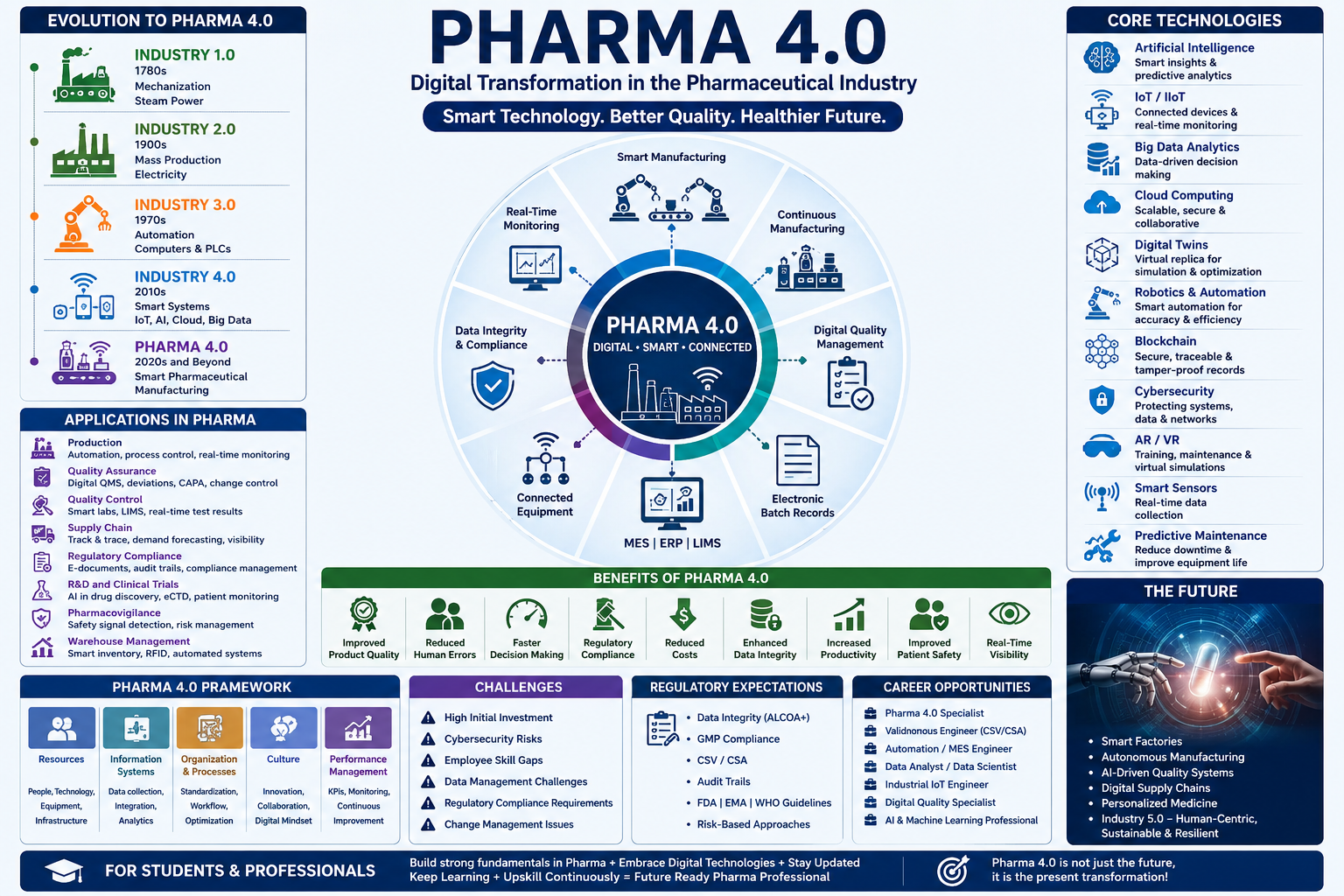
Industry 5.0 emphasizes collaboration between people and advanced automation.
Future operators may:
- Supervise automated processes
- Interpret analytics
- Manage exceptions
- Make risk-based decisions
Human expertise remains essential for GMP compliance and quality oversight.
32.10 Agentic AI
Emerging AI agents may assist with:
- Drafting validation documentation
- Preparing change control assessments
- Reviewing audit trails
- Identifying process trends
- Supporting deviation investigations
- Recommending preventive actions
Organizations should implement governance to ensure AI-assisted activities remain transparent, reviewable, and appropriate for regulated environments.
Future Recipe Architecture
ERP
 │
 ▼
Cloud MES
 │
 ▼
Digital Recipe Platform
 │
 ├── AI Decision Support
 ├── Digital Twin
 ├── Historian
 ├── Predictive Analytics
 └── Electronic Batch Record
 │
 ▼
SCADA
 │
 ▼
PLC
 │
 ▼
Smart Manufacturing Equipment
Emerging Skills for Pharmaceutical Professionals
Future recipe engineers should develop knowledge in:
Process Analytical Technology (PAT)
ISA-88 and ISA-95
GAMP® 5
Data analytics
AI governance
Cybersecurity
Cloud manufacturing platforms
Digital validation
Data integrity
Pharmaceutical Quality Systems
Conclusion
Recipe Management is a cornerstone of modern pharmaceutical manufacturing. A well-governed recipe lifecycle—supported by validated computerized systems, effective quality risk management, robust data integrity controls, and disciplined change management—helps ensure that every batch is manufactured consistently and in compliance with GMP requirements.
As the industry adopts Pharma 4.0 technologies, advanced analytics, Digital Twins, and AI-assisted workflows, organizations should continue to balance innovation with strong quality systems, validation, and human oversight to maintain product quality, patient safety, and regulatory compliance.
About the Author
Ramesh Palav is a pharmaceutical professional with 20+ years of industry experience in manufacturing, GMP, quality systems, validation, compliance, and operational excellence. Through Pharma Manufacturing Hub, he shares practical insights on pharmaceutical careers, manufacturing, quality, validation, Pharma 4.0, AI, and professional development.
His goal is to help students, freshers, experienced professionals, and career-break professionals build the knowledge and skills needed to succeed in the pharmaceutical industry.