
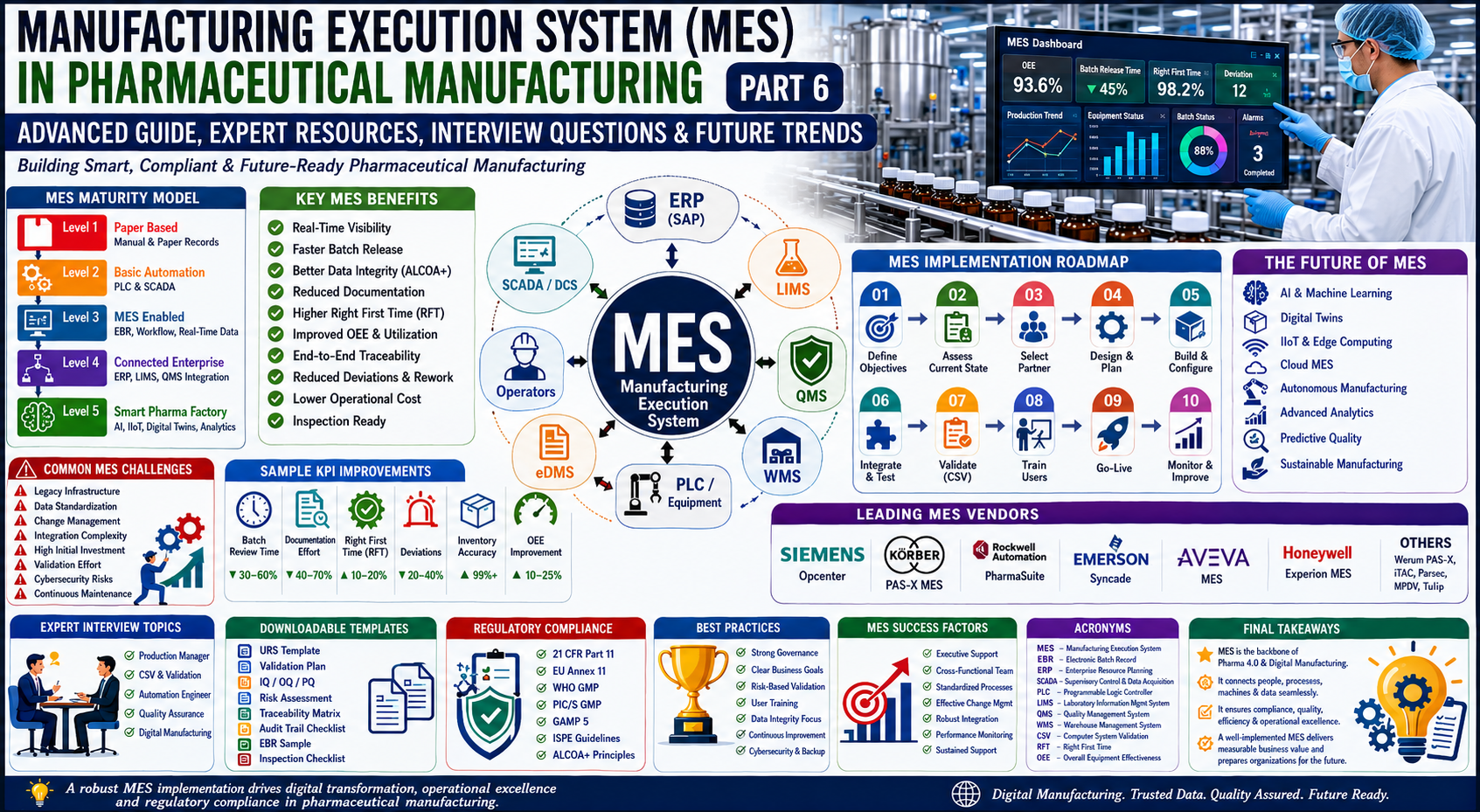
Part 6: Advanced Reference Guide, Expert Interview Questions, Industry Resources, Downloadable Templates & Final Recommendations
Executive Summary
A Manufacturing Execution System (MES) implementation does not end with software deployment. Long-term success depends on governance, continuous improvement, periodic validation, cybersecurity, regulatory readiness, workforce competency, and performance monitoring.
This final part provides practical resources that pharmaceutical professionals can use throughout the MES lifecycle—from planning and implementation to inspections and continuous optimization.
Table of Contents
- MES Maturity Model
- MES Project Team Structure
- Sample User Requirements Specification (URS)
- MES Risk Assessment Example
- MES Master Data Requirements
- Performance Monitoring Dashboard
- Regulatory Inspection Questions
- Production Manager Interview Questions
- CSV & Validation Interview Questions
- Automation Engineer Interview Questions
- MES Career Roadmap
- Downloadable Templates
- Future Trends Beyond Pharma 4.0
- Final Recommendations
1. MES Digital Maturity Model
| Level | Description | Characteristics |
|---|---|---|
| Level 1 | Paper-Based | Manual documentation, paper BMR |
| Level 2 | Basic Automation | PLC & SCADA implementation |
| Level 3 | MES Enabled | Electronic Batch Records, workflow automation |
| Level 4 | Connected Enterprise | ERP, LIMS, QMS integration |
| Level 5 | Smart Pharma Factory | AI, Digital Twins, IIoT, Predictive Analytics |
Goal
Organizations should progressively move toward Level 5 while maintaining GMP compliance and a validated state.
2. Typical MES Project Team
A successful implementation requires collaboration across multiple departments.
| Function | Responsibility |
|---|---|
| Project Sponsor | Strategic direction and funding |
| Project Manager | Overall project execution |
| Production | Business process owner |
| QA | GMP and compliance oversight |
| QC | Laboratory integration |
| Engineering | Equipment integration |
| Automation | PLC/SCADA connectivity |
| IT | Infrastructure and cybersecurity |
| Validation | CSV documentation |
| Warehouse | Material flow integration |
| Vendor | Configuration and technical support |
3. Sample User Requirements Specification (URS)
Business Requirements
- Support Electronic Batch Records (EBR)
- Enable electronic signatures
- Maintain complete audit trails
- Support Review by Exception
- Integrate with ERP
- Integrate with SCADA
- Integrate with LIMS
- Integrate with QMS
- Generate production reports
- Maintain ALCOA+ compliance
Functional Requirements
- Batch creation
- Recipe management
- Material verification
- Barcode scanning
- Equipment verification
- Operator authentication
- Workflow management
- KPI dashboards
Compliance Requirements
- 21 CFR Part 11
- EU Annex 11
- WHO GMP
- GAMP 5
- ALCOA+
4. Sample MES Risk Assessment
| Risk | Impact | Probability | Mitigation |
|---|---|---|---|
| Incorrect recipe selection | High | Low | Recipe version control |
| Network outage | High | Medium | Redundant infrastructure |
| Unauthorized access | High | Low | Role-based access and MFA |
| Equipment communication failure | Medium | Medium | Interface monitoring |
| Incomplete audit trail | High | Low | Periodic audit trail review |
Risk assessments should be reviewed periodically and after major system changes.
5. MES Master Data
Reliable master data is essential for consistent system performance.
Typical Master Data
- Products
- Recipes
- Bill of Materials
- Equipment
- Utilities
- Materials
- Packaging components
- Operators
- User roles
- Warehouses
- Production lines
- Sampling plans
Poor master data governance is a common cause of implementation issues.
6. MES Performance Dashboard
Key operational metrics include:
Production
- Batches completed
- Batch cycle time
- Schedule adherence
- Throughput
Quality
- Right First Time (RFT)
- Deviations
- CAPA status
- IPC pass rate
Equipment
- OEE
- Downtime
- Availability
- Performance
- Quality rate
Compliance
- Audit trail reviews completed
- Electronic signature exceptions
- Validation status
- Change control backlog
7. Regulatory Inspection Questions
Inspectors commonly ask:
- How is the MES validated?
- How are electronic signatures managed?
- How do you review audit trails?
- How is access controlled?
- How are user roles approved?
- How are changes controlled?
- How are backups tested?
- How do you ensure data integrity?
- How is recipe version control maintained?
- How are deviations handled within MES?
Being able to answer these confidently is an important part of inspection readiness.
8. Production Manager Interview Questions
- What is a Manufacturing Execution System?
- How does MES improve GMP compliance?
- Explain Electronic Batch Records.
- What is Review by Exception?
- How does MES reduce human error?
- Explain batch genealogy.
- What KPIs would you monitor?
- How does MES improve OEE?
- Explain MES integration with ERP.
- Describe the benefits of paperless manufacturing.
9. CSV & Validation Interview Questions
- What is Computer System Validation?
- Explain IQ, OQ and PQ.
- What is a Traceability Matrix?
- Why is URS important?
- Explain GAMP 5 categories.
- How do you validate interfaces?
- What is a validated state?
- How are changes managed?
- What is periodic review?
- How do you validate electronic signatures?
10. Automation Engineer Interview Questions
- Explain ISA-95 architecture.
- Difference between PLC and SCADA.
- What is OPC UA?
- How does MES communicate with PLCs?
- Explain historian integration.
- What are industrial communication protocols?
- How is equipment status verified?
- Explain barcode integration.
- What is Industrial IoT?
- Explain real-time data acquisition.
11. MES Career Roadmap
Professionals working with MES may develop expertise in:
- Pharmaceutical Production
- Manufacturing Excellence
- Automation Engineering
- Computer System Validation (CSV)
- Digital Transformation
- Industrial Automation
- Quality Systems
- Regulatory Compliance
- Pharma 4.0
- Data Integrity
Recommended Skills
- GMP
- 21 CFR Part 11
- EU Annex 11
- GAMP 5
- ISA-95
- SAP ERP
- SCADA
- PLC
- LIMS
- QMS
- Data Analytics
- Risk Management
12. Downloadable Resource Ideas
Create these resources for readers to download from your website:
- MES Implementation Checklist
- URS Template
- Validation Plan Template
- IQ/OQ/PQ Templates
- Risk Assessment Template
- Traceability Matrix Template
- Electronic Batch Record Sample
- Audit Trail Review Checklist
- Data Integrity Checklist
- GMP Inspection Readiness Checklist
These downloadable resources can also help generate newsletter subscriptions and repeat visitors.
13. Beyond Pharma 4.0
Future MES platforms are expected to incorporate:
- Generative AI-assisted documentation
- AI-powered deviation investigations
- Intelligent electronic work instructions
- Predictive quality analytics
- Digital Twins for process simulation
- Sustainable manufacturing metrics
- Advanced cybersecurity monitoring
- Autonomous scheduling recommendations
- Connected global manufacturing networks
These technologies will enhance decision support while operating within validated, GMP-compliant processes.
14. Final Recommendations
Organizations planning an MES implementation should:
- Define clear business objectives before selecting software.
- Standardize manufacturing processes before digitalization.
- Involve QA, Production, Engineering, IT, and Validation from the start.
- Adopt a risk-based validation strategy.
- Design integrations using ISA-95 principles.
- Prioritize user training and change management.
- Monitor KPIs and continuously optimize workflows.
- Maintain strong cybersecurity and data integrity controls.
- Perform periodic reviews to sustain the validated state.
- Treat MES as a long-term operational capability rather than a one-time IT project.
Final Thoughts
Manufacturing Execution Systems have become a strategic enabler for pharmaceutical organizations seeking to improve quality, compliance, operational efficiency, and digital maturity. By combining validated technology, standardized processes, skilled personnel, and continuous improvement, MES supports safer medicines, stronger regulatory compliance, and more resilient manufacturing operations.
As pharmaceutical manufacturing continues to evolve, organizations that invest in robust MES strategies will be better positioned to adopt AI, advanced analytics, connected factories, and future Pharma 4.0 innovations while maintaining the high standards required for patient safety and product quality.
Thank You for Reading
We hope this six-part guide has provided a practical and comprehensive understanding of Manufacturing Execution Systems in pharmaceutical manufacturing.
Learn • Implement • Innovate • Excel
About the Author
Ramesh Palav is a seasoned professional in GxP Quality, Computer System Validation (CSV), Data Integrity, and Pharmaceutical IT Compliance. He has extensive experience in implementing and managing GxP computerized systems, risk-based validation, audit trails, data integrity, and regulatory compliance. Through his articles and professional insights, he aims to share practical knowledge and help pharmaceutical and life-sciences professionals strengthen quality, compliance, and data integrity.