
Introduction
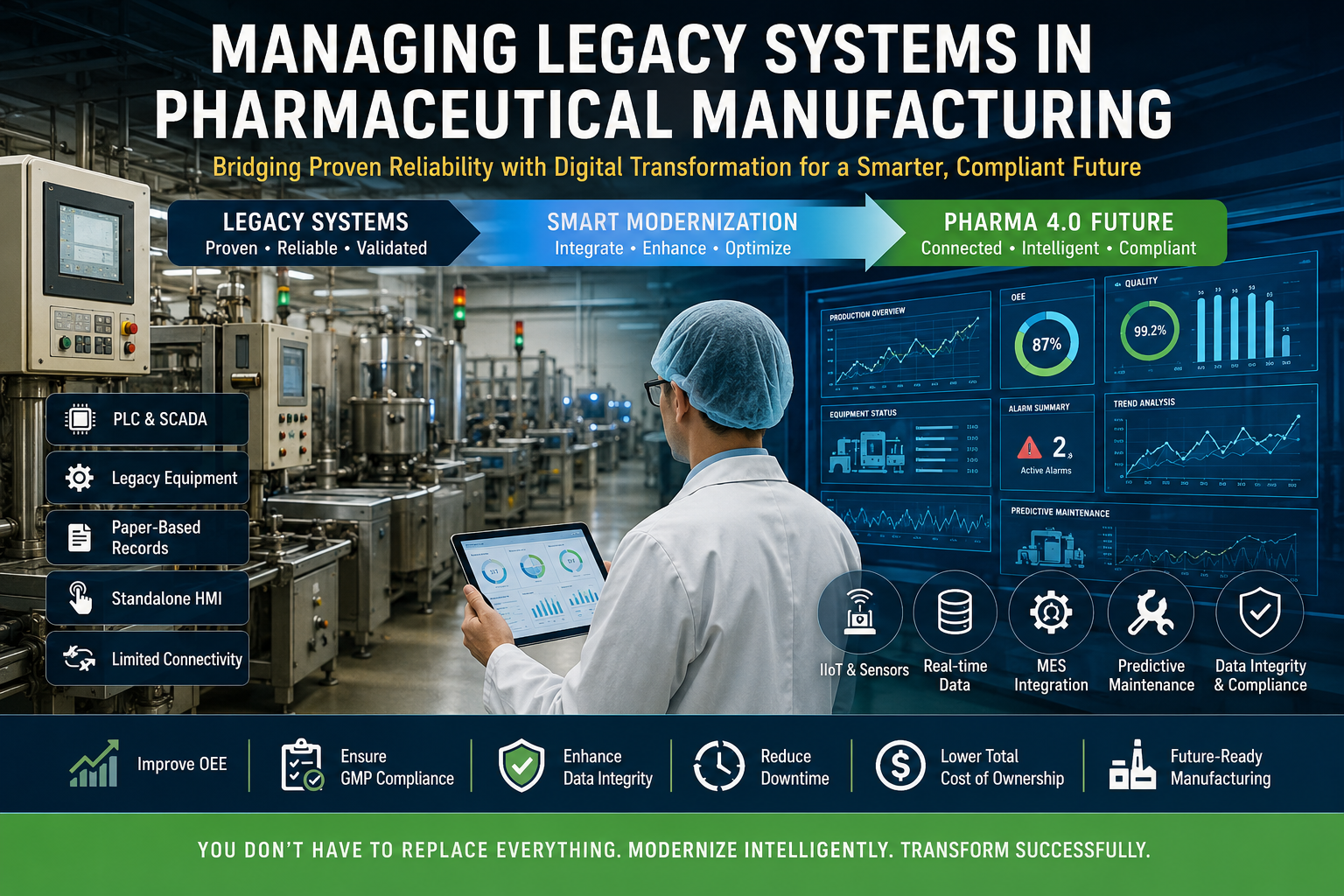
The pharmaceutical industry has always balanced two equally critical objectives: ensuring uncompromised product quality and maintaining operational efficiency. While many industries rapidly replace aging technologies, pharmaceutical manufacturers often continue operating equipment that has been in service for 15, 20, or even 30 years. These legacy systems remain integral to production because they have consistently demonstrated reliability, undergone extensive validation, and supported regulatory compliance over many years.
However, the expectations placed on pharmaceutical manufacturers have changed significantly. Regulatory agencies now demand greater transparency, stronger data integrity, enhanced cybersecurity, and improved traceability throughout the product lifecycle. At the same time, organizations are striving to achieve Pharma 4.0, adopting digital technologies such as Manufacturing Execution Systems (MES), Electronic Quality Management Systems (eQMS), Industrial Internet of Things (IIoT), Artificial Intelligence (AI), and predictive analytics to improve productivity and decision-making.
This creates a challenging situation for many pharmaceutical companies. On one hand, they must modernize to remain competitive and meet evolving regulatory expectations. On the other hand, replacing every legacy machine is often neither financially practical nor operationally feasible. Equipment replacement may require substantial capital investment, lengthy qualification activities, process redevelopment, regulatory submissions, production interruptions, and extensive employee retraining.
As a result, many pharmaceutical organizations are embracing a hybrid modernization strategy—one that preserves proven legacy assets while selectively integrating modern digital technologies. Instead of replacing functioning equipment, companies are extending its value through intelligent connectivity, software upgrades, industrial gateways, and advanced analytics. This approach enables organizations to improve operational visibility, strengthen compliance, and build a scalable digital manufacturing environment while protecting existing investments.
Today’s leading pharmaceutical manufacturers recognize that successful digital transformation is not defined by replacing every machine. Rather, it is about enabling smart integration, maintaining validated systems, and creating a roadmap that aligns technology investments with business objectives, regulatory requirements, and long-term operational excellence.
What Are Legacy Systems in Pharmaceutical Manufacturing?
A legacy system refers to any equipment, software application, automation platform, or information system that remains operational despite being based on older technology. Although these systems may not incorporate the latest digital capabilities, they continue to perform their intended functions reliably and consistently.
In pharmaceutical manufacturing, legacy systems are extremely common because production equipment is typically designed for long operational lifecycles. Many facilities still operate machinery commissioned decades ago that continues to produce high-quality products meeting stringent GMP requirements.
Legacy systems should not automatically be viewed as obsolete or inefficient. In many cases, they represent mature, stable, and highly reliable technologies that have successfully supported validated manufacturing processes over many years.
Common Examples of Legacy Systems
1. PLC-Based Manufacturing Equipment
Many pharmaceutical manufacturing processes are controlled by Programmable Logic Controllers (PLCs) installed years ago. Examples include:
- High-shear granulators
- Fluid bed dryers
- Tablet compression machines
- Coating equipment
- Capsule filling machines
- Blister packaging lines
- Bottle filling systems
Although these PLCs may lack Ethernet connectivity or modern communication protocols, they continue to control critical manufacturing operations with exceptional reliability.
2. Legacy SCADA Systems
Supervisory Control and Data Acquisition (SCADA) systems are widely used for monitoring utilities and manufacturing processes.
Older SCADA platforms may:
- Run on outdated operating systems
- Use proprietary communication protocols
- Have limited reporting capabilities
- Lack cybersecurity features
- Offer minimal integration with enterprise applications
Despite these limitations, many remain fully validated and continue supporting daily operations.
3. Standalone Human Machine Interfaces (HMIs)
Many production machines still utilize local HMI panels that provide operators with machine controls, alarms, and process parameters.
These interfaces often:
- Store limited historical data
- Operate independently
- Lack centralized monitoring
- Cannot transmit production data automatically
Consequently, operators frequently record information manually for batch documentation.
4. Aging Manufacturing Equipment
Numerous pharmaceutical plants continue using older but dependable equipment, including:
- Tablet presses
- Granulators
- Coating pans
- Encapsulation machines
- Inspection systems
- Labeling machines
- Cartoners
- Palletizers
These machines often achieve excellent Overall Equipment Effectiveness (OEE) despite their age because they have been maintained meticulously and optimized through preventive maintenance programs.
5. HVAC and Utility Control Systems
Critical utilities such as:
- HVAC systems
- Purified Water (PW)
- Water for Injection (WFI)
- Clean Steam
- Compressed Air
- Nitrogen Generation
are frequently managed by legacy Building Management Systems (BMS) or PLC-based control systems. While mechanically reliable, these systems may offer limited data visualization, remote access, or predictive maintenance capabilities.
6. Paper-Based Batch Documentation
Many pharmaceutical manufacturers continue relying on paper records, including:
- Batch Manufacturing Records (BMRs)
- Equipment logbooks
- Cleaning records
- Preventive maintenance logs
- Calibration records
- Deviation forms
- CAPA documentation
Although compliant when managed correctly, paper-based systems introduce challenges related to efficiency, traceability, and data availability.
7. Legacy Laboratory Systems
Some quality control laboratories still operate:
- Older Laboratory Information Management Systems (LIMS)
- Standalone chromatography software
- Instrument-specific data acquisition systems
- Custom-developed laboratory databases
These applications may not integrate seamlessly with modern enterprise platforms, resulting in manual data transfers and increased administrative effort.
8. Custom-Built Software Applications
Over many years, pharmaceutical organizations often develop internal applications to support:
- Production scheduling
- Equipment monitoring
- Inventory tracking
- Maintenance planning
- Document management
While these systems are tailored to specific business needs, they may depend on outdated technologies and lack ongoing vendor support.
9. Obsolete Operating Systems
Legacy environments frequently include systems running:
- Windows XP
- Windows 7
- Windows Server 2008
- Proprietary embedded operating systems
Such platforms may no longer receive security updates, increasing cybersecurity risks while still supporting validated applications.
10. Non-Networked Equipment
Many manufacturing assets operate independently without direct connectivity to:
- MES
- ERP
- LIMS
- eQMS
- Data historians
- Cloud platforms
As a result, production information often requires manual collection and transcription.
Why Do Legacy Systems Continue to Exist?
A common misconception is that pharmaceutical companies retain legacy systems because they resist innovation. In reality, organizations make deliberate business decisions based on technical, regulatory, and financial considerations. Several factors explain why legacy systems remain prevalent across the industry.
1. High Capital Investment
Replacing a single production line can require investments ranging from hundreds of thousands to several million dollars. Beyond the purchase price, organizations must also consider:
- Installation costs
- Facility modifications
- Utility upgrades
- Engineering resources
- Qualification activities
- Validation documentation
- Regulatory impact assessments
- Employee training
For many facilities, extending the life of existing assets through modernization offers a significantly better return on investment.
2. Proven Reliability
Legacy equipment has often demonstrated years of dependable performance. Machines that consistently meet production targets and quality standards represent a lower operational risk than introducing entirely new technologies.
Experienced operators understand these systems thoroughly, enabling efficient troubleshooting and minimizing unplanned downtime.
3. Extensive Validation Investment
Pharmaceutical equipment undergoes rigorous qualification, including:
- Design Qualification (DQ)
- Installation Qualification (IQ)
- Operational Qualification (OQ)
- Performance Qualification (PQ)
Replacing validated systems requires repeating much of this lifecycle, consuming considerable time, effort, and financial resources.
Maintaining validated equipment while selectively upgrading software or connectivity can significantly reduce project complexity.
4. Long Equipment Lifecycles
Unlike consumer technology, pharmaceutical manufacturing equipment is engineered for longevity. Properly maintained systems commonly remain operational for 20–30 years or longer.
Major manufacturers continue supplying spare parts, service support, and upgrade options that extend equipment life without necessitating full replacement.
5. Production Continuity
Pharmaceutical products often address critical patient needs, making uninterrupted manufacturing essential. Replacing an entire production line may require extended shutdowns for installation, qualification, validation, and regulatory approval.
Such interruptions can impact:
- Product availability
- Customer commitments
- Revenue
- Supply chain stability
- Patient access to medicines
Consequently, organizations frequently modernize incrementally while maintaining ongoing production.
6. Limited Capital Expenditure Budgets
Digital transformation initiatives must compete with numerous other investment priorities, including:
- Capacity expansion
- New product introductions
- Research and development
- Sustainability projects
- Utility upgrades
- Regulatory commitments
Organizations therefore prioritize modernization projects based on business value and risk rather than replacing all legacy assets simultaneously.
7. Availability of Skilled Operators
Many experienced operators, engineers, and maintenance technicians possess extensive knowledge of legacy equipment. Their expertise contributes significantly to reliable plant performance.
Replacing established systems may require comprehensive retraining and could temporarily reduce operational efficiency during the transition period.
8. Spare Parts and Service Support
Contrary to popular belief, many original equipment manufacturers (OEMs) continue supporting older equipment through:
- Spare parts programs
- Retrofit kits
- Controller upgrades
- Software enhancements
- Service agreements
These offerings enable pharmaceutical companies to extend equipment life while gradually introducing modern capabilities.
9. Regulatory Stability
Any significant equipment modification can trigger:
- Change control activities
- Risk assessments
- Validation updates
- SOP revisions
- Training requirements
- Regulatory evaluations
For validated systems consistently producing compliant products, organizations often determine that targeted modernization presents a lower regulatory risk than complete replacement.
10. Business Risk Management
Every modernization decision involves balancing cost, compliance, operational continuity, and long-term strategic objectives. Leading pharmaceutical companies recognize that successful digital transformation is not achieved through wholesale replacement of legacy infrastructure but through carefully planned, risk-based modernization.
By integrating legacy systems with modern digital technologies—such as industrial gateways, OPC UA communication, data historians, IIoT sensors, and MES platforms—organizations can unlock valuable operational insights while preserving validated manufacturing processes. This balanced approach minimizes disruption, maximizes return on existing investments, and establishes a scalable foundation for future Pharma 4.0 initiatives.
What’s Next ?
we will explore:
- Major Challenges Faced by Pharma Professionals when managing legacy systems, including data integrity, cybersecurity, validation, and integration issues.
- How Pharmaceutical Professionals Are Successfully Managing Legacy Systems, covering practical strategies such as digital maturity assessments, risk-based gap analysis, OPC UA integration, IIoT deployment, software upgrades, MES connectivity, cybersecurity enhancements, preventive maintenance, and workforce training.
These sections will provide actionable guidance for organizations seeking to modernize legacy pharmaceutical manufacturing environments while maintaining GMP compliance and operational excellence.
About the Author
Ramesh Palav is a seasoned professional in GxP Quality, Computer System Validation (CSV), Data Integrity, and Pharmaceutical IT Compliance. He has extensive experience in implementing and managing GxP computerized systems, risk-based validation, audit trails, data integrity, and regulatory compliance. Through his articles and professional insights, he aims to share practical knowledge and help pharmaceutical and life-sciences professionals strengthen quality, compliance, and data integrity.