
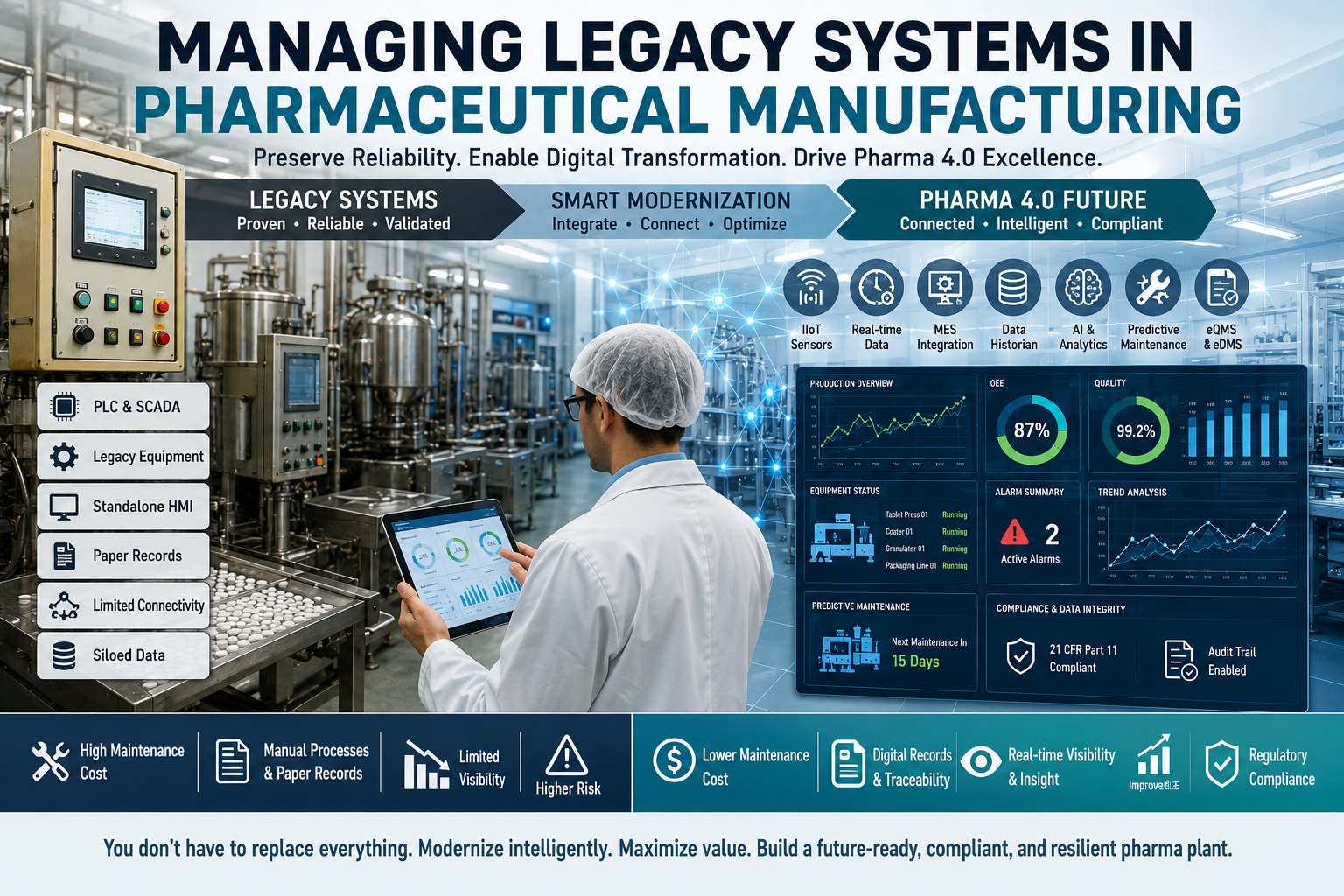
In Part 1A, we explored why legacy systems continue to play a vital role in pharmaceutical manufacturing despite the rapid advancement of digital technologies. While these systems offer proven reliability and validated performance, they also present significant operational and regulatory challenges. Pharmaceutical professionals must therefore strike a careful balance between maintaining existing validated systems and embracing digital transformation initiatives aligned with Pharma 4.0.
This section discusses the most common challenges associated with legacy systems and the practical strategies leading pharmaceutical organizations are using to modernize their manufacturing environments while maintaining compliance, productivity, and business continuity.
Major Challenges Faced by Pharma Professionals
Managing legacy systems is no longer simply an engineering concern. It requires collaboration across production, quality assurance, engineering, automation, information technology (IT), operational technology (OT), validation, and regulatory affairs. As regulatory expectations continue to evolve and digital technologies become more prevalent, the limitations of legacy systems become increasingly apparent.
1. Data Integrity Limitations
One of the most significant concerns associated with legacy systems is ensuring data integrity. Older machines often lack secure electronic records, user authentication, audit trails, and automated data capture capabilities. As a result, production data may be manually recorded, increasing the risk of transcription errors, incomplete documentation, or delayed reporting.
Regulatory agencies such as the US FDA, EMA, and WHO expect pharmaceutical companies to demonstrate compliance with the ALCOA+ principles—ensuring data is Attributable, Legible, Contemporaneous, Original, Accurate, Complete, Consistent, Enduring, and Available. Organizations relying on paper records or isolated legacy systems often face additional effort to meet these expectations.
2. Limited Connectivity and System Integration
Many legacy production machines were never designed to communicate with enterprise systems such as Manufacturing Execution Systems (MES), Enterprise Resource Planning (ERP), Laboratory Information Management Systems (LIMS), or Electronic Quality Management Systems (eQMS).
This lack of connectivity creates several challenges:
- Manual data entry between systems
- Delayed production reporting
- Limited production visibility
- Inconsistent information across departments
- Reduced traceability
- Increased administrative workload
Without seamless data exchange, organizations struggle to establish a unified digital manufacturing environment capable of supporting real-time decision-making.
3. Manual Documentation and Paper-Based Processes
Despite advances in digital manufacturing, many pharmaceutical plants continue to depend on paper-based documentation for batch records, equipment logs, maintenance records, and cleaning verification. Manual documentation introduces several operational inefficiencies, including slower document review, increased risk of human error, longer batch release cycles, and greater administrative effort during audits.
Digitizing these processes has become a strategic priority for organizations pursuing operational excellence and inspection readiness.
4. Cybersecurity Vulnerabilities
Legacy automation systems frequently operate on outdated operating systems and unsupported software platforms that no longer receive security updates. Many were designed for isolated industrial environments and therefore lack modern cybersecurity features such as role-based access control, network segmentation, encryption, and multi-factor authentication.
As manufacturing facilities become increasingly connected, these vulnerabilities can expose critical production systems to cyber threats, ransomware attacks, and unauthorized access. Protecting Operational Technology (OT) environments has therefore become an essential component of pharmaceutical digital transformation.
5. Validation and Change Management Challenges
Every modification made to a validated pharmaceutical system must be carefully assessed through formal change control procedures. Even seemingly minor software upgrades or communication interface additions may require impact assessments, risk evaluations, testing, documentation updates, and personnel training.
Organizations must ensure that modernization activities preserve the validated state of existing systems while demonstrating continued compliance with regulatory requirements. This often makes modernization projects more complex than comparable initiatives in non-regulated industries.
6. Increasing Maintenance Costs
Although legacy equipment can remain highly reliable, aging components may require more frequent maintenance, specialized spare parts, or expert technical support. In some cases, original equipment manufacturers may discontinue support for obsolete hardware, increasing the difficulty of sourcing replacement components.
Maintenance teams therefore face the challenge of balancing preventive maintenance activities with strategic modernization investments that improve long-term equipment reliability.
How Pharmaceutical Professionals Are Successfully Managing Legacy Systems
Rather than replacing every legacy asset, successful pharmaceutical organizations are adopting structured, risk-based modernization strategies that maximize existing investments while gradually introducing digital capabilities.
Conducting Digital Maturity Assessments
The modernization journey begins with understanding the current state of the manufacturing environment. Organizations perform comprehensive digital maturity assessments to evaluate automation levels, data availability, system connectivity, cybersecurity readiness, validation status, and business priorities.
These assessments help identify improvement opportunities and establish realistic digital transformation roadmaps aligned with organizational objectives.
Performing Risk-Based Gap Analysis
Not every legacy system requires immediate replacement or upgrade. Leading organizations prioritize modernization activities based on risk to product quality, patient safety, regulatory compliance, cybersecurity, operational performance, and business continuity.
Risk-based decision-making ensures that investments focus on systems delivering the greatest operational and compliance benefits.
Preserving Validated Systems While Modernizing
One of the most effective strategies involves retaining validated hardware while upgrading surrounding software, visualization platforms, and communication interfaces. For example, an existing PLC controlling a tablet press may continue operating while a modern SCADA platform or industrial gateway provides enhanced monitoring, reporting, and integration capabilities.
This approach minimizes disruption while extending equipment life.
Enabling Connectivity Through Industrial Gateways
Industrial gateways and protocol converters allow older equipment to communicate with modern manufacturing systems without extensive hardware replacement. Technologies such as OPC UA, Modbus gateways, and Ethernet communication interfaces enable legacy machines to exchange production data securely with MES, historians, and enterprise applications.
By unlocking valuable production information, organizations gain real-time visibility into equipment performance and manufacturing operations.
Implementing IIoT and Data Historians
Industrial Internet of Things (IIoT) sensors can be installed on legacy equipment to monitor vibration, temperature, energy consumption, pressure, humidity, and other critical process parameters. Combined with data historians, these technologies provide continuous operational insights that support predictive maintenance, trend analysis, root cause investigations, and Overall Equipment Effectiveness (OEE) improvement.
Instead of relying solely on reactive maintenance, engineering teams can identify potential failures before they affect production.
Strengthening Cybersecurity
Modern pharmaceutical manufacturers are implementing comprehensive OT cybersecurity programs that include network segmentation, endpoint protection, secure remote access, vulnerability assessments, backup strategies, and regular patch management where feasible.
Cybersecurity is increasingly viewed not only as an IT responsibility but also as an essential element of GMP compliance and business resilience.
Investing in Workforce Development
Technology alone cannot ensure successful modernization. Organizations invest heavily in training production operators, maintenance technicians, automation engineers, validation professionals, and quality teams to operate effectively within hybrid manufacturing environments that combine legacy equipment with modern digital technologies.
Cross-functional collaboration and continuous learning are essential for achieving sustainable digital transformation.
Part 1 Summary
Legacy systems remain a fundamental part of pharmaceutical manufacturing because they continue to deliver reliable, validated, and compliant production. However, increasing expectations for digital connectivity, data integrity, operational efficiency, and cybersecurity require organizations to rethink how these systems are managed.
Leading pharmaceutical companies are demonstrating that digital transformation does not require replacing every machine. Instead, they are extending the value of legacy assets through risk-based modernization, intelligent integration, Industrial IoT, secure communication technologies, enhanced data management, and phased implementation strategies.
This balanced approach enables manufacturers to protect previous investments, maintain GMP compliance, improve Overall Equipment Effectiveness (OEE), strengthen inspection readiness, and establish a scalable foundation for the transition toward Pharma 4.0 and smart manufacturing.
Coming Up in Next.
we will explore:
- A 10-step modernization roadmap for legacy pharmaceutical plants.
- Technologies enabling legacy systems to support Pharma 4.0, including OPC UA, Edge Computing, AI, Digital Twins, MES, eQMS, and Cloud Analytics.
- Regulatory expectations covering 21 CFR Part 11, EU Annex 11, GAMP 5 (Second Edition), WHO GMP, PIC/S GMP, and risk-based Computer System Validation (CSV).
- Practical implementation guidance to help pharmaceutical organizations modernize legacy systems while maintaining compliance, operational excellence, and long-term business value.
About the Author
Ramesh Palav is a seasoned professional in GxP Quality, Computer System Validation (CSV), Data Integrity, and Pharmaceutical IT Compliance. He has extensive experience in implementing and managing GxP computerized systems, risk-based validation, audit trails, data integrity, and regulatory compliance. Through his articles and professional insights, he aims to share practical knowledge and help pharmaceutical and life-sciences professionals strengthen quality, compliance, and data integrity.