
Introduction: Why Production Plan Execution Matters in OSD Manufacturing
In Oral Solid Dosage (OSD) manufacturing, creating a production schedule is only the beginning. The real challenge is converting that schedule into released batches delivered on time, at the required quality, and within available manufacturing capacity.
Pharmaceutical Production Planning determines what products must be manufactured, in what quantities, and by when. OSD Production Plan Execution converts these requirements into coordinated shop-floor activities.
Even a well-designed production plan can fail because of unavailable materials, equipment breakdowns, delayed Quality Control (QC) results, excessive product changeovers, manpower shortages, weak shift handovers, or poor cross-functional coordination.
Execution failures reduce Production Schedule Adherence, equipment utilization, and OTIF delivery while increasing work-in-process inventory, manufacturing cycle time, overtime, deviations, and production costs.
Successful Pharmaceutical Production Management therefore requires disciplined execution, manufacturing readiness, real-time visibility, rapid escalation, and effective decision-making.
Understanding the OSD Production Plan
The OSD production plan connects market demand and supply requirements with manufacturing capacity.
The process typically begins with the Master Production Schedule (MPS), which defines product quantities and required delivery timelines.
Material Requirements Planning (MRP) translates the MPS into requirements for APIs, excipients, packaging materials, and other manufacturing resources.
The detailed production schedule converts these requirements into equipment-level and shift-level manufacturing activities.
An effective OSD production plan considers batch sizes, campaign quantities, material availability, equipment capacity, manpower, cleaning requirements, product changeovers, preventive maintenance, calibration, QC testing, and batch release timelines.
For example, scheduling multiple products requiring extensive cleaning between batches can significantly reduce available manufacturing capacity. Production sequence optimization should therefore minimize unnecessary changeovers while maintaining validated hold times, cleaning requirements, and campaign limits.
Production Readiness Before Batch Execution
One of the most effective ways to improve schedule adherence is to prevent batches from entering production without complete manufacturing readiness.
A formal Batch Readiness Review should verify:
- APIs, excipients, and packaging materials are available and released.
- Approved BMRs and BPRs are available.
- Manufacturing equipment is qualified and available.
- Calibration and preventive maintenance activities are current.
- Equipment and manufacturing areas have the required cleaning status.
- Environmental conditions and critical utilities are available.
- Operators are trained and qualified.
- Open deviations, CAPAs, and change controls have been assessed.
- Required tooling, change parts, punches, dies, screens, and accessories are available.
- QA and QC support requirements are understood.
Production Managers can use a Production Readiness Checklist 24–72 hours before planned batch initiation.
This simple control prevents schedule disruption caused by avoidable readiness failures.
Translating the Production Plan into Daily Execution
Monthly production plans must be converted into weekly schedules, daily targets, and shift-level execution plans.
Daily production meetings should review the status of every critical batch, equipment availability, manpower requirements, material constraints, QC priorities, engineering support, and schedule risks.
Shift plans should clearly define equipment allocation, batch priorities, expected completion times, cleaning activities, changeovers, and critical sampling requirements.
Shift handovers are particularly important. The outgoing team should communicate batch status, equipment problems, process observations, pending documentation, deviations, and expected activities during the next shift.
Visual management boards and digital dashboards can display:
Plan vs. Actual Production, Schedule Adherence, OEE, Downtime, Batch Status, Deviations, Changeovers, QC Status, and Critical Constraints.
The objective is simple: production problems must become visible early enough for corrective action.
Execution Across the OSD Manufacturing Process
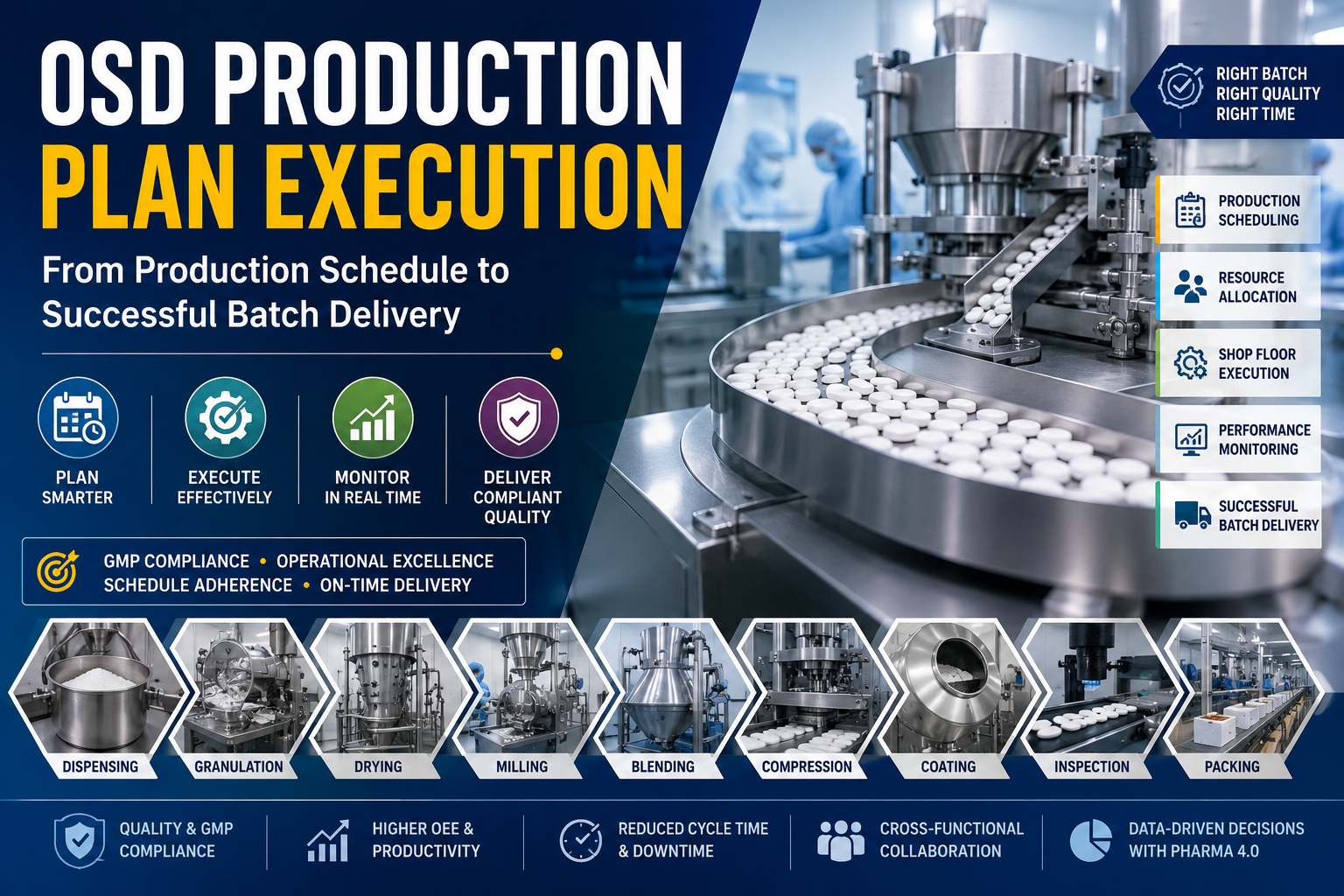
The typical OSD Manufacturing Process follows:
Dispensing → Granulation → Drying → Milling/Sifting → Blending → Compression → Coating → Inspection → Packing
These operations cannot be managed independently.
Poor synchronization creates work-in-process inventory and manufacturing delays.
For example, increasing granulation output provides little benefit when compression capacity is already constrained. Similarly, maximizing compression output can create excessive tablet inventory when coating equipment is unavailable.
Production Managers should identify the constraint or bottleneck operation and synchronize upstream and downstream activities accordingly.
Critical path activities, equipment occupancy, validated hold times, cleaning duration, and QC turnaround times should be continuously monitored.
The goal is not maximum output from every machine. The goal is optimized end-to-end product flow.
Cross-Functional Coordination for Successful Execution
Production plan execution is a cross-functional responsibility.
PPC controls scheduling and priorities. Production executes manufacturing activities. Warehouse ensures material availability. QA provides oversight and disposition support. QC manages sampling and testing priorities.
Engineering maintains equipment and utilities. Validation ensures qualified systems remain in a compliant state. Procurement manages supplier constraints, while Supply Chain coordinates market requirements and inventory priorities.
Daily production review meetings and tiered accountability meetings can significantly improve execution.
A typical escalation structure may include:
Tier 1: Shift-level operational review.
Tier 2: Department-level production review.
Tier 3: Site leadership review of critical constraints.
Each problem should have an owner, action, target completion time, and escalation pathway.
Managing Production Constraints and Unplanned Events
No pharmaceutical production schedule executes exactly as planned.
Equipment breakdowns, material shortages, deviations, utility failures, manpower shortages, extended changeovers, QC delays, and urgent market requirements are common operational challenges.
Effective production teams use structured constraint management.
First, identify the impact on patient supply, batch quality, regulatory commitments, and downstream operations.
Second, assess alternative equipment, production sequences, manpower deployment, and testing priorities.
Third, create a documented recovery plan.
For example, if a compression machine experiences an extended breakdown, Production and PPC may evaluate alternate qualified equipment, adjust downstream coating schedules, prioritize critical products, and coordinate QC testing requirements.
However, schedule recovery must never bypass validated processes, approved procedures, or GMP requirements.
GMP Compliance During Production Plan Execution
Production targets must never override product quality or GMP compliance.
Line clearance, status labeling, equipment cleaning, documentation, in-process controls, data integrity, and deviation management must remain effective even when production schedules are under pressure.
ALCOA+ principles should apply to paper and electronic manufacturing records.
Electronic Batch Records, SCADA systems, MES platforms, and automated equipment must maintain appropriate access controls, audit trails, electronic records, and data review processes.
Any schedule recovery action involving alternate equipment, changed production sequences, extended hold times, reprocessing, or manufacturing process changes should undergo appropriate Quality Risk Management and change-control evaluation.
A successful Production Manager Pharmaceutical Industry protects three priorities simultaneously:
Quality + Compliance + Delivery.
Key Performance Indicators for OSD Production Execution
Production KPIs provide objective visibility into execution performance.
Production Schedule Adherence (PSA)
PSA = (Activities Completed as Scheduled ÷ Activities Planned) × 100
Schedule Attainment
Schedule Attainment = (Actual Production Completed ÷ Planned Production) × 100
Overall Equipment Effectiveness (OEE)
OEE = Availability × Performance × Quality
Other important indicators include FTR/RFT, yield, rejection percentage, equipment downtime, changeover time, manufacturing cycle time, batch release cycle time, capacity utilization, OTIF delivery, and deviation rate.
KPIs should drive action rather than simply appear in monthly reports.
For example, repeated schedule losses caused by changeovers should trigger SMED initiatives, campaign optimization, cleaning-cycle improvement, or scheduling changes.
Digital Technologies and Pharma 4.0
Digitalization is transforming Pharmaceutical Manufacturing Operations.
Advanced Planning and Scheduling systems can create capacity-constrained schedules and rapidly evaluate alternative production scenarios.
MES in Pharmaceutical Manufacturing provides real-time production visibility, workflow control, and electronic execution management.
ERP platforms such as SAP connect demand, materials, procurement, inventory, and production orders.
Electronic Batch Records improve documentation accuracy and review efficiency, while SCADA systems provide equipment and process visibility.
Real-time OEE monitoring and digital And-on systems allow production teams to identify abnormalities quickly.
AI in Pharmaceutical Manufacturing can support predictive maintenance, production scheduling, deviation trend detection, and manufacturing risk prediction.
Digital twins and predictive analytics can simulate manufacturing scenarios before changes are implemented.
Integration between ERP, APS, MES, LIMS, QMS, and warehouse systems creates end-to-end visibility from market demand to batch release.
A Practical Framework for OSD Production Plan Execution
Production Managers can apply the following execution framework:
Plan → Verify Readiness → Allocate Resources → Execute → Monitor → Identify Constraints → Escalate → Recover Schedule → Review Performance → Implement CAPA and Continuous Improvement
The framework should operate continuously.
Every shift monitors execution. Every day reviews constraints. Every week analyzes performance trends. Every month converts recurring losses into improvement projects.
This creates a closed-loop production management system.
Common Mistakes That Cause Production Plan Failure
Common execution failures include starting batches without complete readiness, creating unrealistic schedules, ignoring equipment capacity, excessive product changeovers, weak shift handovers, delayed escalation, poor deviation management, and inadequate coordination between Production, PPC, QA, QC, Warehouse, and Engineering.
Another major mistake is focusing exclusively on production quantity.
A high production output with excessive deviations, poor yield, long batch release cycles, or delayed market delivery does not represent manufacturing excellence.
The objective is reliable, compliant, and predictable batch delivery.
Key Takeaways
- Verify complete batch readiness before starting manufacturing.
- Translate monthly schedules into clear daily and shift-level targets.
- Manage the entire OSD value stream rather than individual equipment performance.
- Identify bottlenecks and synchronize upstream and downstream operations.
- Establish rapid cross-functional escalation and schedule recovery mechanisms.
- Use KPIs to identify recurring losses and drive continuous improvement.
- Integrate digital systems to create real-time manufacturing visibility.
Conclusion: Building an Execution-Driven OSD Organization
Successful OSD Production Plan Execution requires more than an optimized production schedule.
It requires manufacturing readiness, disciplined shop-floor execution, cross-functional collaboration, real-time performance monitoring, effective constraint management, rapid problem-solving, and uncompromising GMP compliance.
The future of Production Planning in Pharmaceutical Industry will increasingly depend on connected manufacturing systems, Advanced Planning and Scheduling, MES, real-time analytics, digital twins, and AI-powered decision support.
Organizations that connect planning with real-time execution will improve Production Schedule Adherence, OEE, manufacturing cycle time, OTIF delivery, and supply reliability.
The competitive advantage will belong to pharmaceutical manufacturers capable of converting production plans into predictable, compliant, and continuously improving manufacturing performance.
Frequently Asked Questions
1. What is OSD Production Plan Execution?
OSD Production Plan Execution is the process of converting approved production schedules into coordinated manufacturing activities that deliver compliant batches on time.
2. How can pharmaceutical companies improve Production Schedule Adherence?
Companies can improve schedule adherence through batch readiness reviews, realistic capacity planning, constraint management, cross-functional meetings, real-time monitoring, and rapid escalation.
3. What is the role of a Production Manager in production plan execution?
The Production Manager coordinates resources, monitors manufacturing performance, manages constraints, ensures GMP compliance, escalates risks, and drives schedule recovery and continuous improvement.
4. How does MES improve OSD production execution?
MES improves production visibility, workflow control, electronic documentation, real-time performance monitoring, traceability, and integration between production and enterprise systems.
5. How can Pharma 4.0 improve pharmaceutical production planning?
Pharma 4.0 enables connected systems, advanced analytics, predictive maintenance, AI-powered scheduling, digital twins, and real-time decision-making to improve manufacturing performance.
Call to Action
Effective production planning becomes valuable only when organizations can execute plans consistently, compliantly, and predictably.
Share this article with pharmaceutical manufacturing professionals, Production Managers, PPC teams, QA professionals, and Operational Excellence leaders who are working to improve production execution.
Follow Pharma Manufacturing Hub for practical insights on OSD manufacturing, GMP compliance, pharmaceutical production management, operational excellence, digital manufacturing, AI, and Pharma 4.0.
About the Author
Ramesh Palav is a seasoned professional in GxP Quality, Computer System Validation (CSV), Data Integrity, and Pharmaceutical IT Compliance. He has extensive experience in implementing and managing GxP computerized systems, risk-based validation, audit trails, data integrity, and regulatory compliance. Through his articles and professional insights, he aims to share practical knowledge and help pharmaceutical and life-sciences professionals strengthen quality, compliance, and data integrity.
Pingback: Production Planning, Scheduling, Execution and Product Release.