
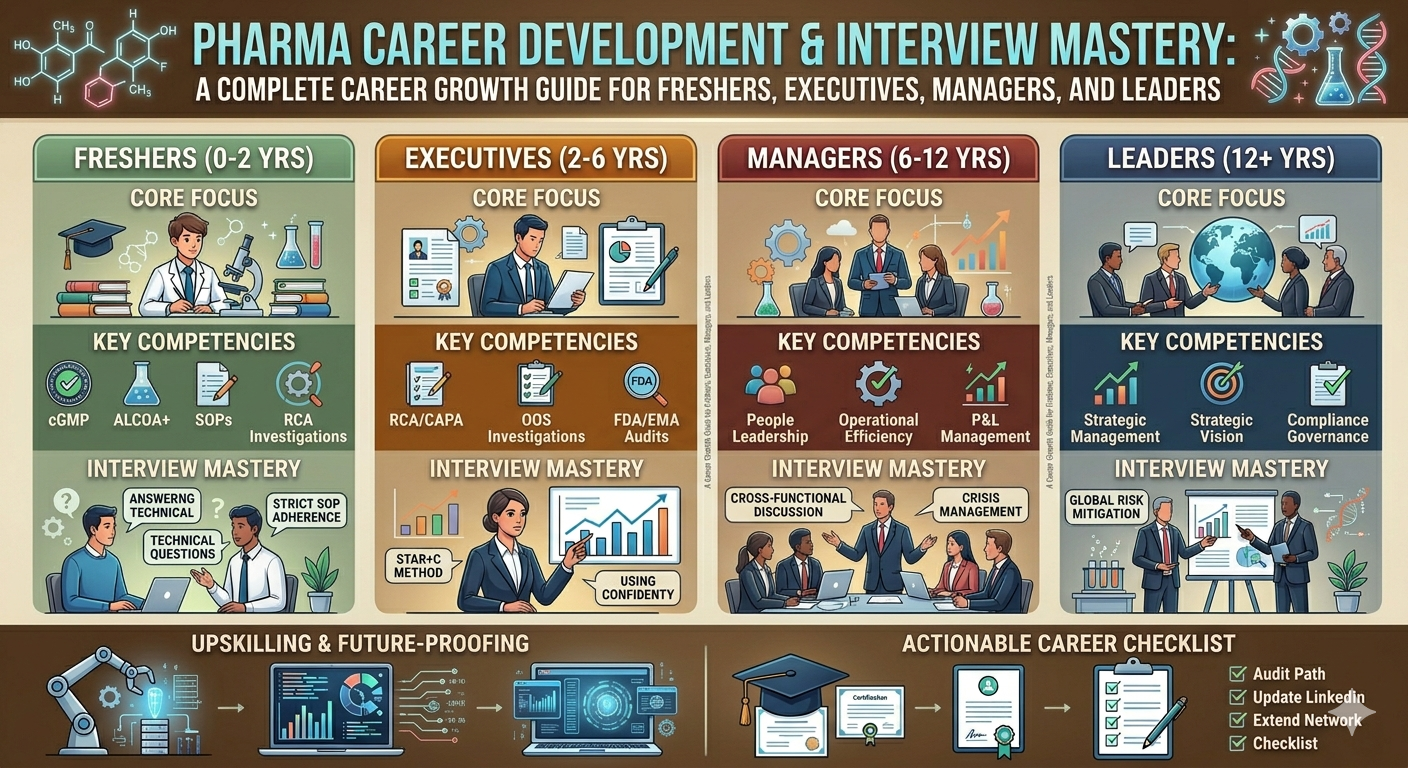
SECTION 1: THE PHARMA LIFECYCLE & CAREER TRACKS
The pharmaceutical industry is not a singular career path; it is an interconnected ecosystem of highly specialized disciplines. A molecule’s journey from initial discovery to a patient’s bedside requires flawless handoffs between distinct functional pillars. Navigating this ecosystem requires a paradigm shift: progression in pharma demands a dual mastery of scientific compliance and business acumen. To build a multi-decade career, you must understand how your specific role impacts the broader drug lifecycle and how value is created across the four primary pillars.
[R&D & Clinical] ──> [Regulatory & PV] ──> [Operations, Production & Quality] ──> [Commercial & Medical]
       │                      │                             │                                │
 (Molecule Value)       (License to Operate)         (Market Supply)                 (Revenue & Access)
1. R&D and Clinical Research
- The Mandate: Discovering safe, efficacious chemical or biological entities and validating them through rigorous clinical trial phases (Phase I-IV).
- Career Trajectory: Moves from bench-scale science and protocol design to medical monitoring, clinical operations, and therapeutic area leadership.
- The Success Driver: Success here shifts from pure academic curiosity to a commercial mindset—understanding how a clinical endpoint translates into market access, intellectual property value, and a viable New Drug Application (NDA) or Biologics License Application (BLA).
2. Regulatory Affairs (RA) and Pharmacovigilance (PV)
- The Mandate: Securing and maintaining the company’s license to operate. RA manages interactions with global health authorities (FDA, EMA, PMDA, CDSCO) and compiles dossiers (NDA,ANDA,MAA). PV monitors the post-market safety profile of the portfolio.
- Career Trajectory: Advances from specialized dossier publishing (e.g., eCTD Module 3 formatting) to strategic global regulatory leadership, where professionals negotiate directly with health authorities to accelerate approval timelines.
- The Success Driver: Transitioning from a literal interpretation of regulations to proactive risk management and strategic pipeline positioning.
3. Operations, Production, and Quality (QA/QC)
- The Mandate: Manufacturing safe, pure, and effective products at scale while maintaining strict current Good Manufacturing Practices (cGMP).
- Career Trajectory: Evolves from shift-level floor execution, laboratory analysis, or batch record review into plant management, global supply chain optimization, and corporate Quality Management System (QMS) governance.
- The Success Driver: Bridging the inherent tension between manufacturing yield and absolute compliance. Leaders must optimize operational throughput without compromising validation states.
4. Commercial, Medical Affairs, and Sales
- The Mandate: Driving market adoption, ensuring patient access, and communicating the therapeutic value proposition to healthcare professionals (HCPs), payers, and institutions.
- Career Trajectory: Progresses from field sales representative or Medical Science Liaison (MSL) to Product/Brand Management, Market Access Strategy, and Business Development leadership.
- The Success Driver: Synthesizing deep medical data with complex commercial dynamics, such as pricing, reimbursement models, and competitor lifecycle management.
SECTION 2: ARCHETYPES OF GROWTH (Tailored Advice by Career Stage)
1. Freshers & Entry-Level (0-2 years)
- (a) The Core Focus: Transitioning theoretical, academic knowledge into a highly regulated, audited execution environment.
- (b) Key Competencies to Build: Absolute mastery of Standard Operating Procedures (SOPs), foundational data integrity principles (ALCOA+), and a conceptual understanding of cGMP or Good Clinical Practices (GCP).
- (c) The “Hidden Hurdle”: The Academic Reflex. Freshers often try to solve problems using unvalidated, creative methods learned in university laboratories. In industry, an unrecorded or unvalidated action—even if scientifically sound—is a critical compliance violation.
Executive Recruiter Insight: When freshers face the “lack of experience” barrier in interviews, they shouldn’t apologize for it. Instead, they should frame their clean-slate status as an asset: “I have no bad habits to unlearn. I am trained to view documentation not as paperwork, but as a core component of patient safety. I understand that if it isn’t documented, it didn’t happen.”
Prove you understand ALCOA+ by explaining how you ensure data is Attributable, Legible, Contemporaneous, Original, and Accurate during your university projects or internships.
2. Executives & Senior Executives (2-6 years)
- (a) The Core Focus: Shifting from task execution to process ownership and technical Subject Matter Expertise (SME).
- (b) Key Competencies to Build: Root Cause Analysis (RCA), writing bulletproof Corrective and Preventive Actions (CAPA), mastering Out-of-Specification (OOS) or Out-of-Trend (OOT) investigations, and confidently interacting with auditors.
- (c) The “Hidden Hurdle”: The Execution Trap. Many executives become so skilled at performing repetitive daily tasks (e.g., running HPLC runs, drafting regulatory variations) that they fail to understand the upstream and downstream impacts of their work.
To break through to the senior level, you must transition from a person who simply reports a deviation to the person who can investigate, find the systemic root cause, and design a CAPA that permanently prevents recurrence.
3. Managers & Department Heads (6-12 years)
- (a) The Core Focus: Moving from individual technical execution to people leadership, operational efficiency, and cross-functional collaboration.
- (b) Key Competencies to Build: Resource allocation, capacity planning, conflict resolution, vendor management, and audit defense leadership.
- (c) The “Hidden Hurdle”: Functional Siloing. Managers often develop a defensive mindset regarding their specific department, which breeds friction.
       [ THE PRODUCTION VS. QUALITY CONTROL FRICTION ]
┌──────────────────────────────┐        ┌──────────────────────────────┐
│          PRODUCTION          │        │       QUALITY CONTROL        │
│  "We must meet the weekly    │  VS.   │  "We must pause the line to  │
│   batch release targets."    │        │   investigate this drift."   │
└──────────────────────────────┘        └──────────────────────────────┘
                                   │
                                   ▼
                       [ MULTI-DISCIPLINARY LEADER ]
             Balances throughput targets with strict validation
             boundaries to protect the company's license to operate.
An elite manager resolves this by aligning both sides around corporate risk and patient safety: “A batch delayed by 48 hours for an investigation is a temporary supply issue; a batch recalled due to a poor investigation is a multi-million dollar disaster that risks our license to operate.”
4. Directors & Executive Leaders (12+ years)
- (a) The Core Focus: Strategic corporate vision, global compliance governance, P&L management, and organizational scalability.
- (b) Key Competencies to Build: Global regulatory strategy, capital expenditure (CapEx) optimization, risk-based decision-making, executive coaching, and succession planning.
- (c) The “Hidden Hurdle”: Complacency in Legacy Practices. Executive leaders frequently fall into the trap of protecting legacy systems (“We’ve always passed audits this way”) instead of driving necessary modernization, such as digital transformation, automated data integrity verification, or advanced manufacturing modalities.
At this level, you are no longer judged by your technical acumen, but by your ability to foster a systemic Culture of Quality across thousands of employees and multiple global sites.
SECTION 3: INTERVIEW MASTERY BY LEVEL (The Pharma-Specific Playbook)
As you climb the pharma career ladder, interview dynamics change. The interview shifts from a test of what you know to an evaluation of how you think, manage risk, and preserve compliance under pressure.
Interview Evaluation Shift
| Level | Primary Interview Focus | Evaluation Metric |
|---|---|---|
| Freshers | Protocols, Basic Science, Trainability | Adherence to SOPs & Learning Agility |
| Executives | Root Cause Analysis, Execution, Technical SME | Process Ownership & Technical Problem Solving |
| Managers | Cross-functional Collaboration, Resource Allocation | Operational Efficiency & Team Leadership |
| Directors | Risk Management, P&L, Strategy, Governance | Business-wide Value Creation & Compliance Integrity |
For Freshers: The Protocol & Trainability Framework
Interviewers hiring entry-level talent look for risk indicators. If a fresher seems overly creative or unwilling to follow rigid rules, they are viewed as a compliance risk.
- Strategy: Frame every answer around structured guidelines. Use phrases like: “While I have deep conceptual knowledge of chromatography from my coursework, I understand that in an industrial environment, the final authority is always the validated SOP.”
- Handling Lack of Experience: “I may not have operated a commercial-scale fluid bed dryer, but I understand the underlying principles of heat and mass transfer, and I am trained to follow batch manufacturing records (BMRs) with zero unauthorized deviations.”
For Executives: The STAR+C Interview Framework
Standard behavioral questions should be answered using a tailored version of the traditional framework: Situation, Task, Action, Result + Compliance/Corrective action (STAR+C). This extension ensures that your technical proficiency is always linked back to regulatory compliance and continuous improvement.
Interview Question Example: “Tell me about a time you identified a laboratory error or an Out-of-Specification (OOS) result.”
- Situation: “While analyzing a stability batch of an oral solid dosage form using HPLC, I noticed a peak area that resulted in an assay value of 88.5%, which fell below our specified limit of 95.0% to 105.0%, indicating an OOS result.”
- Task: “My responsibility was to immediately halt further analysis, secure the sample injections, confirm the instrument state, and initiate an OOS investigation according to Phase Ia of our standard operating procedures, without discarding any solutions.”
- Action: “I documented the observation immediately and notified my supervisor. I executed a thorough laboratory investigation using a fishbone diagram to isolate potential errors. I confirmed that the instrument was fully calibrated and columns were within their lifecycles. However, upon reviewing the sample preparation logs, I discovered that the stock solution dilation required a syndication step for complete dissolution that had been shortened by 10 minutes due to a misunderstanding of a recent SOP update. I did not attempt to retest into compliance; instead, I fully documented this laboratory error.”
- Result: “The initial OOS was invalidated based on confirmed laboratory error, and a fresh sample preparation yielded an assay value of 99.2%, within specification.”
- Compliance/Corrective Action (+C): “To ensure long-term compliance, I raised a CAPA to update our sample preparation worksheet, adding a mandatory dual-signature verification check for syndication times. I also led a shift-wide training session on the revised SOP. Our next internal audit flagged this investigation as an exemplary model of robust deviation management.”
For Managers & Leaders: The License to Operate Playbook
When interviewing for managerial and director-level roles, you will face complex crisis management scenarios. Your answers must show that you can balance commercial pressure with regulatory compliance while protecting the company’s License to Operate.
Interview Question Example: “How would you handle a critical observation from an unannounced regulatory audit (e.g., an FDA Form 483 or EU GMP non-compliance notice) that threatens to shut down a production line?”
An elite leader should structure their response around an immediate, systematic 4-step crisis protocol:
[1. Containment & Transparency] ──> [2. Cross-Functional RCA] ──> [3. Strategic Remediation] ──> [4. Regulatory Engagement]
- 1. Containment and Absolute Transparency: “My immediate priority is to isolate the scope of the exposure. I would order an immediate containment hold on all batches produced on that line within the validated window. I would establish a war room with the Quality Assurance head and plant operations, and concurrently notify executive leadership. We must maintain absolute transparency; hiding or minimizing a finding from an investigator transforms a technical observation into a fatal integrity issue.”
- 2. Cross-Functional Root Cause Analysis: “I would assign a dedicated multi-disciplinary task force—comprising Engineering, Validation, Production, and Quality Control—to perform an exhaustive, accelerated root cause analysis. If the finding involves data gaps in electronic batch records, we will run full computerized system validation audits to identify where our data integrity controls broke down.”
- 3. Risk-Based Strategic Remediation Plan: “Instead of applying a quick fix, I would construct a comprehensive, phased remediation plan with clear milestones. If a production line must be paused, I will work closely with supply chain and project management to adjust production schedules at our sister facilities, ensuring we protect patient supply and prevent market stockouts while we fix the issue.”
- 4. Proactive Regulatory Engagement: “I would author the formal response to the regulatory agency within the required window (e.g., 15 business days for an FDA 483). The response will not be defensive. It will detail our immediate containment actions, present a clear root cause, and provide a fully funded, time-bound CAPA roadmap. I would then request a formal meeting with the regulatory agency’s review team to walk them through our governance plan, demonstrating that our organization takes full ownership of our compliance state.”
SECTION 4: UPSKILLING & FUTURE-PROOFING
The life sciences landscape is shifting rapidly. The skillsets that secured promotions over the past twenty years are no longer enough to sustain leadership roles over the next decade. Industry professionals must actively future-proof their careers across three key areas:
1. Digitalization (Pharma 4.0)
The traditional paper-dependent plant floor is being replaced by integrated digital ecosystems. Professionals who cannot bridge the gap between physical science and digital infrastructure will find their growth limited.
- Electronic Batch Records (EBR) & MES: Companies are moving away from paper batch manufacturing records (BMRs) to Manufacturing Execution Systems (MES). You need to understand how digital workflows configure recipe parameters and enforce real-time compliance.
- AI & Machine Learning in Drug Discovery and PV: In R&D, AI is cutting down target-to-lead identification timelines from years to weeks. In Pharmacovigilance, natural language processing algorithms are automating adverse event triage. Future leaders must learn how to design, validate, and manage these algorithmic workflows.
- Predictive Maintenance and PAT: Process Analytical Technology (PAT), such as near-infrared (NIR) spectroscopy, allows for real-time monitoring of critical quality attributes (CQAs) during manufacturing, replacing historical end-product testing.
2. Manufacturing Modalities: Continuous vs. Batch
Traditional batch manufacturing is hit-driven, prone to individual human error, and requires extensive holdup times for quality testing. The industry is moving toward Continuous Manufacturing, where raw materials are continuously fed into an automated system that outputs finished products.
- Required Competencies: To excel in this environment, you must build expertise in process automation (PLC/SCADA systems), real-time release testing (RTRT), statistical process control (SPC), and advanced multivariate data analysis (MVDA).
3. Executive Recruiter Matrix: High-ROI Certifications
Do not accumulate certifications indiscriminately. Choose credentials that complement your career stage and target track to maximize your professional value.
| Certification | Ideal Career Stage | Target Functional Tracks | Return on Investment (ROI) Analysis |
|---|---|---|---|
| Regulatory Affairs Certification (RAC) | Executives to Managers (3-8 years) | Regulatory Affairs, Clinical Ops, Quality Assurance | Very High: The global standard for regulatory professionals. It demonstrates your ability to interpret complex, multi-region guidelines (FDA,EMA,ICH) and directly accelerates your readiness for global strategy roles. |
| Project Management Professional (PMP) | Senior Executives to Managers (4-10 years) | Clinical Trials, Tech Transfer, R&D, Tech Ops | High: Essential for driving complex, cross-functional projects like technology transfers, site validations, or clinical trial operations on time and within budget. |
| ASQ Certified Quality Engineer / Auditor (CQE/CQA) | Executives to Managers (2-7 years) | Quality Control, Quality Assurance, Validation | Excellent: Provides immediate technical credibility during regulatory audits. It signals to executive search algorithms that you possess advanced statistical capabilities and auditing frameworks. |
| Lean Six Sigma Black Belt | Managers to Directors (6+ years) | Operational Excellence, Plant Ops, Supply Chain | Very High for Operations: Equips you with the data-driven toolsets needed to reduce cycle times, eliminate batch waste, optimize yields, and cut operational costs without compromising compliance. |
SECTION 5: THE ACTIONABLE CAREER CHECKLIST
To transform these insights into professional growth, execute this high-priority action plan over the next 7 days.
Phase 1: Career Path & Network Audit (Days 1–3)
- [ ] Identify Your Track Blindspot: Schedule a 15-minute alignment sync with a leader in an adjacent department. If you are in QC, speak with Production; if you are in Regulatory, speak with Clinical Ops. Ask them: “What is the single biggest bottleneck my department causes for your team, and how can we work together to solve it?”
- [ ] Map Your Technical Deficit: Review the user manuals for your site’s core technical platforms (e.g., your site’s LIMS, TrackWise QMS, or Veeva Vault document control system). Identify two system features you do not fully understand and look up internal training resources to master them.
- [ ] Expand Your Industry Footprint: Join at least two major global professional associations relevant to your track:
- PDA (Parental Drug Association) or ISPE (International Society for Pharmaceutical Engineering) for Operations, Manufacturing, and Quality.
- TOPRA (The Organisation for Professionals in Regulatory Affairs) or RAPS (Regulatory Affairs Professionals Society) for Regulatory tracks.
- DIA (Drug Information Association) for Clinical and Medical Affairs tracks.
Phase 2: LinkedIn Optimization for Pharma Executive Search (Days 4–5)
Pharma headhunters use specific search strings and boolean parameters to find talent. If your profile lacks precise regulatory keywords and system acronyms, you will remain invisible to executive recruiters.
- [ ] Rewrite Your Headline: Replace generic headlines like “Quality Assurance Manager at X Pharma” with keyword-dense, value-driven positioning:Quality Assurance Leader | SME in cGMP, FDA Audit Defense, TrackWise QMS, CAPA & Deviation Investigations | Lean Six Sigma Black Belt
- [ ] Optimize Your Summary with Key Terms: Ensure your LinkedIn ‘About’ section naturally integrates industry acronyms. Write an impact statement that highlights your technical scope:“Managed and defended successful FDA and EMA audits. Directed QA oversight for ANDA submissions, sterile aseptic manufacturing lines, and computerized system validations (CSV) adhering to 21 CFR Part 11.”
- [ ] Quantify Your Achievements: Revise your employment history to focus on measurable outcomes rather than lists of daily duties:
- Change this: “Responsible for reviewing deviations and laboratory investigations.”
- To this: “Oversaw and resolved over 150 high-priority deviations and OOS investigations using 5-Whys and Fishbone analyses. This reduced average batch release cycle times by 18% while maintaining a flawless compliance profile during an unannounced FDA inspection.”
Phase 3: Technical Networking & Engagement (Days 6–7)
- [ ] Publish a Technical Insight: Write a short, professional commentary on LinkedIn (150-200 words) discussing a recent regulatory shift, such as an updated Annex 1 guideline or a new FDA draft guidance on data integrity. Tag relevant industry groups or colleagues to kick off a discussion. This positions you as an active, informed professional rather than a passive observer.
- [ ] Set Up Regulatory Tracking: Bookmark and subscribe to RSS feeds or newsletters from the FDA (e.g., FDA Warning Letters log), EMA, and the RAPS/ISPE publications. Dedicate 20 minutes every Monday morning to studying recently issued warning letters. Understanding why other companies fail audits is one of the fastest ways to build your own risk-assessment capabilities.
About the Author
Ramesh Palav is a GxP Compliance and Computer System Validation (CSV) professional with experience in pharmaceutical manufacturing, quality systems, data integrity, and digital transformation. He is passionate about helping organizations adopt compliant, efficient, and practical digital solutions while maintaining regulatory expectations and patient safety.