Introduction
A Purified Water System in Pharmaceutical Manufacturing is much more than a conventional industrial water-treatment plant. It is a critical pharmaceutical utility that can directly influence product quality, microbiological control, cleaning effectiveness, process consistency, equipment condition, and regulatory compliance.
Water may function as a raw material, solvent, processing aid, cleaning medium, formulation ingredient, or utility supporting pharmaceutical manufacturing. The United States Pharmacopeia recognizes water as being widely used in pharmaceutical processing, formulation, manufacturing, cleaning, and related activities.
For this reason, a pharmaceutical water system must be approached as a GMP-controlled lifecycle system rather than simply as a water-generation skid.
A robust system requires coordinated control of:
Source Water → maltreatment → Purification → Storage → Distribution → Point of Use → Sampling → Testing → Trending → Sanitization → Qualification → Continued Verification
The most important principle is that the required water quality should be determined from the intended use, applicable pharmacopoeial requirements, product/process risk, and regulatory expectations. There is no universal water configuration that is automatically appropriate for every pharmaceutical facility.
WHO guidance specifically addresses water-treatment systems, storage and distribution, commissioning, qualification, validation, sampling, testing and routine monitoring of water for pharmaceutical use.
This article provides a practical engineering, GMP, QA/QC, microbiological and validation perspective on pharmaceutical purified-water systems.
What Is a Purified Water System?
A Purified Water System (PW System) is an engineered system designed to produce, store and distribute water meeting the applicable pharmacopoeial requirements for Purified Water.
A typical system may contain several treatment stages such as:
- Source-water assessment
- maltreatment
- Multimedia filtration
- Activated-carbon treatment
- Softening or antiscalant treatment
- Cartridge/micron filtration
- Reverse osmosis
- Electrodeionization
- UV treatment
- Ultrafiltration where justified
- Final filtration where appropriate
- Purified-water storage
- Sanitary distribution
- Online monitoring
- Sampling and laboratory testing
- Sanitization
The actual process should not be selected merely because it is a common industry configuration.
The treatment train should be justified using:
- Source-water quality
- Seasonal variation
- Required water quality
- Required flow and capacity
- Product/process requirements
- Microbiological risk
- Chemical contamination risk
- System operating philosophy
- Sanitization strategy
- Regulatory requirements
- Lifecycle cost and maintainability
- Quality risk management
The ISPE Water and Steam Systems Baseline Guide specifically addresses design, construction, operation and lifecycle management of pharmaceutical water systems and discusses pretreatment, membrane technologies, microbial control and ozone sanitization.
Why Pharmaceutical Water Quality Matters
Water can become a significant source of:
- Microbial contamination
- Endotoxin contamination
- Chemical contamination
- Organic contamination
- Particulate contamination
- Cross-contamination
- Biofilm formation
A water system can therefore affect:
- Assay
- Dissolution
- Stability
- Microbial quality
- Preservative effectiveness
- Product appearance
- Product consistency
- Cleaning performance
- Equipment hygiene
- Sterile manufacturing controls
The FDA inspection guidance for high-purity water systems emphasizes that microorganisms may exist either as free-floating organisms or attached to system surfaces as biofilm. Biofilm can subsequently release organisms into the circulating water, making microbiological control a system-design issue rather than simply a laboratory-testing issue.
This leads to a critical GMP principle:
Testing water does not create quality; the system must be designed and operated to consistently produce water of the required quality.
Pharmaceutical Water Grades
Water requirements should always be matched to the intended application.
| Water Type | Typical Quality | Typical Application | Key Controls |
|---|---|---|---|
| Potable Water | Drinking-water quality | Feedwater and selected utility/process applications where permitted | Source-water quality and applicable drinking-water requirements |
| Purified Water (PW) | Applicable pharmacopoeial quality | Many pharmaceutical manufacturing and cleaning applications | Chemical and microbiological control |
| Water for Injection (WFI) | Higher pharmaceutical quality with applicable endotoxin requirements | Parenteral and other applications where WFI is required | Microbial, endotoxin and chemical control |
| Highly Purified Water (HPW), where applicable | Enhanced pharmaceutical quality defined by applicable framework | Specific applications where recognized | Pharmacopoeial/regulatory requirements |
Water grade selection must be based on:
- Intended pharmaceutical use
- Applicable pharmacopoeia
- Product formulation
- Manufacturing process
- Regulatory jurisdiction
- Microbiological risk
- Endotoxin risk
- Cleaning requirements
- Site water strategy
The FDA’s historical inspection guidance distinguishes purified water and WFI and discusses their use in drug-product manufacturing.
Important distinction: PW vs WFI
Purified Water is not automatically equivalent to WFI.
Where a formulation or process requires WFI, substituting PW merely because PW meets its own specification is not an acceptable engineering assumption.
WFI requirements must be evaluated against the applicable current pharmacopoeia and regulatory framework. WHO also provides guidance for WFI production by methods other than distillation, demonstrating that modern membrane-based approaches can be used where the applicable regulatory requirements are satisfied.
Purified Water Requirements Across Pharmaceutical Dosage Forms
Oral Solid Dosage — OSD
Purified water may be used in applications including:
- Wet granulation
- Binder preparation
- Granulating-fluid preparation
- Coating-solution preparation
- Equipment cleaning
- Process-area cleaning where applicable
- Other product-contact activities based on the validated process
Wet granulation
Water quality can directly influence:
- Microbial burden
- Granule quality
- Drying requirements
- Product stability
- Process consistency
The quantity and quality of water should therefore be controlled as part of the manufacturing process.
Tablet coating
Purified water may be used for aqueous coating formulations.
Important considerations include:
- Microbial quality
- Chemical quality
- Storage time of prepared coating solution
- Hold time
- Tank hygiene
- Temperature
- Formulation compatibility
Oral Liquids
Examples include:
- Syrups
- Oral solutions
- Oral suspensions
- Emulsions
- Mouthwash-type pharmaceutical preparations where applicable
Water can represent a large proportion of the finished formulation.
Consequently, microbial quality is especially important.
Important control parameters include:
- Conductivity
- TOC
- Microbial count
- Objectionable organisms as appropriate
- Temperature
- Storage time
- Distribution-system performance
For non-sterile products, the significance of a microbial finding depends not only on the numerical count but also on the identity and characteristics of the microorganism and the product/process context. FDA inspection guidance emphasizes this risk-based perspective.
Parenteral and Sterile Manufacturing
The distinction between PW and WFI is particularly important.
Depending on the application, WFI may be required for:
- Injectable formulation
- Certain sterile manufacturing operations
- Final rinsing of specified product-contact equipment/components
- Other applications defined by the applicable regulatory and pharmacopoeial requirements
PW should therefore not be automatically substituted for WFI.
The appropriate grade must be defined during:
- Product development
- Process design
- URS preparation
- Quality risk assessment
- Regulatory assessment
Ophthalmic Products
Water requirements depend on the product and process.
Consider:
- Microbial control
- Chemical quality
- Endotoxin considerations where applicable
- Product formulation
- Final product sterilization
- Component and equipment cleaning
Some ophthalmic applications may require WFI depending on the intended use and applicable requirements.
Topical Products
Examples include:
- Creams
- Gels
- Lotions
- Dermatological preparations
- Aqueous ointment systems
Water quality can influence:
- Microbial quality
- Product stability
- Preservative performance
- Emulsion behavior
- Product consistency
FDA guidance emphasizes that microbiological controls for topical products should be based on the nature and intended use of the product and the potential hazard associated with contamination.
Nasal Products
For nasal formulations, water-quality requirements should be determined from:
- Formulation
- Route of administration
- Microbiological risk
- Product specifications
- Sterility requirements where applicable
- Applicable regulatory requirements
Transdermal and Specialized Products
Water requirements should be assessed based on:
- Product-contact surfaces
- Formulation
- Manufacturing process
- Microbiological susceptibility
- Cleaning strategy
- Regulatory requirements
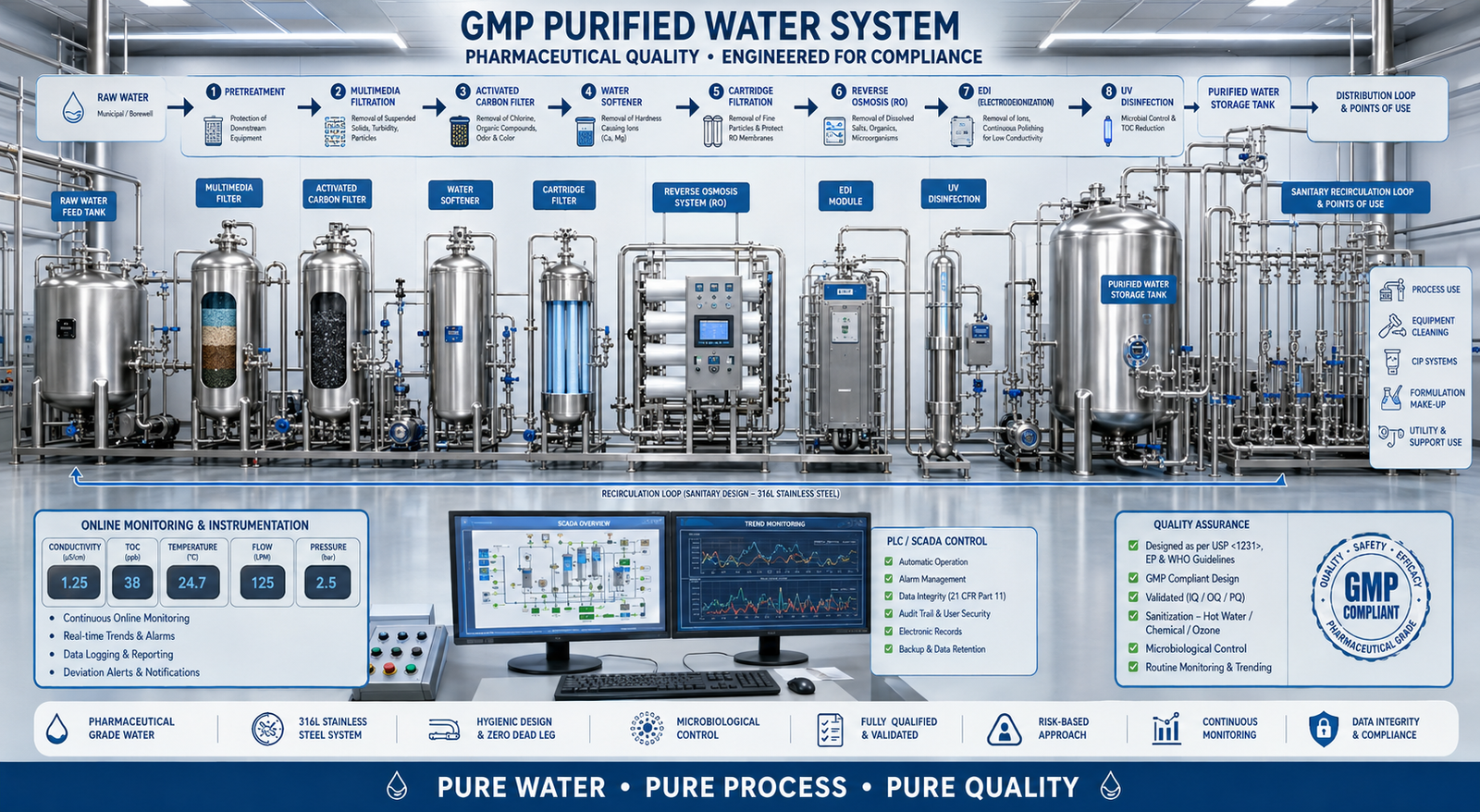
Purified Water Generation Process
A representative PW system may be configured as follows:
Raw/Source Water
↓
Raw Water Storage / Feed
↓
Pre-filtration
↓
Multimedia Filtration, where applicable
↓
Activated Carbon
↓
Softener / Antiscalant, where applicable
↓
Micron Filtration
↓
Reverse Osmosis
↓
EDI
↓
UV
↓
Final Treatment, where applicable
↓
PW Storage Tank
↓
Distribution Pump
↓
Sanitary PW Distribution Loop
↓
Points of Use
↓
Return to Storage Tank
The configuration is illustrative. Actual design should be established through source-water characterization, process requirements, risk assessment and engineering design.
maltreatment System
maltreatment protects the primary purification technologies.
Multimedia Filter
A multimedia filter may remove:
- Suspended solids
- Turbidity
- Larger particulate matter
Critical controls
- Differential pressure
- Flow
- Backwash frequency
- Filter condition
- Feed-water turbidity
Failure of pretreatment can overload downstream RO membranes.
Activated Carbon Filter
Activated carbon is commonly used for reduction of:
- Chlorine
- Chloramines, depending on design
- Certain organic contaminants
However, carbon beds can themselves become microbiologically challenging environments if poorly controlled.
FDA inspection guidance specifically notes the importance of microbiological control in water-treatment systems and identifies deionization systems as potential microbial-growth locations.
Controls may include:
- Differential pressure
- Chlorine/chloramine monitoring where applicable
- Backwashing
- Sanitization strategy
- Carbon replacement
- Microbiological monitoring
Water Softener
A softener may be installed to reduce hardness before RO.
Hardness primarily consists of ions such as:
- Calcium
- Magnesium
Without adequate hardness control, scaling can reduce RO performance.
Critical parameters include:
- Feed hardness
- Regeneration cycle
- Brine concentration
- Differential pressure
- Outlet hardness
Antiscalant Dosing
Antiscalant may be used where justified by the source-water chemistry and RO design.
The design should consider:
- Chemical compatibility
- Dosing accuracy
- Chemical concentration
- Injection point
- Storage
- Calibration
- Supplier qualification
- Impact on downstream treatment
The use of antiscalant should be based on a documented engineering assessment rather than assumed as mandatory.
Cartridge and Micron Filtration
Cartridge filtration may provide final pretreatment protection.
Consider:
- Nominal vs absolute filtration characteristics
- Filter integrity where relevant
- Differential pressure
- Replacement frequency
- Material compatibility
- Microbial risk
- Filter housing drainability
Reverse Osmosis
Principle
Reverse osmosis uses a semipermeable membrane and pressure to separate water from many dissolved and particulate contaminants.
RO can reduce:
- Dissolved salts
- Many organic contaminants
- Microorganisms
- Particulates
- Colloidal contaminants
RO is not simply a “purity machine”; its performance depends strongly on:
- Feed-water quality
- Pressure
- Temperature
- Recovery
- Membrane condition
- maltreatment
- Fouling
- Scaling
Key RO parameters
- Feed conductivity
- Product conductivity
- Reject conductivity
- Differential pressure
- Feed pressure
- Recovery
- Temperature
- Permeate flow
- Rejection percentage
A common performance indicator is:
% Rejection = [(Feed Conductivity − Permeate Conductivity) / Feed Conductivity] × 100
The acceptance criteria should be defined by the validated system design and manufacturer/site requirements.
Double-Pass RO
Double-pass RO may be used when greater dissolved-solids reduction is required.
Typical arrangement:
Feed → RO-1 → RO-2 → EDI/Other Treatment
Advantages may include:
- Improved ionic removal
- Lower EDI loading
- Better final-water quality
Disadvantages can include:
- Higher capital cost
- Greater water consumption
- More instrumentation
- More maintenance
Electrodeionization — EDI
EDI combines ion-exchange principles with electrical separation.
It can provide continuous polishing of ionic contaminants after RO.
Typical monitoring includes:
- Feed conductivity
- Product conductivity
- Voltage/current
- Flow
- Pressure
- Product quality
- Temperature
EDI performance can deteriorate because of:
- Poor RO performance
- Scaling
- Fouling
- Incorrect flow
- High ionic load
- Membrane/resin deterioration
UV Treatment
UV may be used for:
- Microbial reduction
- TOC reduction at suitable wavelengths/designs
- Control of microbial proliferation
UV should not be considered a substitute for good hygienic design.
Critical parameters include:
- UV intensity
- Lamp operating hours
- Flow rate
- Lamp condition
- Sleeve condition
- Alarm status
A UV system with a degraded lamp may continue to show water flow while providing inadequate microbial reduction.
Ultrafiltration
UF can provide removal/reduction of:
- Particulates
- Microorganisms
- High-molecular-weight contaminants
- Endotoxin-related contaminants depending on membrane and system design
UF application should be based on the required water quality and validated performance.
Nanofiltration
Nanofiltration may be considered for specialized separation requirements.
It should not be included merely because it is technologically available.
Its justification should consider:
- Feed chemistry
- Target contaminants
- Membrane selectivity
- Recovery
- Cleaning
- Sanitization
- Lifecycle cost
Final Filtration
Final filtration may be used where justified by the system and application.
The design should address:
- Filter rating
- Integrity
- Compatibility
- Differential pressure
- Sanitization compatibility
- Replacement strategy
- Microbial-retention expectations where applicable
Final filtration should not be used as a substitute for inadequate upstream system design.
Purified Water Storage Tank Design
The storage tank is a critical part of the PW system.
Material of Construction
316L stainless steel is commonly selected for pharmaceutical water systems because of its corrosion resistance and suitability for hygienic construction.
Important considerations include:
- Material certificates
- Surface finish
- Weld quality
- Passivation
- Internal geometry
- Drainability
- Cleaning
- Sanitization
- Inspection
Tank Geometry
The tank should minimize:
- Stagnant zones
- Uncleanable surfaces
- Product accumulation
- Poor drainage
- Difficult-to-access areas
A properly designed tank should be drainable and cleanable.
Spray Ball
A spray device may be used to support:
- Cleaning
- Sanitization
- Surface coverage
Coverage should be demonstrated where the cleaning/sanitization strategy depends on it.
Vent Filter
The storage tank vent must protect the water from contamination while allowing appropriate pressure equalization.
Consider:
- Filter rating
- Hydrophobicity
- Condensate management
- Integrity testing where applicable
- Replacement
- Sanitization
- Differential pressure
Instrumentation
Typical instruments include:
- Level transmitter
- Temperature transmitter
- Pressure transmitter
- Conductivity
- TOC where appropriate
Instrumentation should be selected according to the criticality of the parameter.
Hygienic Design of the PW Distribution Loop
The distribution system should maintain the required water quality from the generation point to every point of use.
Typical arrangement:
Storage Tank → Pump → Supply Header → POUs → Return Header → Storage Tank
A circulating loop is commonly used because continuous circulation can reduce the opportunity for stagnation.
ISPE guidance addresses storage/distribution configurations, microbial control, sampling, point-of-use design, materials and instruments.
Key Distribution-Loop Design Parameters
Continuous Circulation
Continuous circulation can help maintain:
- Consistent water quality
- Flow
- Temperature
- Microbial control
However, circulation alone does not guarantee microbiological control.
Flow Velocity
The loop should be designed to maintain the validated operating condition required for the selected system.
The objective is to avoid stagnant or poorly mixed regions.
Velocity criteria should not be blindly copied from another facility.
Turbulent Flow
Turbulent flow can reduce boundary-layer effects and improve hydraulic performance.
The design should consider:
- Pipe diameter
- Flow rate
- Fluid properties
- Pump capacity
- Pressure drop
Dead Legs and Stagnation
A dead leg is a branch or section of piping where water movement is significantly reduced or absent.
Dead legs can create:
- Stagnation
- Temperature variation
- Microbial growth
- Biofilm
- Difficult sanitization
- Poor sampling representativeness
Poor design
Main Loop ────────────────
             |
             |
             |
             Valve
             POU
A long stagnant branch can create a microbiological risk.
Better hygienic design
Main Loop ────────────────
          |
        Short
        hygienic
        branch
          |
         POU
The actual acceptable geometry should be determined using the applicable design standard, system configuration and risk assessment rather than a single universal dimensional rule.
Pipe Slope and Drainability
Where applicable, piping should be designed to facilitate:
- Drainage
- Sanitization
- Drying where required
- Inspection
- Maintenance
Poor drainage can leave residual water after sanitization and create microbial-growth opportunities.
Valves and Diaphragm Components
Common hygienic valve considerations include:
- Minimal internal crevices
- Drainability
- Suitable elastomers
- Cleanability
- Sanitization compatibility
- Maintenance accessibility
Diaphragm valves are frequently selected for hygienic applications because they can reduce internal contamination niches when correctly designed and installed.
Materials of Construction
316L Stainless Steel
Important characteristics include:
- Corrosion resistance
- Hygienic compatibility
- Weldability
- Passivation capability
- Surface-finish control
Welding
Pharmaceutical water systems may use orbital welding to achieve consistent hygienic joints.
Documentation can include:
- Welder qualification
- Weld logs
- Weld maps
- Visual inspection
- Boroscope inspection where required
- Weld acceptance criteria
- Material traceability
Passivation
Passivation can improve corrosion resistance by promoting formation of a stable passive surface layer.
Passivation records should document:
- Procedure
- Chemical used
- Concentration
- Exposure conditions
- Rinsing
- Acceptance criteria
- Verification/testing
Electropolishing
Electropolishing may be considered for applications requiring enhanced surface characteristics.
It can reduce surface roughness and improve cleanability, but it should be selected based on engineering and risk considerations.
Elastomers, Gaskets and Polymers
These components require consideration of:
- Chemical compatibility
- Temperature resistance
- Sanitization compatibility
- Extractables/leachables where relevant
- Compression characteristics
- Aging
- Material certification
A stainless-steel system can still have a contamination risk if its elastomeric components are poorly selected or maintained.
Purified Water System Sanitization
Sanitization is a key microbiological-control strategy.
There is no universal sanitization frequency that applies to every PW system.
Frequency should be scientifically justified based on:
- System design
- Sanitization method
- Historical microbial trends
- System usage
- Temperature
- Water quality
- Risk assessment
- Seasonal effects
- Validation data
Thermal Sanitization
Hot-water sanitization uses elevated temperature for a defined exposure period.
Critical parameters include:
- Temperature
- Exposure time
- System coverage
- Flow
- Return temperature
- Cold spots
- Instrumentation
The validated cycle should demonstrate adequate coverage of the system.
Chemical Sanitization
Chemical sanitization may use a validated chemical agent compatible with the system.
Controls include:
- Chemical identity
- Concentration
- Contact time
- Temperature
- Distribution throughout the system
- Material compatibility
- Rinsing
- Residual verification
- Post-sanitization sampling
The chemical should not create a secondary contamination problem.
Ozone Sanitization
Ozone can be used as an ambient-temperature sanitization strategy in appropriately designed systems.
Consider:
- Ozone generator
- Ozone concentration
- Contact/exposure time
- Distribution
- Ozone monitoring
- Ozone destruction
- Residual control
- Worker safety
- Material compatibility
ISPE identifies ozone for ambient sanitization as one of the technologies addressed in its Water and Steam Systems guidance.
Sanitization Validation
A sanitization cycle should be demonstrated to be effective.
Evidence may include:
- Microbiological results
- Trend comparison
- Cycle parameters
- Temperature mapping where applicable
- Ozone concentration profiles where applicable
- Chemical concentration verification
- Worst-case location evaluation
Pharmaceutical Water Sampling
Sampling is one of the most underestimated parts of a water-system control strategy.
A system may be performing normally while a poor sampling technique generates misleading results.
Sampling plans should be risk-based.
Potential sampling locations include:
- Storage tank
- Supply line
- Return line
- Generation outlet
- High-risk POUs
- Low-use POUs
- Frequently used POUs
- Remote POUs
- Post-sanitization locations
- Worst-case locations
WHO guidance explicitly addresses sampling and testing as part of the lifecycle control of pharmaceutical water systems.
Sampling Principles
Operators should control:
- Sample-point sanitization
- Sampling container suitability
- Sampling technique
- Flush procedure
- Sample volume
- Sample identification
- Transport conditions
- Holding time
- Laboratory receipt
- Chain of custody where applicable
The sampling method itself should be qualified or appropriately controlled.
Chemical and Physical Monitoring
Typical parameters include:
| Parameter | Purpose |
| Conductivity | Indicator of ionic contamination |
| TOC | Indicator of organic carbon contamination |
| Temperature | Process and microbial-control parameter |
| Pressure | Distribution-system performance |
| Flow | Hydraulic performance |
| pH | Where relevant to system/process |
| Resistivity | Related ionic-quality measurement where used |
Conductivity
Conductivity provides an indication of ionic content.
Increasing conductivity may indicate:
- RO deterioration
- EDI performance deterioration
- Ion-exchange failure
- Contamination
- Instrument malfunction
- Temperature-compensation issues
An investigation should distinguish between:
true water-quality deterioration
and
measurement-system failure.
Total Organic Carbon — TOC
TOC measures organic carbon in water.
An increasing TOC trend may be associated with:
- Organic contamination
- Treatment deterioration
- Carbon-filter problems
- Biofilm
- Cleaning residues
- System contamination
TOC should be interpreted as part of an overall control strategy rather than as a standalone indicator.
Microbiological Monitoring
Microbial monitoring may include:
- Total microbial count/bioburden
- Organism identification where justified
- Objectionable-organism assessment
- Trend analysis
The importance of organism identification is especially high when:
- Action limits are exceeded
- Repeated alerts occur
- Opportunistic organisms are detected
- The water is used in susceptible products
- Product impact is possible
Endotoxin
Endotoxin control is particularly important for water systems and applications where endotoxin requirements apply, especially WFI-related systems.
The specific testing requirements should be established from:
- Applicable pharmacopoeia
- Product requirements
- Regulatory expectations
- Water grade
- Intended use
A PW monitoring program should not automatically copy the endotoxin program used for WFI.
Alert Limits, Action Limits and Specifications
These terms should not be treated as interchangeable.
Specification
A formal acceptance requirement applicable to the material or process.
Alert Limit
A predefined level indicating that a system may be moving away from its normal state and warrants evaluation.
Action Limit
A level requiring defined investigation and action according to the site’s procedure.
Trend Limit
A statistically or scientifically justified indication of a meaningful change in system performance.
Limits should be scientifically justified using:
- Pharmacopoeial requirements
- Historical system performance
- Risk assessment
- Product/process requirements
- Regulatory expectations
What to Do After an Alert
A sensible workflow is:
Alert → Verify Data → Review Trend → Check Sampling → Evaluate Laboratory Result → Assess System → Determine Cause → Monitor
An alert does not necessarily mean the water is automatically unacceptable, but it should trigger the response defined by the approved procedure.
What to Do After an Action-Limit Excursion
A more comprehensive response may include:
- Data verification
- Laboratory investigation
- Sample review
- Instrument review
- Trend analysis
- System inspection
- Sanitization review
- Maintenance review
- Previous excursion review
- Product/process impact assessment
- Root-cause analysis
- CAPA
- Effectiveness verification
FDA inspection guidance emphasizes reviewing water-system data, investigation reports and maintenance records during inspection of high-purity systems.
Water System Qualification
Qualification demonstrates that the system has been appropriately designed, installed and operated and can perform its intended function.
A practical lifecycle can include:
URS → DQ → FAT → SAT → IQ → OQ → PQ → Continued Verification
Modern ISPE guidance emphasizes science- and risk-based commissioning and qualification approaches for pharmaceutical water systems. Its third edition C&Q guide, published in 2025, specifically addresses URS, automation functional requirements, risk-based approaches and lifecycle management.
User Requirement Specification — URS
The URS should define:
- Required water grade
- Water-quality requirements
- Generation capacity
- Peak demand
- Average demand
- Storage capacity
- Distribution requirements
- Number of POUs
- Operating philosophy
- Sanitization strategy
- Instrumentation
- Automation
- Alarm requirements
- Data requirements
- Maintenance requirements
- GMP requirements
- Safety requirements
A common mistake is specifying only:
“Generate X litres/hour.”
A good URS also defines quality, availability, redundancy, monitoring, sanitization and lifecycle expectations.
Design Qualification — DQ
DQ should demonstrate that the proposed design can meet:
- URS
- GMP requirements
- Regulatory requirements
- Engineering requirements
- Quality-risk controls
Design review should include:
- P&IDs
- Equipment specifications
- Materials
- Flow paths
- Tank sizing
- Loop design
- Sampling
- Sanitization
- Instrumentation
- Automation
- Alarm philosophy
Factory Acceptance Test — FAT
FAT may include:
- Equipment inspection
- Component verification
- Instrument checks
- Functional testing
- PLC/SCADA testing
- Alarm testing
- Documentation review
- Material verification
- Panel inspection
FAT should be planned to avoid duplicating unnecessary site testing.
Site Acceptance Test — SAT
SAT verifies that the system has arrived at the site correctly and can be prepared for installation/commissioning.
Typical activities include:
- Equipment inspection
- Damage assessment
- Identification verification
- Documentation verification
- Shipment-condition review
- Site utility verification
Installation Qualification — IQ
IQ can include verification of:
- Equipment identification
- P&IDs
- Equipment tags
- Material certificates
- Pipe specifications
- Weld documentation
- Weld maps
- Passivation records
- Instrument calibration
- Utility connections
- Installation drawings
- Manuals
- Spare parts
- Component certificates
Operational Qualification — OQ
OQ should challenge the operating functions.
Typical testing includes:
- Normal operating ranges
- High/low alarms
- Interlocks
- Pump operation
- Valve operation
- Flow
- Pressure
- Temperature
- Conductivity
- TOC
- Level controls
- Sanitization sequence
- Automation functions
- Power-failure response
Performance Qualification — PQ
PQ demonstrates consistent performance under defined operating conditions.
It may include:
- Extended monitoring
- Chemical testing
- Microbiological testing
- Sampling across the distribution system
- Seasonal evaluation
- System-performance trending
- Sanitization performance
- Worst-case locations
PQ should not be reduced to “collecting samples for a few days.”
The duration and scope should be scientifically justified based on the system, applicable requirements and site validation strategy.
Phased Validation Approach
A useful lifecycle model is:
Phase 1 — Initial Qualification and Baseline
Establish:
- System performance
- Sampling locations
- Operating ranges
- Baseline microbial levels
- Chemical-quality trends
Phase 2 — Extended Monitoring
Evaluate:
- Seasonal changes
- Microbial trends
- Sanitization performance
- Operating stability
- Variability
Phase 3 — Continued Verification
Maintain:
- Routine sampling
- Trend analysis
- Preventive maintenance
- Calibration
- Periodic review
- Change control
- Requalification/reverification as justified
This supports the principle that a water system is a lifecycle-controlled system rather than a one-time validation project.
Automation, SCADA and Data Integrity
Modern PW systems increasingly use:
- PLC
- HMI
- SCADA
- Historian
- Online conductivity
- Online TOC
- Temperature sensors
- Flowmeters
- Pressure transmitters
- Level transmitters
Automation can provide better visibility of:
- Trends
- Alarms
- Sanitization cycles
- Operating parameters
- Equipment status
- Deviations
However:
Automation does not automatically equal compliance.
The computerized system must be appropriately assessed and controlled.
Data Integrity Considerations
Depending on system functionality and intended use, controls may include:
- Unique user IDs
- Role-based access
- Password management
- Audit trails where applicable
- Electronic records
- Electronic signatures where applicable
- Backup
- Restore testing
- Data retention
- Time synchronization
- Alarm history
- Change control
- Periodic review
FDA’s Part 11 guidance explains the applicability of electronic-record requirements and the Agency’s approach to electronic records and signatures.
EU GMP Annex 11 provides the European framework for computerized systems; Annex 15 addresses qualification and validation. The European Commission maintains the current EudraLex Volume 4 framework and annexes.
CSV Considerations
For an automated PW system, CSV activities may include:
URS → Risk Assessment → Functional Specification → Configuration Specification → Testing → Traceability → Validation → Operation → Periodic Review
The assessment should determine which computerized functions are GMP-relevant.
Examples:
- Water-quality alarms
- Sanitization records
- Critical process parameters
- Electronic batch/process records
- Audit trails
- User access
- Alarm acknowledgement
- Data historians
Calibration Requirements
Critical instruments may include:
- Conductivity sensors
- TOC analyzers
- Temperature sensors
- Pressure transmitters
- Flowmeters
- Level transmitters
- pH sensors where applicable
- UV intensity sensors
- Ozone sensors where applicable
Calibration intervals should not be blindly assigned as universal values.
Intervals should consider:
- Risk
- Manufacturer recommendations
- Historical drift
- Instrument criticality
- Failure history
- Process requirements
- Regulatory expectations
Out-of-Tolerance Calibration
If a critical instrument is found out of tolerance:
- Document the finding.
- Determine the period potentially affected.
- Review previous calibration results.
- Assess instrument drift.
- Review water-quality records.
- Assess product/process impact.
- Determine whether additional sampling is needed.
- Correct or replace the instrument.
- Document the investigation.
- Implement CAPA if justified.
Routine Operation and Maintenance
Daily Checks
Depending on system design:
- Water quality
- Conductivity
- TOC
- Temperature
- Flow
- Pressure
- Pump status
- Alarms
- Tank level
- Leakage
- System status
Weekly Checks
May include:
- maltreatment performance
- Differential pressure
- Filter status
- RO performance
- EDI performance
- UV status
- Trend review
- POU review
Monthly/Periodic Activities
May include:
- Sanitization
- Preventive maintenance
- Calibration
- Filter inspection
- RO performance analysis
- Tank inspection
- Loop inspection
- Trend analysis
The exact frequency should be established by the site’s approved maintenance and monitoring program.
RO Membrane Monitoring
Useful performance indicators include:
- Permeate conductivity
- Feed conductivity
- Rejection
- Flow
- Pressure
- Differential pressure
- Temperature
A gradual decline can indicate:
- Scaling
- Fouling
- Membrane aging
- maltreatment failure
EDI Monitoring
Track:
- Product conductivity
- Feed conductivity
- Flow
- Pressure
- Current
- Voltage
- Temperature
A change in EDI performance should trigger evaluation of upstream RO and pretreatment performance before replacing the EDI module.
UV Monitoring
Track:
- Lamp status
- Lamp hours
- UV intensity
- Flow
- Alarm status
- Sleeve condition
Deviations, Excursions, OOS/OOT and CAPA
Typical events include:
- Microbial excursion
- Conductivity excursion
- TOC excursion
- Endotoxin excursion where applicable
- Repeated alerts
- Action-limit failure
- Instrument failure
- Sampling error
- Laboratory error
- Sanitization failure
A robust investigation follows:
Detection → Data Verification → Laboratory Review → Sampling Review → Trend Review → System Review → Root Cause → Product Impact Assessment → CAPA → Effectiveness Check
Product Impact Assessment
When water fails an applicable requirement, the investigation should not stop at:
“The water failed.”
The team should determine:
- Which batches used the water?
- Which manufacturing steps were involved?
- Was the water product-contacting?
- Was there subsequent microbial reduction?
- What organism was recovered?
- Was the organism objectionable?
- Was the result confirmed?
- Was the sample representative?
- What was the historical trend?
- Was there a common cause?
FDA inspection guidance emphasizes the importance of considering water results in relation to products manufactured with that water.
Risk Management
ICH Q9 provides the framework for pharmaceutical quality risk management. Risk management can be applied to:
- System design
- Sampling
- Sanitization
- Maintenance
- Change control
- Qualification
- Microbial excursions
Useful tools include:
FMEA
Failure Mode → Effect → Cause → Existing Control → Risk Ranking → Action
HACCP
Can be used where appropriate to identify critical control points.
Major PW System Risks
| Risk | Potential Impact | Typical Control |
| Microbial contamination | Product/process contamination | Hygienic design, sanitization, monitoring |
| Biofilm | Persistent microbial excursions | Design + sanitization + investigation |
| Stagnation | Microbial growth | Circulation and hygienic piping |
| Dead legs | Local contamination | Hygienic design |
| Poor sanitization | Repeated excursions | Validated sanitization |
| RO failure | Chemical-quality failure | Online monitoring |
| EDI failure | Ionic contamination | Conductivity monitoring |
| Instrument failure | False acceptance/rejection | Calibration |
| Poor sampling | Misleading data | Controlled sampling |
| Data-integrity failure | Compliance risk | CSV and access controls |
Common PW System Failures and Troubleshooting
| Problem | Possible Cause | Investigation | Corrective Action |
| Increased microbial count | Stagnation/biofilm | Trend + location review | Sanitization + RCA |
| High conductivity | RO/EDI deterioration | Conductivity trend | Investigate purification stage |
| High TOC | Organic contamination | TOC trend | Investigate source/treatment |
| Low loop flow | Pump/valve/obstruction | Flow verification | Maintenance |
| Repeated microbial excursions | Design/sanitization issue | System review | Engineering + CAPA |
| RO rejection deterioration | Membrane degradation | Feed/product conductivity | Membrane investigation |
| UV failure | Lamp aging | UV intensity | Replace/maintain |
| Repeated POU excursion | Local stagnation | POU investigation | Use/design investigation |
| Tank contamination | Poor cleaning/sanitization | Tank inspection | Correct sanitization/design |
| Pressure instability | Pump/valve/control issue | Pressure trend | Engineering investigation |
Practical Troubleshooting Logic
Scenario 1: Microbial excursion at one POU
Ask:
- Is the POU frequently used?
- Was the sampling technique correct?
- Was the sample container suitable?
- Was the POU sanitized correctly?
- Is there a local dead leg?
- Is there a valve problem?
- Is the trend isolated or recurring?
- Are adjacent POUs normal?
- Was the system recently maintained?
A localized excursion should not automatically be interpreted as a complete-loop failure.
Scenario 2: Microbial excursion at multiple POUs
Look for:
- Sanitization failure
- Poor sanitization coverage
- Low circulation
- Temperature problem
- Biofilm
- Source-water change
- maltreatment failure
- Extended shutdown
- Maintenance intervention
Scenario 3: High Conductivity
Investigate:
Source → maltreatment → RO → EDI → Final Treatment → Instrument
Do not immediately replace the conductivity sensor without confirming the water-quality condition.
GMP and Regulatory Expectations
A pharmaceutical water system should be designed and controlled within the site’s overall pharmaceutical quality system.
Key international references include:
- WHO GMP
- WHO Water for Pharmaceutical Use guidance
- FDA expectations and inspection guidance
- EU GMP
- PIC/S
- ISPE
- ICH Q9
- ICH Q10
- USP
- Ph. Eur.
- Indian Pharmacopoeia
- Applicable national regulations
WHO adopted its GMP guidance on water for pharmaceutical use in TRS 1033 Annex 3 in 2021. The guidance covers available water specifications, appropriate water quality for pharmaceutical applications, and GMP expectations for design, installation and operation.
The FDA’s high-purity-water inspection guide remains useful background for understanding regulatory inspection concerns, although FDA explicitly states that the guide itself does not bind the Agency or create legal rights.
ISPE guidance is valuable for engineering and industry good practice, but it should not automatically be interpreted as a regulation. The distinction between mandatory regulatory requirements and engineering recommendations/industry practice should always be maintained.
Regulatory Requirement vs Engineering Good Practice
This distinction is extremely important during audits.
Regulatory requirement
A requirement established by:
- Applicable law
- Regulation
- Pharmacopoeia where legally applicable
- Binding regulatory framework
- Approved product/regulatory commitment
Engineering good practice
Examples may include:
- Preferred piping configuration
- Particular pump arrangement
- Specific instrumentation architecture
- Recommended redundancy
- Preferred surface finish
- Preferred automation configuration
An engineering recommendation becomes a site requirement when it is incorporated into an approved specification, URS, design standard or validated system.
Therefore:
Never describe an engineering preference as a universal GMP requirement unless the applicable authoritative source actually requires it.
PW System Design Checklist
- URS approved
- Water grade defined
- Intended uses documented
- Source-water assessment completed
- Seasonal source-water variation assessed
- Capacity established
- Peak demand calculated
- maltreatment designed
- Purification technologies justified
- Storage capacity established
- Tank design reviewed
- Distribution loop designed
- Dead-leg assessment completed
- Drainability verified
- Materials of construction approved
- Welding strategy established
- Passivation strategy established
- Instrumentation identified
- Sampling points defined
- Sanitization strategy established
- P&IDs approved
- Material certificates available
- Welding documentation available
- Passivation completed
- Calibration completed
- IQ completed
- OQ completed
- PQ completed
- Microbial monitoring established
- Chemical monitoring established
- Alert/action limits established
- SOPs approved
- Training completed
- Preventive maintenance established
- Data-integrity controls implemented
- Change-control process established
- Periodic review established
Top 15 Design Considerations for a GMP-Compliant PW System
1. Water Quality
Define quality based on intended use.
2. Capacity
Calculate average, peak and future demand.
3. Flow
Ensure the distribution system operates within its validated hydraulic range.
4. Storage
Avoid unnecessarily large storage volumes that can increase residence time.
5. Distribution
Maintain appropriate circulation and hydraulic control.
6. Dead Legs
Minimize stagnant zones.
7. Drainability
Design the system so that water and sanitizing fluids can be appropriately removed where required.
8. Material of Construction
Select materials compatible with water, sanitization and operating conditions.
9. Sanitization
Select a validated and maintainable strategy.
10. Temperature
Control and monitor temperature according to the system’s microbiological-control strategy.
11. Microbiological Control
Treat microbial control as a system-design issue.
12. Instrumentation
Install appropriate critical monitoring instruments.
13. Sampling
Design representative and accessible sample points.
14. Automation and Data Integrity
Ensure GMP-relevant electronic data are appropriately controlled.
15. Lifecycle Validation
Maintain the system through continued verification, change control and periodic review.
15 Common PW System Design and Operational Mistakes
1. Designing only for capacity
A high-capacity system can still be microbiologically poor.
2. Ignoring seasonal source-water variation
Feed-water chemistry and microbiology can vary throughout the year.
3. Poor pretreatment
maltreatment failures can overload downstream equipment.
4. Excessive dead legs
Stagnation creates microbial risk.
5. Inadequate circulation
Poor flow can create local water-quality deterioration.
6. Poor drainability
Residual water can become a contamination source.
7. Incorrect sampling locations
Sampling only the easiest locations may not represent system performance.
8. Inadequate sanitization
Sanitization must address the actual system configuration.
9. Insufficient microbiological trending
A single test result is less informative than a well-designed trend.
10. Ignoring low-use POUs
Infrequently used points may represent higher microbiological risk.
11. Poor calibration
Incorrect instruments can create false confidence.
12. Weak change control
Changes to piping, valves, instruments or software can alter system performance.
13. Treating PQ as a short-term exercise
A water system requires sustained performance evidence.
14. Ignoring data integrity
Electronic records must be trustworthy and controlled.
15. Failure to reassess after modification
Any significant change should trigger documented impact assessment and appropriate qualification/reverification.
Practical Example: PW System for a Medium-Sized Pharmaceutical Manufacturing Facility
The following is an illustrative example only and is not a universal design specification.
Consider a facility manufacturing:
- Tablets
- Capsules
- Oral liquids
- Topical products
The site estimates:
- Average PW demand: approximately 2,000 L/hour
- Peak demand: approximately 3,500 L/hour
- PW storage: approximately 5,000 L
- Distribution: continuous recirculating sanitary loop
Illustrative Generation Train
Potable Source Water
↓
Multimedia Filter
↓
Activated Carbon
↓
Softener/Antiscalant
↓
Cartridge Filter
↓
RO
↓
EDI
↓
UV
↓
PW Storage
↓
Distribution Loop
The actual treatment train should be based on source-water analysis and system-performance requirements.
Illustrative Distribution Strategy
The loop may serve:
- Granulation area
- Coating area
- Oral-liquid manufacturing
- Equipment-cleaning locations
- Utility sampling points
Sampling locations could include:
- Tank outlet
- Loop supply
- Remote POU
- High-use POU
- Low-use POU
- Loop return
The final sampling plan should be justified through risk assessment.
Illustrative Monitoring
Online:
- Conductivity
- Temperature
- Flow
- Pressure
- Level
Periodic laboratory testing:
- Microbiological quality
- TOC
- Applicable chemical parameters
- Additional parameters based on water grade and site requirements
Illustrative Sanitization
The site may select:
- Thermal sanitization
- Ozone
- Chemical sanitization
The selection should consider:
- System materials
- Operating temperature
- Microbial history
- Equipment design
- Maintenance
- Product/process requirements
Illustrative Qualification
URS → DQ → FAT → SAT → IQ → OQ → PQ → Continued Verification
The qualification strategy should include engineering documentation, instrument verification, operating challenges, sanitization verification and sustained water-quality monitoring.
Water System Lifecycle Management
A PW system should be treated as a living GMP system.
Lifecycle management includes:
Design
↓
Construction
↓
Commissioning
↓
Qualification
↓
Validation
↓
Routine Operation
↓
Monitoring
↓
Trending
↓
Maintenance
↓
Change Control
↓
Periodic Review
↓
Continued Verification
↓
Improvement
Pharmaceutical Water Trend Analysis
Trend analysis is one of the strongest tools available to utilities, QA, QC and engineering teams.
Useful trends include:
- Conductivity
- TOC
- Microbial counts
- Temperature
- Flow
- Pressure
- RO rejection
- EDI performance
- Sanitization results
- POU-specific performance
A trend may identify deterioration before an action limit is reached.
For example:
5 → 8 → 15 → 25 → 40 CFU/mL
may be more informative than simply waiting for a predefined action limit.
Trend review should therefore look for:
- Gradual increases
- Repeated alerts
- Seasonal patterns
- Location-specific patterns
- Post-maintenance patterns
- Post-sanitization recovery patterns
Continued Verification
Continued verification should confirm that:
- The system remains in control.
- Water quality remains consistent.
- Sanitization remains effective.
- Instrumentation remains reliable.
- Microbial trends remain acceptable.
- Maintenance does not introduce contamination.
- Changes have been appropriately assessed.
This is where Engineering + QA + QC + Microbiology + Validation must work together.
Frequently Asked Questions
1. What is a Purified Water System in pharmaceutical manufacturing?
A purified-water system is an engineered system used to generate, store and distribute water meeting the applicable pharmacopoeial requirements for Purified Water. It includes water treatment, storage, distribution, monitoring and lifecycle controls.
2. What is purified water used for in pharmaceutical manufacturing?
Depending on the applicable requirements, PW can be used as a formulation ingredient, processing water, cleaning medium and for activities such as wet granulation and aqueous coating preparation.
3. What is the difference between PW and WFI?
PW and WFI are different pharmaceutical water grades with different applicable quality requirements and intended uses. WFI is generally associated with applications requiring the higher level of control defined by the applicable pharmacopoeial and regulatory framework.
4. Can purified water be used for tablet manufacturing?
Yes, where the manufacturing process requires pharmaceutical-grade water and the applicable requirements specify PW. Wet granulation and aqueous coating are common examples.
5. Is purified water used in oral liquid manufacturing?
Yes. PW is commonly important in oral-liquid manufacturing, subject to the formulation and applicable requirements. Microbial and chemical control are particularly important.
6. Why is microbial control important in PW systems?
Water systems can support microbial growth and biofilm formation if poorly designed or operated. Microbial contamination can affect pharmaceutical products and processes.
7. What is a PW distribution loop?
It is a sanitary piping system designed to circulate purified water from storage through points of use and back to storage while maintaining required water quality.
8. Why are dead legs dangerous?
Dead legs can create stagnant areas where microorganisms can multiply and biofilm can develop.
9. How is a PW system sanitized?
Depending on system design, thermal, chemical or ozone sanitization may be used. The selected method should be validated and scientifically justified.
10. What parameters are monitored in purified water?
Typical parameters include conductivity, TOC, temperature, flow, pressure and microbiological quality. Additional parameters depend on the water grade and intended use.
11. What is water-system qualification?
Qualification provides documented evidence that the water system has been appropriately designed, installed and operates/performs as intended.
12. What is the difference between IQ, OQ and PQ?
IQ verifies correct installation.
OQ verifies operation across defined conditions.
PQ demonstrates consistent performance under intended operating conditions.
13. How frequently should pharmaceutical water be sampled?
There is no universal sampling frequency applicable to every system. Frequency should be scientifically justified using risk, water grade, system design, historical data, applicable requirements and site procedures.
14. What causes microbial excursions in PW systems?
Potential causes include:
- Stagnation
- Biofilm
- Poor sanitization
- Dead legs
- Low-use POUs
- Poor sampling
- Maintenance intervention
- maltreatment problems
- Temperature problems
- Extended shutdowns
15. What is the role of RO and EDI?
RO removes a broad range of dissolved and other contaminants, while EDI provides continuous ionic polishing after suitable pretreatment, commonly after RO.
16. What is TOC in pharmaceutical water?
Total Organic Carbon is an indicator of organic carbon present in the water and is commonly used as part of pharmaceutical-water chemical monitoring.
17. Why is conductivity monitored?
Conductivity provides an indication of ionic contamination and is useful for monitoring the performance of purification stages such as RO and EDI.
18. How should a PW system be validated?
A lifecycle approach may include URS, design review, commissioning, IQ, OQ, PQ and continued verification, supported by risk assessment, monitoring and documented change control.
19. What are common PW system GMP deficiencies?
Examples include poor hygienic design, dead legs, inadequate sampling, weak microbial trending, insufficient sanitization control, poor documentation, calibration failures and inadequate change control.
20. How can PW system performance be maintained over its lifecycle?
Through:
Routine Monitoring + Trend Analysis + Sanitization + Preventive Maintenance + Calibration + Change Control + Periodic Review + Continued Verification
Key Takeaways for Pharmaceutical Professionals
A successful PW system depends on more than the selection of RO, EDI or another purification technology.
The most important lessons are:
1. Quality starts with design
A poorly designed system cannot be rescued by laboratory testing alone.
2. Microbial control is a system problem
Biofilm, stagnation, dead legs, temperature and sanitization all interact.
3. Sampling must be representative
A poor sampling plan can create false confidence.
4. Qualification is not validation by paperwork
The system must demonstrate actual performance.
5. Trend analysis is powerful
Changes in performance may be visible before formal action limits are reached.
6. Water grade must match intended use
PW and WFI should never be treated as interchangeable.
7. Automation requires data-integrity controls
Digital monitoring improves visibility only when the underlying computerized system and records are appropriately controlled.
8. The system requires lifecycle management
Continued verification, maintenance, change control and periodic review are essential.
Conclusion
A Purified Water System in Pharmaceutical Manufacturing is a critical GMP system that can directly influence product quality, microbiological safety, cleaning performance, process consistency and regulatory compliance.
The most effective systems combine:
Good Design → Good Engineering → Effective Qualification → Robust Validation → Continuous Monitoring → Effective Sanitization → Trend Analysis → Lifecycle Control
A successful pharmaceutical water strategy therefore integrates:
- Engineering
- Utilities
- Production
- QA
- QC
- Microbiology
- Validation
- Automation
- Maintenance
- Regulatory Compliance
The objective is not simply to produce water that passes a laboratory test. The objective is to establish a robust, hygienically designed, qualified, validated, monitored and maintainable system capable of consistently producing water of the required quality for its intended pharmaceutical use.
As pharmaceutical manufacturing becomes increasingly automated and data-driven, PW systems are also evolving toward online instrumentation, continuous monitoring, improved data analytics, science- and risk-based qualification, and lifecycle management.
For pharmaceutical professionals, the fundamental principle remains unchanged:
Build quality into the water system rather than attempting to test quality into the water after generation.
References and Authoritative Resources
- WHO — Good Manufacturing Practices: Water for Pharmaceutical Use, TRS 1033 Annex 3. WHO adopted this guidance in 2021 and it covers water specifications, appropriate applications, design, installation and operation of pharmaceutical water systems.
- FDA — High Purity Water System Inspection Guide. Useful for understanding FDA inspection considerations relating to design, microbiological control, monitoring, investigations and maintenance. FDA notes that the guide is inspection reference material and is not legally binding.
- FDA — Water for Pharmaceutical Use. FDA inspection guidance covering pharmaceutical water types and manufacturing applications.
- USP General Chapter <1231> — Water for Pharmaceutical Purposes. Provides general information on pharmaceutical water use and water-system considerations.
- ISPE Baseline Guide Vol. 4 — Water & Steam Systems, Third Edition. Industry engineering guidance covering design, construction, operation and lifecycle management.
- ISPE Good Practice Guide — Approaches to Commissioning and Qualification of Pharmaceutical Water and Steam Systems, Third Edition, 2025. Provides current science- and risk-based C&Q approaches for pharmaceutical water and steam systems.
- European Commission — EudraLex Volume 4. Includes EU GMP requirements and relevant annexes, including Annex 11 for computerized systems and Annex 15 for qualification and validation.
- FDA — 21 CFR Part 11 Guidance. Relevant where GMP-regulated electronic records and electronic signatures are used.
- ICH Q9 — Quality Risk Management. Use the current applicable revision when establishing pharmaceutical water-system risk-management strategies.
- Applicable Current Pharmacopoeias. Always consult the current applicable editions of USP, Ph. Eur., Indian Pharmacopoeia and other jurisdiction-specific standards before defining specifications or regulatory commitments.
Regulatory note: Regulatory and pharmacopoeial requirements can change. Before using this article for a GMP project, qualification protocol, regulatory submission, SOP or audit response, verify the current applicable edition and jurisdiction-specific requirements.