
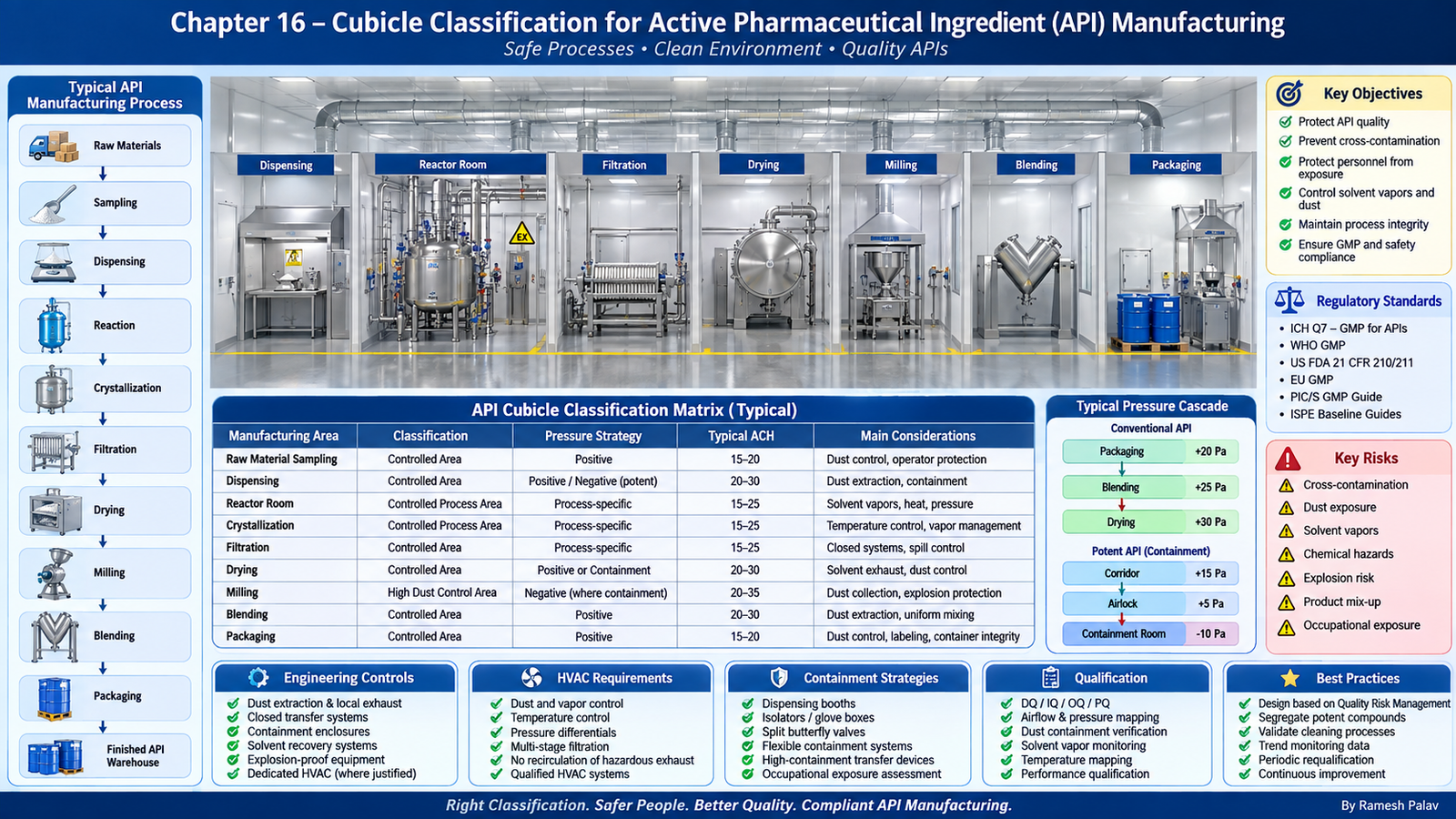
16.1 Introduction
Active Pharmaceutical Ingredient (API) manufacturing differs significantly from finished dosage form manufacturing due to the complexity of chemical synthesis, biological processing, solvent handling, reaction chemistry, and containment requirements. API facilities often involve multiple unit operations such as reaction, crystallization, filtration, drying, milling, blending, and packaging, each with unique engineering and contamination control challenges.
Unlike sterile manufacturing, most API processes do not require classified cleanrooms. However, they demand rigorous control of:
- Cross-contamination
- Product mix-ups
- Occupational exposure
- Solvent vapors
- Dust generation
- Chemical hazards
- Environmental emissions
- Explosion risks
Cubicle classification in API facilities should be based on Quality Risk Management (ICH Q9) and aligned with:
- ICH Q7 – Good Manufacturing Practice for APIs
- WHO GMP
- US FDA 21 CFR Parts 210 & 211 (where applicable)
- EU GMP
- PIC/S GMP Guide
- ISPE Baseline Guides
- Applicable industrial safety standards
16.2 Objectives of API Cubicle Classification
The objectives are to:
- Protect API quality.
- Prevent cross-contamination.
- Protect personnel from hazardous exposure.
- Control solvent vapors and dust.
- Maintain process integrity.
- Facilitate cleaning and maintenance.
- Support safe handling of hazardous chemicals.
- Ensure GMP and occupational safety compliance.
16.3 Typical API Manufacturing Process
A simplified API manufacturing process is shown below.
Raw Materials
       │
       ▼
Dispensing
       │
       ▼
Reaction
       │
       ▼
Crystallization
       │
       ▼
Filtration
       │
       ▼
Drying
       │
       ▼
Milling
       │
       ▼
Blending
       │
       ▼
Packaging
       │
       ▼
Finished API Warehouse
Depending on the process, additional operations such as extraction, distillation, solvent recovery, chromatography, or micronization may be included.
16.4 API Cubicle Classification Matrix
The following table provides typical engineering guidance. Actual classifications should be established through process development, hazard analysis, and Quality Risk Management.
| Manufacturing Area | Typical Classification | Pressure Strategy | Typical ACH | Temperature | RH |
|---|---|---|---|---|---|
| Raw Material Sampling | Controlled Area | Positive | 15–20 | 20–25°C | Process dependent |
| Dispensing | Controlled Area | Positive or Negative (potent APIs) | 20–30 | 20–25°C | Process dependent |
| Reactor Room | Controlled Process Area | Process-specific | 15–25 | Process dependent | Process dependent |
| Crystallization | Controlled Process Area | Process-specific | 15–25 | Process dependent | Process dependent |
| Filtration | Controlled Area | Process-specific | 15–25 | Process dependent | Process dependent |
| Drying | Controlled Area | Positive or Containment | 20–30 | Process dependent | Low RH if required |
| Milling | High Dust Control Area | Negative (where containment is required) | 20–35 | 20–25°C | Low RH if required |
| Blending | Controlled Area | Positive | 20–30 | 20–25°C | Process dependent |
| Packaging | Controlled Area | Positive | 15–20 | 20–25°C | Process dependent |
16.5 Raw Material Sampling Cubicle
Purpose
Sampling incoming APIs, intermediates, solvents, and excipients for Quality Control testing.
Design Features
- Sampling booth
- Dust extraction
- HEPA-filtered supply air (where required)
- Stainless steel work surfaces
- Controlled access
Major Risks
- Dust exposure
- Sample contamination
- Operator exposure
- Product mix-up
16.6 Dispensing Cubicle
Purpose
Accurate weighing and dispensing of raw materials before processing.
Engineering Controls
- Dispensing booth
- Dust extraction
- Closed transfer containers
- Barcode verification
- Differential pressure monitoring
For potent APIs, additional containment measures such as isolators or downflow booths may be required.
16.7 Reactor Cubicle
The reactor room is the heart of chemical API manufacturing.
Typical Equipment
- Glass-lined reactors
- Stainless steel reactors
- Agitated vessels
- Pressure reactors
Major Risks
- Chemical reactions
- Solvent vapors
- Heat generation
- Pressure build-up
- Toxic gas release
Engineering Features
- Mechanical ventilation
- Local exhaust where required
- Process control instrumentation
- Emergency shutdown systems
- Spill containment
- Explosion-protected electrical equipment where flammable atmospheres may occur
16.8 Crystallization Cubicle
Purpose:
Formation of crystalline API.
Design Considerations
- Temperature control
- Agitation
- Controlled cooling
- Solvent vapor management
- Product containment
16.9 Filtration Cubicle
Purpose:
Separation of solids from liquids.
Equipment
- Nutsche Filter
- Filter Press
- Pressure Filter
- Vacuum Filter
Controls
- Closed transfer systems
- Solvent recovery where applicable
- Local exhaust ventilation
- Spill control
16.10 Drying Cubicle
Purpose:
Removal of residual solvents or moisture.
Equipment
- Vacuum Tray Dryer
- Rotary Vacuum Dryer
- Fluid Bed Dryer
- Conical Dryer
Design Requirements
- Temperature control
- Vacuum systems
- Solvent exhaust
- Dust containment
16.11 Milling Cubicle
Purpose:
Particle size reduction.
Risks
- Fine API dust
- Occupational exposure
- Explosion hazards (for combustible powders)
- Cross-contamination
Engineering Controls
- Closed milling systems
- Local exhaust ventilation
- Containment enclosures
- Dust collectors
- Explosion protection where applicable
16.12 Blending Cubicle
Purpose:
Homogeneous mixing of API batches or final blending before packaging.
Equipment
- Bin Blender
- Ribbon Blender
- Cone Blender
Controls
- Controlled environment
- Closed charging systems
- Dust extraction
- Environmental monitoring
16.13 Packaging Cubicle
Purpose:
Packaging APIs into drums, bags, or containers.
Risks
- Dust release
- Product contamination
- Labeling errors
- Operator exposure
Controls
- Dust extraction
- Controlled weighing
- Container integrity verification
- Label reconciliation
- Segregated packaging materials
16.14 Solvent Handling Areas
Many APIs are manufactured using organic solvents.
Common Solvents
- Methanol
- Ethanol
- Acetone
- Isopropyl Alcohol (IPA)
- Toluene
- Ethyl Acetate
Engineering Requirements
- Explosion-proof electrical systems (where required)
- Solvent vapor detection
- Mechanical ventilation
- Solvent recovery systems
- Earthing and bonding
- Fire protection systems
16.15 HVAC Requirements
API HVAC design should support:
- Dust control
- Solvent vapor removal
- Temperature control
- Pressure differentials
- Occupational exposure control
Typical features include:
- Multi-stage filtration
- Local exhaust ventilation
- Dedicated exhaust systems for hazardous processes
- Dedicated HVAC for highly potent APIs where justified
- No recirculation of hazardous exhaust air unless specifically treated and justified
16.16 Pressure Cascade
Pressure strategy depends on product and process risk.
Conventional API
Packaging
   +20 Pa
      │
Blending
   +25 Pa
      │
Drying
   +30 Pa
Potent API
Corridor
   +15 Pa
      │
Airlock
    +5 Pa
      │
Containment Room
   -10 Pa
Pressure values should be confirmed during design qualification and HVAC balancing.
16.17 Material Flow
Warehouse
     │
Sampling
     │
Dispensing
     │
Reaction
     │
Filtration
     │
Drying
     │
Packaging
     │
Finished Goods
Material flow should be unidirectional and should avoid crossing with waste or personnel routes.
16.18 Personnel Flow
Entry
   │
Change Room
   │
Personnel Airlock
   │
Manufacturing Area
   │
Exit
For potent APIs, personnel may require enhanced PPE, dedicated change rooms, and decontamination procedures.
16.19 Environmental Monitoring
Typical monitoring includes:
| Parameter | Monitoring |
|---|---|
| Temperature | Continuous or scheduled |
| Relative Humidity | As required by process |
| Differential Pressure | Continuous in critical areas |
| Airborne Dust | Occupational and process monitoring |
| Solvent Vapors | Continuous where appropriate |
| Air Quality | Risk-based |
| Surface Cleanliness | Cleaning verification |
Microbiological monitoring is generally not required unless justified by the process or product.
16.20 Containment Strategies
For potent or hazardous APIs, engineering containment may include:
- Isolators
- Split butterfly valves
- Glove boxes
- Downflow booths
- Closed charging systems
- Flexible containment systems
- High-containment transfer devices
Containment performance should be verified using occupational exposure assessments.
16.21 Explosion Protection
Some API operations involve combustible dusts or flammable solvents.
Typical controls include:
- Hazardous area classification
- Explosion-relief panels
- Explosion suppression systems
- Inert gas blanketing
- Static electricity control
- Earthing and bonding
- ATEX or equivalent equipment where required by local regulations
16.22 Qualification Requirements
API manufacturing cubicles should undergo:
- Design Qualification (DQ)
- Installation Qualification (IQ)
- Operational Qualification (OQ)
- Performance Qualification (PQ)
Additional tests may include:
- Airflow verification
- Pressure mapping
- Dust containment verification
- Temperature mapping
- Solvent vapor monitoring
- Local exhaust performance testing
16.23 Common Inspection Observations
Inspectors frequently identify:
- Inadequate dust containment.
- Shared HVAC without documented risk assessment.
- Poor solvent handling practices.
- Incorrect pressure differentials.
- Inadequate cleaning validation.
- Poor segregation of potent compounds.
- Insufficient occupational exposure controls.
- Incomplete qualification documentation.
16.24 Best Practices
- Perform documented Quality Risk Management (QRM) before facility design.
- Use dedicated containment for potent APIs where required.
- Install closed transfer systems to minimize exposure.
- Integrate solvent recovery and explosion protection into process design.
- Validate HVAC performance and pressure cascades.
- Trend environmental and occupational exposure data.
- Periodically review containment strategies as products or processes change.
- Maintain comprehensive cleaning validation and preventive maintenance programs.
16.25 Case Study – Multi-Purpose API Manufacturing Facility
Product
Non-potent synthetic API
Manufacturing Sequence
Dispensing
     │
Reaction
     │
Crystallization
     │
Filtration
     │
Drying
     │
Milling
     │
Packaging
Facility Design
| Area | Pressure | Key Engineering Feature |
|---|---|---|
| Dispensing | +15 Pa | Dust extraction booth |
| Reactor Room | Neutral to slight positive (process-specific) | Solvent exhaust |
| Filtration | +10 Pa | Closed filtration system |
| Drying | +20 Pa | Vacuum drying with exhaust |
| Milling | Contained | Local exhaust and dust collector |
| Packaging | +15 Pa | Controlled filling station |
Benefits
- Improved operator safety.
- Effective dust control.
- Reduced solvent exposure.
- Enhanced GMP compliance.
- Efficient process flow and product quality.
16.26 API Cubicle Audit Checklist
| Checkpoint | Status |
|---|---|
| Dispensing containment verified | ☐ |
| Reactor ventilation adequate | ☐ |
| Solvent exhaust system qualified | ☐ |
| Dust extraction operational | ☐ |
| Pressure cascade maintained | ☐ |
| HVAC qualification current | ☐ |
| Cleaning validation approved | ☐ |
| Occupational exposure assessment completed | ☐ |
| Explosion protection inspected | ☐ |
| SOPs reviewed and current | ☐ |
Chapter Summary
API manufacturing facilities require a unique approach to cubicle classification because of the diverse chemical, physical, and occupational hazards involved. Unlike finished dosage manufacturing, API facilities emphasize containment, solvent management, dust control, and process safety. A risk-based design integrating HVAC systems, pressure strategies, containment technologies, environmental controls, and lifecycle qualification ensures product quality, personnel protection, environmental safety, and compliance with ICH Q7 and global GMP requirements.
Key Takeaways
- API cubicle classification should be driven by product, process, and occupational risk.
- Reactor rooms, filtration areas, drying rooms, milling operations, and packaging areas each require tailored engineering controls.
- Dust containment, solvent handling, and explosion protection are major design considerations.
- HVAC systems, pressure cascades, and containment technologies must be aligned with the specific hazards of the process.
- Lifecycle qualification, environmental monitoring, and periodic risk assessment help maintain a compliant and safe API manufacturing environment.
Next Chapter
Chapter 17 – HVAC Zoning in Pharmaceutical Manufacturing, covering Air Handling Unit (AHU) zoning, return air zoning, dedicated vs. shared HVAC systems, recirculation limitations, pressure zoning, contamination control strategies, cleanroom zoning, energy optimization, qualification, and GMP best practices for pharmaceutical manufacturing facilities.
About the Author
Ramesh Palav is a pharmaceutical manufacturing professional with 21+ years of experience in Oral Solid Dosage manufacturing, production operations, GMP compliance, qualification, validation, QMS and operational excellence. Through Pharma Manufacturing Hub, he shares practical industry knowledge with pharmaceutical professionals, students and manufacturing leaders.